Introduction
At the very heart of Moscow’s Red Square, where centuries of Russian history converge, stands one of the most extraordinary creations in the world — Saint Basil’s Cathedral. Its kaleidoscope of colors, spiraling domes, and dreamlike forms seem to defy gravity and logic alike, yet together they form an image so iconic that it has come to embody Russia itself. Few buildings anywhere possess such an immediate power to astonish, to inspire, and to tell a nation’s story in architecture and light.
Built in the 16th century under Tsar Ivan IV “the Terrible”, Saint Basil’s Cathedral was conceived as both a triumphal monument and a spiritual vision — a structure meant to commemorate the conquest of Kazan and Astrakhan and the unification of Russia under Moscow’s crown. Yet what arose on Red Square between 1555 and 1561 transcended mere politics or celebration. The cathedral, with its blazing colors and fantastical towers, became a symbol of divine creativity — a bridge between heaven and earth, history and faith, imagination and power.
The cathedral’s official name, the Cathedral of the Intercession of the Most Holy Theotokos on the Moat, reflects its religious significance, but it is the popular name — Saint Basil’s — that reveals the people’s devotion. It honors the humble Moscow holy man Basil the Blessed, whose grave lies beneath its walls.
To stand before Saint Basil’s Cathedral is to witness the spirit of Russia made visible: bold, visionary, mysterious, and deeply human. Its towers rise like flames frozen in motion, each dome painted in patterns of emerald, ruby, sapphire, and gold — a living mosaic of faith and artistry that has watched over Moscow for nearly five centuries.
Even amid the vastness of Red Square, nothing compares to its brilliance. Saint Basil’s does not simply adorn the city; it defines it.
A Brief History of Saint Basil’s Cathedral
The history of Saint Basil’s Cathedral is inseparable from the story of Russia’s rise as a unified state. Its creation marked not only a military victory but the dawn of a new national identity — expressed not through words or weapons, but through architecture.
The Vision of Ivan the Terrible
In 1552, Tsar Ivan IV, later known as Ivan the Terrible, achieved one of medieval Russia’s greatest victories: the conquest of the Kazan Khanate, a Tatar stronghold that had long threatened Moscow. To commemorate this triumph, Ivan ordered the construction of a church that would symbolize divine favor and national unity.
The chosen site was Red Square, outside the Kremlin’s eastern walls, along the old moat that once protected the fortress. The cathedral’s official name — The Cathedral of the Intercession of the Most Holy Theotokos on the Moat — referred both to its position and to the feast day of the Virgin’s Intercession, which coincided with the victory.
Construction began in 1555 and lasted until 1561. According to chronicles, the work was supervised by two master builders: Postnik Yakovlev and Barma (sometimes thought to be the same person). The architects combined traditional Russian forms with influences from Byzantine and Islamic design, creating something entirely new — a structure unlike anything in Europe or Asia.
Legend holds that Ivan, upon seeing its completion, was so astonished by its beauty that he ordered the architects blinded so they could never create anything equal. While likely myth, the story captures the awe the cathedral inspired even in its own time.
Architectural Design and Symbolism
The cathedral was conceived as a composition of nine individual chapels built on a single base. Each chapel is crowned by a dome, no two of which are alike. Together they form a symmetrical yet visually dynamic whole — a constellation of towers spiraling toward the sky.
The design reflects the cosmic symbolism of medieval Orthodoxy: eight side chapels encircling the central Church of the Intercession represent the eight-pointed Orthodox cross and the eight directions of the world, with the ninth dome symbolizing heaven at the center.
Each dome is decorated with its own color and pattern — spirals, scales, diamonds, and stripes — symbolizing diversity within unity. The bright palette we know today was added in the 17th century; the original structure was painted in shades of red and white, echoing the brickwork of the Kremlin.
Inside, the cathedral surprises with intimacy rather than grandeur. Narrow staircases, low arches, and candlelit chapels create a labyrinthine atmosphere, drawing visitors into prayer and contemplation. Frescoes cover the walls with floral motifs and biblical scenes — a delicate contrast to the exuberance of the exterior.
The Legend of Saint Basil the Blessed
The cathedral’s popular name derives from Saint Basil the Blessed (1468–1552), one of Russia’s most venerated “holy fools” — men who renounced worldly comfort to live in poverty and speak truth through divine madness. Basil was known for his prophetic visions and acts of charity. He openly criticized the rich, including Ivan the Terrible himself, yet was revered as a saint after his death.
Basil was buried near the cathedral’s walls, and in 1588, a small chapel was built over his grave. This addition transformed the entire structure’s identity in the eyes of the people: it was no longer merely a royal monument, but a sanctuary of faith and humility. From that time forward, Muscovites called it Pokrovsky Sobor na Rvu — Khram Vasiliya Blazhennogo — “The Cathedral of the Intercession on the Moat, the Church of Saint Basil the Blessed.”
The Cathedral Through the Centuries
Over the following centuries, Saint Basil’s Cathedral became both witness and participant in Russia’s turbulent history. Fires, invasions, and revolutions threatened it repeatedly, yet it endured.
During the Time of Troubles (1605–1613), Polish and Lithuanian troops occupied Moscow and damaged the cathedral’s domes, which were later restored by order of Tsar Mikhail Romanov. In the 17th century, the colorful onion domes were repainted and new decorative patterns added, transforming the church into the vibrant mosaic that defines it today.
In 1812, when Napoleon’s army entered Moscow, the French emperor was said to have been so struck by the cathedral’s beauty that he ordered it preserved. As his troops retreated, they attempted to blow it up, but a sudden rain extinguished the fuses — a story that only deepened the building’s legendary aura of divine protection.
The cathedral’s survival through the Soviet era is equally remarkable. In the 1920s, after decades of neglect, it was converted into a museum of architecture and religion. Under Stalin, it narrowly escaped demolition when planners proposed clearing Red Square for military parades. Legend claims that preservationist Pyotr Baranovsky, who fought to save the building, was imprisoned for his resistance — but his defiance ensured that Saint Basil’s endured when so many other monuments were lost.
Restoration and Preservation
Major restoration work took place in the 1950s and again in the 1990s, when the cathedral’s colors, frescoes, and foundations were carefully stabilized. Today, it functions both as a museum and a place of worship, with services occasionally held in the chapel of Saint Basil.
In 1990, the cathedral, along with the Kremlin and Red Square, was inscribed on the UNESCO World Heritage List, recognized as a masterpiece of global architecture.
Through all its transformations, Saint Basil’s Cathedral has remained a symbol of Moscow’s spirit — radiant yet enduring, ornate yet humble, earthly yet transcendent. It stands as proof that beauty born of faith can outlast every empire, ideology, and age.
Key Landmarks and Attractions
To look at Saint Basil’s Cathedral from afar is to see a single, dazzling silhouette. To step inside is to discover that it is, in fact, a constellation of churches — nine sanctuaries grown together over one foundation, like a cluster of lit candles. This is what makes Saint Basil’s so unlike Western cathedrals: it is not one vast nave, but a sacred labyrinth, a procession through chapels, vaults, icon corners, and painted passages that lead you upward and inward at the same time. Below are the elements that give the cathedral its unmistakable power.
The Central Church of the Intercession
At the heart of the entire ensemble stands the central Church of the Intercession of the Most Holy Theotokos — the “core” for which the whole cathedral was originally conceived. This is the tallest volume, over which the other eight churches are “woven.”
- Function: Built to commemorate the capture of Kazan on the feast of the Intercession (October 1, O.S.), it represents Moscow’s victory as divinely sanctioned.
- Architecture: The space is vertical rather than wide; walls rise steeply, drawing the eye upward. Medieval Russian churches often emphasized height as an image of prayer; here, that principle is radicalized — the church is almost a stone icon of ascension.
- Atmosphere: Frescoes in floral and geometric patterns soften the narrowness, creating the feeling of being inside a painted casket. Candles and icon lamps make the space glow rather than shine.
- Insider tip: Stand in the center and look up with the light behind you — you’ll see how deliberately the builders used dark and bright zones to make the height seem even greater.
The Eight Side Chapels – A Victory in Architecture
Around the central church are eight separate chapels, each dedicated to a saint or feast connected to stages of Ivan IV’s military campaign. This is not random — it’s a narrative in stone, where every victory receives its chapel.
Key chapels include:
- Chapel of the Holy Trinity (Northeast): Symbolizes divine help in battle; often calmer in decoration.
- Chapel of the Entry into Jerusalem: Its festive dedication mirrors the triumphal feeling of Red Square on major holidays.
- Chapel of Saint Nicholas of Velikoretsk: Reflects Russia’s long devotion to Nicholas the Wonderworker, protector of travelers and armies.
- Chapel of Saints Cyprian and Justina (South): Linked to a specific day of the Kazan campaign.
Each chapel has its own iconostasis, vaulting, ornament, and floor level — walking through them is like moving through a sequence of jewel boxes.
- Insider tip: Many visitors rush to the main, most colorful domes and miss the quieter chapels. Linger in the side ones — they preserve the most “monastic” feeling of the 16th century.
The Chapel of Saint Basil the Blessed
This is the spiritual heart of the people’s cathedral. Added in 1588, over the grave of Basil the Blessed, it transformed a tsarist victory monument into a place of humble veneration.
- Who was Basil? A yurodivy — a “holy fool,” one who lived in voluntary poverty and rebuked injustice without fear. Moscow loved him; that love renamed the whole cathedral.
- Interior: Smaller, more intimate than the state chapels. Icons of Basil often show him thin, barefoot, in rags — a stark contrast to the riot of color outside.
- Meaning: The presence of a holy fool’s grave right next to a monument of imperial triumph is very Russian — power and humility, side by side.
- Insider tip: If the chapel is open for prayer, keep silence — locals still light candles here, not as tourists, but as believers.
The Domes – A Symphony in Color and Form
The cathedral’s nine domes are what make it instantly recognizable. No two are the same, and each seems almost sculpted rather than built.
- Original look: In the 16th century, the color scheme was far more restrained — mostly red brick and white stone.
- 17th-century transformation: Under the Romanovs, domes were painted in greens, yellows, blues, and deep reds, with spiral, scale, and checkerboard patterns. The effect was to turn the cathedral into a festive icon for Red Square — a visible blessing on the city.
- Symbolism: The flames-of-heaven legend comes from these domes — they look like burning candles or rising fires, an image of the Holy Spirit and of Russia’s newly “inflamed” faith after victory.
- Insider tip: For photography, the southeastern corner of Red Square (near the St. Basil’s garden/railing) gives the most complete view of all domes without obstruction.
The Gallery Passages and “Maze” Interior
Unlike Western cathedrals, which open into one giant interior, Saint Basil’s is full of narrow vaulted corridors connecting the chapels.
- Purpose: These were processional spaces — priests could move from one chapel to another on feast days without exiting the building.
- Decoration: In the 17th–18th centuries, these passages were painted with floral, vine, and berry motifs — delicate, cheerful, almost folk in style. This creates an intimate, house-like feeling despite the building’s fame.
- Experience: You don’t just “look” at Saint Basil’s — you walk through it like a story. Each turn gives a new angle of a dome, a small icon, an old brick arch.
- Insider tip: Move slowly. Because the passages are narrow, waiting 20–30 seconds between groups lets you experience them in silence — and hear footsteps echo off 16th-century brick.
The Lower Arcade and Foundation
Saint Basil’s stands on a high, whitewashed base — historically, it rose above the moat that once ran along the Kremlin.
- Why elevated? To make it visible from far along the trade routes and to protect it from floods.
- What to notice: The arches and arcades beneath the church are not just technical — they give the building its “hovering” appearance, as if the colored domes float above Red Square.
- Insider tip: Walk all the way around the cathedral (many only see the western façade). The north and east sides reveal older brickwork and the cathedral’s relationship to the former moat.
The Bell Tower
On the western side (toward Red Square) stands the cathedral’s belfry, added a bit later than the main body.
- It is more modest than the domes but crucial to the ensemble — without the bell tower, the cathedral would feel visually unfinished from the square.
- Bells called Muscovites to services here for centuries and marked state events on Red Square.
- Insider tip: When special services are held and bells are rung, stand across the square — the sound bounces off the Kremlin walls and creates a powerful acoustic “halo” around the cathedral.
The Western Entrance and Porch
The main approach from Red Square is theatrical and deliberate. Steps rise to a covered porch surrounded by carved brick arches and painted patterns.
- Function: This was the ceremonial entry used on major feast days and royal processions.
- Design: Bright, ornamental, and welcoming — unlike Kremlin gates, which were often defensive.
- Insider tip: This porch is one of the best places to observe the brickwork patterns — diamonds, arches, zigzags — that predate the 17th-century color explosion.
The Cathedral in the Red Square Ensemble
Saint Basil’s is not isolated — it is the eastern anchor of Red Square. Its role only makes sense when seen together with:
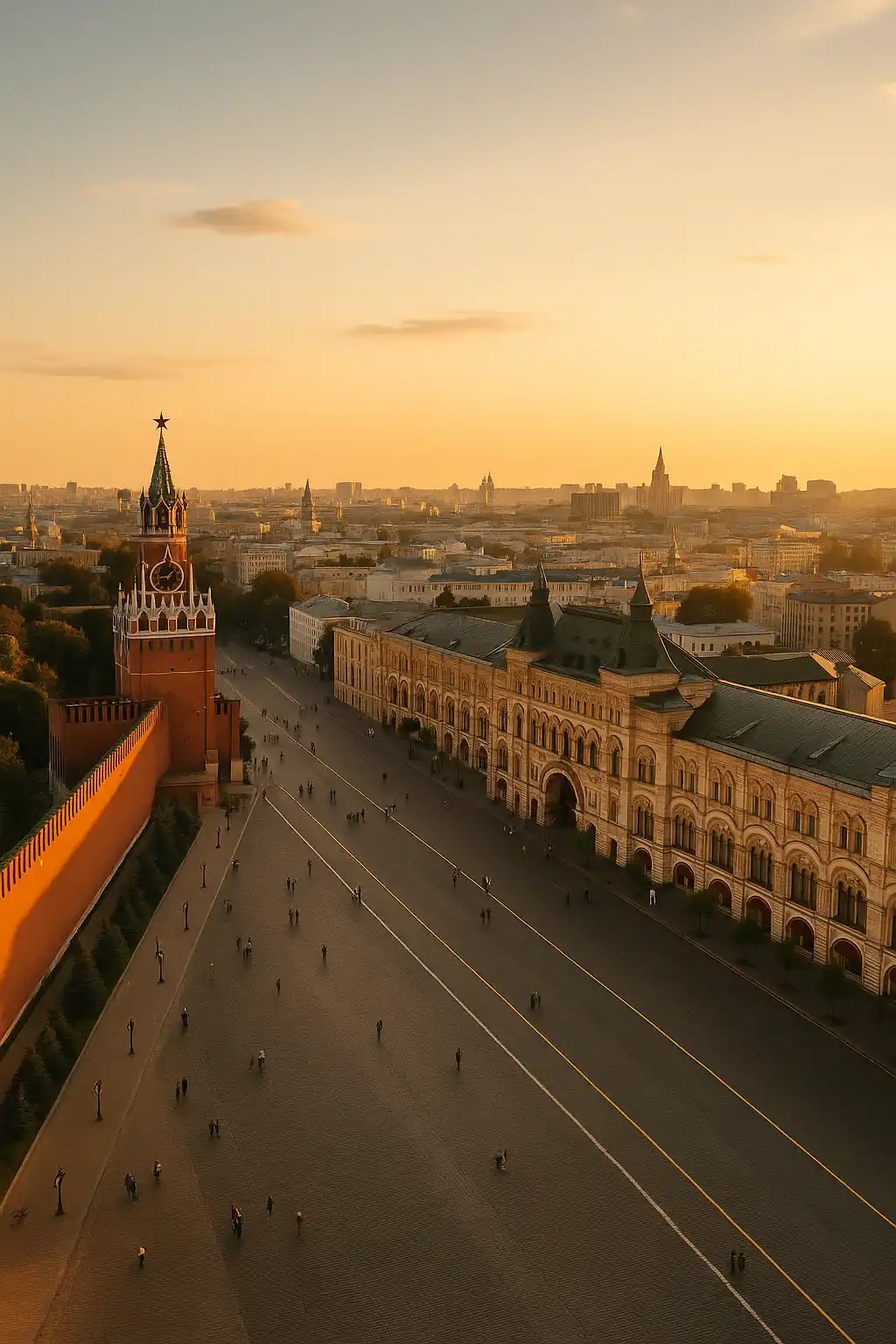
- The Kremlin walls and Spasskaya Tower (power, state, eternity)
- The GUM building (trade, urban life)
- Lenin’s Mausoleum (20th-century political layer)
- Kazan Cathedral (rebuilt, echoing Moscow’s religious continuity)
Placed at the square’s southern end, Saint Basil’s acts like an exclamation mark at the end of Russia’s most famous public space. It “softens” the martial geometry of the Kremlin with color and faith.
- Insider tip: For the classic postcard view, stand near the State Historical Museum at the northern end of Red Square and look south — the square becomes a corridor leading straight to Saint Basil’s.
Museum Exhibitions and Artifacts
As a state museum, Saint Basil’s often displays:
- Models of the cathedral showing how it looked in different centuries
- Icons from the 16th–19th centuries
- Documents and drawings related to restoration after fires and wars
These displays help visitors understand that what we see today is the result of centuries of careful restoration — the colors, domes, and patterns we admire were protected, repainted, and rescued many times.
- Insider tip: If there is a temporary exhibition on the cathedral’s 20th-century preservation, don’t skip it — the story of how it was saved under Stalin is as dramatic as its medieval construction.
Night Illumination
In the evening, subtle lighting reveals the cathedral’s sculptural quality. The domes seem to float against the dark, and the red brick warms to deep copper tones.
- Insider tip: Visit once by day and once by night. The daytime cathedral is festive and bright; the nighttime cathedral is mystical, almost otherworldly — the perfect contrast for a photo series or blog post.
Nature and Outdoor Setting – Red Square and the Kremlin Embankment
Although Saint Basil’s Cathedral is surrounded by brick and stone, its presence is inseparable from the landscape that shaped Moscow itself. The cathedral’s drama comes not only from its color but from where it stands — at the meeting point of city, sky, and river, on the edge of a great open plain that once served as both market and battlefield. To understand Saint Basil’s fully, one must see it not as a single monument but as the culmination of an entire natural and urban composition.
The Setting of Red Square
Red Square stretches before the cathedral like a stage. In the sixteenth century this was an open marketplace lying just outside the Kremlin moat. When the cathedral rose at its southern end, it defined the square’s axis forever. The stone pavement that today feels purely urban once lay above earth embankments, market stalls, and wooden shops. Even after centuries of rebuilding, the square’s vastness preserves that primal feeling of space — a breathing pause in the dense heart of Moscow.
The square’s geometry frames Saint Basil’s as the climax of perspective: approach from the north and every step draws the eye toward its spiraling domes. The Kremlin’s red walls form one border, while the long façade of GUM balances the other. Between them, the cathedral burns like a torch at the far end — a symbol not of symmetry but of revelation.
Insider Tip: Arrive just before sunrise when the cobblestones still hold the night’s coolness. The cathedral glows in the first light while the square remains empty — an experience far more intimate than the daytime crowds.
The Kremlin Walls and Spasskaya Tower
To the west of the cathedral rises the Spasskaya Tower, the most famous of the Kremlin’s fortifications. Its pointed spire and great clock create a vertical dialogue with Saint Basil’s domes. One speaks the language of order and time; the other, of spirit and imagination. The small stretch of open ground between them — once the filled-in moat — is the hinge between church and state, faith and power.
Standing there, visitors can feel the tension that defined Russian history: the sacred beside the secular, harmony beside command.
Insider Tip: From the base of the Spasskaya Tower, look southeast toward the cathedral’s gold cross. This alignment was deliberately chosen so that the rising sun would illuminate both towers on major feast days.
The Moskva River Embankment
Just beyond the cathedral’s south side, the land falls away toward the Moskva River. In Ivan IV’s time, the river was a defensive boundary and trade artery; today it is a quiet belt of water that reflects the domes and the Kremlin walls. The proximity of the river gives the cathedral its theatrical backdrop — on misty mornings the lower terraces vanish, and the structure appears to hover above water and air.
A short walk along the Kremlyovskaya Embankment reveals different moods of the cathedral: bright and triumphant in daylight, spectral at dusk, crystalline under snow. From the opposite bank, near Zaryadye Park, the full panorama of Red Square unfolds, with Saint Basil’s crowning the view like a jewel.
Insider Tip: For photographers, the observation deck in Zaryadye Park provides the best elevated perspective — the cathedral framed by river curves, bridges, and skyline.
The Seasons of Red Square
Moscow’s continental climate transforms the square and the cathedral with each season:
- Winter: Snow smooths the cobblestones and muffles sound; the domes gleam against pale skies, evoking fairy-tale illustrations.
- Spring: Melting snow mirrors the cathedral’s colors in puddles; church bells mingle with the roar of returning swifts.
- Summer: Long evenings flood Red Square with amber light; street musicians play near the gates, and the smell of linden trees from nearby gardens drifts across the open space.
- Autumn: Crisp air and low sun turn the brick and gold into deep copper tones — perhaps the most photogenic season of all.
Insider Tip: Visit during early October, when leaves from the Kremlin’s trees blow across the square; the contrast between red brick and falling gold leaves creates a quintessential Moscow scene.
The Relationship Between Architecture and Sky
Saint Basil’s owes much of its impact to the open sky above Red Square. The architects deliberately kept the surrounding area low so that the cathedral would stand against pure air, not competing roofs. Its color palette — greens, blues, yellows, and reds — was chosen to vibrate with Moscow’s changeable light: grey in morning, silver in winter, fiery at sunset.
The result is a building that seems to change personality with the weather. Under clouds it appears solemn and monumental; under sun it becomes festive and playful. This responsiveness to the elements makes it feel alive, as though it were breathing the same air as the city.
Insider Tip: After rain, when the cobblestones are wet, reflections double the domes — a phenomenon painters and photographers have pursued for centuries.
Zaryadye Park – A Modern Counterpart
Next to the cathedral, Zaryadye Park has restored the link between Moscow’s historic core and its natural environment. Built on the site of demolished Soviet buildings, the park uses terraces of grass, birch groves, and glass pavilions to echo the layered slopes that once descended to the river. From its floating bridge, visitors can look back at Saint Basil’s and see how seamlessly the sixteenth-century masterpiece and the twenty-first-century landscape coexist.
Insider Tip: In the evening, stay on the bridge until the cathedral’s lights come on. The reflection of its domes in the river below is one of the most poetic views in all of Moscow.
A Monument Rooted in Earth and Light
For all its fantasy, Saint Basil’s is profoundly tied to the earth beneath it — to the old clay of the Kremlin Hill and to the line of the Moskva River that has shaped the city for a thousand years. Its colors, once pigments ground from minerals and plants, literally grew out of the soil. Its towers mirror the rhythm of nearby hills.
To stand before it is to sense how Russian architecture has always sought harmony with nature rather than domination of it: verticality balanced by horizon, brightness by shadow, stone by sky. In that equilibrium lies the cathedral’s enduring miracle — a structure both human and elemental, a bridge between the solidity of the ground and the infinite of the heavens.
Food and Dining near Saint Basil’s Cathedral
To visit Saint Basil’s Cathedral is to stand at the center of Moscow — a crossroads of history, architecture, and cuisine. Just as the cathedral unites the many colors and cultures of Russia in one vision, the surrounding area blends traditional Russian dishes with cosmopolitan influences gathered over centuries of trade and travel. From elegant restaurants overlooking Red Square to small cafés tucked along ancient lanes, dining near Saint Basil’s can feel like a continuation of the city’s story — one where flavor and history meet.
A Culinary Heritage Born from the Heart of Russia
The foods around Red Square echo the same idea that shaped the cathedral: unity in diversity. The earliest taverns near this spot served pilgrims and merchants who arrived by river or from the distant steppe. Their meals were simple — black bread, salted fish, cabbage soup, and mead — yet these staples formed the base of a culinary tradition that endures. Today, those same tastes appear refined and reinterpreted in restaurants that combine historical authenticity with modern comfort.
Insider Tip: When you dine near the cathedral, look for menus that mention “домашняя кухня” (home-style cooking) — these places often preserve the most authentic flavors of old Moscow.
Traditional Russian Restaurants near Red Square
Within walking distance of Saint Basil’s Cathedral are several establishments that specialize in classic Russian cuisine — dishes that once graced the tables of tsars and travelers alike.
- Grand Café Dr. Zhivago – Located on Mokhovaya Street near the Kremlin walls, this restaurant celebrates the romance of Soviet-era Moscow. Red-and-white interiors, elegant glassware, and a view of the Kremlin make it a fitting counterpart to Saint Basil’s grandeur. Try beef stroganoff, borscht, and herring under a fur coat for a nostalgic yet polished meal.
Insider Tip: Visit during the early afternoon for quieter service and sunlight streaming through the windows — perfect for a reflective pause after visiting the cathedral. - Varenichnaya №1 – A beloved chain offering a nostalgic journey into 1970s Soviet décor and comfort food. Their pelmeni (dumplings) and vareniki (sweet or savory stuffed dumplings) are made by hand, just as they were in old Moscow households.
Insider Tip: The location near GUM provides a warm refuge in winter, with vintage posters and samovars that recreate a homely Moscow kitchen atmosphere. - Matryoshka Restaurant – Combining regional Russian ingredients with haute presentation, this modern venue near the river embankment reinterprets dishes from Siberia to the Black Sea. Expect reindeer tartare, smoked sturgeon, and beetroot salad with goat cheese — a culinary reflection of Russia’s vast geography.
Insider Tip: Pair a traditional kvass or honey drink instead of wine — it brings out the earthy sweetness in many Russian dishes. - Balchug Viewpoint Lounge – Across the river on Balchug Island, this spot offers fine dining with panoramic views of the Kremlin and Saint Basil’s domes. In summer, the terrace becomes one of Moscow’s most atmospheric evening settings.
Insider Tip: Reserve a sunset table — as the cathedral lights up, the reflection on the Moskva River doubles the spectacle.
Street Food and Casual Eats
While Red Square itself is home to grand dining, its side streets offer the opposite — small bakeries and stalls serving quick, flavorful bites.
- Blini (Russian pancakes): Thin and slightly crisp, served with caviar, sour cream, or jam.
- Pirozhki: Small baked or fried buns filled with meat, cabbage, or potato — the snack of Moscow pedestrians since the Middle Ages.
- Kvass stands: During summer, you’ll find wooden barrels selling this mildly fermented rye drink — refreshing, tangy, and deeply Russian.
The pedestrian underpasses leading toward Zaryadye Park and Nikolskaya Street often host modern kiosks offering these traditional snacks, blending the old city’s flavors with today’s fast pace.
Insider Tip: If you want a snack with a view, take your blini or pirozhki to one of the benches in Zaryadye Park and watch the cathedral’s domes gleam across the river.
The GUM Food Hall – Elegance and Everyday Moscow
Adjacent to Red Square, the GUM Department Store contains a food hall that is an attraction in itself. Here, you can find artisanal chocolates, honey from Russian apiaries, smoked fish from the north, and dozens of tea varieties. The Soviet-style GUM Cafeteria on the top floor remains a favorite among locals, serving nostalgic dishes like Olivier salad, cutlets with buckwheat, and borscht at modest prices.
The combination of marble halls, natural light, and the distant view of Saint Basil’s domes gives even a simple lunch the feeling of occasion.
Insider Tip: Buy a jar of local honey or a tin of herbal tea — perfect edible souvenirs that capture the flavor of Moscow’s heritage.
Modern Dining and Fusion Cuisine
Moscow’s culinary scene has evolved rapidly in the last decade, and the area around Red Square reflects that transformation. A few blocks north, Nikolskaya Street and Kitay-Gorod host restaurants that reinterpret Russian ingredients with global techniques.
- Beluga Restaurant: A luxury spot famous for caviar tastings and modern Russian seafood dishes.
- White Rabbit Café (slightly farther west): Internationally acclaimed, offering panoramic city views and creative reimaginations of Russian classics — a destination for culinary explorers.
- Depo Food Mall: A short metro ride away, showcasing hundreds of regional cuisines from across Russia and beyond.
These restaurants represent the same spirit of creative synthesis that once inspired the builders of Saint Basil’s: taking diverse elements and uniting them into a single, unforgettable experience.
Insider Tip: Moscow’s fine dining often includes set “business lunches” during weekdays — high-quality three-course meals at a fraction of dinner prices, ideal for travelers on a schedule.
Local Markets and Everyday Food Culture
If you wish to experience food as Muscovites do, venture slightly beyond Red Square to Danilovsky Market or Tsentralny Market — indoor halls filled with regional products, street stalls, and small cafés. Here, one can taste vareniki, borscht, honey cakes, and pickled vegetables made by local families and farmers.
Insider Tip: Sample the medovik (honey cake) and napoleon pastry — both traditional desserts that pair perfectly with black tea brewed samovar-style.
Seasonal Festive Foods
Throughout the year, Red Square hosts markets and fairs that fill the air with aromas of roasting nuts, fresh pastries, and hot mulled wine.
- Winter Holidays: Try sbiten (a spiced honey drink) and gingerbread cookies shaped like the cathedral’s domes.
- Maslenitsa (Pancake Week): A cheerful pre-Lenten festival in late February or March devoted to blini — often served with red caviar or sweet condensed milk.
- Easter Season: Bakeries near the cathedral sell kulich (Easter bread) and paskha (sweet cheese dessert).
These festive foods are not mere curiosities — they continue centuries-old rituals linking faith, nature, and taste.
Insider Tip: Visit Red Square’s Christmas Market in December. With Saint Basil’s illuminated in the background and the scent of cinnamon and pine in the air, it is one of Moscow’s most magical sensory experiences.
A Taste of the Cathedral’s Symbolism
Eating near Saint Basil’s is a symbolic act. Just as the cathedral gathers many domes into one unity, Moscow’s cuisine gathers many influences — from peasant soups and Tatar spices to aristocratic pastries and modern creativity. Each dish tells part of the same story: survival, imagination, and celebration.
To share a meal here, within sight of those painted domes, is to feel part of a larger continuity — a living tradition as nourishing to the soul as to the body.
Shopping near Saint Basil’s Cathedral
Shopping near Saint Basil’s Cathedral is not merely a practical activity — it is an encounter with Moscow’s layered identity. Just as the cathedral unites contrasting forms and colors, the shops and markets surrounding Red Square bring together old traditions, Soviet nostalgia, and modern creativity. From handcrafted icons and lacquer boxes to designer boutiques and historical department stores, every purchase here connects visitors to a piece of the city’s cultural memory.
GUM – The Grand Department Store of Red Square
Directly opposite Saint Basil’s Cathedral rises the GUM (Glavnyi Universalnyi Magazin), Russia’s most famous department store and a living monument to Moscow’s urban history. Built between 1890 and 1893 in an eclectic style blending steel, glass, and neoclassical forms, GUM was revolutionary for its time. Its arched glass roof, designed by engineer Vladimir Shukhov, floods the interior with natural light, transforming shopping into a theatrical experience.
Today, GUM houses hundreds of boutiques, cafés, and souvenir shops, yet it retains its 19th-century charm — marble floors, wrought-iron balconies, and the gentle echo of footsteps beneath its vaulted arcades.
Here, visitors can find:
- Russian fashion designers such as Ulyana Sergeenko and Bosco di Ciliegi
- Luxury brands (Chanel, Dior, Hermès)
- Traditional Soviet-style ice cream stalls, still serving plombir in waffle cups, just as they did decades ago
Insider Tip: Even if you don’t plan to shop, stroll through GUM’s three levels. From the upper galleries, the view of Red Square through the glass façade perfectly frames Saint Basil’s colorful domes in the distance.
The GUM Food Hall and Souvenirs
The Gastronom No. 1 food hall inside GUM is an institution in itself. Its wooden counters and brass fixtures evoke the elegance of pre-revolutionary Moscow, while its shelves brim with Russian specialties:
- Caviar and smoked fish from the Volga and Caspian regions
- Honey and jam from Siberia
- Herbal teas and berry preserves from Altai
- Chocolate from the Red October factory, one of Moscow’s sweetest legacies
Insider Tip: Purchase small tins of caviar or jars of buckwheat honey — compact, authentic souvenirs that reflect the richness of Russian soil and rivers.
Nikolskaya Street – Moscow’s Pedestrian Shopping Boulevard
A few minutes’ walk from the cathedral lies Nikolskaya Street, one of Moscow’s oldest and most atmospheric lanes. Once home to monasteries and bookshops, it has become a vibrant pedestrian boulevard lined with boutiques, cafés, and illuminated arches that sparkle like fairy lights at night.
This street offers a more intimate shopping experience than GUM, with stores selling Russian-made cosmetics, leather goods, and contemporary fashion alongside old-style souvenir stalls. Street performers and musicians often fill the air with song, turning a simple walk into a small celebration.
Insider Tip: Visit at dusk when the hanging lights above Nikolskaya form a glittering tunnel leading toward Red Square — a photographer’s dream.
Traditional Crafts and Artisanal Souvenirs
For travelers seeking gifts that embody Russia’s artistry, Moscow’s souvenir shops near the cathedral and along Varvarka Street provide treasures rooted in centuries of craftsmanship. Typical items include:
- Matryoshka dolls (nesting dolls): Originating in the late 19th century, these hand-painted figures symbolize family and continuity.
- Lacquer boxes: Miniature paintings on papier-mâché from the villages of Fedoskino and Palekh, depicting fairy tales and Russian landscapes.
- Icon reproductions: Small, hand-gilded icons available at museum stores and monastery gift shops.
- Wooden toys and carved boxes: Reflecting peasant traditions from central Russia.
- Orenburg shawls: Exquisitely soft lace scarves made from goat down in the southern Urals — one of Russia’s most refined textile arts.
Insider Tip: Look for artisans signing their names on the back of lacquer boxes or shawl labels — genuine handmade items are always marked by their creator.
Zaryadye Park Gift Pavilion
The modern Zaryadye Park, located just behind Saint Basil’s, includes a small but well-curated gift pavilion focusing on Moscow’s heritage. Here, visitors can find eco-friendly souvenirs such as wooden ornaments shaped like the cathedral’s domes, local honey, and postcards featuring photographs taken by Moscow artists.
The design of the pavilion itself — minimalist glass and wood — contrasts beautifully with the cathedral’s ornate silhouette across the river, symbolizing the dialogue between Moscow’s past and future.
Insider Tip: During the warmer months, the pavilion sometimes hosts craft demonstrations — watch artisans paint miniatures or weave birch-bark jewelry.
Antique and Vintage Finds
For collectors, the Izmailovsky Market (accessible by metro) remains the best destination for antique icons, Soviet memorabilia, and traditional crafts. Although it lies a short ride away, many visitors to Saint Basil’s make the journey to see how Moscow’s folk traditions continue to live through art.
At Izmailovsky, stalls overflow with samovars, medals, coins, old books, and military badges, alongside modern reproductions. Bargaining is part of the culture here, and the atmosphere — colorful, slightly chaotic, deeply Russian — offers a different kind of authenticity than the polished halls of GUM.
Insider Tip: Early mornings on weekends bring the best selection. Look for stalls selling handmade birch-bark boxes or vintage enamel pins from Soviet times — small yet meaningful keepsakes.
Soviet Nostalgia and Contemporary Moscow Design
Many stores near Red Square blend nostalgia with modern style. You’ll find retro Soviet posters, sputnik figurines, and enamel cups displayed alongside minimalist products from young Moscow designers. The contrast mirrors the city itself — one eye on the past, the other on the horizon.
- Vkusvill and LavkaLavka: Sell organic foods and artisanal goods from local farms.
- Concept stores in Kitay-Gorod: Offer fashion, ceramics, and books from Moscow’s new creative generation.
- Bookshops: Such as Respublika or Moscow House of Books, carry illustrated histories of the Kremlin and Saint Basil’s — excellent for travelers seeking deeper context.
Insider Tip: Many Russian brands now focus on sustainability and heritage — purchasing from them supports local craft revival movements.
Buying Icons and Religious Items
Because of the cathedral’s spiritual importance, visitors often wish to purchase icons or small religious souvenirs. While Saint Basil’s itself functions primarily as a museum, icons blessed for personal devotion can be found at nearby churches, such as Kazan Cathedral on Red Square or Cathedral of Christ the Savior.
Insider Tip: When buying religious items, ensure they come from an official church shop (церковная лавка) — these proceeds usually support local parishes or restoration projects.
Seasonal Markets and Festivals
Throughout the year, Red Square transforms into a market square reminiscent of its medieval origins.
- Christmas and New Year Market: Wooden stalls sell ornaments, hand-knit scarves, and sweets shaped like the cathedral’s domes.
- Maslenitsa Fair: Pancake stalls and folk crafts celebrate the end of winter.
- Harvest Festival (Golden Autumn): Farmers from across Russia bring apples, cheeses, and honey to the city center.
Each festival renews Red Square’s ancient role as Moscow’s meeting place — not just for trade, but for shared joy.
Insider Tip: Visit at night during the winter market season. Under strings of lights and falling snow, Saint Basil’s domes shimmer behind rows of handmade crafts — a living postcard of Russia’s festive soul.
Day Trips and Nearby Attractions
A visit to Saint Basil’s Cathedral opens the door to far more than one monument. The cathedral stands at the symbolic center of Russia, surrounded by landmarks that together form the living fabric of Moscow — a city where every street corner carries traces of empires, revolutions, and rebirth. Within walking distance or a short journey from Red Square, travelers can encounter centuries of art, architecture, and daily life that complement the cathedral’s splendor.
The Moscow Kremlin
No destination lies closer in space or meaning. Just beyond Saint Basil’s rises the Kremlin, the fortress from which Moscow’s rulers governed for over five hundred years. Its red walls and towers form the backdrop of Russian history — palaces, cathedrals, and government halls gathered within a single walled triangle overlooking the river.
Inside the Kremlin’s gates, highlights include:
- Cathedral Square, the heart of old Muscovite ritual life, surrounded by the Assumption, Annunciation, and Archangel Cathedrals, where tsars were crowned and buried.
- The Ivan the Great Bell Tower, rising like a white flame visible from miles away.
- The Armory Museum, housing the Imperial Crown, Fabergé eggs, royal carriages, and thrones.
- The Tsar Cannon and Tsar Bell, masterpieces of scale and craftsmanship.
A walk through the Kremlin reveals the continuity between Saint Basil’s spiritual vision and the power that once emanated from these walls — two sides of the same Russian story.
Insider Tip: Visit early in the morning on weekdays to avoid queues. Combine the cathedral and Kremlin in one day; they were designed to be experienced as a single sacred-political axis.
Zaryadye Park – Moscow’s Modern Landscape
Immediately behind Saint Basil’s Cathedral lies Zaryadye Park, one of Moscow’s most innovative public spaces. Created on the site of former Soviet buildings, the park blends natural landscapes from across Russia — tundra, steppe, forest, and meadow — into a terraced urban oasis descending toward the Moskva River.
Highlights include:
- The Floating Bridge, a daring cantilevered walkway extending over the river, offering unmatched panoramic views of the cathedral, Kremlin, and city skyline.
- The Ice Cave Pavilion, simulating permafrost environments with art installations.
- Seasonal concerts and festivals celebrating Russian music and ecology.
Zaryadye represents Moscow’s future-facing spirit — modern, ecological, yet deeply respectful of its historic surroundings.
Insider Tip: Sunset on the Floating Bridge is one of the best photo moments in the entire city — the domes of Saint Basil’s ignite with color as the river reflects the fading sky.
Kitay-Gorod – Moscow’s Medieval Quarter
East of Red Square lies Kitay-Gorod, one of Moscow’s oldest districts and a living museum of medieval streets. Its narrow lanes preserve the city’s pre-imperial texture, filled with churches, courtyards, and merchant houses.
Notable stops include:
- Varvarka Street, where restored churches such as St. George and St. Barbara recall 17th-century Moscow.
- The Old English Court, a museum dedicated to Russia’s earliest trade ties with England.
- The Znamensky Monastery, an example of Muscovite Baroque architecture.
Walking through Kitay-Gorod feels like tracing the city’s original veins — where commerce, craftsmanship, and faith intertwined long before imperial grandeur.
Insider Tip: Stop at a small café on Varvarka Street to enjoy tea brewed in a samovar — a local ritual that connects the old merchant Moscow with today’s creative city culture.
The State Historical Museum
At the northern edge of Red Square stands the State Historical Museum, whose red façade and turrets mirror the Kremlin itself. Inside, it holds Russia’s most comprehensive collection of artifacts, from prehistoric relics to royal regalia. Exhibits illuminate every period of the nation’s past — the perfect intellectual counterpart to the spiritual narrative told by Saint Basil’s.
Insider Tip: The museum’s central staircase is decorated with portraits of Russian rulers and heroes — climb it slowly to feel the rhythm of time embodied in one ascent.
Lenin’s Mausoleum
Midway between the Kremlin wall and Saint Basil’s stands the Mausoleum of Vladimir Lenin, a stark granite pyramid built in 1930. Though ideologically distant from the cathedral’s faith, it has become an inseparable part of Red Square’s story — a 20th-century echo of ancient forms. The juxtaposition of sacred and secular, saint and revolutionary, defines Moscow’s complex identity.
Insider Tip: If you choose to enter, remember that silence is required; the visit is brief but profoundly atmospheric — a meditation on how power transforms into ritual.
GUM and Nikolskaya Street
For those who prefer a lighter complement to sightseeing, the GUM department store and the pedestrian Nikolskaya Street offer elegant arcades, cafés, and souvenir shops. Both streets are best explored in the evening when lights illuminate the facades and Saint Basil’s gleams like a jewel at the square’s far end.
Insider Tip: Many cafés here remain open late — ideal for a warm drink while watching Red Square empty after dark.
The Bolshoi Theatre and Theatre Square
A short metro ride north brings visitors to the Bolshoi Theatre, the cradle of Russian ballet and opera. The theatre’s neoclassical portico and statue of Apollo embody a different side of Moscow’s art — disciplined grace and grandeur rather than mystical color. Attending a performance here after visiting Saint Basil’s completes a cultural arc from sacred architecture to living art.
Insider Tip: Even if tickets are sold out, take a guided daytime tour of the Bolshoi; its chandeliered auditorium and backstage workshops are themselves cultural treasures.
Cathedral of Christ the Savior
Rising above the Moskva River west of the Kremlin, the Cathedral of Christ the Savior represents Russia’s modern revival of Orthodoxy. Originally built in the 19th century, destroyed under Stalin, and reconstructed in the 1990s, it mirrors Saint Basil’s resilience across centuries.
The cathedral’s white marble and golden domes form a deliberate contrast to Saint Basil’s vivid palette — together, they express the continuity of Russian faith through changing ages.
Insider Tip: From the pedestrian bridge behind Christ the Savior, look east — the skyline unites both cathedrals and the Kremlin in one sweeping view, symbolizing Moscow’s sacred geography.
Short Excursions Beyond Central Moscow
If time allows, travelers can explore nearby estates and parks that extend the spirit of Moscow’s architecture and faith:
- Kolomenskoye Museum-Reserve: A former royal estate with wooden churches and gardens, echoing Saint Basil’s tent-roof forms.
- Tsaritsyno Palace: A vast neo-Gothic complex commissioned by Catherine the Great, surrounded by lakes and forested paths.
- Novodevichy Convent: A UNESCO World Heritage site whose tranquil walls and ponds reflect centuries of Russian monastic life.
Each destination complements Saint Basil’s by showing another face of Moscow — royal, romantic, or reflective.
Insider Tip: Purchase a Moscow Central Circle (MCC) or Metro day pass to access these sites efficiently. The metro itself, with its mosaics and chandeliers, feels like an underground museum linking all corners of the city.
Experiencing the Whole Ensemble
Seen together, Saint Basil’s Cathedral, the Kremlin, Red Square, and the surrounding landmarks form one of the world’s most coherent cultural ensembles. The cathedral may be the jewel, but its setting — the river, the walls, the streets — is the crown.
Exploring these spaces in sequence allows visitors to trace Moscow’s evolution from medieval principality to global capital, from fortress to metropolis, from sacred vision to living city.
Insider Tip: Spend at least two full days exploring the area. Day one for Red Square, Saint Basil’s, and the Kremlin; day two for Zaryadye, Kitay-Gorod, and the wider city. Early mornings and twilight hours provide the most evocative light and the fewest crowds.
Practical Information
Visiting Saint Basil’s Cathedral is not only an architectural experience but also a carefully choreographed encounter with the living heart of Moscow. The cathedral stands at the southern end of Red Square, within walking distance of nearly all major landmarks, hotels, and transport lines. Planning your visit well ensures that its brilliance is experienced in peace and comfort, not in haste. Below is everything a traveler should know before stepping beneath its painted domes.
How to Get There
By Metro:
The easiest way to reach Saint Basil’s Cathedral is via the Moscow Metro, which is efficient, clean, and remarkably beautiful in its own right.
- Take the Red Line (Line 1) to Okhotny Ryad Station, or the Blue Line (Line 3) to Ploshchad Revolyutsii Station.
- Alternatively, use Teatralnaya Station on the Green Line (Line 2) — all three stations are interconnected and exit directly toward Red Square.
- From the metro exit, follow signs for Krasnaya Ploshchad (Red Square) — the cathedral’s domes are visible the moment you emerge into daylight.
Walking time from the metro: 5–7 minutes.
By Taxi or Car:
Moscow’s traffic around Red Square can be dense, and private vehicles are restricted near the Kremlin. The nearest drop-off point is along Varvarka Street or Moskvoretskaya Street, about a five-minute walk away.
By Foot:
Most central hotels, such as those near the Bolshoi Theatre or Tverskaya Street, are within a pleasant 15–20-minute walk. Walking to Saint Basil’s allows you to experience the gradual reveal of the cathedral’s domes — one of Moscow’s great visual moments.
Insider Tip: If arriving by metro, choose the Ploshchad Revolyutsii exit. The bronze sculptures in this station — particularly the soldier with a bronze dog — are famous for good luck. Locals rub the dog’s nose before important events; it’s said to ensure a calm heart before stepping into Red Square.
Opening Hours
Saint Basil’s Cathedral functions primarily as a museum, though it remains a consecrated Orthodox church where services are occasionally held.
- Daily Hours: 11:00 a.m. – 5:00 p.m.
- Closed: The first Wednesday of each month for maintenance.
- Ticket Office: Closes 45 minutes before the cathedral.
Hours may vary slightly during religious holidays or special events. For the most accurate schedule, check the official Moscow Kremlin Museums website or the Moscow City Tourism portal before visiting.
Insider Tip: Arrive at opening time or around 4:00 p.m. for minimal queues. Midday hours (12:00–2:00 p.m.) are usually busiest, especially in summer.
Tickets and Admission
- General Admission: Grants access to the cathedral interior, galleries, and chapels.
- Guided Tours: Available in Russian and English; include historical background and access to smaller chapels not always open to the public.
- Children under 16: Reduced or free admission depending on the season.
- Audio Guides: Available in multiple languages, with fascinating commentary about each dome’s meaning and the cathedral’s legends.
Tickets can be purchased online or at the booth near the entrance. Online reservations are recommended during weekends or holidays.
Insider Tip: Opt for the combined “Red Square Museum Pass” when available; it covers entry to the cathedral, State Historical Museum, and Zaryadye Park pavilions, often at a discounted rate.
Best Time to Visit
Saint Basil’s changes character with light and season. To capture its most magical moods:
- Morning (before 10:30): Soft sunlight illuminates the domes and cobblestones; quiet atmosphere.
- Late Afternoon (around 5:00): Warm golden tones perfect for photography.
- Evening: Exterior viewing only, but the cathedral’s illumination turns it into a jewel glowing against the night sky.
Seasonal Notes:
- Spring (April–May): Crisp air and blooming trees around Red Square.
- Summer (June–August): Long daylight hours, vibrant festivals, and outdoor cafés nearby.
- Autumn (September–October): Mild weather and fewer crowds — often the best time for travelers.
- Winter (November–February): Snow and holiday lights make the cathedral seem lifted from a fairy tale.
Insider Tip: For photographers, early January mornings after fresh snow provide the rare sight of the cathedral bathed in pale light, the square nearly empty — pure Moscow serenity.
Accessibility and Facilities
Saint Basil’s is an ancient building with narrow staircases and uneven floors. Accessibility is limited, though staff are helpful.
- Wheelchair Access: Limited to the outer galleries and select ground-level areas.
- Restrooms: Located in nearby GUM and Zaryadye Park (5-minute walk).
- Cloakroom: Available at the museum entrance for coats and bags.
- Gift Shop: Small but well-curated, selling art prints, postcards, and books about the cathedral’s architecture and history.
Insider Tip: The staircases inside are steep and winding — wear comfortable shoes with good grip, and hold the railings carefully.
Safety and Etiquette
The area around Red Square is extremely secure, patrolled by police and museum staff. Still, respect the space as both a sacred site and national monument:
- Keep voices low inside the chapels.
- Photography is allowed without flash; tripods require special permission.
- Do not touch icons or frescoes.
- Dress modestly; head coverings for women are customary though not required.
During public holidays, sections of Red Square may close temporarily for official ceremonies — check schedules ahead of time to avoid delays.
Insider Tip: If you encounter a small service inside the Saint Basil’s Chapel, pause quietly at the back. Even a brief moment of liturgy amid the painted walls offers a glimpse into the cathedral’s living faith.
Guided Tours and Experiences
Official guided tours bring Saint Basil’s history vividly to life. Options include:
- Architectural Tour: Explains symbolism, structure, and restoration.
- Historical Tour: Focuses on Ivan the Terrible, the Kazan campaign, and later centuries.
- Family Tour: Simplified version with interactive storytelling for children.
Many private guides in Moscow also offer combined “Red Square heritage” walks, including the Kremlin, Zaryadye Park, and Kitay-Gorod, ideal for first-time visitors.
Insider Tip: Choose a guide who is also an art historian — many have deep knowledge of iconography and color symbolism that adds layers of meaning beyond what text panels provide.
Nearby Facilities and Amenities
Dining: Numerous restaurants and cafés line Red Square, Nikolskaya Street, and GUM — from elegant dining to traditional bakeries.
ATMs: Found inside GUM and Zaryadye Park.
Wi-Fi: Free Wi-Fi available in Red Square and the cathedral courtyard area.
Souvenirs: Official museum shop offers reproductions of icons, models of the cathedral, and scholarly books in multiple languages.
Visiting Duration and Pace
A typical visit lasts 45–90 minutes, depending on interest. Allow extra time for photography outside and a walk around the entire perimeter — each angle reveals a different symmetry. Those combining Saint Basil’s with the Kremlin or museums should allocate half a day in total.
Insider Tip: After your visit, walk 100 meters south toward the river embankment. The view back toward Saint Basil’s, with the domes rising above the old bridge, is one of Moscow’s most enduring scenes — a perfect conclusion to your exploration.
Photography Tips
- Best daylight angle: From the northwest corner of Red Square around 9:00 a.m., when sunlight hits the domes directly.
- Golden hour: From Zaryadye Park’s bridge at sunset.
- Night photography: Tripods not allowed on Red Square; stabilize the camera on railings for clear shots.
- Winter magic: Use the glow of nearby lamps to capture warm tones against snow.
Visitor Conduct During Festivals
During national holidays such as Victory Day (May 9) or City Day (early September), Red Square hosts parades and concerts. The cathedral remains closed for security reasons but becomes the visual centerpiece of celebrations.
Insider Tip: For these days, view the cathedral from the opposite side of the river — you’ll witness fireworks or light shows framed by its silhouette.
Insider Tips & Local Experiences
Even after countless photographs and guidebooks, Saint Basil’s Cathedral continues to surprise those who approach it with patience rather than haste. Beneath its vivid colors lies a world of stillness, echoes, incense, and human devotion. To experience the cathedral as Muscovites do is to slow the rhythm, notice the details, and let the centuries speak in their own quiet language.
Arrive at Dawn or Dusk
The most powerful moments at Saint Basil’s occur when Red Square is nearly empty. In the early morning, the cobblestones glisten with dew and pigeons circle lazily around the spires. The air is crisp, bells from distant churches carry softly over the river, and the cathedral’s colors shift from blue-grey to gold as the sun rises.
At dusk, the light turns amber and the domes begin to glow against a darkening sky. The hum of the city fades, replaced by footsteps and murmured conversations.
Insider Tip: Step back toward the State Historical Museum just before sunset; from that distance the cathedral seems to hover, its domes like flames frozen above the square.
Listen to the Bells
The bell tower beside the cathedral still rings on feast days and during special services. The sound is not loud but resonant, echoing from the Kremlin walls and blending with street music and conversation. It is the heartbeat of old Moscow — irregular, human, full of emotion.
Insider Tip: If you hear bells while inside the cathedral, pause and close your eyes. The vibration through the brick vaults makes you feel part of the architecture itself.
Follow the Footsteps of Pilgrims
Long before tourism, believers came here to venerate Saint Basil the Blessed, the barefoot holy fool buried beside the cathedral. Even now, elderly women in scarves light candles before his icon, whispering short prayers before returning to daily life.
You need not be Orthodox to feel the quiet gravity of these moments; the gestures themselves — crossing, bowing, lighting a flame — are fragments of a faith older than the city’s stones.
Insider Tip: Carry a small candle purchased at the church stall and light it silently; no words are necessary.
Discover the Cathedral’s Murmuring Corridors
Inside, the narrow corridors act as both passageways and echoes of history. Each twist reveals a tiny chapel, a staircase carved into thick masonry, or a patch of fresco glowing under lamplight. The scent of beeswax, stone, and old pigment creates a sensory memory unlike any museum.
Insider Tip: Linger when groups move ahead; five seconds of solitude in these passages can feel like stepping back to the sixteenth century.
Observe the Colors Up Close
The domes appear festive from afar, but their artistry is subtler near at hand: brush marks in the paint, small irregularities in pattern, signs of restoration layered over centuries. Touch is forbidden, yet one can sense the human labor behind every curve.
Insider Tip: Use the zoom on your camera not for distant panoramas but for detail — a swirl of green on yellow, a chipped tile — evidence that this miracle was made by real hands.
Meet the Cathedral’s Guardians
The guides and attendants working inside are often art historians or conservators who have spent years caring for the monument. Many carry personal stories about restoration under difficult conditions. A polite greeting in Russian — Zdravstvuyte — often opens conversations that reveal insights unavailable in guidebooks.
Insider Tip: Ask softly about the 20th-century restorations; some staff remember older colleagues who saved the cathedral during Soviet closures.
Feel the Silence Beyond the Crowds
Even on the busiest summer day, silence can be found. Walk around the back toward the Moskvoretskaya Street side, where the tourist flow thins. From there, the cathedral’s asymmetry becomes visible — a rhythm of domes rising like musical notes.
Sit for a few minutes on the low stone wall; the wind from the river carries scents of grass and water, and the entire ensemble feels suspended between earth and heaven.
The Night Walk Along the River
After dark, cross the Bolshoy Moskvoretsky Bridge. Turn back halfway across: the cathedral appears luminous, mirrored in the river below. Streetlamps trace golden paths across the water, and the sound of traffic becomes a distant murmur.
Insider Tip: Winter nights are the most magical; snow softens every surface, and the domes gleam like colored ice.
Participate in a Feast Day
On Orthodox holidays, especially the Intercession of the Virgin (October 14, O.S.) — the cathedral’s namesake — short services and processions occur. Priests in embroidered vestments chant under the open sky while crowds respond with candles and song.
Insider Tip: Arrive early and stand at the outer edge; even without understanding the words, the cadence of the prayers and bells conveys the spirit of continuity that defines Russian faith.
Savor the Human Scale
Despite its fame, Saint Basil’s is smaller than most imagine — built not to impress with size but to astonish with intricacy. Its modest rooms and crooked stairways remind visitors that grandeur can arise from intimacy.
Insider Tip: Notice how people instinctively lower their voices upon entering. That collective hush is part of the cathedral’s magic; everyone becomes a participant in its preservation.
The Winter Fair and Candlelight
During the New Year and Christmas markets, Red Square fills with wooden stalls, pine trees, and music. Amid the laughter and smell of roasted nuts, the cathedral stands serene, its domes glinting through snowflakes.
Insider Tip: Visit after 9 p.m., when the crowd thins and the combination of snow, lights, and choral music turns the square into a scene of timeless wonder.
A Moment of Reflection
Before leaving, walk once around the entire perimeter. Each angle shows a different face: from the Kremlin side, solemn and regal; from the river side, light and playful. End where you began — facing the western porch. Many visitors pause here instinctively, offering silent thanks or simply taking a deep breath before stepping back into modern Moscow.
In these small gestures — walking, watching, listening — the cathedral reveals itself not as a relic, but as a living presence. It rewards attention, humility, and curiosity, the same virtues that shaped its creation.
Conclusion
Few structures in the world possess the power to define not only a city’s skyline but also its spirit. Saint Basil’s Cathedral is one of them — a building so extraordinary that it transcends its material form. To see it once is to remember it forever; to stand before it is to feel the full weight and wonder of Russian history concentrated in a single point of color and light.
Built nearly five centuries ago by the command of Ivan the Terrible, it began as a monument to conquest — a stone hymn of victory after the fall of Kazan. Yet time transformed it into something far deeper. Over centuries of war, revolution, and renewal, the cathedral ceased to represent triumph over others and came to symbolize triumph over time itself.
Its beauty is not logical; it is emotional. No symmetry binds it, no rules constrain it. Nine chapels rise like dreams around a single core, each dome painted differently, each line breaking free from strict geometry. It is the architecture of faith translated into motion — as if the builders tried to capture in stone the fire of prayer and the radiance of heaven. When sunlight hits the domes, they shimmer like jewels; when snow covers them, they glow with quiet dignity. Every season and every light reveals another mood, another layer of meaning.
The story of Saint Basil’s is also the story of survival. It has stood through Napoleon’s invasion, fires, neglect, and the long decades when religion itself was silenced. Legends say Stalin once considered demolishing it to open Red Square for parades, but its defenders refused to yield. Their courage preserved not just a building but the heart of Moscow’s memory.
Today, Saint Basil’s endures as a bridge between earthly Moscow and eternal Russia. Within its walls, faith still flickers in candle flames; outside, millions pass each year, drawn by the same mystery that first awed Ivan’s court. It remains both intimate and monumental, human and divine — a paradox that defines the Russian soul.
Why visit Saint Basil’s Cathedral? Because in one glance, it offers everything Russia has ever been: the devotion of its believers, the ambition of its rulers, the imagination of its artists, and the resilience of its people. It is the country’s most eloquent storyteller — speaking not through words, but through color, shadow, and silence.
To walk its narrow corridors is to feel the centuries whisper around you. To step out onto Red Square afterward is to see modern Moscow through the lens of its ancient heart. No photograph can reproduce its atmosphere; no description can capture its scent of wax and stone. Saint Basil’s must be felt, not merely seen.
For travelers seeking more than beauty — for those searching for meaning within architecture — this cathedral offers a lesson as timeless as faith itself: that harmony can be born from difference, that imagination can triumph over fear, and that even in an age of steel and glass, one man’s prayer carved in brick can still outshine an empire.
In the end, Saint Basil’s is not just a masterpiece of architecture — it is a testament to endurance, to creation, and to the belief that beauty, once revealed, never truly fades.
It stands on Red Square not as a relic of the past, but as a living symbol — the radiant heart of Moscow, where heaven still seems close enough to touch.
