Introduction
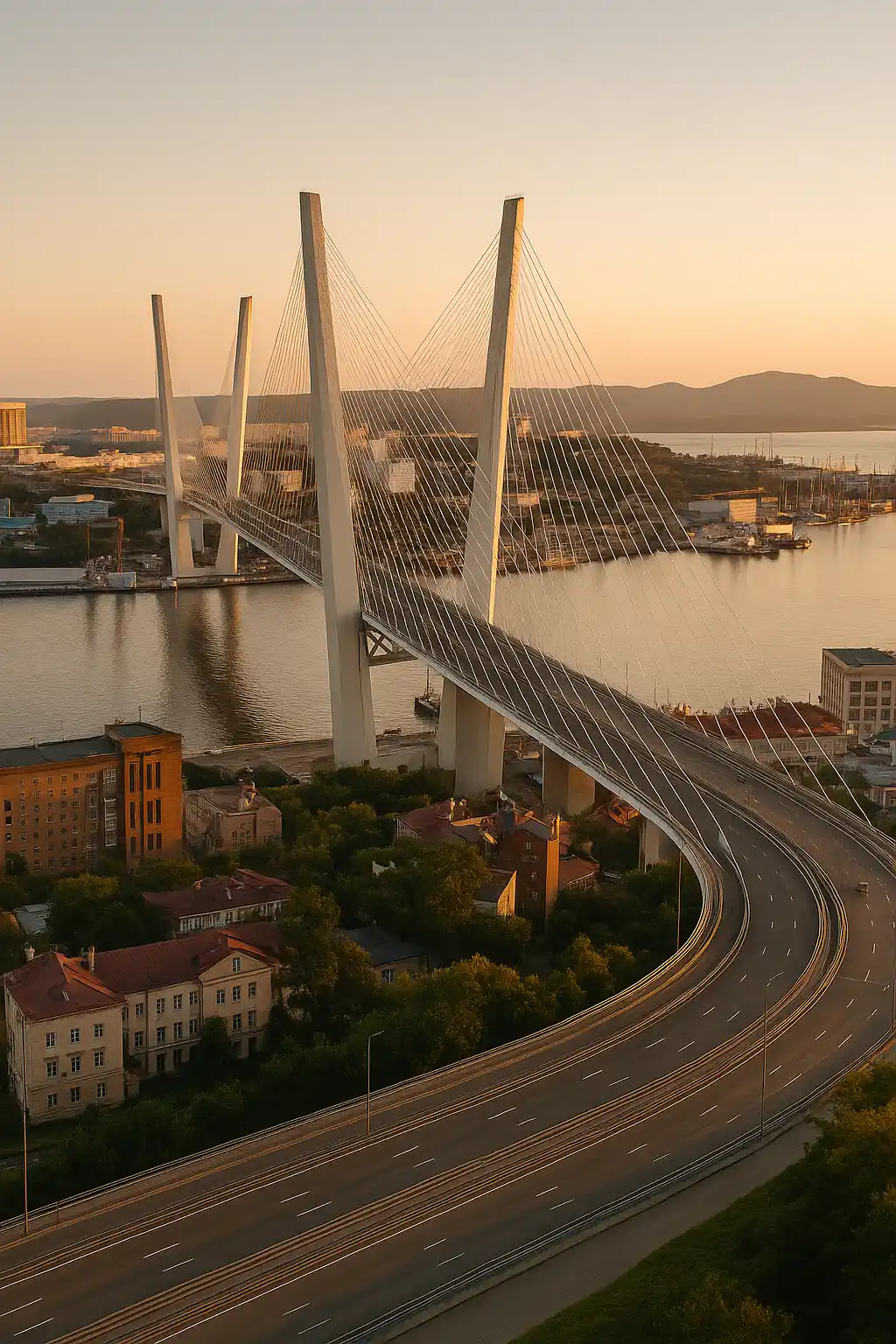
Suspended like a golden arc over the blue expanse of Zolotoy Rog Bay, the Golden Bridge (Золотой мост) in Vladivostok stands as one of Russia’s most striking symbols of modern engineering and Far Eastern ambition. Spanning more than 1.3 kilometers, this elegant cable-stayed bridge connects the city center with the Pervomaysky District, uniting the hills of Vladivostok across a bay once accessible only by winding coastal roads. Since its completion in 2012, the Golden Bridge has become not just an infrastructure marvel, but a defining feature of the city’s skyline — sleek, graceful, and radiant in every season.
Vladivostok, perched on the rugged edge of the Pacific coast, has always been Russia’s window to the East. Its geography of peninsulas, bays, and steep hills once made movement across the city a challenge. The construction of the Golden Bridge transformed not only transportation but also perception — turning the city into a symbol of connection between Europe and Asia, land and sea, tradition and modernity. The bridge’s shimmering silhouette, especially when illuminated at night, embodies the spirit of a city reborn as an international hub at the edge of the continent.
For travelers, the Golden Bridge is more than a landmark to photograph. It’s a living artery of Vladivostok, offering panoramic views of the harbor, the ships of the Pacific Fleet, and the distant silhouettes of Russky Island. Walking or driving across it at sunset feels almost cinematic — a merging of nature’s vastness and human ingenuity. The bridge reflects the essence of Vladivostok itself: daring, resilient, and endlessly looking toward the horizon.
A Brief History of the Golden Bridge
The story of the Golden Bridge (Золотой мост) is inseparable from the story of Vladivostok’s transformation — from a remote military port on Russia’s Pacific frontier to a modern gateway linking East and West. For more than a century, the city’s topography dictated its rhythm. The Zolotoy Rog Bay, a narrow inlet stretching deep into the city’s heart, divided Vladivostok into distinct districts. To cross from one side to the other meant winding through steep hills and congested roads, a journey that could take more than an hour.
By the early 2000s, Vladivostok was ready for change. The government’s vision to revitalize Russia’s Far East culminated in a series of ambitious infrastructure projects, chief among them the construction of a bridge across the Golden Horn. This bridge would not only ease daily life for residents but also stand as a symbol of national pride and technological achievement — a modern icon for a city often described as Russia’s “San Francisco of the East.”
Conception and Planning
Plans for a bridge across Zolotoy Rog had existed since the 1960s, but financial and logistical challenges delayed any real progress. The city’s mountainous terrain and seismic activity made such an undertaking exceptionally complex. The project gained momentum in 2007, when Vladivostok was chosen to host the 2012 Asia-Pacific Economic Cooperation (APEC) Summit. The event brought international attention to the Far East and spurred massive urban renewal.
The Golden Bridge was envisioned as a centerpiece of this transformation — an architectural statement to rival the world’s great coastal bridges. It would symbolize connection not only within Vladivostok but also between Russia and its Pacific partners.
Design and Construction
Construction began in July 2008 under the direction of Mostovik, a leading Russian engineering firm. The bridge was designed as a cable-stayed structure, chosen for both stability and visual impact. Its six lanes stretch across 1,388 meters, supported by two 226-meter-high pylons that resemble the twin masts of a great ship — a fitting tribute to Vladivostok’s maritime heritage.
Engineers faced significant challenges: deep waters, strong winds, and frequent fogs that sweep across the bay. Yet despite the region’s harsh climate, construction advanced rapidly. More than 4,000 tons of steel cables and 35,000 cubic meters of concrete were used, along with specialized anti-corrosion materials to resist the salty air.
The bridge deck was assembled using an innovative cantilever method, where segments were suspended and joined in mid-air from each pylon — an operation that required millimeter precision. At its highest point, the bridge rises nearly 65 meters above sea level, allowing large ships to pass freely beneath.
The Grand Opening
The Golden Bridge officially opened on 11 August 2012, in a ceremony attended by regional officials, engineers, and thousands of residents who had watched its rise day by day. For Vladivostok, the moment carried emotional weight: a physical realization of the city’s long-held dream to unite its shores.
When the first vehicles crossed the span, the bay below erupted in celebration. Ships sounded their horns, church bells rang, and fireworks reflected across the water. The bridge’s golden illumination — achieved through hundreds of LED lights — transformed it into a gleaming arc visible from nearly every hilltop.
Engineering Symbolism and Cultural Identity
While the Golden Bridge serves a practical purpose, its design also carries rich symbolism. The name “Golden” references both the Zolotoy Rog Bay (“Golden Horn”) and the golden light that envelops the structure at sunrise and sunset. The bridge’s twin pylons, standing like open gates, represent Vladivostok’s role as Russia’s Pacific portal, facing eastward toward Japan, Korea, and beyond.
For residents, it has become more than infrastructure — it is an emblem of pride and belonging. The bridge links neighborhoods that were once divided by geography and embodies the city’s dynamic blend of Russian spirit and Asian horizon.
Recognition and Legacy
In the years since its opening, the Golden Bridge has been recognized as one of the most beautiful cable-stayed bridges in the world. Its clean lines and graceful proportions have drawn comparisons to San Francisco’s Golden Gate Bridge and Busan’s Gwangan Bridge. Yet it retains a character entirely its own — shaped by the geography of the Russian Far East and the resilience of those who built it.
Beyond aesthetics, the bridge has transformed daily life. It has reduced travel times, boosted commerce, and integrated the city’s fragmented districts into a cohesive whole. What was once a symbol of separation has become a conduit of unity — both practical and poetic.
Today, standing on its pedestrian walkway, one can feel the hum of the traffic, the vibration of the cables, and the pulse of a city that has finally learned to cross its own boundaries. The Golden Bridge is more than a feat of engineering; it is a declaration — that even on the edge of the continent, Russia reaches outward, building paths of connection in every direction.
Key Landmarks and Attractions around the Golden Bridge
The Golden Bridge (Золотой мост) is more than an architectural marvel — it is the centerpiece of a panoramic landscape that captures the essence of Vladivostok, a city built on hills and surrounded by water. Every viewpoint, monument, and nearby district tells another part of the city’s story: its naval power, its cosmopolitan culture, and its enduring link between Russia and the Pacific.
Viewpoints and Scenic Platforms
Few experiences in Vladivostok compare to seeing the Golden Bridge from above. The city’s steep hills provide natural observation decks where the bridge appears like a golden thread suspended across the bay.
1. Eagle’s Nest Hill (Орлиное Гнездо)
This is the city’s most famous viewpoint, located about 200 meters above sea level. From here, visitors can see the full sweep of the bridge arching over Zolotoy Rog Bay, with ships moving beneath and the sea fading into mist beyond the horizon. The view at sunrise reveals the bridge glowing against soft pink skies, while at night it shimmers like a ribbon of light. The site also features a monument to the heroes of the Russo-Japanese War, linking the past and present of Vladivostok’s maritime identity.
2. Tokarevsky Lighthouse (Маяк Токаревского)
At the southern tip of the city’s peninsula lies one of Russia’s oldest and most photographed lighthouses. Built in 1876, it marks the entrance to Vladivostok’s harbor. From the lighthouse pier, one can admire the bridge’s silhouette across the water — a contrast of modern steel and historic stone. The lighthouse is reachable by a narrow causeway that disappears at high tide, adding an adventurous touch to the visit.
3. Sportivnaya Embankment (Спортивная набережная)
A lively promenade just below the bridge, this area combines leisure, art, and seaside charm. Street musicians, food stalls, and open-air cafés line the walkway, offering local snacks and panoramic views. It’s one of the best spots to photograph the bridge at twilight, especially when its reflection ripples across the bay.
Cultural and Historical Monuments
4. Vladivostok Fortress and Battery No. 7
A short drive from the bridge lies part of the Vladivostok Fortress, a vast 19th-century defense network once considered one of the strongest coastal fortifications in the world. The preserved Battery No. 7 features underground passages, gun turrets, and exhibits about the military history of the Pacific Fleet. Standing on its ramparts, visitors can see both the Golden Bridge and the newer Russky Bridge — two eras of strategic power meeting in one view.
5. The Monument to the Fighters for Soviet Power in the Far East
Located at the Central Square (Ploshchad Bortsov Revolyutsii), this grand monument honors those who fought during the Russian Civil War. The square serves as the heart of Vladivostok’s public life — parades, festivals, and markets often take place here. From this point, the bridge’s gleaming pylons rise in the distance, linking the old revolutionary city with its modern skyline.
The Waterfront Experience
6. Golden Horn Bay Promenade
Following the curve of the bay beneath the bridge, this promenade captures the rhythm of daily life in Vladivostok. Fishermen cast their lines from the piers, while couples stroll along the railings. Cafés serve hot coffee and local pastries, and at dusk, the sound of foghorns mingles with the murmur of traffic on the bridge above. It’s a place where modern infrastructure meets maritime nostalgia — a living portrait of the city’s dual nature.
7. Vladivostok Port and Ship Quays
Directly below the bridge lies the Commercial Seaport, one of Russia’s oldest Pacific harbors. Watching cargo ships, ferries, and fishing boats glide beneath the Golden Bridge reveals the continuity of Vladivostok’s seafaring soul. Visitors can also explore the nearby Museum Ship Krasny Vympel, a preserved early 20th-century vessel that now serves as a floating exhibition.
Architectural and Cultural Highlights Nearby
8. Vladivostok Railway Station (Вокзал Владивосток)
Just a few minutes from the bridge, this ornate station marks the eastern terminus of the Trans-Siberian Railway. Its neo-Russian architecture and painted frescoes mirror those of Moscow’s Yaroslavsky Station — symbolically connecting the two ends of the world’s longest railway. Standing on its platform, travelers can see the bridge’s distant outline and feel the full journey’s scope: from the Baltic to the Pacific.
9. Arseniev Regional Museum
Named after explorer Vladimir Arseniev, this museum delves into the natural and cultural history of the Russian Far East. Exhibits cover indigenous cultures, maritime exploration, and early settlement. Its location near the bridge makes it an ideal stop for visitors seeking context before or after viewing the landmark.
10. Vladivostok Funicular and Upper City Lookouts
Installed in 1962, the city’s small funicular railway climbs the steep slope near Svetlanskaya Street. From its upper station, visitors gain another exceptional perspective on the Golden Bridge framed by the roofs of the old town. This short but charming ride costs less than a cup of coffee and remains a local favorite.
The Russky Bridge Connection
While the Golden Bridge spans Zolotoy Rog Bay, its “sister structure,” the Russky Bridge, crosses the Eastern Bosporus Strait to Russky Island. Completed in the same year, it holds the record as the world’s longest cable-stayed bridge. From certain angles, both bridges can be seen together, their pylons rising like twin sentinels over the Pacific.
Many visitors make a circuit of both — beginning at the Golden Bridge, crossing to the Russky Bridge, and visiting Russky Island’s sights, including the Far Eastern Federal University campus and the Voroshilov Battery military museum. The contrast between the urban skyline and the island’s wild coastal cliffs is breathtaking.
The Golden Bridge by Night
As evening falls, the bridge undergoes its most magical transformation. Hundreds of LED lights illuminate its cables and pylons, turning them into strands of gold against the deep blue of the bay. Reflections shimmer across the water, and from Eagle’s Nest Hill or the harbor promenade, the sight feels almost otherworldly.
Locals call it Zolotoy Rog’s Crown of Light. For photographers, this is the perfect time — long exposures capture the glow of traffic streaming like rivers of fire across the span, symbolizing the lifeblood of a modern city that never sleeps.
A Living Landmark
What makes the Golden Bridge unique is how seamlessly it integrates into the fabric of Vladivostok. It is at once an object of beauty, a practical necessity, and a gathering point. Street festivals, marathons, and national celebrations often feature the bridge as a backdrop. Even ordinary commuters crossing it at sunrise pause to take in the view — of harbor cranes, fishing boats, and the infinite horizon beyond.
Seen from any angle — below from the bay, beside from the waterfront, or above from the hills — the bridge captures the essence of Vladivostok: a city defined by its geography, strengthened by its people, and forever reaching forward.
Nature and Outdoor Activities
Though the Golden Bridge is a masterpiece of modern engineering, its power lies equally in how it interacts with the natural world. Suspended across the Zolotoy Rog Bay, it appears to grow organically from the hills that define Vladivostok’s terrain. The meeting of sea, sky, and steel gives the city an identity unlike any other in Russia — one where nature and structure are in constant dialogue.
From every angle, the bridge reflects the shifting moods of the Far Eastern landscape: wrapped in morning fog, gleaming in the midday sun, or glowing softly in the pale northern twilight. Around it, travelers find countless opportunities to explore the wild beauty that frames this Pacific city.
The Landscape of the Bay
The Zolotoy Rog Bay, or Golden Horn, is the geographical heart of Vladivostok. Its deep, narrow inlet, resembling the shape of an ancient lyre, has defined the city’s life since its founding in 1860. The bay’s calm waters serve as a natural harbor, sheltering vessels from the storms of the Sea of Japan.
Standing on the bridge, visitors see the bay stretch toward the open sea — fishing boats below, gulls circling above, and cargo cranes moving with mechanical grace. In the distance, Russky Island and the Eastern Bosporus Strait shimmer under the horizon line. The interplay of industrial and natural elements forms a tableau of contrasts — one that epitomizes Vladivostok’s dual spirit: rugged and refined, isolated yet connected.
The Power of Fog and Wind
The city’s maritime climate gives it an ever-changing atmosphere. Fog rolls in from the sea without warning, enveloping the bridge in a silver veil. Locals call it tuman po Vladivostokski — “fog in Vladivostok style.” When the mist lifts, sunlight flashes on wet steel, and the entire bay seems reborn.
Strong winds, especially in autumn, test both the bridge and those who cross it on foot. Yet these elements contribute to the sense of grandeur — the reminder that here, on the edge of the continent, nature still reigns supreme. For photographers and poets, these fleeting transformations make the Golden Bridge an endless source of inspiration.
Seaside Parks and Waterfront Walks
The city’s coastline offers a wealth of scenic spaces that complement the view of the Golden Bridge:
1. Naberezhnaya Tsesarevicha (The Crown Prince’s Embankment)
This waterfront park stretches along the northern shore of Zolotoy Rog Bay, directly beneath the bridge’s arc. It features elegant walkways, fountains, and sculptures dedicated to Russia’s maritime heritage. Benches face the water, making it an ideal place to rest, reflect, or watch the sunset as the bridge lights begin to glow.
2. Sportivnaya Embankment and Central Beach
Closer to the city center, this area blends urban energy with seaside leisure. In summer, locals gather here for swimming, paddleboarding, or picnicking along the shore. Street vendors sell sweet pastries and cold kvass, while live bands perform at open-air stages. The view of the bridge rising in the distance adds a sense of cinematic drama to this lively promenade.
3. Pokrovsky Park
Located slightly inland, this tranquil park features tall birch and pine trees, walking paths, and small ponds. It’s a favorite spot for quiet strolls after exploring the waterfront. In autumn, when leaves turn golden, the reflections mirror the tones of the bridge itself — a visual symphony of gold and green.
Hiking and Viewpoints
For those who wish to see the Golden Bridge from every possible perspective, the surrounding hills offer several rewarding hikes:
- Eagle’s Nest Hill: The most accessible trail, offering panoramic views of both the bridge and the city center. The climb takes about 20 minutes and rewards visitors with one of the most photographed vistas in the Russian Far East.
- Orlinaya Mountain Ridge: Extending northwest of the city, this trail system provides longer hikes through mixed forest, culminating in high ridges where the bridge and bay appear as part of a vast coastal mosaic.
- Russky Island Cliffs: Accessible via the Russky Bridge, these hikes lead to viewpoints where the entire skyline of Vladivostok — including the Golden Bridge — can be seen framed by ocean and forest.
Each trail reveals a different facet of the city’s geography. From above, the bridge’s golden cables look like strings of light connecting earth and sea, while from below, they appear like sails lifting toward the Pacific.
Marine and Coastal Adventures
Vladivostok’s maritime setting invites exploration beyond its streets. Boat tours, departing from the harbor near the bridge, offer close-up views of the structure from below — a perspective that reveals its enormous scale and intricate symmetry. Passengers often sail past naval vessels, fishing boats, and islands that dot the bay, with the captain narrating the city’s seafaring stories.
Other activities include:
- Kayaking and Paddleboarding: Calm summer waters allow paddlers to glide beneath the bridge’s arches, feeling the vibration of traffic above.
- Harbor Cruises: Evening cruises provide breathtaking views as the bridge lights illuminate the skyline.
- Fishing Excursions: Local fishermen charter small boats for visitors to catch Pacific perch or crab in nearby coves.
For wildlife enthusiasts, the surrounding sea supports seals, dolphins, and migratory birds — evidence of how alive this frontier ecosystem remains.
Russky Island and the Eastern Bosporus
Just beyond the Golden Bridge lies Russky Island, connected to the mainland by its colossal twin, the Russky Bridge. The island’s rocky cliffs, pine forests, and hidden beaches make it a favorite escape for locals and travelers alike.
Visitors can explore:
- Voroshilov Battery Museum, a preserved coastal defense site with sweeping ocean views.
- Shamora Bay, known for swimming and seaside cafés.
- Far Eastern Federal University, whose modern architecture complements the elegance of the Golden Bridge.
From Russky Island’s viewpoints, the bridge appears like a golden crescent on the horizon — the symbol of a city reaching gracefully across the sea.
Seasonal Transformations
Each season lends the Golden Bridge and its surroundings a different mood:
- Spring: The hills burst into bloom, the air turns clear, and sunlight glints sharply off the steel cables.
- Summer: The bay fills with yachts, and the promenades come alive with festivals and open-air concerts.
- Autumn: Mists drift through the city, coloring everything in subdued tones of amber and silver — the perfect time for photographers.
- Winter: The bay sometimes freezes near the shore, turning the landscape into a monochrome painting. The bridge, shining against snow and ice, becomes a beacon of warmth in the cold Pacific air.
A Symphony of Nature and Design
The magic of the Golden Bridge lies in its harmony with the elements. It doesn’t dominate the landscape — it completes it. The pylons rise from the water like natural cliffs; the cables curve like rays of sunlight; the roadway stretches like a path drawn across the horizon.
To walk or drive across the bridge is to witness this union firsthand — where sea breezes, gull cries, and the hum of engines merge into a single rhythm. It is a reminder that even the most modern achievements can coexist with the timeless beauty of nature.
Vladivostok, framed by hills, fog, and ocean light, offers not just scenery but feeling — the sense of standing at the edge of the world, where land ends and possibility begins.
Food and Dining in Vladivostok
The experience of visiting the Golden Bridge (Золотой мост) is inseparable from the flavors that surround it. Vladivostok’s cuisine reflects its maritime character and cosmopolitan history — a mix of Russian traditions, Asian influences, and the bounty of the Sea of Japan. Here, the salt of the ocean lingers not only in the air but also on the plate. Dining with a view of the bridge connects two pleasures: the visual beauty of the bay and the sensory richness of the region’s food.
The Essence of Vladivostok Cuisine
Vladivostok’s culinary identity has always been defined by proximity — to the sea, to Asia, and to Siberia. Fishermen bring in fresh catch daily, markets overflow with Pacific crab, scallops, shrimp, sea urchins, and salmon, while local farms supply vegetables, herbs, and berries from the fertile valleys inland.
The city’s multicultural past — shaped by Korean, Japanese, and Chinese communities — has produced a uniquely blended cuisine. Dumplings resemble Chinese jiaozi, soups carry the heat of Korean spice, and sauces borrow the umami depth of Japan. Yet through it all, Russian heartiness remains. Bread, potatoes, and smoked fish still anchor the meal, creating harmony between East and West — much like the bridge that unites the city itself.
Seafood — The Star of the Table
In Vladivostok, seafood isn’t just a dish; it’s a ritual. Locals pride themselves on freshness and simplicity, often eating what the fishermen caught that very morning.
- King Crab (Камчатский краб): The undisputed star. Served steamed, grilled, or in creamy bisque, it embodies the luxury of the Pacific coast.
- Scallops (Гребешки): Often pan-seared with butter or served raw in delicate carpaccios.
- Sea Urchins (Морские ежи): A rare delicacy, prized for their creamy roe, found in upscale restaurants or local seafood bars.
- Octopus and Squid: Common in street stalls, marinated and grilled with sesame and soy.
- Salmon and Halibut: Smoked or cured, often accompanied by rye bread and horseradish.
At many restaurants near the Golden Horn Bay, diners can see the fishing boats that supplied their meal — a direct line from sea to plate.
Notable Dining Spots near the Golden Bridge
1. Zuma
Perhaps Vladivostok’s most renowned restaurant, Zuma perfectly captures the city’s cosmopolitan flavor. Its menu blends Japanese precision, Korean spice, and Russian comfort — think crab dumplings, sushi rolls with Far Eastern caviar, and cod baked with ginger. Large windows frame stunning views of the bay and the bridge illuminated at night.
2. Supra
Located on the hills above Zolotoy Rog Bay, Supra specializes in Georgian cuisine — khachapuri, lamb stews, and aromatic herbs — served in a cozy wooden interior. The terrace offers panoramic views of the bridge and harbor, especially at sunset.
3. Five O’Clock Tea & Bar
Situated near the waterfront promenade, this stylish spot fuses modern café culture with Pacific seafood. Try the sea urchin toast or a dessert of local sea buckthorn mousse while watching ships glide beneath the bridge.
4. Ogonyok Grill & Bar
A contemporary restaurant featuring open-fire cooking. Steaks, crab, and fish are grilled over charcoal while guests enjoy wide-angle views of the Golden Bridge from its floor-to-ceiling windows. The name Ogonyok means “little flame,” a perfect metaphor for its warm atmosphere.
5. Republic Café
A favorite among locals, Republic serves casual breakfasts, pastries, and seafood pastas. Its minimalist design and view of the bridge make it a great stop for morning coffee or late-night wine.
6. Moloko & Med (Milk & Honey)
Located close to the funicular station, this small café specializes in modern Russian comfort food — blinis with red caviar, fish soups, and baked crab. The view from its outdoor terrace captures both the hills and the glowing arc of the bridge.
Markets and Local Food Culture
To feel the pulse of Vladivostok’s culinary life, visit its markets and food bazaars, where vendors sell the freshest local produce.
- Vladivostok Central Market: The city’s most famous, bustling with stalls of live crab, mussels, dried fish, pickled vegetables, and fragrant teas.
- Sportivnaya Market: Located near the embankment, it’s a favorite among locals for seasonal fruits, berries, and honey.
- Street Food Stalls: Along the promenade, you’ll find vendors selling pirozhki (filled pastries), chebureki (crispy meat turnovers), and skewered seafood — quick bites with unbeatable bay views.
The ritual of bargaining, tasting, and sharing stories makes these markets more than commercial spaces — they are social theaters of the Far East.
Flavors of the Far Eastern Land
While seafood dominates, inland flavors still shape the menu:
- Taiga herbs and berries — cloudberries, lingonberries, and pine nuts are used in sauces and desserts.
- Siberian pelmeni — handmade dumplings filled with venison or fish, often served in broth.
- Local honey and sea buckthorn — featured in teas, cocktails, and sweets for their bright flavor and health benefits.
Restaurants often combine these native ingredients with Asian techniques — a fusion that feels natural in this coastal crossroads.
Dining with a View
Eating near the Golden Bridge offers one of the most atmospheric experiences in Vladivostok. At night, when the structure glows against the dark water, restaurants along Naberezhnaya Tsesarevicha fill with conversation and the soft clink of glasses. Windows reflect both the bridge and candlelight, merging the outer and inner worlds in golden symmetry.
On summer evenings, couples sit at outdoor terraces watching the traffic stream across the bridge like liquid fire. Musicians play softly, and the scent of grilled seafood mixes with sea air. Few moments capture Vladivostok’s soul more vividly — the intersection of light, taste, and motion.
Culinary Festivals and Events
The city hosts several events that celebrate its growing reputation as Russia’s culinary frontier:
- Pacific Meridian Gastronomy Week: Held each autumn, featuring local chefs and international guests.
- Far Eastern Crab Festival: A summertime celebration of the region’s most famous delicacy, with tastings, cooking shows, and live music along the waterfront.
- Seafood & Wine Evenings: Organized in various restaurants, pairing fresh local catches with regional wines and vodkas.
These events coincide beautifully with the bridge’s illuminated nights, making the entire city feel like one grand celebration of taste and connection.
A Harmony of Flavor and Light
In many ways, Vladivostok’s cuisine mirrors the Golden Bridge itself — both born from contrasts and balance. Just as the bridge unites the city’s divided shores, the local kitchen unites distant traditions: Russian warmth with Asian precision, land with sea, simplicity with sophistication.
To dine here is to taste the geography — the salt of the Pacific, the sweetness of taiga honey, the spice of travel. And as the lights of the bridge shimmer across your table, you realize that in Vladivostok, food is not just sustenance; it is a reflection of the journey itself — a bridge between people, cultures, and moments in time.
Shopping in Vladivostok
Shopping in Vladivostok is an experience that goes far beyond souvenirs — it is a glimpse into the soul of Russia’s Pacific coast. Just as the Golden Bridge unites the city’s divided shores, Vladivostok’s markets and boutiques unite East and West, tradition and modernity, sea and taiga. Whether exploring artisan shops beneath the hills or browsing bustling waterfront stalls, visitors find goods that reflect the region’s natural riches, maritime heritage, and multicultural roots.
The Spirit of the City’s Markets
Vladivostok’s shopping culture grew from its history as a port city and trading hub. For more than 150 years, merchants from China, Japan, and Korea exchanged silk, ceramics, and tea for Russian furs, fish, and wood. Today, those influences remain — evident in the smells of dried seaweed, the shine of lacquered boxes, and the soft colors of handmade textiles.
Markets here are as much social spaces as commercial ones. Vendors call out greetings, offer samples of local honey or smoked fish, and chat with customers about weather, fishing, or the latest ship arrivals.
Vladivostok Central Market (Центральный рынок)
The Central Market, located near the railway station, is the beating heart of Vladivostok’s commerce. Under one roof, visitors find an astonishing array of products — from fresh seafood and spices to crafts and regional delicacies.
- Seafood Hall: Tanks of live crab, oysters, scallops, and sea cucumbers. Sellers clean and pack purchases for shipping or immediate dining at nearby cafés.
- Local Produce: Taiga berries, wild mushrooms, pine nuts, and golden honey from the Primorye countryside.
- Crafts and Gifts: Carved wooden boxes, amber jewelry, and traditional shawls from Ussuriysk and Khabarovsk.
The market is busiest on weekends, when locals stock up on fresh ingredients. Arrive early to watch fishermen unload their catch or sample dried squid sold in paper cones — a snack symbolic of the Far East.
Sportivnaya Market and Waterfront Stalls
Along the Sportivnaya Embankment, small market stalls and pop-up vendors appear throughout the year. Here, shopping feels casual and intimate — part stroll, part discovery.
Popular items include:
- Handcrafted souvenirs made from seashells and driftwood.
- Locally produced sea salt and algae-based cosmetics.
- Handmade ceramics featuring motifs of the Golden Bridge and Zolotoy Rog Bay.
- Knitted scarves and socks made from local wool, sold by elderly women who chat warmly with passersby.
During summer, the promenade turns into an open-air bazaar, filled with music, street performers, and the aroma of grilled seafood. It’s a perfect spot to pick up small gifts while soaking in the city’s maritime atmosphere.
Far Eastern Specialties
Many of Vladivostok’s best souvenirs come from the surrounding Primorsky Krai region, known for its natural abundance.
- Sea Buckthorn Products: This bright orange berry is used in jams, teas, syrups, and skincare. Its sweet-tart flavor is the taste of the Russian Far East.
- Taiga Honey: Collected from wild bees in forested valleys, prized for its floral complexity and health benefits.
- Cedar Nuts: Packed in elegant wooden boxes, they make excellent gifts and travel snacks.
- Dried Fish and Seafood Snacks: A staple of local culture — often enjoyed with beer, they come in dozens of varieties.
- Pearl Jewelry and Coral Trinkets: Sold near the harbor, reflecting Vladivostok’s connection to the sea.
Designer Boutiques and Local Brands
For those seeking something more refined, Vladivostok has a growing scene of local designers and eco-conscious brands.
- 7 Skies Studio: A boutique offering clothing inspired by marine tones and minimalist Siberian aesthetics.
- Primorsky Souvenir House: Near Naberezhnaya Tsesarevicha, this shop sells elegant crafts, icons, and artwork themed around the bridge and regional landmarks.
- Art Bazaar Gallery: Features rotating exhibitions of handmade jewelry, ceramics, and paintings by local artists.
These shops embody a new generation of Far Eastern creativity — rooted in place yet looking outward, much like the bridge itself.
Shopping with a View
The best shopping experiences in Vladivostok are often accompanied by a view of the Golden Bridge. From the windows of boutiques near the waterfront, the pylons rise like sentinels over the bay, their golden reflections dancing across shopfronts.
Cafés attached to these shops invite visitors to linger over tea while browsing local crafts. In the evening, when the bridge lights up, the entire area transforms into a golden marketplace where sea air mingles with the scent of cedarwood and coffee.
Artisanal Workshops and Local Encounters
Beyond markets and stores, many artisans welcome visitors into their workshops. Some of the most memorable experiences include:
- Watching craftsmen carve amber jewelry from Baltic stones imported through the port.
- Visiting ceramic studios that use sea sand and local clay to create naturally textured pottery.
- Attending a small masterclass in Russian lacquer miniature painting or wood carving.
These interactions provide not only authentic souvenirs but also meaningful connections with the people behind them — storytellers, not just sellers.
Modern Malls and Duty-Free Shopping
For a more conventional experience, Vladivostok’s modern shopping centers offer a mix of Russian and international brands:
- Kalina Mall: Large, bright, and family-friendly, with a cinema and restaurants.
- Pioneer Mall: Close to the city center, featuring boutiques and technology stores.
- Primorye Duty Free: Located near the port area, offering cosmetics, liquor, and gifts for travelers arriving by ferry.
These malls provide comfort and convenience, but the soul of shopping in Vladivostok still resides in its markets — where the sound of bargaining and the scent of seaweed blend into the rhythm of the city.
Symbolic Souvenirs
Before leaving, most visitors choose at least one item that symbolizes their journey:
- A miniature of the Golden Bridge in brass or crystal.
- A photobook of Vladivostok’s skyline under changing light.
- A hand-painted postcard showing the bridge shrouded in fog.
Each serves as a tangible memory of standing at the threshold of Russia and the Pacific — a reminder that even at the farthest edge of the country, artistry and warmth flourish.
A Reflection of Connection
Shopping in Vladivostok, like crossing the Golden Bridge itself, is an act of connection. Every item — from a jar of sea buckthorn jam to a handcrafted ceramic cup — carries the essence of a place where cultures converge and horizons widen. The bridge may unite the city’s shores, but its spirit extends into every stall, shop, and artisan’s hand.
In the glow of evening, as market lights flicker beneath the golden pylons, it becomes clear that commerce here is not merely transaction — it is storytelling, woven from sea winds, craftsmanship, and the quiet pride of the Far East.
Day Trips from Vladivostok
The Golden Bridge is not just the centerpiece of Vladivostok — it is also the gateway to some of the most captivating landscapes and cultural treasures in Russia’s Far East. Crossing it feels like crossing into discovery: beyond its golden arc lie rugged coastlines, misty islands, and quiet villages where time seems to pause. A few hours from the city, travelers find pristine beaches, war relics, Buddhist temples, and breathtaking natural reserves that reveal the region’s vast diversity.
Russky Island (Остров Русский)
Just across the Russky Bridge, the city gives way to the wild beauty of Russky Island, a place that perfectly combines history, nature, and sea views. Once a restricted military zone, the island now welcomes travelers eager to explore its coastal trails, historic fortifications, and panoramic cliffs overlooking the Sea of Japan.
Key attractions include:
- Voroshilov Battery: A massive early 20th-century coastal defense complex with underground tunnels, artillery towers, and observation decks. The guided tours vividly describe the island’s role in protecting the Pacific Fleet.
- Cape Tobizina: A stunning viewpoint at the southern tip of the island, offering dramatic cliffs, turquoise water, and seabird colonies. Ideal for photography and short hikes.
- Far Eastern Federal University (FEFU) Campus: An architectural marvel that blends modern design with ocean vistas. Cafés and parks here provide an excellent spot for relaxation after sightseeing.
- Beaches at Bukhta Vityaz and Bukhta Novik: Popular for swimming, picnics, and kayaking during summer.
Russky Island is accessible by car or bus in about 30 minutes from the city center. In many ways, it is the natural extension of the Golden Bridge — a place where the city’s energy meets the calm of the open sea.
Shkotovsky Waterfalls and Kedrovaya Pad Nature Reserve
About 80 kilometers northeast of Vladivostok, the Shkotovsky District reveals a different side of Primorye — lush valleys, mountain rivers, and forests echoing with birdsong. The Shkotovsky Waterfalls, hidden deep in the taiga, form a cascade of crystal streams surrounded by moss-covered rocks. Hiking trails lead visitors through birch and cedar groves, with clear pools ideal for summer dips.
Nearby lies the Kedrovaya Pad Nature Reserve, Russia’s oldest protected area, established in 1916. It shelters the Amur leopard, one of the rarest big cats in the world, as well as Asiatic black bears and over 300 bird species. Guided eco-tours introduce visitors to the region’s fragile ecosystem and conservation efforts.
This trip requires an early start but rewards travelers with some of the Far East’s purest air and most unspoiled landscapes.
Lazovsky Nature Reserve
Further along the coast, about 250 kilometers northeast of Vladivostok, lies the Lazovsky Nature Reserve, where mountains descend directly into the sea. The reserve’s combination of subtropical forest, rocky shoreline, and turquoise bays makes it one of the most scenic spots in Primorye.
Visitors can explore trails to Mount Petrov Island, see ancient Korean dolmens, and spot sea eagles gliding over pine-covered ridges. The area is rich in biodiversity — from spotted deer to sea lions — and remains a haven for wildlife photographers.
Overnight stays in eco-lodges or guesthouses are available, but a one-day visit still offers a powerful glimpse of the untouched Far Eastern wilderness.
Nakhodka
About 190 kilometers east of Vladivostok lies Nakhodka, a coastal port city known for its relaxed pace and warm microclimate. The town stretches along curved bays framed by wooded hills, and its name — meaning “Discovery” — perfectly reflects its tranquil charm.
Visitors can stroll along Primorsky Boulevard, explore the Seaside Park, or visit Sister Mountain (Sestra) for panoramic views of the harbor. The nearby Livadia Bay offers sandy beaches and calm waters, ideal for summer swimming.
Seafood restaurants line the harbor, serving local crab and smoked fish caught that morning. For those seeking a contrast to Vladivostok’s intensity, Nakhodka provides the calm of a seaside retreat.
Arseniev and the Museum of the Explorer
Located about 250 kilometers inland, the town of Arseniev sits at the foot of the Sikhote-Alin Mountains. Named after the famous explorer Vladimir Arseniev, whose expeditions inspired the classic film Dersu Uzala, the town is home to the Arseniev Museum of Local Lore, which chronicles the discovery and mapping of the Russian Far East.
Surrounding hills offer hiking trails with views over valleys where the explorer once camped. The trip appeals especially to travelers interested in history and literature, connecting the modern traveler to the spirit of early adventure in Siberia’s wild frontier.
Livadia and Wrangel Island (Not to be Confused with the Arctic One)
Closer to Nakhodka, Livadia offers some of the region’s best beaches, while Wrangel Island (a small coastal islet in Primorye, distinct from the Arctic island) provides opportunities for boat trips, diving, and snorkeling in surprisingly clear waters. Coral fragments and schools of fish thrive near its rocky shores, showing that even at Russia’s edge, the sea teems with color and life.
Buddhist Temples and Cross-Cultural Heritage
The Far East’s proximity to Asia has left traces of Buddhist influence in architecture and culture. Near the town of Artyom, about 50 kilometers from Vladivostok, stands a serene Buddhist temple complex surrounded by gardens and prayer wheels. Its golden roofs echo the bridge’s own tones, reflecting harmony between Russia’s Orthodox roots and the spiritual traditions of the East.
This visit offers a peaceful pause between urban and natural exploration — a place to meditate, breathe, and watch the sunlight play across the Pacific horizon.
Suggested Itineraries
- Half-Day: Russky Island – Voroshilov Battery and Cape Tobizina.
- Full-Day: Kedrovaya Pad Reserve and Shkotovsky Waterfalls.
- Weekend Escape: Nakhodka and Livadia beaches with overnight stay.
- Cultural Journey: Arseniev town and the Buddhist temple near Artyom.
Each route reveals a different face of the Primorsky region — from cliffs and forests to quiet sanctuaries and bustling harbors.
The Meaning of Distance
Traveling from Vladivostok feels unlike travel anywhere else in Russia. The distances are long, the roads winding, and the scenery ever-changing — from pine forests to ocean waves, from foggy hills to sunlit bays. Every journey begins by crossing the Golden Bridge, a symbolic departure from the city into the broader world beyond.
Each road radiating from the bridge tells a different story — of explorers, sailors, monks, and modern travelers who, like you, followed the horizon eastward in search of something vast and unknown.
A Bridge to Exploration
The Golden Bridge does not end at its far shore; it begins there. It invites discovery — of landscapes unspoiled by crowds, of coastlines alive with wind and light, and of the quiet strength that defines Russia’s Pacific frontier.
For those who venture beyond, each day trip from Vladivostok becomes part of a larger narrative — one that connects sea and steppe, past and present, solitude and wonder.
Practical Information
Visiting the Golden Bridge in Vladivostok is one of the highlights of any journey through Russia’s Far East. Towering gracefully over the Zolotoy Rog Bay, this bridge can be admired from multiple points across the city — by foot, by car, or from one of the many observation decks that reveal its full splendor. Understanding how to navigate Vladivostok’s geography, weather, and infrastructure ensures that travelers experience the landmark in all its golden brilliance.
Location and Access
The Golden Bridge connects Downtown Vladivostok with the Pervomaysky District, crossing the Golden Horn Bay in the city’s center. It begins near Svetlanskaya Street, one of the main arteries of Vladivostok’s old town, and ends on the northern side near Captain Shefner Street.
- GPS Coordinates: 43.1145° N, 131.8856° E
- Bridge Length: 1,388 meters
- Height of Pylons: 226 meters
- Road Lanes: Six (three in each direction)
Pedestrian access is permitted only during special events, but there are several nearby viewpoints and walkways where visitors can photograph the bridge safely:
- Naberezhnaya Tsesarevicha (Crown Prince’s Embankment) – best for evening views.
- Eagle’s Nest Hill (Orlinoe Gnezdo) – best for panoramic daylight shots.
- Tokarevsky Lighthouse Pier – best for distant symmetrical views.
How to Get There
By Air:
Vladivostok is served by Vladivostok International Airport (VVO), located about 38 kilometers north of the city center. The airport handles domestic and international flights to Moscow, Seoul, Tokyo, Beijing, and Bangkok.
- Travel Time: 45–60 minutes by car.
- Transport Options: Aeroexpress train to Vladivostok Station (50 minutes), taxis, or ride-hailing apps such as Yandex Go.
By Train:
Vladivostok marks the eastern terminus of the Trans-Siberian Railway. Trains from Moscow take approximately 6.5 days, passing through Siberia and the Ural Mountains before reaching the Pacific. The station itself, with its ornate façade and ocean backdrop, is one of the city’s landmarks. From the station, the Golden Bridge is only 2 kilometers away — a short taxi ride or 25-minute uphill walk.
By Sea:
Ferries operate seasonally to Japan (Sakaiminato) and the Republic of Korea (Donghae). Cruise ships occasionally dock in the city’s harbor, offering passengers direct views of the bridge upon arrival.
By Car or Bus:
The A370 Federal Highway connects Vladivostok with Khabarovsk (760 km) and further to the Siberian interior. Long-distance buses operate between major regional towns, while local buses and minibuses connect all city districts.
Getting Around Vladivostok
The city is compact yet hilly.
- Walking: Many of the best viewpoints are accessible on foot, though some involve steep climbs.
- Public Transport: Buses and trams run frequently, with routes covering the bridge’s surrounding neighborhoods.
- Ride-Hailing Apps: Yandex Go and Maxim offer affordable and efficient rides.
- Funicular Railway: The small funicular between Pushkinskaya and Sukhanov Streets provides a quick ascent to Eagle’s Nest Hill and costs less than a bus fare.
Best Time to Visit
Vladivostok’s maritime climate creates striking seasonal variations:
- May–September (Summer–Early Autumn): The most popular time to visit. Temperatures range between 15°C and 25°C, skies are clear, and festivals take place along the embankment.
- October–November (Autumn): Misty mornings and golden foliage create atmospheric photographs of the bridge.
- December–March (Winter): Cold but striking. The bay’s edges freeze, the air turns crystal-clear, and the bridge glows vividly against the snow.
- April (Spring): A season of renewal, with fewer crowds and mild temperatures.
For photography, sunrise and sunset offer the best lighting. The bridge’s golden hue shines brightest when low sunlight filters through Pacific fog — a scene that has inspired countless local artists.
Climate and Weather Tips
- Average Temperature: Ranges from –12°C in winter to +25°C in summer.
- Wind: Strong coastal winds are common; light jackets or scarves are recommended even in warmer months.
- Fog: Frequent in spring and early summer, adding dramatic atmosphere to the cityscape.
Always check visibility forecasts before planning a viewpoint visit — fog can obscure the bridge entirely for several hours, then lift suddenly to reveal dazzling sunlight.
Safety and Etiquette
Vladivostok is a safe and welcoming city. Violent crime is rare, and tourist areas are well-patrolled. However, as with any urban destination:
- Keep valuables close in crowded markets.
- Avoid isolated harbor areas late at night.
- Respect traffic when photographing near roadways — bridge access for pedestrians is restricted to prevent accidents.
When interacting with locals, polite greetings and a few words in Russian — Spasibo (Thank you), Pozhaluysta (Please), Dobry den’ (Good day) — are appreciated. Vladivostok residents are proud of their city’s maritime identity and are usually eager to share recommendations.
Accessibility
The Golden Bridge’s surroundings are largely accessible to visitors with reduced mobility. The main embankment and observation decks offer ramps and smooth pathways, while major museums, hotels, and restaurants provide wheelchair-friendly entrances. Taxis and Yandex Go vehicles can accommodate special requests.
For visually impaired travelers, guided tours with audio descriptions are available through several local agencies.
Accommodation Near the Golden Bridge
Vladivostok offers a range of lodging options within easy reach of the bridge:
- Luxury: Hyundai Hotel Vladivostok — panoramic views of Zolotoy Rog Bay and elegant dining.
- Boutique: Villa Arte Hotel — refined interiors with art displays and proximity to the waterfront.
- Mid-Range: Avenue Hotel — cozy rooms with views toward the bridge and walking access to the embankment.
- Budget: Capsule Hotel Zodiac and Hostel Luna — clean, friendly, and central.
Many rooms overlook the bay; waking up to the sight of the Golden Bridge framed by morning mist is one of the quintessential Vladivostok experiences.
Communication and Connectivity
Vladivostok has excellent internet coverage. Free Wi-Fi is available in most cafés, parks, and public transport hubs.
- SIM Cards: Major providers (MTS, Beeline, Megafon) offer prepaid plans at the airport and convenience stores.
- Electricity: 220V European-style sockets (Type C and F).
- Language: Russian is primary; English is spoken in hotels, restaurants, and by younger residents.
Health and Safety
Tap water in Vladivostok is officially treated, but bottled water is recommended. Pharmacies are well-stocked, and healthcare facilities are modern and reliable. Travel insurance covering medical care is advisable for international visitors.
Essential Information Summary
- Bridge Location: Zolotoy Rog Bay, Vladivostok, Russia
- Airport: Vladivostok International (VVO), 38 km
- Language: Russian
- Currency: Russian Ruble (RUB)
- Timezone: UTC +10
- Emergency Numbers: 112 (general), 102 (police), 103 (ambulance)
Insider Practical Tip
While walking routes across the bridge itself are limited, visitors can enjoy a 360-degree bridge experience by combining several vantage points: start from the Eagle’s Nest Viewpoint, descend via funicular to the Crown Prince’s Embankment, and finish with dinner at one of the waterfront restaurants. This sequence captures the bridge from every perspective — above, below, and alongside — making it one of the most rewarding city itineraries in Russia.
Insider Tips & Local Experiences
The Golden Bridge is the defining image of Vladivostok — yet to truly understand it, one must experience it as locals do: through quiet observation, sea air, and moments that blend routine with wonder. The bridge is not just crossed or photographed; it is lived. Its golden cables shimmer above everyday life — fishermen casting lines at dawn, students riding buses below, and families strolling along the bay as evening falls. The best insights come not from rushing to see the landmark, but from allowing its presence to unfold slowly, through experience and perspective.
Best Times to Experience the Bridge
The Golden Bridge transforms with light and weather.
- At Sunrise: Soft mist often drifts over Zolotoy Rog Bay, wrapping the bridge in pale gold. From Eagle’s Nest Hill, the first light reveals its silhouette against a quiet city. This is the moment photographers cherish — the merging of fog, sea, and awakening color.
- At Sunset: The city glows in amber tones, and the bridge becomes a mirror of fire over calm waters. Locals gather along the Crown Prince’s Embankment with coffee or ice cream, watching the lights switch on one by one.
- At Night: The bridge’s LED illumination outlines its pylons and cables in golden threads visible from miles away. The reflection across the bay is pure magic — an icon of modern Vladivostok seen against the vast Pacific night.
The Eagle’s Nest Ritual
For many residents, a walk or drive to Eagle’s Nest Hill (Орлиное Гнездо) is a weekly ritual. Standing at the viewing deck, they pause to look out across the bay, taking in both bridges — the Golden and the Russky — gleaming side by side. The moment carries quiet pride. Couples come here to celebrate anniversaries; students bring friends visiting from afar. A legend says that making a wish here while facing east ensures safe travels across all seas.
Arrive just before dusk, when city lights begin to flicker, and the harbor hum softens. The view from Eagle’s Nest is perhaps the single image that defines Vladivostok: ships, sea, and the bridge arching like a golden horizon line.
Walking the Waterfront Like a Local
Although pedestrian access to the bridge itself is limited, the Naberezhnaya Tsesarevicha and Sportivnaya Embankment offer the next best experience — the life of the city unfolding under its shadow.
Locals walk slowly here, coffee in hand, watching the reflection of the bridge ripple on the water. Street artists sketch, sailors stroll in uniform, and the sound of gulls mixes with laughter from cafés. On warm evenings, street musicians play near the promenade steps, their songs rising softly into the golden light.
Buy a cone of “Morozhenoye po-vladivostokski” (Vladivostok-style ice cream) — creamy, simple, and perfectly nostalgic — then walk toward the water. The combination of sea breeze, distant ship horns, and the golden glow of the bridge creates an atmosphere that feels cinematic and intimate at once.
Hidden Viewpoints and Local Secrets
While most visitors crowd the main embankments, Vladivostok hides a few secret vantage points known mostly to residents:
- Pushkinskaya Street Terrace: A quiet overlook behind the university, framed by old linden trees. From here, the bridge appears in perfect symmetry, floating above red rooftops.
- Svetlanskaya 135 Rooftop Café: An unmarked spot locals know for its unparalleled evening view. Ask discreetly in the nearby building lobby — some residents allow short visits for photos or tea.
- Battery No. 7 Lookout: On clear mornings, the rising sun lights both the fortress walls and the bridge’s western cables in the same golden hue — a symbolic union of past and present.
Experience the Bridge During Fog
Fog in Vladivostok is not an inconvenience — it is a performance. The Golden Bridge disappears, then re-emerges in fragments, each cable fading in and out of the mist. The city’s sounds — waves, engines, and bells — become muffled, replaced by the hum of invisible motion. Locals call this moment “golden silence.” Photographers wait hours for it, capturing the bridge as it vanishes into clouds like a dream half-remembered.
Join a Harbor Cruise at Dusk
For a perspective few visitors experience, board an evening harbor cruise departing from the piers below the bridge. As the ship glides under the span, the view upward is breathtaking: golden cables towering overhead, reflecting in the bay like inverted suns. The gentle vibration of engines and the cool sea wind create an atmosphere both exhilarating and peaceful.
Some tours include dinner or tea service — a perfect way to see Vladivostok’s skyline drift into twilight. The sight of the bridge illuminated from below, its pylons glowing softly in the mist, remains one of the most unforgettable images of Russia’s Pacific coast.
The Café-with-a-View Tradition
Locals have a tradition of “sitting with the bridge” — spending an hour in a café simply watching it, without hurry. The idea is that you can feel the city breathe while time slows around you.
Recommended spots include:
- Five O’Clock Bar – for a relaxed drink and panoramic windows.
- Zuma Café Terrace – for elegant seafood with golden reflections at night.
- Ogonyok Grill – for coffee during fog or rain, when the bridge’s lights blur into watercolors.
Each offers the same intangible reward: the feeling of being part of the city’s rhythm rather than an observer outside it.
Cultural Notes and Local Etiquette
- Weather Awareness: Always carry a light jacket — coastal weather can shift within minutes.
- Photography: Locals are accustomed to visitors taking photos, but avoid obstructing traffic or private property when seeking new angles.
- Greetings: A simple “Zdravstvuyte” (Здравствуйте) earns smiles. People are proud of their city and often eager to share personal viewpoints for the best shots.
- Patience: Vladivostok moves at its own pace — slower, more reflective, like the sea itself.
Participate in Local Events
If your visit coincides with Navy Day in late July, you’ll see the Golden Bridge as the centerpiece of a grand maritime celebration. Warships line the bay, fireworks light the sky, and the city gathers along the embankment. The bridge becomes the luminous arch under which the festival unfolds — a modern crown for a seafaring city.
Other annual highlights include:
- Vladivostok Marathon: Runners cross the bridge at dawn in a rare opportunity to walk its full length.
- City Day (July): Music, dance, and open-air concerts along the waterfront.
- Bridge Illumination Nights: Special events when the lights are synchronized with classical or modern music.
The Human Connection
Spend enough time in Vladivostok, and you’ll notice that residents never tire of the bridge. Taxi drivers mention its beauty at night; artists sketch it endlessly; couples stop mid-conversation to glance toward it when it glows at sunset. The Golden Bridge has become part of the collective identity — a reminder of possibility, of what can be built even at the world’s edge.
To experience it fully, don’t just photograph it — pause, breathe, and let the sounds and light surround you. Whether standing on Eagle’s Nest Hill, sitting in a café by the bay, or watching fog roll in, you’ll feel the same sensation locals describe in one phrase: “Zdes nachinayetsya Rossiyskiy okean” — “Here begins the Russian ocean.”
Final Reflection Before Leaving
On your last evening, return to the waterfront. As the tide laps gently against the shore and the Golden Bridge glows above, you’ll understand why this city feels both faraway and familiar. Its bridge is not merely steel and light — it is a conversation between earth and sea, between solitude and connection.
Locals will tell you: “Don’t say goodbye to the bridge — say ‘see you again.’” Because everyone who stands beneath its golden span leaves a little part of themselves behind, carried away by the wind across the Pacific.
Conclusion
The Golden Bridge is more than an architectural triumph — it is the beating heart of Vladivostok, a symbol of how this far eastern city bridges not only its own shores but the vast worlds it connects. Suspended above the deep blue of Zolotoy Rog Bay, it unites hills, neighborhoods, and histories in one sweeping gesture of light and steel. Yet beyond its scale and beauty, what gives the bridge its enduring power is what it represents: connection, resilience, and the quiet dignity of a city that has always lived on the edge — of continents, of seas, and of time itself.
When it opened in 2012, the Golden Bridge was heralded as a sign of Russia’s renewal in the Pacific. It did more than ease traffic or shorten commutes; it redefined how people saw their own city. For the first time, the residents of Vladivostok could stand in one place and look directly across the bay — a view that once required long detours or imagination. The bridge transformed geography into unity, giving the city a new horizon line that glows each evening in threads of gold.
A Mirror of the City’s Soul
Vladivostok has always been a place of contrasts — European and Asian, urban and wild, practical and poetic. The Golden Bridge reflects these dualities with precision. Its massive pylons evoke strength and endurance, while its slender cables curve with grace and optimism. It belongs equally to industry and to art, to movement and to stillness. From dawn mist to midnight glow, it changes with the moods of the sea, just as Vladivostok changes with its weather — sudden, dramatic, unforgettable.
Seen from afar, the bridge’s form recalls a harp strung across the bay — a fitting image for a city that lives by rhythm: the pulse of engines, the song of the tide, the hum of life returning each morning. To cross the bridge is to move through that rhythm, to become part of the city’s heartbeat.
The Meaning of Connection
Every great city has a structure that defines it — Paris has the Eiffel Tower, Istanbul has the Bosphorus Bridge, San Francisco the Golden Gate. For Vladivostok, it is the Golden Bridge, a symbol not of dominance but of dialogue. It speaks of connection — between Europe and Asia, between land and ocean, between past and future. Its name itself carries hope: gold, not as wealth, but as light.
Standing on the embankment beneath it, you feel how perfectly the bridge belongs to its setting. The water reflects its shimmer, the fog softens its edges, and the hills frame it like an open gate to the Pacific. Ships glide below, seagulls wheel above, and the entire scene breathes unity — human creation merging with nature’s vast design.
A Landmark of Emotion and Memory
For locals, the Golden Bridge is not just a place to admire but to return to. It witnesses first dates, farewells, and celebrations. It appears in songs, poems, and countless photographs. Children grow up tracing its outline in their drawings, and visitors leave with its image burned into memory — a line of gold across the horizon.
There is something almost cinematic about it. Fog drifts through its cables like smoke in a film; sunlight flares against its steel like a spark on water. Every moment on or near the bridge carries the feeling of transition — between where you have been and where you are going, between the known and the unknown.
The Edge of the Pacific
Few places in the world capture geography’s poetry as vividly as Vladivostok. Here, the Golden Bridge stands at the very edge of Russia, yet it faces outward — toward Japan, Korea, China, and the endless Pacific. It embodies the city’s spirit: curious, forward-looking, and unafraid of distance.
When night falls and the lights stretch across Zolotoy Rog Bay, the bridge seems to hover between sea and sky, a pathway illuminated by human imagination. To watch it from Eagle’s Nest Hill or from the deck of a ship below is to feel that rare harmony between civilization and nature — a moment when engineering becomes art.
Why the Golden Bridge Matters
Beyond its function, the Golden Bridge has become a symbol of continuity — proof that even on the world’s farthest edge, progress can shine. It tells a story of connection in a fragmented world, of beauty in a place once seen only for its military importance, and of pride reborn in a city that once looked inward but now looks to the horizon.
For travelers, it offers more than a photo opportunity. It is a gateway to understanding Vladivostok itself: its people, its landscape, its ability to thrive between sea fog and sunlight. The bridge reminds every visitor that borders are only lines — what truly endures are the crossings between them.
A Closing Reflection
To stand beneath the Golden Bridge at twilight is to witness both the past and the future suspended above the water. The hum of traffic becomes a lullaby, the lights ripple like gold across the bay, and the sea whispers against the shore. In that sound, in that glow, you hear the voice of Vladivostok — strong, proud, and infinitely open.
The bridge’s beauty is not static; it is alive with motion, like the city itself. Every journey across it, every photograph taken, every quiet moment spent watching it from afar, adds another thread to the story it continues to weave. The Golden Bridge is not simply a feat of steel and engineering — it is a bridge of meaning, linking people, time, and hope.
And when you finally turn away, its reflection still lingers — a line of light across the sea, a reminder that even at the world’s edge, connection glows eternal.
Summary:
The Golden Bridge (Золотой мост) in Vladivostok stands as a symbol of connection between continents, cultures, and generations. Completed in 2012, it spans 1,388 meters across Zolotoy Rog Bay, joining the city’s divided hills into a single vibrant whole. Beyond its architectural brilliance, the bridge embodies the spirit of Vladivostok — resilient, visionary, and deeply tied to the sea. Its golden lights reflect the city’s transformation from a distant military port into a cosmopolitan Pacific gateway. For travelers, it is both a destination and a revelation — the moment where Russia meets the ocean, and where beauty and purpose become one.


