Introduction
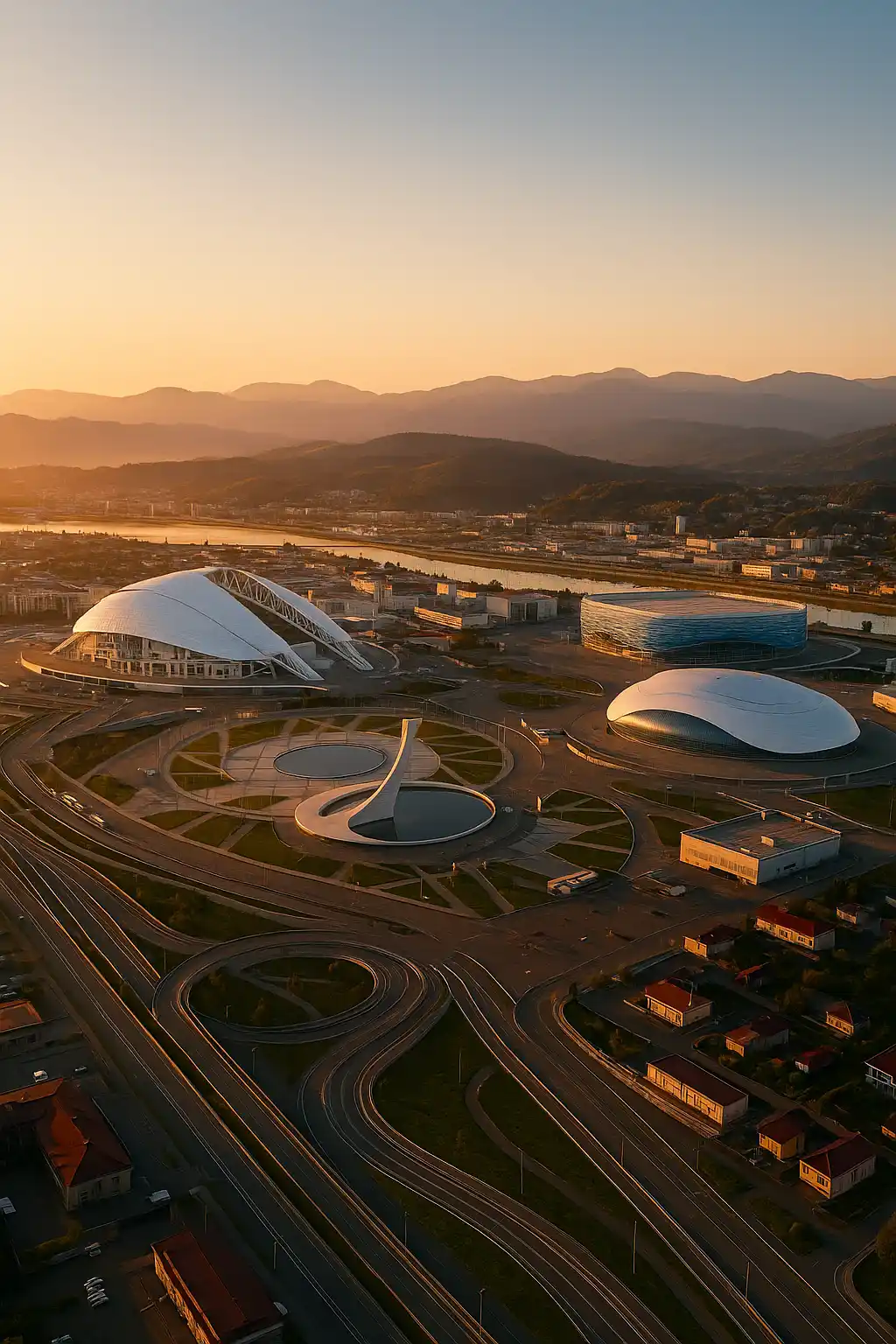
Nestled between the blue expanse of the Black Sea and the snow-capped peaks of the Caucasus Mountains, the Sochi Olympic Park stands as a modern symbol of Russia’s transformation — a seamless union of sport, architecture, and natural beauty. Built for the 2014 Winter Olympic Games, this vast coastal complex transformed Sochi from a quiet subtropical resort into a global destination, redefining its identity and skyline alike.
Stretching across the Imeretinsky Valley in southern Adler District, the park encompasses arenas, promenades, fountains, and public plazas that once hosted the world’s best athletes. Today, it thrives as a multifunctional space — part museum, part sports complex, part open-air festival ground. With the Black Sea shimmering to the west and the Caucasus Mountains rising to the east, visitors experience a breathtaking panorama where sea breezes meet alpine air.
The Olympic Park is not merely a relic of a global event; it is a living testament to Sochi’s ongoing evolution. The same venues that witnessed gold medal victories now welcome concerts, ice shows, motorsport events, and cultural festivals. Families cycle along the waterfront, music drifts from open cafés, and the famous Singing Fountains draw crowds each night in a spectacle of light and sound.
For travelers, the park is both destination and experience — a place to walk through history while immersed in the present. Whether gazing at the Olympic Flame Bowl, visiting the Bolshoy Ice Dome, or exploring nearby beaches, every corner reflects ambition, innovation, and a touch of coastal serenity. The Sochi Olympic Park is more than a reminder of 2014; it is a living celebration of sport, culture, and the enduring connection between human achievement and the natural world.
A Brief History of Sochi Olympic Park
The Sochi Olympic Park stands today as one of the most ambitious urban and infrastructural projects in modern Russia — a vision that began not with blueprints, but with an idea: to create a world-class sporting venue that would showcase Russia’s vitality on the global stage. The story of the park is inseparable from the story of Sochi itself — a city long celebrated for its subtropical climate, palm-lined boulevards, and reputation as Russia’s Riviera.
The Birth of a Vision
For decades, Sochi had been a favored domestic resort, yet few imagined it would one day host the Winter Olympic Games. When the International Olympic Committee selected Sochi as the host city for the XXII Olympic Winter Games in 2007, it marked a turning point in the city’s history. Russia faced a formidable challenge: to build, almost from scratch, the infrastructure capable of accommodating the world’s most complex sporting event — all within a region better known for beaches than for snow.
The answer lay in geography. The Imeretinsky Valley, a flat coastal plain in the Adler District near the border with Abkhazia, offered an ideal site. Its proximity to both the Black Sea and the Caucasus Mountains allowed organizers to create a dual-cluster Olympic concept: the Coastal Cluster (for indoor and ice events) and the Mountain Cluster (for skiing and snowboarding), connected by a new high-speed rail line.
The Sochi Olympic Park became the heart of the Coastal Cluster — a 200-hectare area that would host the opening and closing ceremonies, ice sports, and the Olympic Flame. It was envisioned not as a temporary event site, but as a permanent urban park that would remain a hub of culture and recreation long after the Games ended.
Design and Architecture
Construction began in 2008, bringing together architects and engineers from across Russia and around the world. The design aimed for a balance between modernity and harmony with the landscape — a coastal aesthetic defined by sweeping curves, reflective surfaces, and open sightlines toward the sea and mountains.
The layout of the Olympic Park was deliberately circular, centered around the Olympic Flame Bowl and Medals Plaza, with the arenas arranged radially like petals around a central core. This plan symbolized unity — the idea that all nations, athletes, and visitors would gather in a single space of celebration.
The venues themselves reflected cutting-edge engineering and cultural symbolism:
- The Fisht Olympic Stadium, with its translucent roof inspired by snowy mountain peaks, became the icon of the Games.
- The Bolshoy Ice Dome, resembling a frozen droplet, showcased Russian precision and technological elegance.
- The Adler Arena, with its crystalline façade, evoked the geometry of ice crystals.
- The Iceberg Skating Palace incorporated dynamic blue glass panels that seemed to shift color with the light — a tribute to the Black Sea waves.
By the time the park was completed in 2013, it was one of the most modern sporting complexes in the world — connected by new highways, an airport expansion, rail lines, and upgraded utilities that transformed the surrounding region.
The 2014 Winter Olympic Games
From 7 to 23 February 2014, Sochi hosted the Winter Olympic Games, followed by the Paralympic Games in March. More than 2,800 athletes from 88 countries competed across 98 events. The Sochi Olympics became the first Winter Games ever held in a subtropical climate — an achievement that symbolized both engineering prowess and environmental adaptation.
The Fisht Stadium hosted spectacular opening and closing ceremonies, combining high-tech projections with live performances that celebrated Russian culture, history, and innovation. Millions around the world watched as the Olympic Flame burned above the park, its reflection shimmering across the bay.
Beyond competition, the Games reshaped Sochi’s identity. Once seen primarily as a seasonal resort, the city emerged as a year-round destination with global recognition. The Olympic Park became the focal point of that transformation — a space that embodied optimism and progress.
Post-Olympic Transformation
Unlike many Olympic sites that fade into neglect, Sochi’s park underwent a carefully planned post-Games transformation. The venues were adapted for new uses:
- Fisht Stadium was redesigned to host football matches and served as a key venue for the 2018 FIFA World Cup.
- The Bolshoy Ice Dome now hosts Kontinental Hockey League (KHL) games and major ice shows.
- The Ice Cube Curling Center became a multi-sport complex.
- The Adler Arena was repurposed for exhibitions and conventions.
In 2014, part of the park was converted into the Sochi Autodrom, home to the Formula 1 Russian Grand Prix from 2014 to 2021. The race circuit winds between the Olympic arenas, combining the thrill of motorsport with the grandeur of Olympic architecture — a rare and dramatic fusion of sport and spectacle.
The surrounding infrastructure also flourished: hotels, promenades, bicycle paths, and public beaches turned the once-quiet valley into one of Russia’s most dynamic leisure districts. What began as a symbol of national ambition evolved into a living, breathing community hub.
A Legacy of Unity and Renewal
Today, the Sochi Olympic Park represents more than an architectural legacy. It is a living monument to collaboration — between nations, disciplines, and dreams. The Games brought together engineers, artists, and athletes from every corner of the globe, leaving behind not just structures, but stories.
Walking through the park today, one feels that legacy in every detail: in the rhythmic sound of cyclists on smooth promenades, in the laughter echoing across Medals Plaza, and in the golden light that still reflects off the Olympic Flame Bowl at dusk. The park has fulfilled its original purpose — not merely to host a moment in time, but to become a space where time continues to celebrate achievement.
It remains one of the few Olympic sites in the world where the spirit of the Games is not a memory but a presence — tangible, enduring, and open to all who come to see where fire once met sea.
Key Landmarks and Attractions
The Sochi Olympic Park is not merely a collection of arenas — it is a living landscape of architecture, history, and light. Every structure within the park tells a story of creativity and transformation. From the shimmering curves of the Fisht Stadium to the nightly glow of the Singing Fountains, each landmark reflects the park’s balance of function and beauty. Exploring it feels like walking through a living museum of modern Russia — a journey where engineering meets art, and where the memory of the Olympic flame still seems to linger in the air.
Fisht Olympic Stadium
Dominating the park’s skyline, the Fisht Olympic Stadium (Стадион Фишт) remains one of the most recognizable symbols of the 2014 Winter Games. Named after Mount Fisht in the western Caucasus, its design captures the essence of the region — a gleaming shell inspired by snow-capped peaks.
Built to host the opening and closing ceremonies of the Olympics, Fisht’s translucent roof illuminated the night sky with a dance of color and light. Inside, the stadium could hold 40,000 spectators, who watched not only athletic triumphs but a carefully choreographed narrative of Russian history and spirit.
After the Games, Fisht underwent a major reconstruction to serve as a football stadium, later hosting matches during the 2018 FIFA World Cup. Today, it regularly welcomes national and international sports events, concerts, and festivals. Visitors can take guided tours through the stands and behind-the-scenes areas, experiencing firsthand where Olympic history was made.
The best vantage point for photography is from the northern promenade at sunset, when the curved roof glows in shades of silver and pink, reflecting the light of the Black Sea.
Bolshoy Ice Dome
Next to Fisht rises the Bolshoy Ice Dome (Большой Ледовый дворец) — an architectural gem designed to resemble a giant frozen drop. Its name, Bolshoy, means “Grand,” and the venue lives up to that title in every sense. The dome hosted ice hockey tournaments during the 2014 Games and has since become one of Russia’s premier multi-purpose arenas.
With a seating capacity of 12,000 and cutting-edge acoustic systems, it hosts KHL hockey games, international competitions, and spectacular ice shows. At night, its LED façade lights up in shifting shades of blue, purple, and gold — a living artwork against the dark sky.
Inside, visitors can explore exhibitions dedicated to the Olympics, and outside, the reflection of the dome in nearby ponds creates some of the park’s most photogenic moments.
Iceberg Skating Palace
Few structures in the Olympic Park embody elegance as vividly as the Iceberg Skating Palace (Ледовый дворец Айсберг). Designed for figure skating and short-track speed skating, it hosted many of the most memorable performances of the Games. The façade — a mosaic of glass panels in varying shades of blue — mirrors the Black Sea’s ever-changing tones.
The venue remains in use for national competitions, ice ballets, and artistic events. Its flexible design allows rapid transformation from an ice rink to a concert hall. Visitors often describe it as the “heartbeat” of the park — a place where athletic grace and artistic expression converge.
Adler Arena
The Adler Arena (Адлер-Арена) stands out with its crystalline architecture and golden-lit interiors. Initially built for speed skating, its long oval design and transparent façade were meant to resemble a drop of ice in sunlight. After the Olympics, it was converted into an exhibition and event hall, hosting international forums, expos, and business conferences.
The surrounding gardens and open plazas offer peaceful resting points during a walk through the park. When viewed from above — either by drone photography or nearby hilltop viewpoints — the Adler Arena’s geometry forms one of the most distinctive shapes in the Sochi landscape.
Ice Cube Curling Center
Compact and elegant, the Ice Cube Curling Center (Кёрлинговый центр Айс Куб) adds a touch of intimacy to the Olympic Park. Built with modular components, it was one of the first fully prefabricated Olympic venues in Russia. Its name and design evoke the precision of curling itself — geometric, symmetrical, and pure.
Today, it functions as a multi-purpose sports complex, hosting volleyball, martial arts, and exhibitions. Visitors can enter the building during events or explore its small museum section dedicated to curling and the broader history of winter sports.
Shayba Arena
Named after the Russian word for “puck,” the Shayba Arena (Арена Шайба) complements the Bolshoy Ice Dome as a smaller, community-oriented venue. Designed for ice hockey and training matches, it now serves youth and amateur leagues, maintaining the Olympic legacy through local engagement.
Its red-and-white façade and circular design evoke a sense of motion — an homage to the sport it once hosted. The arena is especially lively during winter festivals when families gather for ice skating shows and youth tournaments.
Medals Plaza and the Olympic Flame Bowl
At the very center of the park lies its most symbolic space: the Medals Plaza (Площадь награждения), where athletes once stood on the podium to receive Olympic honors. Framed by the shining venues, the plaza remains a place of collective memory and national pride.
The plaza’s focal point is the Olympic Flame Bowl, a towering white structure shaped like a swan’s neck, rising 50 meters above the surrounding fountains. During the 2014 Games, the flame burned continuously here, visible from miles away. Today, the bowl remains unlit except during major commemorative events, but its presence continues to embody the enduring spirit of the Olympics.
Visitors gather here each evening for the Singing Fountains — a choreographed spectacle of water, light, and music that has become one of Sochi’s most beloved attractions. As classical and contemporary melodies fill the air, the fountains rise and fall in perfect harmony with colored illumination, turning the square into a scene of living art.
Sochi Autodrom
Perhaps the most dramatic post-Olympic adaptation within the park is the Sochi Autodrom (Сочи Автодром), the first Formula 1 circuit ever built in Russia. Laid out through the park’s boulevards and around the Olympic venues, it offers one of the world’s most unique race environments.
From 2014 to 2021, the Formula 1 Russian Grand Prix turned Sochi into a global motorsport destination. Fans filled grandstands that rose beside the Iceberg Palace and Bolshoy Dome, watching cars speed past the same paths where Olympians once walked.
Outside race days, the circuit transforms into a driving experience center, offering go-karting, professional training, and guided tours. Visitors can even walk sections of the track, feeling the scale of the course that once echoed with engines and cheers.
Olympic Village and Coastal Promenade
Adjacent to the main park lies the Olympic Village, once home to thousands of athletes. Today it serves as a residential and hotel district, with seaside pathways, cafés, and bicycle rentals. The nearby Imeretinsky Embankment stretches for several kilometers along the Black Sea, offering unobstructed views of sunsets and ships gliding beyond the horizon.
This promenade remains one of the most tranquil parts of the park — perfect for long evening walks, morning jogs, or simply sitting with coffee as the waves and the sound of distant fountains merge into calm rhythm.
Sochi Park Theme Park
Next to the Olympic Park rises Sochi Park, a family amusement complex inspired by Russian folklore and fairy tales. Its colorful towers, roller coasters, and cultural exhibits create a whimsical contrast to the sleek modernism of the Olympic venues.
Highlights include the Firebird Roller Coaster, the Bogatyrya Fortress Hotel — a fairy-tale castle that doubles as a luxury resort — and the Magic Tree Pavilion, where traditional Russian stories come to life through multimedia art.
Sochi Park adds a playful counterpoint to the Olympic Park’s grandeur, making the entire district a destination not just for sports fans but for families, art lovers, and dreamers.
Nature and Outdoor Activities
One of the most extraordinary aspects of visiting the Sochi Olympic Park is its setting — a place where subtropical beaches meet snow-capped peaks, and where the landscape itself feels like part of the experience. The park is not isolated from nature; it is surrounded by it. In a single day, visitors can walk along the Black Sea promenade, cycle past palm trees and fountains, and gaze eastward toward the white crests of the Caucasus Mountains. Few destinations in the world offer such contrast — a city where summer and winter coexist in one frame.
The Black Sea Coastline
Stretching just beyond the park’s western boundary lies the Imeretinsky Embankment, one of the longest and most scenic coastal promenades in Russia. The air here carries the scent of salt and pine, and the rhythmic sound of waves provides the park’s natural soundtrack. The beach is made up of smooth pebbles that glisten under the sun, and the sea’s temperature remains mild from late May through October, thanks to Sochi’s subtropical climate.
Cyclists, skaters, and joggers share the wide boulevard, which extends for several kilometers toward Adler Beach and the Khosta River. Wooden sun decks and small cafés line the route, offering fresh juices, coffee, and traditional chebureki (crispy meat pastries) — a perfect reward after a long ride.
On calm evenings, the water reflects the lights of the Olympic Park, turning the shoreline into a mirror of gold and blue. Sunsets here are especially vivid, with the distant silhouette of the Caucasus fading into a pink haze — a scene that captures the essence of Sochi’s natural beauty.
Cycling and Walking Trails
The Olympic Park was designed with sustainability and recreation in mind, featuring over 16 kilometers of pedestrian and cycling routes that link every major venue. Bicycles, scooters, and electric carts can be rented near the Singing Fountains Square or the Formula 1 circuit entrance.
Cycling along these smooth paths offers a sense of freedom — the sea on one side, the glowing domes of the park on the other. The route continues toward Imeretinsky Nature Park, home to lagoons, reed beds, and hundreds of bird species. Flamingos and herons can often be seen gliding above the wetlands, creating a serene counterpoint to the city’s energy.
Morning rides are particularly atmospheric: soft sunlight, light mist, and the distant hum of waves form a tranquil setting for reflection and discovery.
Imeretinsky Nature Park
Adjacent to the Olympic complex, the Imeretinsky Nature Park (Имеретинский природный парк) preserves one of the last coastal wetland ecosystems in the region. Once overlooked, this area became a vital environmental project during the Games, restoring habitats for migratory birds and native flora.
Visitors can follow raised wooden walkways through fields of reeds, watch swans gliding on quiet waters, and spot rare species such as the Dalmatian pelican. The park is especially popular with photographers and ornithologists, offering a peaceful escape within walking distance of the Olympic venues.
Sochi National Park
A short drive north of the Olympic Park lies Sochi National Park (Сочинский национальный парк) — one of Russia’s oldest and most biodiverse protected areas. Covering nearly 2,000 square kilometers, it extends from coastal forests to alpine meadows, encompassing waterfalls, caves, and thermal springs.
Among the park’s highlights are:
- Agura Waterfalls: A series of cascades descending through a narrow gorge, surrounded by lush vegetation.
- Akhun Mountain and Observation Tower: Offering panoramic views of the Black Sea and the Caucasus Range — especially breathtaking at sunset.
- Yew-and-Boxwood Grove: An ancient subtropical forest filled with twisted vines and moss-covered trees, home to species that have existed since the Ice Age.
Hiking here is accessible year-round. Even short trails reveal the diversity of Sochi’s environment — from palms and magnolias to firs and alpine herbs. For travelers staying near the Olympic Park, excursions to Sochi National Park can be arranged as half-day or full-day trips.
Rosa Khutor and the Mountain Cluster
No exploration of Sochi’s natural landscape is complete without visiting the Mountain Cluster, located about 50 kilometers inland. The resort of Rosa Khutor served as the centerpiece for the 2014 Winter Olympics’ alpine events, and today it stands as one of Russia’s premier year-round destinations.
In winter, it offers world-class skiing and snowboarding across 100 kilometers of slopes. In summer, it transforms into a hiking and mountain-biking paradise, with cable cars ascending to viewpoints overlooking valleys and glacial peaks.
The journey from the Olympic Park to Rosa Khutor is part of the adventure: a scenic one-hour drive or train ride through the Mzymta River valley, passing through tunnels, villages, and mountain curves that reveal the scale and grandeur of the Caucasus.
At the summit, the Rosa Peak Observation Deck (2,320 meters above sea level) provides one of the most dramatic panoramas in southern Russia — the Black Sea shimmering faintly in the distance beneath the line of snowy ridges.
Botanical Gardens and Subtropical Beauty
Sochi’s reputation as a botanical haven dates back to the early 20th century. Within easy reach of the Olympic Park are several gardens showcasing the region’s lush flora:
- Southern Cultures Park (Парк Южных культур): A landscaped oasis near Adler, featuring magnolias, bamboo, cypress trees, and lotus-covered ponds. Originally laid out in 1910, it remains a favorite for leisurely walks and picnics.
- Sochi Arboretum (Дендрарий): Further north in Central Sochi, this expansive garden houses over 1,800 species of plants from around the world, including towering palms and Japanese maples. A cable car offers an aerial view of the collection and the sea beyond.
Both parks highlight Sochi’s rare ecological diversity — a place where olive trees, roses, and pines coexist under the same sun.
Sea Excursions and Marine Life
From the nearby port of Imeretinsky Harbor, visitors can embark on boat tours and yacht excursions along the Black Sea coast. These cruises reveal the Olympic Park from a new perspective — the shimmering arenas framed by the sea and backed by the Caucasus peaks.
Dolphins are frequently sighted in these waters, often swimming alongside the boats in playful groups. Sunset cruises are particularly popular, offering sweeping views of the coastline illuminated by the warm glow of the sinking sun.
During summer, adventure seekers can try parasailing, paddleboarding, or diving at designated beaches near the Adler District. The water remains calm, and the currents are mild — ideal for beginners and families.
Year-Round Outdoor Lifestyle
Thanks to its mild climate, Sochi supports an outdoor lifestyle throughout the year. Spring and autumn are ideal for hiking, cycling, and photography; summer brings beach relaxation and evening concerts; and winter transforms the nearby mountains into a snowy wonderland while the coast remains green and walkable.
Locals take great pride in this diversity. It’s common to hear them say, “In Sochi, you can ski in the morning and swim in the afternoon.” Few places in the world make that phrase literally true.
The Harmony of Nature and Design
What makes the Olympic Park exceptional is not just its architecture, but how it fits into this landscape. The designers preserved open views toward both the mountains and the sea, ensuring that even amidst modern structures, visitors never lose sight of nature’s grandeur. At every turn, the natural and the human-made complement one another — the shining roofs reflecting the sky, the fountains echoing the rhythm of the waves.
The park embodies a modern Russian vision of harmony: progress that enhances, rather than replaces, the environment. Walking through it, one senses that the spirit of the 2014 Games — unity, balance, and the beauty of coexistence — still lives on in the air, the light, and the landscape.
Food and Dining in Sochi Olympic Park
To truly experience the Sochi Olympic Park, one must taste it. Food here is not simply sustenance — it is an expression of geography, climate, and culture. The city of Sochi sits at a culinary crossroads, where the flavors of the Black Sea, Caucasus Mountains, and Mediterranean coast merge into a distinctive regional cuisine. The Olympic Park, with its mix of restaurants, seaside cafés, and food pavilions, offers travelers an opportunity to explore this diversity through taste, aroma, and atmosphere.
The Culinary Identity of Sochi
Sochi’s food reflects the bounty of its surroundings. The Black Sea provides fresh fish, mussels, and shrimp; the nearby foothills yield citrus fruits, figs, walnuts, and honey; and the influence of Kuban and Georgian cooking adds spice and depth. The result is a cuisine that is bright, fragrant, and comforting — equally suited to a seaside lunch or an elegant evening meal.
The Olympic Park district, located in the Adler area, has evolved into one of the region’s culinary hotspots. Here, modern dining meets southern hospitality: seaside terraces serve grilled fish beside luxury restaurants offering creative interpretations of Caucasian classics.
Local Specialties to Try
Visitors to Sochi often discover that the simplest dishes are the most memorable. The city’s markets and eateries feature foods that are both rustic and refined — dishes rooted in everyday life but infused with local character.
Some of the must-try specialties include:
- Kebabs (Shashlik): Marinated meat grilled over open coals, served with fresh herbs, onions, and pomegranate seeds. Best enjoyed at casual outdoor cafés along the promenade.
- Khachapuri: A Georgian-style cheese bread baked to golden perfection. The Adjarian khachapuri — shaped like a boat and filled with cheese, butter, and egg — is particularly popular by the coast.
- Black Sea Fish: Freshly caught mullet (kefal), sea bass, and flounder are typically grilled or baked with lemon and local spices.
- Lobio and Pkhali: Bean-based dishes flavored with walnuts, garlic, and herbs — vegetarian options deeply rooted in Caucasian tradition.
- Churchkhela: Strings of walnuts dipped in thickened grape juice, a sweet and energy-rich snack sold at market stalls.
- Dolma: Vine leaves stuffed with rice and meat, a beloved dish of Armenian and Georgian origin often found on Sochi tables.
Each dish tells part of the region’s story — of trade routes, mountain harvests, and seaside abundance.
Dining Inside the Olympic Park
The park itself features a range of dining options that reflect both international standards and local authenticity. Many venues occupy ground floors of hotels and pavilions built for the Games, now transformed into welcoming spaces for travelers and residents alike.
Notable places include:
- Café Olimp: A relaxed setting overlooking Medals Plaza, serving soups, grilled meats, and local desserts. Its terrace offers direct views of the Singing Fountains — perfect for dinner during the nightly show.
- La Terrasse Sochi: A Mediterranean-style restaurant with panoramic views of the Black Sea and the Olympic Flame Bowl. Known for seafood platters, pasta with mussels, and chilled regional wines.
- Bolshoy Ice Bar: Located near the Bolshoy Ice Dome, this modern venue combines sports atmosphere with fine dining, offering smoked salmon blinis, caviar tastings, and Black Sea oysters.
- Formula Lounge: Overlooking the Sochi Autodrom, it’s a favorite for motorsport fans, with international cuisine and an outdoor deck where guests can watch the circuit.
- Khutorok Café: A traditional eatery near the Olympic Village, specializing in hearty Caucasian comfort food — lamb kebabs, bean stews, and flatbreads baked in clay ovens.
Each of these spots offers a different perspective of the park — from refined elegance to casual coastal relaxation — yet all share one quality: the sense of vitality that defines Sochi.
The Atmosphere of Southern Hospitality
What distinguishes dining in Sochi is not only the food but the mood. Meals here are long, social, and often accompanied by toasts of Kuban wine or local chacha (grape brandy). Music plays softly, sea air drifts through open windows, and the line between restaurant and living room blurs.
Service is warm and personal — waiters are quick to recommend their favorite dishes or to share a brief story about where the ingredients come from. Many restaurants source produce from small local farms, emphasizing freshness and regional identity.
Even street food carries this sense of pride. Vendors along the promenade sell grilled corn, roasted chestnuts, and sunflower seeds, while small bakeries tempt passersby with pirozhki (filled pastries) warm from the oven. The result is a culinary experience that feels alive — immediate, generous, and deeply connected to place.
Markets and Food Experiences Nearby
Beyond the park’s borders, several local markets invite visitors to experience the flavors of Sochi in their most authentic form:
- Adler Market (Адлерский рынок): Just a few kilometers away, this bustling hall offers fresh produce, mountain honey, cheeses, dried fruits, and aromatic spices from the Caucasus. The smell of smoked meats and herbs fills the air — a sensory immersion into the region’s food culture.
- Central Sochi Market: Located in the city center, it’s a paradise for culinary enthusiasts. Vendors offer samples of everything from homemade wine to fig preserves, often accompanied by cheerful conversation.
- Winery Visits: The Krasnaya Polyana Winery and Gai-Kodzor Vineyards (slightly further afield) offer tastings of Russian southern wines that pair perfectly with seafood and local cheeses.
Visiting these places provides more than shopping — it reveals the social rhythm of the region, where food connects people as much as it nourishes them.
The Evening Dining Experience
As dusk falls over the Olympic Park, dining takes on a new character. The venues surrounding the Singing Fountains fill with light, and the sound of music blends with the water’s rhythm. Couples gather for cocktails on open terraces, families share platters of grilled fish, and travelers linger late into the night as the sea breeze carries the aroma of citrus and charcoal.
Many restaurants host live music, featuring jazz, soft pop, or traditional Georgian songs. The overall feeling is one of celebration — not loud or hurried, but warm and alive. It reflects Sochi’s southern temperament, a blend of elegance and spontaneity.
A Blend of Cultures on a Plate
What makes Sochi’s dining scene truly distinctive is its multicultural foundation. Russian, Armenian, Georgian, Greek, and Turkish influences intertwine, reflecting centuries of migration and trade along the Black Sea. Chefs here embrace this diversity not as fusion but as tradition — a natural outcome of geography.
The result is a cuisine that is at once local and cosmopolitan, ancient and modern. A simple salad of tomatoes, herbs, and sulguni cheese may taste familiar, yet its flavor is enriched by mountain soil and coastal sun. A bowl of seafood soup echoes both Mediterranean and Slavic traditions. Every bite feels rooted in place.
The Taste of Sochi
To dine in the Olympic Park is to taste the region’s identity — resilient, sunlit, and full of movement. Meals here mirror the park itself: born of global vision yet deeply tied to the land and sea that sustain it.
Whether savoring grilled fish under palm trees or sipping local wine with a view of the Olympic Flame, every experience carries a sense of belonging — to a city that celebrates life through flavor.
For visitors, the memory of Sochi often lingers not through photographs or souvenirs, but through the echo of a shared meal — warm bread, sea breeze, and laughter beneath the southern stars.
Shopping in Sochi Olympic Park
Shopping in the Sochi Olympic Park is not merely about souvenirs; it is an immersion into the rhythm of the Black Sea coast — the colors, textures, and sounds that define southern Russia. Here, amid sleek Olympic architecture and seaside promenades, travelers discover a marketplace of contrasts: handcrafted souvenirs beside designer boutiques, fragrant local produce beside modern art pieces. Every item tells a story of transformation — from a resort town’s heritage to a cosmopolitan destination that blends sport, culture, and coastal leisure.
The Spirit of Southern Markets
Sochi’s shopping culture reflects its identity as both a resort and a crossroads. For generations, the city has welcomed travelers from across Russia and the Caucasus, and its markets continue that tradition of exchange. Even within the modern setting of the Olympic Park, echoes of traditional bazaars remain — stalls filled with sun-dried fruits, ceramics, and woven fabrics that recall the region’s ancient trade routes.
The Olympic Park Promenade and nearby Imeretinsky Embankment are lined with open-air kiosks where visitors can browse everything from hand-painted magnets to artisan jewelry made from seashells and river stones. The atmosphere is easygoing: vendors greet customers warmly, music drifts from nearby cafés, and the scent of roasted nuts and citrus mingles with sea air.
Popular Souvenirs and Local Crafts
- Black Sea Salt and Cosmetics: Sochi’s mineral-rich sea salt and locally produced cosmetics — often infused with algae, lavender, or citrus oils — make elegant and useful gifts. Many are handcrafted in small workshops in the Adler and Khosta districts.
- Honey and Nuts from the Caucasus: Mountain honey, pine nuts, and walnut spreads are staples of the local diet and are often sold in beautifully designed jars or boxes. Their aroma captures the essence of the nearby forests.
- Wine and Chacha: Regional wines from Krasnodar Krai and Abrau-Durso, as well as small-batch chacha (a Georgian-style grape spirit), are popular with visitors. These beverages embody the sunny character of southern Russia and pair well with local sweets.
- Sochi Tea: Grown in the nearby Dagomys region, Sochi tea is the northernmost cultivated tea in the world. Visitors can buy loose-leaf blends packed in decorative tins, a perfect souvenir of the subtropical climate.
- Handmade Crafts: Local artisans create wood carvings, embroidered textiles, and ceramic miniatures of Olympic venues. Each piece reflects both personal craftsmanship and the region’s cultural fusion — Slavic precision with Caucasian ornamentation.
- Sports Memorabilia: The park’s Olympic shops sell official merchandise — pins, jerseys, and medals replicas — that celebrate the 2014 Winter Games. For many travelers, owning a piece of that history carries special meaning.
Imeretinsky Market
A short walk from the main park entrance, the Imeretinsky Market (Имеретинский рынок) offers a vivid glimpse into Sochi’s southern soul. It’s less formal than a shopping mall and more authentic than a souvenir shop — a place where locals and travelers meet amid stalls of fruit, spices, and homemade wine.
The colors are dazzling: oranges and pomegranates piled high beside glass jars of honey; strings of dried peppers hanging next to wooden crafts. Vendors offer samples generously — a spoon of jam, a sip of wine, a handful of nuts. Shopping here becomes a sensory experience, blending taste, scent, and conversation.
Many artisans sell items made specifically from local materials — driftwood sculptures from the Black Sea coast, jewelry made with polished pebbles, and embroidered linen inspired by traditional Caucasian patterns.
Shopping Centers and Modern Retail
For visitors seeking modern comfort and variety, the area surrounding the Olympic Park includes several shopping centers that combine entertainment, dining, and retail:
- Mandarin Shopping Mall (Мандарин Молл): Located in Adler near the waterfront, this open-air complex features international brands, boutiques, and restaurants overlooking the sea. Its architecture, designed with tropical landscaping and fountains, creates a relaxed resort vibe.
- MoreMall: One of the largest shopping centers in southern Russia, located about 25 minutes from the Olympic Park. It offers a mix of local and global brands, cinemas, and cafés — ideal for a day of leisure away from the sun.
- Park Gallery Sochi: A boutique concept space with art exhibits, design pieces, and limited-edition collections by Russian designers — popular among younger visitors seeking contemporary souvenirs.
These venues complement the park’s open-air markets, giving travelers the freedom to move between traditional and modern experiences.
Art, Design, and Olympic Legacy
The creative energy of the Sochi Olympic Park has inspired a growing scene of local designers who blend athletic symbolism with artistic expression. Pop-up galleries often feature photography from the 2014 Games, limited prints of the venues, or hand-drawn city maps capturing the park’s geometry.
Visitors can purchase posters, postcards, and collectible pins that represent the Olympic spirit — elegant keepsakes that evoke both nostalgia and pride. One small boutique near the Fisht Stadium specializes in jewelry shaped like the Olympic Flame Bowl, made from silver and amber. Each piece serves as a quiet reminder of the moment when the world gathered here.
The Souvenir of Experience
In Sochi, shopping extends beyond objects. Often, the most meaningful souvenirs are experiences — a conversation with a craftsman, a sip of local tea shared at a market stall, or the sound of the sea echoing through an open-air shop. The Olympic Park’s design encourages this interaction: its plazas and promenades blur the boundary between commerce and culture, turning every purchase into part of the city’s narrative.
Visitors might leave with a bottle of wine, a handwoven scarf, or a piece of pottery — but also with the memory of warmth, laughter, and sunlight on the Black Sea. These intangible impressions are the true treasures of Sochi’s coastal charm.
Practical Shopping Tips
- Timing: Markets open early, usually around 8 a.m., and close near sunset. Evening hours are ideal for cooler temperatures and fewer crowds.
- Payment: Credit cards are accepted in malls and larger shops, but small market vendors often prefer cash (Russian rubles).
- Negotiation: Modest bargaining is common at open-air stalls. Smile, be polite, and enjoy the exchange — it’s part of the experience.
- Packaging: Many shops can pack wine, honey, and fragile souvenirs for travel. Keep receipts for customs if flying internationally.
A Reflection of Coastal Life
Shopping in the Sochi Olympic Park mirrors the region itself — a blend of movement and stillness, tradition and innovation. Between architectural landmarks and the endless sea, travelers find items that carry the essence of this place: sunlight, craftsmanship, and the optimism of a city that once welcomed the world.
The best souvenir, however, may be the simplest — a small shell picked up on the beach, glinting in the same light that shimmers across the Olympic Flame.
Day Trips from Sochi Olympic Park
The Sochi Olympic Park may stand as a modern symbol of Russia’s renewal, yet just beyond its boundaries lies a world of natural wonder, historical depth, and quiet beauty. From coastal villages and mountain monasteries to hidden waterfalls and borderland landscapes, the region around Sochi offers countless excursions that reveal the essence of the Black Sea and the Caucasus. Each journey begins with a simple view: the park’s gleaming domes fading behind you as the road curves toward forested valleys or the open sea.
Krasnaya Polyana – The Mountain Resort of the Caucasus
Just 50 kilometers northeast of the Olympic Park, the alpine resort of Krasnaya Polyana (Красная Поляна) offers a complete change of scenery. Connected by a modern highway and railway built for the 2014 Games, it rises from sea level to mountain heights in less than an hour — one of the most dramatic elevation shifts in Europe.
During the Olympics, Krasnaya Polyana hosted skiing and snowboarding events, and today it thrives as a year-round resort. Visitors can ascend by cable car to the Rosa Peak (2320 m), where the panorama stretches from snowfields to the Black Sea horizon. In summer, the slopes transform into green meadows filled with wildflowers and hiking trails, while in winter, they become a haven for skiing, snowboarding, and snowshoeing.
The resort area includes:
- Rosa Khutor: The most developed of the mountain clusters, featuring hotels, spas, restaurants, and boutiques set along the Mzymta River.
- Gorky Gorod: A family-friendly zone with indoor attractions, shopping, and entertainment.
- Gazprom Mountain Resort: Known for its quieter atmosphere and forest trails.
Whether you seek adventure or relaxation, Krasnaya Polyana embodies the dual identity of Sochi — a place where sea and summit share the same horizon.
Akhshtyrskaya Cave and Skypark AJ Hackett Sochi
Halfway between the coast and the mountains, near the village of Krasnoflotskoye, lies the Akhshtyrskaya Cave, an ancient archaeological site overlooking the Mzymta River gorge. This cave once sheltered prehistoric humans more than 100,000 years ago and now offers guided tours through chambers filled with geological formations.
Nearby stands one of the most thrilling attractions in southern Russia — the Skypark AJ Hackett Sochi, home to Europe’s highest pedestrian suspension bridge. Spanning 439 meters across the gorge, it provides breathtaking views of cliffs, forests, and the distant sea. For the adventurous, the park offers bungee jumps, zip lines, and a giant swing — but even those who simply walk across the bridge experience the exhilaration of floating between sky and earth.
Dagomys and Central Sochi
Heading north along the coast, travelers encounter Dagomys, a tranquil district known for its tea plantations and botanical gardens. This is where Sochi tea — the northernmost cultivated tea in the world — is grown. The gentle slopes, mild humidity, and mineral-rich soil give the tea a distinctive aroma.
Guided tours allow visitors to walk among the rows of green tea bushes, learn about production, and sample freshly brewed leaves while overlooking the Black Sea. Nearby, the Central Sochi district offers cultural sites such as:
- Sochi Arboretum (Дендрарий): A lush botanical garden with species from around the world.
- Winter Theatre: A neoclassical landmark hosting concerts and performances.
- Riviera Park: A historic leisure ground with fountains, sculptures, and shaded alleys — perfect for families.
These destinations combine elegance and nostalgia, revealing Sochi’s early-20th-century charm beneath its modern Olympic image.
Matsesta and the Healing Springs
Just north of Sochi’s city center lies Matsesta (Маце́ста), famed for its sulfur hot springs, known since the 19th century for their therapeutic properties. The name itself means “fiery water” in the local Adyghe language.
Visitors can bathe in the warm mineral pools at the Matsesta Balneological Resort, where natural sulfur water flows from deep underground. Treatments are believed to improve circulation and skin health, but even a simple soak offers deep relaxation after exploring the Olympic Park’s long promenades.
The journey from the park takes about 40 minutes by car — a pleasant coastal drive lined with subtropical vegetation and sea views.
Abkhazia – A Glimpse Beyond the Border
For travelers seeking something more unusual, a short trip south brings you to the Russian–Abkhazian border at Psou River, just 10 kilometers from the Olympic Park. With proper documentation (passport and visa requirements vary by nationality), it’s possible to enter Abkhazia, a region renowned for its dramatic scenery and historic monasteries.
Highlights include:
- Gagra: A seaside town with palm-lined boulevards, historic villas, and beaches backed by mountains.
- Lake Ritsa: A sapphire-blue mountain lake surrounded by evergreen forests — one of the most photographed sites in the Caucasus.
- New Athos Monastery: A magnificent 19th-century Orthodox complex set on a hillside overlooking the sea.
Visiting Abkhazia offers a rare cultural contrast — an encounter with another layer of the Black Sea’s diverse history, only a short journey from the modern architecture of the Olympic Park.
Vorontsov Caves and Khosta Valley
Nature lovers will find the Vorontsov Caves (Воронцовские пещеры) an unforgettable destination. Located in the Khosta Valley, about an hour’s drive north of the park, the caves form one of the largest karst systems in Russia, extending over 11 kilometers underground. Guided tours lead through illuminated chambers with stalactites, fossils, and underground lakes.
The surrounding forests are equally impressive — home to wild orchids, ferns, and ancient boxwood trees. The air here is rich with oxygen and the scent of moss, a refreshing contrast to the coastal climate.
Lazarevskoye and the Northern Coast
Further along the coast, the Lazarevskoye District offers a glimpse into Sochi’s quieter seaside life. Small villages, local markets, and pebble beaches make this area ideal for those seeking peace away from the crowds. The Mamedovo Gorge, with its waterfalls and lush greenery, invites for short hikes and picnics.
Travelers can also visit 33 Waterfalls, a natural cascade system hidden in the Shakhe River valley — an enchanting spot especially after rainfall when the water flows abundantly through moss-covered rocks.
Day Trip Logistics and Travel Tips
- Transportation: Day trips can be arranged by taxi, rental car, or organized tours. The Lastochka high-speed train connects Sochi, Adler, and Krasnaya Polyana efficiently.
- Best Time to Go: Spring and early autumn offer comfortable weather for outdoor exploration; winter trips focus on mountain sports and thermal spas.
- Duration: Most excursions are within one to two hours of the Olympic Park, allowing easy return the same evening.
- Essentials: Carry water, sunscreen, and identification (passport) — especially when approaching border areas.
The Freedom of the Landscape
Every road leading out of the Sochi Olympic Park reveals another dimension of this region — wild, ancient, and deeply poetic. The sea shimmers to the west, the mountains rise to the east, and the air carries the scent of pine, salt, and citrus. Whether you choose a mountain summit or a quiet village, the journey itself becomes part of the destination.
As the day ends and the car descends back toward the Olympic Flame’s glow, travelers often realize that these excursions — like the Games themselves — were never only about movement, but about perspective. From the coast to the clouds, the Sochi region unfolds as a landscape of balance: nature and architecture, tradition and renewal, sea and sky in perfect dialogue.
Practical Information
Visiting the Sochi Olympic Park is an experience where comfort meets discovery. Its accessibility, coastal setting, and year-round attractions make it one of Russia’s most visitor-friendly destinations. Understanding how to navigate the park, when to go, and what to expect ensures that every journey — whether for a day or a week — unfolds with ease and rhythm.
Location and Overview
The Sochi Olympic Park (Сочинский Олимпийский парк) lies in the Imeretinsky Valley of the Adler District, at the southern edge of Sochi near the border with Abkhazia. It covers over 200 hectares along the Black Sea coast, framed by the Caucasus Mountains to the east and open sea to the west.
Coordinates: 43.405° N, 39.955° E
Distance from Sochi city center: 27 kilometers
Distance from Adler Airport: 10 kilometers
The park is fully open to the public year-round, with most venues now serving cultural, recreational, and sporting purposes. The area is also home to the Sochi Autodrom, Rosa Khutor Mountain Cluster, and the Imeretinsky Embankment, forming one of the most developed resort corridors in southern Russia.
How to Get There
By Air:
The nearest airport, Sochi International Airport (AER), is located in Adler, only 10 kilometers from the park. It handles domestic flights from Moscow, Saint Petersburg, and other major Russian cities, as well as international routes from Istanbul, Dubai, Yerevan, and seasonal European destinations.
- Travel Time: 15–20 minutes by car or taxi.
- Public Transport: Bus No. 57 connects the airport directly with the Olympic Park.
By Train:
The Lastochka high-speed train links Sochi’s main railway station with Adler and the Olympic Park. Trains depart hourly and take around 45 minutes. The Olympic Park Station (Олимпийский парк) sits within walking distance of the main entrances and nearby hotels.
By Car:
The A147 coastal highway runs from Tuapse through Sochi to Adler and continues toward the Abkhazian border. Well-maintained and scenic, it follows the coastline with panoramic sea views. Private taxis and ride-hailing services like Yandex Go are widely available.
By Sea:
In summer, passenger ferries and private yachts connect Sochi’s central marina with the Adler district. Short cruises offer views of the Olympic Park from the sea — particularly striking at sunset when the domes and flame bowl reflect golden light.
Getting Around
The Olympic Park was designed for pedestrians and cyclists. Distances between venues are moderate, and pathways are wide, clean, and accessible.
- On Foot: Walking is the most pleasant way to explore. The park’s circular layout allows easy navigation between landmarks.
- Bicycles and Scooters: Rentals are available at multiple points, including the Singing Fountains Plaza and the Autodrom entrance. Electric scooters can be rented via mobile apps.
- Tourist Trains: Small electric shuttles operate around the park for families or those preferring less walking.
- By Car: Parking is plentiful around the perimeter, though not allowed inside the pedestrian zones.
Best Time to Visit
Sochi’s subtropical climate makes it suitable for travel year-round. However, each season offers its own character and rhythm:
- Spring (March–May): Blossoming magnolias, mild temperatures (15–20°C), and fewer tourists. Ideal for photography and walking.
- Summer (June–September): Beach season, warm sea (22–26°C), lively nightlife, and open-air concerts.
- Autumn (October–November): Golden light, calm atmosphere, and comfortable temperatures around 18°C — excellent for sightseeing and hiking.
- Winter (December–February): Snow in the mountains, mild coast (8–12°C). A perfect balance between seaside relaxation and winter sports at Krasnaya Polyana.
The best visiting months for most travelers are May through October, when the park is alive with activity and the sea is warm enough for swimming.
Climate and Weather
- Climate Type: Humid subtropical (Köppen Cfa)
- Average Annual Temperature: 16°C
- Average Rainfall: 1,700 mm (mostly in late autumn and winter)
- Sunniest Months: June–September
Evenings along the coast can be breezy, so a light jacket is advisable. In summer, sunscreen and hats are essential for long walks under the southern sun.
Accommodation Near the Park
The area surrounding the Olympic Park has become one of Russia’s most dynamic hospitality zones. Options range from luxury resorts to family-friendly hotels and budget hostels.
- Luxury:
- Radisson Blu Resort & Congress Centre – Elegant rooms, spa facilities, and views of the Black Sea.
- Bogatyr Hotel – A fairy-tale-style castle located next to Sochi Park, ideal for families.
- Mid-Range:
- Imeretinsky Hotel – Spacious rooms and an excellent location near the promenade.
- Barkhatnye Sezony – A large resort complex with multiple dining options and pools.
- Budget:
- Hostel Olympic Park – Clean, modern, and close to public transport.
- Guesthouse Elena – Friendly, family-run option in nearby Adler.
All hotels are within walking or cycling distance of the main park entrances, and many offer direct access to the beach.
Food, Drink, and Services
Cafés, restaurants, and snack bars are scattered throughout the park and along the embankment. Fresh water fountains and restrooms are well-maintained, and most public facilities are open late into the evening.
Wi-Fi is available across the park, and mobile coverage is strong (4G widely available). International visitors can purchase local SIM cards from MTS, Beeline, or Megafon kiosks at the airport or railway station.
Safety and Visitor Etiquette
The Olympic Park is considered one of the safest public spaces in southern Russia. Security patrols are frequent, and surveillance systems remain in operation since the Olympic period.
Visitors should observe standard etiquette:
- Respect restricted areas around venues.
- Avoid climbing on monuments or fountains.
- Dispose of waste properly — the park is known for its cleanliness.
Swimming is permitted at designated beaches only. Lifeguards operate from May through September.
Accessibility
Accessibility was a core principle of the park’s design. Wide ramps, smooth pavements, tactile tiles, and elevators in major venues ensure that wheelchair users and visually impaired visitors can navigate comfortably. Public restrooms and viewing platforms are adapted for reduced mobility.
Tickets and Admission
Entry to the Olympic Park grounds is free, but some venues — such as the Sochi Autodrom, Fisht Stadium, or Sochi Park amusement park — require separate tickets. Guided tours are available in English and Russian, often including behind-the-scenes access to sporting arenas and the Formula 1 track.
Tickets can be purchased online or at visitor kiosks near the Singing Fountains Square.
Useful Tips for Travelers
- Local Currency: Russian Ruble (RUB). Most restaurants and shops accept cards.
- Timezone: UTC +3 (Moscow Time).
- Emergency Numbers: 112 (general), 101 (fire), 103 (ambulance).
- Language: Russian. English is spoken in hotels, restaurants, and major attractions.
- Voltage: 220V, plug types C and F.
Connectivity and Transport Links
For extended trips, the park serves as an ideal base. Trains and buses connect directly to Sochi city center, Krasnaya Polyana, and the Abkhazian border. The Sochi Transport Hub, located near the park’s entrance, integrates local and regional networks.
High-speed trains also provide connection to Tuapse, Novorossiysk, and Krasnodar, making the park a convenient starting point for wider exploration of Russia’s southern coast.
The Ideal Visit
To experience the park fully, plan at least two days: one for exploring its architectural and cultural landmarks, and another for the sea promenade, markets, and evening fountain show. Pair this with a day trip to Krasnaya Polyana or the tea plantations of Dagomys, and you’ll capture the complete picture of Sochi’s remarkable dual landscape — ocean and mountain, modernity and memory.
Insider Tips & Local Experiences
The Sochi Olympic Park is more than a landmark — it is a living space where daily life unfolds against the backdrop of modern architecture and the endless Black Sea horizon. To experience it like a local is to move beyond the postcard views and step into the rhythm of the city’s southern temperament: slow mornings, golden afternoons, and luminous nights filled with music and sea air.
The Morning Calm
Early morning is the park’s most peaceful time. The promenade is quiet except for cyclists and joggers, the fountains still, and the sea mirroring the first light. Locals begin their day with a brisk walk or a cup of coffee from one of the small kiosks near the Imeretinsky Embankment. The air smells faintly of salt and flowers, and the only sounds are waves and birds.
This is the perfect hour for photography — the Olympic venues shimmer under soft light, and the Caucasus peaks are visible before the haze sets in. The Olympic Flame Bowl glows white against a pale sky, and its reflection on the wet tiles creates almost surreal symmetry.
Watching the Sunset Over the Black Sea
If there is one ritual every Sochi resident and visitor shares, it is watching the sunset. From late spring to autumn, hundreds gather along the promenade each evening as the sun dips into the sea. The sky turns from gold to crimson, and the glass façades of the Olympic arenas catch the final rays. Street musicians begin to play; couples sit on benches with ice cream or wine; children run through the fountains.
For the best views, locals recommend the area near La Terrasse Sochi restaurant or the Bolshoy Ice Dome plaza. As the horizon darkens, the park’s lights come alive — blues, pinks, and golds reflecting off the water in a shimmering dance that continues long after dusk.
The Singing Fountains Show
Every evening, the Singing Fountains transform the Medals Plaza into a spectacle of color and sound. The synchronized jets rise up to 60 meters high, choreographed to classical and popular music. Families, tourists, and couples gather around the circular pool, their faces illuminated by shifting light.
Shows usually begin after sunset and run several times each evening, with free admission. Locals often bring snacks or drinks and sit on the surrounding steps — it’s one of those simple pleasures that define the park’s atmosphere: communal, open, and joyful.
Cycling the Olympic Circle
One of the most enjoyable local traditions is renting a bicycle or electric scooter and completing a loop around the entire Olympic complex. The “Olympic Circle” route is approximately 8 kilometers, tracing the perimeters of the arenas, fountains, and coastal roads.
It’s best to start in late afternoon when the heat softens. Along the way, you’ll pass the Fisht Stadium, the Bolshoy Ice Dome, the Sochi Autodrom, and countless viewpoints of the sea and mountains. Locals often stop midway for coffee or ice cream, turning the ride into a social ritual rather than a workout.
Hidden Viewpoints and Quiet Corners
Despite its grandeur, the park still offers places of stillness — spots known mostly to residents:
- The Lagoon Path: A narrow walkway behind the Ice Cube Curling Center leading to a small lagoon where reeds and swans create an unexpected oasis of calm.
- Observation Deck by Fisht Stadium: Accessible via a short climb up the hill toward the parking zone; from here, the entire park unfolds like a model city.
- Sochi Autodrom’s Sky Lounge: On non-race days, visitors can access the rooftop café overlooking the track — a panoramic spot where architecture, mountains, and sea meet.
These vantage points reveal the park’s quiet side — where the geometry of its design meets the fluidity of nature.
The Local Tempo
Sochi moves at a rhythm unlike any other Russian city. Life here follows the sun: mornings for walking or cycling, afternoons for rest or sea swimming, and evenings for dining and conversation. The southern temperament is warm but unhurried — hospitality expressed through gestures, not schedules.
Locals often greet visitors with a relaxed smile and the phrase “Kak vam u nas?” (“How do you like it here?”). The tone is not formal but genuinely curious. Sharing impressions of the weather, the sea, or the food opens the door to conversation — and sometimes friendship.
Eat Like a Local
To eat like a Sochi resident is to dine slowly and with heart. Lunch is often the main meal, featuring fresh salads, soups like kharcho or solyanka, and grilled fish. Dinner leans toward social gatherings — wine, music, and shared plates of shashlik or khachapuri.
Small family-owned cafés along the Imeretinsky Promenade serve homemade food at affordable prices, often prepared from recipes passed down for generations. Locals recommend Khinkali House for dumplings, Kuban Café for local specialties, and U Samvela for Armenian cuisine.
Events and Local Life
Throughout the year, the park hosts festivals, concerts, and sporting events that keep the spirit of the Olympics alive:
- Sochi Autodrom Racing Events: From amateur car shows to motorcycle festivals.
- Ironstar Triathlon: A major international event that uses the park as a starting point.
- New Wave Music Festival: A summer celebration featuring Russian and international performers.
- Winter Jazz Evenings: Intimate concerts held in the pavilions around Medals Plaza.
Locals participate enthusiastically — not as spectators, but as hosts proud of their city’s global role. Many events are free or low-cost, fostering a sense of shared celebration rather than exclusivity.
Sochi by Night
After dark, the park transforms into an illuminated dreamscape. The Fisht Stadium glows in white and blue, the Iceberg Palace reflects in mirrored pools, and the Olympic Flame Bowl stands at the center, a luminous sculpture against the night sky.
Cafés extend their hours; the air is filled with live music and the distant hum of sea waves. For many, this is the moment when the Olympic Park reveals its true character — a place where technology and tranquility coexist. Couples stroll hand in hand, photographers capture long-exposure images of the fountains, and families linger long past midnight in the mild southern air.
The Meaning of the Place
To locals, the Olympic Park is not simply a venue or tourist attraction. It is part of their identity — a reminder of when their city stood at the center of the world’s attention. Even now, years after the Games, residents still feel pride in its architecture and symbolism.
Many describe the park as “the heart of new Sochi” — a space that connects generations, uniting sport, culture, and community. Watching children cycle past the Olympic Flame or teenagers skate along the plazas, one senses that legacy continuing.
Seasonal Experiences
- Spring: Blossoming trees and calm promenades; ideal for nature walks and photography.
- Summer: Beach season and vibrant nightlife; concerts and food festivals every weekend.
- Autumn: Warm seas, golden light, and fewer crowds — a favorite season for locals.
- Winter: Mountain excursions combined with quiet coastal walks; the park glows under mild southern skies.
Each season carries its own beauty, but the sense of openness — the ability to breathe, walk, and look freely toward both mountains and sea — remains constant.
A Local’s Advice
The most valuable advice from Sochi residents is simple: “Don’t rush.” The Olympic Park is best experienced at your own pace. Sit by the fountains, watch the changing colors, listen to the conversations around you, and let the place unfold naturally.
The spirit of Sochi lies in balance — between motion and rest, sunlight and shadow, sound and silence. Those who embrace that balance discover not just a destination, but a feeling that lingers long after they leave.
Conclusion
The Sochi Olympic Park stands as one of the most remarkable transformations in modern Russia — a space where ambition met geography and where the world once gathered beneath the southern sun. What was once a quiet coastal plain between the mountains and the Black Sea has become a living symbol of connection, resilience, and the harmony between human creation and nature’s vast beauty.
When the Olympic flame was first lit here in 2014, it marked more than the beginning of a global sporting event. It marked the rebirth of a city, the reimagining of an entire region. Sochi — long celebrated as Russia’s Riviera — stepped confidently into the world stage, not by abandoning its natural grace, but by amplifying it. The park that grew from that moment has endured far beyond its original purpose.
The Bridge Between Worlds
The Sochi Olympic Park is a bridge between opposites: between sea and mountain, past and future, leisure and achievement. Its arenas curve like waves beside the Black Sea; its plazas open wide toward the Caucasus; its lights reflect both the warmth of southern hospitality and the precision of modern design. To walk its paths today is to move through a living dialogue between Russia’s heritage and its vision for tomorrow.
Every structure tells a story. The Fisht Stadium still echoes with the ceremonies that once united nations. The Bolshoy Ice Dome continues to host games and concerts that fill its glassy interior with laughter and applause. The Olympic Flame Bowl, though no longer burning, still captures the sky in its white arc — a reminder that inspiration, once ignited, does not fade.
A Living Legacy
Unlike many Olympic sites that fade into silence, Sochi’s park thrives. Children ride scooters along the same paths that athletes once walked. Families picnic near the Singing Fountains, their laughter blending with the music of water and wind. Cyclists trace circles around the arenas as sea breezes drift through the palm trees.
The park’s success lies not only in its architecture but in its continuity. It was designed to evolve — to shift from global spectacle to local life, from one-time event to enduring landmark. Today, it functions as both: a national monument and a neighborhood square, a place where visitors and residents share the same view of the horizon.
Where Fire Meets Water
Perhaps the most poetic quality of the Sochi Olympic Park is its elemental balance. Fire once burned in the Olympic Bowl; water dances nightly in the fountains; air flows freely between open plazas; and the earth beneath — fertile, coastal, timeless — anchors it all. This interplay of elements gives the park its vitality, making it more than a physical space. It is a stage for renewal, a daily reminder of human potential.
Evening is when this harmony feels most tangible. As the sun sets behind the Black Sea, the light turns molten, the domes glow, and the mountains fade into soft silhouettes. The park becomes a theater of color and sound — children’s voices mingling with music, waves breaking softly beyond the embankment, and the fountains rising in luminous arcs.
Why Sochi Olympic Park Matters
To visit the Sochi Olympic Park is to witness how vision can transform landscape — how a single event can redefine a city’s destiny. It is a place that embodies optimism: a belief that beauty, sport, and community can coexist without borders. It celebrates the union of technology and nature, of discipline and joy, of past glory and everyday life.
For travelers, the park offers more than architecture and history. It offers feeling — the sensation of space, light, and freedom that comes from standing between the Black Sea and the Caucasus Mountains. It invites reflection on what human creativity can achieve when guided by purpose rather than excess.
The Enduring Spirit of Sochi
Years after the Olympic flame was extinguished, its light still lingers here — in the reflections on the water, in the rhythm of the fountains, and in the pride of the people who call this city home. The park has fulfilled its destiny not by remaining frozen in the past, but by moving gracefully into the present, welcoming new generations to experience its calm, its grandeur, and its sense of possibility.
Walking through it, one senses that the spirit of the Games — the belief in unity, courage, and excellence — has not disappeared. It has simply taken new forms: a cyclist gliding through morning mist, a family watching the sunset, a musician playing beneath the glow of the Flame Bowl. These quiet scenes carry the same essence as the ceremonies that once captivated the world.
The Sochi Olympic Park endures not because of what it was, but because of what it has become — a place where fire meets water, where steel meets sky, and where human endeavor continues to shine against the vast and timeless backdrop of the Black Sea.
Final Reflection
To stand here at dusk, with the sea breeze on your face and the lights of the park shimmering like constellations, is to understand Sochi’s essence: a city defined not by boundaries but by movement — between nature and architecture, between history and the present moment.
Few places capture the spirit of renewal as vividly as this one. The Olympic Park remains both a memory and a promise, a symbol of what humanity can build when it dreams boldly and builds beautifully.
For travelers, it is not simply a destination but a feeling — one that stays long after you leave, like the echo of waves against the shore, or the reflection of gold still glimmering in your mind.
Summary:
The Sochi Olympic Park is a masterpiece of modern Russia — a coastal complex that unites the grandeur of Olympic architecture with the tranquility of the Black Sea and the majesty of the Caucasus Mountains. Built for the 2014 Winter Games, it has become a thriving hub of culture, sport, and community. Visitors experience both the spirit of the Olympics and the serenity of a resort city, walking between flame and water, between history and the living present. The park’s legacy is one of transformation — proof that Sochi’s light, like its name, continues to shine at the edge of the sea.


