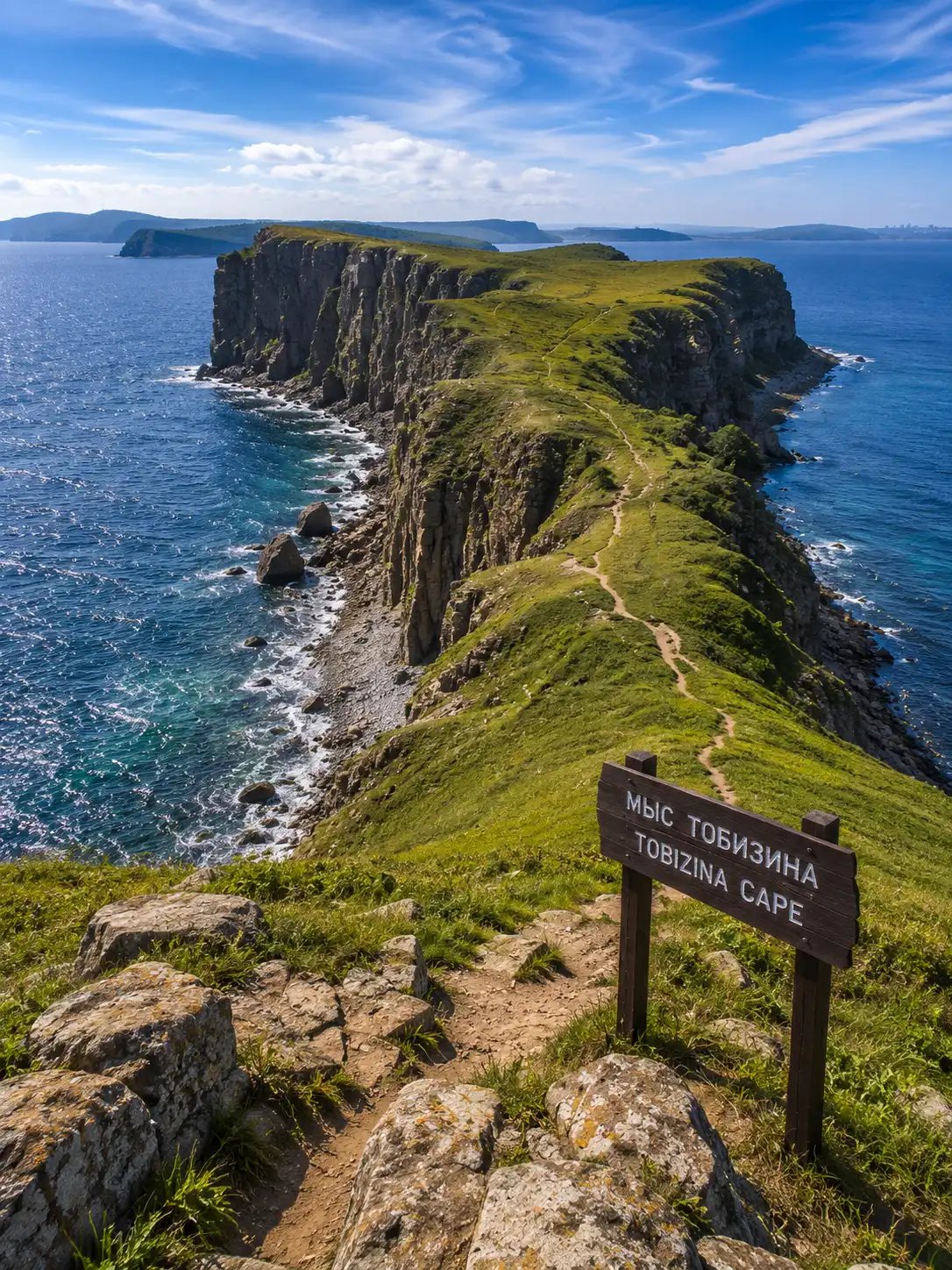
Cape Tobizina is one of the most dramatic coastal destinations in Vladivostok. Located on the southern side of Russky Island, the cape combines steep sea cliffs, open grassland, wind-shaped forest, small pebble coves, abandoned military structures and wide views across Peter the Great Gulf.
Known in Russian as Mys Tobizina, or Мыс Тобизина, the destination has become one of the most popular hiking routes near Vladivostok. It offers a strong contrast to the city centre, where bridges, apartment blocks, port cranes and steep urban streets dominate the landscape. At Cape Tobizina, the skyline opens almost completely, leaving sea, cliffs, grass and changing coastal weather.
The usual walk begins near Karpinsky Bay or from a parking area farther inland, depending on road access and the chosen route. From Karpinsky Bay, the official regional tourism description gives a trail distance of approximately 2.5 kilometres to the cape, requiring around one hour at a relaxed pace. Longer organised routes can reach approximately four kilometres in each direction and eight kilometres in total because buses and vehicles may stop farther from the main trail.
Cape Tobizina is accessible to many reasonably fit travellers, but it should not be confused with a completely safe urban promenade. The route includes uneven ground, exposed coastal sections, slippery rock and unprotected cliffs. Near the final plateau, some versions of the trail include a short rocky climb. Fog, strong wind, rain and winter ice can make the same path substantially more difficult.
This Wander Russia guide explains how to reach Cape Tobizina, what to expect on the trail, how difficult the hike is, what to bring, how to behave around foxes and cliffs, and how to combine the route with other attractions on Russky Island.
Where Is Cape Tobizina?
Cape Tobizina lies in the southeastern part of Russky Island, within the administrative territory of Vladivostok.
Russky Island is connected to mainland Vladivostok by the Russky Bridge. After crossing the bridge, travellers continue south through the island’s road network toward the end of the Sapper Peninsula and the area around Karpinsky Bay.
The cape projects into the waters of Peter the Great Gulf. Its narrow shape creates steep coastline on both sides, giving hikers repeated views of the open sea during the final part of the route.
Although Cape Tobizina feels remote, it remains geographically close to the city. This accessibility is one reason regional tourism authorities consistently include it among the principal outdoor destinations near Vladivostok.
The journey should still be planned as a substantial half-day activity. Transport from the city, the walk to the cape, stops for photography and the return journey can easily occupy five or six hours.
The Landscape of Cape Tobizina
The route crosses several different coastal environments.
Near the starting area, hikers move through forest and along rough roads or trails. Trees have developed irregular shapes because of strong winds, creating a visibly weathered landscape. The official tourism description specifically notes these wind-shaped trees as one of the distinctive features of the route.
The forest gradually opens toward exposed grassland and rocky coastline. From elevated sections, hikers can see the sea below, small coves, offshore rocks and the long shape of the Tobizina Peninsula.
The final area contains flat stone surfaces, fractured cliffs and unusual rock patterns. Regional tourism material compares some of these formations with a chessboard or puzzle because of the way cracks divide the stone into geometric sections.
The sea changes colour according to weather and light. Under clear summer conditions, sheltered water can appear turquoise or deep blue. During fog or storms, the same coastline becomes grey, severe and far more exposed.
The landscape is especially photogenic because human development remains limited. A few military remains and informal paths are visible, but the main impression comes from the natural relationship between grass, rock and sea.
Why Is the Cape Called Tobizina?
The name is associated with the Tobizin family and is commonly linked to the naval officer German Tobizin, who lived during the nineteenth century.
English transliterations vary. Travellers may encounter Tobizina, Tobizin, Tobisina or Tobizin Cape.
The Russian form Мыс Тобизина is the most reliable reference when using local maps or speaking with drivers.
The English spelling does not change the destination. All of these variants normally refer to the same cape on Russky Island.
The Hiking Route
There is no single fixed starting point used by every visitor.
The shorter version begins around Karpinsky Bay. From there, the official tourism portal describes a trail of approximately 2.5 kilometres to the cape, taking about one hour at a relaxed pace.
Organised tours often begin farther away because buses cannot always reach the closest trailhead. A 2025 official tour description listed approximately four kilometres of walking in each direction and eight kilometres in total, with a complete excursion duration of around five and a half hours.
The first section may follow a dirt road through the forest. Hikers then continue along the peninsula, passing coastal viewpoints and military remains.
Near the final section, the route narrows and becomes more exposed. Some paths descend toward a small isthmus before climbing again to the final plateau. One local route description notes that the last section includes a short climb over rocks.
The precise walking distance therefore depends on parking, transport restrictions and the chosen path.
Karpinsky Bay
Karpinsky Bay serves as one of the traditional starting areas.
The bay contains a small beach and sheltered water compared with the exposed outer cape. Some visitors swim there after returning from the hike, although water temperature and sea conditions must always be considered.
The road toward the bay may be rough. Drivers sometimes leave vehicles before the final section and continue on foot to protect their cars from poor surface conditions. The regional tourism portal mentions both options: parking near the end of the paved road and walking through the forest, or driving farther toward Karpinsky Bay when conditions permit.
The bay is not a fully developed beach resort. Facilities can be limited or seasonal, and visitors should bring their own water, food and sun protection.
Military Remains Along the Trail
Russky Island played an important role in the defence of Vladivostok.
Near the beginning of the Tobizina route, hikers may encounter coastal anti-landing semi-caponier No. 7, built in 1912 as part of the larger Vladivostok Fortress system.
These remains connect the coastal landscape with the military history of the island.
Some structures are visible from established paths, but abandoned fortifications should not be entered without guidance. Underground rooms, shafts and tunnels may contain unstable ceilings, standing water, rusted metal and hidden drops.
The safe approach is to observe accessible external features or join a specialist fortress excursion when deeper historical interpretation is desired.
How Difficult Is the Hike?
The route is generally described as an easy or moderate hike for people with normal fitness.
It does not require mountaineering equipment under ordinary dry conditions. The elevation gain is limited compared with a mountain route, and much of the trail follows broad forest or coastal paths.
The main challenge comes from distance, uneven ground and exposed final sections.
A traveller comfortable walking eight kilometres on mixed terrain should usually manage the standard organised route. The shorter Karpinsky Bay version is less demanding.
However, difficulty increases significantly in:
- Heavy rain
- Dense fog
- Strong wind
- Winter snow
- Ice
- Extreme summer heat
- Late-evening darkness
The cliffs and slippery rocks create more serious risk than physical exhaustion.
The Final Rocky Section
The approach to the outer cape becomes narrower and more dramatic.
Depending on the selected path, hikers may need to descend slightly toward an isthmus and then climb over rock to reach the final plateau.
This section does not normally require ropes, but travellers should use both hands where necessary and avoid carrying loose objects.
Non-slip footwear is important. The official organised-tour description specifically recommends comfortable shoes with reliable grip.
People with severe balance problems, significant mobility limitations or fear of exposed terrain may prefer to stop at an earlier viewpoint.
The best views do not exist only at the very end. Several excellent panoramas appear before the final rocky section.
Cliff Safety
The cliffs are the greatest hazard at Cape Tobizina.
Some edges are vertical or undercut. Grass can grow close to the drop, making the boundary difficult to judge.
Rock may be fractured by frost, rain and wave erosion. A surface that appears stable can break without warning.
Visitors should remain several metres back from edges, especially during wind or fog.
Jumping, climbing onto isolated rocks or posing at the outer edge creates unnecessary risk.
The area is known among rope-jumping and cliff-diving enthusiasts, but these activities require specialised equipment, local knowledge and professional safety systems. Their presence should not encourage ordinary visitors to imitate them.
Foxes on the Route
Foxes are frequently seen along the trail.
They have become accustomed to people and may approach hikers in search of food.
Regional tourism authorities explicitly advise visitors not to feed or touch them.
Feeding changes natural behaviour and encourages foxes to associate people with food. This can lead to aggression, dependence and increased risk of disease transmission.
Food should remain sealed inside a backpack.
Photographs can be taken from a respectful distance without attempting to attract the animal.
Children should not approach or chase foxes.
Best Time to Visit
Cape Tobizina can be visited throughout the year, but late spring through early autumn provides the most practical conditions.
May brings green slopes and strong contrast between fresh vegetation and dark cliffs. Regional tourism guidance specifically identifies the cape as an attractive destination during this period.
June offers long daylight but may still bring fog and cool wind.
July and August provide the warmest conditions and are popular for swimming, picnics and coastal hiking. These months can also be crowded.
September often offers clearer air, cooler temperatures and attractive late-summer colour.
October can remain suitable, but wind and cold increase.
Winter creates a dramatic landscape of snow, ice and dark sea. The route becomes substantially more dangerous and should be attempted only with appropriate clothing, traction and reliable knowledge of conditions.
Fog and Coastal Weather
Fog is common around Vladivostok and Russky Island.
It can arrive quickly and reduce visibility across the exposed peninsula.
A clear start does not guarantee clear conditions at the cape.
Fog creates impressive photography, but it also hides cliff edges and landmarks. Groups should remain close together and avoid informal side paths.
Strong wind is another constant factor. The wind can be significantly stronger at the cape than at the parking area.
A light jacket is useful even during summer.
Rain makes rock and grass slippery. The hike should be postponed during severe weather rather than treated as an activity that must continue at any cost.
What to Wear and Bring
Recommended equipment includes:
- Supportive shoes with non-slip soles
- A windproof jacket
- A waterproof outer layer
- Drinking water
- Snacks or a simple lunch
- Sun protection
- Insect repellent
- A charged phone
- Offline maps
- A power bank
- A small first-aid kit
- A headlamp
- Warm clothing outside midsummer
- Gloves and a hat during colder seasons
Open sandals and smooth city shoes are unsuitable.
There is little shade on the exposed part of the cape, so sun protection matters even when temperatures feel mild.
How to Reach Cape Tobizina by Car
Drivers cross the Russky Bridge and continue south through Russky Island.
The final paved section ends before the main walking route. The regional tourism portal advises leaving the car near the end of University Avenue and continuing toward Karpinsky Bay on foot, although some drivers proceed farther when road conditions permit.
Road quality changes after rain and between seasons.
Low-clearance rental cars may not be suitable for the roughest section.
Parking should not block roads, emergency access or private property.
Navigation should be downloaded before departure because mobile reception can weaken in remote sections.
How to Reach Cape Tobizina by Public Transport
The official tourism portal lists bus 29d from the Emerald stop in central Vladivostok toward the Communal CHP stop. From there, travellers continue approximately two kilometres on foot toward the beach in Karpinsky Bay before joining the main trail.
Public transport routes can change, so the current schedule should be checked on the day of travel.
The public-transport option adds substantial walking and can make the complete journey long.
A taxi is more convenient, but return transport should be arranged in advance. It may be difficult to request a car from the trailhead when mobile reception is weak or demand is high.
An organised tour provides the simplest option for visitors unfamiliar with the island.
Organised Tours
Bus-and-walking tours commonly depart from central Vladivostok.
An official 2025 programme included transport across the Golden and Russky bridges, an eight-kilometre round-trip hike and approximately 20–60 minutes at the final plateau, depending on weather and group preference.
A guide can help with navigation, the final rocky section and historical interpretation.
Tours also reduce the problem of arranging return transport.
The trade-off is less flexibility. The pace, stops and time at the cape depend on the group.
Travellers should ask whether water, food, trekking poles or insurance are included.
Swimming Around Cape Tobizina
Several bays and coves around the route appear inviting during summer.
Karpinsky Bay is more suitable for a cautious swim than the exposed outer cliffs, provided local conditions are calm.
The open sea near the cape can be cold, rough and difficult to exit.
There are generally no lifeguards.
Cliff jumping should not be attempted without professional supervision.
Water quality, jellyfish, waves and temperature should be assessed before entering.
A swim is optional and should never be treated as an essential part of the hike.
Photography Tips
Cape Tobizina is especially suited to wide landscape photography.
A wide-angle lens captures the cliffs, grass and sea within one frame.
A moderate telephoto lens helps isolate rock formations, boats and distant coastline.
Morning light can be soft and quiet. Late afternoon creates stronger texture on the cliffs.
Fog produces minimal and atmospheric images but reduces safety.
Photographers should never step closer to the edge for a better angle.
A person standing safely on the trail can provide scale without creating unnecessary risk.
Drones require careful attention to local restrictions, weather and wildlife. Strong coastal wind can make safe operation impossible even where flight is legally permitted.
Combining Cape Tobizina with Other Attractions
Cape Tobizina can be combined with one additional Russky Island attraction.
The Primorsky Aquarium is the strongest indoor option, but combining a full aquarium visit with the complete hike creates a long day.
The Far Eastern Federal University embankment provides a relaxed stop with views toward the Russky Bridge.
The Voroshilov Battery offers military history and works well for travellers who prefer an organised tour.
Cape Vyatlin is another coastal destination, but visiting both capes properly in one day can be tiring.
A balanced day should prioritise either nature or museums rather than attempting everything.
Suggested Day Itinerary
Begin early in central Vladivostok.
Cross the Russky Bridge by car, taxi or tour vehicle.
Continue toward the trailhead and begin walking before midday heat or crowds increase.
Allow approximately three to four hours for the complete hike, photography and rest.
Return to the vehicle and stop at the university embankment or a coastal café.
Cross back to Vladivostok before evening traffic becomes heavy.
This schedule provides a complete experience without turning the day into a rushed checklist.
Responsible Travel
Cape Tobizina receives large numbers of visitors during summer.
Rubbish should be carried back to the city.
Food waste must not be left for foxes.
Plants should not be damaged, and stones should remain in place.
Campfires can create serious risk during dry weather and should not be made without permission.
Vehicles should remain on existing roads and parking areas.
Repeated off-road driving damages grass and accelerates erosion.
The beauty of the cape depends on visitors treating it as a natural landscape rather than an informal entertainment ground.
Is Cape Tobizina Worth Visiting?
Cape Tobizina is one of the most rewarding natural excursions from Vladivostok.
It is close enough for a half-day or full-day trip but distant enough to feel separated from the city.
The route does not require advanced hiking experience, yet it offers cliffs, open sea and a strong sense of scale.
Its popularity means that summer weekends can be busy.
Travellers seeking complete solitude may prefer an early weekday start or a quieter coastal route elsewhere on Russky Island.
Wander Russia recommends Cape Tobizina as the first major nature hike for visitors to Vladivostok.
Frequently Asked Questions
How long is the hike?
From Karpinsky Bay, the official tourism portal describes a route of approximately 2.5 kilometres each way. Longer tour versions can total about eight kilometres.
How much time is needed?
Allow approximately three to five hours for the walking portion, depending on the starting point, pace and stops.
Is the hike difficult?
It is generally easy to moderate, but the final section includes uneven rock and exposed cliffs.
Can children visit?
Older children accustomed to hiking may manage the route with close supervision. The cliffs make the destination unsuitable for uncontrolled young children.
Can visitors feed the foxes?
No. Regional tourism authorities specifically advise against feeding or touching them.
Is there an entrance fee?
The natural trail is generally free, while transport and guided tours have separate costs.
Can the cape be visited in winter?
Yes, but snow, ice, wind and reduced daylight make the route considerably more difficult.
Is public transport available?
A bus can reach part of Russky Island, followed by a longer walk toward Karpinsky Bay. Routes should be verified locally.
Can visitors swim?
Swimming may be possible in sheltered bays during suitable summer conditions, but there are generally no lifeguards.
What is the greatest danger?
Unprotected cliff edges, slippery rock and rapidly changing coastal weather are the main risks.
Conclusion
Cape Tobizina is one of the places where Vladivostok’s urban identity gives way to the open landscape of the Sea of Japan.
The journey begins with modern engineering as visitors cross the Russky Bridge. Farther south, paved roads end, forest paths begin and the city gradually disappears behind the hills.
The route leads through wind-shaped trees, military remains, open grassland and fractured coastal rock. Each stage reveals more of the sea until the peninsula narrows and cliffs dominate both sides.
The cape is accessible, but it is not harmless.
Unprotected drops, fog, wind and slippery surfaces require attention. The final plateau should be approached calmly, without stepping onto unstable edges or attempting extreme photographs.
Foxes add character to the route, but their willingness to approach people reflects repeated feeding rather than domestication. Responsible visitors keep food stored and allow the animals to remain wild.
The landscape changes with every season. Summer brings green slopes and blue water. Autumn offers clearer air and quieter paths. Winter transforms the route into a cold and exposed coastal journey.
For travellers exploring Vladivostok with Wander Russia, Cape Tobizina provides the clearest introduction to the natural side of Russky Island.
It is close enough to reach in one day, dramatic enough to remain memorable and varied enough to reward the entire walk rather than only the final viewpoint.
