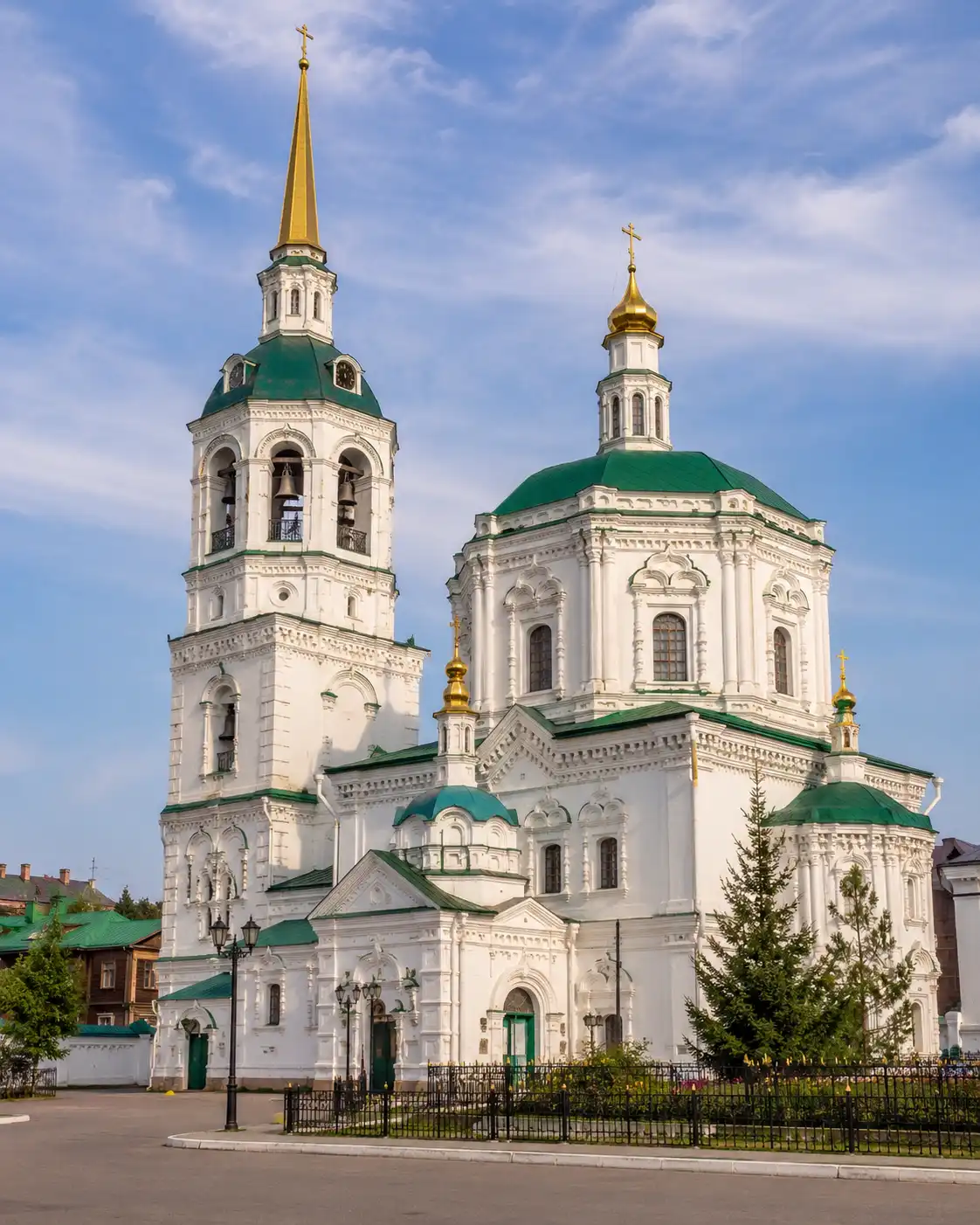
Odigitrievsky Cathedral is the oldest surviving stone building in Ulan-Ude and one of the most important Orthodox landmarks in Buryatia. Standing in the historical centre near the Uda River, the cathedral represents a very different religious and architectural tradition from the Buddhist datsans for which the region is best known.
Known in Russian as Свято-Одигитриевский собор, the church is also called the Cathedral of the Smolensk Icon of the Mother of God Hodegetria. Its name refers to a revered Orthodox image of the Virgin Mary known as the Hodegetria, meaning “She Who Shows the Way.” The icon presents the Mother of God pointing toward Christ as the spiritual path.
Construction began in 1741 and continued until 1785, meaning that the building developed over approximately four decades. It became the first permanent stone structure in what was then Verkhneudinsk, the former name of Ulan-Ude. The cathedral is now recognised as an important example of Siberian Baroque and as a federal cultural-heritage monument.
The cathedral’s importance goes beyond architecture. It reflects the growth of Verkhneudinsk as a trading settlement, the influence of merchants from the Transbaikal region, the spread of Russian Orthodoxy eastward and the dramatic religious changes of the Soviet period.
After being closed by the authorities, the building was used for anti-religious and historical museum purposes. It was eventually returned to the Russian Orthodox Church and restored as an active cathedral during the post-Soviet religious revival.
For travellers following Wander Russia through Ulan-Ude, Odigitrievsky Cathedral provides an essential counterpoint to Ivolginsky Datsan and Rinpoche Bagsha. Together, these sites reveal the religious diversity that defines Buryatia.
This guide explains the cathedral’s history, architecture, religious significance, Soviet-era transformation, visitor etiquette, location, photography and the best way to include it in a walking route through central Ulan-Ude.
Where Is Odigitrievsky Cathedral?
Odigitrievsky Cathedral stands at the southern end of the historical centre of Ulan-Ude, close to the right bank of the Uda River and not far from its confluence with the Selenga.
The commonly listed address is 2 Lenin Street. It lies near the end of the historical pedestrian route that begins around Soviet Square and continues along Lenin Street through the old commercial quarter.
The location is historically significant.
The cathedral was built near the river routes that supported the early settlement. Verkhneudinsk developed as a fortified post, trading centre and stopping point on routes connecting Siberia, Mongolia and China.
The church therefore stood close to the economic and geographical heart of the old town rather than in a remote religious district.
Modern visitors can reach it easily on foot from the Lenin Head Monument, the pedestrian section of Lenin Street, the reconstructed Triumphal Arch and several historic merchant buildings.
Why the Cathedral Is One of Ulan-Ude’s Essential Sights
Odigitrievsky Cathedral belongs among the top attractions in Ulan-Ude because it represents several central themes in the city’s history.
It is:
- The first stone building in Ulan-Ude
- A major example of Siberian Baroque
- A surviving monument from eighteenth-century Verkhneudinsk
- An active Orthodox cathedral
- A witness to Soviet anti-religious policy
- A key landmark within the historical city centre
The cathedral also helps travellers understand that Buryatia is not culturally defined by Buddhism alone.
Orthodox Christianity, Russian merchant culture, Cossack expansion and imperial administration also shaped the city.
The contrast between Buddhist and Orthodox architecture is one of the most interesting aspects of Ulan-Ude. Colourful datsans rise on the hills and steppe beyond the centre, while Odigitrievsky Cathedral anchors the oldest Russian urban district near the river.
The First Wooden Church
Before the stone cathedral was built, a wooden church stood on or near the same site.
Historical descriptions identify this earlier structure as the Church of the Virgin of Vladimir, built around 1700. It was a modest wooden cemetery church with a separate bell tower.
Wood was the dominant building material in early Siberian settlements. It was accessible, practical and familiar to Russian builders moving eastward.
However, wooden churches were vulnerable to fire, harsh weather and structural deterioration.
As Verkhneudinsk became wealthier and more important, local merchants and residents sought a larger permanent church constructed from stone.
The later cathedral symbolised not only religious devotion but also economic stability and civic ambition.
Construction from 1741 to 1785
Construction of Odigitrievsky Cathedral began in 1741 and lasted until 1785.
The unusually long building period reflects the difficulty of constructing a large stone church in eighteenth-century Transbaikalia. Materials, skilled labour, transportation and financial support were all more difficult to organise than in the major cities of European Russia.
The project was funded largely by merchants from Verkhneudinsk and Kyakhta, together with donations from local residents.
Kyakhta was one of the principal trading centres on the Russian-Chinese frontier. Merchants involved in the tea trade and other commercial networks accumulated substantial wealth.
Their support for the cathedral demonstrates the relationship between commerce and religion in the development of early Ulan-Ude.
The church was constructed in stages, allowing part of the building to function before the complete upper structure was finished.
The Lower and Upper Churches
Odigitrievsky Cathedral was designed as a two-level church.
The lower chapel was dedicated to the Epiphany. This section functioned as the warmer winter church and could be heated more effectively during the severe Transbaikal cold.
The upper church was dedicated to the Smolensk Icon of the Mother of God Hodegetria.
This arrangement was common in parts of Russia where winter conditions made large upper halls difficult to heat. The lower space offered a more practical setting for services during the coldest months.
The two-level design also gave the cathedral greater architectural height and visual importance within the relatively low wooden town.
The Meaning of Hodegetria
The word Hodegetria comes from Greek and is generally translated as “She Who Shows the Way.”
In this iconographic type, the Virgin Mary holds the Christ Child and gestures toward him, identifying Christ as the path to salvation.
The Smolensk Hodegetria became one of the most revered images in Russian Orthodox tradition.
Churches dedicated to this icon often carried associations with protection, guidance and safe travel.
These meanings were especially appropriate in Verkhneudinsk, a settlement situated along major trade and transport routes.
Merchants, travellers, soldiers and pilgrims passed through the region on long and often dangerous journeys across Siberia and toward Mongolia and China.
Siberian Baroque Architecture
The cathedral is regarded as an important example of Siberian Baroque.
Siberian Baroque developed during the eighteenth century as Russian builders adapted European Baroque forms, older Russian church traditions and local construction techniques to the conditions of Siberia.
Odigitrievsky Cathedral combines a strong vertical silhouette with decorative brickwork, curved architectural forms and a bell tower attached to the western side.
Its architecture is expressive without reaching the extreme decorative richness found in some churches of Moscow or Saint Petersburg.
The building feels both monumental and regional.
The white walls, rounded forms, tall bell tower and golden roof elements create a recognisable Orthodox profile, while the brick decoration and compact proportions reflect the Siberian environment in which it was built.
The Main Church Volume
The central church body rises above a five-sided apse.
A high dome and lantern crown the structure, giving the cathedral a strong vertical emphasis.
Decorative pediments, curved wall forms and window surrounds soften the mass of the building and create the rounded appearance characteristic of Baroque architecture.
The cathedral’s corners are visually connected through ornamental brick details, reducing the impression of a rigid rectangular block.
This makes the church appear more sculptural when viewed from different angles.
The most effective exterior walk circles the building slowly rather than viewing only the front façade.
The Bell Tower
The bell tower is attached to the western side of the cathedral.
Its design follows the traditional “octagon on quadrangle” arrangement, in which an octagonal upper structure rises above a square base.
Arched openings allow the sound of the bells to carry across the historical centre.
The tower is completed by a helmet-shaped roof and spire, creating a strong contrast with the rounded central dome.
The bell tower served both religious and urban functions.
Church bells marked services, religious festivals, funerals and important events. In an early settlement without modern communication systems, their sound organised daily life and could also warn residents of danger.
Decorative Brickwork
One of the most interesting architectural features is the combination of Baroque decoration with older Russian brick traditions.
Window frames, cornices and wall details use carefully shaped masonry to create a patterned surface.
The decorative language is linked with seventeenth-century Russian architecture and with the craftsmanship of builders who moved eastward from northern and central Russia.
The details are best seen in angled sunlight, when shadows reveal the depth of the brickwork.
Late morning or afternoon can therefore be more rewarding for architectural photography than flat midday light.
Earthquakes and Structural Survival
Ulan-Ude lies within a region affected by seismic activity.
The cathedral has survived earthquakes as well as political change and long periods of non-religious use. Travel accounts frequently note this endurance as part of the building’s remarkable history.
Its survival reflects both the strength of the original masonry and later restoration work.
The building’s age and seismic environment make continued conservation especially important.
Visitors may occasionally encounter restricted sections, scaffolding or maintenance work intended to protect the structure.
Verkhneudinsk as a Trading City
The cathedral was built during the growth of Verkhneudinsk as a major trading settlement.
Its position connected routes through Siberia with Mongolia and China. The later development of the Tea Road brought merchants, goods and cultural exchange through the region.
Historical timelines identify the eighteenth-century fairs of Verkhneudinsk as important to the city’s commercial rise.
Merchant funding for the cathedral reflects this prosperity.
Religious construction allowed successful traders to demonstrate status, support the community and seek spiritual merit.
The cathedral therefore represents both faith and the commercial history of the city.
The Cathedral Before the Revolution
Before the Russian Revolution, Odigitrievsky Cathedral served as one of the central Orthodox institutions of Verkhneudinsk.
Services marked the religious calendar, baptisms, marriages, funerals and public celebrations.
The church also functioned as a visible symbol of Russian settlement and imperial authority in Transbaikalia.
Its position near the historic centre reinforced that role.
The cathedral’s bells, processions and festivals would have formed part of the everyday sound and visual landscape of the city.
Closure During the Soviet Period
The cathedral was closed in 1929 during the Soviet campaign against organised religion.
Across the Soviet Union, churches, monasteries, mosques and Buddhist datsans were closed, demolished or converted to secular use.
Clergy faced arrest, exile and restrictions, while religious property was confiscated.
Odigitrievsky Cathedral survived partly because the building was adapted for other institutional purposes.
Its survival was therefore both fortunate and deeply connected with the removal of its original religious function.
The Anti-Religious Museum
From the 1930s, the cathedral housed an anti-religious museum.
Such museums were created to present religion as superstition, social control or a historical stage that socialism claimed to have overcome.
Religious art and objects could remain inside, but their meaning was reinterpreted through an atheist ideological framework.
Later, the building was used by local-history and Buryatia-history museums.
This museum use helped prevent the structure from being completely abandoned or demolished, but the interior and sacred character changed significantly.
Return to the Orthodox Church
The cathedral was returned to the Russian Orthodox Church during the post-Soviet religious revival.
Restoration work took place during the 1990s, and religious services resumed. Sources commonly identify 1995 as an important year in this process.
The return required more than reopening the doors.
Altars, icons, liturgical furnishings and sacred spaces had to be restored or recreated. Structural conservation was also necessary after decades of alternative use.
The cathedral is now an active religious institution and an important centre of Orthodox life in Ulan-Ude.
The Cathedral Interior
The interior is more intimate than the monumental exterior may suggest.
Icons, candles, gilded elements and painted religious images create the visual environment of an active Orthodox church.
The upper and lower levels reflect the historical two-church arrangement.
Visitors may encounter services, private prayers, baptisms or clergy performing other religious duties.
The interior should therefore not be treated as a museum gallery.
Silence and discretion are appropriate.
Icons and Sacred Objects
Orthodox icons are not understood simply as decorative paintings.
Within Orthodox Christianity, they function as sacred images and aids to prayer.
Visitors may see worshippers lighting candles, bowing or making the sign of the cross before an icon.
These actions should be given space and privacy.
The cathedral is dedicated to the Smolensk Hodegetria, and Marian imagery holds particular importance within the church.
The exact icons and relics accessible to visitors can change according to liturgical arrangements and restoration.
Visiting During a Service
Attending part of an Orthodox service can provide a deeper understanding of the cathedral’s living role.
Services may include chanting, incense, candles, scripture readings and repeated movement by clergy.
Visitors may stand quietly near the rear of the church.
Orthodox services often involve long periods of standing, and local worshippers may enter or leave at different times.
Tourists should avoid moving repeatedly through the centre, photographing the clergy or standing directly in front of worshippers.
Visitor Etiquette
Appropriate behaviour includes:
- Speaking quietly
- Turning phones to silent mode
- Avoiding food and drinks inside
- Following photography restrictions
- Not interrupting services
- Wearing modest clothing
- Removing hats for men when customary
- Covering the head for women when requested or preferred
- Avoiding direct photography of worshippers
- Not touching icons or sacred objects unnecessarily
Visitors do not need to imitate religious gestures if they are unfamiliar with them.
Respectful observation is sufficient.
Opening Hours
Current travel listings commonly present the cathedral as open daily from approximately 09:00 until 18:00.
However, this is an active religious building rather than a conventional museum.
Opening conditions can change during services, religious holidays, restoration or private ceremonies.
Visitors should treat published hours as a practical guide rather than a permanent guarantee.
Admission is generally free, although donations can be made.
Best Time to Visit
A weekday morning is usually the best time for a quiet visit.
The cathedral may be less crowded, and morning light can illuminate the façade attractively.
Late afternoon is also useful for photography because shadows reveal the decorative brickwork.
Sundays and major Orthodox feast days provide a richer religious atmosphere but may bring larger congregations and less freedom to explore the interior.
Winter is especially atmospheric when snow surrounds the white walls and golden roofs.
Photography Tips
The cathedral is best photographed from several angles.
A frontal view shows the relationship between the church body and bell tower.
A side view reveals the apse, dome and changing wall forms.
A lower angle can emphasise the vertical silhouette against the sky.
Useful photographic details include:
- Decorative window frames
- Brick ornaments
- The bell tower
- Golden roof elements
- Crosses against the sky
- Snow around the cathedral
- Candlelight inside, when photography is permitted
- The church framed by historic streets
Wide-angle lenses can be useful, but excessive distortion may make the bell tower appear unnatural.
The Cathedral in Winter
Winter gives Odigitrievsky Cathedral one of its strongest visual settings.
Snow softens the surrounding streets, while the white walls and gold details remain clearly visible against blue or pale-grey skies.
Temperatures in Ulan-Ude can be extremely low.
Visitors should wear insulated footwear, gloves and a windproof coat.
Icy pavements can make walking around the building difficult, especially while concentrating on photography.
Combining the Cathedral with Lenin Street
The cathedral forms the natural endpoint of the historical walk along Lenin Street.
A strong route begins at Soviet Square and the Lenin Head Monument.
Continue through the reconstructed Triumphal Arch and along the pedestrian section often called Ulan-Ude’s Arbat.
Pass merchant buildings, cafés and the Museum of the History of Ulan-Ude.
Continue south toward Revolution Square and Odigitrievsky Cathedral.
This route presents Soviet, imperial, commercial and religious layers within one compact walk.
Combining Orthodox and Buddhist Ulan-Ude
Odigitrievsky Cathedral is especially meaningful when combined with a Buddhist site.
A balanced Ulan-Ude itinerary may include:
- Lenin Head Monument
- Historical Lenin Street
- Odigitrievsky Cathedral
- Rinpoche Bagsha Datsan
- Ivolginsky Datsan on a separate half-day excursion
This comparison should not be treated as a competition between religions.
Instead, it reveals the cultural complexity of Buryatia.
Orthodox Christianity and Tibetan Buddhism both continue to shape the region, alongside Buryat traditions and Soviet historical memory.
How Much Time Is Needed?
A basic visit requires approximately 20 to 30 minutes.
Travellers interested in architecture, photography and the historical surroundings may spend 45 minutes to one hour.
The cathedral works best as part of a two- to three-hour walking route through the old centre.
Attending a service will naturally require additional time.
How to Reach the Cathedral
The cathedral is easy to reach on foot from central Ulan-Ude.
Using the Russian name Свято-Одигитриевский собор in a navigation application provides the clearest result.
A taxi can reach nearby streets, but the historical centre is compact enough that walking is usually preferable.
Public transport also operates through surrounding central districts.
Visitors arriving from Rinpoche Bagsha or the railway station may find a taxi convenient during winter.
Accessibility
The surrounding area is largely urban and paved.
However, church entrances may include steps and raised thresholds.
The historical two-level arrangement may limit access to some interior spaces.
Snow and ice reduce accessibility during winter.
Visitors with specific mobility requirements should ask church staff which entrance is most suitable.
Is Odigitrievsky Cathedral Worth Visiting?
Odigitrievsky Cathedral is essential for understanding the historical centre of Ulan-Ude.
Its value comes from much more than appearance.
The cathedral represents the first permanent stone architecture of the city, merchant patronage, Siberian Baroque, Orthodox expansion, Soviet anti-religious policy and post-Soviet restoration.
It also balances the Buddhist identity for which Buryatia is internationally known.
Wander Russia recommends including it in every central Ulan-Ude walking route.
Frequently Asked Questions
Where is Odigitrievsky Cathedral?
It stands at approximately 2 Lenin Street in the historical centre of Ulan-Ude.
When was it built?
Construction began in 1741 and was completed in 1785.
Why is it important?
It is the first stone building in Ulan-Ude and a major example of Siberian Baroque.
What does Odigitria mean?
It refers to the Hodegetria icon of the Mother of God, traditionally understood as “She Who Shows the Way.”
Was the cathedral closed during the Soviet period?
Yes. It was closed in 1929 and later used as an anti-religious and historical museum.
When was it returned to the church?
The cathedral was restored and returned to Orthodox use during the 1990s, with 1995 commonly identified as an important year.
Is it still an active church?
Yes. It functions as an active Orthodox cathedral.
Is there an entrance fee?
General entry is normally free, although donations are welcome.
How long should a visit take?
Allow around 30 to 60 minutes.
What should be visited nearby?
Pedestrian Lenin Street, the Triumphal Arch, Soviet Square, the Lenin Head Monument and the historical merchant quarter are all nearby.
Conclusion
Odigitrievsky Cathedral is one of the most important surviving monuments of old Verkhneudinsk.
Its construction marked a turning point in the development of the settlement. A permanent stone cathedral demonstrated that the frontier town had become wealthy, stable and important enough to support ambitious architecture.
The merchants who financed the church were part of a wider trading world connecting Siberia, Kyakhta, Mongolia and China.
Their cathedral became the first stone building of the city and one of the clearest expressions of eighteenth-century Russian culture in Transbaikalia.
Architecturally, the building combines Baroque movement with older Russian brick traditions. The rounded church volume, attached bell tower, decorative windows and tall vertical silhouette make it recognisable without overwhelming the surrounding historical centre.
Its survival is equally significant.
The cathedral endured earthquakes, revolution, closure and decades of secular use. The anti-religious museum installed within its walls attempted to transform a sacred building into evidence against religion.
Yet the structure remained standing.
Its return to Orthodox worship during the 1990s added another historical layer rather than erasing the previous ones.
Today, worshippers light candles and attend services in a building that has served radically different political and cultural purposes over nearly three centuries.
For visitors, this continuity makes the cathedral more meaningful than a reconstructed historical façade.
It remains alive.
Odigitrievsky Cathedral also plays an essential role in understanding Ulan-Ude as a multicultural city.
The Buddhist temples of Ivolginsky Datsan and Rinpoche Bagsha express Buryatia’s Tibetan Buddhist traditions. The Lenin Head Monument represents the Soviet period. Odigitrievsky Cathedral preserves the Orthodox and merchant history of Verkhneudinsk.
Together, these landmarks explain why Ulan-Ude cannot be reduced to one identity.
For Wander Russia, Odigitrievsky Cathedral is the natural fourth destination in the city’s essential itinerary and the spiritual endpoint of a walk through the historical centre.
