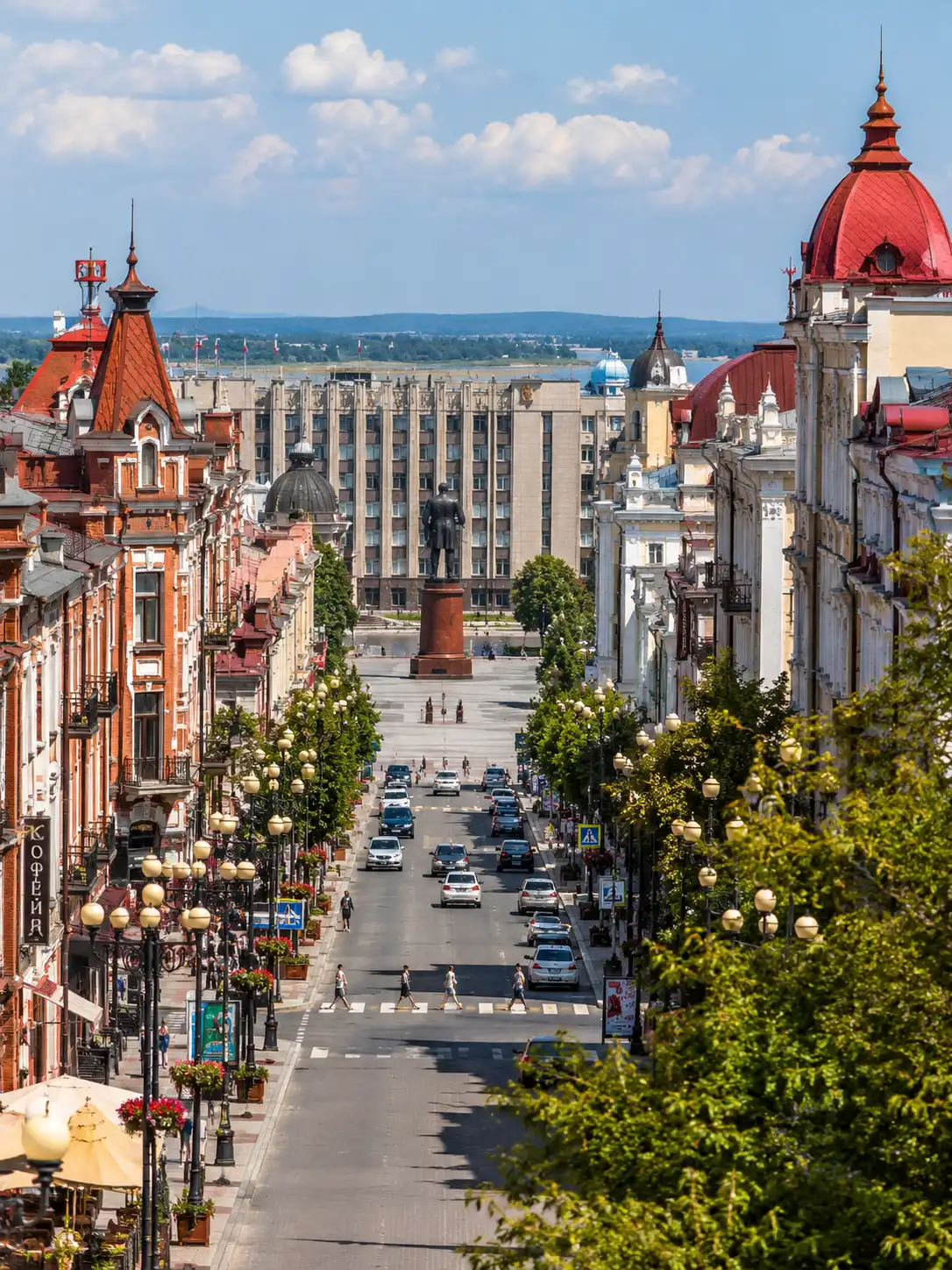
Muravyov-Amursky Street and Lenin Square form the central historical axis of Khabarovsk. Together, they provide one of the most effective ways to explore the city on foot, connecting its principal public square with merchant architecture, former trading houses, cafés, museums, religious landmarks and the elevated parks overlooking the Amur River.
Known in Russian as улица Муравьёва-Амурского and площадь Ленина, the street and square reveal how Khabarovsk developed from a nineteenth-century military settlement into one of the main administrative and cultural centres of the Russian Far East. The walk is not focused on a single monumental attraction. Its value comes from the sequence of buildings, public spaces and changing views encountered while moving through the historical centre.
Muravyov-Amursky Street begins near Lenin Square and continues toward Komsomolskaya Square, the Assumption Cathedral and the cultural district near Muravyov-Amursky Park. From there, visitors can proceed to the Grodekov Regional Museum, Amur Cliff and the Admiral Nevelskoy Embankment.
The complete route therefore moves naturally from formal city space toward the river. Lenin Square introduces the administrative and Soviet face of Khabarovsk. Muravyov-Amursky Street presents the commercial and architectural history of the city. The parks and viewpoints at the far end reveal the Amur landscape that made the development of Khabarovsk possible.
Official city tourism material identifies the route from Lenin Square through Muravyov-Amursky Street as the classic walk through Khabarovsk’s historical centre. The street passes many of the city’s notable late nineteenth- and early twentieth-century buildings before reaching the Amur waterfront district.
This Wander Russia guide explains the history of Lenin Square, the architectural character of Muravyov-Amursky Street, the principal buildings and landmarks, the best walking route, seasonal conditions, photography opportunities and practical visitor information.
Where Are Lenin Square and Muravyov-Amursky Street?
Lenin Square lies in the central district of Khabarovsk.
The square marks the transition between Karl Marx Street and Muravyov-Amursky Street. Until 1992, these two sections formed one continuous street named Karl Marx Street. The restoration of the Muravyov-Amursky name returned part of the city’s pre-revolutionary identity to the historical centre.
From Lenin Square, Muravyov-Amursky Street runs southwest toward the Amur River district. The route passes through the most architecturally interesting section of central Khabarovsk and ends near Komsomolskaya Square, the Assumption Cathedral and the parks above the river.
The walking distance is manageable for most visitors. A direct walk can be completed relatively quickly, but the historical buildings, cafés, side streets and nearby museums justify allowing several hours.
The street remains open to traffic. It is not a fully pedestrianised promenade, although the pavements are generally broad enough for comfortable sightseeing.
Why This Is the Essential City Walk
The route between Lenin Square and the Amur contains several different historical layers.
Lenin Square reflects imperial, Soviet and contemporary public life. Muravyov-Amursky Street preserves merchant houses and commercial architecture from the period when Khabarovsk was expanding rapidly. Komsomolskaya Square and the Assumption Cathedral add religious and civic landmarks, while the riverfront district introduces the geography of the Amur.
This makes the route especially useful for first-time visitors.
A traveller who begins directly at Amur Cliff will see the city’s most famous panorama but may not understand how the historical centre developed behind it. Walking from Lenin Square creates a more complete narrative.
The journey gradually changes in character. The broad administrative square gives way to a long commercial street. Historical façades, cafés and shops create a more intimate atmosphere. The route then approaches churches, museums and green spaces before finally opening toward the Amur.
The Origins of Lenin Square
Lenin Square was established in 1864, only a few years after the founding of Khabarovsk.
Its original name was Nikolaevskaya Square. During the revolutionary period, it became Freedom Square. A monument to Vladimir Lenin was installed in 1925, and the square later received the names Stalin Square and Lenin Square during successive Soviet periods. A major reconstruction in the late twentieth century created much of the present appearance.
These changing names reflect the political history of the city.
Nikolaevskaya Square belonged to imperial Russia. Freedom Square represented the revolutionary transition. Stalin Square reflected the centralised Soviet period, while Lenin Square became the name that survived into the present.
The square therefore contains more than one historical identity, even though its most visible monument belongs to the Soviet era.
The Size and Layout of Lenin Square
Lenin Square covers approximately 25,300 square metres and is one of the largest public squares in Russia. It is surrounded by government, educational and commercial buildings and remains one of the principal locations for civic gatherings and public celebrations in Khabarovsk.
The scale becomes especially clear when standing near the centre and looking toward the surrounding façades.
The square contains landscaped sections, fountains, broad paved areas and the Lenin monument. Its open design contrasts with the more continuous streetscape of Muravyov-Amursky Street.
The square is not surrounded by one unified architectural style. Buildings from different periods face the open space, creating a combination of imperial, Soviet and modern urban forms.
The Lenin Monument
The monument to Vladimir Lenin remains the most recognisable feature of the square.
The statue was installed in 1925. Together with its pedestal, it rises to approximately 6.67 metres. Bronze plaques bearing quotations were incorporated into the monument’s design. During a later reconstruction, the statue was moved from the central part of the square toward one side.
The monument should be interpreted within the history of Soviet public space.
Lenin statues were installed in cities across the Soviet Union, often becoming focal points for parades, political ceremonies and public gatherings. In Khabarovsk, the statue continues to give the square its name and visual identity even though the surrounding city has changed significantly.
Visitors do not need to share the political symbolism to appreciate the monument as part of the urban history of Khabarovsk.
Public Events and Seasonal Decorations
Lenin Square continues to serve as a venue for important city events.
Celebrations, official ceremonies, public concerts and seasonal installations can take place here. Winter is particularly notable because ice sculptures and festive decorations have traditionally appeared in central squares and parks.
The open space also functions as an everyday meeting point. Residents cross it on the way to work, students gather near the surrounding institutions and families use the landscaped areas during suitable weather.
The atmosphere can therefore range from quiet and administrative to crowded and festive depending on the date.
Visitors arriving during a large event should expect temporary traffic changes, barriers or security controls.
Beginning the Walk
The most logical route begins at Lenin Square.
Spend time observing the square from several positions rather than remaining only beside the Lenin monument. The surrounding buildings provide context and show how the square functions as an administrative centre.
From the southwestern side, begin walking along Muravyov-Amursky Street toward the Amur.
The street gradually introduces older architecture and a more commercial atmosphere. Cafés, restaurants, shops and public institutions occupy many of the buildings.
Official and independent travel guides consistently identify the walk from Lenin Square to the Amur along Muravyov-Amursky Street as the principal historical route through Khabarovsk.
Who Was Muravyov-Amursky?
Muravyov-Amursky Street is named after Nikolai Muravyov-Amursky, Governor-General of Eastern Siberia during the nineteenth century.
He played an important role in Russian expansion and administration along the Amur River. His policies contributed to the establishment of Russian settlements and the consolidation of control over territories that later became part of the modern Russian Far East.
His legacy is highly visible in Khabarovsk. The main historical street, the oldest city park and the major monument above the Amur all bear his name.
Within Russian regional history, he is often presented as a founder and state-builder. A broader interpretation should also recognise that his activities formed part of imperial expansion into areas inhabited by Indigenous peoples and connected historically with Qing China.
Understanding this complexity makes the street name more meaningful.
The Historical Architecture
Muravyov-Amursky Street contains many buildings from the late nineteenth and early twentieth centuries.
Khabarovsk expanded rapidly as administrative offices, merchants, transport companies and financial institutions established themselves in the city. Successful business owners constructed brick buildings intended to display permanence and prosperity.
The result is a varied architectural corridor rather than a perfectly uniform ensemble.
Visitors can observe:
- Red-brick merchant houses
- Decorated commercial façades
- Former revenue houses
- Corner towers
- Arched windows
- Ornamental balconies
- Classical columns and cornices
- Art Nouveau details
- Soviet-era administrative buildings
- Modern shops inserted into historic structures
Several historically important trading and merchant buildings continue to define the appearance of the central street. These include properties associated with the Pyankov and Khlebnikov merchant families and the former Kunst and Albers trading company.
Merchant Khabarovsk
The architecture reflects the commercial growth of the city.
Khabarovsk stood at an important intersection of river transport, overland routes and administrative power. Merchants supplied food, clothing, imported goods and equipment to a growing population of officials, soldiers, workers and travellers.
Trading houses often occupied prominent corner positions or constructed buildings with shops on the ground floor and offices or accommodation above.
The façades were designed to attract attention and communicate success.
Modern businesses now occupy many of these structures, but the original commercial function remains visible in large windows, street-level entrances and internal courtyards.
The Kunst and Albers Legacy
Kunst and Albers was one of the best-known trading companies operating in the Russian Far East before the Revolution.
The firm developed department stores and commercial properties in several cities, including Khabarovsk and Vladivostok. Its buildings represented the international commercial connections of the region.
A former Kunst and Albers property in Khabarovsk later became associated with the Far Eastern Art Museum. The survival and reuse of such buildings show how imperial commercial architecture was incorporated into Soviet and post-Soviet cultural life.
The broader significance lies in the international character of early Khabarovsk. The city was not isolated from global commerce despite its great distance from European Russia.
Trees, Pavements and Street Atmosphere
Muravyov-Amursky Street is notable not only for individual façades but also for its overall urban atmosphere.
Trees soften the long architectural corridor, while broad pavements make the route suitable for walking. Traffic remains present, but many visitors find the street more relaxed than the main roads of larger Russian cities.
Cafés, bakeries and restaurants provide frequent opportunities for breaks.
The changing building heights and styles create visual variety. One block may contain an ornate pre-revolutionary merchant house, while the next presents a heavier Soviet administrative building or a modern commercial renovation.
This irregularity is part of the attraction.
Side Streets and Courtyards
The main street provides the formal view of historical Khabarovsk, but side streets and courtyards reveal additional layers.
Some courtyards contain service buildings, external staircases, old brick walls and later additions. Others have been renovated for cafés or shops.
These spaces should be explored respectfully because many remain residential or functional rather than tourist attractions.
Visitors should avoid locked gates, private stairways and areas marked against entry.
The most effective approach is to observe open passages while keeping the main route as the structural guide.
Komsomolskaya Square
At the river end of Muravyov-Amursky Street, visitors reach Komsomolskaya Square.
The square provides another important civic space and forms the transition toward the Amur-facing parks and museums.
Its architectural identity is strongly connected with the Assumption Cathedral, whose blue roofs and golden domes dominate the area.
The route from Lenin Square to Komsomolskaya Square demonstrates how Khabarovsk’s public spaces developed in different periods. Lenin Square presents Soviet political symbolism, while Komsomolskaya Square combines religious reconstruction, historical memory and access to the river district.
The Assumption Cathedral
The Assumption Cathedral, also known as the Dormition Cathedral, is one of the most distinctive religious landmarks in central Khabarovsk.
The present building is a reconstruction of an earlier cathedral demolished during the Soviet period. Its blue roofs, white façades and golden domes create a strong visual endpoint to the walk along Muravyov-Amursky Street.
The cathedral should be visited respectfully as an active Orthodox place of worship.
Visitors should dress appropriately, keep voices low and avoid photographing worshippers without permission.
The cathedral’s reconstruction reflects the broader return of Orthodox religious architecture to Russian city centres after the Soviet period.
Continuing Toward the Amur
From Komsomolskaya Square, continue toward the cultural district surrounding Muravyov-Amursky Park.
The Grodekov Regional Museum, Far Eastern Art Museum and Amur Cliff are all within a short distance.
Visitors can then descend to the Admiral Nevelskoy Embankment through the park or nearby stairways.
This final section gives the route its geographical conclusion. The street does not simply stop at another administrative block. It leads toward the river that shaped Khabarovsk.
A complete walk from Lenin Square to the Amur therefore tells the city’s story in sequence: public power, commerce, religion, culture and geography.
A Recommended Half-Day Route
Begin at Lenin Square in the morning.
Walk around the square and examine the Lenin monument and surrounding architecture.
Continue along Muravyov-Amursky Street, pausing at historic merchant façades and side streets.
Stop at a café or restaurant around the middle of the route.
Continue toward Komsomolskaya Square and visit the exterior or interior of the Assumption Cathedral.
Proceed to the Grodekov Museum district and enter Muravyov-Amursky Park.
Finish at Amur Cliff or descend to the river embankment.
Without museum visits, this route can be completed comfortably in three to four hours. Adding the Grodekov Museum can extend it into a full-day programme.
Best Time to Visit
The route can be walked throughout the year.
Late spring offers fresh greenery and generally comfortable temperatures.
Summer creates the liveliest street atmosphere, though heat and humidity can make the midday hours tiring.
September is often especially suitable because temperatures are milder and the first autumn colours appear.
Winter gives Lenin Square and Muravyov-Amursky Street a very different character. Snow, ice sculptures and festive lighting can make the centre visually attractive, but severe cold requires careful preparation.
Early autumn and late spring generally provide the best balance between comfort and visual interest.
Best Time of Day
Morning is ideal for architectural photography and a quieter visit to Lenin Square.
Late morning and afternoon provide the most active café and shopping atmosphere.
Evening works well for combining the walk with sunset at Amur Cliff or the embankment.
A practical schedule begins at Lenin Square around mid-morning and reaches the river district in the late afternoon.
Photography Tips
Muravyov-Amursky Street is especially suitable for urban and architectural photography.
A standard lens works well for complete façades and street scenes.
A moderate telephoto lens helps isolate decorative details, balconies and rooflines.
A wide-angle lens may be useful in Lenin Square but can distort historic buildings when used too close.
Useful subjects include:
- Lenin Square from a corner position
- The Lenin monument with surrounding buildings
- Red-brick merchant façades
- Decorative windows and balconies
- Tree-lined street perspectives
- Cafés within historical buildings
- The Assumption Cathedral at the end of the route
- Evening lights along the street
- Snow and ice installations in winter
- Contrasts between imperial and Soviet architecture
Traffic should always be considered. Visitors should not step into the road for a photograph.
Food and Cafés
Muravyov-Amursky Street is one of the easiest areas in Khabarovsk to find food.
The route includes cafés, bakeries, restaurants and shops offering Russian, Asian and international dishes.
This is an appropriate place to try regional combinations influenced by the city’s proximity to China and other parts of East Asia.
Specific restaurants can change, so visitors should rely on current local information rather than older lists.
A flexible approach works best: walk part of the route, choose a busy and well-maintained venue and continue after a break.
Accessibility
Lenin Square is broad and largely level.
Muravyov-Amursky Street also has relatively manageable pavements, although crossings, curbs and occasional uneven surfaces may create difficulties.
The final route toward the river includes slopes and stairs.
Visitors with limited mobility can explore the square and main street independently, then use a taxi to reach Muravyov-Amursky Park or the embankment.
Winter snow and ice reduce accessibility considerably.
Safety
The historical centre is generally straightforward to explore.
The principal risks are traffic, slippery winter surfaces and fatigue during extreme temperatures.
Visitors should:
- Use marked crossings
- Watch for turning vehicles
- Wear shoes with good grip
- Carry water in summer
- Dress for severe cold in winter
- Keep valuables secure in crowded public events
- Avoid entering private courtyards
- Check temporary road or square closures
The route remains active and urban rather than isolated.
Is Muravyov-Amursky Street Worth Visiting?
Muravyov-Amursky Street is essential for understanding central Khabarovsk.
No single building defines the route. Its importance comes from the complete architectural and urban sequence.
The street reveals how merchants, officials, religious institutions and cultural organisations shaped the historical centre.
Lenin Square adds a contrasting layer of Soviet public symbolism and modern civic life.
Wander Russia recommends treating the street and square as one connected attraction rather than writing or visiting them separately. Together, they form the city’s strongest urban walking route.
Frequently Asked Questions
Where does Muravyov-Amursky Street begin?
The historical visitor route begins at Lenin Square and continues toward Komsomolskaya Square and the Amur district.
Is the street pedestrianised?
No. It remains open to traffic, though the pavements are generally suitable for walking.
How long does the walk take?
A direct walk may take under an hour, but two to four hours are recommended for architecture, cafés and nearby landmarks.
When was Lenin Square created?
The square dates to 1864 and was originally called Nikolaevskaya Square.
How large is Lenin Square?
The square and surrounding architectural area cover approximately 25,300 square metres.
What are the main attractions along the route?
Historic merchant buildings, cafés, Komsomolskaya Square, the Assumption Cathedral, museums and access to Muravyov-Amursky Park are among the principal highlights.
Can the route be combined with Amur Cliff?
Yes. Continuing to Amur Cliff and the embankment creates the most complete version of the walk.
Is the route suitable in winter?
Yes, but temperatures can be severe and pavements may be icy.
Is there an entrance fee?
The street and squares are free to explore. Museums and individual attractions may charge admission.
What is the best season?
Late spring and September generally offer comfortable walking conditions, while winter provides festive decorations and ice sculptures.
Conclusion
Muravyov-Amursky Street and Lenin Square provide the clearest urban introduction to Khabarovsk.
The square presents the city as an administrative and civic centre. Its changing names—from Nikolaevskaya to Freedom, Stalin and Lenin Square—reflect the political transformations that shaped Khabarovsk from the imperial period through the Soviet era and into the present.
Muravyov-Amursky Street reveals another side of the city.
Its merchant houses, trading buildings and commercial façades preserve the period when Khabarovsk was becoming a prosperous regional centre connected with river transport, administration and international trade.
The architecture is varied rather than uniform. Red-brick properties stand beside classical façades, Soviet buildings and modern commercial spaces. This mixture gives the street authenticity. It remains part of daily Khabarovsk rather than functioning as a preserved museum district.
The route also has a clear geographical direction.
Beginning at Lenin Square, travellers move through the formal centre, pass the commercial heart of the historical city and reach Komsomolskaya Square and the Assumption Cathedral. Museums, parks and the Amur then appear beyond.
This progression makes the walk more meaningful than a disconnected list of buildings.
The final view over the river explains why the city developed here. The Amur supported military movement, trade and administration, while the high bank provided security and visibility.
For Wander Russia, Muravyov-Amursky Street and Lenin Square belong together as one complete article and one essential walking route. They show Khabarovsk at street level before the river landscape opens at the end.
