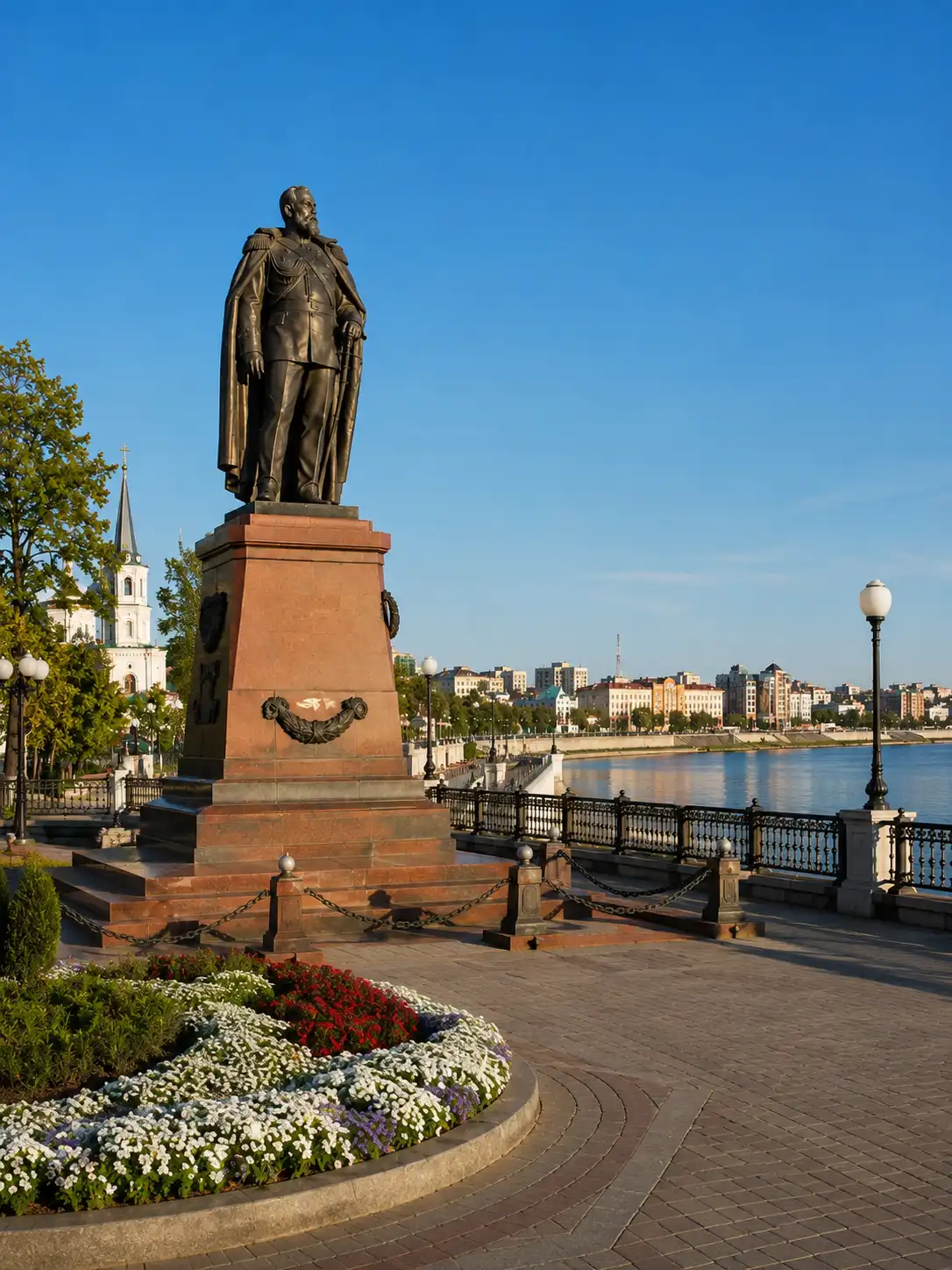
The Angara River Embankment and the Monument to Alexander III form one of the most important public spaces in Irkutsk and one of the clearest places to understand the city’s historical identity. Located along the only river that flows out of Lake Baikal, the embankment combines wide river views, elegant walks, civic monuments, historical associations, landscaped public space and direct access to several of Irkutsk’s main attractions.
Known in Russian as the Lower Angara Embankment and associated with the памятник Александру III, this area is not simply a waterfront promenade. It is one of the symbolic centres of Irkutsk. The broad river, the statue of Emperor Alexander III, nearby churches and historical buildings, and the open views across the water all help explain why Irkutsk became one of the most important cities in eastern Siberia.
The Angara itself is fundamental to this story. Unlike many urban rivers, it is directly connected with one of the most famous natural landmarks in the world. The Angara begins at Lake Baikal and flows westward, linking Baikal with the Yenisei basin. In Irkutsk, it gives the city a sense of openness and scale that few inland Siberian cities possess.
The embankment is also one of the most pleasant places for an everyday walk. Residents come here to stroll, sit on benches, meet friends, take photographs and watch the changing light over the river. Visitors often begin or end their city exploration here because the area connects easily with the historical centre, Kirov Square, Epiphany Cathedral, the Church of the Savior and the surrounding old streets.
For Wander Russia, the Angara River Embankment and the Monument to Alexander III belong among the essential must-see places in Irkutsk because they combine history, atmosphere and geography in one accessible setting. This guide explains the history of the embankment, the meaning of the monument, the connection to the Trans-Siberian Railway, what to see nearby, the best times to visit and practical planning tips.
Where Is the Angara River Embankment?
The central Angara embankment lies in the heart of Irkutsk, close to the historical centre and within walking distance of several of the city’s most important landmarks.
The section most visitors experience stretches near Gagarin Boulevard and the area around the Monument to Alexander III. It connects naturally with central squares, historical churches and major city streets. This makes it one of the easiest attractions in Irkutsk to include in a walking itinerary.
The monument itself stands prominently on the embankment and is visible from multiple directions. It acts as both a landmark and a meeting point. The surrounding riverside walkway provides open views over the Angara and creates a contrast with the denser built environment of the old city.
Because the embankment is central, it is easy to reach on foot, by public transport or by taxi. Many visitors staying in the historical centre or exploring 130 Kvartal can include the embankment without complicated planning.
Why This Is One of Irkutsk’s Essential Sights
The Angara River Embankment is one of the most important places in Irkutsk because it brings together several layers of the city’s identity.
It is important for geographical reasons, because the Angara is one of Siberia’s great rivers and the only outflow of Lake Baikal.
It is important historically, because the river helped shape Irkutsk’s development as a transport, trade and administrative centre.
It is important symbolically, because the Monument to Alexander III connects the city with the story of imperial expansion, Siberian governance and the construction of the Trans-Siberian Railway.
It is important socially, because the embankment continues to function as one of Irkutsk’s most active public spaces.
Unlike a single museum or church, the embankment is experienced through movement. People walk, pause, look across the river and connect different parts of the city through the waterfront route. That is why it works so well as both a major sight and an everyday place.
The Angara River
The Angara River is one of the defining natural features of Irkutsk.
It begins at Lake Baikal and is the only river flowing out of the lake. This fact alone gives it special significance. Lake Baikal is not only one of Russia’s most famous natural landmarks but also one of the deepest and oldest freshwater lakes in the world. The Angara therefore carries with it a direct symbolic connection to Baikal.
In Irkutsk, the river appears broad, calm and powerful. Its water is often clearer and colder than many other large urban rivers, because of its Baikal origin. The flow creates an open landscape that distinguishes Irkutsk from many inland cities where rivers feel more enclosed.
The Angara also influenced practical life. It supported transport, trade and settlement and shaped the physical expansion of the city. Standing on the embankment helps visitors understand that Irkutsk was not built in isolation. It developed in relation to water, routes and movement.
The Development of the Embankment
Like many riverfronts, the Angara embankment changed over time.
In earlier periods, riverbanks in Siberian cities were more functional than decorative. They were used for transport, loading, practical access and connection with urban life. Over time, as the city developed and modern public planning became more important, the riverfront was improved as a civic space.
The embankment that visitors see today reflects both historical memory and modern urban design. Railings, walking paths, planted areas, benches and paved sections create a clean and welcoming riverfront.
This transformation gave Irkutsk a public space that is both historical and contemporary. The embankment does not feel like a preserved relic cut off from everyday life. It remains part of how the city lives now.
The Monument to Alexander III
The Monument to Alexander III is one of the best-known monuments in Irkutsk and one of the main historical symbols of the city.
The statue honours Emperor Alexander III, who played an important role in the imperial vision that led to the construction of the Trans-Siberian Railway. Although he did not live to see the entire project completed, his reign is closely associated with its beginning and political backing.
The monument stands on a high pedestal and presents the emperor in a commanding, dignified pose. Its placement on the embankment gives it both symbolic and visual strength. The statue faces the river and the city in a way that reflects authority, direction and state presence.
For many visitors, the monument is more than just an imperial statue. It represents the moment when Siberia became more strongly integrated into the wider Russian Empire through infrastructure, administration and long-distance communication.
History of the Monument
The original monument to Alexander III was created in the early twentieth century. It was intended to honour the emperor’s role in the beginning of the Trans-Siberian Railway, one of the most ambitious infrastructure projects in Russian history.
Like many imperial monuments in Russia, it did not survive the Soviet period unchanged. The original statue was removed after the Revolution. For decades, the historical continuity of the site was broken, even though the location retained its symbolic value.
Later, during the post-Soviet period, the monument was restored. The present version re-established the historical idea of the site and returned one of Irkutsk’s most important urban symbols to the embankment.
This history reflects a broader pattern seen across Russia. Monuments do not only represent individuals. They also reflect changing political systems, values and memory. The Alexander III monument therefore tells two stories: the imperial one that created it and the modern one that restored it.
Why Alexander III Matters in Irkutsk
Some visitors wonder why Irkutsk, rather than Moscow or Saint Petersburg, places such emphasis on Alexander III.
The answer lies in the importance of Siberia and the Trans-Siberian Railway.
Irkutsk was one of the major cities of eastern Siberia and later became one of the key stops on the transcontinental route. The railway transformed Siberia politically, economically and symbolically. It connected regions that had once been separated by enormous distances and difficult travel conditions.
Alexander III is remembered in Irkutsk because he represents the state decision to bind Siberia more closely to the rest of the empire. His monument therefore belongs naturally in a city whose identity is deeply connected with eastern expansion and communication across vast territory.
The Trans-Siberian Railway Connection
The Monument to Alexander III is strongly connected with the history of the Trans-Siberian Railway.
The railway changed everything for Siberia. Before its construction, movement across the region was slow, difficult and often seasonal. Roads were limited, distances were immense and communication with European Russia was far less efficient.
The Trans-Siberian Railway created a new geography of connection. Irkutsk became one of the central cities in this system. Goods, officials, travellers, ideas and economic development all moved more easily through the city.
This is why the monument feels particularly meaningful here. It is not just a generic tribute to a ruler. It stands in a city that directly benefited from the historical process he helped initiate.
Visitors interested in this theme may find that the embankment and monument work well as a starting point before exploring other historical parts of Irkutsk linked with imperial and railway history.
The Design and Setting of the Monument
The monument’s impact comes not only from the statue itself but also from its setting.
The broad base and open space around it allow the sculpture to dominate the immediate surroundings without feeling crowded. The Angara behind it creates a natural backdrop, while the embankment’s pedestrian layout makes it easy to view the monument from several angles.
This gives the statue a sense of presence and clarity. It can be appreciated as public art, as a piece of historical memory and as part of the river landscape.
The monument is especially impressive in changing light. Morning light can make the sculpture appear crisp and formal, while evening light adds warmth and stronger atmosphere.
What the Embankment Feels Like Today
Today, the Angara River Embankment is one of the most pleasant places to walk in Irkutsk.
It has a relaxed, open atmosphere. Residents and visitors mix naturally. Some people come specifically for the monument, others for photography, and many simply use the waterfront as a place to spend time.
This everyday quality is one of the area’s strengths. The embankment is not overly formal or distant. It feels part of the life of the city.
In summer, the riverside is lively but not overwhelming. In autumn, cooler air and softer light create a more reflective mood. In winter, snow and ice transform the scene into something distinctly Siberian, while the monument gains even more visual strength against the white landscape.
Walking Along the Embankment
A walk along the embankment is one of the simplest and most rewarding activities in Irkutsk.
The route is comfortable and allows visitors to experience the river gradually rather than from one fixed viewpoint. Benches and open sections encourage stopping and looking rather than hurrying through.
A typical walk can begin near the Monument to Alexander III and continue along the river, or it can start farther away and return to the monument as a focal point.
This walk works especially well when combined with the nearby churches and central squares. The embankment is not isolated from the city. It connects directly to the historical core.
Nearby Attractions
One of the major advantages of visiting the embankment is how easily it combines with other important Irkutsk sights.
Nearby attractions include:
- Epiphany Cathedral
- Church of the Savior
- Kirov Square
- The historical centre of Irkutsk
- Karl Marx Street
- 130 Kvartal
- Various museums and historical buildings
This means the embankment is not just a separate riverfront walk. It can form part of a broader city route. A visitor can move from church architecture to imperial history to river views within a short distance.
The Embankment and Irkutsk’s Historical Identity
Irkutsk has several identities at once. It is a Siberian city, a historical trading centre, a gateway to Lake Baikal and a place of wooden architecture and imperial memory.
The Angara River Embankment helps bring these identities together.
The river links Irkutsk to Baikal. The monument links it to imperial Russia and the Trans-Siberian story. The central location links it to the historical city. The modern promenade links it to present-day urban life.
For this reason, the embankment is not just attractive. It is interpretive. It helps visitors understand how the city fits into the larger history of Siberia.
Best Time to Visit
The embankment can be visited throughout the year.
Late spring and summer are the easiest seasons for walking. The weather is milder, the paths are comfortable and the riverfront feels especially active.
Early autumn is also very rewarding. The air is often clearer, temperatures are pleasant and the light over the Angara can be particularly beautiful.
Winter creates a much more dramatic atmosphere. Snow, cold air and the icy environment give the embankment a strong Siberian identity. Visitors need proper clothing, but the reward is a distinctive and memorable view.
Best Time of Day
Morning is excellent for a quieter visit and for clearer architectural and photographic observation.
Late afternoon and evening are often the most atmospheric times. The light becomes warmer, the river reflects the changing sky and the monument gains more dramatic contrast.
Sunset and blue hour are especially suitable for photography. The transition between natural light and city illumination creates one of the most attractive moods on the embankment.
Photography Tips
The embankment is one of the best photography locations in Irkutsk.
Useful subjects include:
- The Monument to Alexander III from the front
- The monument with the Angara behind it
- River views along the embankment
- Benches, railings and riverside details
- The embankment in evening light
- Winter snow and the monument
- People walking along the waterfront
- Nearby church silhouettes in changing light
A wide-angle lens works well for combining the monument and river. A standard lens is often better for more natural proportions. Morning and late afternoon usually provide the most attractive light.
River Cruises and Water Perspective
Depending on season and local operations, river excursions or boat views may add another dimension to the embankment experience.
Seeing the monument and city from the water can help visitors understand the scale of the embankment and its relationship to the wider urban landscape.
Even when a formal cruise is not part of the itinerary, the presence of the river itself encourages visitors to think beyond the city streets and appreciate Irkutsk as a riverside settlement.
How Much Time Is Needed?
A short visit to the monument and immediate embankment can take 30 to 45 minutes.
A more relaxed visit with walking, photography and nearby sights can easily take 1.5 to 2 hours.
When combined with the historical centre, churches and 130 Kvartal, the embankment can form part of a half-day walking itinerary.
Accessibility
The embankment is relatively easy to access and generally suitable for most visitors.
The main walking surfaces are more comfortable than many older side streets in historic districts. However, winter ice and snow can make conditions more difficult. Visitors with mobility requirements should pay special attention during cold months.
The open layout also means the monument can be appreciated without climbing significant stairs or completing a demanding route.
Suggested Walking Route
A practical route for many visitors is:
- Begin at Kirov Square
- Visit Epiphany Cathedral
- Walk to the Church of the Savior
- Continue toward the Angara River Embankment
- Spend time at the Monument to Alexander III
- Walk along the river
- Continue later toward 130 Kvartal or the central streets
This route gives a strong first introduction to Irkutsk and combines religion, empire, urban history and landscape in one experience.
Is the Angara River Embankment Worth Visiting?
Yes, absolutely.
For first-time visitors, it is one of the most essential places in Irkutsk. It is visually appealing, historically meaningful and easy to include in almost any itinerary.
Some attractions are important mainly because of their interior collections or technical historical value. The Angara embankment is different. Its value comes from atmosphere, setting and symbolic power. It is a place to understand, not just to see.
Wander Russia recommends giving it real time rather than treating it as a quick photo stop.
Frequently Asked Questions
Where is the Monument to Alexander III in Irkutsk?
It stands on the Angara River Embankment in central Irkutsk, close to the historical centre.
Why is there a monument to Alexander III in Irkutsk?
The monument honours Alexander III’s association with the beginning of the Trans-Siberian Railway and the integration of Siberia into the imperial transport network.
What is special about the Angara River?
It is the only river flowing out of Lake Baikal, which gives it major geographical and symbolic importance.
How long should visitors spend here?
Around 30 to 45 minutes for a short visit, or 1.5 to 2 hours with a full walk and photography.
Is the embankment good for photography?
Yes. It is one of the best places in Irkutsk for river views, monument photography and evening atmosphere.
Can it be visited in winter?
Yes, but visitors need warm clothing and suitable footwear because the weather can be severe.
What is nearby?
Epiphany Cathedral, the Church of the Savior, Kirov Square, 130 Kvartal and the historical centre are all nearby.
Conclusion
The Angara River Embankment and the Monument to Alexander III belong at the heart of any visit to Irkutsk.
The embankment shows the city in relation to water, openness and everyday life. The monument shows the city in relation to empire, infrastructure and the history of Siberia.
Together, they create one of the clearest and most memorable expressions of Irkutsk’s identity.
The Angara gives the place its atmosphere. The monument gives it historical focus. The surrounding centre gives it cultural depth.
That is why this is much more than a scenic waterfront. It is one of the places where Irkutsk becomes easiest to understand.
For Wander Russia, this is the essential second must-see destination in Irkutsk after 130 Kvartal and one of the strongest places to begin discovering the city beyond its famous wooden architecture.
