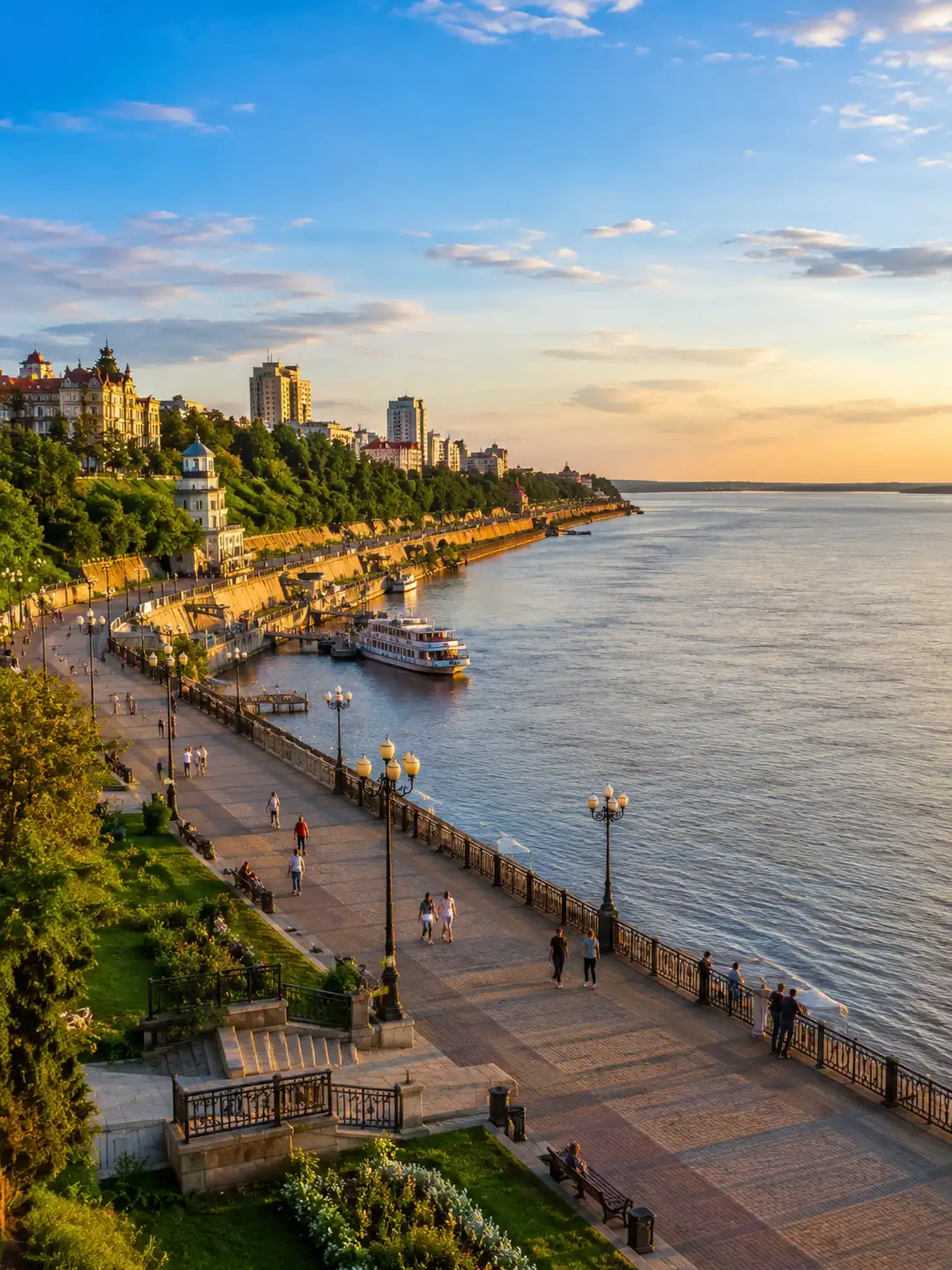
The Amur River Embankment is one of the defining public spaces in Khabarovsk and one of the strongest places to experience the city’s relationship with the river. Running beneath the elevated historical centre, the landscaped waterfront combines broad river views, walking paths, observation areas, seasonal boat traffic, recreational zones and access to several of Khabarovsk’s most important cultural landmarks.
The central section is commonly associated with Admiral Nevelskoy Embankment, known in Russian as Набережная адмирала Невельского. It lies below Muravyov-Amursky Park and the famous Amur Cliff, creating a multi-level urban landscape in which visitors can first observe the river from above and then descend to the water’s edge.
The Amur is not merely a scenic background. It influenced the location, growth, economy and political importance of Khabarovsk. The city developed on the high right bank because this position offered visibility over the river while providing access to one of East Asia’s major waterways. Even today, the river continues to determine the atmosphere of the city centre.
A walk along the embankment reveals the scale of the Amur more clearly than any map. The opposite shoreline appears distant, islands divide the flow into channels and the colour of the water changes according to weather, sediment and season. During summer, pleasure boats and river traffic animate the view. In winter, ice and snow transform the waterfront into a severe northern landscape.
The embankment works best as part of a larger route. Visitors can combine it with Amur Cliff, Muravyov-Amursky Park, the Grodekov Regional Museum, the Far Eastern Art Museum and Muravyov-Amursky Street. These nearby attractions form the historical and cultural core of Khabarovsk. Muravyov-Amursky Park itself is officially presented as the city’s oldest park, located along the Amur and containing the architectural landmark known as the Cliff.
This Wander Russia guide explains the history and character of the Amur River Embankment, its connection with Admiral Nevelskoy, seasonal conditions, river excursions, walking routes, photography opportunities and practical considerations for planning a visit.
Where Is the Amur River Embankment?
The principal visitor section of the embankment lies below the historical centre of Khabarovsk on the right bank of the Amur River.
Muravyov-Amursky Park and Amur Cliff occupy the elevated ground above it. Shevchenko Street, the Grodekov Museum and several important cultural buildings are located nearby. This makes the waterfront accessible from one of the most concentrated sightseeing districts in the city.
The central route is often reached through stairways and sloping paths descending from the upper park. Visitors may also approach from adjoining streets or by taxi, depending on current access and seasonal conditions.
The embankment should not be understood as one short observation platform. It belongs to a wider riverfront landscape extending along the city’s high bank. Different sections may contain promenades, beach areas, boat facilities, retaining walls and recreational spaces.
The exact boundaries associated with the name Admiral Nevelskoy Embankment can be interpreted differently in local usage. For most travellers, the useful definition is the landscaped central waterfront directly below Muravyov-Amursky Park and Amur Cliff.
Why the Amur Defines Khabarovsk
Khabarovsk cannot be understood separately from the Amur.
The city originated as a military and administrative post in the nineteenth century. Its position above the river allowed troops, officials and supplies to move through a vast region where overland travel remained difficult.
The Amur later supported trade, passenger movement, fishing and regional communication. It also strengthened the city’s strategic importance close to the modern border between Russia and China.
From the embankment, the river appears too broad and complex to be regarded simply as a decorative urban waterway. Channels, islands and distant shores create a much larger geographical landscape.
The city faces the river rather than hiding it behind continuous industrial development. Parks, viewpoints and public walking areas allow residents and visitors to experience the waterfront directly.
This relationship explains why so many of Khabarovsk’s principal symbols are connected with the Amur. The Muravyov-Amursky monument, the Amur Cliff viewpoint and the Khabarovsk Bridge all refer to the river in different ways.
Admiral Gennady Nevelskoy
The embankment is named after Admiral Gennady Nevelskoy, one of the major Russian naval explorers associated with the Amur region and the Pacific coast.
Nevelskoy’s expeditions helped clarify the geography of the lower Amur and demonstrated that Sakhalin was an island separated from the mainland by a navigable strait.
His work contributed to Russian strategic planning and expansion in the Far East during the nineteenth century.
Naming the embankment after him connects the modern recreational waterfront with the era of exploration, mapping and imperial administration that shaped the development of Khabarovsk.
Visitors do not need detailed knowledge of naval history to enjoy the promenade, but understanding the name adds useful context. The embankment commemorates a figure whose work helped establish how the Amur connected inland territory with the Pacific.
The Relationship with Amur Cliff
The Amur Cliff and the embankment form two levels of the same visitor experience.
From the cliff, travellers see the river as a broad geographical system. The height provides an overview of channels, islands, beaches and the distant horizon.
After descending to the embankment, the scale changes. The water feels closer, boats become easier to observe and the sound of wind and waves becomes part of the experience.
This transition from panoramic viewpoint to river level is one of the strongest walking sequences in Khabarovsk.
The official national tourism portal identifies Muravyov-Amursky Park as the oldest city park and notes its position along the Amur beside the Cliff, which was used as a military observation post in 1943 and later incorporated into the Grodekov Museum.
A first-time visitor should ideally experience both levels rather than choosing only the park or the waterfront.
The Character of the Promenade
The embankment combines formal landscaping with the openness of a major river.
Paved paths, railings, benches and observation areas provide the urban structure. Beyond them lies a river landscape that remains wider and more natural than the waterfronts of many large cities.
The atmosphere changes according to time of day.
Morning is quieter and works well for walking or exercise.
Afternoon brings more families, visitors and seasonal activity.
Evening is the most atmospheric period, especially when warm light reflects across the river and the city behind the promenade begins to illuminate.
The embankment is not a heavily commercialised entertainment district. Its main attraction is the river itself.
Seasonal kiosks, temporary facilities and boat services may operate, but the core experience remains walking, observing the water and understanding the position of Khabarovsk above the Amur.
The Amur River Landscape
The Amur is one of the longest major river systems in the world and one of the most important waterways of Northeast Asia.
Around Khabarovsk, the river divides around islands and sandbanks. Its appearance can change considerably according to water level.
During high water, channels widen and low-lying areas may disappear beneath the river.
During lower water, sand, beaches and exposed shoreline become more visible.
The water often carries substantial sediment, so its colour may range from blue-grey to brown depending on season, weather and recent rainfall.
The river should not be expected to resemble a clear mountain stream. Its character comes from scale, movement and the enormous drainage region that feeds it.
The City Beach
A sandy riverbank area lies beneath the high central bank and has traditionally functioned as a city beach and recreational space.
The presence of sand gives the waterfront a relaxed visual character during summer. Residents may walk, sit or spend time beside the river.
However, the existence of a beach does not automatically mean that swimming is officially permitted or safe.
River conditions can include strong currents, changing depth, sediment, water-quality concerns and vessel traffic. Visitors should follow current local signs and public-health guidance rather than assuming that a popular shoreline is an approved bathing area.
Even without swimming, the beach adds variety to the walk and creates attractive views from the upper park.
Walking Along the Embankment
The central embankment is suitable for a relaxed walk rather than a demanding hike.
The main route is relatively level once the riverfront has been reached. The greater physical challenge is often the descent from and later ascent to the upper historical centre.
A basic walk may take 30 to 60 minutes.
A longer visit with photography, rest stops and a return through Muravyov-Amursky Park can occupy two hours.
Visitors can also use the embankment as the final stage of a broader historical route beginning at Lenin Square and continuing along Muravyov-Amursky Street toward the river.
Comfortable footwear is useful because stairs, slopes and seasonal surface conditions can make the complete route more demanding than the flat riverside section suggests.
Boat Trips on the Amur
During the navigation season, river excursions may operate from Khabarovsk’s waterfront.
A boat trip offers a different understanding of the city. From the water, the height of the bank becomes clearer, and Amur Cliff appears as part of a continuous elevated urban edge.
Depending on the route, passengers may see sections of the city skyline, islands, river channels and distant bridge structures.
Schedules can vary according to river level, weather, demand and navigation restrictions.
Travellers should verify departure points and operating dates locally. Old online timetables are not reliable enough for fixed planning.
Boat excursions are most practical during the warmer months when the river is open and daylight is long.
River Cruises and Evening Excursions
Evening river trips can be especially atmospheric.
The setting sun may colour the broad surface of the Amur while buildings and monuments along the high bank begin to illuminate.
The view from the river differs from the sunset seen from the embankment. Instead of looking outward from the city, passengers look back toward Khabarovsk and see how the historical centre rises above the water.
Warm clothing may still be necessary in summer because wind over the river can feel significantly cooler than conditions on land.
Passengers should also prepare for insects during calm summer evenings.
Seasonal River Transport
The Amur has long served as a transport route rather than only a recreational setting.
Modern passenger and commercial services depend on regional demand, navigation conditions and infrastructure.
Visitors may see small boats, working vessels and seasonal passenger craft.
The exact level of activity changes from year to year and should not be assumed from historical photographs.
The continuing presence of river traffic is important because it demonstrates that the Amur remains a functional waterway rather than a static scenic feature.
Spring on the Embankment
Spring in Khabarovsk can be highly changeable.
Snow and ice gradually disappear, river conditions shift and the waterfront may remain wet or muddy in some areas.
Cold wind from the Amur can persist even when central streets feel warmer.
The landscape becomes more attractive as trees in the upper park begin to turn green, but early spring is not always the most comfortable period for a long riverside walk.
Visitors should wear waterproof footwear and check whether lower paths are open after winter.
Summer on the Embankment
Summer is the liveliest season.
Long daylight, warm temperatures and active public spaces make the embankment one of the most appealing places in central Khabarovsk.
The upper park provides shade, while the waterfront offers open river views.
July and August can be hot and humid. Strong sunshine is possible, and shaded rest areas are more limited beside the water than in the park above.
Useful items include drinking water, sun protection and insect repellent.
Heavy summer rain can also raise river levels and affect access to lower shoreline sections.
Autumn on the Embankment
Early autumn is often the most attractive period for a balanced visit.
Temperatures become more comfortable, humidity decreases and the trees above the river begin to change colour.
September generally provides enough daylight for a long city walk while avoiding the strongest summer heat.
October can be visually beautiful but considerably colder, especially when wind crosses the open water.
The combination of autumn foliage in Muravyov-Amursky Park and broad river views makes this one of the strongest seasons for photography.
Winter on the Embankment
Winter transforms the Amur into a broad frozen or partly frozen landscape.
Snow covers the riverbank, temperatures fall sharply and wind chill can become severe.
The embankment remains visually impressive, but a winter visit requires proper clothing.
Insulated boots, gloves, a hat and a wind-resistant outer layer are essential.
Ice can form on steps, ramps and paved surfaces. Visitors should move carefully and avoid unofficial descents toward the frozen river.
Walking onto river ice is unsafe unless an officially controlled route has been established. Ice thickness can vary because of currents, channels and changing weather.
High Water and Flooding
The Amur is capable of substantial seasonal changes in water level.
Heavy rainfall across the wider basin can affect Khabarovsk even when local weather appears calm.
High water may cover beaches, affect lower promenades or require temporary barriers.
Visitors should respect closures and never cross flooded sections.
The width and power of the river are part of its attraction, but they also create real natural hazards.
Best Time of Day
Morning offers the quietest atmosphere.
The promenade is suitable for an early walk before the central district becomes busier.
Late afternoon and sunset provide the strongest light for most visitors.
The Amur’s broad surface reflects changing sky conditions, and the upper bank can create attractive silhouettes.
After sunset, the city lights become more visible, but the river itself loses detail. Blue hour often provides the most balanced combination of water, sky and urban illumination.
Photography Tips
The embankment offers several types of photography.
A wide-angle lens works well for the river, sky and long promenade.
A standard lens is suitable for people, boats and the relationship between the waterfront and the high bank.
A telephoto lens can isolate distant river islands, vessels or sections of the Khabarovsk Bridge.
Useful subjects include:
- Amur Cliff viewed from river level
- Reflections during sunset
- Boats crossing the river
- Autumn trees above the embankment
- Winter ice and snow
- The city beach and broad horizon
- Stairways connecting the park and waterfront
- The skyline rising above the river
Tripods should not block busy walking paths.
Drone flights may be restricted by urban, border and aviation regulations and should never be assumed to be legal without confirmation.
Nearby Museums
The Grodekov Regional Museum is located close to the upper park and provides the strongest cultural addition to a waterfront visit.
Its collections explain the natural history, archaeology, Indigenous cultures and political development of the wider region.
The Far Eastern Art Museum is also nearby.
This concentration of museums and landscapes makes the area one of the most efficient sightseeing zones in Khabarovsk.
Hotels and visitor accommodation are also concentrated nearby. Official national tourism listings describe the Intourist Hotel on Amursky Boulevard and the historic Parus Hotel on Shevchenko Street as being close to the Amur embankment and surrounding cultural attractions.
Combining the Embankment with Muravyov-Amursky Street
A particularly strong city route begins at Lenin Square.
From there, walk along Muravyov-Amursky Street through the historic centre.
Continue toward Komsomolskaya Square, the Assumption Cathedral and the museum district.
Enter Muravyov-Amursky Park, visit the monument and Amur Cliff, then descend to the embankment.
This route moves naturally from formal city architecture toward the open river landscape.
It can occupy half a day without museums or a full day when cultural institutions are included.
Combining the Embankment with the Grodekov Museum
Begin at the Grodekov Museum during the morning.
After exploring the regional collections, walk through Muravyov-Amursky Park and visit the cliff viewpoint.
Descend to the embankment during the late afternoon.
Finish with a riverside walk and sunset.
This sequence is especially effective because the museum explains the region intellectually before the river reveals its scale physically.
Food and Rest Stops
The central district above the embankment contains cafés, restaurants and hotels.
Food choices directly beside the river may be seasonal or limited.
Visitors planning a long walk should consider eating before descending or returning to the upper centre afterward.
Carrying water is advisable during summer.
The nearby Intourist Hotel is officially described as being steps from the embankment and surrounded by museums, theatres, restaurants and central services.
How to Reach the Embankment
The waterfront can be reached on foot from the historical centre.
Travellers near Shevchenko Street, the Grodekov Museum or Muravyov-Amursky Park can descend by the available stairways and paths.
A taxi can provide access closer to the lower level where roads permit, which may be useful for visitors with limited mobility.
Public transport serves the central area, but the final route generally involves walking.
Current local maps are helpful because restoration, weather or high water can affect individual access points.
Accessibility
The embankment itself contains relatively level sections, but reaching it from the upper city can involve stairs and steep slopes.
Visitors using wheelchairs or walking aids should investigate lower-level vehicle access rather than relying on the park descent.
Rest areas and surface quality can vary by section.
Winter ice, snow and high-water closures can significantly reduce accessibility.
Muravyov-Amursky Park and the upper viewpoint may provide a practical alternative for visitors unable to reach the lower promenade.
Safety
The embankment is an established public space, but the river requires respect.
Visitors should:
- Remain behind barriers where provided
- Avoid entering restricted shoreline areas
- Follow swimming prohibitions
- Supervise children closely
- Keep away from unstable riverbanks
- Respect high-water closures
- Wear suitable footwear in winter
- Avoid walking on uncontrolled ice
- Check boat-safety procedures before excursions
- Leave the lower waterfront during severe storms
The Amur can appear calm while still containing strong currents.
How Much Time Is Needed?
A short riverfront walk requires approximately one hour.
A relaxed visit with the cliff, park and embankment takes two to three hours.
Adding the Grodekov Museum and Far Eastern Art Museum creates a half-day or full-day cultural itinerary.
A seasonal boat excursion adds additional time and should be planned separately.
Is the Amur River Embankment Worth Visiting?
The embankment is essential for understanding Khabarovsk.
The city’s streets and museums explain its history, but the riverfront explains why the city exists in this location.
The Amur provides scale, orientation and atmosphere.
Walking below the high bank also creates a useful contrast with the viewpoint above. From Amur Cliff, the visitor observes the landscape. On the embankment, the visitor becomes part of it.
Wander Russia recommends visiting both levels and allowing enough time to experience the changing light over the river.
Frequently Asked Questions
Where is Admiral Nevelskoy Embankment?
It lies on the Amur River below the historical centre, Muravyov-Amursky Park and Amur Cliff.
Is the embankment free?
Public walking areas can generally be visited without an admission fee. Boat excursions and commercial services are separate.
How long should visitors spend there?
Allow at least one hour for the promenade and two to three hours when combining it with the upper park and viewpoint.
Can visitors swim in the Amur?
Swimming conditions and restrictions vary. Visitors should follow current official signs and should not assume that the city beach is an approved bathing area.
Are boat trips available?
Seasonal river excursions may operate during the navigation period, depending on weather, river level and local schedules.
When is the best season?
June through September generally offers the most comfortable conditions. Early autumn is especially attractive for cooler weather and changing foliage.
Can the embankment be visited in winter?
Yes, but severe cold, wind and ice require appropriate clothing and caution.
Is it close to the Grodekov Museum?
Yes. The museum and Muravyov-Amursky Park are located directly above and near the central riverfront.
Is the walk difficult?
The embankment itself is relatively level, but reaching it from the upper city can involve stairs and slopes.
What is the best time for sunset?
Late afternoon and early evening provide the strongest river light, although the exact sunset time changes significantly by season.
Conclusion
The Amur River Embankment is one of the places where the identity of Khabarovsk becomes clearest.
The city stands on a high bank above one of Asia’s great rivers. That relationship shaped its military origins, regional influence and later urban development.
Muravyov-Amursky Park and Amur Cliff present the river from above. Admiral Nevelskoy Embankment brings visitors down to its level.
Together, these spaces create one continuous historical and geographical experience.
The waterfront changes constantly. Summer brings boats, warm evenings and active public life. Autumn adds colour and clearer air. Winter turns the Amur into an immense frozen landscape. High water can remove beaches and alter access within a short period.
These changes demonstrate that the river remains a powerful natural system rather than a controlled decorative canal.
The promenade is also valuable because it balances the formal history of central Khabarovsk. Museums, monuments and historic streets explain administration, exploration and regional expansion. The embankment adds everyday life: walkers, families, boats, wind and changing light.
A successful visit should not be rushed. The attraction lies less in completing a fixed checklist than in observing how the city, cliff and river relate to one another.
For travellers following Wander Russia through the Russian Far East, the Amur River Embankment provides the essential second chapter of Khabarovsk after Amur Cliff. The viewpoint reveals the river’s scale, while the promenade reveals its presence.
