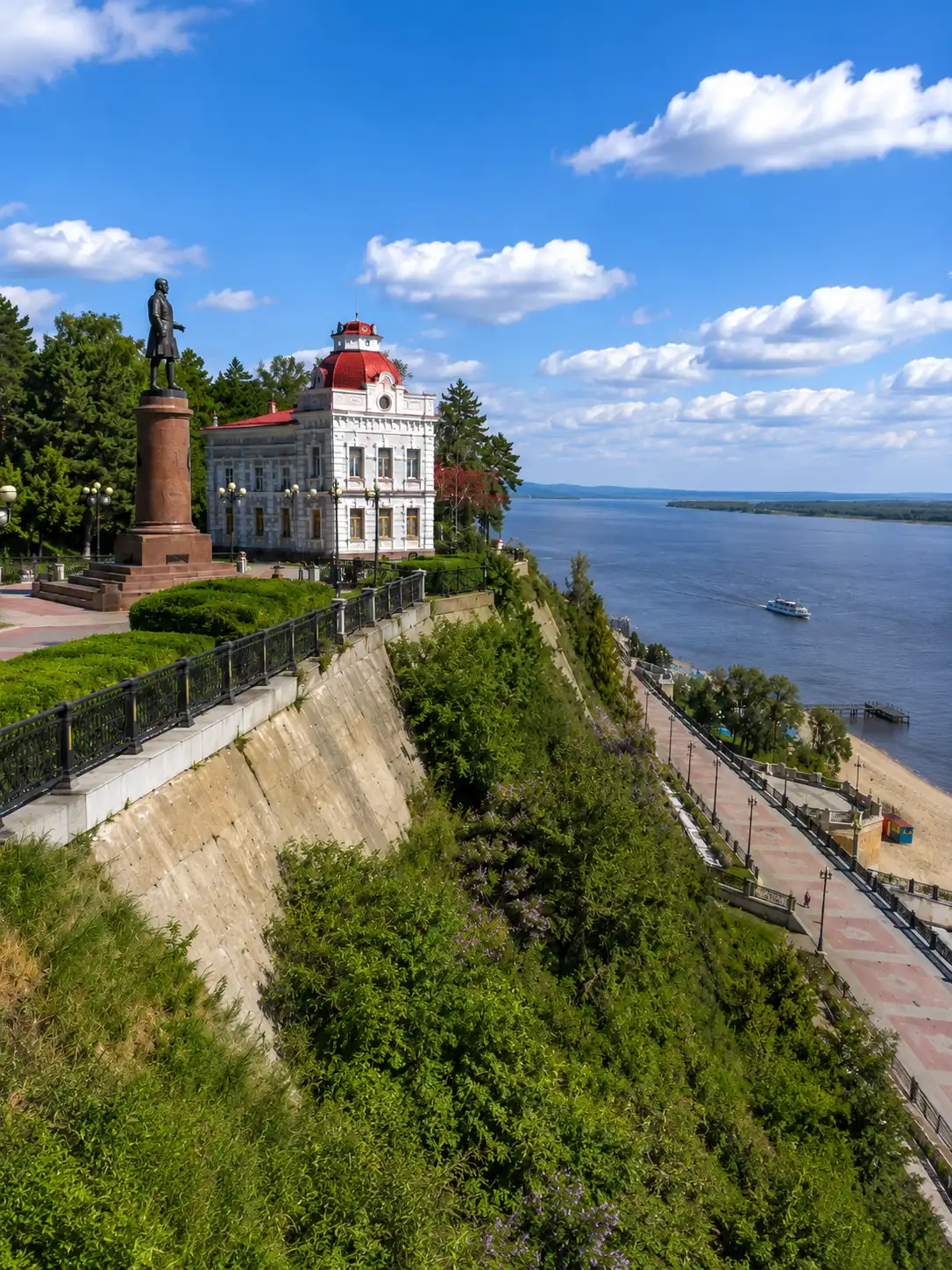
Amur Cliff and Muravyov-Amursky Park form the most important scenic and historical landmark in Khabarovsk. Located on the high bank of the Amur River, the site combines a panoramic observation point, the city’s oldest park, the monument to Governor-General Nikolai Muravyov-Amursky, museum buildings, shaded walking paths and direct access toward the river embankment.
Known in Russian as Амурский утёс and Парк имени Н. Н. Муравьёва-Амурского, the two attractions are best experienced together. The cliff provides the defining view over the Amur, while the park explains how the elevated riverbank became part of Khabarovsk’s historical identity.
This is one of the most appropriate places to begin exploring the city. From the observation area, visitors immediately understand the geographical relationship between Khabarovsk and the Amur. The river is not a decorative element beside the city. It shaped the location of the original military post, supported transport and trade, influenced regional politics and continues to define the visual character of the Khabarovsk waterfront.
The park adds a quieter and more landscaped setting above the river. Its paths connect monuments, museums, viewpoints and cultural spaces. The Amur Cliff building, once used as a military observation post, is now connected with the Grodekov Museum and the regional tourist-information system. The surrounding area also provides easy access to the Grodekov Regional Museum, the Far Eastern Art Museum and the Admiral Nevelskoy Embankment.
This Wander Russia guide explains the history of Amur Cliff, the founding of Khabarovsk, the Muravyov-Amursky monument, the park, the river views, seasonal conditions, photography, access and the best way to organise a visit.
Where Are Amur Cliff and Muravyov-Amursky Park?
Amur Cliff and Muravyov-Amursky Park are located in the historical centre of Khabarovsk on the high right bank of the Amur River.
The Amur Cliff building stands at 15 Shevchenko Street, while the main Grodekov Museum is located nearby at 11 Shevchenko Street. The park extends along the elevated riverbank and connects naturally with the museum district, observation areas and stairways leading toward the embankment.
The location is central enough to reach on foot from several major city attractions. Muravyov-Amursky Street, Komsomolskaya Square, the Assumption Cathedral, the Grodekov Museum and the Far Eastern Art Museum are all within the wider historical centre.
The park’s elevated position is essential to its appeal. Visitors stand above the river rather than directly beside it, allowing the Amur to be seen as a broad landscape stretching toward the horizon.
Why This Is the Main Landmark of Khabarovsk
Khabarovsk contains churches, museums, historic merchant houses and important engineering structures, but Amur Cliff provides the clearest introduction to the city as a whole.
It combines four essential themes:
- The founding of Khabarovsk
- The geography of the Amur River
- The historical role of Nikolai Muravyov-Amursky
- The city’s modern identity as a regional capital and riverfront destination
The official Grodekov Museum describes the cliff as a quiet or “silent” symbol of Khabarovsk and connects the location with both the foundation of the city and events during the Civil War. The regional tourism portal similarly presents it as one of the principal viewpoints over the Amur and the urban skyline.
Unlike an attraction based on one building or object, the importance of Amur Cliff comes from the complete setting. The architecture, river, park, monument and surrounding museums work together.
The Founding of Khabarovsk
The high riverbank around Amur Cliff is closely connected with the origins of Khabarovsk.
The city developed from the military post of Khabarovka, established in 1858 during the expansion of Russian administration along the Amur. The site was selected because the elevated bank provided a commanding position over the river and surrounding territory.
The Amur was the region’s main transport route. Moving soldiers, supplies and officials by water was considerably more practical than travelling through the surrounding forests and undeveloped land.
The original settlement grew from military and administrative needs, but its position later supported commerce, shipping and urban expansion.
Standing at the cliff today helps explain why this specific location mattered. The high bank offered visibility and security, while the river provided movement and communication.
The Amur River
The Amur is one of the great rivers of East Asia.
It forms part of the international border between Russia and China and flows through a vast region of forests, wetlands, agricultural land and settlements before reaching the Sea of Okhotsk.
At Khabarovsk, the river appears broad and powerful. Its width changes according to season and water level, while islands and channels create a complex landscape beyond the main flow.
The river has influenced nearly every stage of the city’s development. It supported exploration, administration, military transport, trade and fishing. It also created natural hazards, especially during periods of high water and flooding.
From Amur Cliff, visitors see the river as more than a line on a map. Its physical scale becomes immediately clear.
The Amur Cliff Building
The small historic building standing on the cliff is one of the most recognisable structures in Khabarovsk.
Its position at the edge of the high bank gives it greater visual prominence than its modest size would suggest. The building appears in many city photographs because it forms a clear foreground against the wide river landscape.
In 1943, the site was used as a military observation post monitoring the river and border area. Today, the building belongs to the wider Grodekov Museum structure. Since September 1, 2024, it has also housed the Tourist Information Center of Khabarovsk Krai.
The function of the interior can change according to exhibitions and regional tourism programmes. Visitors should therefore check current access rather than assuming that a permanent museum display is always available.
Even when the building is closed, the surrounding observation area remains the main attraction.
The Observation Deck
The observation deck beside Amur Cliff offers one of the broadest and most accessible views in Khabarovsk.
The panorama includes the Amur River, embankment, beach areas, distant channels and sections of the city skyline. On clear days, the horizon feels especially open because the opposite landscape remains comparatively low.
The viewpoint is attractive throughout the day, but the mood changes considerably with the light.
Morning can provide clearer air and fewer visitors. Late afternoon creates warmer colour across the river. Sunset often produces the most dramatic atmosphere, especially when clouds reflect orange, pink and violet tones.
The viewpoint is also popular during public celebrations and fireworks, when the elevated position provides a broad view over the riverfront.
Muravyov-Amursky Park
Muravyov-Amursky Park is the oldest park in Khabarovsk and a recognised natural monument located along the Amur River. It is named after Nikolai Muravyov-Amursky, the nineteenth-century Governor-General of Eastern Siberia associated with Russian expansion and administration in the Amur region.
The park provides a landscaped transition between the historical centre and the steep riverbank.
Its paths pass through mature trees, monuments, museum buildings and viewpoints. Benches and shaded areas make it suitable for a slower walk, especially during the warm summer months.
The park is less formal than a palace garden and less entertainment-focused than a modern amusement park. Its strongest qualities are location, history and river views.
A complete visit should include both the upper park and the cliffside observation area.
Nikolai Muravyov-Amursky
Nikolai Muravyov-Amursky was one of the most influential Russian administrators connected with the development of the Far East during the nineteenth century.
As Governor-General of Eastern Siberia, he promoted navigation and Russian settlement along the Amur. His policies helped strengthen Russian control in the region and played an important role in the political developments that established the modern border between Russia and China.
His legacy remains complex. In Russian regional history, he is often presented as a major state-builder and founder figure. From a broader historical perspective, his policies were also part of imperial expansion into territories inhabited by Indigenous communities and situated within long-standing Chinese and regional networks.
Understanding both perspectives provides a more mature interpretation of the monument and park.
The Monument to Muravyov-Amursky
The monument to Nikolai Muravyov-Amursky stands prominently in the park above the river.
The original monument was created by sculptor Alexander Opekushin and unveiled in 1891. Its elevated position was chosen to connect the governor-general visually with the Amur region he helped bring under Russian administration.
The monument was removed after the revolution and later restored during the post-Soviet period.
Today, it is one of the most widely recognised symbols of Khabarovsk. The image of Muravyov-Amursky and the city’s Amur landscape is also closely associated with the design of Russia’s 5,000-ruble banknote.
Visitors often photograph the monument together with the river, but the statue deserves more than a brief photo stop. It represents the political history behind the creation of Khabarovsk and the transformation of the wider Amur region.
The 5,000-Ruble Connection
Khabarovsk is strongly associated with the Russian 5,000-ruble banknote.
The banknote features the monument to Muravyov-Amursky, while the reverse side depicts the Khabarovsk Bridge across the Amur.
This has made the monument and river panorama nationally recognisable even among people who have never visited the city.
For travellers, finding the viewpoint and comparing the actual landscape with the banknote has become a popular small ritual.
However, Amur Cliff itself should not be reduced to a banknote location. The park and viewpoint have much deeper historical and geographical significance.
Walking Through the Park
The park can be explored comfortably during a one- to two-hour walk.
A typical route begins near Shevchenko Street and the Grodekov Museum.
Continue toward the monument to Muravyov-Amursky and the upper river viewpoints.
Walk through the tree-lined paths toward Amur Cliff and spend time on the observation deck.
From there, either return through the park or descend toward the Admiral Nevelskoy Embankment.
The walk is not physically demanding, although some routes include slopes and stairs.
Visitors with limited mobility may prefer to remain on the upper level and use a taxi or separate access point for the embankment.
The Grodekov Regional Museum
The Grodekov Khabarovsk Regional Museum stands immediately beside the park.
It is one of the most important cultural institutions in the Russian Far East and contains the region’s largest collection devoted to its history, nature and cultures. The museum was founded in 1894 and developed from the Amur Department of the Imperial Russian Geographical Society.
The museum’s permanent displays cover natural history, archaeology, ethnography, Indigenous peoples, regional development and historical events.
Combining the museum with the park creates a balanced visit. The cliff explains Khabarovsk through landscape, while the museum explains the wider region through objects, documents and scientific collections.
The main museum currently lists opening hours from Tuesday through Sunday, 10:00 to 18:00, with Monday closed. Schedules can change, and the last Friday of the month may be affected by sanitation procedures.
The Far Eastern Art Museum
The Far Eastern Art Museum is also located near the park.
Its collections provide an additional cultural dimension to the historical district and may include Russian, European, regional and decorative art.
Travellers with a full day can combine Amur Cliff, Muravyov-Amursky Park, the Grodekov Museum and the art museum without leaving the central area.
This concentration of institutions makes Shevchenko Street one of the strongest cultural zones in Khabarovsk.
Descending to the Amur Embankment
The park stands above the river, while the embankment lies below the cliff.
Stairways and sloping paths connect the two levels. Descending allows visitors to experience the Amur from water level after first seeing it from above.
The contrast is valuable.
From the cliff, the river appears broad and geographical. From the embankment, it feels closer, more active and more connected with everyday recreation.
Visitors can continue walking along the Admiral Nevelskoy Embankment, observe boats and seasonal river traffic or remain until sunset.
The return climb should be considered when planning energy and time.
Boat Trips on the Amur
During the navigation season, river excursions may depart from waterfront areas in Khabarovsk.
A boat trip provides a different view of Amur Cliff, the park and the city skyline. From the water, the height of the riverbank becomes more obvious.
Boat schedules depend on season, river conditions and local operations.
High water, weather and navigation restrictions may affect departures.
Travellers should check current information locally rather than relying on fixed schedules from previous years.
Best Time to Visit
Amur Cliff and Muravyov-Amursky Park can be visited throughout the year.
Late May through September provides the most comfortable walking conditions.
June brings long daylight and fresh green vegetation.
July and August can be warm and humid, with occasional heavy rain.
September is often especially attractive because temperatures become milder and the first autumn colours appear.
October can offer clear air and stronger autumn tones, although cold weather arrives quickly.
Winter creates a dramatic river landscape of snow, ice and pale light. The view can be beautiful, but wind from the Amur makes the temperature feel considerably lower.
Summer Conditions
Summer is the most active season in the park.
Trees provide shade, the embankment is lively and riverboat operations are more likely.
Warm weather also brings mosquitoes and other insects, especially near the river.
Heavy rainfall can make paths slippery and contribute to changing river levels.
A light waterproof jacket and insect repellent are useful even during a short city visit.
Winter Conditions
Winter in Khabarovsk is cold, dry and often windy.
The Amur may freeze, producing a wide white landscape below the cliff.
Clear winter days can provide excellent visibility, but exposed viewpoints may feel severe because of wind chill.
Footwear with strong grip is essential. Snow and ice can affect stairs, slopes and the observation area.
A winter visit should be shorter unless visitors are equipped with insulated clothing, gloves, a hat and suitable boots.
Best Time of Day
Morning is best for quiet walking and museum access.
Late afternoon provides warmer light across the river and is ideal for photography.
Sunset is the most atmospheric period, especially during summer and early autumn.
Night visits can offer illuminated city views, but the river itself becomes less visible and icy surfaces require additional caution in winter.
A balanced itinerary can begin with the museums, continue through the park and finish at the cliff near sunset.
Photography Tips
A wide-angle lens works well for combining the cliff building, sky and river.
A standard lens provides more natural proportions for the monument and park paths.
A telephoto lens can isolate distant boats, islands and sections of the opposite bank.
Useful compositions include:
- The Amur Cliff building against the river
- The Muravyov-Amursky monument with the landscape
- Tree-lined park paths
- The embankment viewed from above
- Sunset reflections on the Amur
- Winter ice and snow
- The city skyline beyond the park
Photographers should remain behind barriers and avoid unstable cliffside edges.
Drone use may be restricted by urban, border and aviation regulations and should never be assumed to be permitted.
How to Reach the Park
The park is located in the historical centre and can be reached by foot, public transport or taxi.
Visitors already exploring Muravyov-Amursky Street, Komsomolskaya Square or the museum district can walk to Shevchenko Street.
A taxi is the easiest option from Khabarovsk railway station or the airport.
Public transport serves the central district, but routes and stops can change. Current local navigation services should be checked on the day of travel.
The official address for Amur Cliff is 15 Shevchenko Street.
Accessibility
The upper park contains paved paths and relatively level areas, but the riverbank setting includes slopes and stairways.
The main monument and cliff viewpoint may be accessible from the upper street level without completing the full descent.
The embankment below is more difficult for visitors who cannot manage stairs.
Winter snow and ice reduce accessibility significantly.
Visitors with mobility requirements should consider arriving by taxi at the upper park and treating the embankment as a separate destination.
Safety
Amur Cliff is an established urban viewpoint, but basic caution remains necessary.
Visitors should:
- Remain behind barriers
- Supervise children
- Avoid slippery edges after rain or snow
- Use marked stairways
- Wear suitable winter footwear
- Keep away from unstable slopes
- Respect temporary closures
- Avoid climbing on monuments
During periods of high river levels, access to lower waterfront areas may be affected.
Suggested Half-Day Itinerary
Begin at the Grodekov Regional Museum in the morning.
Spend approximately two hours exploring the main exhibitions.
Continue into Muravyov-Amursky Park and walk toward the governor-general’s monument.
Visit the Amur Cliff building and observation deck.
Pause for photographs and views across the river.
Descend toward the Admiral Nevelskoy Embankment when conditions allow.
Finish with a riverside walk or remain until sunset.
This route connects history, regional culture, park scenery and the Amur within one compact programme.
Is Amur Cliff Worth Visiting?
Amur Cliff is essential for any first visit to Khabarovsk.
Its importance does not depend on one spectacular building. The value comes from the complete relationship between the city, park, monument and river.
The viewpoint explains why Khabarovsk was founded here and why the Amur remains central to its identity.
Muravyov-Amursky Park provides the historical and landscaped setting needed to make the cliff more than a short photo stop.
Wander Russia recommends allowing at least one to two hours for the park and viewpoint, or half a day when the Grodekov Museum and embankment are included.
Frequently Asked Questions
Where is Amur Cliff?
It is located at 15 Shevchenko Street in central Khabarovsk.
What can visitors see from the viewpoint?
The panorama includes the Amur River, embankment, islands, distant shoreline and parts of the Khabarovsk skyline.
Is Muravyov-Amursky Park free?
The outdoor park and public viewpoints can generally be visited without admission. Museum exhibitions may require tickets.
Why is the site historically important?
The elevated riverbank is connected with the founding of Khabarovsk and later military observation of the Amur.
What is inside the Amur Cliff building?
The building belongs to the Grodekov Museum system and has housed cultural and historical programmes. Since September 2024, it has also housed the regional Tourist Information Center.
How long is needed?
Allow one to two hours for the park and viewpoint. Add several hours for museums and the embankment.
When is the best time to visit?
Late afternoon and sunset provide the strongest river light. September is especially suitable for comfortable walking and early autumn colours.
Can the site be visited in winter?
Yes, but strong wind, ice and severe cold require suitable clothing and footwear.
Is it close to the Grodekov Museum?
Yes. The main museum stands at 11 Shevchenko Street, only a short walk from the cliff.
Is the Muravyov-Amursky monument shown on Russian money?
The monument and Khabarovsk’s Amur imagery are associated with the 5,000-ruble banknote.
Conclusion
Amur Cliff and Muravyov-Amursky Park provide the clearest introduction to Khabarovsk.
The site connects the city’s founding story with the geography that made that story possible. The high bank provided visibility and strategic value, while the Amur supported transport, administration and later commercial development.
The cliff building adds a human-scale landmark to the immense river landscape. Its wartime use as an observation post reflects the continuing strategic importance of the border region, while its modern museum and tourist-information functions give the structure a new public role.
Muravyov-Amursky Park frames the viewpoint with paths, trees, museums and monuments. The statue of Nikolai Muravyov-Amursky represents the imperial history of Russian expansion along the Amur, while the nearby Grodekov Museum provides a broader interpretation of regional nature, Indigenous cultures and historical change.
The location is therefore much more than a scenic overlook.
It is a place where visitors can examine how geography, empire, migration, military strategy and modern urban identity came together on the bank of one of Asia’s great rivers.
The view changes through the year. Summer brings green trees and active river traffic. Autumn adds colour and clearer air. Winter transforms the Amur into a vast frozen landscape.
Each season reveals a different character, but the essential relationship remains the same: Khabarovsk stands above the river, and the river continues to define the city.
For Wander Russia, Amur Cliff is the natural first chapter of any Khabarovsk journey.
