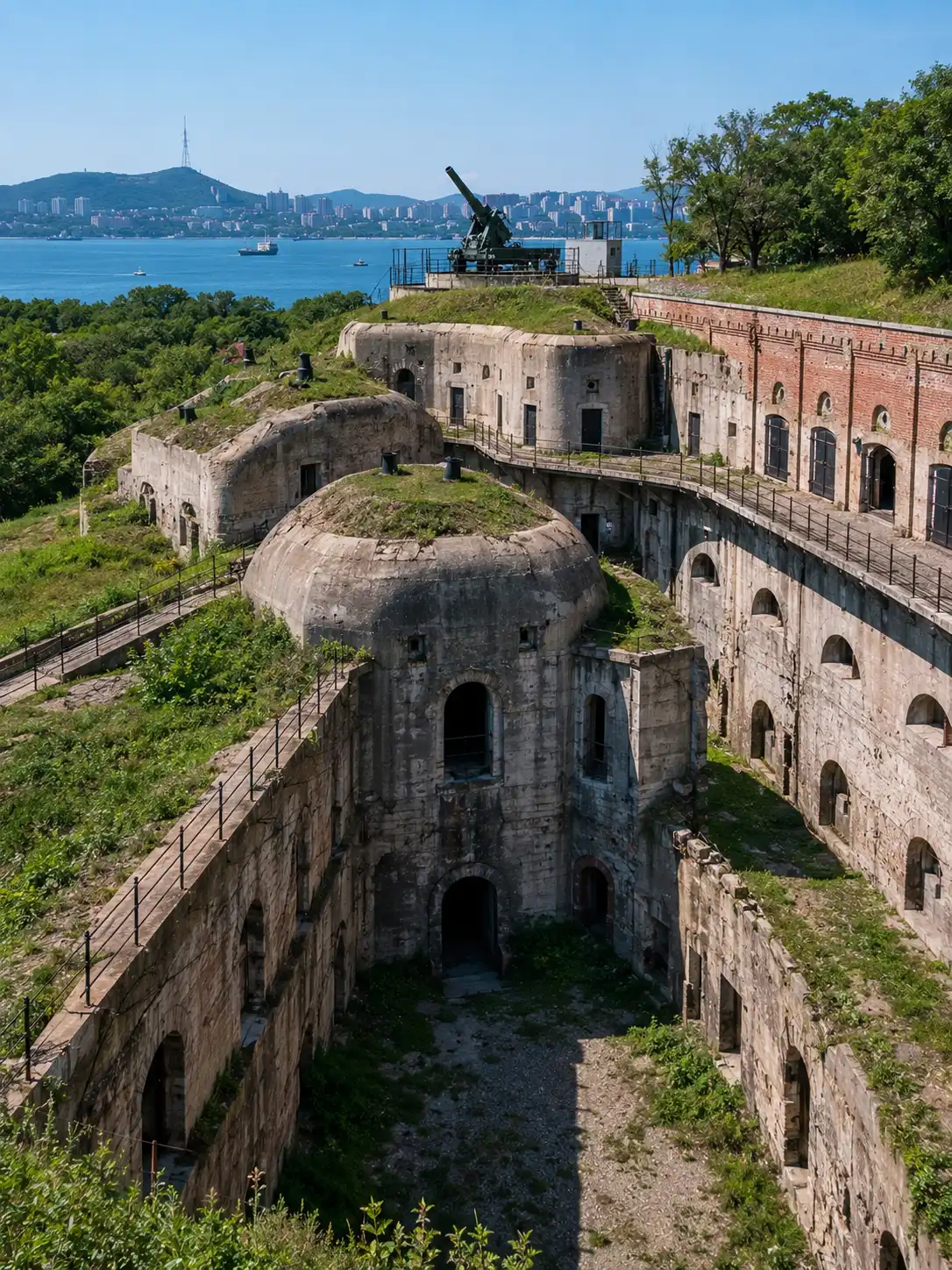
Vladivostok Fortress is one of the most extensive and unusual military heritage sites in the Russian Far East. Unlike a conventional fortress built around a single castle, wall or central citadel, it is a vast defensive system spread across the hills, islands, capes and coastal approaches surrounding Vladivostok.
Known in Russian as Владивостокская крепость, the fortress includes forts, coastal batteries, land batteries, underground galleries, tunnels, powder magazines, caponiers, shelters and observation positions constructed to defend the strategically important harbour and the maritime approaches to the city.
The modern Vladivostok Fortress Museum-Reserve was established to preserve, study and interpret this enormous network. Its visitor facilities introduce the history of the fortifications, while individual sites across the mainland and Russky Island allow travellers to experience the surviving architecture in its original landscape. The museum describes its mission as preserving the fortress heritage and explaining the significance of this exceptional historical and architectural monument.
The fortress should not be understood as one compact museum that can be completely explored in a single hour. A short visit can focus on the central visitor centre or a maintained battery, while a deeper exploration may require several separate excursions to forts and coastal positions spread around Vladivostok and Russky Island.
This complete Wander Russia guide explains the history, defensive structure, principal visitor sites, tunnels, batteries, guided tours, safety rules and practical planning needed to explore Vladivostok Fortress responsibly.
What Is Vladivostok Fortress?
Vladivostok Fortress is a large system of military fortifications created to protect the city, Golden Horn Bay, the Eastern Bosphorus, Russky Island and the maritime approaches through Peter the Great Gulf.
The complex was built primarily between the late nineteenth century and the beginning of the twentieth century. Construction developed through several major phases as military technology, regional politics and understanding of modern artillery changed. The wider system eventually included sixteen major forts, numerous coastal and land batteries, caponiers and a defensive network extending for more than 150 kilometres, with almost ten kilometres of underground galleries.
The fortress was not designed as a single continuous wall. Engineers used Vladivostok’s steep and irregular terrain as part of the defensive plan.
Forts were positioned on hills and ridges to control land approaches. Coastal batteries covered bays, channels and possible naval routes. Underground passages protected troops, ammunition and communications from artillery fire.
This relationship between military architecture and landscape is one of the fortress’s defining qualities.
Why Vladivostok Needed a Fortress
Vladivostok was founded as a military post in 1860 and developed into an increasingly important Pacific harbour.
Its position close to China, Korea and Japan gave the city strategic value but also exposed it to possible attack from land and sea. The harbour, naval facilities and transport links needed a defensive system capable of resisting modern warships and large artillery forces.
In 1889, Vladivostok officially received fortress status, marking a major stage in the development of its permanent defences. Engineers began expanding coastal batteries, land fortifications, roads, communications and protected military infrastructure around the city.
The regional situation became more serious during the years surrounding the Russo-Japanese War of 1904–1905. The experience of that conflict influenced later construction, particularly the design of stronger concrete positions, deeper underground spaces and more carefully protected approaches.
The fortress developed into one of the most ambitious military engineering projects in the Russian Far East.
A Fortress Built Into the Terrain
The geography of Vladivostok strongly influenced the design.
The city occupies a peninsula cut by bays and surrounded by hills, islands and narrow maritime passages. Instead of attempting to impose one standard geometric fortress plan, engineers adapted every structure to its location.
Some batteries face directly toward the sea. Others are hidden behind hills or positioned on reverse slopes, where enemy ships or artillery would have difficulty observing them.
Forts contain buried galleries, concrete casemates, ammunition rooms and defensive ditches. Roads were designed to allow troops and supplies to move between positions while remaining partly concealed.
Underground telephone and telegraph lines connected important structures through a central communications system. Electricity and modern engineering were incorporated into many principal positions, making the complex highly advanced for its time.
Did Vladivostok Fortress Ever Fight a Major Battle?
One of the most interesting facts about the fortress is that it was never tested in the full-scale battle for which it had been designed.
Official tourism material explains that the fortress’s military strength itself may have served as a deterrent. No enemy attempted a direct major assault on Vladivostok while the defensive system stood at its most powerful.
This does not mean the project had no military value. A fortress can fulfil part of its strategic purpose simply by making an attack appear too costly or difficult.
Its absence from a famous battle also helps explain why many structures survived in recognisable form. They were not destroyed during a prolonged siege, although later neglect, reuse, dismantling and weather caused substantial damage.
The End of Construction
The outbreak of the First World War changed priorities.
Modern weapons, ammunition and military supplies were increasingly needed on the European front. Construction slowed, and some equipment intended for Vladivostok was transferred elsewhere.
The revolution and political upheaval of 1917 brought the main construction programme to an end before every planned element had been completed.
The fortress was later demilitarised during the early Soviet period, and many weapons were removed. Some structures became warehouses, military facilities or restricted areas, while others were gradually abandoned.
Russky Island remained closely connected with the Pacific Fleet during the Soviet period, and newer coastal artillery, radar and military installations appeared alongside the earlier imperial fortifications.
The result is a landscape containing several overlapping layers of Russian military history.
The Modern Museum-Reserve
The Vladivostok Fortress State Museum-Reserve was created in 2019 to coordinate research, preservation, restoration and public access.
Its task is particularly complex because the fortress is not one building. It is a dispersed cultural landscape containing numerous structures in different states of preservation.
Some sites have been restored or adapted for organised visits. Others remain closed, partly ruined or accessible only from outside.
The museum-reserve works to preserve authenticity while gradually improving public access. It also organises exhibitions, festivals, lectures, guided excursions and cultural programmes connected with the history of Vladivostok and its fortifications.
The Central Visitor Centre
The visitor centre is one of the best places to begin.
Regional tourism information identifies the museum-reserve visitor centre at 6 Petra Velikogo Street, within the historic centre of Vladivostok. It lies within walking distance of Korabelnaya Embankment, the Tsarevich Triumphal Arch and the S-56 Submarine Museum.
Beginning at the visitor centre helps travellers understand the overall scale of the fortress before choosing specific forts or batteries.
Maps, historical interpretation and staff guidance can prevent a common mistake: assuming that the nearest visible structure represents the entire complex.
Current exhibitions, tours and opening arrangements should be checked through the official museum-reserve website because access to individual sites can change.
The Former Fortress Museum at Nameless Battery
Another important location associated with the fortress stands at the former Nameless Battery, traditionally linked with the museum at Batareynaya Street.
The battery occupies a hill above the Sportivnaya waterfront and combines preserved military architecture with artillery displays and city views.
Historic guns, naval weapons and military equipment have been exhibited in the outdoor areas, while former casemates have housed displays explaining the history of the fortress and military technology.
The site demonstrates one of the characteristic qualities of Vladivostok Fortress: defensive structures were frequently placed in locations that now provide remarkable views across bays, coastlines and modern urban districts.
Visitors should verify which museum facilities and exhibitions are operating at the time of travel, as the organisation and use of individual sites have changed during the development of the museum-reserve.
Fort Pospelov
Fort Pospelov is one of the more accessible historic fortifications on Russky Island.
It is located on the Saperny Peninsula and is identified by regional tourism authorities as one of the island’s military structures available to visitors. The fortification was originally known as Fortification No. 4 and was constructed as tensions increased in East Asia during the late nineteenth century.
The site contains concrete defensive spaces, covered positions, galleries and exterior earthworks integrated into the landscape.
Fort Pospelov is valuable because visitors can understand how a land fort differed from a coastal battery. Its purpose was not only to fire toward ships but also to defend important approaches across the island.
A guided visit provides the clearest explanation of the layout, as entrances and corridors can otherwise appear confusing.
Novosiltsevskaya Battery
The Novosiltsevskaya Battery is one of the most visually rewarding fortress sites on Russky Island.
Its position close to the modern Russky Bridge creates a dramatic meeting of early twentieth-century coastal defence and twenty-first-century engineering.
The battery was designed to cover maritime approaches through the Eastern Bosphorus and surrounding waters. Gun positions, concrete structures and observation areas reveal how artillery was placed to control strategic channels.
The surrounding view now includes the immense pylons and cables of Russky Bridge, making the site particularly attractive for photography.
Regional tourism information recommends restored positions such as Novosiltsevskaya Battery and Fort Pospelov for visitors interested in the island’s military history.
Forts on Russky Island
Russky Island contains many of the most significant structures in the entire fortress system.
The island guarded the southern maritime approaches to Vladivostok and provided positions for both coastal artillery and land defence.
Visitors may encounter forts, batteries, powder magazines, coastal caponiers and later Soviet military structures.
Some sites are maintained or opened during guided programmes. Others remain hidden by forest and vegetation.
Russky Island’s forts are especially rewarding because they combine history with open coastal scenery. The same excursion may include concrete galleries, sea views, forest tracks and modern bridge panoramas.
However, the dispersed nature of the sites means private transport or an organised tour is usually necessary.
Coastal Batteries
Coastal batteries were designed to engage enemy ships.
Their gun positions faced bays, channels and open sea routes. Ammunition magazines and crew shelters were placed inside reinforced structures, while observation posts helped identify targets and coordinate fire.
Some batteries used open gun positions, while others incorporated protected casemates or disappearing weapons.
The coastal structures reveal how carefully the fortress was adapted to maritime geography. A battery might appear small when viewed alone, but its field of fire was coordinated with other positions across the water.
Together, these overlapping zones were intended to make naval penetration extremely difficult.
Land Forts
The land forts protected Vladivostok from attack across the peninsula and surrounding ground.
These structures often contain defensive ditches, counterscarps, caponiers, firing positions and underground barracks.
A caponier allowed defenders to fire along a ditch and prevent enemy troops from crossing it safely.
The earth covering many concrete structures provided additional protection against artillery and helped hide the forts within the landscape.
From a distance, some positions look like ordinary overgrown hills. Only when visitors reach an entrance, ditch or concrete opening does the scale of the fort become visible.
Underground Galleries and Tunnels
The underground spaces are among the most memorable elements of Vladivostok Fortress.
Tunnels connected barracks, ammunition storage areas, observation points and defensive positions. Thick concrete and earth protected the interiors from artillery fire.
Inside, temperatures can remain cool even during summer. Moisture, darkness and uneven floors create a very different atmosphere from the open coastal viewpoints outside.
A guided tour may include lantern-lit corridors, former powder magazines, communication passages and rooms used by soldiers.
These underground structures should not be entered independently unless the site is officially open.
Why Abandoned Forts Are Dangerous
Unrestored fortifications can contain serious hazards.
Possible dangers include:
- Open shafts
- Unprotected stairways
- Collapsing ceilings
- Deep flooded rooms
- Rusted metal
- Broken glass
- Unstable concrete
- Hidden holes beneath vegetation
- Complete darkness
- Poor mobile reception
Some structures have been closed temporarily with doors or barriers, while others remain accessible only externally. The museum-reserve publishes current changes in access and asks visitors to follow safety rules at open natural sites.
Online photographs and old route descriptions should never be treated as proof that an interior remains safe or legally accessible.
Why a Guided Tour Is Recommended
The fortress becomes far easier to understand with a knowledgeable guide.
Without explanation, a concrete opening may look like an ordinary bunker. A guide can identify whether it served as an ammunition magazine, crew shelter, observation station, caponier or tunnel entrance.
Guides also explain how separate sites worked together as one defensive system.
Most importantly, organised tours reduce the risk of entering unsafe or restricted sections.
Specialist excursions may focus on one fort, several Russky Island positions, coastal batteries or the engineering history of the complete fortress.
Tour availability changes by season and restoration work, so current programmes should be checked directly with the museum-reserve or authorised operators.
How Much Time Is Needed?
The amount of time depends entirely on the selected experience.
A central visitor-centre or museum visit may require approximately one to two hours.
A guided visit to one fort or battery can occupy two to three hours, including transport and walking.
A half-day tour may combine several nearby structures.
A full-day Russky Island fortress route can include multiple forts, coastal batteries and panoramic stops.
Several days would be needed to gain a broader understanding of the complete system.
Travellers should avoid trying to visit too many sites quickly. One well-explained fort often provides more value than several rushed exterior stops.
Best Time to Visit
The central museum facilities can be visited throughout the year, subject to current opening schedules.
For outdoor forts and batteries, late spring through early autumn provides the most practical conditions.
June offers long daylight and fresh vegetation, although rain and mud remain possible.
July and August provide warm conditions but can bring humidity, mosquitoes and dense vegetation around less maintained structures.
September is often especially suitable. Temperatures are cooler, visibility can be clearer and autumn colour begins to appear.
October can remain attractive but brings shorter daylight and colder wind.
Winter fort tours can be atmospheric, but snow and ice create significant risks on stairs, tunnels and exposed slopes.
What to Wear and Bring
For a museum or visitor-centre visit, ordinary comfortable clothing is sufficient.
For forts and batteries, recommended equipment includes:
- Strong walking shoes
- A windproof jacket
- Warm layers
- A headlamp
- Spare batteries
- Gloves
- Drinking water
- Insect repellent
- A charged phone
- Offline maps
- A small first-aid kit
- Clothing that can tolerate dust and damp surfaces
A phone flashlight alone is not ideal for longer underground sections because it drains the battery needed for communication.
Helmets may be supplied during some organised tours.
Photography
Vladivostok Fortress offers excellent architectural, landscape and historical photography.
Wide-angle lenses are useful inside tunnels and casemates.
A standard lens works well for courtyards, entrances and artillery positions.
Telephoto lenses help frame coastal batteries against bridges, ships or distant islands.
Fog can create strong atmosphere around concrete ruins and overgrown defensive lines.
Visitors should avoid climbing onto unstable structures for a higher viewpoint.
Drone use requires caution because Vladivostok contains military facilities, strategic infrastructure, controlled airspace and protected areas. Permission should never be assumed.
Combining the Fortress with Other Attractions
The central visitor centre combines naturally with Korabelnaya Embankment, S-56, the Pacific Fleet Memorial and the Tsarevich Triumphal Arch.
A Russky Island fortress day can be combined with Russky Bridge viewpoints, the Far Eastern Federal University area or one carefully selected coastal stop.
The Voroshilov Battery belongs to a later Soviet period but provides an interesting comparison with the earlier imperial fortress system.
Cape Tobizina and Cape Vyatlin should usually be planned separately from a detailed fortress tour unless transport and timing are carefully organised.
Is Vladivostok Fortress Worth Visiting?
Vladivostok Fortress is essential for travellers interested in military architecture, engineering, urban history and the strategic development of the Russian Far East.
Its greatest strength is scale.
The complex reveals that Vladivostok was not defended by one symbolic fort. The entire landscape was transformed into a coordinated military system.
The forts, batteries and tunnels also explain why the city’s hills, islands and channels mattered historically.
Wander Russia recommends beginning with an official museum or guided visit before exploring outdoor locations. This provides the context needed to recognise what each structure was designed to do.
Frequently Asked Questions
Is Vladivostok Fortress one building?
No. It is a dispersed system of forts, batteries, tunnels and defensive structures across Vladivostok and Russky Island.
When was it built?
Most of the fortress system was constructed between the late nineteenth century and the First World War period.
How large is the fortress?
The wider system includes sixteen major forts, numerous batteries and more than 150 kilometres of defensive lines, with almost ten kilometres of underground galleries.
Did the fortress fight a major battle?
No full-scale assault tested the complete system. Its power may have discouraged a direct attack.
Can visitors enter the tunnels?
Only officially open and supervised tunnels should be entered.
Where should a first visit begin?
The museum-reserve visitor centre at 6 Petra Velikogo Street provides a practical introduction.
Are there fortress sites on Russky Island?
Yes. Russky Island contains numerous forts, batteries and military structures.
Is Fort Pospelov open to tourists?
It is identified by regional tourism authorities as one of the more accessible visitor sites, but current arrangements should still be checked.
How long does a visit take?
A short museum visit takes around one to two hours, while a complete outdoor excursion may require half a day or longer.
Is independent exploration safe?
Unrestored and abandoned structures can be dangerous. Guided access is strongly recommended.
Conclusion
Vladivostok Fortress is one of the most ambitious military landscapes in Russia.
Its forts do not stand separately from the city. They are built into its hills, islands, bays and maritime passages.
This is what makes the complex so important. It demonstrates how engineers used geography itself as a defensive system.
Coastal batteries watched the sea. Land forts protected approaches across the peninsula. Underground galleries sheltered soldiers, ammunition and communications. Roads and cables connected the positions into one coordinated network.
The fortress was never tested by the vast assault it had been designed to resist. Yet its military power influenced the strategic history of Vladivostok and may have helped prevent such an attack.
Later political change, demilitarisation and decades of varied use left the structures in very different conditions. Some became museums. Some remained military property. Others disappeared into forest or deteriorated behind the expanding city.
The creation of the museum-reserve offers a new opportunity to preserve and interpret this heritage.
For visitors, the fortress requires patience. It cannot be reduced to one photograph, one bunker or one short tunnel.
A meaningful experience begins with understanding the overall system and then exploring selected sites in detail.
The central visitor centre provides historical context. Fort Pospelov reveals the structure of a land fort. Coastal batteries demonstrate control of the maritime approaches. Russky Island shows how military history and dramatic scenery remain closely connected.
Safety is essential. The mystery of abandoned tunnels can be attractive, but darkness, water, damaged concrete and hidden shafts make independent exploration dangerous.
The strongest experience comes through authorised access and informed interpretation.
For travellers following Wander Russia through Vladivostok, the fortress adds an essential layer to the city. The bridges show modern engineering, the harbour reveals maritime life and the fortress explains the strategic logic that shaped the entire landscape.
