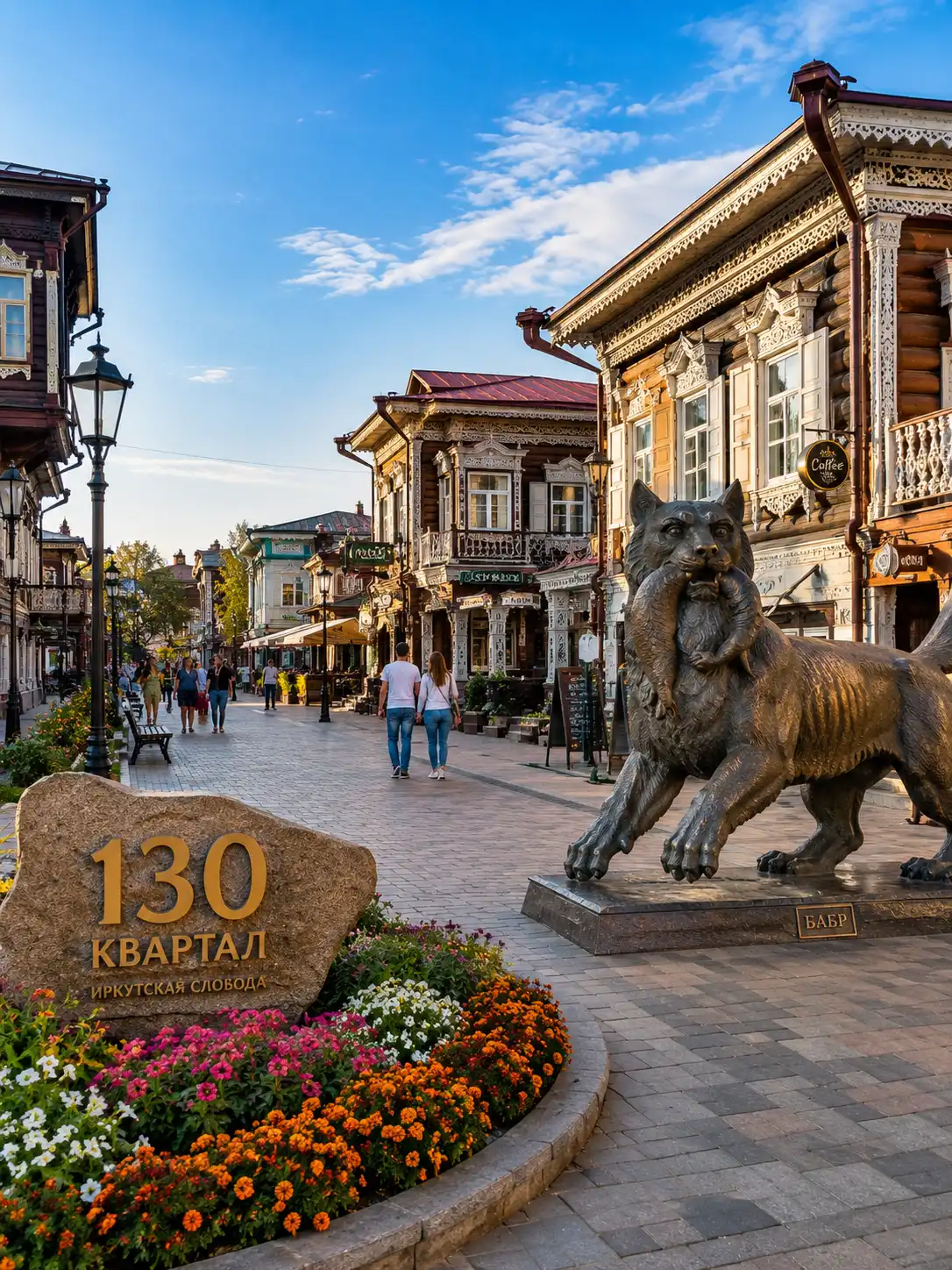
130 Kvartal is one of the most recognisable urban attractions in Irkutsk and one of the easiest places to experience the city’s famous wooden architecture in a compact, pedestrian-friendly setting. Also known as Irkutsk Sloboda, the quarter combines restored historic houses, reconstructed Siberian-style buildings, cafés, restaurants, boutiques, cultural venues and one of Irkutsk’s most photographed modern monuments.
Known in Russian as 130-й квартал or Иркутская слобода, the district stands in the southern part of Irkutsk’s historical centre at the foot of Krestovaya Hill. Its triangular territory is broadly enclosed by Sedova Street, 3 Iyulya Street and Kozhova Street, close to several of the city’s main transport routes and commercial areas.
The quarter should not be understood as an untouched historic neighbourhood preserved exactly as it looked in the eighteenth or nineteenth century. It is a carefully created heritage and leisure district. Some buildings were restored in their original locations, some were transferred from other parts of Irkutsk, several lost structures were reconstructed and other buildings were designed to match the historical character of the area. That combination has generated debate, but it has also created one of the city’s most accessible and lively public spaces.
For visitors following Wander Russia through Irkutsk, 130 Kvartal offers an effective introduction to Siberian timber architecture, local food, urban history and contemporary city life. It works particularly well as the first stop in Irkutsk because it is easy to explore, centrally located and visually distinctive.
This guide explains the history, reconstruction, architecture, principal landmarks, walking route, restaurants, evening atmosphere, practical access and the best way to combine 130 Kvartal with other important sights in Irkutsk.
Where Is 130 Kvartal?
130 Kvartal is located in central Irkutsk near the intersection of several important streets, including Sedova, 3 Iyulya, Timiryazeva, Lenina and Krasnogo Vosstaniya. Its southern edge approaches Kozhova Street, while the district lies within walking distance of the Angara River, central theatres, museums and the main historic streets.
The official national tourism listing gives 3 Iyulya Street as the principal visitor address and identifies the quarter as a historic area with wooden houses, museums, shops, cafés and restaurants.
Because of its central position, the area can be reached by public transport, taxi or on foot from much of central Irkutsk. Bus, tram and route-taxi stops are located on the surrounding streets, making the quarter one of the most accessible attractions in the city.
The pedestrian zone itself is compact. Most visitors can walk from one end to the other quickly, but exploring the architecture, courtyards, shops and restaurants properly requires more time.
Why Is It Called 130 Kvartal?
The name simply refers to the historical planning number of the urban block.
In Russian cities, neighbourhoods and development areas were often identified by numbered quarters or blocks. This particular area became known as the 130th Quarter and retained that name when the heritage redevelopment project was created.
The alternative name Irkutsk Sloboda refers to an old type of settlement or neighbourhood, often associated with craftsmen, merchants or residents living outside the formal centre of a town.
The word helps communicate the intended atmosphere: a district of smaller wooden houses, lanes, workshops and everyday urban life rather than grand stone government buildings.
The Early History of the Area
People began building houses in the territory of the future 130th Quarter during the early eighteenth century.
At that time, the land lay outside the established boundaries of Irkutsk and developed in a semi-rural way. Wooden houses, small yards and domestic outbuildings shaped the area. Even as surrounding districts became more urban, the quarter retained the appearance of a village within the expanding city.
By the nineteenth century, active construction had increased, but timber remained the dominant building material. This was typical of Irkutsk, where wooden architecture became one of the defining features of the city.
The buildings included modest workers’ houses, merchant properties, residential structures and decorated urban homes.
Irkutsk’s timber architecture became known for carved window frames, ornamental cornices, galleries, decorated façades and carefully proportioned two-storey houses. The city still contains a large number of wooden structures, although many remain vulnerable to fire, decay and redevelopment.
The Great Fire of 1879
The fire of 1879 was one of the most destructive events in Irkutsk’s urban history.
Large sections of the city were destroyed, including wooden houses, commercial properties and public buildings. The disaster changed the architectural balance of central Irkutsk because stone construction became more important afterward.
However, wooden houses continued to shape many residential districts.
The survival of timber neighbourhoods is one reason Irkutsk remains visually distinct from many other Siberian cities. 130 Kvartal was later created partly to concentrate and present this architectural tradition in a protected public space.
Decline During the Twentieth Century
By the late twentieth and early twenty-first centuries, many buildings in the quarter were in poor condition.
Some houses lacked modern services, others had been altered repeatedly and several were considered unsafe. The area contained valuable architecture, but it was not functioning as an organised heritage district.
This created a difficult preservation question.
Leaving the quarter unchanged would have allowed further deterioration. Complete demolition would have erased a historical layer of the city. A large-scale redevelopment therefore became the chosen solution.
Creation of Irkutsk Sloboda
The modern project was developed in preparation for the 350th anniversary of Irkutsk.
In 2008, regional authorities approved the creation of a special historical zone based on the 130th Quarter. The plan included restoring significant wooden houses, reconstructing lost buildings, transferring architectural monuments from other districts and adding modern cultural and commercial facilities.
Residents of unsafe buildings were relocated, restoration work accelerated and the district began receiving visitors during Irkutsk’s anniversary celebrations in 2011.
The wider project continued beyond the initial opening.
The intention was not to recreate one exact year in Irkutsk’s history. Instead, the quarter was designed as a heritage-themed urban zone where historic architecture could support cafés, museums, workshops, shops and public events.
How Authentic Is 130 Kvartal?
The authenticity of 130 Kvartal is one of the most important questions for visitors.
The quarter contains genuine historical buildings, relocated architectural monuments, reconstructed houses and modern structures designed to resemble traditional Siberian architecture.
Baikal State University describes the area as containing around 65 houses, with some restored, some reconstructed and others transferred from different streets in Irkutsk.
This means the district is not an untouched historic neighbourhood.
Some travellers appreciate the successful preservation and attractive pedestrian environment. Others feel that the commercial atmosphere and reconstructed buildings make it less authentic than the original wooden streets elsewhere in Irkutsk.
Both perspectives are reasonable.
The best interpretation is to treat 130 Kvartal as a curated introduction to Irkutsk’s wooden heritage. It should be followed by walks through original residential districts where historic houses remain within their everyday urban context.
Siberian Wooden Architecture
The architecture is the main reason to visit.
Traditional Irkutsk wooden houses often display detailed carving around windows, rooflines and entrances. These decorative elements are sometimes compared with wooden lace because of their complexity.
Common architectural features include:
- Carved window surrounds
- Ornamental shutters
- Decorative cornices
- Timber balconies
- Two-storey façades
- Raised ground floors
- Deep roof overhangs
- Elaborate entrance frames
- Contrasting painted details
- Courtyards and rear service buildings
The architecture developed in response to climate, available materials and local craftsmanship.
Wood was abundant, provided insulation and allowed houses to be constructed relatively quickly. At the same time, Irkutsk’s wealthy merchants and officials used elaborate carving to display prosperity and taste.
The Pedestrian Street
The central pedestrian route is the core of the visitor experience.
Wooden houses line the street, while restaurants, cafés, souvenir shops and cultural venues occupy many of the interiors. The walking area is paved and landscaped, making it far more accessible than some of Irkutsk’s older residential streets.
The route has a gradual change in elevation and eventually connects with the modern Modny Kvartal shopping complex.
This juxtaposition of historic-style wooden architecture and contemporary retail is deliberate. The quarter was designed as a functioning part of modern Irkutsk rather than an isolated museum.
The Babr Monument
The Babr Monument stands near the entrance to 130 Kvartal and is one of the most photographed symbols of Irkutsk.
The babr is the mythical or heraldic animal shown on the city’s coat of arms. It resembles a Siberian tiger or another large feline carrying a sable in its mouth.
The unusual appearance originated partly from historical confusion in heraldic descriptions. Over time, the creature developed into a unique civic symbol.
The bronze monument provides a strong starting point for the walk and is especially popular with families and visitors taking introductory photographs.
It also connects the modern heritage quarter with the broader identity of Irkutsk.
Museums and Cultural Spaces
Several buildings in the quarter contain museums, exhibitions or cultural facilities.
The national tourism listing mentions venues such as the Museum of the Siberian Railway, the Window to Asia complex and the Crafts Compound.
Cultural spaces can change function over time, and individual exhibitions may have separate opening hours.
Visitors should therefore check which venues are operating during their stay rather than assuming that every historic building can be entered.
Even without indoor visits, the district functions as an open-air architectural walk.
Crafts and Souvenir Shops
The redevelopment project included space for craft workshops, souvenir stores and small businesses.
Visitors may find local products connected with Lake Baikal, Siberian woodwork, jewellery, textiles, regional food and decorative objects.
Quality varies considerably.
Some shops offer locally produced crafts, while others sell standard tourist souvenirs found across Russia.
Travellers interested in authentic regional products should ask where items were made and avoid assuming that every object sold in a wooden building is locally produced.
Cafés and Restaurants
Food and nightlife are central to the modern identity of 130 Kvartal.
The area contains restaurants, coffee shops, bars and casual dining venues housed in restored or reconstructed wooden buildings. This makes the quarter one of the easiest places in Irkutsk to combine sightseeing with lunch or dinner.
Visitors may find Russian, Siberian, Georgian, Asian and international cuisine.
Specific businesses change, so fixed restaurant lists can become outdated quickly.
A practical approach is to walk through the quarter first, inspect current menus and choose a busy venue with a well-maintained interior.
The district becomes especially lively during the evening, when residents join visitors for dinner, drinks and social gatherings. Recent destination guides continue to describe it as one of Irkutsk’s most active café and restaurant areas.
What to Eat
A visit to Irkutsk offers an opportunity to try regional Siberian and Baikal dishes.
Depending on the restaurant, menus may include:
- Buryat buuzy or pozy
- Siberian pelmeni
- Omul dishes
- Local freshwater fish
- Meat soups
- Taiga berries
- Pine-nut desserts
- Herbal teas
- Russian pastries
- Regional preserves
Omul availability and regulations can change, so visitors should choose reputable restaurants and avoid purchasing fish from informal sources without clear information.
Evening Atmosphere
130 Kvartal is particularly attractive after dark.
Illumination emphasises the carved façades, rooflines and painted woodwork. Restaurants and bars become more active, and the pedestrian layout feels more intimate than during the daytime.
Street musicians and seasonal events sometimes add to the atmosphere.
Evening is therefore ideal for travellers more interested in dining and urban life than detailed architectural photography.
For the strongest photographs of the buildings, late afternoon and blue hour provide a useful transition between natural light and illumination.
Best Time to Visit
The quarter can be visited throughout the year.
Late spring and summer provide the most comfortable walking conditions and the liveliest outdoor atmosphere.
Early autumn offers cooler temperatures and attractive light.
Winter gives the wooden buildings a distinctly Siberian appearance. Snow, warm lighting and decorated roofs create strong visual contrast, although temperatures can be severe.
Because the area includes indoor cafés and restaurants, it remains practical even during cold or unstable weather.
Best Time of Day
Morning is best for quiet photography.
Fewer visitors are present, façades are easier to frame and the pedestrian street feels calmer.
Afternoon is better for shopping, exhibitions and cafés.
Evening provides the liveliest atmosphere and strongest illumination.
A balanced visit can begin in the late afternoon, continue through sunset and finish with dinner.
Photography Tips
130 Kvartal is one of Irkutsk’s easiest photography locations.
A standard lens works well for individual houses and street scenes.
A wide-angle lens can capture the pedestrian route, but excessive width may distort wooden façades.
Useful subjects include:
- Carved window frames
- Painted shutters
- Timber balconies
- The Babr Monument
- Snow-covered roofs
- Evening illumination
- Wooden houses beside modern buildings
- Courtyards and entrances
- Café terraces
- Architectural details in angled sunlight
Morning and late afternoon usually provide more texture than midday.
Accessibility
The pedestrian routes are generally easier to navigate than many original historic streets in Irkutsk.
Paving, ramps and modern public spaces improve access, although snow and ice can create difficulties in winter.
Some historic buildings contain steps, raised thresholds or narrow interiors.
Visitors with mobility requirements should check individual museums and restaurants before entering.
The area’s central location makes taxi access relatively straightforward.
How Much Time Is Needed?
A basic walk requires approximately 45 minutes.
A more complete visit with photography, shopping and coffee takes one and a half to two hours.
Adding museums, lunch or dinner can extend the visit to half a day.
The quarter works especially well as an arrival-day attraction because it does not require difficult transport or a rigid schedule.
Combining 130 Kvartal with Other Attractions
The quarter can be combined with several central Irkutsk landmarks.
A practical route includes:
- 130 Kvartal
- Babr Monument
- Holy Cross Church
- Karl Marx Street
- Angara River Embankment
- Monument to Alexander III
- Kirov Square
- Epiphany Cathedral
Travellers interested in original wooden architecture should also walk beyond the quarter through older residential streets and visit the Decembrists Museum.
Taltsy Museum provides a further comparison because it preserves traditional wooden architecture in a large open-air setting outside Irkutsk.
130 Kvartal or Original Wooden Irkutsk?
Both are worth seeing.
130 Kvartal is organised, restored, pedestrian-friendly and convenient. It provides a concentrated overview of decorative wooden architecture and modern leisure.
Original wooden districts are less polished but often more historically authentic. Houses remain embedded in ordinary streets beside cars, apartment blocks and daily residential life.
The strongest Irkutsk itinerary includes both.
The quarter introduces the architectural language. The surrounding city shows how that architecture developed and survived.
Is 130 Kvartal Worth Visiting?
Yes, particularly for first-time visitors.
The district is attractive, central and easy to explore. It combines architecture, food, shopping and evening atmosphere within one compact zone.
Its reconstructed character should be understood honestly.
130 Kvartal is not a perfectly preserved eighteenth-century neighbourhood. It is a modern heritage project using restored, transferred and reconstructed wooden buildings.
That does not make it meaningless. The project preserved architectural monuments, created public interest in Irkutsk’s timber heritage and transformed a deteriorating area into an active urban district.
Wander Russia recommends using it as the starting point for a wider exploration of wooden Irkutsk.
Frequently Asked Questions
Where is 130 Kvartal?
It is located in central Irkutsk around 3 Iyulya Street, Sedova Street and Kozhova Street.
Is 130 Kvartal authentic?
The quarter combines restored original buildings, relocated houses, reconstructed monuments and modern structures designed in a historical style.
Is there an entrance fee?
The public pedestrian area can be explored freely. Museums and individual attractions may charge admission.
How many houses are there?
Baikal State University describes the quarter as containing around 65 houses.
How long should visitors stay?
Allow one to two hours for a basic visit and longer when including restaurants, shops or museums.
What is the Babr Monument?
It represents the unusual feline creature on Irkutsk’s coat of arms, shown carrying a sable.
When is the best time to visit?
Morning is best for photography, while evening offers the liveliest atmosphere and illuminated architecture.
Is it open in winter?
Yes. The public district remains accessible, although snow and ice require suitable clothing and footwear.
Are there restaurants?
Yes. The quarter contains numerous cafés, restaurants and bars.
What should be visited nearby?
Holy Cross Church, the Angara embankment, Karl Marx Street and the historic city centre are easy to combine with the quarter.
Conclusion
130 Kvartal is one of the most successful and debated heritage projects in Irkutsk.
Its strength lies in accessibility.
Visitors can walk through a concentrated landscape of carved wooden houses, cafés, workshops and public spaces without navigating traffic-heavy residential streets or searching for isolated buildings.
Its limitations are equally clear.
The quarter is not an untouched historical settlement. Some houses were transferred, some rebuilt and some created in a style intended to match the older structures.
The modern restaurants, shopping facilities and carefully designed pedestrian areas make the district feel more curated than the original wooden neighbourhoods elsewhere in Irkutsk.
However, heritage does not survive through authenticity alone.
Buildings require maintenance, funding and practical use. By placing restaurants, museums, shops and cultural venues inside the quarter, the project gave many structures a continuing economic function.
The district also renewed public interest in Irkutsk’s wooden architecture.
Visitors who begin here often continue toward the Decembrists’ houses, older residential streets and Taltsy Museum. The quarter therefore functions as an introduction rather than a complete substitute for the city’s wider architectural heritage.
Its evening life adds another dimension.
During the day, the carved façades and timber details attract attention. At night, illumination, restaurants and social activity turn the area into one of central Irkutsk’s liveliest meeting places.
For Wander Russia, 130 Kvartal is the natural first destination in Irkutsk.
It presents the city’s most recognisable architectural tradition in a clear and engaging form, while also revealing how historic preservation and modern tourism can exist within the same urban space.
