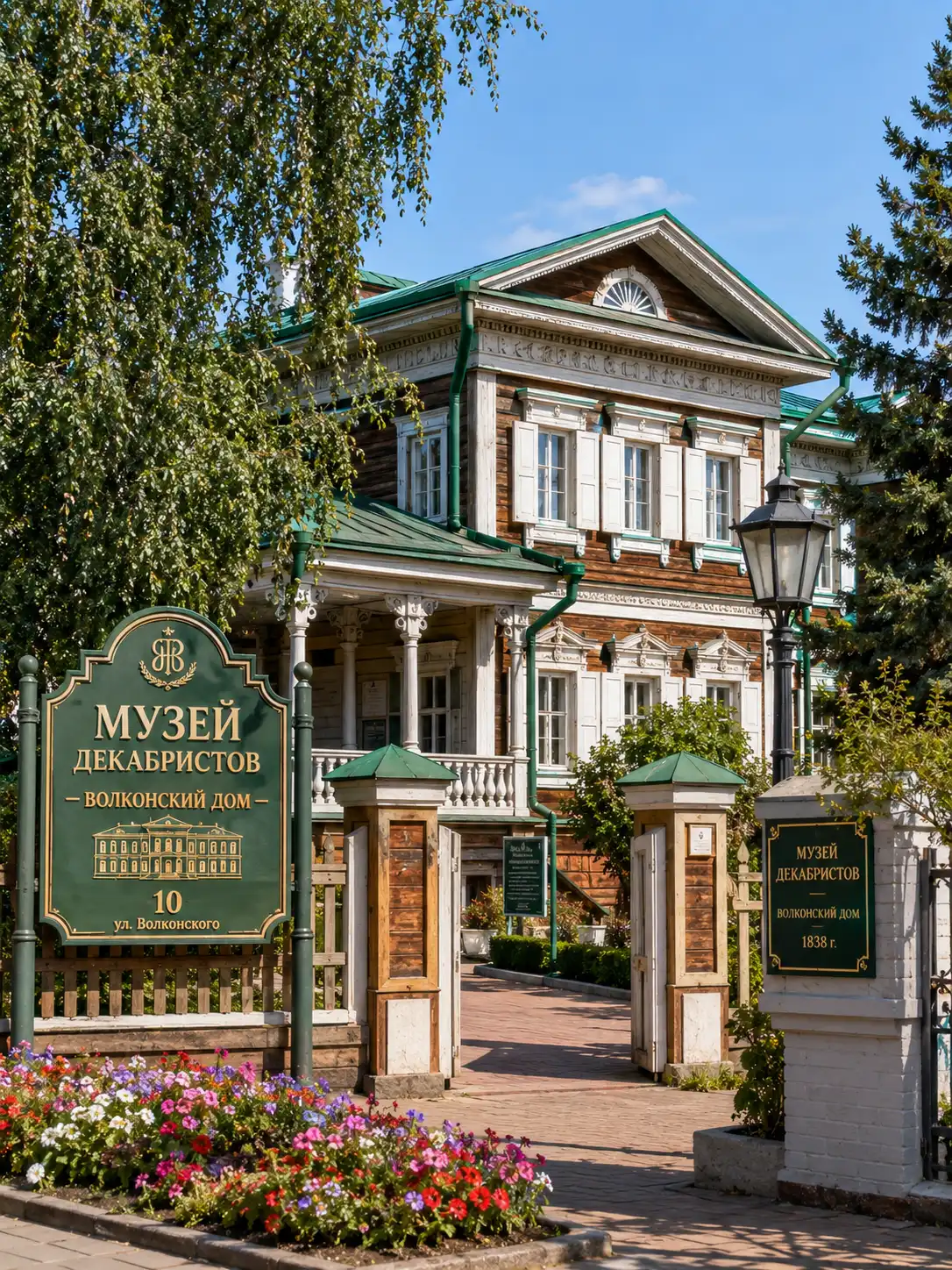
The Irkutsk Regional Memorial Decembrists Museum is one of the most important historical attractions in Irkutsk and one of the strongest places to understand how political exile changed the cultural life of Siberia. The museum consists of two separate wooden estates associated with the families of Prince Sergey Volkonsky and Prince Sergey Trubetskoy, leading participants in the Decembrist movement of 1825.
Known in Russian as Иркутский областной историко-мемориальный музей декабристов, the museum does not focus only on the failed uprising in Saint Petersburg. Its exhibitions explore the much longer story that followed: arrest, trial, forced labour, exile, family separation, settlement in Siberia and the gradual creation of a new intellectual and social environment in Irkutsk.
The two museum houses stand within walking distance of each other but offer different experiences. The Volkonsky House presents an elegant noble estate with reconstructed family interiors, music rooms, personal belongings, domestic buildings and a winter garden associated with Princess Maria Volkonskaya. The Trubetskoy House provides a broader account of the Decembrists, their political ideals, imprisonment, families and life in Siberian settlement.
Together, the houses form one of the most complete memorial complexes devoted to the Decembrists in Russia. The museum was established in 1970 and developed around the estates connected with the Volkonsky and Trubetskoy families. Authentic family objects, documents, books, furniture and musical instruments are displayed within reconstructed nineteenth-century interiors.
For travellers following Wander Russia through Irkutsk, the museum provides essential historical context. The city is often introduced through wooden architecture, Orthodox churches, the Angara River and its role as the gateway to Lake Baikal. The Decembrists Museum reveals another identity: Irkutsk as a place of political exile that became unexpectedly enriched by some of the most educated and culturally active families of imperial Russia.
Who Were the Decembrists?
The Decembrists were members of a political movement formed mainly among officers and nobles during the early nineteenth century.
Many had served in the Russian army during the Napoleonic Wars and travelled through Europe. Their experiences exposed them to constitutional government, legal reform and criticism of absolute monarchy and serfdom.
After returning to Russia, some officers joined secret societies advocating political change. Their goals differed, but they generally included limits on autocratic power, the introduction of constitutional principles and the abolition of serfdom.
The movement reached its decisive moment on December 14, 1825, when rebel officers led troops onto Senate Square in Saint Petersburg. They refused to swear allegiance to Emperor Nicholas I and attempted to force political change during a moment of uncertainty following the death of Alexander I.
The uprising was poorly coordinated and quickly suppressed.
Five leaders were executed. Many others were stripped of rank and noble rights, sentenced to forced labour and sent to Siberia. Their punishment was intended to remove them permanently from the political and social life of European Russia.
Instead, the exiles and their families later became deeply influential in Siberian culture.
Why Irkutsk Became Important to the Decembrists
The first stage of punishment involved prisons and labour sites in Transbaikalia, including mines and fortified settlements.
After completing periods of forced labour, many Decembrists were assigned to permanent settlement in Siberian villages. They were forbidden to return freely to European Russia and lived under varying degrees of police supervision.
Irkutsk became one of the most important centres of this exile world.
Some Decembrists initially lived in rural settlements outside the city. Over time, several families were allowed to move into Irkutsk, which was already a prosperous administrative and commercial centre.
Their arrival had a significant cultural effect.
Many were highly educated and had experience in military leadership, languages, literature, science, art and music. They organised social gatherings, taught children, maintained libraries and introduced intellectual traditions that influenced local society.
The Decembrists did not transform Irkutsk alone, and their role should not overshadow the merchants, officials, Indigenous communities and earlier residents who had already shaped the city. However, their contribution became one of the most celebrated elements of Irkutsk’s nineteenth-century identity.
The Wives Who Followed Them into Exile
One of the most powerful parts of the Decembrist story concerns the women who voluntarily followed their husbands to Siberia.
Under imperial rules, these women had to give up important legal privileges, social status, property rights and, in some cases, contact with children who remained behind. They entered a harsh and uncertain environment far removed from court life and noble society.
Ekaterina Trubetskaya was the first Decembrist wife to reach Siberia. Maria Volkonskaya soon followed.
Their decision became one of the enduring themes of Russian literature and historical memory. The women were portrayed as symbols of loyalty, courage, self-sacrifice and moral strength. The national tourism description of the museum notes that particular attention is given to the wives who followed their husbands into exile and became associated in Russian culture with devotion and selflessness.
The museum presents them not simply as passive companions. They organised households, maintained family life, supported prisoners, built social networks and helped create spaces of culture and education within exile.
The Two Museum Estates
The Decembrists Museum consists of the Volkonsky House at 10 Volkonsky Lane and the Trubetskoy House at 64 Dzerzhinsky Street.
The houses are close enough to visit during the same half-day itinerary.
The Volkonsky House focuses strongly on the life of Sergey and Maria Volkonsky, their children, their estate and their cultural influence in Irkutsk.
The Trubetskoy House places the family of Sergey and Ekaterina Trubetskoy within the wider history of the Decembrist movement, political repression and Siberian settlement.
Visitors interested in the full story should see both houses rather than choosing only one.
The Volkonsky House
The Volkonsky House is one of the most elegant surviving wooden estates in Irkutsk.
The building was originally constructed in 1838 in the village of Urik, where the Volkonsky family lived after Sergey Volkonsky completed part of his punishment and was assigned to settlement. When the family was later allowed to move to Irkutsk, the house was dismantled, transported and reconstructed in the city. Sources generally place this move in the mid-1840s, with the family acquiring land in Irkutsk around 1846.
Transporting a substantial wooden house was possible because traditional Siberian buildings were constructed from interlocking logs. The structure could be carefully taken apart, moved and reassembled.
After reconstruction in Irkutsk, the house was expanded and developed into a refined noble residence.
The building combines elements of classical mansion design with Siberian timber construction. Its balanced façade, upper floor, carved details and surrounding outbuildings show how exiled aristocratic families adapted metropolitan habits to local materials and conditions.
Sergey Volkonsky
Prince Sergey Grigoryevich Volkonsky came from one of Russia’s most distinguished aristocratic families.
He served as an army officer, fought during the Napoleonic Wars and became a general at a relatively young age. His military success placed him within the elite of imperial society.
His participation in the Decembrist movement led to arrest, loss of rank and exile.
The contrast between his former life and Siberian punishment is central to the museum narrative. A general and prince who had moved within the highest levels of Russian society was forced into hard labour and settlement thousands of kilometres from Saint Petersburg.
The museum avoids presenting his Siberian life only as tragedy. It also shows how the family adapted, created a household and became part of Irkutsk’s social world.
Maria Volkonskaya
Maria Volkonskaya is one of the most celebrated figures associated with the Decembrists.
She was young when her husband was arrested and exiled. Despite opposition from relatives and the imperial authorities, she chose to follow him to Siberia.
Her journey became a symbol of personal courage and loyalty.
In Irkutsk, Maria Volkonskaya became known for music, hospitality and cultural activity. The Volkonsky estate developed into an important social meeting place. The house hosted conversations, musical performances and gatherings involving exiled families and members of Irkutsk society.
The museum preserves objects and reconstructed interiors connected with this cultural life, including musical instruments and rooms used for entertaining guests.
Her story is especially important because it complicates the image of exile. Siberia was a place of punishment and loss, but within those restrictions the Volkonskys created a home marked by dignity, education and artistic activity.
The Interiors of the Volkonsky House
The museum rooms recreate the atmosphere of a nineteenth-century noble household adapted to Siberian conditions.
Visitors may see:
- Reception rooms
- Family bedrooms
- A dining room
- A music room
- Children’s spaces
- Personal portraits
- Period furniture
- Books and documents
- Clothing and household objects
- Musical instruments
Some exhibits are authentic belongings associated with Decembrist families, while other furnishings are historically appropriate reconstructions.
The arrangement helps visitors understand everyday life rather than only political history.
The materials, room size and decoration demonstrate how noble traditions survived far from the imperial capital. At the same time, the exposed timber and practical design reveal adaptation to Siberian climate and available resources.
The Winter Garden
One of the most unusual features associated with the Volkonsky estate is the winter garden.
Maria Volkonskaya reportedly cultivated plants in an enclosed space designed to protect them from the severe Irkutsk winter. The reconstructed winter garden illustrates both noble domestic culture and the effort required to preserve beauty and comfort in the Siberian climate.
The garden should not be viewed only as luxury.
For a family cut off from its former environment, plants, music and domestic refinement may also have provided psychological continuity with the life they had lost.
The Pyramid Piano
A distinctive musical object in the museum is the pyramid-shaped piano associated with the Volkonsky household.
Music played an important role in the cultural life of the estate. Maria Volkonskaya was known for her musical interests, and the house became a centre for performances and salons.
The instrument’s unusual vertical shape makes it one of the museum’s most memorable exhibits.
It also reinforces an important point: the Decembrists’ contribution to Irkutsk did not depend only on political ideas. Their homes introduced forms of music, literature, education and social exchange that influenced the city’s cultural development.
The Volkonsky Estate Buildings
The house is part of a larger estate rather than an isolated residence.
The historical complex includes or reconstructs several practical structures, such as:
- Servants’ quarters
- Stables
- A carriage house
- Storage buildings
- A barn
- A well
- Domestic service areas
The estate layout provides a more complete picture of nineteenth-century household organisation.
A noble family depended on servants, horses, food storage, heating and constant physical labour. The refined rooms inside the main house were supported by a much larger practical system outside.
The Trubetskoy House
The Trubetskoy House Museum is located at 64 Dzerzhinsky Street.
The building is one of Irkutsk’s most unusual wooden houses and is associated with the memory of Prince Sergey Trubetskoy, his wife Ekaterina and the broader Decembrist community. The museum exhibition reopened in 2011 after a major restoration begun in 2007. Its principal exhibition, “A Fate That Reflected an Era,” presents the Trubetskoy family and their circle within reconstructed mid-nineteenth-century interiors.
Historical discussion continues regarding the exact relationship between the present house and the Trubetskoy family. Some specialists note that the family’s direct residence in the building is not documented as clearly as the Volkonskys’ connection with their estate.
The museum addresses this by presenting the house as a memorial and historical space devoted not only to one residence but to the wider Decembrist experience.
Sergey Trubetskoy
Prince Sergey Trubetskoy was selected as one of the principal leaders of the Decembrist uprising.
He was intended to act as the uprising’s “dictator” or central coordinator on December 14, 1825.
However, he did not appear on Senate Square at the decisive moment.
This absence became one of the most controversial episodes in Decembrist history. Interpretations range from fear and collapse of confidence to a recognition that the uprising had little chance of success.
Trubetskoy was arrested, sentenced and sent to Siberia.
His later life was shaped by exile, settlement and family responsibility rather than by the single dramatic day for which he is usually remembered.
Ekaterina Trubetskaya
Ekaterina Trubetskaya was the first wife of a Decembrist to follow her husband into Siberia.
Her journey became a precedent for the other women.
Authorities attempted to discourage her by describing the severe conditions and requiring her to surrender noble privileges. She continued despite these warnings.
In Siberia, she supported her husband and other exiles, helped organise family life and became a stabilising figure within the Decembrist community.
Her story is presented through documents, portraits, domestic objects and the broader interpretation of the museum.
She died in Irkutsk before the general amnesty of 1856 and was buried at Znamensky Monastery together with several of her children. The grave provides a powerful connection between the Decembrists Museum and another of Irkutsk’s major historical sites.
What Can Be Seen in the Trubetskoy House?
The Trubetskoy House focuses more directly on political history and the collective experience of the Decembrists.
Exhibits may include:
- Portraits of movement members
- Copies and original documents
- Books and letters
- Maps of exile routes
- Objects connected with forced labour
- Family belongings
- Reconstructed domestic rooms
- Information about secret societies
- Material on the uprising of 1825
- Exhibitions about the Decembrist wives
The house helps visitors follow the story from aristocratic society and military service through political conspiracy, rebellion, imprisonment and life in Siberia.
Wooden Architecture
Both houses are important examples of Irkutsk’s wooden architectural heritage.
The Volkonsky House combines noble classical planning with Siberian construction.
The Trubetskoy House has a more compact and unusual exterior, with carefully proportioned timber walls, carved details and an elevated central section.
The houses should be examined from outside as well as inside.
Visitors can observe:
- Log construction
- Carved window surrounds
- Timber galleries
- Decorative cornices
- Raised foundations
- Steep roofs adapted to snow
- Enclosed service yards
- Traditional Siberian craftsmanship
These features connect the museum with the broader wooden architecture seen in 130 Kvartal and older residential streets.
The difference is that the Decembrist estates preserve architecture together with documented family history, making the houses both artistic and biographical monuments.
Decembrist Evenings
The museum maintains a tradition known as Decembrist Evenings.
These cultural events are generally associated with the anniversary period of the December uprising and may include lectures, theatrical programmes, concerts, readings and historical discussions. One travel source notes that the festival is traditionally held during the second half of December.
The events continue the cultural atmosphere historically associated with the Volkonsky household.
Visitors interested in attending should verify the current programme well in advance, as individual events may require reservations and schedules vary from year to year.
Music and Cultural Programmes
The Volkonsky estate is particularly suited to chamber concerts and historical musical programmes.
The intimate rooms, wooden interiors and association with Maria Volkonskaya create an appropriate setting for nineteenth-century music.
Museum events may also include literary evenings, educational programmes and performances explaining the Decembrist period.
These activities prevent the houses from becoming static memorials. They continue the role of the estate as a cultural meeting place.
How Much Time Is Needed?
A visit to one house normally requires approximately one to one and a half hours.
Seeing both houses properly requires around three hours, especially when using an audio guide or joining a guided tour.
Visitors with a deep interest in Russian political history, literature or wooden architecture may spend half a day in the museum district.
The two estates should not be rushed. Their value lies in personal details, room arrangements and the gradual narrative rather than in one spectacular object.
Opening Hours
Current national tourism information lists the museum as generally open Tuesday through Sunday from 11:00 until 18:00, with Monday closed.
Other listings have shown slightly different opening times, and the two branches have sometimes followed different weekly closure schedules.
Visitors should therefore check the official museum website shortly before travelling, especially when planning to see both estates on the same day.
Holiday schedules, restoration work and cultural events can also affect access.
Language and Guided Tours
Much of the detailed interpretation may be presented primarily in Russian.
Travellers who do not read Russian will benefit from an audio guide, translation application or organised English-language tour.
A guide is particularly useful because the story includes many people, family relationships, political organisations and stages of punishment.
Without explanation, the rooms may look like attractive nineteenth-century interiors. With historical context, they become evidence of exile, adaptation and cultural influence.
Photography
Photography rules may vary by room and temporary exhibition.
Exterior photography is generally straightforward.
Inside, flash and professional equipment may be restricted to protect documents, textiles and historic objects.
Useful photographic subjects include:
- The Volkonsky House façade
- Carved wooden details
- Estate courtyards
- The winter garden
- Period rooms
- Musical instruments
- The Trubetskoy House exterior
- Historic staircases
- Books, portraits and domestic objects
- Snow-covered wooden buildings in winter
Visitors should avoid leaning on furniture or crossing barriers for a better photograph.
Best Time to Visit
The museum can be visited throughout the year.
Summer and early autumn provide comfortable conditions for walking between the two estates and exploring the outdoor buildings.
Winter creates a historically appropriate atmosphere. Snow around the wooden houses makes it easier to imagine the severity of Siberian exile, though temperatures may be extremely low.
A weekday morning usually provides the quietest experience.
December can be especially meaningful because of the anniversary of the uprising and the traditional Decembrist Evenings, but it may also bring special-event crowds and altered opening arrangements.
Combining the Museum with Other Attractions
The Decembrists Museum can be combined with several nearby sights.
A practical route includes:
- Volkonsky House
- Trubetskoy House
- Transfiguration Church
- Historic wooden residential streets
- Central Irkutsk
- 130 Kvartal
- Znamensky Monastery on a separate extension
The museum also pairs naturally with Znamensky Monastery because Ekaterina Trubetskaya and several of her children are buried there.
This route connects domestic exile history with religious and burial memory.
Accessibility
The museum occupies historic wooden buildings that were not originally designed for modern accessibility.
Steps, narrow doorways, raised thresholds and upper floors may present difficulties.
The Volkonsky estate includes several separate buildings and outdoor surfaces that can become slippery in winter.
Visitors with specific mobility requirements should contact the museum in advance to determine which rooms and exhibitions can be reached.
Is the Decembrists Museum Worth Visiting?
The Decembrists Museum is essential for travellers interested in Russian history, exile, literature or the cultural development of Siberia.
Its strength lies in the human scale of the story.
The failed uprising in Saint Petersburg lasted only a few hours. The consequences lasted for decades.
The museum shows those consequences through houses, letters, furniture, portraits, music and family life.
Wander Russia recommends visiting both the Volkonsky and Trubetskoy houses and allowing at least three hours for the complete experience.
Frequently Asked Questions
What is the Decembrists Museum?
It is a two-estate memorial museum devoted to the Decembrist movement, Siberian exile and the families of Sergey Volkonsky and Sergey Trubetskoy.
Where is the Volkonsky House?
It is located at 10 Volkonsky Lane in Irkutsk.
Where is the Trubetskoy House?
It is located at 64 Dzerzhinsky Street.
When was the museum founded?
The memorial museum was established in 1970.
Are the houses original?
The Volkonsky House was built in Urik in 1838, later dismantled and moved to Irkutsk. The Trubetskoy House is a historic wooden building used as a memorial museum, though the exact extent of the family’s direct residence there has been debated.
How long is needed?
Allow one to one and a half hours for each house or around three hours for both.
Are the houses close together?
Yes. They can be reached on foot during the same visit.
What are the main exhibits?
Family possessions, portraits, documents, books, furniture, musical instruments and reconstructed nineteenth-century interiors.
When is the museum open?
Current tourism information generally lists Tuesday through Sunday from 11:00 to 18:00, with Monday closed, but branch schedules should be verified before visiting.
Is the museum suitable for children?
Older children interested in history may find the stories and interiors engaging. Younger visitors may benefit from an educational or guided programme.
Conclusion
The Irkutsk Decembrists Museum tells one of the most remarkable stories in Siberian history.
The events began in Saint Petersburg with a failed political uprising led mainly by noble officers. The rebellion was suppressed quickly, but its consequences stretched across thousands of kilometres and several decades.
Men who had served as generals, princes and educated members of imperial society were sent to mines, prisons and remote settlements.
Their wives faced a separate choice.
Ekaterina Trubetskaya, Maria Volkonskaya and others surrendered comfort, legal privilege and family security to follow their husbands into exile. Their decisions became symbols of courage and devotion, but the museum also shows the practical reality behind those ideals: difficult journeys, household labour, illness, separation and the challenge of building a new life.
The two museum houses bring that history into a personal scale.
The Volkonsky estate reveals a family that recreated a cultured home in Siberia. Music, books, plants and social gatherings transformed exile into a new centre of intellectual life.
The Trubetskoy House explains the broader political movement, the uprising, punishment and the network of families who created a shared community in Siberia.
These stories also changed Irkutsk.
The Decembrists did not arrive as ordinary settlers. They carried education, artistic interests, European experience and political ideas. Within the restrictions imposed upon them, they taught, wrote, organised music and participated in the cultural development of the city.
Their influence later became part of Irkutsk’s civic identity.
The houses themselves add another layer. They preserve the refined possibilities of Siberian wooden architecture and demonstrate how metropolitan noble culture was adapted to local materials and climate.
For Wander Russia, the Decembrists Museum is the essential eighth destination in Irkutsk.
It shows that Siberia was not only a distant place of punishment. It also became a place where displaced people created families, culture and new forms of belonging.
