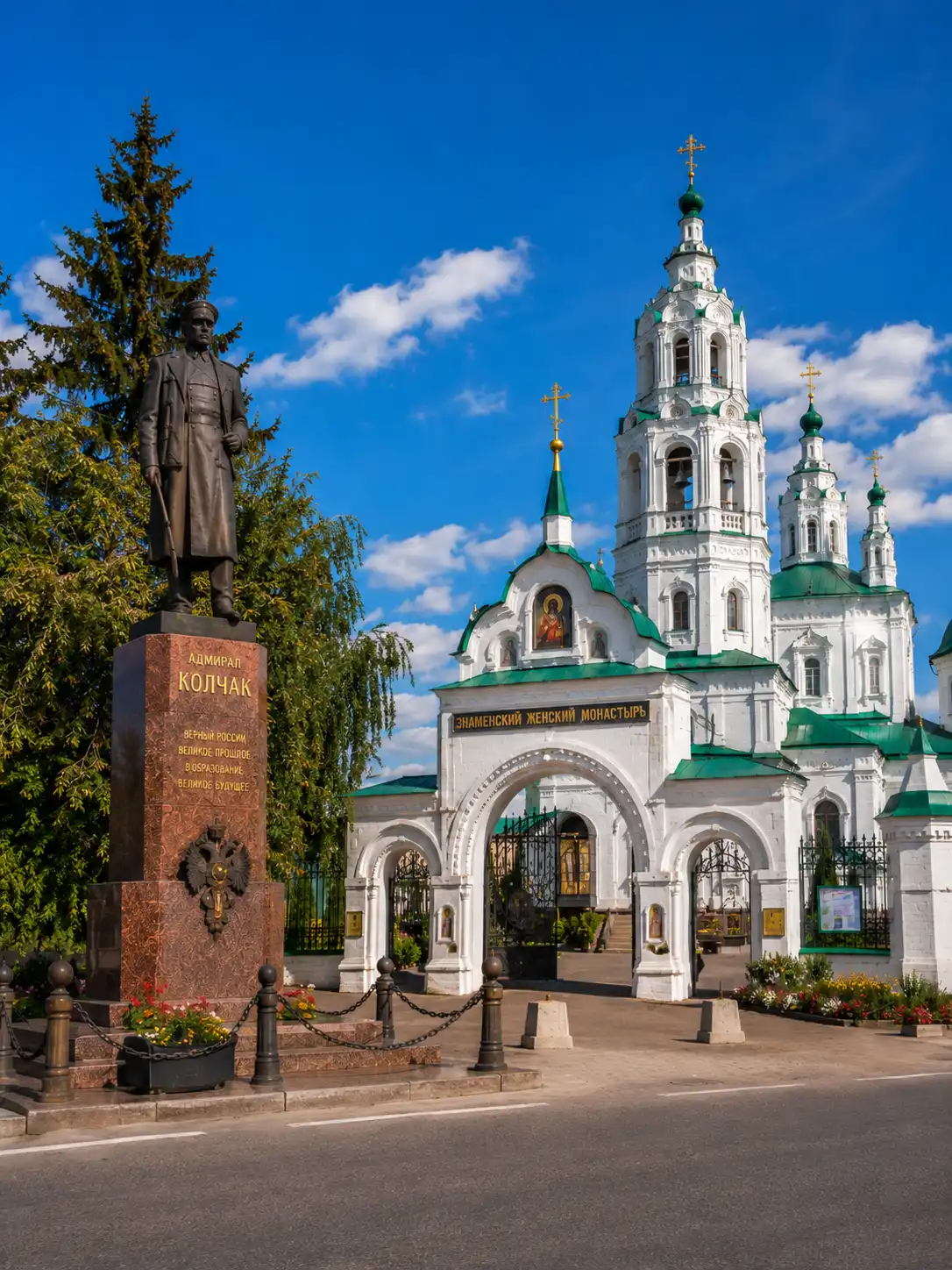
Znamensky Monastery is one of the oldest Orthodox monastic complexes in Siberia and one of the most historically layered religious sites in Irkutsk. Located near the meeting of the Ushakovka and Angara rivers, the active women’s monastery combines Siberian Baroque architecture, sacred relics, a historic cemetery, the grave of explorer and merchant Grigory Shelikhov, and a controversial monument to Admiral Alexander Kolchak.
Known in Russian as Знаменский монастырь, the monastery was founded in 1689, less than three decades after the establishment of Irkutsk. Its original buildings were constructed from wood, while the surviving stone Church of the Sign was begun in 1757 with financial support from Irkutsk merchant Ivan Bichevin. The main church was later remodelled internally during the nineteenth century.
The monastery’s location outside the most compact part of the historic centre gives it a quieter atmosphere than Kirov Square, Epiphany Cathedral or the Church of the Savior. Trees and enclosed monastic grounds separate the religious complex from the surrounding roads, while the nearby rivers connect the site with the geography that shaped early Irkutsk.
Znamensky Monastery is not merely an architectural monument. It remains an active Orthodox convent and a place of pilgrimage. The Church of the Sign houses sacred objects connected with Saint Innocent of Irkutsk, the first Orthodox bishop of the city and an important missionary figure in Siberian history. The monastery cemetery preserves the graves of religious leaders, merchants, explorers and members of prominent Irkutsk families.
The entrance area also contains the large bronze monument to Admiral Alexander Kolchak, the White movement leader who was executed in Irkutsk in February 1920. Installed in 2004, the monument connects the monastery with one of the most disputed episodes of the Russian Civil War.
For travellers following Wander Russia through Irkutsk, Znamensky Monastery provides an essential combination of religion, architecture, imperial expansion, Siberian exploration and revolutionary history. This guide explains the foundation of the monastery, the Church of the Sign, the sacred relics, the cemetery, the Kolchak monument, visitor etiquette, photography and practical planning.
Where Is Znamensky Monastery?
Znamensky Monastery is located in the right-bank district of Irkutsk, near the confluence of the Ushakovka River with the Angara.
The complex lies northeast of Kirov Square and the oldest central churches. It is close enough to reach from central Irkutsk without a long journey, but it is not part of the most compact pedestrian sightseeing zone. Visitors normally arrive by taxi, public transport or as part of a guided city excursion.
The monastery stands near Angarskaya Street and the traffic circle leading toward the historic Rabocheye district. Its position beside two rivers once provided both physical separation and practical access.
The surrounding area feels noticeably calmer after entering the monastery gates. Traffic noise decreases, trees enclose the grounds and the religious buildings become the dominant visual focus.
The complex can be combined efficiently with Kazan Church because both attractions lie outside the main Kirov Square cluster and can be reached during the same half-day route.
Why Znamensky Monastery Is One of Irkutsk’s Must-See Places
Znamensky Monastery deserves a place among Irkutsk’s essential sights because it represents several important parts of Siberian history within one compact complex.
It is one of the oldest surviving monasteries in the region, an active centre of Orthodox worship and a notable example of eighteenth-century stone architecture.
The monastery also preserves:
- The Church of the Sign
- The relics associated with Saint Innocent of Irkutsk
- A historic monastic cemetery
- The grave of Grigory Shelikhov
- The Alexander Kolchak monument
- Connections with missionary history
- Evidence of Soviet religious suppression
- Modern Orthodox revival
Few sites in Irkutsk combine so many different historical themes.
The older churches around Kirov Square explain the foundation and architectural development of the city. Znamensky Monastery adds monastic life, missionary activity, merchant patronage, exploration of the North Pacific and the political violence of the Russian Civil War.
The Foundation of the Monastery in 1689
Znamensky Monastery was founded in 1689, making it one of the oldest Orthodox monastic institutions in Siberia.
Irkutsk itself had been established only in 1661. The creation of a monastery within the following decades demonstrates how quickly the settlement developed from a wooden military post into a permanent administrative and religious centre.
The first monastic buildings were constructed from wood. This was typical of early Siberian settlements, where timber was abundant and stone construction remained expensive and technically difficult.
The original complex included a wooden church, monastic cells and practical buildings needed to support the community.
As with many wooden religious institutions, fire, decay and Siberian weather threatened the early structures. The gradual replacement of wood with stone reflected both economic growth and the desire to create a more permanent spiritual centre.
A Women’s Monastery
Znamensky Monastery developed as a women’s religious community.
Orthodox convents traditionally provided places for prayer, communal work, charity and spiritual discipline. They could also offer refuge for widows, elderly women and others who chose or required religious community life.
The monastery’s role extended beyond private devotion.
Nuns participated in embroidery, sewing, icon decoration, education, care and practical work supporting the complex. Monasteries often became centres where religious objects, vestments and decorative textiles were produced.
The active female community continues today, meaning visitors are entering a living convent rather than a historical museum.
Residential areas, working buildings and private monastic spaces should therefore be respected and avoided unless public entry is clearly indicated.
The Church of the Sign
The principal architectural monument is the Church of the Sign of the Mother of God.
The stone church was founded in 1757 with the financial support of Irkutsk merchant Ivan Bichevin. It became the central religious building of the monastery and one of the notable surviving Orthodox churches of eighteenth-century Irkutsk.
The name refers to the Orthodox icon known as Our Lady of the Sign.
This image generally presents the Mother of God with raised hands in prayer and the Christ Child shown within a circular medallion. The icon symbolises the Incarnation and the prophetic sign of divine presence.
Churches dedicated to this image became widespread across Russia, and the dedication gave the monastery its modern name.
Siberian Baroque Architecture
The Church of the Sign reflects the regional development of Siberian Baroque.
This architectural tradition combined Russian Orthodox building forms with decorative influences adapted to Siberian craftsmanship and materials. Churches often display ornamented window surrounds, layered cornices, curved gables and carefully modelled brick façades.
The monastery church is usually described as richly decorated with white architectural ornament that resembles stone lacework.
Its visual character is more restrained than the colourful Epiphany Cathedral but more decorative than the early Church of the Savior.
The façade includes:
- White plastered walls
- Ornamental window frames
- Repeated arches and mouldings
- Green roof elements
- Golden Orthodox crosses
- A strong vertical bell-tower composition
- Decorative gables
- Layered eighteenth-century forms
The building should be viewed from several angles because the monastic grounds reveal architectural relationships that are not obvious from the entrance alone.
Nineteenth-Century Interior Changes
The interior of the Church of the Sign was remodelled during the nineteenth century.
A major interior reconstruction took place in 1882 according to a design associated with architect V. A. Kudelsky.
This means the building does not represent one completely unchanged eighteenth-century moment.
Like many active churches, it evolved according to liturgical needs, artistic taste, available funding and structural requirements.
Icons, wall paintings, decorative carving and the arrangement of the sacred spaces were altered or renewed over time.
The interior visitors see today also reflects later restoration after the Soviet period.
Saint Innocent of Irkutsk
One of the monastery’s most important religious associations is Saint Innocent of Irkutsk.
Born Ivan Kulczycki around 1680, he became a monk, teacher and bishop. He was originally prepared for missionary leadership connected with China but was later appointed the first bishop of Irkutsk in 1727. He learned Mongolian and became closely associated with Orthodox missionary work in Siberia.
He died in 1731 and was canonised in 1804.
Saint Innocent is sometimes called the Apostle of Siberia because of his role in the development of Orthodox Christianity across the region.
His relics became an important object of pilgrimage, and Znamensky Monastery is identified as his principal shrine in Irkutsk.
Visitors may encounter worshippers praying before the shrine, lighting candles or leaving written requests.
This area should be approached with particular respect. Photography may be restricted, and visitors should avoid blocking pilgrims or treating the shrine as a curiosity.
Religious Art and Iconostases
The church interior contains icons, carved details, frescoes and an Orthodox iconostasis separating the altar from the main worship space.
An iconostasis is not simply a decorative screen. Its organised rows of icons communicate the structure of Orthodox sacred history and establish the symbolic boundary of the altar.
Travel descriptions frequently highlight the monastery’s icons and richly painted interior as principal features.
The atmosphere is usually quieter and more intimate than in the larger churches of central Irkutsk.
Candlelight, chanting and incense can make even a short visit memorable, especially when a service is taking place.
The Historic Cemetery
The monastery cemetery is one of the most historically valuable parts of the complex.
It contains graves connected with church leaders, merchants, explorers and influential Irkutsk families. The surviving monuments vary in age, style and condition.
Some graves are marked by stone crosses or elaborate monuments, while others are more modest.
The cemetery illustrates how monasteries served as prestigious burial locations. Wealthy benefactors and notable regional figures often wished to be buried close to a sacred institution.
Visitors should move quietly, remain on established paths and avoid sitting or leaning on grave monuments.
The Grave of Grigory Shelikhov
One of the best-known graves belongs to Grigory Shelikhov.
Shelikhov was an eighteenth-century Russian merchant and explorer associated with commercial expansion into Alaska and the North Pacific. His activities helped establish Russian settlements and trading interests in what became Russian America.
He is often described as one of the principal early organisers of Russian colonisation in Alaska.
His burial at Znamensky Monastery links Irkutsk with a much wider history stretching across Siberia and the Pacific Ocean. Visitor accounts identify his grave as one of the most significant monuments in the cemetery.
Shelikhov’s legacy should be understood critically.
His activities supported exploration and commerce, but they also formed part of colonial expansion that profoundly affected Indigenous communities in Alaska and the North Pacific.
The grave therefore represents both regional ambition and the complex consequences of imperial expansion.
Other Burials and Irkutsk Society
The cemetery also preserves graves connected with clergy, merchants and members of prominent local families.
These monuments reveal the social networks that supported the monastery.
Merchant donations financed buildings, icons, church vessels and charitable work. In return, benefactors could gain prestige, commemoration and burial within sacred ground.
The cemetery functions as a historical record of Irkutsk society.
Names, inscriptions and artistic styles show how wealth, faith and civic identity were expressed across different periods.
A guided visit is particularly valuable because many inscriptions are in Russian and the significance of individual graves may not be obvious without explanation.
Closure During the Soviet Period
The monastery was closed during the Soviet campaign against religious institutions.
The Church of the Sign was officially closed on July 17, 1934, and monastery buildings were transferred to the Irkutsk hydroport.
This change ended organised monastic life and removed the complex from its original religious function.
Buildings were adapted for secular uses, while sacred objects and interior decorations were damaged, removed or dispersed.
The survival of the principal church was fortunate. Many monasteries and churches across the Soviet Union were demolished completely.
In Irkutsk, practical reuse and later heritage recognition helped preserve enough of the complex for restoration.
Return to Religious Use
Individual monastery buildings, including the Church of the Sign, were returned to believers in 1945.
This return occurred earlier than the revival of many other religious institutions and reflected the partial relaxation of anti-religious policy during and after the Second World War.
The church gradually resumed its religious role.
Full monastic life and restoration developed further during the late Soviet and post-Soviet periods.
The complex now functions again as an active women’s monastery, with regular worship, pilgrimage and religious administration.
Alexander Kolchak and Irkutsk
The monastery entrance is closely associated with Admiral Alexander Kolchak.
Kolchak was a naval officer, polar explorer and leader of the anti-Bolshevik White movement during the Russian Civil War. He assumed the title of Supreme Ruler of Russia but was eventually captured and transferred to authorities in Irkutsk.
He was interrogated in the city and executed in February 1920. His body was reportedly placed beneath the ice of the Ushakovka River.
The exact circumstances and location continue to carry political and historical sensitivity.
Kolchak remains a deeply disputed figure. Supporters emphasise his naval career, polar exploration and opposition to Bolshevism. Critics focus on authoritarian rule, repression and violence carried out under his government.
The Kolchak Monument
The bronze monument to Alexander Kolchak stands near the entrance to Znamensky Monastery.
It was installed in 2004 to mark the 130th anniversary of his birth. The monument was created by sculptor Vyacheslav Klykov and shows the admiral standing in a long military coat.
The pedestal contains relief figures representing a White Guard soldier and a Red Army soldier crossing weapons.
This imagery symbolises the civil conflict that divided Russia after the Revolution.
The location was selected because Kolchak’s final days and execution are associated with this part of Irkutsk. However, the exact execution site is marked separately by a memorial cross near the Ushakovka River.
The monument has generated controversy because Kolchak has not been legally rehabilitated by Russian courts, and interpretations of his historical role remain divided.
Visitors should therefore understand the statue as a contested work of historical memory rather than a neutral military monument.
The Monastery and the Russian Civil War
The presence of the Kolchak monument creates an unusual relationship between sacred space and political history.
The monastery itself predates the Revolution by more than two centuries. Its buildings belong to Orthodox religious history, while the monument at the entrance introduces the violence and ideological division of the Civil War.
This contrast makes the site especially valuable for travellers interested in the complexity of Russian memory.
Irkutsk contains monuments connected with imperial rule, Soviet power, political exile and anti-Bolshevik forces. Znamensky Monastery brings several of these narratives together within one location.
Visitor Etiquette
Znamensky Monastery remains an active convent.
Appropriate behaviour includes:
- Speaking quietly
- Wearing modest clothing
- Removing hats for men inside the church
- Covering shoulders and knees
- Following local guidance regarding head coverings
- Avoiding private monastic buildings
- Not photographing nuns or worshippers without permission
- Remaining quiet near graves and sacred relics
- Following signs regarding interior photography
- Avoiding food, smoking and loud conversation within the grounds
Visitors do not need to participate in Orthodox rituals.
Respectful observation is sufficient.
Photography
The monastery offers several strong photographic subjects.
Useful compositions include:
- The Church of the Sign framed by trees
- White decorative architecture against blue sky
- Green roofs and golden crosses
- Cemetery monuments
- The Kolchak statue at the entrance
- Snow-covered grounds in winter
- Religious details and exterior carvings
- The church viewed through the monastery gates
- Candlelight inside when photography is permitted
- Autumn foliage surrounding the complex
The best exterior light often appears during morning or late afternoon.
Cemetery photography should remain respectful. Visitors should avoid theatrical poses, standing on graves or treating burial monuments as decorative props.
Best Time to Visit
The monastery can be visited throughout the year.
Late spring and summer provide comfortable walking conditions and green surroundings.
September is particularly attractive because the grounds become quieter and early autumn colours add warmth to the white architecture.
Winter creates a more solemn atmosphere. Snow, dark trees and the monastery walls produce a distinctly Siberian landscape.
However, winter temperatures can be severe, and paths may be icy.
A weekday morning generally offers the calmest experience.
Sundays and Orthodox feast days provide more active religious life but may bring larger congregations.
Opening Hours
Current third-party travel listings commonly show daytime access, often around 09:00 to 17:00, but the monastery is an active religious institution and schedules may change according to services, holidays and internal requirements.
Visitors should treat published times as general guidance rather than a permanent museum schedule.
The outdoor entrance area and Kolchak monument may remain visible outside church visiting hours, but access to the monastery grounds or interior should never be assumed.
How to Reach the Monastery
A taxi is the simplest option from Kirov Square, 130 Kvartal or Irkutsk railway station.
Public transport also serves the surrounding district. Some visitor guides mention routes from central Irkutsk toward the Fortuna area, but transport numbers and stops can change. Current local navigation services are more reliable than older printed information.
The monastery can also be included in a guided city tour focusing on Orthodox architecture or Russian Civil War history.
Walking from the central historical district is possible for active visitors, but the route passes busy roads and is less scenic than the compact centre.
How Much Time Is Needed?
A basic visit takes approximately 45 minutes.
A more complete visit including the church, sacred shrine, cemetery and Kolchak monument requires one to one and a half hours.
Travellers interested in Russian Civil War history, religious art or cemetery inscriptions may spend two hours.
The site works well as part of a half-day itinerary with Kazan Church.
Suggested Half-Day Route
A practical eastern Irkutsk route includes:
- Kazan Church
- Znamensky Monastery
- Kolchak Monument
- Historic monastery cemetery
- Ushakovka River memorial area
- Return to the central city
This combination presents late imperial architecture, active Orthodox life and Civil War memory within one manageable route.
Visitors should allow extra time for transport because these attractions lie outside the tight Kirov Square sightseeing zone.
Accessibility
The principal monastery paths are generally manageable, but individual church entrances may include steps and raised thresholds.
The historic cemetery contains uneven surfaces and narrow routes.
Winter snow and ice can significantly reduce accessibility.
Visitors with mobility requirements should use a taxi and ask locally which entrance provides the easiest route.
Because the site remains an active convent, modern accessibility modifications may be more limited than at purpose-built museums.
Is Znamensky Monastery Worth Visiting?
Znamensky Monastery is essential for travellers who want to understand Irkutsk beyond its central churches and wooden architecture.
Its importance comes from the combination of sacred life, architectural history, missionary tradition, merchant patronage, exploration and political memory.
The monastery is quieter and less immediately colourful than Kazan Church or Epiphany Cathedral, but its historical depth is exceptional.
Wander Russia recommends allowing at least one hour and approaching the site as both a religious institution and a place of complex historical memory.
Frequently Asked Questions
When was Znamensky Monastery founded?
The monastery was founded in 1689, making it one of the oldest Orthodox monasteries in Siberia.
When was the stone Church of the Sign built?
Its foundation was laid in 1757 with support from merchant Ivan Bichevin.
Is the monastery still active?
Yes. It functions as an active women’s Orthodox monastery.
What is the main sacred object?
The monastery is closely associated with the relics of Saint Innocent of Irkutsk, the city’s first bishop and an important Siberian missionary.
Who is buried in the monastery cemetery?
The cemetery contains graves of clergy, merchants and prominent regional figures, including explorer and merchant Grigory Shelikhov.
Why is there a monument to Kolchak?
Alexander Kolchak was executed in Irkutsk in 1920. The monument was installed near the monastery in 2004 because his final days are associated with this area.
Was the monastery closed during the Soviet period?
Yes. The Church of the Sign was closed in 1934, and monastery property was transferred to the Irkutsk hydroport. Some buildings were returned to believers in 1945.
Is there an entrance fee?
General access to active Orthodox churches and monastery grounds is usually free, though donations are welcome.
How long should visitors stay?
Allow approximately one to one and a half hours.
What should be combined with the monastery?
Kazan Church is the most practical nearby attraction to combine with Znamensky Monastery.
Conclusion
Znamensky Monastery is one of the places where the long and complicated history of Irkutsk becomes especially visible.
The monastery was founded in 1689, when Irkutsk was still a young Siberian settlement. Its first wooden buildings represented the early expansion of Orthodox religious life eastward.
The later stone Church of the Sign reflected a more prosperous city supported by merchants, trade and regional administration.
Its architecture preserved the decorative language of eighteenth-century Siberia, while nineteenth-century changes adapted the interior to new artistic and religious expectations.
The monastery also became a place of burial and memory.
Grigory Shelikhov’s grave connects Irkutsk with Russian expansion toward Alaska and the North Pacific. The relics of Saint Innocent connect the monastery with missionary history and the development of the Siberian diocese.
The Soviet period brought closure, confiscation and secular use. Yet the Church of the Sign survived and returned to worship earlier than many other religious buildings.
The active convent visible today represents continuity after decades of disruption.
The Kolchak monument adds an entirely different layer.
Its presence at the entrance confronts visitors with the unresolved memory of the Russian Civil War. Kolchak can be interpreted as admiral, explorer, authoritarian ruler, anti-Bolshevik leader or victim of revolutionary violence. The monument does not settle that debate. It makes the debate visible.
This combination makes Znamensky Monastery far more than a quiet religious stop.
It is a place where Orthodox faith, Siberian colonisation, merchant wealth, Pacific exploration, Soviet repression and Civil War memory meet.
For Wander Russia, Znamensky Monastery is the essential seventh destination in Irkutsk and one of the strongest places for understanding the city’s spiritual and political depth.
