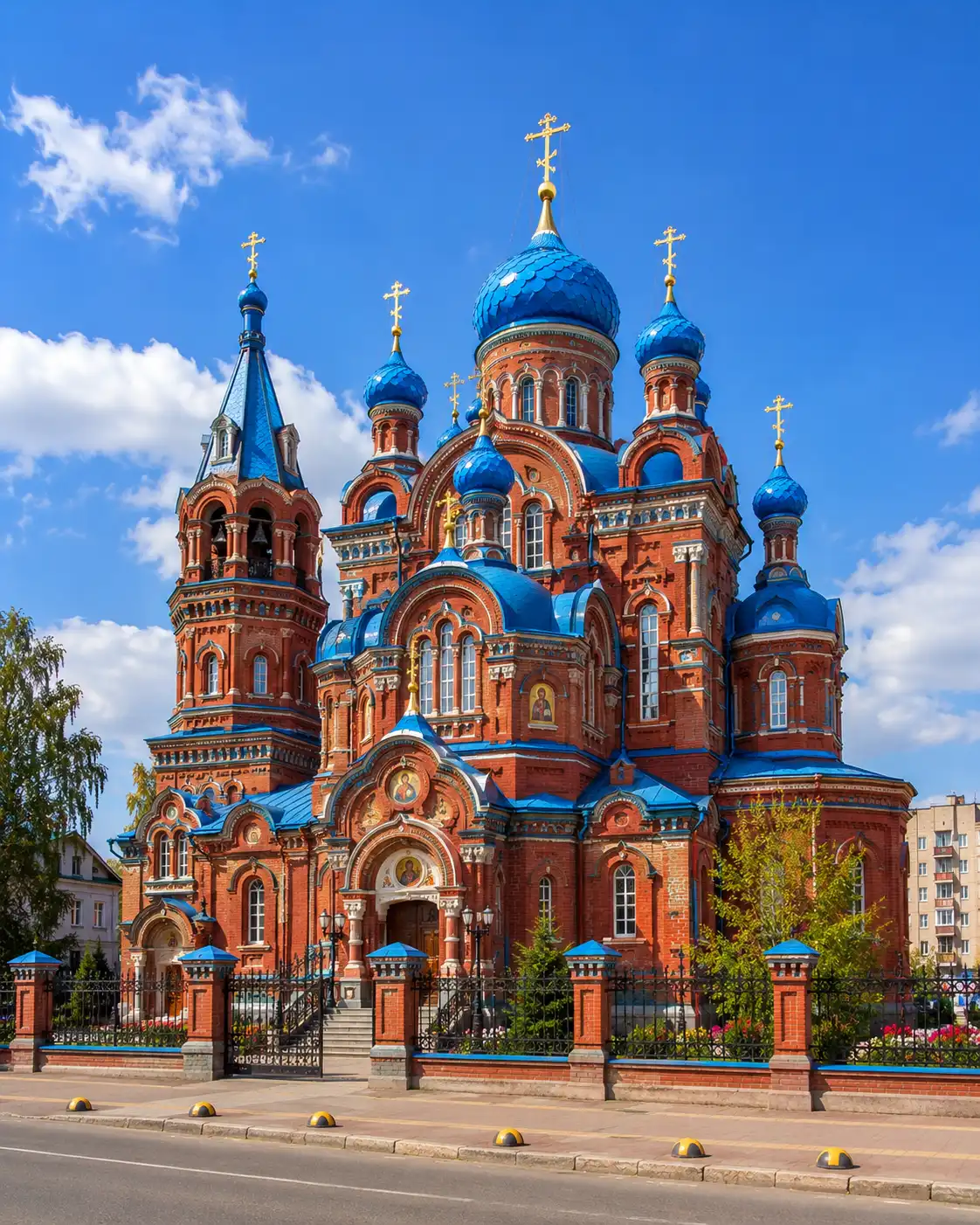
Kazan Church is one of the most visually impressive Orthodox landmarks in Irkutsk and one of the most recognisable religious buildings in eastern Siberia. Located in the historic Rabocheye suburb northeast of the city centre, the church is known for its red-brick walls, blue domes, golden crosses, rounded towers and richly decorated interior.
Known in Russian as Казанская церковь or Храм Казанской иконы Божией Матери, the building is dedicated to the Kazan Icon of the Mother of God, one of the most revered sacred images in Russian Orthodoxy. The church was built during the final decades of the Russian Empire, when Irkutsk was expanding rapidly as a commercial, administrative and transport centre.
Construction began in 1885 and continued for approximately seven years. The church opened to worshippers in 1892, supported largely by donations from local merchants, industrialists and residents of the surrounding craftsmen’s settlement. Its Russian-Byzantine architectural style, symmetrical plan and colourful domes made it one of the most ambitious religious buildings constructed in Irkutsk during the nineteenth century.
The building should not be confused with the former Kazan Cathedral that once stood near Kirov Square. That larger cathedral was constructed in the late nineteenth century and destroyed during the Soviet era. The surviving Kazan Church on Barrikad Street is a separate building and remains an active place of Orthodox worship.
During the Soviet period, the church was closed and adapted for several secular functions. It served as a warehouse, a training facility and a workshop before restoration began during the final years of the Soviet Union. Religious life later returned, and the building again became one of the most important Orthodox centres in Irkutsk.
For travellers following Wander Russia through Irkutsk, Kazan Church provides a strong contrast with the older Church of the Savior and Epiphany Cathedral. Those churches represent the early eighteenth-century development of the city, while Kazan Church reflects the wealth, confidence and architectural ambition of late imperial Irkutsk.
This complete guide explains the church’s history, architecture, interior, iconostasis, religious significance, Soviet transformation, visitor etiquette, photography opportunities and practical travel information.
Where Is Kazan Church?
Kazan Church stands at 34 Barrikad Street in Irkutsk’s Rabocheye suburb.
The district lies northeast of the compact historical centre and was historically associated with craftsmen, workers and industrial activity. It was once known as Remeslennaya Sloboda, meaning the Craftsmen’s Settlement.
The church therefore developed outside the oldest fortress district around Kirov Square, the Church of the Savior and Epiphany Cathedral.
Its location reflects the nineteenth-century expansion of Irkutsk. As the population increased, new residential districts required additional churches, schools and community institutions.
Kazan Church became the principal religious landmark of this growing neighbourhood.
The church is not as easy to include in a central walking route as the monuments around Kirov Square. Most visitors reach it by taxi, public transport or private vehicle. The journey from central Irkutsk is relatively short, but traffic and weather should be considered.
The commonly listed address is:
34 Barrikad Street, Irkutsk.
Current visitor listings generally describe the church as open daily, though exact hours may change according to services, holidays and church requirements.
Why Kazan Church Is One of Irkutsk’s Essential Sights
Kazan Church belongs among the city’s most important attractions because of its combination of architecture, religious significance and historical survival.
It represents a later stage of Irkutsk’s development than the churches of the historical centre. By the 1880s, the city had become a wealthy commercial and administrative centre with strong merchant families, expanding suburbs and growing connections across Siberia.
The church expresses that prosperity.
Its colourful Russian-Byzantine architecture is more monumental than the restrained Church of the Savior and visually different from the decorative Siberian Baroque of Epiphany Cathedral.
The building also has a powerful urban presence. Its domes and towers rise above the surrounding neighbourhood, making it visible from several nearby streets.
Inside, the scale and decoration create an atmosphere closer to a cathedral than to a modest parish church.
The church is also important because it survived the Soviet period. Many religious buildings in Irkutsk were demolished completely. Kazan Church was closed and altered, but its structure remained standing and could later be restored.
The Kazan Icon of the Mother of God
The church is dedicated to the Kazan Icon of the Mother of God.
This icon is among the most important images in Russian Orthodox Christianity. It depicts the Virgin Mary with the Christ Child and is associated with protection, guidance, healing and national deliverance.
According to Orthodox tradition, the icon was discovered in Kazan during the sixteenth century after a young girl reported a vision revealing where it was buried.
Copies of the image spread throughout Russia, and churches dedicated to the Kazan Mother of God appeared in cities, villages and military centres.
The icon became especially associated with moments of national crisis and military victory.
For believers, the image is not merely a historical painting. It is a sacred object used in prayer and devotion.
Visitors to Kazan Church may see worshippers lighting candles, bowing, making the sign of the cross or praying before icons connected with the cathedral’s dedication.
The Craftsmen’s Settlement
The church was built to serve residents of Irkutsk’s expanding craftsmen’s district.
The Rabocheye suburb contained workshops, worker housing and families connected with trades, manufacturing and urban services. The district lay outside the ceremonial centre but played an important role in the city’s economic life.
By the late nineteenth century, the local population had grown enough to require a substantial church.
Kazan Church was therefore conceived not simply as a decorative monument but as a working parish for an active community.
Baikal State University describes the church as a building created by local merchants and philanthropists for the craftsmen who lived and worked in the district.
This social context is important.
The church’s impressive architecture might suggest that it was designed only for wealthy elites, but its original purpose was connected with the everyday religious needs of a growing suburban population.
Foundation and Construction
The ceremonial laying of the foundation took place on July 27, 1885.
A religious procession travelled from Irkutsk’s former Kazan Cathedral to the construction site, where Archbishop Veniamin blessed the project.
The church was financed through private donations.
Local merchants, industrialists and philanthropists contributed money, materials and support. Historical accounts identify several important Irkutsk families among the donors, demonstrating how strongly merchant patronage influenced religious construction during the period.
The project took approximately seven years to complete.
By Easter 1892, the church had opened to parishioners.
The completion of such a large structure outside the oldest centre showed how far Irkutsk had expanded during the nineteenth century.
Russian-Byzantine Architecture
Kazan Church is generally described as an example of Russian-Byzantine or Neo-Byzantine architecture.
This style became influential during the nineteenth century, especially under Emperor Alexander III. It drew inspiration from Byzantine religious architecture while incorporating Russian domes, decorative brickwork and national motifs.
The style was intended to express continuity between the Russian Orthodox Church, the Byzantine Empire and the identity of the Russian state.
Kazan Church follows a symmetrical, centrally organised plan dominated by a large main dome and several smaller surrounding towers.
Its main visual features include:
- Red-brick exterior walls
- Blue onion-shaped domes
- Golden Orthodox crosses
- Rounded arches
- Decorative white stone or plaster details
- Multiple towers and roof levels
- Large central windows
- Symmetrical façades
- Ornamental brickwork
- A monumental central volume
The church looks especially impressive from a slight distance, where the complete arrangement of domes and towers becomes visible.
The Exterior Colour Scheme
The colours are one of the building’s most memorable features.
Warm red walls create the main structural background. White decorative elements emphasise arches, cornices and window frames. Blue domes rise above the building, while golden crosses and details reflect sunlight.
The combination is particularly striking under clear Siberian skies.
During winter, the red and blue architecture stands out strongly against snow. In summer, green trees and landscaped areas soften the masonry and create a more colourful setting.
The present appearance reflects extensive restoration work. Some decorative elements were recreated after decades of secular use and deterioration.
The result is visually rich, though visitors should remember that not every painted or decorative surface survives unchanged from the nineteenth century.
The Central Dome
The main dome dominates the composition.
It rises above the central prayer hall and creates the building’s strongest vertical element. Smaller towers surround it, giving the church a balanced and almost palace-like silhouette.
The dome carries both architectural and symbolic meaning.
In Orthodox church design, the dome can represent heaven, while the space beneath it becomes the spiritual centre of the interior.
Light entering through upper windows helps draw attention upward.
From outside, the central dome can be photographed effectively from several angles, but the strongest complete view usually comes from a position allowing the smaller domes to remain visible around it.
Bell Towers and Irkutsk’s Largest Church Bell
Kazan Church is associated with one of the largest church bells in Irkutsk.
The bell system contributes to the ceremonial and acoustic identity of the church. Bells announce services, feast days, funerals and important religious events.
Russian travel descriptions frequently identify the church as the home of Irkutsk’s largest bell.
The bell towers are integrated into the broader architectural composition rather than standing as one completely separate vertical structure.
Their rounded forms and decorative openings reinforce the Neo-Byzantine character of the church.
Visitors may hear the bells before or after services, particularly on Sundays and major Orthodox holidays.
The Interior
The interior is richly decorated with icons, wall paintings, ornamental patterns, candle stands and gilded elements.
The large central space creates a sense of openness, while the domed ceiling draws the eye upward.
Unlike Western churches organised around rows of fixed seating, Orthodox churches generally contain large standing areas. Worshippers move between icons, light candles and remain standing during much of the service.
The walls and ceilings are covered with religious imagery.
These paintings are not merely decorative. They create a symbolic representation of the Christian spiritual world and support the liturgical function of the building.
Natural light entering through the windows can create especially atmospheric conditions during morning and afternoon services.
The Iconostasis
The iconostasis is one of the most important interior features.
An iconostasis is a screen covered with icons that separates the altar from the main worship space in an Orthodox church.
Kazan Church contains an especially monumental modern iconostasis. Travel sources describe it as carved from stone, with some accounts identifying Indian granite and Chinese craftsmanship. The structure is reported to rise approximately 13 metres and weigh around 70 tonnes.
The exact material and modern restoration history should be interpreted carefully, but the scale is immediately visible.
The iconostasis creates a strong visual focus inside the church. Its icons are arranged in symbolic rows representing Christ, the Mother of God, saints, feast days and events from Christian history.
Visitors should remain behind barriers and avoid touching the structure.
Frescoes and Wall Paintings
The interior contains extensive painted decoration.
Images of saints, angels, biblical events and Orthodox teachers cover walls, arches and ceilings.
The paintings help create a complete religious environment rather than a building containing only isolated icons.
Some of the present decoration was recreated during restoration because the Soviet-era use of the church damaged or removed earlier interior elements.
The modern programme aims to restore the visual richness expected within a major Orthodox church.
Visitors interested in religious art should allow enough time to look upward and examine the smaller scenes rather than focusing only on the iconostasis.
The Church During the Soviet Period
Following the Russian Revolution, the political environment surrounding religious institutions changed dramatically.
Kazan Church continued functioning for a period but was eventually closed in 1936.
The building was then adapted for several secular uses.
Historical accounts describe it functioning as a warehouse, a training centre for cinema technicians and later a souvenir-production workshop.
These uses altered the interior and removed many sacred objects.
The domes, decorative details and religious furnishings suffered neglect or modification. Yet the main structure survived.
This made later restoration possible.
Protection as an Architectural Monument
By the later Soviet period, the architectural value of the building received greater official recognition.
The church was placed under state protection as a cultural monument during the 1970s, helping prevent demolition and creating a legal foundation for restoration.
This development reflects a broader change in Soviet heritage policy.
Religious practice remained restricted, but historic churches were increasingly recognised as architecture and cultural history rather than being viewed only as symbols of religion.
Kazan Church survived through this transition from suppression to preservation.
Restoration and Religious Revival
Restoration began during the late 1980s and continued through the post-Soviet period.
Parishioners, clergy, craftspeople and donors contributed to the recovery of the church.
Domes, crosses, decorative façades and interior religious spaces were restored or recreated. The building gradually returned to active worship.
The restoration was not a simple return to the exact appearance of 1892. Decades of damage required reconstruction, and some modern artistic elements were introduced.
Nevertheless, the project restored the architectural integrity and spiritual purpose of the church.
Today, Kazan Church again serves as one of Irkutsk’s principal Orthodox landmarks.
Is It a Church or a Cathedral?
The building is often called both Kazan Church and the Cathedral of the Kazan Icon of the Mother of God.
These terms are used inconsistently in travel publications and local descriptions.
A cathedral is technically a church serving as the seat of a bishop. The building’s ecclesiastical status has changed or been described differently over time.
For general travel purposes, Kazan Church is the most common English name, while Cathedral of Our Lady of Kazan communicates its scale and religious importance.
Visitors should not confuse it with the former Kazan Cathedral once located near Kirov Square.
Active Religious Life
Kazan Church remains an active Orthodox place of worship.
Regular services, feast-day liturgies, baptisms, funerals and prayer services take place inside.
The feast days associated with the Kazan Icon of the Mother of God are especially important and may attract large congregations.
Visitors arriving during a service are generally welcome to remain quietly near the rear or side of the church.
Tourist movement should not interfere with worship.
Visitor Etiquette
Appropriate behaviour includes:
- Speaking quietly
- Turning phones to silent mode
- Wearing modest clothing
- Removing hats for men when customary
- Covering the head for women when requested or preferred
- Avoiding food and drinks inside
- Not touching icons or the iconostasis
- Following all photography rules
- Avoiding direct photographs of worshippers
- Remaining clear of processions and clergy
Visitors are not required to make the sign of the cross or participate in Orthodox rituals.
Respectful observation is sufficient.
Photography
The church is one of the strongest architectural photography subjects in Irkutsk.
The most useful exterior compositions include:
- The complete church from across Barrikad Street
- The central dome framed by smaller towers
- Blue domes against a clear sky
- Red walls contrasted with snow
- Golden crosses in angled sunlight
- Decorative arches and brick details
- Evening illumination
- The church framed by trees
- Reflections after rain
- The interior iconostasis when photography is permitted
A standard or moderate wide-angle lens works well.
Very wide lenses can distort the domes and towers when used too close.
Winter photographs are particularly striking because the saturated colours contrast strongly with snow.
Interior photography rules can vary, especially during services.
Best Time to Visit
Kazan Church can be visited throughout the year.
Summer provides comfortable outdoor conditions and green surroundings.
Early autumn brings softer light and fewer visitors.
Winter creates the most dramatic visual contrast, though temperatures can be severe.
A weekday morning is generally the best time for a calm visit.
Sunday mornings and major feast days offer a deeper religious atmosphere but may be crowded.
Current online listings commonly indicate daily opening hours, though published times vary between approximately 07:00–20:00 and 08:00–19:00. Because this is an active church, the service schedule and current local information should take priority.
How to Reach Kazan Church
The church lies outside the most compact sightseeing centre.
A taxi is the easiest option, particularly during winter.
Public transport also serves Barrikad Street and the surrounding Rabocheye district, but specific routes can change.
Using the Russian name Казанская церковь or the address улица Баррикад, 34 in a navigation application provides the clearest result.
Visitors travelling by private vehicle may find parking in nearby streets, though access can become busier during services and religious festivals.
How Much Time Is Needed?
A basic visit requires approximately 30 to 45 minutes.
Travellers interested in architecture, interior art and quiet observation should allow one hour.
Attending part of a service or photographing the church from several angles can extend the visit to 90 minutes.
Because the church lies away from the central historical cluster, transport time should also be included.
Combining Kazan Church with Other Attractions
Kazan Church can be combined with several eastern and central Irkutsk attractions.
A practical route may include:
- Kazan Church
- Znamensky Monastery
- Monument to Admiral Kolchak
- Central Irkutsk
- Kirov Square
- Epiphany Cathedral
- Church of the Savior
- Angara River Embankment
Visitors interested in religious architecture can compare Kazan Church with Epiphany Cathedral and the Church of the Savior.
The contrast is especially useful:
- Church of the Savior represents early eighteenth-century stone architecture.
- Epiphany Cathedral reflects Siberian Baroque.
- Kazan Church represents late nineteenth-century Russian-Byzantine design.
Together, the three buildings reveal nearly two centuries of architectural change.
Accessibility
The surrounding area is urban and generally reachable by road.
The church grounds and main approach may contain steps or raised thresholds.
Interior movement can be limited during crowded services.
Winter snow and ice reduce accessibility significantly.
Visitors with mobility requirements should use a taxi and ask church staff about the most suitable entrance.
Is Kazan Church Worth Visiting?
Kazan Church is absolutely worth visiting.
It is one of the most visually impressive buildings in Irkutsk and offers a different architectural experience from the older churches near Kirov Square.
The colourful exterior attracts photographers, while the monumental interior and active religious life provide cultural depth.
Its location outside the central pedestrian zone requires slightly more planning, but the visit rewards the effort.
Wander Russia recommends including Kazan Church in every extended Irkutsk itinerary and in any route focused on Orthodox architecture.
Frequently Asked Questions
Where is Kazan Church?
It stands at 34 Barrikad Street in Irkutsk’s Rabocheye district.
When was it built?
Construction began in 1885, and the church opened in 1892.
What architectural style does it represent?
It is generally described as Russian-Byzantine or Neo-Byzantine.
Why is it called Kazan Church?
It is dedicated to the Kazan Icon of the Mother of God, one of the most revered images in Russian Orthodoxy.
Was it closed during the Soviet period?
Yes. It was closed in 1936 and later used as a warehouse, training centre and workshop.
Is it still an active church?
Yes. It functions as an active Orthodox place of worship.
Is there an entrance fee?
General entry to an active Orthodox church is normally free, though donations are welcome.
How long should visitors stay?
Allow approximately 45 minutes to one hour.
Can visitors photograph the interior?
Rules vary. Visitors should check signs and ask permission, particularly during services.
What is the best season for photography?
Winter provides especially strong contrast between the red walls, blue domes, gold crosses and white snow.
Conclusion
Kazan Church represents the confidence and prosperity of late imperial Irkutsk.
Unlike the early stone churches beside the old fortress, it was built in a city that had already become a major Siberian centre of trade, administration and transport.
Its patrons were merchants, industrialists and residents who wanted a church worthy of the growing craftsmen’s district.
The result was one of Irkutsk’s most distinctive religious buildings.
Red walls, blue domes, rounded towers and golden crosses create a powerful exterior silhouette. Inside, the monumental iconostasis, painted walls and domed space produce an atmosphere of ceremonial richness.
The building’s history also reflects the political changes of the twentieth century.
Closure in 1936 ended active worship. Warehousing, technical training and workshop use altered the interior and removed the church from community life.
Yet the structure survived.
State protection and later restoration allowed the building to return to religious use. Parishioners and craftspeople reconstructed what decades of neglect had damaged.
Today, Kazan Church functions simultaneously as an architectural monument, active parish and symbol of Orthodox revival.
Its position outside the polished historical centre adds another layer of meaning. The church remains connected with the neighbourhood it was built to serve rather than existing only as a tourist monument.
For Wander Russia, Kazan Church is the essential sixth destination in Irkutsk.
The Church of the Savior explains the city’s fortress origins. Epiphany Cathedral reveals Siberian Baroque. Kazan Church completes the architectural story by presenting the monumental religious style of the late Russian Empire.
