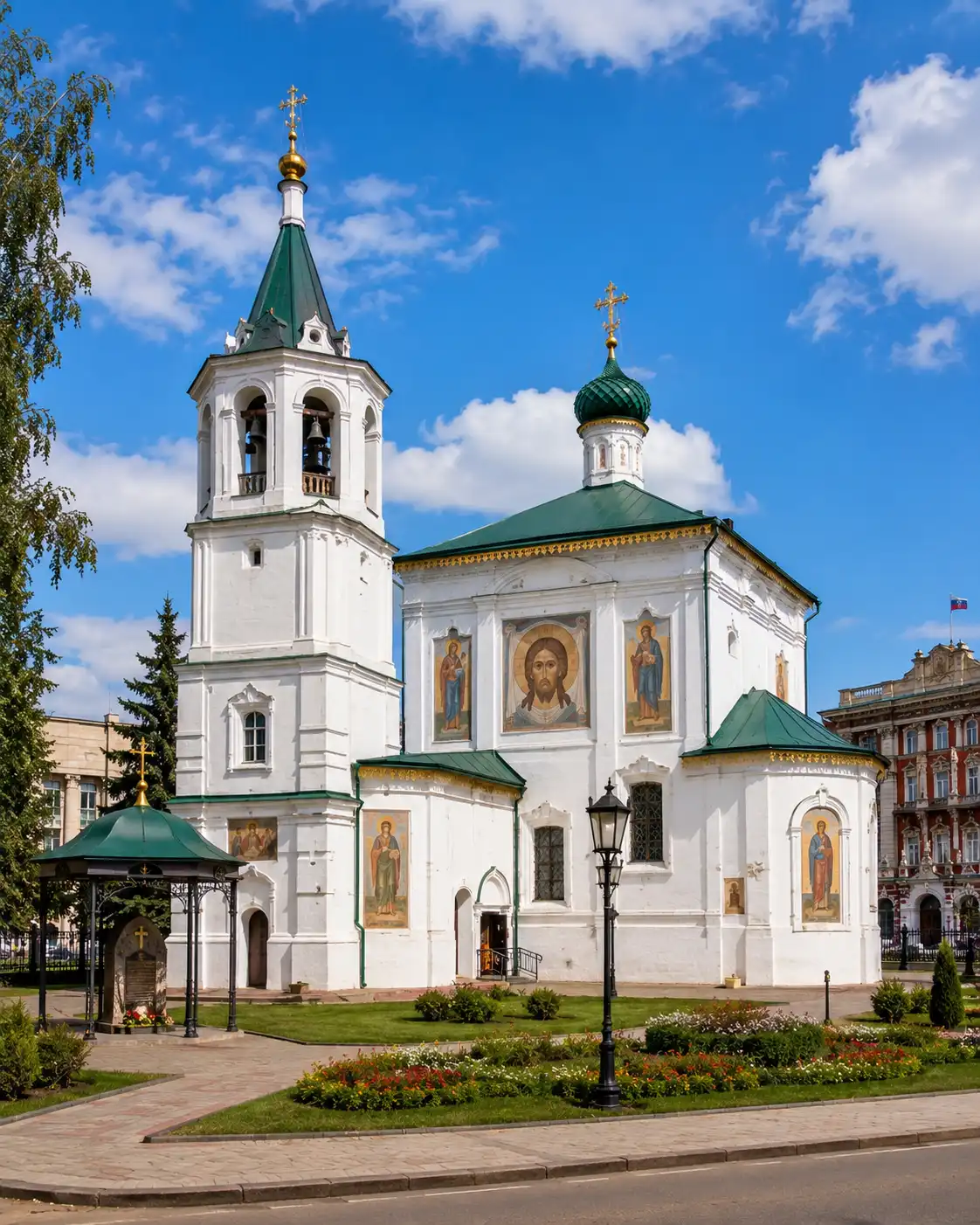
The Church of the Savior is one of the most historically significant buildings in Irkutsk and one of the essential landmarks for understanding how the city began. Standing beside Kirov Square, the Eternal Flame memorial and the Angara River, the compact white church is the oldest surviving stone building in Irkutsk and the only major structure still marking the territory of the original wooden fortress.
Known in Russian as Спасская церковь or Храм Спаса Нерукотворного Образа, the church is dedicated to the Image of the Savior Not Made by Hands, one of the most revered iconographic traditions in Russian Orthodoxy. Its restrained white exterior, green roof, high bell tower and rare outdoor frescoes distinguish it from the more colourful Epiphany Cathedral nearby.
The present stone church was designed by the Siberian builder Moisey Dolgikh and completed during the first decade of the eighteenth century. UNESCO Russia describes it as completed by 1710, while historical accounts generally place the main construction between 1706 and 1710. A later bell tower and spire altered the silhouette during the nineteenth century.
Although its architecture appears modest compared with the grand cathedrals of Moscow or Saint Petersburg, the Church of the Savior carries exceptional historical weight. It stands where Irkutsk’s first settlers built homes, administrative structures and defensive walls. The church survived fires, earthquakes, the demolition of the old fortress, Soviet closure and decades of secular use before returning to Orthodox worship during the early twenty-first century.
Its most unusual feature is the group of religious paintings preserved on its exterior walls. External frescoes are rare in Siberian church architecture, making the Spasskaya Church especially valuable for architectural and artistic study. The surviving images include the Savior, saints and scenes connected with the church’s religious dedication.
For travellers following Wander Russia through Irkutsk, the Church of the Savior provides the clearest physical connection with the city’s seventeenth-century origins. This guide explains its fortress history, architecture, frescoes, religious meaning, Soviet-era transformation, visitor etiquette and the best way to combine it with nearby attractions.
Where Is the Church of the Savior?
The Church of the Savior stands at 2 Sukhe-Batora Street in the historic centre of Irkutsk.
It is located immediately north of Kirov Square and close to the regional government building, the Eternal Flame memorial, Epiphany Cathedral and the Lower Angara Embankment. The compact concentration of monuments makes this one of the most rewarding walking areas in the city.
The church occupies ground associated with the original Irkutsk ostrog, the wooden fortified settlement founded in 1661. Most of the fortress disappeared as the city expanded, but the location of the church preserves the memory of the early defensive and administrative centre.
Visitors can reach the church easily on foot from Kirov Square. It is also within walking distance of Karl Marx Street, the Angara waterfront and several stops on Irkutsk’s self-guided Green Line historical route.
Why the Church Is One of Irkutsk’s Essential Sights
The Church of the Savior belongs among the city’s most important attractions for several reasons.
It is the oldest surviving stone building in Irkutsk, the principal architectural remnant of the original fortress and one of the earliest stone churches in eastern Siberia. It also preserves a rare group of outdoor religious frescoes and demonstrates how early Russian builders adapted traditional church forms to the conditions of Siberia.
Its history also reflects nearly every major phase of Irkutsk’s development:
- The establishment of the wooden fortress
- The growth of a permanent Siberian settlement
- The transition from timber to stone architecture
- Imperial religious and military history
- Earthquake damage and architectural additions
- Soviet closure and secular use
- Heritage restoration
- The return of active Orthodox worship
Unlike a reconstructed historical attraction, the church remains on the site where much of this history actually unfolded.
The First Wooden Church
The first Church of the Savior was built inside the Irkutsk fortress during the seventeenth century.
Historical sources commonly place its construction around 1670–1672, shortly after the establishment of the settlement. It stood within the central part of the ostrog and served the first Cossacks, administrators and settlers.
The original church was constructed from wood, the dominant building material in early Siberian settlements. Timber was abundant and practical, but wooden structures were extremely vulnerable to fire.
The first church was eventually destroyed, and the growing settlement needed a more durable religious building. The decision to construct a stone replacement demonstrated that Irkutsk was becoming a permanent city rather than remaining a temporary frontier post.
Construction of the Stone Church
The present stone church was constructed during the first decade of the eighteenth century.
Moisey Dolgikh, a Siberian builder experienced in stone construction, is associated with the design. The main church was built between approximately 1706 and 1710, while additional sections were completed during the following years.
The project was supported by local authorities and residents, including the Irkutsk commander Ivan Sinyavin according to several historical accounts. Building in stone required skilled labour, lime, bricks and transport arrangements that were difficult to organise in early eighteenth-century Siberia.
The upper altar was consecrated in 1710. The church gradually became one of the principal religious buildings of the growing town.
Its completion marked an important architectural transition. Wooden houses and defensive walls still dominated Irkutsk, but the stone church introduced permanence into the cityscape.
The Savior Not Made by Hands
The church is dedicated to the Image of the Savior Not Made by Hands.
This Orthodox iconographic tradition depicts the face of Christ on a cloth. According to Christian tradition, the image appeared miraculously rather than being created by an ordinary artist.
In Russian Orthodoxy, the image became associated with protection, military banners and the spiritual defence of cities and communities.
Historical accounts connect the Irkutsk church with a banner bearing the image of the Savior, reportedly transferred ceremonially into the new stone building after its consecration. The banner became associated with the frontier settlers and Cossacks who established Irkutsk.
The dedication was therefore especially appropriate for a church standing inside a military fortress.
Architecture of the Church
The Church of the Savior is relatively compact, but its proportions create a strong vertical composition.
The main rectangular church volume is joined with a tall western bell tower. White plastered walls contrast with green roof surfaces and gold crosses, producing a restrained appearance compared with the elaborate orange and white decoration of Epiphany Cathedral.
The architecture developed in several stages. The original early eighteenth-century church formed the core, while later chapels, the bell tower and spire altered its silhouette. UNESCO Russia notes that the bell tower and spire reached their later form during the nineteenth century.
The building demonstrates early Siberian stone architecture before the full decorative development of Siberian Baroque. Its importance lies less in overwhelming ornament than in its historical survival, balanced form and unusual painted façades.
The Bell Tower
The western bell tower forms the most prominent vertical element of the church.
Its square lower levels rise into narrower upper sections completed by a steep roof and Orthodox cross. The tower can be seen from Kirov Square, the memorial area and several points along the historical centre.
The church bells were historically known for their powerful and clear sound. UNESCO Russia describes them as among the finest in Siberia in terms of strength and purity.
Church bells served several purposes in early Irkutsk. They announced religious services, feast days and funerals, but they could also warn residents of fires or emergencies.
The bell tower therefore had both spiritual and practical importance within the fortress and later city.
The Exterior Frescoes
The exterior frescoes are the church’s most unusual artistic feature.
Painted religious images survive on the outside walls, particularly on the southern façade and the eastern area near the apse. Such external decoration is uncommon in Siberian Orthodox architecture, where harsh winters, moisture and temperature changes make painted surfaces difficult to preserve.
The paintings include images of the Savior, saints and religious scenes. Their style has been compared with northern Russian traditions, particularly mural decoration associated with Veliky Ustyug.
Visitors should walk completely around the church rather than viewing only the main entrance. The largest and most visually interesting frescoes are found away from the standard frontal viewpoint.
Late morning or afternoon light often reveals the painted details more clearly, although tree shadows may partly cover the walls during summer.
Why Exterior Frescoes Are Rare
Most Orthodox church painting is found inside buildings, where icons and frescoes are protected from weather.
Exterior frescoes face rain, snow, frost, sunlight and major temperature changes. In Irkutsk, winter conditions can be especially severe, and repeated freezing and thawing damage painted plaster.
The survival of the Spasskaya Church paintings therefore reflects repeated conservation work as well as the original craftsmanship.
They also make the building valuable beyond local history. The church preserves evidence of a decorative tradition that was never widespread in Siberia and has disappeared from many other sites.
Interior of the Church
The interior is divided between lower and upper spaces connected with the historical two-level arrangement of the church.
Icons, candle stands, religious paintings and gilded elements create the atmosphere of an active Orthodox place of worship. The interior is smaller and more intimate than Epiphany Cathedral.
Visitors may encounter prayer services, baptisms or private worship. The church should therefore not be treated simply as an architectural museum.
A staircase provides access to upper areas. Visitors with limited mobility should be aware that parts of the interior may be difficult to reach, as modern reviews note a relatively long flight of stairs leading toward the upper sanctuary.
Photography rules can vary. Signs and instructions from church staff should always be followed.
The Church and the Irkutsk Fortress
The church is the most important surviving physical link with the original Irkutsk ostrog.
The fortress was a wooden defensive complex containing walls, towers, administrative buildings, storage facilities and homes. As Irkutsk expanded, the fortifications lost their military role and were gradually demolished.
The Church of the Savior survived because it was built from stone and continued serving religious and later secular functions.
Standing beside the church today, visitors should imagine a very different environment. Instead of government offices, landscaped memorials and paved streets, the area contained timber walls, watchtowers, small houses and the practical structures of a Siberian frontier settlement.
The church marked the spiritual centre of that community.
Military and Civic History
The church was closely connected with the civic and military life of Irkutsk.
Historical accounts state that troops received blessings here before leaving to fight during the Napoleonic Wars in 1812. The church also preserved objects connected with the first Cossack settlers and the military traditions of the fortress.
Its bells announced important events, while religious processions and public ceremonies passed through the surrounding centre.
This combination of faith, defence and civic identity was typical of early Russian frontier settlements. The church did not stand apart from daily life. It helped organise and interpret it.
Earthquakes and Structural Damage
Irkutsk lies within a seismically active region near Lake Baikal.
The Church of the Savior suffered damage during several earthquakes, including a significant event in 1861. Restoration and reinforcement were required to protect the building and repair cracks.
The church also experienced the effects of severe winters, changing groundwater and the movement of surrounding urban soil.
Its survival reflects constant adaptation. The building visible today is ancient, but it has been repaired and modified repeatedly rather than remaining untouched since the eighteenth century.
Closure During the Soviet Period
The Church of the Savior remained active during the early Soviet years but was closed in 1931.
After closure, the building was used for several secular purposes. Workshops, communal accommodation and different organisations occupied parts of the structure. Historical descriptions mention shoemaking facilities and residential use among the functions imposed on the former church.
The transformation damaged the religious interior and removed the building from parish life.
However, unlike many churches destroyed during Soviet anti-religious campaigns, the Spasskaya Church remained standing.
Recognition as a Heritage Monument
In 1948, the church received official recognition as an architectural monument.
This status protected it from demolition even though active worship had not resumed.
Major restoration work took place from the 1960s through the 1980s under the supervision of conservation specialists, including Moscow architect Galina Oranskaya. The work stabilised the building, investigated historical forms and restored damaged decorative elements.
Following restoration, the church served as an exhibition space connected with the Irkutsk Regional Museum.
This period helped preserve the architecture and allowed the public to enter the building, although its original religious function remained suspended.
Return to Orthodox Worship
The Church of the Savior was returned to the Irkutsk Orthodox diocese in November 2006.
After approximately 75 years without normal parish life, the first renewed liturgy was celebrated around Orthodox Christmas in January 2007.
The return required the restoration of liturgical space, icons and religious furnishings.
Today, the church again functions as an active place of prayer while remaining one of Irkutsk’s most important protected monuments.
This dual role requires a balance between tourism and worship. Visitors are welcome, but ceremonies and parish needs take priority.
The Memorial Chapel and Early Settlers
Behind the church stands an open-sided memorial chapel created during the early twenty-first century.
The chapel contains a memorial stone connected with the first settlers of Irkutsk. Human remains discovered during restoration and archaeological work around the church were placed in a crypt beneath the memorial structure.
This addition reinforces the historical importance of the church grounds.
The site is not only where the first stone church survived. It also contains the burial memory of people associated with the earliest period of the settlement.
Visitors should treat the chapel and surrounding area respectfully.
Visitor Etiquette
The Church of the Savior remains an active Orthodox church.
Appropriate behaviour includes:
- Speaking quietly
- Turning phones to silent mode
- Wearing modest clothing
- Removing hats for men when customary
- Covering the head for women when requested or preferred
- Avoiding food and drinks inside
- Not photographing worshippers without permission
- Following signs concerning interior photography
- Allowing services to continue without interruption
- Avoiding casual poses beside memorial structures
Visitors do not need to participate in Orthodox rituals.
Quiet observation is sufficient.
Best Time to Visit
The church can be visited throughout the year.
Late spring through early autumn provides the most comfortable conditions for walking around the exterior and studying the frescoes.
Winter offers a particularly atmospheric view. Snow creates strong contrast with the white walls, green roof and dark painted images.
A weekday morning is usually the best time for a quiet visit.
Sundays and religious feast days provide a richer spiritual atmosphere but may limit movement inside the church.
Opening hours may change according to services, holidays and church requirements, so rigid museum-style scheduling should be avoided.
Photography Tips
The church offers several excellent photographic perspectives.
Useful compositions include:
- The bell tower against the sky
- The church framed by trees from Kirov Square
- Exterior frescoes on the southern wall
- The apse and memorial chapel
- The church with Epiphany Cathedral nearby
- Snow-covered grounds during winter
- The church beside the Eternal Flame area
- Architectural details in angled sunlight
A standard lens works well for natural proportions.
A moderate wide-angle lens is useful from close range, but excessive distortion can make the bell tower appear unnaturally tilted.
The exterior frescoes should be photographed carefully without touching the walls or crossing barriers.
Combining the Church with Nearby Attractions
The Church of the Savior belongs to one of Irkutsk’s strongest walking routes.
A practical sequence includes:
- Kirov Square
- Eternal Flame memorial
- Church of the Savior
- Memorial chapel for the first settlers
- Epiphany Cathedral
- Former Polish Catholic Church
- Lower Angara Embankment
- Monument to Alexander III
These attractions can be explored within two to three hours, depending on interior access and photography.
The close grouping of Orthodox, Catholic, Soviet and civic landmarks makes the district especially valuable for understanding Irkutsk’s layered history.
Church of the Savior or Epiphany Cathedral?
Both should be visited.
The Church of the Savior is older, more closely connected with the original fortress and architecturally restrained. Its exterior frescoes are especially rare.
Epiphany Cathedral is larger, more colourful and more representative of the decorative development of Siberian Baroque.
Together, they show how Irkutsk changed during the early eighteenth century—from a small fortified settlement into a prosperous and ambitious Siberian city.
How Much Time Is Needed?
A basic visit requires approximately 20 to 30 minutes.
Travellers interested in the exterior frescoes, architecture, memorial chapel and interior should allow 45 minutes to one hour.
Combining the church with Kirov Square and Epiphany Cathedral creates a two-hour historical itinerary.
Accessibility
The exterior surroundings are central and largely paved.
The ground-level area can be viewed without major difficulty, but upper interior sections may require climbing stairs.
Winter ice and compacted snow can reduce accessibility around the church and memorial area.
Visitors with mobility needs should ask church staff which parts of the interior can be reached comfortably.
Is the Church of the Savior Worth Visiting?
The Church of the Savior is essential for any first visit to Irkutsk.
Its importance does not depend on size or decorative richness. It is valuable because it stands where the city began and preserves architecture from the first generation of permanent stone construction.
The exterior frescoes add an artistic feature rarely found elsewhere in Siberia.
Wander Russia recommends visiting it together with Epiphany Cathedral and Kirov Square rather than treating it as an isolated church.
Frequently Asked Questions
Where is the Church of the Savior?
It stands at 2 Sukhe-Batora Street beside Kirov Square in central Irkutsk.
When was it built?
The present stone church was built mainly between 1706 and 1710, with later additions and modifications.
Why is it historically important?
It is the oldest surviving stone building in Irkutsk and the principal remaining monument of the original fortress.
What makes the exterior unusual?
The church preserves religious frescoes painted on its outside walls, a rare feature in Siberian architecture.
Was it closed during the Soviet period?
Yes. It was closed in 1931 and used for workshops, accommodation and museum exhibitions.
When did religious services resume?
The building returned to the Orthodox diocese in 2006, and renewed services began around Orthodox Christmas in 2007.
Is it still an active church?
Yes. It functions as an active Orthodox place of worship and a protected architectural monument.
Is there an entrance fee?
General entry to active Orthodox churches is normally free, although donations may be made.
How long should visitors stay?
Allow approximately 30 to 60 minutes.
What is nearby?
Kirov Square, Epiphany Cathedral, the Eternal Flame memorial and the Angara embankment are all within a short walk.
Conclusion
The Church of the Savior is the most direct surviving link between modern Irkutsk and the small wooden fortress established on the Angara in the seventeenth century.
The first settlers built a wooden church inside the ostrog. When Irkutsk became more permanent and prosperous, that fragile structure was replaced with stone.
The new church represented security, faith and confidence in the future of the settlement.
Its architecture remained relatively modest, but the building acquired great symbolic importance. The Savior image was associated with protection, the bells organised civic and religious life, and the church became closely connected with the Cossacks and early residents of Irkutsk.
The exterior frescoes gave the building a rare artistic identity. Their survival through Siberian winters, earthquakes and political upheaval makes them among the church’s most valuable features.
The Soviet period removed the building from worship and transformed it into workshops, accommodation and exhibition space. Yet official heritage protection and extensive restoration prevented its destruction.
Its return to the Orthodox Church in 2006 restored a function that had been interrupted for three quarters of a century.
Today, the church stands beside a Soviet war memorial, a regional government building, the colourful Epiphany Cathedral and the river that shaped Irkutsk. Few places in the city bring so many historical periods together within such a small area.
For Wander Russia, the Church of the Savior is the essential fifth destination in Irkutsk. It is not the city’s largest or most ornate church, but it may be the one that tells Irkutsk’s story most clearly.
