Ivolginsky Datsan is the principal Buddhist monastery complex in Buryatia and one of the most important spiritual destinations in the Russian Far East. Located in the Ivolga Valley around 30 kilometres from Ulan-Ude, the monastery serves as the spiritual centre of the Buddhist Traditional Sangha of Russia and the residence of the Pandito Khambo Lama, the senior Buddhist leader within this tradition.
Known in Russian as Иволгинский дацан and in Buryat as Хамбын Хүрээ, the complex combines active temples, sacred stupas, prayer wheels, monastic residences, educational buildings, a Buddhist university and the temple associated with Dashi-Dorzho Itigelov, the twelfth Pandito Khambo Lama. It is not merely a historical monument or tourist attraction. Monks study and perform rituals here, pilgrims arrive to pray, local families request blessings and major Buddhist festivals bring together believers from across Buryatia and beyond.
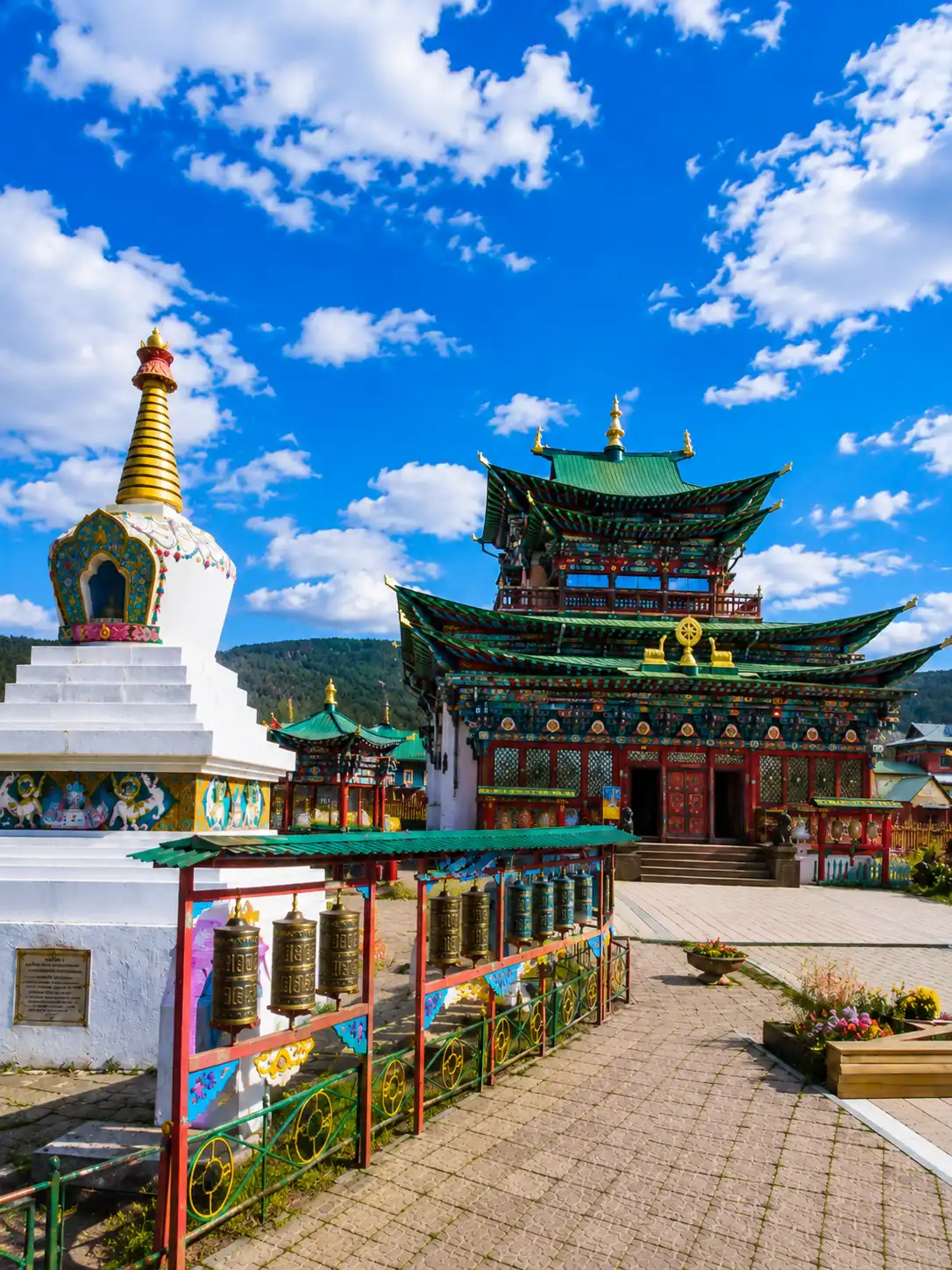
The monastery stands in an open steppe landscape near the foothills of the Khamar-Daban mountain system. Golden roofs, brightly painted façades and rows of prayer wheels create a striking contrast with the grassland, distant hills and wide Transbaikal sky. The setting is especially memorable because the complex appears gradually across the open valley rather than being enclosed by dense urban development.
Ivolginsky Datsan was founded in 1945, at a time when many religious institutions in the Soviet Union remained closed or severely restricted. Its establishment marked the beginning of the organised revival of Buddhism in Buryatia after decades of repression, the destruction or closure of monasteries and the persecution of monks. Over time, the original small prayer house developed into the largest Buddhist monastic complex in Russia.
For travellers following Wander Russia through Ulan-Ude and Buryatia, Ivolginsky Datsan provides the clearest introduction to the region’s Buddhist identity. This guide explains its history, architecture, religious traditions, major temples, prayer route, visitor etiquette, transport and practical planning.
Where Is Ivolginsky Datsan?
Ivolginsky Datsan lies near the settlement of Verkhnyaya Ivolga in the Ivolginsky District of the Republic of Buryatia.
The monastery is approximately 30 kilometres from central Ulan-Ude. The surrounding district occupies part of the Selenga River region and includes steppe valleys, forested mountains and settlements connected with both Buryat and Russian culture.
The relative isolation from the city contributes to the atmosphere. Ulan-Ude provides traffic, commercial streets, railway connections and Soviet-era public spaces. The monastery lies within a quieter rural landscape where the sky feels wider and the rhythm of the visit becomes slower.
The journey usually takes between 40 minutes and one hour, depending on traffic, transport and the starting point in Ulan-Ude.
Why Ivolginsky Datsan Is Important
Ivolginsky Datsan is important on several levels.
It is the administrative and spiritual centre of the Buddhist Traditional Sangha of Russia. The Pandito Khambo Lama resides here, and important religious decisions, ceremonies and educational activities are connected with the complex.
It is also one of the clearest symbols of the survival and revival of Buddhism after Soviet repression. Before the Russian Revolution, numerous datsans and smaller temples operated across Buryatia and other Buddhist regions. During the Soviet period, most were closed, destroyed or converted for secular use, while thousands of monks were arrested, exiled or sent to labour camps.
The opening of Ivolginsky Datsan in 1945 therefore represented more than the construction of a new temple. It created an officially recognised centre around which religious knowledge, monastic education and public worship could gradually be rebuilt.
Today, the monastery also serves as a cultural destination for visitors who want to understand Buryatia beyond Lake Baikal and central Ulan-Ude. Its temples, rituals, language, architecture and artistic details reveal a cultural landscape influenced by Tibetan Buddhism, Mongolian traditions, Buryat history and Russian political change.
The Meaning of the Word Datsan
The word datsan is widely used in Buryatia, Transbaikalia and other Russian Buddhist regions.
Within Tibetan Buddhist traditions, it originally referred to a monastic college or educational faculty where monks studied philosophy, medicine and religious texts. In Russia, the term gradually came to describe a complete monastery complex containing temples, educational buildings and residences.
Ivolginsky Datsan therefore functions simultaneously as a place of worship, a monastery, a centre of Buddhist learning and the headquarters of a religious organisation.
The full Buryat name is commonly translated as the monastery where the wheel of teaching turns, bringing happiness and complete joy. The wheel is one of Buddhism’s central symbols and represents the teaching of the Buddha and its continuing transmission.
The Foundation in 1945
The monastery was opened shortly after the end of the Second World War.
This timing was extraordinary. Soviet religious policy had caused the destruction or closure of most Buddhist institutions during the preceding decades. Nevertheless, authorities permitted the Buryat Buddhist community to establish a new centre on land near Verkhnyaya Ivolga.
A local Buryat family donated a small house that was adapted for religious use. Monks and volunteers gradually developed the site, adding places for prayer and accommodation.
The first building was modest and bore little resemblance to the complex visitors see today. Its historical importance lies in the fact that it created a legal and physical foundation for the continuation of Buryat Buddhist practice.
The monastery grew slowly at first. New temples appeared, the monastic population increased and religious education became more organised. After the end of the Soviet period, the expansion accelerated and Ivolginsky Datsan became increasingly visible as the national centre of traditional Russian Buddhism.
Buddhism in Buryatia
Buddhism became established among the Buryats primarily through cultural and religious connections with Mongolia and Tibet.
The form practised in Buryatia belongs mainly to the Gelug tradition of Tibetan Buddhism. It developed local characteristics through Buryat language, art, customs and relationships with older forms of spiritual practice.
Before Soviet repression, datsans played an important role in education, medicine, philosophy, art and community life. Monks studied religious texts, astrology, traditional medicine and ritual practice.
The monastery tradition was therefore wider than worship alone. Datsans acted as intellectual and cultural centres in rural society.
Ivolginsky Datsan continues this educational role through its Buddhist university and monastic training facilities. The regional tourism authority describes the complex as including educational buildings, a Buddhist university, a library, sacred stupas, residences and temples.
Architecture of the Monastery
The architecture of Ivolginsky Datsan combines Tibetan, Mongolian, Buryat and Russian construction influences.
The temples are generally brightly painted, with red, green, blue, white and gold appearing across roofs, columns, decorative bands and carved details. Roof edges curve upward, while symbolic animals, wheels, lotus motifs and protective figures appear throughout the complex.
The buildings are not arranged around one monumental central avenue in the style of some European monasteries. Instead, visitors move between separate temples, stupas, residences and educational structures within an open compound.
This layout reflects the gradual historical development of the site. The monastery expanded from a small religious house into a complete complex over several decades.
The open steppe setting also affects the visual impression. The temples stand against distant hills and broad skies, giving the complex a sense of space that would be lost within a dense city.
The Main Tsogchen Dugan
The main assembly temple is commonly known as the Tsogchen or Sogchen Dugan.
This is one of the central places of worship within the monastery. Monks gather here for prayers, teachings and major rituals.
The interior typically contains images of Buddhas, bodhisattvas, teachers and protective deities. Painted pillars, hanging fabrics, ritual objects and offerings create a richly layered visual environment.
Visitors may hear chanting, bells, drums or long horns during ceremonies. These sounds are part of active religious practice rather than a performance organised for tourists.
Entry conditions can vary depending on the ceremony. Visitors should remain quiet, avoid walking directly in front of monks and follow instructions given by temple attendants.
The Temple of Dashi-Dorzho Itigelov
One of the most significant buildings in the complex is the temple connected with Dashi-Dorzho Itigelov, the twelfth Pandito Khambo Lama.
Itigelov was an important Buddhist leader during the early twentieth century. According to the monastery tradition, he entered meditation in the lotus position in 1927 and died while reciting prayers. His body was placed in a cedar sarcophagus and buried without changing its seated posture.
His remains were examined in 1957 and again in 1973 before being reburied. In 2002, they were transferred to Ivolginsky Datsan and placed in a specially constructed temple. The official regional tourism presentation describes Itigelov as the monastery’s most important sacred figure and notes that pilgrims travel from distant regions to honour him.
For believers, Itigelov is not viewed simply as a historical monk. He is regarded as remaining in a profound meditative state and as offering spiritual help to those who approach with sincere intentions.
The temple is therefore one of the most sacred areas of the complex.
Viewing the Sacred Body of Itigelov
The body of Itigelov is not necessarily available for public viewing every day.
Special access is generally connected with important Buddhist dates and ceremonies. At other times, the temple can still be visited according to current monastery rules, but direct viewing may be restricted.
Travellers should not assume that purchasing a tour guarantees access.
The experience should also be approached as a religious pilgrimage rather than a curiosity. Photography, loud conversation and intrusive behaviour are inappropriate.
Visitors who are unfamiliar with the tradition can still enter respectfully, observe the ritual environment and learn why Itigelov has become one of the most important Buddhist figures in modern Buryatia.
The Buddhist University
Ivolginsky Datsan includes a Buddhist university where monks study philosophy and traditional Tibetan medicine.
The educational role continues the historical function of Buryat datsans as centres of learning. Students may study logic, ritual, sacred texts, language, medical traditions and other areas connected with Buddhist scholarship.
The university is not an ordinary tourist attraction, and access to classrooms or residential sections may be limited.
Nevertheless, its presence is essential to understanding the monastery. Ivolginsky Datsan is not only preserving old buildings and ceremonies. It is training new generations who will continue religious and intellectual traditions.
Sacred Stupas and Suburgans
The grounds contain sacred stupas, known locally as suburgans.
These structures may preserve relics, commemorate important teachers or symbolise aspects of Buddhist teaching.
Their white bodies, decorated niches and golden upper sections create some of the most recognisable visual elements of the complex.
Visitors should walk around stupas clockwise. This direction follows the traditional movement of Buddhist circumambulation and expresses respect for the sacred object.
The same clockwise direction should generally be followed around temples and the wider monastery circuit.
Prayer Wheels
Rows of prayer wheels are located throughout the monastery.
The wheels contain printed prayers or mantras. Turning them clockwise is understood within the tradition as symbolically setting those prayers into motion.
Visitors may turn the wheels gently while walking clockwise around the complex.
They should not spin them aggressively, reverse their direction or use them only as decorative props for photographs.
Prayer wheels provide one of the most accessible ways for non-Buddhist visitors to participate respectfully in the rhythm of the monastery without interrupting religious practice.
The Traditional Pilgrimage Route
A visit commonly follows a clockwise circuit around the monastery.
Begin near the entrance and move in the same direction used by pilgrims. Continue past prayer wheels, stupas and the outer walls of the temples.
This practice is sometimes called goroo or kora, depending on language and tradition.
The purpose is not simply to complete a sightseeing loop. Circumambulation is a meditative and devotional act.
Visitors may walk quietly, observe local worshippers and turn prayer wheels when appropriate.
Moving against the established direction can disrupt the flow and may be considered disrespectful.
Khurdes and Ritual Movement
The prayer drums are sometimes referred to locally as khurdes.
A regional tourism article published in June 2026 specifically highlighted the custom of walking around a temple clockwise and turning the khurde prayer wheels. This indicates that the practice remains a central part of how visitors are introduced to Buryat Buddhist etiquette.
The movement should be calm and deliberate.
Visitors do not need to understand every mantra or symbol to participate respectfully. The most important elements are direction, quiet behaviour and awareness that local people may be completing a personal religious practice.
Buddhist Art and Symbolism
The monastery contains a large number of visual symbols.
Lotus flowers represent purity and spiritual development.
The Dharma wheel represents the teaching of the Buddha.
Deer positioned beside a wheel often refer to the Buddha’s first teaching in the Deer Park.
Lions can symbolise courage and the strength of Buddhist teaching.
Bright colours are not merely decorative. They may carry religious meaning and help distinguish architectural sections, deities or ritual functions.
Visitors who join a guided tour will gain a much deeper understanding of these details than those who view the buildings only from the outside.
The Museum of Buddhist Art
The monastery complex includes a museum devoted to Buddhist artistic and cultural objects.
Collections may include thangkas, ritual items, manuscripts, sculptures, textiles and objects connected with the history of Buryat Buddhism.
Opening arrangements can vary, and the museum may not follow the same access conditions as the outdoor monastery grounds.
A museum visit is especially useful for travellers who want to distinguish between decorative elements, ritual tools and sacred images.
Religious Ceremonies
Ceremonies take place throughout the year according to the Buddhist calendar.
These may include prayers for health, prosperity, protection, the dead or the removal of obstacles.
Large festivals attract pilgrims from across Buryatia and neighbouring regions. The monastery becomes much busier, and access to certain temples may be controlled.
Visitors attending during a major ceremony should expect crowds, queues and limited opportunities for quiet photography.
At the same time, such days reveal the monastery as a living religious centre rather than a collection of empty buildings.
Sagaalgan and Other Festivals
Sagaalgan, the Buryat Buddhist New Year, is one of the most important annual celebrations.
The festival generally takes place according to the lunar calendar and is associated with purification, family gatherings, temple prayers and the beginning of a new cycle.
Dates change every year.
Other important ritual days may be connected with the Buddha, major teachers and the presentation of Itigelov’s sacred body.
Travellers planning around a festival should check the current monastery calendar rather than relying on dates from previous years.
Visitor Etiquette
Ivolginsky Datsan welcomes visitors, but it remains an active monastery.
Appropriate behaviour includes:
- Walking clockwise around temples and stupas
- Turning prayer wheels clockwise
- Speaking quietly
- Removing hats when entering temples when requested
- Avoiding exposed clothing
- Not touching statues or ritual objects
- Following photography restrictions
- Not interrupting monks or worshippers
- Avoiding smoking and alcohol
- Respecting closed residential and educational areas
Visitors should not point their feet toward altars or sacred images when sitting.
Money and offerings should be placed only in designated locations.
Photography
Exterior photography is generally possible in many parts of the complex.
The colourful temples, prayer wheels, stupas and steppe background provide excellent subjects.
Interior photography may be prohibited or restricted. The rules can vary by temple and ceremony.
The temple of Itigelov should be treated with particular sensitivity.
Visitors should look for signs and ask permission rather than assuming that photography is allowed because other people are using phones.
Drones should not be used without explicit authorisation. The site is a religious institution, and aerial filming can disturb ceremonies and violate local restrictions.
Consulting a Lama
Some visitors come to speak with a lama about health, personal decisions, astrology or spiritual concerns.
Consultations form part of the continuing religious role of the datsan.
Procedures, availability and language vary. A local guide or the visitor-information service can help explain where to ask and whether an appointment is required.
Travellers should approach consultations sincerely rather than treating them as entertainment.
Food at the Datsan
Simple Buryat food may be available near or within the visitor area.
Common possibilities include buuzy, the steamed meat dumplings widely associated with Buryat cuisine, along with soups, tea and pastries.
Offerings and restaurant services can change according to season and visitor numbers.
A meal near the monastery provides a natural opportunity to connect the religious visit with regional food culture.
How to Reach Ivolginsky Datsan
The regional tourism authority lists route 161 from Ulan-Ude’s Central Market toward the Ivolginsky area. Local transport arrangements can change, so the current departure point and schedule should be checked before travel.
Public transport is usually the most affordable option, but the complete journey may require additional local transport or walking depending on the final stop.
A taxi provides the simplest direct route from central Ulan-Ude.
Organised excursions are useful for first-time visitors because they combine transport with explanations of Buddhist etiquette, architecture and history.
How Much Time Is Needed?
A short visit requires approximately two hours.
A more complete experience with the prayer circuit, major temples, a guide and time for food requires three to four hours.
Special ceremonies or access to the Itigelov temple can lengthen the visit considerably.
Travellers interested in Buddhism should reserve at least half a day.
Best Time to Visit
Ivolginsky Datsan can be visited throughout the year.
Late spring and summer bring green steppe landscapes, long daylight and comfortable outdoor walking.
Autumn often provides clear air, golden grass and quieter conditions.
Winter is visually striking but extremely cold. Open areas of the complex are exposed to wind, and temperatures can be severe.
Festival dates offer the richest ceremonial atmosphere but also the largest crowds.
For a quiet first visit, a weekday morning outside a major festival is usually most practical.
Weather and Clothing
Buryatia has a strongly continental and relatively dry climate, with hot summers and very cold winters. The Ivolga Valley is exposed, so wind can make conditions feel more severe.
Useful clothing includes:
- Comfortable closed shoes
- A windproof layer
- Modest trousers or a long skirt
- Covered shoulders
- Sun protection during summer
- Warm insulated clothing during winter
- Gloves and a hat in cold weather
Visitors should be prepared for a noticeable temperature difference between sunny open areas and shaded temple interiors.
Accessibility
The grounds include relatively level outdoor sections, but individual temples may have steps, thresholds or narrow entrances.
Snow and ice can reduce accessibility in winter.
Visitors with mobility needs should arrange direct transport and ask locally which temples have the most suitable access.
The outdoor prayer route may still provide a meaningful experience even when every interior cannot be entered.
Combining the Datsan with Ulan-Ude
A visit can be combined with several central Ulan-Ude attractions.
A practical full-day route may include:
- Lenin Head Monument and Soviet Square
- Odigitrievsky Cathedral
- A walk through the historic centre
- Ivolginsky Datsan in the afternoon
However, the monastery deserves enough time and should not be reduced to a rushed final stop.
Travellers particularly interested in Buddhism may combine Ivolginsky Datsan with Rinpoche Bagsha Datsan on a separate day.
Is Ivolginsky Datsan Worth Visiting?
Ivolginsky Datsan is the most important cultural and spiritual excursion from Ulan-Ude.
It reveals a side of Russia that differs sharply from the Orthodox churches, imperial architecture and Soviet monuments found in many other cities.
The monastery demonstrates that Russian cultural history also includes Buryat, Mongolian and Tibetan Buddhist traditions.
Its significance is not based only on architecture. The community remains active, monks continue to study and pilgrims continue to pray.
Wander Russia recommends allowing at least half a day and visiting with respect for the living religious character of the site.
Frequently Asked Questions
Where is Ivolginsky Datsan?
It lies near Verkhnyaya Ivolga, approximately 30 kilometres from Ulan-Ude.
Why is the monastery important?
It is the spiritual centre of the Buddhist Traditional Sangha of Russia and the residence of the Pandito Khambo Lama.
When was it founded?
The monastery was opened in 1945.
Can non-Buddhists visit?
Yes. Visitors are welcome when they respect monastery rules and religious ceremonies.
Which direction should visitors walk?
The traditional route moves clockwise around temples and stupas.
Can visitors see Dashi-Dorzho Itigelov?
Public access to the sacred body is generally connected with special religious dates and is not guaranteed every day.
Is photography allowed?
Exterior photography is often possible, while interior rules vary by temple and ceremony.
How long should a visit take?
Allow at least two hours, with three to four hours recommended for a complete visit.
Can the monastery be reached by public transport?
Regional tourism information lists route 161 from Ulan-Ude’s Central Market area, but current details should be verified locally.
Is the monastery open in winter?
Yes, but temperatures can be extremely cold and outdoor areas are exposed.
Conclusion
Ivolginsky Datsan is one of the most significant religious and cultural destinations in the Russian Far East.
Its history reflects both destruction and renewal. Buddhism had deep roots in Buryatia before Soviet repression closed monasteries and removed monks from public religious life. The foundation of Ivolginsky Datsan in 1945 created a small but crucial centre from which organised Buddhist practice could survive and later expand.
The original donated house gradually became a complex of temples, residences, educational buildings, sacred stupas and prayer routes.
Today, the monastery serves pilgrims, students, monks and ordinary families. It is also the administrative centre of traditional Russian Buddhism and the residence of its senior religious leader.
The temple of Dashi-Dorzho Itigelov adds a particularly sacred dimension. For believers, his preserved seated body represents spiritual achievement and continuing presence rather than a museum object.
Visitors who approach only to take photographs may appreciate the architecture, but they will miss much of the meaning.
The deeper experience comes from following the clockwise path, turning the prayer wheels gently, observing ceremonies without interruption and recognising that the entire complex remains active.
The landscape also matters. The open Ivolga Valley, distant hills, dry air and broad sky place the monastery firmly within Buryatia rather than separating it from the surrounding region.
For Wander Russia, Ivolginsky Datsan is the essential first destination in any Ulan-Ude itinerary. It explains why Buryatia cannot be understood only as the eastern shore of Lake Baikal or as another region of Siberia.
It is a Buddhist cultural heartland with its own architecture, language, memory and living religious traditions.
