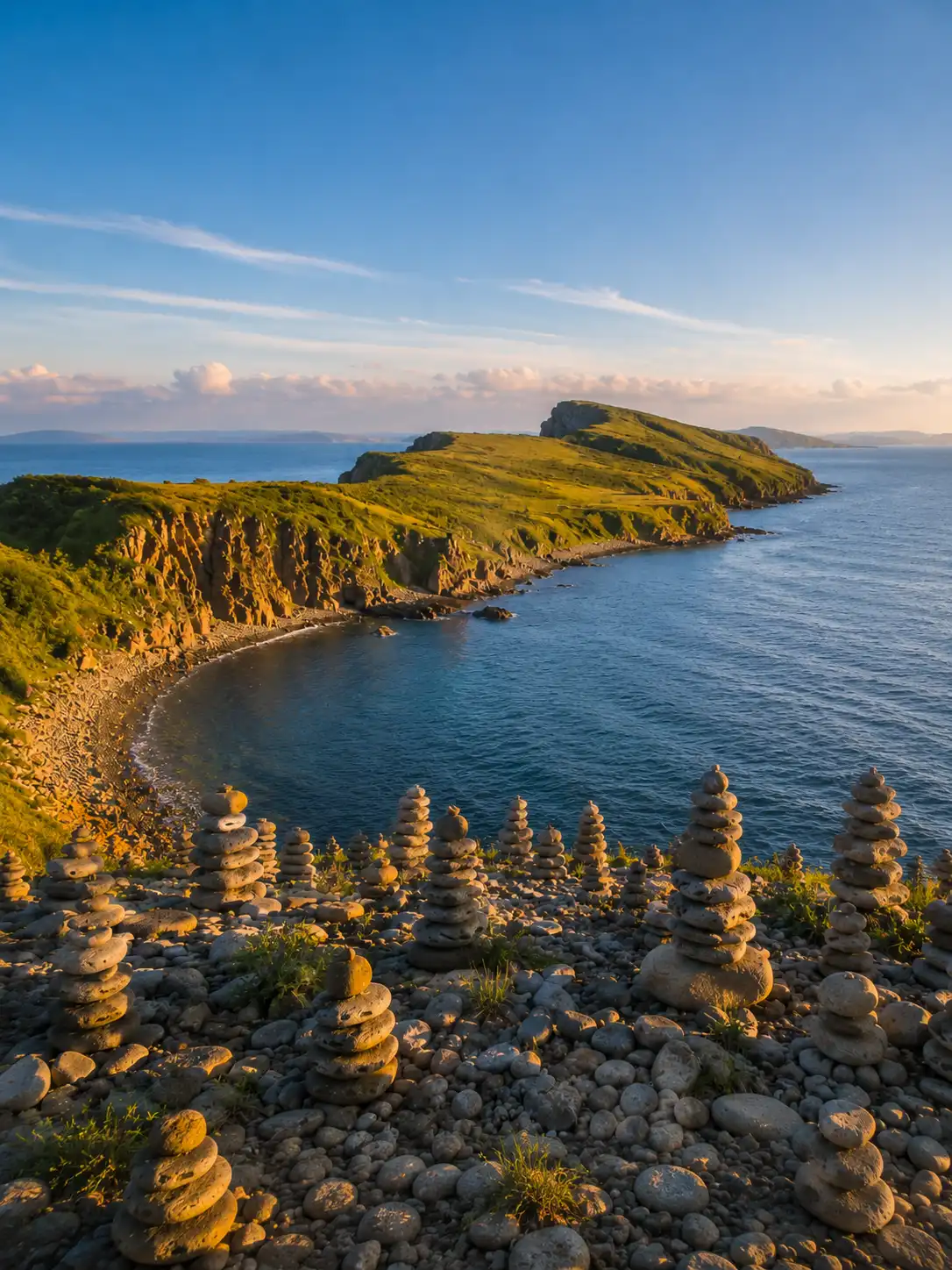
Cape Vyatlin is one of the most scenic and less crowded coastal destinations on Russky Island. Located on the island’s southern coast, the cape combines high rocky cliffs, narrow beaches, open sea views, forested slopes and a long peninsula extending into the waters of Peter the Great Gulf.
Known in Russian as Mys Vyatlina, or Мыс Вятлина, the destination is sometimes described as the quieter relative of nearby Cape Tobizina. Both capes offer dramatic maritime landscapes, but Cape Vyatlin generally receives fewer visitors and has a more secluded atmosphere.
The cape lies between Chernysheva Bay to the west and Bogdanovicha Bay to the east. Its rocky headland projects almost one kilometre into the sea, while steep cliffs rise above the water along much of the coastline. From elevated sections, visitors can see neighbouring capes, offshore reefs and the southern shoreline of Russky Island.
Cape Vyatlin is not a developed resort or formally managed hiking park. Access involves unpaved roads, uneven paths and steep descents toward the beaches. Facilities are limited, mobile reception can be unreliable and the exposed coast is strongly affected by fog, wind and changing sea conditions.
This Wander Russia guide explains how to reach Cape Vyatlin, what to see, how difficult the walk is, where the stone towers are located, what safety risks to consider and how to combine the cape with other attractions on Russky Island.
Where Is Cape Vyatlin?
Cape Vyatlin lies on the southern coastline of Russky Island within the administrative territory of Vladivostok.
The cape is positioned west of Cape Tobizina and south of the developed northern areas around the Far Eastern Federal University and Primorsky Aquarium. Chernysheva Bay lies on one side of the headland, while Bogdanovicha Bay lies on the other.
Russky Island is connected with mainland Vladivostok by the Russky Bridge. From central Vladivostok, visitors cross the bridge and continue south through the island’s road network.
The final access routes are unpaved and may become muddy, deeply rutted or difficult after rain. A vehicle with good ground clearance is preferable, although the exact road condition varies by season.
Cape Vyatlin can be visited throughout the year, but the official regional tourism presentation treats it primarily as a natural sightseeing destination rather than a fully serviced attraction. Admission is generally free.
Why Visit Cape Vyatlin?
Cape Vyatlin offers a quieter coastal experience than Cape Tobizina.
The landscape is defined by steep cliffs, forest, grass-covered slopes and open views over the Sea of Japan. The headland is long and narrow, creating sea views on both sides during parts of the walk.
Visitors can combine a short coastal hike with a descent toward one of the beaches. Stone towers built by previous visitors have become one of the cape’s best-known visual features.
The destination suits travellers interested in:
- Coastal walking
- Landscape photography
- Quiet beaches
- Rocky cliffs
- Maritime views
- Informal picnics
- Russky Island nature
- Less crowded alternatives to Cape Tobizina
Cape Vyatlin is not necessarily more spectacular than Tobizina, but it often feels less commercial and less heavily visited.
For travellers spending two days on Russky Island, the two capes provide contrasting experiences rather than duplicate attractions.
The Shape of the Cape
Cape Vyatlin is a long rocky peninsula.
Descriptions of its exact dimensions vary, but the headland extends almost one kilometre into the sea and is approximately 160 to 260 metres wide in several sections. Some cliffs rise more than 25 metres above the water.
The landform is covered partly by forest and partly by open grassland.
Rocky edges descend sharply toward the sea, while lower sections connect with pebble beaches in the neighbouring bays.
A reef extends offshore from the cape for several hundred metres. During rough weather, waves break visibly across rocks and shallow sections around the outer headland.
The peninsula’s shape creates strong panoramic views. From the upper slopes, visitors can look across bays on both sides and toward the neighbouring Cape Tobizina.
Chernysheva Bay
Chernysheva Bay lies west of Cape Vyatlin.
The beach is relatively narrow and backed by steep coastal slopes. Depending on weather and recent storms, the shoreline may consist of pebbles, rocks and sections of coarse sand.
The bay can feel sheltered compared with the outer cape, but it remains exposed to changing wind and waves.
The descent toward the beach can be steep. After rain, loose soil and wet grass make the path slippery.
Visitors should not assume that the easiest-looking descent is the safest one. Following an established route is preferable to cutting directly down the slope.
Chernysheva Bay is suitable for a rest or picnic, although there are generally no lifeguards, cafés or permanent changing facilities.
Bogdanovicha Bay
Bogdanovicha Bay lies east of Cape Vyatlin.
The coastline provides another perspective of the headland and its rocky cliffs.
The two beaches on either side of the cape differ in shape, exposure and access. This variety is one reason the destination is more interesting than a single viewpoint.
The eastern side can experience different wind and wave conditions from the western side during the same visit.
A calm bay should not be interpreted as permanently safe. Wind direction and sea conditions can change during the day.
Visitors planning to swim should observe the water carefully and avoid entering during strong surf or poor visibility.
The Stone Towers
The stone towers are one of Cape Vyatlin’s most recognisable features.
On a beach below the cape, visitors have built numerous small pyramids from rounded stones. The tradition became especially visible after a public event in 2015, when 155 stone towers were created for Vladivostok’s anniversary. Since then, many visitors have continued building their own small structures and making wishes.
The towers create an unusual visual landscape when viewed together.
Some are small and simple, while others contain carefully balanced layers of stones.
The tradition is informal rather than ancient. It should not be presented as an Indigenous or historic ritual.
Visitors who build a tower should use loose stones already lying on the beach and avoid removing material from cliffs or damaging vegetation.
Large unstable towers should not be constructed where they could fall onto other people.
How the Cape Got Its Name
Cape Vyatlin is named after a Russian hydrographer associated with the mapping and study of the region.
Russian and English spellings vary. Visitors may encounter Vyatlina, Vyatlin or Viatlina.
The standard Russian form is Мыс Вятлина.
Using the Russian name in navigation applications can improve search results and reduce confusion with other locations.
The name became part of the official geographical terminology in the early twentieth century, although accounts of the precise naming history differ in secondary sources.
The Walking Route
The walking experience varies according to where the vehicle stops.
Some visitors drive relatively close to the upper coastal area and complete only a short walk to viewpoints and the beach descent.
Others leave the vehicle farther away because of poor road conditions and walk several kilometres along dirt tracks.
There is no single official circular route comparable with a fully marked national-park trail.
A typical visit includes:
- Walking from the parking area toward the upper cape
- Reaching one or more cliff viewpoints
- Continuing along the narrow headland
- Descending toward the stone-tower beach
- Returning along the same route
The total walking time may range from two to four hours depending on access, pace, photography and the chosen beach.
Visitors should use offline navigation because intersecting vehicle tracks and informal paths can be confusing.
How Difficult Is the Walk?
The main upper route is generally easy to moderate.
There is no large elevation gain, and much of the walking takes place on dirt tracks, grass or broad coastal ground.
The more difficult sections are the beach descents and cliff approaches.
Steep slopes, loose stones, mud and wet grass can make movement difficult. People with knee, balance or mobility problems may prefer to remain on the upper viewpoints.
The route becomes substantially harder in:
- Heavy rain
- Thick fog
- Strong wind
- Snow
- Ice
- Darkness
- Very hot weather
Unlike Cape Tobizina, Vyatlin does not have one universally recognised final viewpoint. Visitors can select a shorter or longer walk according to conditions.
Cliff Safety
The cliffs are high, steep and mostly unprotected.
Some edges are covered by grass, making it difficult to see where stable ground ends.
Rock can be fractured or undercut by erosion. A person standing close to the edge may be above a section with little support underneath.
Visitors should remain several metres back from drops.
Sitting with legs hanging over the cliff, jumping between rocks or posing on narrow ledges is dangerous.
Strong wind creates additional risk. Sudden gusts can affect balance, especially when carrying a backpack or camera.
Fog can hide both the edge and the route back to the parking area.
A safe viewpoint from farther inland usually provides a better complete photograph than the unstable outer edge.
Beach Descent Safety
The descent toward the beach is one of the more demanding parts of a visit.
Paths may be narrow and steep, particularly after rain.
Loose stones can move underfoot, while grass and exposed soil become slippery.
Supportive footwear with strong grip is essential.
Trekking poles can improve stability but may be awkward on very steep sections.
Visitors should descend one at a time where the path narrows and avoid standing directly below another person on loose rock.
The return climb is often more tiring than the descent appears.
Travellers should keep enough energy and daylight for the climb back to the vehicle.
Swimming
Swimming may be possible during warm summer weather, particularly in the more sheltered bays.
However, Cape Vyatlin is not a managed bathing destination.
There are generally no lifeguards, rescue posts or formal water-quality notices displayed at remote beaches.
Water in Peter the Great Gulf remains cool outside the warmest part of summer.
Currents and wave direction can change quickly around a projecting cape.
Open-water events in the wider area describe the coast as affected by unpredictable currents and possible strong surf, underlining that even experienced swimmers treat the water with caution.
Visitors should avoid swimming alone, entering during fog or moving far from shore.
How to Reach Cape Vyatlin
The most practical options are private car, taxi or organised tour.
From central Vladivostok, travellers cross the Russky Bridge and continue south through Russky Island.
The final approach follows unpaved roads.
A high-clearance vehicle is useful, particularly after rain.
Taxi drivers may be willing to reach the area, but return transport must be arranged in advance. It may not be easy to request a new vehicle from the cape because of weak reception or road conditions.
Organised tours frequently include a Vyatlin viewpoint as one stop during a wider Russky Island excursion, although many short programmes do not include the full beach walk.
Travellers should ask whether the tour includes only an upper viewpoint or an actual descent to the stone towers.
Public Transport
Public transport does not usually provide a simple direct connection to the final cape.
Buses can reach developed sections of Russky Island, but visitors may still face a long walk, taxi transfer or combination of transport modes.
Routes and schedules can change.
For travellers without a vehicle, an organised excursion is normally more practical than attempting to combine public buses with remote walking tracks.
The return journey is especially important. Missing the final bus or failing to secure a taxi can leave visitors far from the developed part of the island.
Road Conditions
Road quality varies sharply.
Main roads near the university and aquarium are paved and maintained.
Farther south, roads become narrower and rougher.
Rain can create mud, deep ruts and standing water. Low vehicles may damage their underbody or become stuck.
Rental-car agreements may prohibit travel on unpaved roads.
Drivers should not follow unfamiliar tracks simply because they appear on a map.
Parking should occur only where the vehicle does not block access or damage grassland.
Repeated off-road driving creates erosion and visible scars across the coastal landscape.
Best Time to Visit
The most practical season runs from late May through October.
June brings green vegetation, long daylight and cooler conditions.
July and August provide the warmest weather and the best chance for swimming, but weekends can be busier.
September is particularly suitable for hiking. Temperatures are cooler, air can be clearer and the landscape begins to change colour.
October offers autumn scenery but shorter daylight and stronger wind.
Winter visits are possible, but snow and ice make slopes and cliff edges dangerous.
Spring conditions can be muddy, windy and unpredictable.
Fog and Maritime Weather
Fog is common around Russky Island.
It may form quickly, especially during summer.
Cape Vyatlin can disappear almost completely even when northern parts of the island remain clear.
Fog changes the atmosphere dramatically. The sea, cliffs and nearby hills become partially hidden, producing strong photographic conditions.
However, navigation becomes more difficult.
Visitors should avoid approaching cliffs when visibility is poor.
Wind can increase quickly on the outer peninsula. A sheltered beach may feel calm while the upper cape is exposed to strong gusts.
Weather conditions should be checked before leaving Vladivostok and reassessed after arriving on the island.
What to Wear and Bring
Recommended equipment includes:
- Hiking shoes with reliable grip
- A windproof jacket
- A waterproof outer layer
- Long trousers
- Drinking water
- Food and snacks
- Sun protection
- Insect repellent
- Offline maps
- A charged phone
- A power bank
- A headlamp
- A small first-aid kit
- Warm clothing outside midsummer
- Trekking poles for the beach descent
Open sandals and smooth city shoes are unsuitable.
There are few reliable facilities, so all essentials should be carried from Vladivostok.
Wildlife
Foxes and small mammals can occur across Russky Island, although Cape Vyatlin is not as strongly associated with fox encounters as Cape Tobizina.
Birds use cliffs and coastal rocks for resting and feeding.
Marine animals may occasionally be visible offshore, but sightings are unpredictable.
Visitors should not feed wildlife.
Food waste must be removed because it encourages animals to approach people.
Dogs should be controlled near cliffs, birds and other hikers.
Photography Tips
Cape Vyatlin is ideal for wide coastal compositions.
A wide-angle lens captures the peninsula, cliffs and bays.
A telephoto lens can isolate neighbouring Cape Tobizina, offshore reefs and distant islands.
The stone towers work best as a foreground element with the sea or cliffs behind them.
Early morning may provide quieter conditions and softer light.
Late afternoon creates stronger texture across the cliff faces.
Fog produces atmospheric images but requires greater caution.
Photographers should never move onto unstable edges for a cleaner frame.
Drone use requires attention to aviation restrictions, military zones, strong wind and wildlife disturbance.
Cape Vyatlin or Cape Tobizina?
Cape Tobizina is generally more famous and offers a more established hiking route.
Cape Vyatlin is usually quieter and provides easier access to beaches and stone-tower formations.
Tobizina is stronger for a continuous peninsula hike ending at dramatic cliffs.
Vyatlin is stronger for travellers who prefer a flexible coastal visit with upper viewpoints and a beach descent.
Both can be visited during the same trip to Vladivostok, but completing both fully in one day may be tiring.
A two-day Russky Island plan provides a better experience.
Combining Cape Vyatlin with Other Attractions
Cape Vyatlin can be combined with one or two nearby stops.
A viewpoint toward Cape Tobizina can be included without completing the entire Tobizina hike.
The Far Eastern Federal University embankment provides a relaxed stop on the return journey.
The Primorsky Aquarium works as a separate half-day attraction, but combining it with a full Cape Vyatlin visit creates a long schedule.
Military-history enthusiasts can add an official fortress site or battery.
A coastal day should remain flexible because road and weather conditions may force changes.
Suggested Half-Day Itinerary
Leave central Vladivostok in the morning.
Cross the Russky Bridge and continue south through the island.
Stop at a safe viewpoint overlooking the coast.
Walk toward the upper section of Cape Vyatlin.
Descend to the stone-tower beach when the path is dry and conditions are suitable.
Allow time for photography, a picnic and a slow return climb.
Return toward northern Russky Island before darkness.
A short stop near the university or a Russky Bridge viewpoint can complete the day.
Responsible Travel
Cape Vyatlin has no large visitor-management system.
Its preservation depends heavily on visitor behaviour.
All rubbish must be removed.
Glass, cans, disposable grills and food packaging should never be left on the beach.
Stone towers should remain small and stable.
Visitors should not remove stones, damage vegetation or create new vehicle tracks.
Campfires can become dangerous during dry weather and should not be made without clear permission and safe conditions.
The cape’s quieter atmosphere will disappear if increased tourism brings uncontrolled parking, waste and erosion.
Is Cape Vyatlin Worth Visiting?
Cape Vyatlin is worth visiting for travellers who want a less crowded coastal alternative on Russky Island.
Its strongest feature is variety.
Visitors can walk across an exposed headland, look down from high cliffs, descend toward a beach and see the unusual stone towers within one compact destination.
The experience is less structured than Cape Tobizina. This requires better preparation but also creates a greater sense of freedom.
Wander Russia recommends Cape Vyatlin for travellers who already plan a full day on Russky Island and have reliable transport.
Frequently Asked Questions
Where is Cape Vyatlin?
It lies on the southern coast of Russky Island between Chernysheva Bay and Bogdanovicha Bay.
Is Cape Vyatlin free to visit?
Yes. The natural attraction is generally free, although transport and guided tours have separate costs.
How long is the walk?
The duration varies according to parking and route choice. Most visits require approximately two to four hours.
Is the route difficult?
The upper route is easy to moderate. Descents to the beach can be steep and slippery.
What are the stone towers?
They are small pyramids built from beach stones. The tradition became widely associated with the cape after a 2015 event.
Can visitors swim?
Swimming may be possible during calm summer conditions, but there are generally no lifeguards and currents can be unpredictable.
Can the cape be reached by a normal car?
Road conditions vary. A vehicle with good ground clearance is more reliable after rain.
Is public transport available?
Public buses reach parts of Russky Island, but the final route to the cape usually requires additional transport or substantial walking.
When is the best time to visit?
June through September generally provides the most practical hiking and coastal conditions.
What is the main danger?
Unprotected cliffs, steep beach descents, strong wind and rapidly changing fog are the principal risks.
Conclusion
Cape Vyatlin reveals a quieter side of Russky Island.
The cape does not have the same fame as Cape Tobizina, but its long rocky headland, twin bays and steep coastal walls create a landscape of equal interest.
The visit can be adapted to different levels of fitness. Some travellers remain on the upper viewpoints, while others descend to the beach and explore the stone towers.
That flexibility is one of the destination’s strengths.
The lack of formal infrastructure also requires responsibility. Roads can be rough, paths are not always marked and cliff edges remain unprotected.
Fog, wind and rain can transform an easy coastal walk into a difficult route.
The stone towers add a distinctive human element, but the deeper attraction is the geography itself. Cape Vyatlin stretches into the open water of Peter the Great Gulf, offering views toward neighbouring capes, reefs and the southern coast of Russky Island.
For travellers following Wander Russia through Vladivostok, the cape works well after the better-known city landmarks and bridge viewpoints.
It provides space, quiet and a direct encounter with the maritime landscape that surrounds the city.
Cape Vyatlin is therefore not simply a secondary version of Cape Tobizina. It is a separate destination with its own beaches, traditions and atmosphere.
