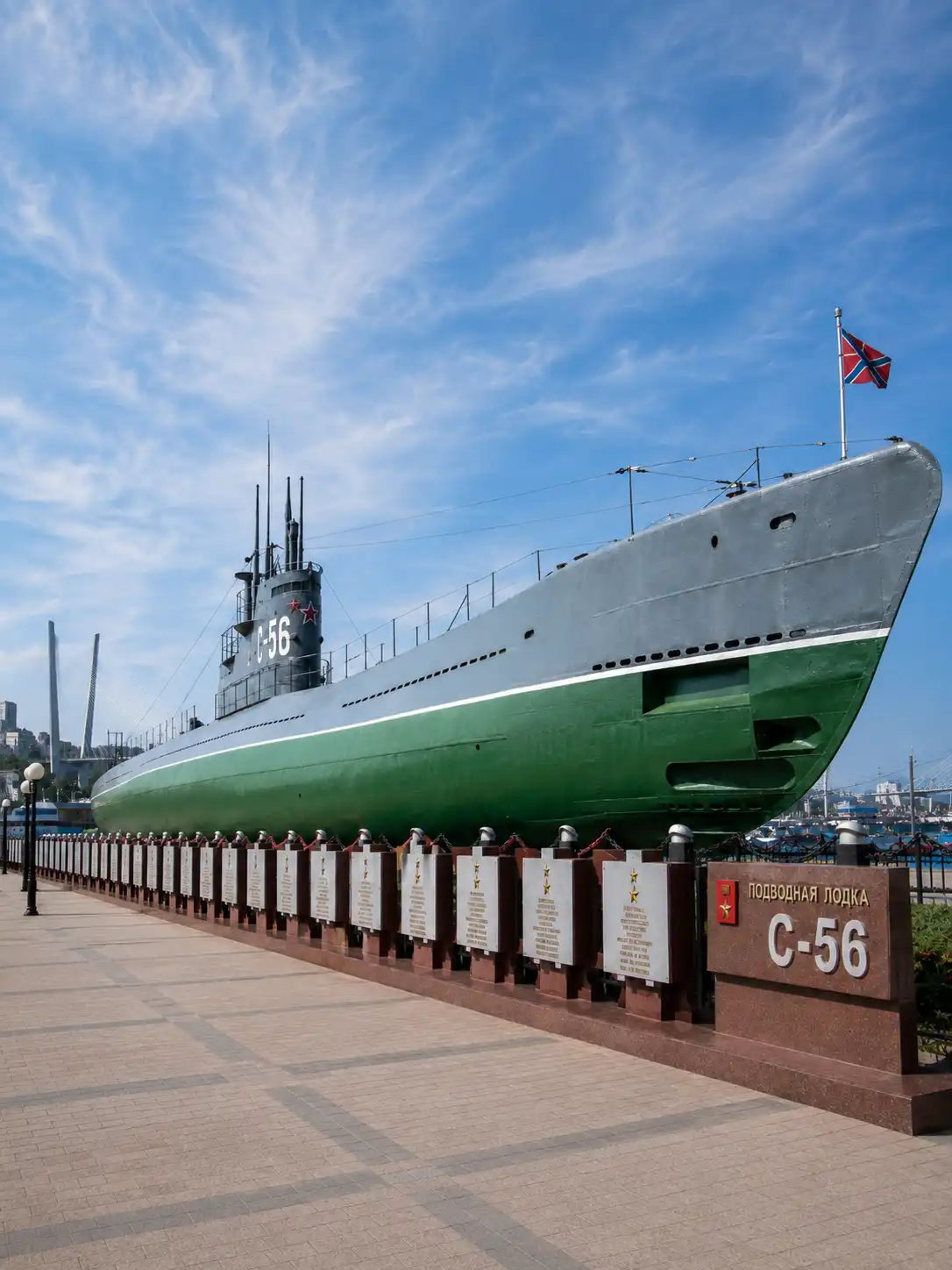
Submarine S-56 is one of the most important historical attractions in Vladivostok and one of the most memorable museum experiences in the Russian Far East. Standing on Korabelnaya Embankment near the waterfront, the submarine is not simply a monument placed in a public square. It is a real wartime vessel preserved as a memorial ship and museum, allowing visitors to step inside one of the most famous Soviet submarines of the Second World War.
For many travelers, S-56 becomes one of the most powerful places in Vladivostok because it combines military history, maritime identity and physical experience. It is one thing to read about naval warfare in a book. It is something completely different to walk through narrow metal compartments, see the torpedo tubes, imagine the noise and pressure of life underwater and understand how sailors lived in a vessel built for danger rather than comfort.
Vladivostok is often introduced through its bridges, hills, viewpoints and coastal scenery. Those places show the city’s beauty and geography. S-56 reveals another side of Vladivostok: its naval significance, its wartime memory and its long connection with the Pacific Fleet. This makes the submarine an essential part of any Wander Russia exploration of the city.
The site is especially rewarding because it also fits easily into a central city itinerary. Visitors can combine S-56 with Korabelnaya Embankment, the Pacific Fleet memorial complex, Vladivostok Railway Station, the central waterfront and other nearby landmarks without needing a long transfer.
This complete guide explains the history of S-56, what can be seen inside, why it matters, how to visit, how much time to allow, what nearby attractions to combine with it and why it remains one of the strongest museum experiences in Vladivostok.
Why S-56 Is So Important
S-56 is important because it was not an ordinary submarine preserved only as a technical object. It became one of the most highly regarded Soviet submarines of the Second World War and developed a reputation for courage, endurance and combat success.
That reputation gives the vessel symbolic power. When visitors approach the submarine today, they are not looking at a random piece of retired naval equipment. They are standing before a wartime vessel that represents a whole chapter of Soviet naval history.
Its importance is also connected with Vladivostok itself. The city has long been one of Russia’s most significant naval centers in the Pacific. A museum ship like S-56 feels completely natural in this setting. It belongs to the city’s identity in a way that would be harder to feel elsewhere.
The submarine also matters because it turns history into physical space. Photographs, documents and memorial plaques can communicate facts, but S-56 communicates atmosphere. Visitors feel how narrow the passages are, how little personal space sailors had and how technical and dangerous submarine service must have been.
Where S-56 Is Located
Submarine S-56 stands on Korabelnaya Embankment in central Vladivostok.
This is one of the city’s most important historical waterfront areas. The location places the submarine in a broader military memorial landscape connected with the Pacific Fleet. Because of this, the visit feels larger than a single museum stop. The surrounding area reinforces the naval and commemorative character of the attraction.
The embankment is centrally placed and can be reached easily on foot from other important landmarks, including Vladivostok Railway Station and parts of the historic center. This convenience makes S-56 especially attractive for first-time visitors.
Its position near the harbor is also symbolically appropriate. The submarine remains closely connected to the sea, naval tradition and the maritime atmosphere of Vladivostok.
The History of Submarine S-56
S-56 belongs to the Soviet submarine forces of the Second World War and is remembered as one of the best-known submarines of that era.
The vessel served in wartime conditions and became closely associated with Soviet naval operations against enemy shipping. Over time, its combat record made it one of the most respected submarines in Soviet memory.
One of the most remarkable aspects of the submarine’s history is the fact that it was not limited to one small regional role. Its story connects the Pacific and Arctic theaters of Soviet naval history, and it became known far beyond Vladivostok.
This wider reputation helped ensure that the vessel would later be preserved rather than scrapped and forgotten.
Today, S-56 is remembered not just as machinery, but as a symbol of wartime service, naval skill and the experience of the sailors who served aboard it.
S-56 and the Second World War
The wartime role of S-56 is central to understanding its significance.
During the Second World War, submarines were among the most difficult and dangerous military vessels to serve on. Crews operated in confined spaces, with constant technical risk, limited air, danger from depth charges and the psychological pressure of long periods underwater.
S-56 became distinguished through its wartime performance and was later celebrated in Soviet military memory. This reputation elevated it from a simple surviving submarine to an emblem of courage and endurance.
A visit to the vessel becomes much more meaningful when seen through that lens. The compartments, torpedo spaces, bunks and equipment are not only technical details. They represent a real human environment in which sailors faced life-threatening situations far from the comfort of land.
This historical layer is what gives S-56 its emotional impact.
From Warship to Memorial Ship
After its active service, S-56 was eventually preserved as a museum ship.
This transformation was important because it allowed the submarine to survive not only as a monument but as a physical educational space. Many historical vessels are remembered through photographs or scaled models. S-56 remains directly accessible to the public.
Its installation on Korabelnaya Embankment turned it into one of Vladivostok’s defining military-historical attractions. Instead of disappearing into storage or being dismantled, the submarine became part of the city’s visible memory.
This also means that modern visitors can engage with naval history in a much more direct way than in many ordinary museums.
The Memorial Complex Around S-56
S-56 does not stand alone in an empty setting.
It forms part of the broader memorial complex often associated with the combat glory of the Pacific Fleet. This surrounding context matters because it turns the visit into more than a single indoor museum experience. The space around the submarine contains monuments, military references and a waterfront atmosphere that strengthen the historical message.
This is one reason the site works so well even for visitors who are not normally focused on military history. The location itself creates a sense of meaning and seriousness.
Walking around the embankment before or after entering the submarine helps place S-56 within the wider naval identity of Vladivostok.
What the Submarine Looks Like from the Outside
From the outside, S-56 immediately looks impressive.
Its long, dark hull, compact superstructure and sharp wartime profile create a strong visual impression even before visitors enter. Unlike large surface ships, submarines have a certain severity to their appearance. They seem built purely for purpose, with little concern for decorative effect.
This makes S-56 visually powerful as a monument. It looks disciplined, functional and direct.
The exterior also helps visitors understand the scale of the vessel. Many people imagine submarines as bigger inside than they really are. Seeing the outside first makes it easier to understand just how much had to be contained within a narrow metal hull.
Photographically, the exterior works very well from several angles, especially when framed with the waterfront and memorial surroundings.
What It Is Like to Go Inside
Entering S-56 is the highlight of the visit.
The interior feels narrow, dense and mechanical. Passageways are tight, doorways are circular or constrained, and the available space feels immediately limited. Even visitors with no military background quickly understand that life aboard such a vessel must have required discipline, endurance and adaptation.
Inside, the submarine no longer feels like an abstract historical object. It becomes a working environment frozen in time.
Visitors move through compartments that once served very practical purposes. The arrangement of space reveals the priorities of a wartime submarine: weapons, control systems, mechanical function, survival and efficiency.
The emotional impact of the interior often comes from its contrast with modern everyday life. There is almost no privacy, almost no spare room and no comfort in the ordinary sense.
Compartments and Layout
One of the most interesting features of the visit is seeing how the submarine was divided internally.
A submarine like S-56 had to organize many functions inside a very small amount of space. These included navigation, command, sleeping, eating, engineering, weapons management and general survival.
Visitors usually encounter several key areas such as:
- Torpedo compartments
- Crew living spaces
- Control areas
- Radio or communications sections
- Engine and machinery zones
- Museum interpretation sections
The exact visitor route may vary, but the overall impression remains the same: every part of the submarine had to serve a purpose.
This highly organized use of space is one of the most striking lessons of the visit.
Torpedo Rooms
The torpedo areas are among the most memorable parts of the submarine.
These sections remind visitors that S-56 was a combat vessel, not simply a means of underwater travel. The torpedoes, tubes and surrounding equipment show the offensive role of the submarine and the technical complexity of underwater warfare.
Seeing the torpedo room also helps explain the danger of service aboard such a vessel. The submarine was not only threatened from outside. It also carried powerful weapons and technical systems within an enclosed environment.
For many visitors, the torpedo compartments create one of the clearest links between the preserved museum ship and the wartime reality it once faced.
Crew Living Conditions
The crew spaces are among the most powerful parts of the visit because they humanize the submarine.
It is easy to admire naval technology from a distance. It is harder not to think about the people once living inside such a cramped environment. The bunks, narrow sleeping areas and limited personal space show just how demanding daily life must have been.
Submarine crews had to function under pressure, fatigue and constant proximity to one another. The design was focused on mission success, not comfort.
This makes the crew spaces especially meaningful. They remind visitors that the story of S-56 is not only about machinery and warfare. It is also about discipline, teamwork and the mental endurance of sailors who lived and worked in extreme conditions.
Technical and Engineering Areas
The engineering sections of S-56 help explain how complex submarine life really was.
Even visitors with limited technical knowledge can appreciate the density of pipes, gauges, controls, mechanical systems and structural details. A submarine is not simply a metal shell with an engine. It is a highly integrated system in which many components must function together under difficult conditions.
These areas also reveal the level of skill required from the crew. Operating and maintaining such a vessel demanded more than courage. It required precision, training and constant attention.
For travelers interested in engineering, these sections may be among the most rewarding parts of the museum.
Museum Displays Inside the Submarine
In addition to the preserved interior, S-56 also contains exhibition elements that help interpret its history.
These museum displays may include photographs, documents, biographical material, wartime information and historical explanations connected with the submarine and its crew.
This interpretive layer is important because it gives context to the physical spaces. Without explanation, a compartment remains an interesting room. With historical material, it becomes part of a story.
The balance between preserved vessel and museum exhibition is one of the reasons the site works so well. Visitors are not simply walking through an empty submarine. They are being guided into understanding what the submarine meant.
Emotional Impact of the Visit
One of the strongest features of S-56 is that it creates an emotional response without needing theatrical presentation.
The submarine does not need spectacle. Its power comes from authenticity.
Walking through the confined spaces, seeing the practical equipment and imagining wartime conditions makes the experience naturally reflective. Visitors often leave with a stronger sense of respect for the people who served aboard submarines.
This is especially true for those who had previously thought of naval warfare only in very general terms. S-56 makes that history personal and physical.
For Wander Russia, this emotional honesty is one of the reasons the site stands out among Vladivostok attractions.
How Much Time Is Needed
A focused visit to S-56 can take around 30 to 45 minutes.
A more complete visit, including time on Korabelnaya Embankment and the surrounding memorial area, can take around one to one and a half hours.
Travelers interested in reading all exhibition material carefully or taking time for photography may wish to stay longer.
Because the attraction is centrally located, it works well as part of a broader route rather than requiring a whole day on its own.
Best Time to Visit
S-56 can be visited throughout the year.
Because much of the experience takes place inside the preserved submarine and within an established memorial area, the attraction is not strongly limited by season in the way coastal hiking sites are.
Summer offers the easiest overall conditions for combining the submarine with a longer waterfront walk.
Autumn often provides good light and a slightly more reflective atmosphere.
Winter adds a more severe, dramatic feeling to the naval memorial landscape, which can suit the historical tone of the site.
Spring is also practical, especially as part of a central city itinerary.
The best time of day is usually earlier rather than very late, especially if you want to combine S-56 with nearby sights.
Photography Tips
S-56 is rewarding for photography both outside and inside.
For exterior photography, useful options include:
- Side views of the hull
- Angles that include the memorial surroundings
- Wider shots with the waterfront context
- Detail shots of the conning tower and deck features
Inside, photography depends on the available light and museum rules, but the compartments, passageways and mechanical details create strong visual opportunities.
Because the interior is tight, wide-angle lenses or smartphone cameras often work better than long lenses.
Low light may require steady hands or careful camera settings.
Nearby Attractions to Combine with S-56
S-56 is easy to combine with several nearby places, which makes it especially useful in a Vladivostok itinerary.
The strongest nearby combinations include:
- Korabelnaya Embankment
- Pacific Fleet memorial complex
- Vladivostok Railway Station
- Svetlanskaya Street
- Millionka Historic Quarter
- Central waterfront areas
- Eagle’s Nest Hill later in the day
This means you can build a strong half-day route that includes history, naval memory and city atmosphere without traveling far.
Suggested Visit Plan
A simple and effective plan is to begin at Vladivostok Railway Station, then walk toward Korabelnaya Embankment and Submarine S-56.
After exploring the submarine and surrounding memorials, continue along the waterfront or move into the historic center.
This sequence works especially well because it connects two important themes of Vladivostok: continental connection through the railway and maritime identity through the Pacific Fleet.
If time remains, continue later toward Eagle’s Nest Hill for a broader city panorama.
Is S-56 Worth Visiting?
Yes, absolutely.
Submarine S-56 is one of the most worthwhile historical attractions in Vladivostok. It is visually interesting, historically significant, emotionally powerful and easy to include in a city itinerary.
Even travelers who are not usually drawn to military museums often find S-56 memorable because the experience is so physical and direct.
It offers something that many city monuments cannot: the chance to step inside history rather than simply look at it from a distance.
For anyone visiting Vladivostok with a serious interest in the city’s identity, S-56 deserves a place near the top of the list.
Frequently Asked Questions
Is S-56 a real submarine?
Yes. S-56 is an authentic historical submarine preserved as a memorial ship and museum.
How long does a visit take?
Most visitors spend between 30 minutes and 1.5 hours depending on how much time they also spend in the surrounding memorial area.
Is S-56 suitable for children?
Yes, but children should be supervised carefully because the interior is narrow and includes ladders, metal surfaces and confined spaces.
Can visitors go inside?
Yes, that is one of the main highlights of the attraction.
Is it only for military-history enthusiasts?
No. It is especially rewarding for them, but many general travelers also find it one of the most memorable experiences in Vladivostok.
Where is it located?
It stands on Korabelnaya Embankment in central Vladivostok.
Can it be combined with other attractions?
Yes. It pairs very well with Vladivostok Railway Station, the central waterfront and nearby historical areas.
Conclusion
Submarine S-56 is one of the places in Vladivostok where history becomes tangible.
It is not only a monument to the past but also a preserved space that allows visitors to feel the physical reality of wartime naval service. The narrow compartments, technical equipment and cramped crew spaces make a far stronger impression than any summary on a plaque could provide.
Its importance comes from more than preserved metal. S-56 represents the wartime courage of its crew, the broader role of Soviet submarines and the naval identity of Vladivostok itself.
Its location on Korabelnaya Embankment strengthens that meaning. The submarine belongs to the memorial landscape of the city and helps explain why Vladivostok is more than a scenic Pacific destination. It is also a place shaped by fleet history, defense and maritime memory.
For travelers following Wander Russia through the Russian Far East, S-56 offers one of the most complete and rewarding historical experiences in the city.
It is compact enough to fit into a broader day of sightseeing, yet powerful enough to remain one of the most memorable stops of the entire visit.
