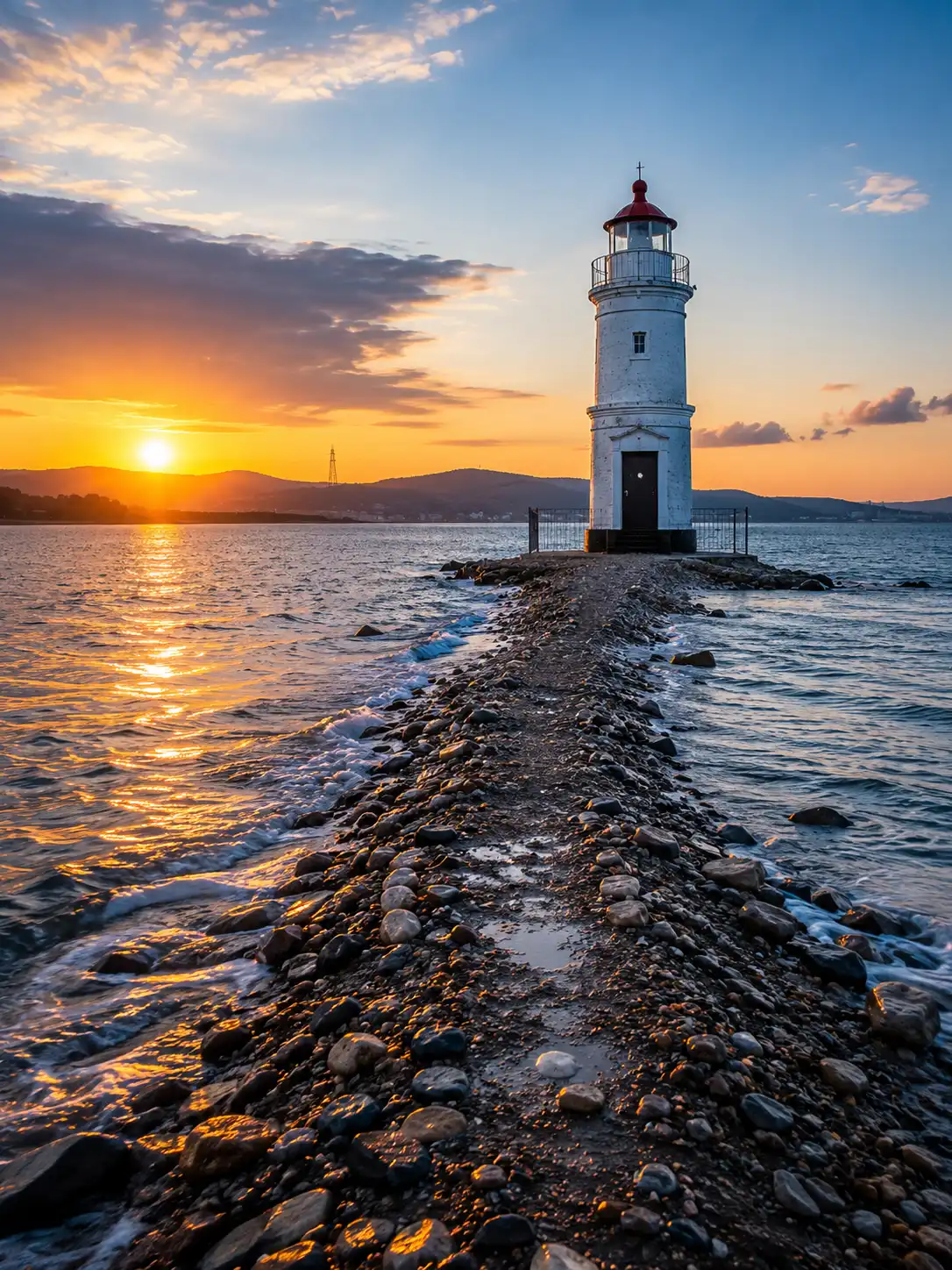
Tokarevsky Lighthouse is one of the most iconic coastal landmarks in Vladivostok and one of the most atmospheric places to experience the city’s relationship with the sea. Standing at the end of a long, narrow spit of land at the edge of the Egersheld Peninsula, the lighthouse marks the entrance area to the harbour and offers wide views over Peter the Great Gulf, the Bosphorus East, Russky Island and the open waters beyond.
Known in Russian as Токаревский маяк or Маяк Токаревского, the lighthouse is sometimes also associated with the name Egersheld Lighthouse because of its location on the Egersheld side of the city. It is not a huge monumental lighthouse in the style of some Atlantic or North Sea structures. Its appeal comes from simplicity, location and atmosphere. A small white tower rising from the water at the end of a narrow path becomes one of the most memorable scenes in Vladivostok.
For many visitors, Tokarevsky Lighthouse is the place where Vladivostok feels most maritime. The city centre can be understood through bridges, hills, monuments and harbours, but Tokarevsky reveals the open coastal character of the region. Here, wind, tide, mist, seabirds and passing ships define the experience. On clear days, the view feels expansive and calm. In fog or stormy weather, the site becomes dramatic and almost cinematic.
The lighthouse is also one of the easiest natural-coastal locations to visit from the city. It does not require a difficult hike or a full-day excursion. At the same time, it should not be underestimated. The narrow spit can be slippery, water levels and waves change, winter ice creates risks and careless behaviour near the sea can become dangerous.
This Wander Russia guide explains the history of Tokarevsky Lighthouse, how to reach it, what to expect at the site, when to go, what can be seen, what safety issues matter and how to combine the lighthouse with other important attractions in Vladivostok.
Where Is Tokarevsky Lighthouse?
Tokarevsky Lighthouse stands at the southwestern edge of Vladivostok on the Egersheld Peninsula.
The site is located near the exit from the inner harbour toward the broader waters of Peter the Great Gulf. It occupies a narrow artificial and natural spit known as Tokarevskaya Koshka, which extends into the sea like a long finger. At the end of this spit, the lighthouse rises from a small offshore foundation reached by a narrow path when conditions allow.
This setting gives the lighthouse special significance. It is not hidden deep inside the city, nor is it located far away on an isolated island. Instead, it sits at the threshold between port and open sea. Ships moving toward Vladivostok pass through waters near the lighthouse, and visitors standing on the spit can look back toward the city or outward toward maritime routes and distant shores.
Because of its location, Tokarevsky Lighthouse is often treated as both a city landmark and a coastal nature destination. It belongs fully to Vladivostok, but it also feels like an edge-of-the-world point where the city gives way to the sea.
Why Tokarevsky Lighthouse Is So Important
The importance of Tokarevsky Lighthouse comes from several layers.
First, it is a navigational structure. Like all lighthouses, its original role is practical rather than decorative. It helps ships orient themselves and move safely through the coastal waters near Vladivostok.
Second, it is symbolic. The image of a white lighthouse at the end of a narrow spit has become one of the best-known visual representations of Vladivostok. It appears in travel guides, local photography and visitor itineraries because it expresses the maritime identity of the city in a very direct way.
Third, it is emotional. Many visitors remember the place not because of technical details but because of the feeling it creates. Walking out over the stones and shallow water toward the lighthouse, with sea on both sides and wind blowing across the gulf, feels very different from walking through the central streets of Vladivostok.
Finally, it is photographic. Few places in the city offer such a simple but powerful composition: lighthouse, water, sky, waves and distant shoreline. The scene changes dramatically with season, weather and time of day.
The History of Tokarevsky Lighthouse
Tokarevsky Lighthouse dates back to the early twentieth century and belongs to the period when Vladivostok was strengthening its identity as a major port and naval centre in the Russian Far East.
As maritime traffic increased, reliable navigation aids became essential. The coastal geography around Vladivostok is complex, with bays, peninsulas, islands, shallow areas and changing weather. Lighthouses and other signalling structures played a major role in guiding ships through these waters safely.
Tokarevsky was constructed to mark an important zone at the harbour approach. Over time, it became one of the best-known aids to navigation in the region.
Although the lighthouse has clear historical value, visitors should remember that it is still primarily a working navigational site rather than a museum monument. It should be approached with respect and not treated as a climbable structure or a recreational platform.
The Name Tokarevsky
The name Tokarevsky is linked to the local geographical designation of the spit and surrounding area.
Visitors may encounter different forms such as Tokarevsky Lighthouse, Tokarevsky Mayak, Tokarevsky Lighthouse Egersheld or simply Egersheld Lighthouse. These all generally refer to the same destination.
The Russian word “mayak” means lighthouse. “Tokarevskaya Koshka” refers to the long narrow spit leading toward the tower. In local usage, the full area and the lighthouse are closely associated, and many visitors speak of going “to Tokarevsky” rather than using a longer title.
The important practical point is that different spellings in maps or taxi apps usually indicate the same site.
What the Lighthouse Looks Like
Tokarevsky Lighthouse is a relatively small, simple white cylindrical tower.
It does not dominate the horizon through height or monumental design. Its visual strength lies in proportion and placement. The tower stands alone against water and sky, which makes it feel much more prominent than its actual size might suggest.
Because the structure is modest, visitors are often surprised by how small it appears when they arrive. Yet that simplicity is part of the charm. Tokarevsky is not impressive because of architectural complexity. It is impressive because it stands in exactly the right place.
The tower’s white colour contrasts beautifully with blue summer water, grey autumn mist, golden evening light and winter ice. This makes it visually effective in almost every season.
Tokarevskaya Koshka: The Long Spit to the Lighthouse
The walk toward the lighthouse is one of the main reasons the site is memorable.
Tokarevskaya Koshka is a long, narrow spit made up of stone, gravel and coastal reinforcement stretching out into the water. Visitors walk along this raised path with the sea visible on both sides. Depending on tide, waves and weather, parts of the route may be dry and easy or partly wet and slippery.
At low or moderate water levels, the walk is relatively straightforward, though uneven. At higher water or during rough sea conditions, waves may cross parts of the path. In winter, ice and frozen spray can make the surface dangerous.
This approach is what gives the site its character. The experience is not just about arriving at the lighthouse. It is about walking along a thin strip of land toward a structure that seems to stand at the boundary between city and sea.
Can You Walk Right Up to the Lighthouse?
In many conditions, yes, visitors can walk close to the lighthouse.
However, whether the final approach is comfortable or advisable depends on weather, sea level and surface conditions. The route is not a polished promenade. It is a coastal path with stones, uneven footing and exposure to water and wind.
Visitors should not assume that because other people are walking to the tower, it is always safe. Calm summer mornings and stormy autumn evenings create entirely different conditions.
It is also important not to interfere with the lighthouse itself. Climbing, entering restricted areas or damaging equipment is not acceptable. The lighthouse should be viewed and photographed respectfully from the outside.
The Experience of Visiting
A visit to Tokarevsky Lighthouse is simple, but that is exactly why it works so well.
There are no complicated ticketing systems, no long museum explanations and no heavily staged interpretation. Instead, the site offers open space, sea air and one of the most recognisable coastal scenes in Vladivostok.
Most visitors begin by parking or arriving near the base of the spit. From there, they walk toward the lighthouse, stopping along the way to photograph the water, watch the waves or look back toward the city.
Some come only for ten or fifteen minutes. Others stay much longer, especially photographers, couples, walkers and travellers who want to experience Vladivostok more slowly.
The site can feel peaceful in the early morning, lively in the afternoon and almost meditative near sunset.
Best Time to Visit Tokarevsky Lighthouse
Tokarevsky Lighthouse can be visited throughout the year, but the experience changes dramatically by season.
In late spring and summer, the path is generally easiest to access. The sea often appears bright blue, and the atmosphere can feel open and light. This is the most comfortable season for casual visitors.
In early autumn, the lighthouse becomes particularly photogenic. The air is often clearer, the light softer and the overall atmosphere more dramatic. Autumn is one of the best seasons for serious photography.
In winter, the site becomes strikingly beautiful but much more challenging. Snow, ice, wind and frozen spray create an almost Arctic mood. The lighthouse standing above icy water can be unforgettable, but the walk becomes more dangerous.
Spring can be mixed, with changing wind, wet surfaces and unstable weather.
Best Time of Day
The best time of day depends on the kind of experience desired.
Morning is ideal for quieter conditions. Fewer visitors are present, and the light can be soft and clean. Calm mornings are particularly good for simple, clear photography.
Late afternoon and sunset are the most popular times. Warm light transforms the water, and the lighthouse silhouette becomes especially attractive. This is often the most atmospheric time to visit.
Blue hour, just after sunset, is excellent for mood. The sky retains colour while the lighthouse and surrounding coast become more subdued and reflective.
Night visits can also be interesting, but they require greater care. The path is uneven, and darkness makes footing less secure.
Weather and Fog
Fog is one of the defining conditions of Vladivostok’s maritime environment, and Tokarevsky Lighthouse is one of the best places to feel its effect.
On foggy days, the lighthouse may appear and disappear in mist, creating a soft and mysterious scene. What would be a straightforward coastal walk in clear weather becomes a much more atmospheric experience.
Wind also plays an important role. The spit is exposed, and even when the city feels relatively calm, the lighthouse area may be windy.
Rain makes the stones slippery, while strong waves can wash over parts of the path.
A visit should therefore always be adapted to actual conditions, not just to plans made earlier in the day.
What Can Be Seen from Tokarevsky Lighthouse?
The site offers wide maritime views.
Visitors can look across the water toward Russky Island, passing ships, the entrance to the harbour and parts of the Vladivostok coastline. Looking back toward land, the urban edge of the city appears in a different and more distant way than from central viewpoints.
The scene is not dominated by one single panorama the way Eagle’s Nest Hill is. Tokarevsky is more about openness and atmosphere than about a dense city overview.
You come here not to see “everything” but to feel where the city meets the sea.
Birdlife can also add interest. Seagulls and other coastal birds are commonly seen, and in some seasons marine animals may occasionally be spotted offshore.
Seals and Marine Life
Tokarevsky Lighthouse has become especially known among some visitors because seals can sometimes be seen in nearby waters.
Sightings are not guaranteed, and wildlife should never be expected on demand. However, the area’s marine environment makes such encounters possible.
If seals are visible, they should be watched quietly and from a respectful distance. No attempt should be made to approach or disturb them.
The site’s coastal ecology is part of its appeal, and visitors should treat it as a living environment rather than only a scenic backdrop.
Safety at Tokarevsky Lighthouse
Although the lighthouse is an easy destination compared with remote hikes, safety matters.
The main risks include:
- Slippery stones
- Sudden waves
- High water levels
- Strong wind
- Ice in winter
- Poor visibility in fog
- Unstable footing near the water
Good shoes are important. Smooth city shoes, sandals or footwear without grip are poor choices.
Visitors should also avoid standing too close to wave-exposed edges, especially when trying to take photographs.
Children should be supervised carefully. Dogs should be controlled, as the narrow path and water on both sides create obvious risks.
What to Wear and Bring
Even a short visit is more enjoyable with the right clothing.
Recommended items include:
- Shoes with good grip
- A windproof jacket
- Warm layers outside midsummer
- Sun protection in summer
- A charged phone
- Water
- A camera or phone with enough storage
- Gloves and a hat in colder seasons
Because the area is exposed, it often feels colder than central Vladivostok.
How to Get There
Tokarevsky Lighthouse is relatively easy to reach from central Vladivostok.
The simplest option is by taxi. The ride is direct and usually convenient, especially for first-time visitors.
It is also possible to reach the Egersheld area by public transport and then continue on foot, depending on the exact route and current transport arrangements.
For visitors with a car, reaching the general area is simple, though parking can be limited during busy periods.
The final stretch always requires walking.
How Much Time Is Needed?
A short visit can be completed in around 30 to 45 minutes.
A more relaxed experience with photography and time to enjoy the coast usually takes one to one and a half hours.
Many visitors combine Tokarevsky Lighthouse with other sights on the same day, especially Egersheld, the central waterfront or hill viewpoints.
Photographers may stay longer, especially at sunrise or sunset.
Photography Tips
Tokarevsky Lighthouse is one of the best photography locations in Vladivostok.
Wide-angle compositions work well for capturing the full spit, sea and sky. A standard lens is ideal for more balanced images, while a telephoto lens can isolate the lighthouse against distant land or water.
Reflections, mist and wave motion all create strong visual possibilities.
Sunrise and sunset are especially rewarding, but overcast and foggy conditions can be just as beautiful.
The best photographs do not always require walking all the way to the lighthouse. Some of the strongest compositions are created from partway along the spit, where the lighthouse, the path and the water align naturally.
Combining Tokarevsky Lighthouse with Other Attractions
Tokarevsky Lighthouse works well with several nearby or complementary locations.
A good coastal and city combination might include:
- Tokarevsky Lighthouse
- Sportivnaya Embankment
- Eagle’s Nest Hill
- Golden Bridge viewpoints
- Millionka
- Vladivostok Railway Station
It also pairs naturally with a broader Egersheld walk or a sunset programme followed by dinner back in the city.
Because the lighthouse does not require a full day, it fits easily into many itineraries.
A Suggested Visit Plan
A simple and effective plan is to visit Tokarevsky Lighthouse either early in the morning or in the late afternoon.
Arrive with enough time to walk slowly along the spit. Pause regularly rather than hurrying straight to the tower.
Spend time at one or two different points along the route, looking back toward the city and outward toward the sea.
If conditions are good, remain until the light changes. The site often becomes more beautiful after a short wait.
Then continue to another Vladivostok attraction or return to the centre.
Is Tokarevsky Lighthouse Worth Visiting?
Tokarevsky Lighthouse is absolutely worth visiting.
It is one of the simplest but strongest experiences in Vladivostok. It does not rely on spectacle, luxury or complex interpretation. Instead, it offers something more essential: a direct encounter with the maritime identity of the city.
The site is scenic, accessible and memorable. It works equally well for first-time visitors, photographers, couples, solo travellers and anyone who wants to feel the coastal atmosphere of Russia’s Pacific edge.
Wander Russia recommends Tokarevsky Lighthouse as one of the essential places in Vladivostok, especially for travellers who want more than monuments and city streets.
Frequently Asked Questions
How far is Tokarevsky Lighthouse from central Vladivostok?
It is relatively close and can usually be reached conveniently by taxi or a combination of public transport and walking.
Can visitors walk to the lighthouse?
Yes, in many conditions visitors can walk along the spit toward the lighthouse, but weather and water conditions may affect how easy or safe this is.
Is there an entrance fee?
The site is generally visited freely as an outdoor coastal landmark.
When is the best time to visit?
Late afternoon, sunset and early morning are usually the most atmospheric times.
Is it safe in winter?
It can be visited in winter, but ice, snow and strong wind create significantly higher risk.
Can seals be seen there?
Sometimes, yes, but sightings are never guaranteed and wildlife should not be disturbed.
How long should visitors stay?
Most visitors spend between 30 minutes and 1.5 hours depending on weather, walking pace and photography.
Is it suitable for children?
Yes, with close supervision because of uneven surfaces and water exposure.
Conclusion
Tokarevsky Lighthouse is one of the clearest expressions of what makes Vladivostok special.
It stands at the meeting point of city and sea, where the dense urban energy of the Russian Far East gives way to open water, wind and maritime space. The lighthouse itself is modest in size, but its setting gives it unusual power.
Walking along Tokarevskaya Koshka toward the white tower is a small journey that captures much of Vladivostok’s character. The city’s identity as a port, a naval centre and a Pacific outpost becomes tangible here.
The experience changes with light and weather. In summer it can feel calm and bright. In autumn it becomes reflective and dramatic. In winter it feels harsh and elemental. In fog it becomes mysterious and almost dreamlike.
That ability to transform without losing its essence is part of what makes the place memorable.
For travellers building a Wander Russia route through Vladivostok, Tokarevsky Lighthouse is not just another viewpoint. It is one of the places where the spirit of the city can be felt most clearly.
