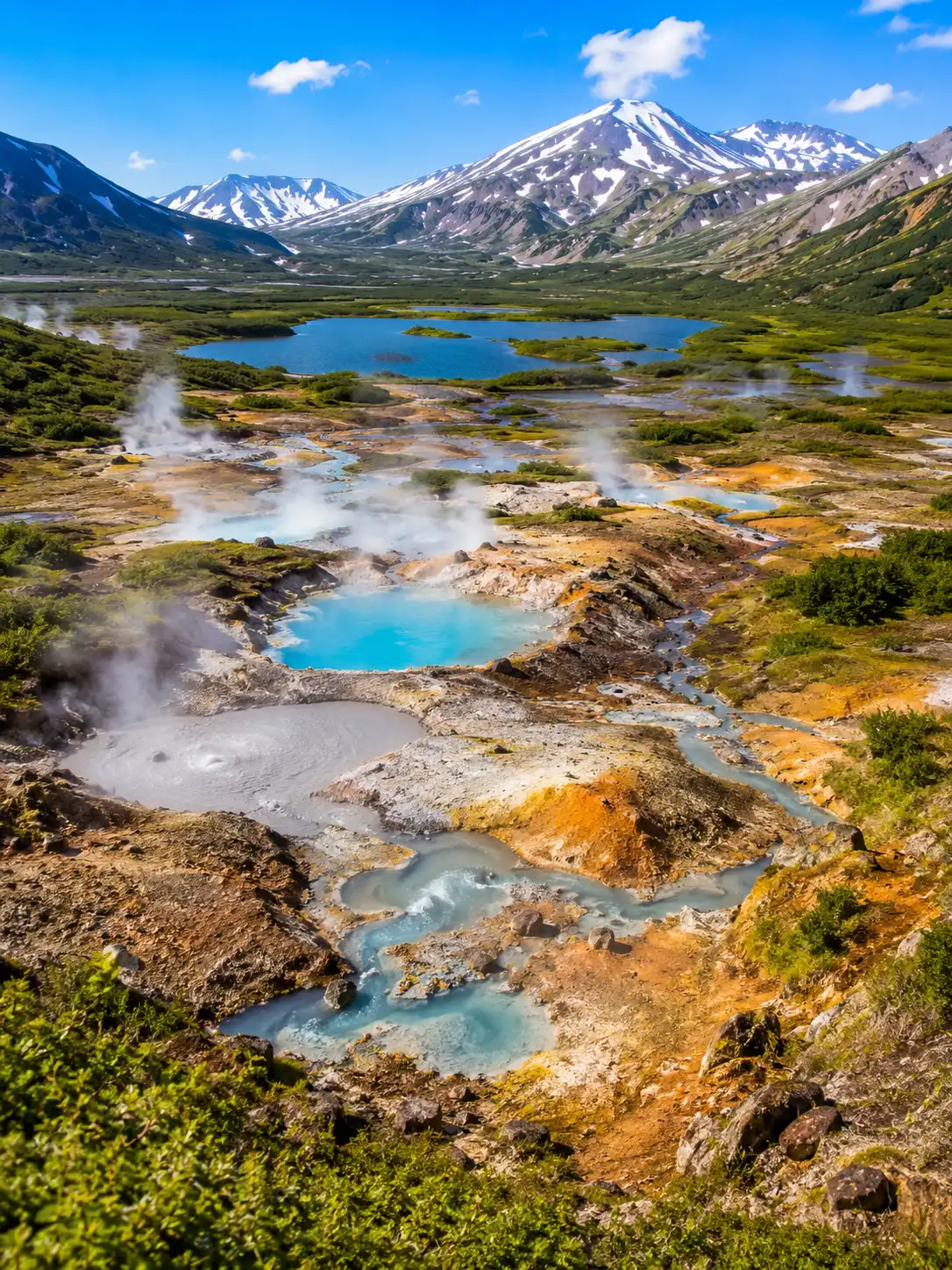
Uzon Caldera is one of the most unusual geothermal landscapes on the Kamchatka Peninsula. Hidden inside the Kronotsky Nature Reserve, the vast volcanic basin contains hot springs, boiling pools, mud pots, fumaroles, mineral lakes, cold streams and colourful thermal fields within a single protected landscape.
Known in Russian as Кальдера Узон, the caldera lies west of the famous Valley of Geysers. The two destinations are often visited during the same helicopter excursion, but they are not the same place. The Valley of Geysers is a narrow river canyon defined by erupting geysers and steep slopes. Uzon is a much broader volcanic depression filled with wetlands, lakes, streams and scattered hydrothermal areas.
From the air, the caldera appears as an immense bowl surrounded by elevated volcanic walls. On the ground, its scale becomes harder to understand because the visitor route crosses only a small part of the basin. Steam rises from pools and vents, mineral deposits colour the soil, and snow-covered volcanoes may appear beyond the rim when the weather is clear.
Uzon is not a conventional hiking attraction or a thermal spa. It lies within a strictly protected nature reserve where access is controlled, movement is limited to designated routes and visitors must remain with reserve personnel or authorised guides. The restrictions protect both travellers and an exceptionally sensitive geothermal ecosystem.
This complete Wander Russia guide explains the origin of the Uzon Caldera, its geothermal features, visitor routes, wildlife, access conditions, safety rules and the best time to plan a journey.
Where Is Uzon Caldera?
Uzon Caldera is located in eastern Kamchatka within the Kronotsky State Nature Biosphere Reserve. It lies approximately 180 kilometres northeast of Petropavlovsk-Kamchatsky, although the precise flight distance varies according to the aviation route and weather.
The caldera sits immediately west of the neighbouring Geysernaya Caldera. Together, the two volcanic depressions form a broad geothermal complex stretching across a significant part of the eastern volcanic zone of Kamchatka.
Uzon itself is approximately 9 by 12 kilometres across. Its floor is relatively flat compared with the surrounding caldera walls and contains numerous lakes, streams, wetlands and thermal fields.
The visitor route covers only a small portion of this enormous landscape. Most of the caldera remains inaccessible to ordinary tourism and is reserved for scientific work, conservation and natural processes.
There is no public road to Uzon. Most visitors arrive by helicopter as part of an organised excursion from the Petropavlovsk-Kamchatsky or Yelizovo area.
How the Uzon Caldera Was Formed
A caldera forms when a major volcanic eruption removes a large volume of magma from beneath a volcano. As the underground chamber loses support, the surface above it can collapse and create a broad depression.
Uzon belongs to a complex volcanic system formed during the Pleistocene. Large explosive eruptions produced extensive deposits of ash and ignimbrite across the surrounding landscape.
The Uzon and Geysernaya calderas together form a depression approximately 7 by 18 kilometres in size. Their formation was associated with powerful eruptions that released enormous quantities of volcanic material.
Later activity continued inside and around the caldera. Small volcanic centres, explosion craters and hydrothermal features developed across the basin.
One of the youngest major volcanic formations is Lake Dalny, a maar created by an explosive interaction between magma and groundwater approximately 7,600 to 7,700 years ago.
The modern caldera is therefore not the result of one simple event. It records repeated phases of eruption, collapse, geothermal circulation, erosion and sedimentation.
Why Uzon Looks Different from Other Kamchatka Volcanoes
Many famous Kamchatka volcanoes are tall cones rising above forests or tundra. Uzon has a completely different form.
Instead of climbing toward a summit, visitors descend into or land within a broad volcanic basin. The landscape feels open and horizontal rather than steep and vertical.
Low ridges, wetlands and lakes occupy much of the floor. Thermal fields appear as patches of white, yellow, orange, brown and grey ground surrounded by green vegetation.
Steam rises from numerous points rather than from one summit crater. Some vents are small and quiet, while others produce continuous clouds of vapour.
This variety makes Uzon feel less like a single volcano and more like an entire geothermal world contained within the walls of an ancient caldera.
The Main Thermal Fields
Uzon contains several hydrothermal areas where hot water, steam and volcanic gases reach the surface.
The Eastern Thermal Field is one of the most active and scientifically important zones. It extends through a relatively narrow area and contains fumaroles, hot springs, boiling pools and mud pots.
The Western Thermal Field contains additional springs, mineral deposits and warm water systems.
Other thermal areas are distributed across the basin, and their appearance changes according to temperature, water supply, seasonal conditions and underground activity.
Visitors usually see only the thermal zones included in the approved excursion route. Independent exploration is not permitted because the surface can be unstable and new hot openings may develop.
Hot Springs and Boiling Pools
Hot springs form when groundwater circulates through heated rock and returns to the surface.
At Uzon, some springs emerge as clear pools, while others contain suspended minerals or microorganisms that influence their colour.
Water temperatures vary greatly. Some pools are warm, while others are close to boiling.
A calm surface should never be interpreted as safe. Thermal water can cause severe burns, and thin mineral crusts may conceal hotter water beneath them.
The pools are not intended for swimming. Visitors must remain on the boardwalk and should never test the temperature with a hand, walking pole or other object.
Mineral-rich water flows from some springs into narrow channels. As it cools, dissolved minerals are deposited along the edges, creating pale or brightly coloured surfaces.
Mud Pots
Mud pots develop where hot water and volcanic gases interact with fine clay and altered volcanic rock.
The resulting mixture bubbles, pulses and sometimes releases small bursts of steam. Depending on the consistency, the mud may appear thick and slow-moving or more liquid.
Mud pots are among the most visually distinctive features of Uzon because their surfaces constantly change.
Gas bubbles rise through the mud and burst, creating circular patterns and miniature craters. Colours vary from grey and beige to dark brown or reddish tones.
The edges can be extremely fragile. A person stepping away from the route may break through a thin crust into hot mud.
Fumaroles and Volcanic Gas
Fumaroles release steam and volcanic gases through cracks in the ground.
The visible white clouds consist largely of condensed water vapour, but emissions can also contain sulphur dioxide, hydrogen sulphide, carbon dioxide and other gases.
Sulphur and altered minerals accumulate around some vents, creating yellow and pale-green deposits.
Wind normally disperses gases, but concentrations can increase in low areas or during calm weather.
Visitors should inform the guide immediately if they experience coughing, dizziness, headache, nausea or eye irritation.
Standing directly inside a steam plume for photography is unsafe. The steam may be hot, while gases can irritate the respiratory system.
Mineral Colours and Microbial Life
The bright colours of Uzon result from several different processes.
Yellow deposits often indicate sulphur. Red, orange and brown tones may come from iron-rich minerals. White and grey surfaces can form through silica, clay alteration and other geothermal processes.
Some thermal pools also support microorganisms adapted to high temperatures and unusual chemical conditions.
These microbial communities can influence the appearance of water and mineral surfaces. Their study helps scientists understand how life survives in extreme environments.
The colours should not be treated as decorative surfaces. They are part of active chemical and biological systems that can be damaged by footsteps or contact.
Lakes Inside the Caldera
Uzon contains several lakes formed through different geological processes.
Lake Dalny is a maar lake occupying an explosion crater in the northern part of the caldera. It is surrounded by a low ring of volcanic material created during the eruption that formed the basin.
Other lakes and ponds occupy depressions across the caldera floor. Some are cold freshwater bodies, while others are influenced by geothermal activity.
The contrast between cold blue lakes and nearby steaming ground demonstrates how varied the caldera is.
Visitors may see birds on the water and bear tracks along the shore, but access to many lakes is restricted.
The exact route depends on reserve regulations, snow, water levels and the condition of boardwalks.
The Discovery of Oil in Uzon
One of the most unusual scientific features of Uzon is the presence of naturally occurring oil within the geothermal system.
Small quantities of oil were identified in thermal pools and sediments inside the caldera. This discovery attracted scientific attention because the oil formed in a young geothermal environment rather than through the conventional long-term geological processes associated with major petroleum deposits.
The phenomenon has been studied as an example of hydrothermal organic transformation.
The oil is not a commercial resource and should not be confused with an industrial field. It is scientifically important because it provides insight into chemical reactions occurring under geothermal conditions.
Visitors may hear about this feature during guided explanations, although the relevant areas may not always be included in the public route.
Wildlife in Uzon Caldera
Uzon is part of a large protected wilderness and supports a variety of wildlife.
Kamchatka brown bears move through the caldera in search of berries, roots, small animals and seasonal food. Warm ground can cause vegetation to emerge earlier in certain places, making some thermal areas attractive during spring.
Bears may also use the open basin as a travel corridor between forests, rivers and surrounding valleys.
Sightings are possible but never guaranteed. The caldera should not be promoted primarily as a bear-watching destination in the same way as Kurile Lake.
Foxes, ground squirrels and other mammals inhabit the wider reserve. Numerous bird species use the wetlands, lakes and open landscapes.
Visitors must remain with guides because wildlife may approach the route unexpectedly.
Feeding animals, leaving food waste or attempting to attract a bear for photographs is prohibited.
How Uzon Differs from the Valley of Geysers
Uzon and the Valley of Geysers are frequently combined, which can create confusion.
The Valley of Geysers is located in a narrow canyon along the Geysernaya River. Its defining features are erupting geysers, steep slopes and concentrated hydrothermal activity.
Uzon is a broad caldera containing several thermal fields, lakes, streams, wetlands and open volcanic terrain.
The valley often feels more dramatic because geysers erupt within a confined landscape. Uzon feels larger, quieter and more varied.
At the Valley of Geysers, visitors follow a route through a canyon. At Uzon, the route crosses part of an open basin with wide views toward the caldera walls.
Both destinations demonstrate geothermal activity, but they should be treated as separate attractions.
How to Visit Uzon Caldera
The standard way to visit Uzon is by organised helicopter excursion.
Flights usually depart from aviation bases near Yelizovo or Petropavlovsk-Kamchatsky. Mi-8 helicopters are commonly used because they can carry groups and operate in remote terrain.
Many programs combine Uzon with the Valley of Geysers during the same day. A thermal bathing stop in another approved area may also be included.
The full excursion generally lasts around six or seven hours. This includes helicopter flights, landings, walking routes and possible additional stops.
Actual time inside Uzon may be limited to around one hour or slightly longer, depending on the program and reserve instructions.
Travellers should read the itinerary carefully. A tour advertised as a Valley of Geysers excursion may include only a brief landing at Uzon.
Helicopter Flight Experience
The helicopter journey is an important part of the excursion.
Flights cross forests, rivers, volcanic plateaus and remote areas without roads or settlements. Depending on visibility, passengers may see Karymsky Volcano, Maly Semyachik, Kronotsky Volcano and other major features of eastern Kamchatka.
Seating is normally assigned according to aviation procedures rather than photographic preference. Not every passenger can have an unobstructed window.
The cabin can be noisy, and ear protection may be provided or recommended.
Passengers must follow crew instructions during boarding, landing and movement near the aircraft. Rotor wash can lift dust, stones and loose clothing.
The flight path may change because of cloud, wind or volcanic activity.
Weather and Flight Cancellations
Helicopter excursions to Uzon are highly weather-dependent.
Fog, low cloud, rain and strong wind can prevent a departure even when conditions near the city initially appear acceptable.
Weather inside the caldera may also differ from conditions at the aviation base.
Cancellations are common enough that travellers should include several flexible days in their Kamchatka itinerary.
The excursion should not be scheduled for the final day before departure from the peninsula.
A cancelled flight is a safety decision rather than a failure of the destination. Mountain aviation in Kamchatka requires adequate visibility and suitable landing conditions.
Best Time to Visit
The main helicopter season generally runs from July through September, with some operations continuing into early October when weather and reserve conditions allow.
July brings long daylight, green vegetation and lingering snow around the caldera walls. Some parts of the route may still be wet or partly covered by snow.
August is one of the busiest months. Thermal fields are clearly visible, vegetation is fully developed and organised flights operate frequently when weather allows.
September brings cooler temperatures and autumn colours. The contrast between red vegetation, pale mineral ground and steam can be especially attractive.
Early October is less predictable. Snow and poor weather may reduce the number of possible flights.
No month guarantees clear skies or a successful landing.
The Visitor Route
After landing, visitors receive safety instructions from reserve staff.
The public route usually follows wooden boardwalks and designated paths through selected thermal areas.
The route is relatively short but includes stops for explanations, photography and observation.
Boardwalks protect both visitors and the ground. Hot water can lie beneath thin crusts, while repeated footsteps would quickly damage vegetation and mineral formations.
The exact route can change because of maintenance, flooding, snow, wildlife or geothermal activity.
Visitors should not expect access to every feature described in scientific publications.
What to Wear and Bring
Weather in the caldera can be cold, wet and windy even during summer.
Recommended equipment includes:
- Waterproof hiking footwear with good grip
- A waterproof and windproof jacket
- Warm insulating layers
- Long outdoor trousers
- A hat and light gloves
- Sunglasses and sun protection
- Insect repellent
- A small daypack
- Personal medication
- Waterproof protection for cameras and phones
- A lens cloth for steam and rain
- Drinking water if not provided
Large luggage may be restricted because helicopter space and weight are limited.
Clothing should be layered because temperatures can change between the aviation base, the flight and the caldera.
Safety Rules
Uzon is an active geothermal environment.
Visitors must follow these rules:
- Remain on the official boardwalk.
- Do not touch thermal water or mud.
- Do not step onto mineral crusts.
- Do not leave the group.
- Do not approach wildlife.
- Do not collect stones, minerals or plants.
- Do not throw objects into pools.
- Follow all instructions from reserve staff.
- Report dizziness or breathing problems immediately.
- Stay clear of the helicopter until invited to approach.
The ground can be dangerous even when it looks dry and solid.
Thin crusts may cover boiling water, and hot steam can emerge through small openings.
Responsible Tourism
Uzon is one of the most sensitive visitor areas inside the Kronotsky Nature Reserve.
Tourism is concentrated along a limited route to reduce damage.
Travellers should avoid touching mineral formations, leaving food waste or creating noise near wildlife.
Nothing should be removed from the caldera.
Professional photography, commercial filming and drone use may require additional permission.
Authorised tourism supports conservation, research, ranger work and infrastructure. Visitors should therefore book only through legal operators working with the reserve.
Scientific Importance
Uzon functions as a natural laboratory for volcanology, geothermal chemistry, microbiology and ecology.
Scientists study hot springs, gases, mineral formation, microbial communities, oil generation, water systems and the recovery of vegetation.
The close proximity of cold lakes, warm wetlands and boiling pools creates unusually diverse research conditions.
Long-term monitoring also helps identify changes in temperature, gas emissions and hydrothermal activity.
Tourist access represents only a small part of the caldera’s role. Most of its value lies in the preserved natural processes that continue without direct human intervention.
Photography Tips
A wide-angle lens is useful for showing the scale of the caldera and the contrast between thermal fields, wetlands and distant mountains.
A telephoto lens helps isolate mud pots, steam vents and wildlife without leaving the trail.
Steam can change direction quickly and cover the lens with moisture. A cloth should remain accessible.
Bright mineral ground and white steam can confuse automatic exposure. Slight underexposure may preserve detail in the highlights.
Visitors should also look beyond the colourful pools. Wider images of the basin often communicate Uzon’s character more effectively than close-up photographs alone.
Photography must never delay the group or encourage movement beyond the boardwalk.
Combining Uzon with the Valley of Geysers
A combined helicopter excursion is the most common program.
The two locations complement each other well. The Valley of Geysers provides dramatic eruptions and a steep canyon environment, while Uzon offers a broad caldera filled with lakes and varied thermal fields.
A typical itinerary may land first at one destination and then the other, depending on aviation logistics and weather.
Some programs include a final stop at approved hot springs outside the strict reserve zone.
Travellers should not assume that bathing is permitted in Uzon. The thermal waters inside the caldera are protected and can be dangerous.
Is Uzon Caldera Worth Visiting?
Uzon is worth visiting for travellers interested in geothermal landscapes, geology, protected wilderness and scientific environments.
The experience is quieter than the Valley of Geysers because there may be fewer dramatic eruptions. Its strength lies in diversity and scale.
Within a relatively short walk, visitors can see boiling pools, mud pots, fumaroles, mineral streams, wetlands and lakes inside an ancient volcanic basin.
The journey is expensive and vulnerable to cancellation. Time on the ground is limited, and the route covers only a small section of the caldera.
Nevertheless, Uzon offers an experience that cannot be reproduced by road-accessible attractions near Petropavlovsk-Kamchatsky.
Wander Russia recommends viewing the caldera as part of a broader Kamchatka itinerary rather than the only objective of the trip.
Frequently Asked Questions
Can Uzon Caldera be reached by road?
No public road connects the caldera with Petropavlovsk-Kamchatsky. Most visitors arrive by organised helicopter.
Can Uzon be visited independently?
No. It lies inside the strictly protected Kronotsky Nature Reserve, and visitors must use authorised access and remain with reserve staff.
Is Uzon the same as the Valley of Geysers?
No. Uzon is a broad volcanic caldera west of the separate Geysernaya Caldera and the Valley of Geysers.
Are there geysers in Uzon?
The caldera contains extensive geothermal activity, including hot springs, fumaroles and mud pots. The famous concentration of geysers lies in the neighbouring Valley of Geysers.
Can visitors swim in the thermal pools?
No. The pools inside Uzon are protected and may be dangerously hot.
How long do visitors spend in the caldera?
Time on the ground varies by itinerary, but it is usually limited because Uzon is one stop within a full-day helicopter program.
When is the best time to visit?
July through September generally provides the most practical helicopter season, with some flights extending into early October.
Are bears present?
Yes. Brown bears move through the caldera, although sightings are not guaranteed.
Is Uzon part of a UNESCO World Heritage Site?
Yes. It lies within the Kronotsky component of the Volcanoes of Kamchatka World Heritage property.
Can helicopter flights be cancelled?
Yes. Fog, low cloud, rain and wind frequently affect operations.
Conclusion
Uzon Caldera is one of Kamchatka’s most complete geothermal landscapes.
Its broad basin preserves the remains of powerful prehistoric eruptions, while continuing underground heat feeds springs, fumaroles, mud pots and mineral-rich pools.
Unlike a classic volcanic cone, Uzon must be understood from within. Visitors land on the floor of an ancient caldera and walk through a landscape where cold lakes, wetlands and boiling ground exist close together.
The experience is carefully controlled. Access is possible only through authorised routes, and the time spent on the ground is limited.
These restrictions are essential. Thermal surfaces can be dangerous, wildlife moves freely through the basin and even a small amount of uncontrolled foot traffic could damage fragile mineral and microbial systems.
Uzon also demonstrates that Kamchatka’s importance extends beyond dramatic eruptions and high mountains. Some of its most remarkable processes occur quietly beneath mud, water and mineral crusts.
A pool changes colour, steam emerges through a new opening and microorganisms survive in conditions that would be hostile to most forms of life.
The neighbouring Valley of Geysers may be more famous, but Uzon provides a broader view of geothermal activity. It shows how an entire volcanic basin can function as a connected system of water, heat, minerals, wildlife and vegetation.
For travellers who reach it, Uzon Caldera offers a rare opportunity to enter one of the most remote and scientifically important protected landscapes in Russia.
