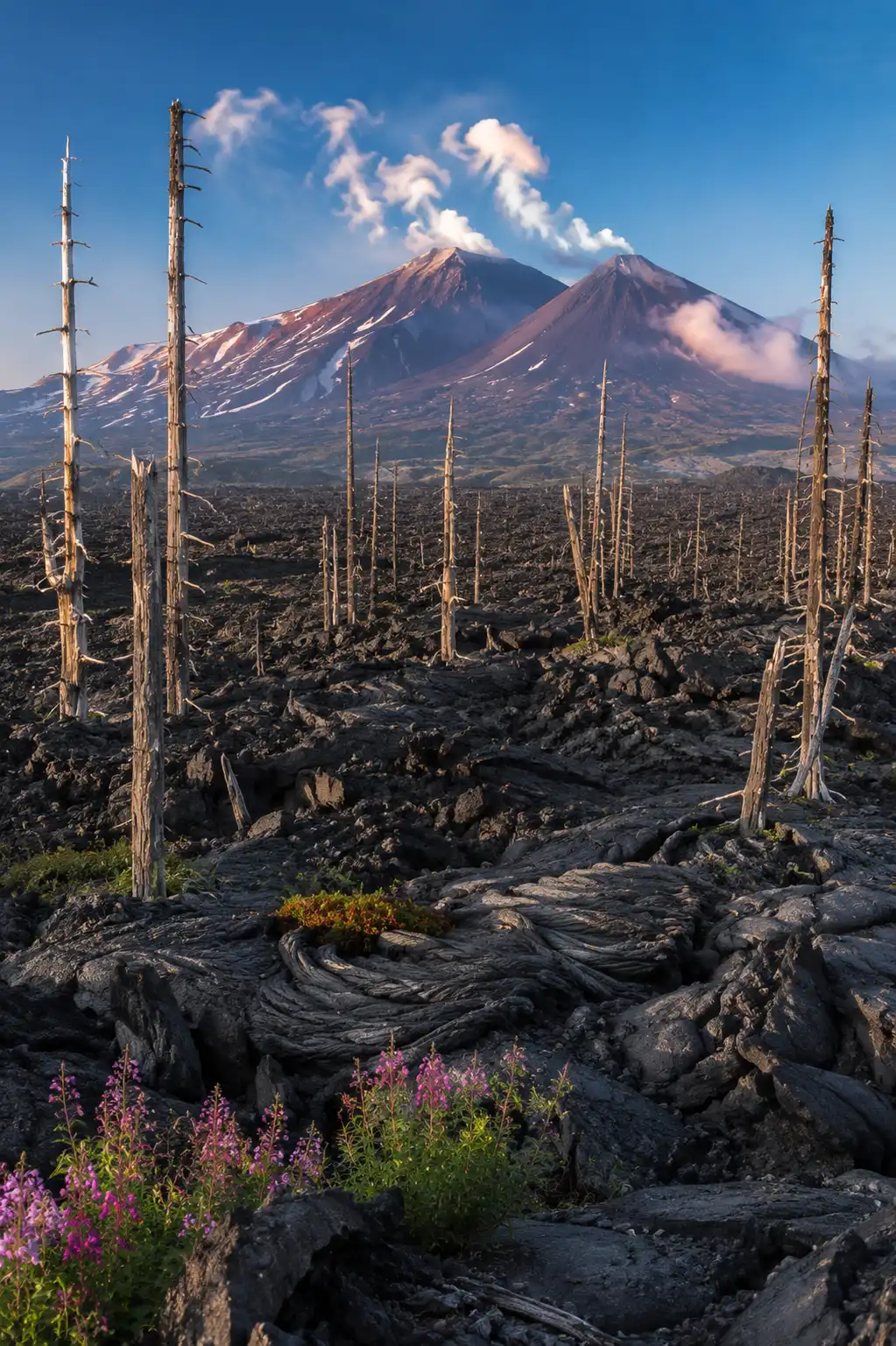
Tolbachik is one of the most dramatic volcanic destinations on the Kamchatka Peninsula. Rather than a single symmetrical cone, the region combines two contrasting volcanic summits, enormous fields of solidified lava, young cinder cones, lava caves and a forest destroyed during one of Kamchatka’s largest historical eruptions.
Known in Russian as Толбачик, the massif rises in central Kamchatka within Klyuchevskoy Nature Park. Much of the landscape visible today was created during the Great Tolbachik Fissure Eruption of 1975–1976 and the later eruption of 2012–2013.
Tolbachik is harder to reach than the volcanoes close to Petropavlovsk-Kamchatsky. Most visits require a long drive north, an approach through Kozyrevsk, off-road transport and several nights in a remote camp. The reward is an unusually complete volcanic experience. Visitors can walk across young lava, climb eruption cones, enter approved lava tubes and stand among the skeletal trees of the Dead Forest.
This Wander Russia guide explains what makes Tolbachik special, how to reach it, what to see, when to travel and how to prepare for a multiday expedition.
Where Is Tolbachik?
The Tolbachik complex lies in central Kamchatka within the Klyuchevskaya group of volcanoes. It rises beside the broad volcanic plateau known as Tolbachinsky Dol, far north of Petropavlovsk-Kamchatsky and Yelizovo.
Kozyrevsk, a village on the Kamchatka River, is the usual staging point. From there, specialised vehicles follow forest tracks, cross rivers and continue over volcanic ground toward camps near the Kleshnya area and the northern eruption cones.
The route is slow. Roads become rough, bridges may be absent and water levels can affect river fords. Travel from Petropavlovsk-Kamchatsky normally occupies most of a day and can take longer when conditions are difficult.
Tolbachik lies inside a protected landscape. Visitors should travel with an authorised operator or qualified local guide who can arrange transport, park fees, registration and any permits required for the route.
Plosky Tolbachik and Ostry Tolbachik
Tolbachik consists of two adjoining but visually different mountains.
Plosky Tolbachik, meaning Flat Tolbachik, is the active part of the complex. Its broad form and relatively gentle upper slopes contrast with the sharper profile beside it. It rises to roughly 3,100 metres and contains a large summit crater and caldera system.
Ostry Tolbachik, meaning Sharp Tolbachik, is older and higher. At approximately 3,680 metres, it has a steep, eroded summit and is generally regarded as extinct. Its broken ridges and glaciers give it a more alpine appearance.
Long fissure zones extend away from the massif. These cracks have allowed magma to reach the surface far from the central summit, creating cinder cones and extensive lava fields. Many of the most interesting sights are therefore spread across Tolbachinsky Dol rather than concentrated at the top.
The Great Tolbachik Fissure Eruption
The Great Tolbachik Fissure Eruption began in July 1975 and continued into 1976. It became the largest historical basaltic eruption recorded in Kamchatka.
The eruption did not remain confined to the summit. Fissures opened across the plateau, producing northern and southern eruption zones. New cones rose, lava spread across the land, and ash and scoria transformed the surrounding forest.
At the Northern Breakthrough, explosive activity built several prominent cinder cones. Volcanic bombs, gases and ash affected a wide area. The Southern Breakthrough produced additional lava flows and formations.
Scientists observed the eruption closely, making Tolbachik an important natural laboratory for studying cone formation, lava movement, gas emissions and ecological recovery.
Today, visitors can climb selected cones and look across a landscape formed within living memory. From above, the scale of the eruption becomes easier to understand than it is in photographs.
The Dead Forest
The Dead Forest, known in Russian as Мёртвый лес, is one of Tolbachik’s most recognisable sights.
Before the 1975–1976 eruption, the area supported a typical Kamchatka forest. Thick ash, scoria and hot volcanic material buried the ground, damaged roots and killed large numbers of trees. Many trunks remained standing, creating a stark forest of bare vertical forms surrounded by black volcanic soil.
The landscape is no longer completely lifeless. Mosses, grasses, fireweed, shrubs and young trees are gradually returning. Their colours contrast strongly with the dark ground and pale dead trunks.
This recovery shows how plants colonise new volcanic surfaces and how ecosystems rebuild after a major disturbance. Progress is slow because the ground contains little developed soil and remains exposed to wind, snow and temperature changes.
Visitors should not climb on fragile trunks or remove pieces of wood. The Dead Forest is both a reminder of the eruption and an active site of ecological succession.
Some routes pass old structures once used by researchers. They add a human element to the landscape, but abandoned buildings should be entered only when a guide confirms that access is safe and permitted.
The 2012–2013 Eruption
A new fissure eruption began on 27 November 2012 south of the massif. It continued until September 2013 and produced extensive lava flows across Tolbachinsky Dol.
The eruption created lava fountains, new cones and rivers of molten rock. Lava destroyed or buried parts of the surrounding terrain and altered routes used by researchers and visitors.
These fields are among the youngest large lava landscapes accessible to travellers in Kamchatka. Heat may remain in deeper cracks, caves and parts of the flow. Guides sometimes demonstrate geothermal warmth in approved places, but visitors should never test cracks or vents independently.
The younger lava often appears darker and sharper than older surfaces. Channels, ridges and collapsed tubes record the direction and movement of the original flow.
Walking over this terrain gives a direct sense of how quickly a volcanic landscape can form. Sharp rock can damage weak footwear, while loose blocks require careful movement.
Northern and Southern Breakthroughs
The Northern and Southern Breakthroughs are central to most Tolbachik itineraries.
At the Northern Breakthrough, visitors usually climb one or more cinder cones created during the 1975–1976 eruption. The ascent is shorter than the climb to Plosky Tolbachik but can still be tiring because loose scoria moves underfoot.
From the top, the view extends over chains of cones, lava fields, the Dead Forest and the main massif. In clear weather, other volcanoes of the Klyuchevskaya group may appear along the horizon.
The Southern Breakthrough includes lava formations, caves and sections of damaged forest. Programs vary, and guides may group the sites according to road and weather conditions.
Volcanic rocks appear in shades of black, red and brown, sometimes with brighter mineral colours. Rocks should not be collected inside the protected park.
Lava Caves and Zvezda Crater
Tolbachik’s lava fields contain tubes formed when the outer surface of a lava flow cooled while molten rock continued moving below it. After the lava drained away, hollow tunnels remained.
Some tours enter approved lava tubes near the Zvezda crater. Inside, visitors may see layered walls, hardened drips and surfaces shaped by flowing lava. The temperature can differ sharply from the outside air, and complete darkness begins beyond the entrance.
A headlamp is essential, while a helmet may be provided or required. Phone lights are inadequate because they leave the hands occupied on uneven ground.
Lava caves should never be explored without a guide. Roofs may be unstable, passages can branch and hidden drops or sharp surfaces can cause injury. Access changes according to collapse, snow, ice and park regulations.
Climbing Plosky Tolbachik
The ascent of Plosky Tolbachik is the most demanding activity on a typical program.
Routes vary according to camp location and conditions, but a summit day can involve about 20 kilometres of walking, a substantial elevation gain and ten to thirteen hours on the mountain. Although often described as non-technical, the climb requires endurance and confidence on loose volcanic terrain.
The lower route crosses ash, lava fragments and open slopes. Higher areas may contain snowfields, strong wind and rapidly changing visibility. When clouds remain clear, the upper section provides views toward the large summit crater.
Non-technical does not mean easy. Altitude, cold wind, unstable footing and the long duration can exhaust travellers who are comfortable on ordinary hikes.
Guides may cancel the climb because of weather, volcanic conditions, route safety or group fitness. The decision should be respected. The lava fields, caves and eruption cones remain worthwhile even when the summit is inaccessible.
Ostry Tolbachik is a far more serious mountaineering objective and is not part of standard hiking tours.
How to Reach Tolbachik
Most organised trips begin in Petropavlovsk-Kamchatsky or Yelizovo.
The route follows the main road north through the interior of Kamchatka, usually passing Milkovo before continuing toward Kozyrevsk. Beyond the regular road network, heavy off-road vehicles or prepared four-wheel-drive vehicles enter forest tracks and volcanic terrain.
The final approach may involve river fords and rough ground. Travel time depends on rainfall, snowmelt, vehicle condition and track maintenance.
A standard tour normally lasts four or five days. Longer programs may combine Tolbachik with other parts of Klyuchevskoy Nature Park, rafting, hot springs or additional volcanoes.
Independent driving is unsuitable for most visitors. Navigation is difficult, mobile coverage is limited and a mechanical problem in remote terrain can become serious. Local drivers understand seasonal tracks, river crossings and safe camp locations.
A Typical Multiday Program
The first day is largely devoted to the long journey north and the off-road drive to camp.
The next day often focuses on the 2012–2013 lava fields, lava tubes and nearby cones. Another day is reserved for the Plosky Tolbachik climb when weather and group fitness allow.
The Northern Breakthrough, Dead Forest and other volcanic formations normally occupy a separate day before the return journey.
Operators often change the order of activities according to the forecast. Travellers should also read the itinerary carefully: a four-day tour can include two long transport days, while a five-day program usually provides more flexibility.
Best Time to Visit
The main hiking and vehicle-access season runs from July through September.
July offers long daylight, lingering snow and fresh vegetation. Tracks can still be wet, and snow may remain on higher routes.
August is the most popular period because access is usually established and multiday tours operate regularly. Nights at camps around 1,200 to 1,300 metres can nevertheless be cold.
September brings autumn colour and cooler weather. Early snow is possible, and the season may end quickly when conditions deteriorate.
Winter visits require specialised vehicles, equipment and guides. Extreme cold, limited daylight and deep snow make them entirely different from standard summer tours.
Weather and Camp Conditions
Weather can change rapidly. Sunshine may be followed by fog, rain, wind or sleet within a few hours.
Accommodation is generally basic. Depending on the operator, visitors may stay in expedition tents, simple cabins or a glamping-style camp. Toilets, showers, electricity and mobile service may be limited or absent.
Cold nights are possible even in midsummer. A suitable sleeping bag, insulating mat and dry sleeping clothes are important.
Volcanic dust can enter tents and equipment. Documents, cameras and electronic devices should be protected in sealed bags.
Tolbachik is not a hotel-based excursion with a short daily transfer. The expected comfort level should be confirmed before booking.
What to Wear and Bring
Recommended equipment includes:
- Waterproof trekking boots with strong soles
- Gaiters to keep ash and stones out of footwear
- A waterproof and windproof jacket
- Warm insulating layers
- Thermal underwear
- Gloves and a warm hat
- Trekking poles
- A headlamp with spare batteries
- Sunglasses and sun protection
- Insect repellent
- A small daypack
- Personal medication and blister care
- Waterproof bags for documents and electronics
- A suitable sleeping bag when not supplied
- Reusable water bottles
Lava is abrasive. Thin-soled urban footwear can be damaged quickly and provides poor protection.
Safety and Volcanic Activity
Tolbachik remains an active volcanic system. Current monitoring reports, park instructions and route closures must be checked before travel.
Hazards can include gas emissions, falling rock, unstable lava, hidden cavities, sudden weather and renewed activity.
Visitors should travel with a qualified guide, follow protected-area rules, avoid unapproved caves and stay away from steaming or unstable ground. Groups must remain together in fog.
Satellite communication and first-aid equipment are valuable where mobile coverage is unreliable. Travellers should confirm what their operator carries and whether their insurance covers remote trekking and evacuation.
Brown bears can move through forests, valleys and camp areas. Food must be stored as instructed, and visitors should not walk alone away from camp.
Photography and Responsible Travel
Tolbachik is ideal for wide landscape photography. Strong compositions combine black lava, skeletal trees, new vegetation and the snow-covered profile of Ostry Tolbachik.
Morning and evening light emphasise lava textures and create long shadows around eruption cones. A wide-angle lens works well for the plateau, while a telephoto lens helps isolate distant volcanoes.
Fine ash can damage cameras. Equipment should remain in a closed bag when not in use, and lens changes should be avoided during strong wind.
Tolbachik lies within Klyuchevskoy Nature Park, part of the UNESCO World Heritage property Volcanoes of Kamchatka. Soft ash and young vegetation are vulnerable, even when the terrain appears indestructible.
Visitors should use established routes, remove all waste, avoid collecting rocks and camp only in approved places. Drone flights require explicit permission and may be prohibited.
Is Tolbachik Worth Visiting?
Tolbachik is worthwhile for travellers seeking a real expedition rather than a short scenic stop.
The drive is long, accommodation is simple and poor weather can prevent the summit ascent. Several days are necessary, and much of the journey crosses rough terrain.
In return, the region displays volcanic processes on an exceptional scale. The cones of 1975–1976, the Dead Forest and the 2012–2013 lava fields form a visible timeline of destruction, creation and recovery.
Climbing the summit is not essential. Walking across young lava, entering an authorised tube and looking across the Dead Forest already provide a complete experience.
Frequently Asked Questions
Can Tolbachik be visited as a day trip from Petropavlovsk-Kamchatsky?
No practical road-based day trip is possible. The distance and off-road approach make a multiday program necessary.
How many days are needed?
Most tours last four or five days. A longer program provides more flexibility for weather and route changes.
Is the climb technically difficult?
The standard ascent of Plosky Tolbachik is generally non-technical but physically demanding. It is long, exposed and partly on loose ground.
Can the Dead Forest be visited without climbing the volcano?
Yes. The Dead Forest, lava fields and eruption cones can be visited separately.
Is Tolbachik still active?
Yes. Plosky Tolbachik and its fissure system remain active. The most recent major eruption lasted from November 2012 until September 2013.
Are the lava caves safe?
Only approved caves should be entered with a guide and suitable equipment. Conditions can change because of collapse, ice and unstable rock.
Conclusion
Tolbachik is one of Kamchatka’s most complete volcanic destinations. Its importance lies not in one crater but in the way the entire landscape records repeated eruptions.
Plosky and Ostry Tolbachik create a powerful skyline. Cones from 1975–1976 rise above the plateau, the Dead Forest preserves the effects of that eruption, and the lava fields of 2012–2013 show that major change continued into the present century.
Reaching the area requires time, off-road transport and acceptance of basic camp conditions. Weather may alter the schedule, and the summit climb can be cancelled. These limitations are part of travel in central Kamchatka.
For travellers prepared for the journey, Tolbachik provides a direct encounter with active geology. Lava forms the ground beneath the trail, the walls of caves and the dark surface through which new vegetation is slowly emerging.
The landscape appears severe, but it is neither lifeless nor static. Tolbachik continues to change, while the Dead Forest continues to recover. Together, they reveal the destructive and creative forces that have shaped the Kamchatka Peninsula.
