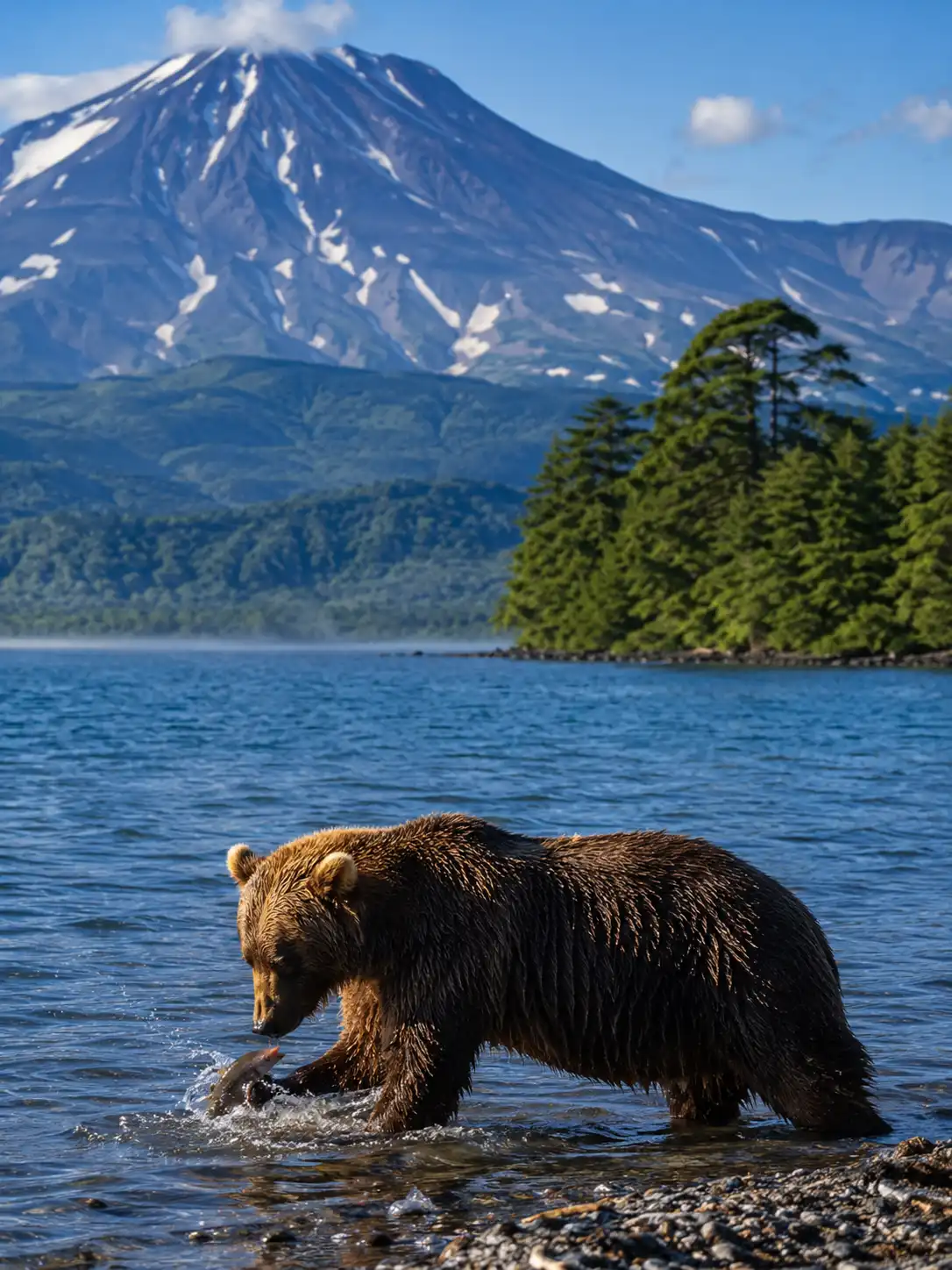
Kurile Lake is one of the most extraordinary wildlife destinations on the Kamchatka Peninsula. Surrounded by volcanic mountains and protected wilderness, the vast caldera lake is famous for its seasonal sockeye salmon migration and the remarkable concentration of Kamchatka brown bears attracted to the water.
Known in Russian as Kurilskoye Ozero, or Курильское озеро, the lake lies within the South Kamchatka Federal Sanctuary. This remote protected area preserves volcanic landscapes, salmon rivers, forests, tundra, marine coastlines and some of the most important wildlife habitats in the Russian Far East.
During the main salmon season, brown bears gather along the shores, river mouths and shallow spawning areas. Some stand in the water waiting for fish, while others patrol beaches, search beneath fallen trees or teach their cubs how to catch salmon. The experience is not comparable to seeing a bear briefly from a road. Visitors enter a functioning ecosystem in which salmon connect the lake, predators, birds, forests and surrounding communities.
Kurile Lake is normally reached by helicopter from the area around Yelizovo or Petropavlovsk-Kamchatsky. Most visitors arrive on organised day excursions, although specialised multiday wildlife and photography programs may include overnight accommodation at a protected ranger station.
This complete Wander Russia guide explains the lake’s volcanic origin, brown bears, salmon migration, visiting conditions, safety requirements and the wider significance of the South Kamchatka Sanctuary.
Kurile Lake or Kuril Lake?
Both Kurile Lake and Kuril Lake are used in English-language travel literature. The Russian name is Курильское озеро, transliterated more precisely as Kurilskoye Ozero.
“Kuril Lake” is currently the most common English geographical name, while “Kurile Lake” appears frequently in tourism publications and international descriptions. Both refer to the same lake in southern Kamchatka and should not be confused with the Kuril Islands extending between Kamchatka and Japan.
The lake is situated in the southern part of the Kamchatka Peninsula, around 240 kilometres from Yelizovo by air. There is no ordinary public road providing convenient access to the protected visitor area. The combination of distance, difficult terrain and strict environmental regulation makes helicopter travel the usual option.
Where Is the South Kamchatka Sanctuary?
The South Kamchatka Federal Sanctuary occupies a large protected territory at the southern end of the Kamchatka Peninsula. Its Russian name is Южно-Камчатский федеральный заказник.
The sanctuary was established in 1983 and is administered by the Kronotsky Nature Reserve. Its conservation regime is stricter than that of an ordinary recreational nature park because the area protects exceptionally important salmon spawning grounds, bear habitats, volcanic systems, bird migration routes and coastal ecosystems.
The protected territory covers more than 3,000 square kilometres, including a substantial marine area. Its landscapes range from the Sea of Okhotsk coast to Pacific shores, volcanic slopes, wetlands, rivers, lakes and mountain tundra.
Kurile Lake forms the ecological heart of the sanctuary. However, the wider protected area also includes the Kambalny and Koshelev volcanic systems, remote coastal habitats, the Lopatka Peninsula and places used by sea otters, seals, Steller sea lions and large numbers of migratory birds.
The South Kamchatka Sanctuary is also part of the UNESCO World Heritage property known as the Volcanoes of Kamchatka. This serial World Heritage site brings together several protected areas that represent the exceptional volcanic diversity, natural beauty and biological richness of the peninsula.
The Volcanic Origin of Kurile Lake
Kurile Lake fills an enormous volcanic depression created by major eruptions thousands of years ago. The lake occupies a caldera formed after the collapse of a volcanic system, leaving a broad basin surrounded by mountains and younger volcanic formations.
The surface of the lake lies approximately 104 metres above sea level. Its maximum depth reaches about 316 metres, making it the deepest freshwater lake on the Kamchatka Peninsula. Its surface covers approximately 77 square kilometres, although measurements may vary slightly between sources.
Because the lake is so deep, its bottom lies far below sea level. The dark water, steep surrounding slopes and volcanic backdrop give it a scale that is difficult to understand from photographs alone.
Several lava islands rise from the lake. The most recognisable is Serdtse Alaida, or the Heart of Alaid. Its distinctive shape has made it one of the visual symbols of Kurile Lake. Other islands include Chayachiy, Nizky and the Samang archipelago.
The lake drains through the Ozernaya River, which flows westward toward the Sea of Okhotsk. Sockeye salmon use this river as their route between the ocean and the freshwater spawning grounds of the lake basin.
The conical Ilyinsky Volcano dominates many views across the water. Depending on the weather, its upper slopes may be clearly visible or hidden behind low clouds. Snow can remain on the volcano well into summer, creating a dramatic contrast with the green lakeshore and the dark bodies of bears moving through the shallows.
The Sockeye Salmon Migration
The ecosystem of Kurile Lake is built around Pacific salmon. The lake and the Ozernaya River support the largest sockeye salmon population in Asia and one of the most important natural salmon systems in the world.
Sockeye salmon hatch in freshwater before migrating toward the ocean. After spending part of their lives at sea, mature fish return to their native river system to reproduce. They enter the Ozernaya River from the Sea of Okhotsk and travel upstream toward Kurile Lake.
The migration generally begins in late spring and continues for several months. The timing and strength of the run vary from year to year because natural populations respond to ocean conditions, water temperature, weather and previous reproductive cycles.
During strong migration years, millions of sockeye may enter the river and lake system. Their bodies gradually change as they prepare to spawn, developing the intense red colouring associated with mature sockeye salmon.
Fish gather in rivers, streams, shallow sections of the lake and gravel spawning areas. Some remain visible close to the shore, while others form dense concentrations at greater depths before approaching their spawning grounds.
After spawning, the adult salmon die. Their bodies remain a fundamental source of nutrients for the entire ecosystem. Bears carry fish away from the water, leaving partially eaten remains in forests and grasslands. Birds, foxes, insects and microorganisms consume the remains, while nutrients eventually enter the soil and vegetation.
The salmon migration therefore supports far more than the fish population itself. It transfers marine nutrients from the Pacific Ocean into the terrestrial environment of southern Kamchatka.
Brown Bears at Kurile Lake
Kurile Lake is one of the most important protected brown bear habitats in Kamchatka. The South Kamchatka Sanctuary supports a large and relatively stable bear population, with around 1,000 animals estimated across the protected territory in official reserve information.
Not all of these bears appear at the lake simultaneously. Nevertheless, significant numbers may gather around the shoreline and tributaries when salmon are abundant.
Kamchatka brown bears are among the largest brown bears in Eurasia. Large adult males may weigh more than half a tonne, although size varies according to sex, age, season and food availability.
The abundance of salmon influences bear behaviour. Where food is plentiful, bears can sometimes feed relatively close to one another despite generally being solitary animals. Dominant males usually occupy productive fishing positions, while females with cubs may select quieter areas to avoid aggressive encounters.
Different bears use different fishing techniques. Some stand in shallow water and attempt to catch passing salmon with their jaws. Others chase fish through narrow channels, search beneath riverbanks or wait near locations where salmon become concentrated.
Experienced bears often target the most energy-rich parts of a fish, particularly when salmon are abundant. Younger animals may spend considerable time learning how to catch slippery fish, producing behaviour that can appear playful but represents an essential survival skill.
Mother bears teach their cubs where to find food and how to interpret the behaviour of other bears. Large family groups are sometimes observed around Kurile Lake because the productive ecosystem can support females with several cubs.
Visitors should never interpret apparently calm behaviour as tameness. These are wild predators capable of moving quickly and reacting unpredictably. Safe observation depends on trained guides, reserve inspectors and strict compliance with local rules.
Other Wildlife Around the Lake
Although bears dominate the visual identity of Kurile Lake, the ecosystem supports many other species.
Steller’s sea eagles are among the most impressive birds in the region. These large raptors may gather around salmon rivers and open water, particularly when fish provide an abundant food source. White-tailed eagles, golden eagles, gulls, ducks and whooper swans also benefit from the lake’s productivity.
Foxes search the shoreline for fish remains and smaller prey. River otters may occur in suitable parts of the watershed, while sable and other forest mammals inhabit the surrounding landscape.
The wider South Kamchatka Sanctuary extends to both the Pacific Ocean and the Sea of Okhotsk. Its coastal waters and islands provide habitat for sea otters, seals, Steller sea lions and marine birds.
Migratory birds pass through the southern tip of Kamchatka in significant numbers. The Lopatka Peninsula forms part of an important route between northern breeding territories and wintering regions farther south.
This diversity explains why the sanctuary cannot be understood only as a bear-watching destination. Bears are highly visible representatives of a much broader natural system.
What a Helicopter Excursion Includes
The standard way to visit Kurile Lake is an organised helicopter tour departing from Yelizovo, Nikolayevka or another approved aviation base near the main urban area of Kamchatka.
Mi-8 helicopters are commonly used because they are suitable for remote flights and can carry relatively large groups. Travellers usually receive a safety briefing before departure and must comply with baggage and seating instructions.
The flight crosses a vast landscape of forests, rivers, volcanic plateaus and mountain systems. Weather conditions determine how much can be seen from the air. On a clear day, the journey itself becomes one of the highlights of the excursion.
After landing near the ranger station, visitors are met by reserve personnel and divided into controlled groups. A guided walk leads toward designated observation areas near the lake or river.
The time spent inside the sanctuary on an ordinary day trip is limited. Depending on the approved route and operating conditions, visitors may have approximately one and a half to two and a half hours in the protected area.
Some programs include a short boat excursion on the lake. Boat trips depend on weather, water conditions, reserve permission and the particular itinerary purchased.
Helicopter excursions to Kurile Lake are often combined with a landing in the Ksudach Caldera and a visit to approved thermal springs. The exact combination varies between operators and may change because of weather or temporary access restrictions.
Travellers should examine the itinerary carefully. A tour advertised as a “Kurile Lake excursion” may include several locations, meaning the total day is long while the actual bear-viewing period remains relatively short.
Multiday Bear-Watching and Photography Tours
Travellers seeking more observation time can consider specialised multiday programs based near the Ozerny ranger station or another authorised location.
These programs offer a different experience from a brief helicopter visit. Remaining near the lake for several days creates more opportunities to observe changes in light, weather, salmon movement and bear behaviour.
Photographers may witness bears fishing at different times of day, mothers travelling with cubs, eagles gathering near the water and mist moving across the volcanic landscape.
Accommodation is simple and designed for work in a remote protected area rather than luxury tourism. Depending on the program, visitors may stay in a guesthouse, stationary tent or authorised camping area protected by electric fencing.
Facilities, electricity and communications can be limited. Guests should expect close coordination with guides and inspectors, restricted movement and a daily program determined by wildlife conditions.
Multiday access requires advance planning and may be substantially more difficult to arrange than a standard day trip. International visitors should confirm entry requirements, transport, insurance and payment arrangements before travelling to Kamchatka.
Best Time to Visit Kurile Lake
The main tourism season generally runs from July through September, with some operations extending into early October when weather and local conditions allow.
July marks the development of the salmon season. The landscape is green, snow may still remain on surrounding volcanoes and bears begin gathering near productive fishing areas.
August is usually considered the central bear-watching period. Large numbers of salmon may be present, and bears often spend significant amounts of time along the water. Demand for flights and specialised accommodation can be high.
September brings cooler temperatures and autumn colours. Bear activity may continue, while the light and landscape can be especially attractive for photography. However, weather becomes increasingly unpredictable as the season progresses.
No date can guarantee a particular number of bears. Salmon movement changes between years, and wildlife does not follow a tourism schedule. A successful visit should be measured by the quality of the overall ecosystem experience rather than by a promised number of animals.
Weather and Flight Cancellations
Kamchatka’s weather is one of the most important factors when planning a helicopter excursion.
Fog, rain, low cloud, strong wind and poor visibility can delay or cancel a flight. Conditions near Yelizovo may differ from those at the lake, while mountain weather can change rapidly during the day.
A cancellation should not automatically be interpreted as poor service. Helicopter crews must consider visibility, wind, landing conditions and the safety of passengers.
Kurile Lake should therefore not be scheduled for the final full day of a Kamchatka trip. Keeping several possible days available improves the chance of rescheduling after a cancellation.
Travellers should also avoid building the entire Kamchatka itinerary around one helicopter excursion. Road-accessible volcanoes, Avacha Bay, Khalaktyrsky Beach, museums, hot springs and local hiking routes provide alternatives during unsuitable flying conditions.
Bear Safety and Visitor Rules
Movement near Kurile Lake is tightly controlled. Visitors must remain with reserve staff and may not leave the protected route independently.
Important rules include:
- Follow every instruction given by reserve inspectors and guides.
- Never approach, feed or call a bear.
- Do not attempt to attract an animal for photography.
- Remain inside designated observation areas.
- Do not walk away from the group.
- Keep food securely stored and follow local rules concerning smells.
- Avoid sudden running or shouting.
- Never block a bear’s route to the water, forest or cubs.
- Do not remove stones, plants, fish remains or other natural objects.
- Keep an appropriate distance even when a bear appears relaxed.
Electric fencing is used around some visitor and accommodation facilities. It reduces the risk of bears entering occupied areas, but it does not replace responsible behaviour.
Guides may alter or cancel an activity when a bear is occupying the route. Visitors must accept that wildlife has priority inside the sanctuary.
What to Wear and Bring
Weather around the lake can be cold, wet and windy even during summer. Conditions may also change between the departure point, helicopter flight and lakeshore.
Suitable equipment includes:
- Waterproof hiking boots
- A waterproof and wind-resistant jacket
- Warm insulating layers
- Long outdoor trousers
- A warm hat and light gloves
- Insect repellent
- Sunglasses and sun protection
- Binoculars
- A camera with spare batteries
- Waterproof protection for electronic equipment
- Essential personal medication
Large luggage is generally unsuitable for a day excursion because helicopter operators impose weight and space restrictions.
A telephoto lens is valuable for wildlife photography. Photographers should never move closer to compensate for inadequate equipment.
Responsible Wildlife Photography
Kurile Lake offers exceptional photographic opportunities, but the welfare of the animals and safety of the group must take priority.
Long lenses allow bears to be photographed without disturbing them. Continuous movement, loud conversations and attempts to gain a lower or closer angle can alter natural behaviour.
The most compelling photographs do not always show a bear filling the entire frame. Wider images that include the lake, volcanoes, salmon and surrounding vegetation often communicate the scale and identity of southern Kamchatka more effectively.
Photographers should protect equipment from rain, spray and condensation. Spare batteries are useful because cold conditions reduce battery performance.
Drone use is normally incompatible with strict protected-area regulations unless specific official permission has been obtained. Visitors should never assume that owning a drone gives them the right to launch it inside the sanctuary.
Conservation and the Fight Against Poaching
The modern protection of Kurile Lake is closely connected with efforts to reduce illegal salmon fishing and bear poaching.
The enormous value of salmon and red caviar once attracted organised poaching to the Ozernaya River and surrounding areas. Illegal fishing damaged spawning populations, while bears were also targeted for body parts and trophies.
Reserve inspectors strengthened patrols, improved field operations and worked to restore effective control over the territory. These efforts helped protect the salmon migration and the wildlife dependent on it.
Conservation remains an ongoing task. Salmon populations must be monitored, illegal activity prevented and tourism carefully managed.
Visitor fees and authorised tourism programs contribute to protected-area operations, scientific research, environmental education and infrastructure. Choosing a legal operator is therefore part of responsible travel.
Is Kurile Lake Worth Visiting?
Kurile Lake is worth visiting for travellers who understand the realities of remote wildlife tourism.
The excursion is vulnerable to weather delays. Helicopter access requires significant organisation, and time at the lake may be shorter than expected. Bear sightings are highly likely during favourable salmon periods but can never be guaranteed.
What makes the destination exceptional is the connection between its individual elements. The lake exists inside a volcanic caldera. Salmon travel from the ocean into freshwater. Bears gather to feed, while eagles, foxes, insects and forests benefit from the same migration.
The experience provides a direct view of an ecosystem rather than a single isolated attraction.
A day trip offers a powerful introduction. A multiday stay provides greater depth, more patience and a better understanding of how wildlife behaviour changes throughout the day.
For travellers building a broader Kamchatka itinerary, Kurile Lake complements the Valley of Geysers, volcano hikes, marine excursions and the black sands of the Pacific coast.
Frequently Asked Questions
Can Kurile Lake be reached by car?
There is no convenient public road to the main protected visitor area. Most tourists arrive by organised helicopter.
Can the lake be visited independently?
No. Access to the South Kamchatka Sanctuary is regulated, and visitors must use authorised arrangements and follow reserve personnel.
When is the best time to see bears?
August is generally regarded as the central bear-watching period, although bears and salmon may be observed during other parts of the summer and early autumn season.
Are bear sightings guaranteed?
No wildlife sighting can be guaranteed. The probability is usually high during the main salmon migration, but animal numbers and behaviour vary.
How long does a day excursion take?
The full excursion generally occupies most of the day. The actual time spent inside the sanctuary may be around one and a half to two and a half hours, depending on the itinerary.
Is Kurile Lake part of a UNESCO World Heritage Site?
Yes. The South Kamchatka Sanctuary is a component of the UNESCO World Heritage property Volcanoes of Kamchatka.
Can visitors swim in the lake?
Tourist swimming is not part of the standard protected-area program. Visitors should enter water only where explicitly authorised by reserve staff.
Is the excursion physically demanding?
The standard route is generally accessible to people with normal mobility, but surfaces, weather and walking conditions vary. Health or mobility concerns should be discussed before booking.
Can children visit?
Conditions and age restrictions depend on the operator and current reserve rules. Families should confirm minimum-age requirements and consider the long helicopter day, weather and need for strict discipline around bears.
Are there hotels at Kurile Lake?
There is no conventional resort. Specialised programs may use ranger-station guest accommodation, stationary tents or authorised camping infrastructure.
Conclusion
Kurile Lake is one of the places where Kamchatka’s defining natural forces meet. Volcanic activity created the deep caldera. Rivers connect the lake to the Sea of Okhotsk. Sockeye salmon return from the Pacific, and their migration supports bears, eagles, forests and human communities.
The South Kamchatka Sanctuary protects this relationship across a much larger landscape of volcanoes, wetlands, rivers and coastlines. Its strict regulations are not an inconvenience added to the journey but a necessary part of preserving the experience.
Visitors must accept uncertainty. A helicopter may not fly, clouds may hide the volcanoes and bears may appear at a different point along the shoreline. The landscape cannot be organised according to a fixed timetable.
That unpredictability is also what makes Kurile Lake meaningful. Bears continue fishing according to the movement of salmon, eagles circle above the water and volcanic mountains rise beyond the caldera without regard for the arrival of a tour group.
For those able to reach southern Kamchatka, Kurile Lake offers more than dramatic wildlife photographs. It reveals how an intact ecosystem functions when salmon, predators, protected land and human restraint remain connected.
