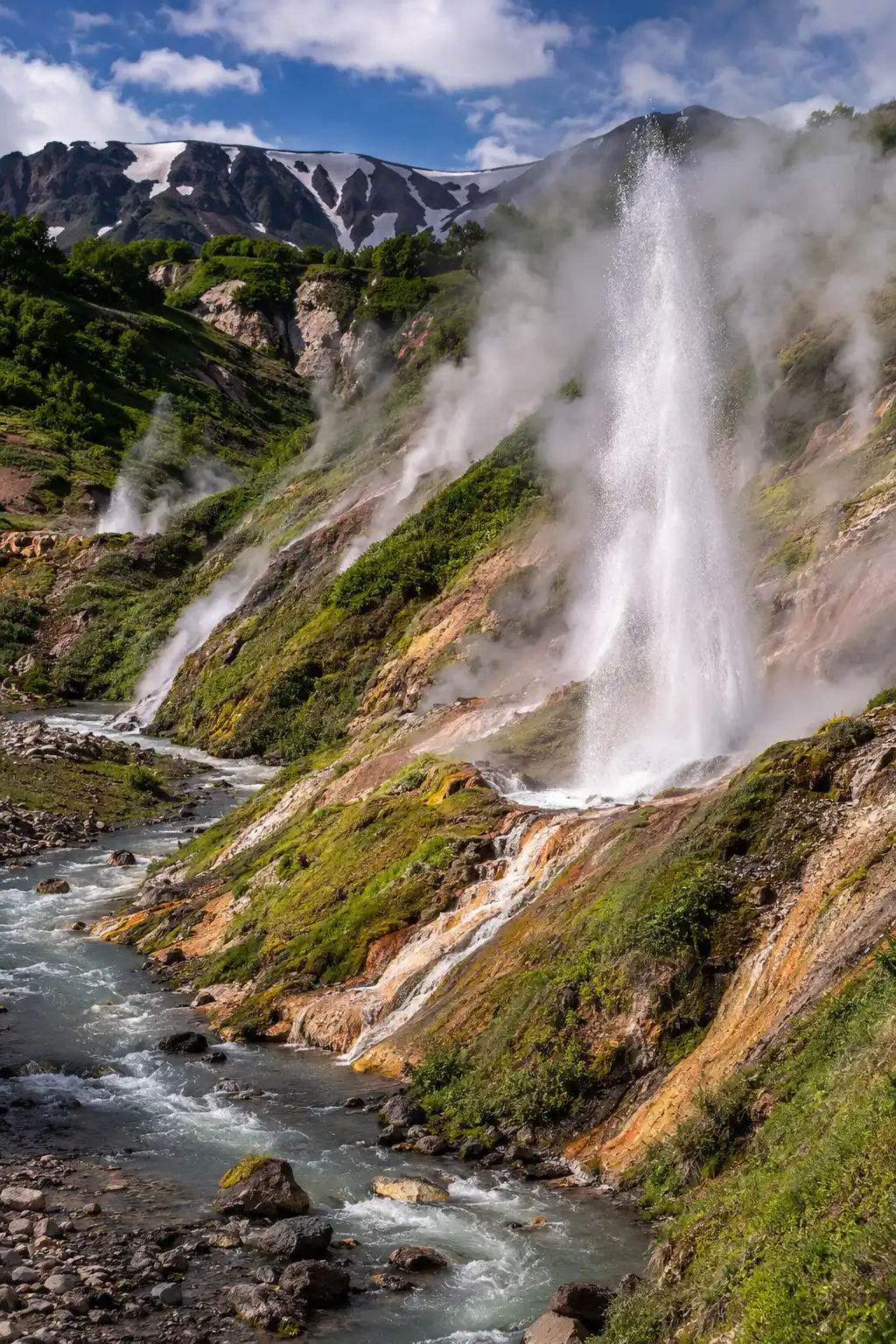
The Valley of Geysers in Kamchatka is one of the most remarkable geothermal landscapes in Russia. Hidden deep inside the protected wilderness of the Kronotsky Nature Reserve, the valley contains an extraordinary concentration of geysers, steaming vents, boiling pools, hot springs and mineral-coloured slopes.
Known in Russian as Dolina Geyzerov, or Долина гейзеров, this remote canyon is not connected to Kamchatka’s towns by ordinary roads. Most visitors reach it by helicopter from the area around Petropavlovsk-Kamchatsky and Yelizovo, making the journey part of the experience. The flight crosses forests, rivers, volcanic plateaus and active mountain systems before descending into a landscape filled with drifting steam.
The valley is not an amusement park, a developed spa or a place for independent wandering. It lies inside a strictly protected nature reserve where visitors follow designated routes under the supervision of reserve staff and professional guides. These restrictions are essential because the ground can be unstable, thermal water can cause severe burns and the surrounding ecosystem is highly sensitive.
For travellers exploring the wild landscapes of the Russian Far East, the Valley of Geysers represents Kamchatka at its most dramatic. It combines active geology, protected wilderness, scientific history and the unpredictability of one of Russia’s most isolated regions.
Where Is the Valley of Geysers?
The Valley of Geysers is located in the eastern part of the Kamchatka Peninsula within the Kronotsky State Nature Biosphere Reserve. It lies approximately 180 kilometres northeast of Petropavlovsk-Kamchatsky, although the actual helicopter route and journey time can vary according to weather conditions and the chosen excursion program.
The geothermal field occupies part of the canyon of the Geysernaya River. The wider canyon extends for several kilometres and is surrounded by steep green slopes, volcanic formations and areas of exposed mineral-rich ground. Steam rising from the hillsides reveals the intense geothermal activity beneath the surface.
Around 60 geysers have been identified in the broader valley, together with numerous hot springs, steam vents, boiling-water features and mud pools. Visitors see only a controlled central section of this much larger geothermal system. Boardwalks and viewing platforms have been constructed to reduce damage to vegetation and keep people away from dangerous thermal ground.
The absence of a public road is one of the defining features of the destination. Reaching the valley requires careful organisation, favourable weather and permission to enter the reserve. This isolation has helped preserve the landscape, but it also means that plans must remain flexible.
Why the Valley of Geysers Is So Special
Geysers require an unusual combination of underground heat, water supply, pressure and suitable rock structures. Water descends through fractures, is heated by volcanic energy and becomes trapped in underground channels. As temperature and pressure increase, part of the water suddenly turns into steam and forces hot water upward through an opening.
Only a limited number of places on Earth possess geothermal systems capable of producing extensive geyser fields. Kamchatka’s valley is especially impressive because many different hydrothermal features are concentrated inside a relatively compact and visually dramatic canyon.
The landscape is constantly active. Steam emerges from openings in the ground, hot water flows across coloured mineral deposits and boiling pools pulse beneath the surrounding vegetation. Some geysers erupt at relatively regular intervals, while others behave less predictably or change after landslides, earthquakes and shifts in the underground water system.
This is not a static geological monument. It is a living environment that can alter naturally over time. Individual geysers may become weaker, disappear, return or develop a different rhythm. New vents can emerge, while changing water levels may temporarily cover existing thermal features.
The contrast between geothermal heat and Kamchatka’s cool climate makes the scenery particularly memorable. Snow may remain on distant slopes while hot steam rises from the valley floor. Green vegetation grows close to bare mineral ground, and cold river water passes through an area shaped by underground volcanic heat.
The Discovery of the Valley
The Valley of Geysers remained unknown to modern science until 1941. At that time, large areas of Kamchatka were still difficult to reach and had not been systematically studied.
Geologist and reserve researcher Tatyana Ustinova travelled through the region with Anisifor Krupenin, an experienced observer and local guide working in the Kronotsky Reserve. Their original objective was connected with investigating the sources and courses of local rivers.
On 14 April 1941, they encountered an unexpected jet of hot water and steam near a previously unexplored warm river. This first recorded geyser was later named Pervenets, meaning “Firstborn”.
The discovery suggested that a much larger geothermal system could exist nearby. During a later expedition in July 1941, Ustinova and Krupenin reached the canyon of the Geysernaya River and documented a valley containing many geysers, hot springs and other thermal phenomena.
Their work became one of the important geographical discoveries made in the Soviet Union during the twentieth century. Ustinova later described and named many of the valley’s geothermal features, helping establish the scientific foundation for future research.
The story of the discovery is especially striking because it occurred during an exceptionally difficult period in history and in a region where transport, communications and field equipment were limited. The researchers travelled through wild terrain without the helicopter access, satellite communication or modern protective infrastructure available today.
What Visitors Can See
The experience begins before landing. From a helicopter, passengers may see Kamchatka’s immense forests, winding rivers, mountain plateaus and volcanic formations. Depending on the route and weather, the flight may also provide views of prominent volcanoes and isolated areas rarely visible from the ground.
After landing near the reserve facilities, visitors receive instructions and join a guided group. The standard excursion follows elevated wooden paths and viewing platforms through the accessible part of the valley.
The route reveals a changing sequence of geothermal features rather than one single attraction. Steam rises from fumaroles, hot water runs across orange and pale mineral surfaces, and boiling pools appear between patches of dense vegetation. The sound of rushing water mixes with bursts of steam and the deeper noise of active geysers.
One of the best-known geysers is Velikan, whose name means “Giant”. It has long been regarded as one of the valley’s most powerful geysers. Its activity illustrates an important reality of visiting Dolina Geyzerov: an eruption cannot always be scheduled to match the arrival of a tourist group. Natural cycles continue independently of excursion timetables.
Other geothermal features may erupt more frequently, creating a better chance of observing the basic stages of geyser activity. Water begins to move inside the vent, steam pressure increases, and a column of hot water may suddenly rise above the ground.
Guides explain how geysers differ from ordinary hot springs, how mineral deposits form and why the geothermal system changes. They also point out sections altered by landslides and show how vegetation returns after natural disturbances.
The standard visitor route is relatively short, at approximately one kilometre, but the excursion normally takes considerably longer than an ordinary walk of the same distance. Groups stop at observation points, wait for geothermal activity and listen to explanations about geology, wildlife and conservation.
Seasonal snow, repairs or safety assessments can change the accessible route. Travellers should therefore regard published itineraries as a general framework rather than a guarantee that every platform or viewing point will be open.
Geysers, Fumaroles and Hot Springs
Although the valley is famous for geysers, its geothermal diversity extends far beyond erupting fountains.
Fumaroles release steam and volcanic gases through cracks in the ground. Their constant white plumes give parts of the valley a misty appearance, especially when cooler air causes steam to condense rapidly.
Hot springs allow heated groundwater to reach the surface without the pressure cycle required for a geyser eruption. Some form flowing streams, while others collect in small pools. Their temperatures can be dangerously high even when the water appears calm.
Mud pools develop where hot water and volcanic gases interact with fine minerals and altered rock. The resulting mixture may bubble, pulse or release small bursts of steam. Colours vary according to mineral composition, temperature and biological processes.
Geyserite deposits form as mineral-rich hot water repeatedly reaches the surface and cools. Over time, these deposits build pale, grey or coloured formations around geyser vents and channels.
The geothermal features should never be touched. Thin crusts can conceal boiling water, and apparently solid ground may be unstable. Remaining on the boardwalk is therefore not simply an environmental request but a fundamental safety rule.
The 2007 Landslide
On 3 June 2007, a major landslide and mudflow transformed part of the Valley of Geysers. A large mass of rock, soil, snow, water and vegetation moved into the canyon, damaging natural features and altering the course of the Geysernaya River.
The debris created a natural dam and caused water to collect behind it. For a time, there were concerns that major sections of the geyser field might be flooded or permanently lost.
The event damaged infrastructure and covered or altered several geothermal features. No visitors or reserve employees were killed, although the scale and speed of the event demonstrated how dynamic and potentially dangerous the landscape can be.
Subsequent changes in water levels revealed that the valley’s geothermal system had not disappeared. Several geysers continued to function, others gradually recovered and the newly formed landscape became an important subject of scientific observation.
Further natural changes occurred in later years, reinforcing the understanding that the Valley of Geysers is continually being reshaped. Landslides, erosion, geothermal alteration and water movement are not interruptions to the valley’s story; they are part of the processes that created it.
For visitors, the landscape now provides a rare opportunity to observe both active geothermal phenomena and the visible consequences of a major geological event.
Wildlife in the Valley
The Valley of Geysers is located inside a large protected wilderness rather than an isolated geological enclosure. Brown bears, foxes and other animals move through the surrounding area, and signs of wildlife may appear close to the visitor route.
Kamchatka brown bears are attracted to many parts of the reserve by seasonal food sources. Warm ground and thermal areas can also create locally favourable conditions. Their presence is one reason visitors must remain with guides and follow instructions immediately.
Seeing a bear is possible, but it is never guaranteed and should not be treated as the main objective of the excursion. Wildlife observation must take place from a safe distance without feeding, approaching or attempting to attract an animal for photographs.
The valley also supports vegetation adapted to Kamchatka’s climate and unusual thermal conditions. Warm soil can influence the timing and distribution of plant growth, creating noticeable contrasts within a small area.
Visitors should avoid removing stones, flowers or other natural objects. Even small actions become significant when repeated by thousands of people in a sensitive protected ecosystem.
How to Visit the Valley of Geysers
The most common way to visit is through an organised helicopter excursion departing from the Petropavlovsk-Kamchatsky or Yelizovo area. The Mi-8 helicopter is widely used for tourism and transport in Kamchatka because it can operate in remote terrain and carry a group of passengers.
A typical program occupies most of the day and may include the Valley of Geysers, Uzon Caldera and a thermal bathing stop elsewhere in Kamchatka. The exact sequence depends on the operator, weather, reserve regulations and conditions at the landing sites.
The flight to the valley takes visitors over approximately 200 kilometres of remote landscape in each direction. Total excursion time is commonly around six or seven hours, although delays and changes are possible.
All access must be arranged legally through authorised channels. The Valley of Geysers lies inside a strict nature reserve, and independent arrival does not give a traveller the right to explore freely.
A small number of visitors reach the area as part of specialised multiday trekking programs. These expeditions require greater preparation, reserve authorisation, experienced guides and suitable physical condition. They should not be confused with ordinary independent hiking.
Helicopter excursions are weather-dependent. Low clouds, fog, wind and poor visibility can prevent a flight even when conditions in Petropavlovsk-Kamchatsky initially appear acceptable. Cancellations are a normal part of travelling in Kamchatka rather than evidence of poor organisation.
For this reason, the excursion should not be planned for the final day before departure from the peninsula. Several flexible days offer a better chance of rescheduling.
Best Time to Visit
The main season usually extends from July into September, with some operations continuing into early October when weather and reserve conditions permit.
July brings long daylight hours, green slopes and lingering snow in higher areas. It is also part of the active summer travel season, and demand for helicopter places can be considerable.
August is often chosen for its mature summer landscapes and broad availability of regional excursions. Rain, fog and sudden weather changes remain possible.
September can bring clearer autumn colours and a more dramatic contrast between vegetation, mineral slopes and early snow. Temperatures are cooler, and the operational season becomes increasingly dependent on weather.
No month guarantees a successful flight. Kamchatka’s climate is strongly influenced by the Pacific Ocean, and conditions can change rapidly. The most effective strategy is to reserve early while keeping the wider itinerary adaptable.
What to Wear and Bring
Conditions in the valley may differ substantially from those near the departure point. The weather can feel cool and damp even during summer, while geothermal areas may be warmer and filled with steam.
Useful clothing and equipment include:
- Waterproof hiking footwear with reliable grip
- A windproof and waterproof outer layer
- Warm layers that can be added or removed
- Long trousers suitable for walking outdoors
- A hat and light gloves during cooler periods
- Insect repellent
- Sun protection and sunglasses
- A camera with spare batteries
- A waterproof cover for electronic equipment
- Any essential personal medication
Large bags may be restricted because helicopter space and weight are limited. Travellers should confirm baggage rules with the organiser before departure.
Food arrangements differ between programs. Some excursions include a meal or refreshments, while others may provide only limited catering. Details should be checked during booking.
Safety and Responsible Travel
Visitors must remain on the designated path and follow the guide. Stepping away from the boardwalk can expose a person to boiling water, weak ground and concealed thermal channels.
The following principles are essential:
- Do not touch thermal water, steam vents or mineral surfaces.
- Do not leave the group without permission.
- Do not feed or approach wildlife.
- Do not collect stones, plants or other natural material.
- Do not throw objects into pools or geyser vents.
- Keep noise at a reasonable level.
- Follow all instructions during helicopter boarding and landing.
- Inform the guide in advance about mobility or health limitations.
The official excursion route does not normally require advanced mountaineering experience, but it includes stairs, boardwalk sections and changes in elevation. People with cardiovascular, respiratory, joint or mobility problems should discuss the route with the organiser and may need to use a shorter section.
Combining the Valley with Uzon Caldera
Many helicopter programs combine the Valley of Geysers with Uzon Caldera, located roughly 16 kilometres to the northwest.
Uzon is a vast volcanic depression filled with lakes, thermal fields, mud pools, steam vents and mineral formations. While the Valley of Geysers is defined by its narrow river canyon and erupting hot-water features, Uzon feels broader and more open.
Visiting both locations demonstrates how varied Kamchatka’s geothermal landscapes can be. The valley presents concentrated activity on steep slopes, while the caldera reveals a wider volcanic basin shaped by long-term hydrothermal processes.
Because both sites lie inside the protected Uzonsko-Geyserny area of the reserve, access is controlled. Landing schedules and walking routes can change according to conservation requirements and local conditions.
Photography Tips
The valley offers dramatic photography, but steam, rain and rapidly changing light can make conditions challenging.
A wider lens is helpful for capturing the river canyon, green slopes and multiple steam columns. A moderate telephoto lens can isolate geyser eruptions, mineral patterns or distant wildlife without leaving the path.
Steam can quickly cover a lens with moisture. A cloth should be kept easily accessible, and camera changes should be minimised in rain or heavy spray.
Photographers should avoid becoming so focused on the viewfinder that they fall behind the group. Viewing time is limited, and guides must keep visitors together for both safety and conservation.
The helicopter flight also provides valuable photographic opportunities. Window reflections can be reduced by holding the camera close to the glass without pressing equipment against it. Passengers must follow crew instructions at all times and should not move around the cabin unless permitted.
Is the Valley of Geysers Worth Visiting?
For travellers interested in volcanoes, geology, remote landscapes and protected nature, the Valley of Geysers is one of Kamchatka’s defining experiences.
The excursion requires flexibility and is vulnerable to weather cancellation. It also represents a significant logistical commitment compared with attractions reached by road. Visitors spend only a limited period inside the valley itself.
Nevertheless, the combination of helicopter travel, active geothermal phenomena and true wilderness creates an experience that is difficult to reproduce elsewhere. The value lies not only in seeing a geyser erupt but in understanding the scale and isolation of the entire landscape.
Wander Russia recommends treating the excursion as one element of a broader Kamchatka itinerary rather than the only purpose of the trip. Volcano hikes, Avacha Bay, Khalaktyrsky Beach, thermal springs and wildlife excursions provide meaningful alternatives when flying conditions are unsuitable.
Frequently Asked Questions
Can visitors drive to the Valley of Geysers?
No public road connects the valley with Petropavlovsk-Kamchatsky. Most visitors arrive by organised helicopter excursion.
Can the valley be visited independently?
No. It lies within the strictly protected Kronotsky Nature Reserve. Entry, transport and movement inside the visitor area must follow reserve regulations.
How long do visitors spend in the valley?
The official excursion inside the valley generally lasts around two to two and a half hours, although the accessible route may change according to seasonal conditions and maintenance.
How difficult is the walking route?
The standard boardwalk route does not require specialist hiking skills, but it contains steps and elevation changes. Visitors with health or mobility limitations should request current information before booking.
Are geyser eruptions guaranteed?
The valley is active, but individual geysers follow natural cycles that may change. A particular famous geyser may not erupt during every visit.
Can a helicopter trip be cancelled?
Yes. Fog, wind, low clouds and poor visibility frequently affect aviation in Kamchatka. Several flexible days should be included in the itinerary.
Is swimming allowed in the Valley of Geysers?
No. The thermal waters inside the protected valley are dangerous and not intended for bathing. Some organised programs include a separate stop at an approved thermal bathing location.
Are bears common in the area?
Brown bears live throughout the reserve and may appear near geothermal areas. Sightings are possible but not guaranteed. Visitors must remain with guides and follow safety instructions.
Conclusion
The Valley of Geysers is not simply a collection of hot springs. It is a dynamic volcanic canyon where underground heat, water, rock and climate continue to reshape the landscape.
Its discovery in 1941 introduced one of Kamchatka’s great natural features to science. The landslide of 2007 later demonstrated that the valley could change dramatically within minutes, while the recovery of several geothermal features revealed the resilience of the system.
A visit requires planning, favourable weather and respect for strict conservation rules. Helicopter access may be delayed, walking routes may be adjusted and individual geysers may not perform according to a tourist timetable.
These uncertainties are part of the character of Kamchatka. The landscape remains more powerful than the travel schedule, and nature determines what can be seen on any particular day.
For those who reach it, Dolina Geyzerov offers a rare view into the active processes beneath the Earth’s surface. Steam drifts across green slopes, hot water moves through mineral channels and geysers continue their cycles in one of the most remote protected regions of Russia.
The Valley of Geysers remains an essential destination for understanding why Kamchatka is regarded as one of the world’s most extraordinary volcanic landscapes.
