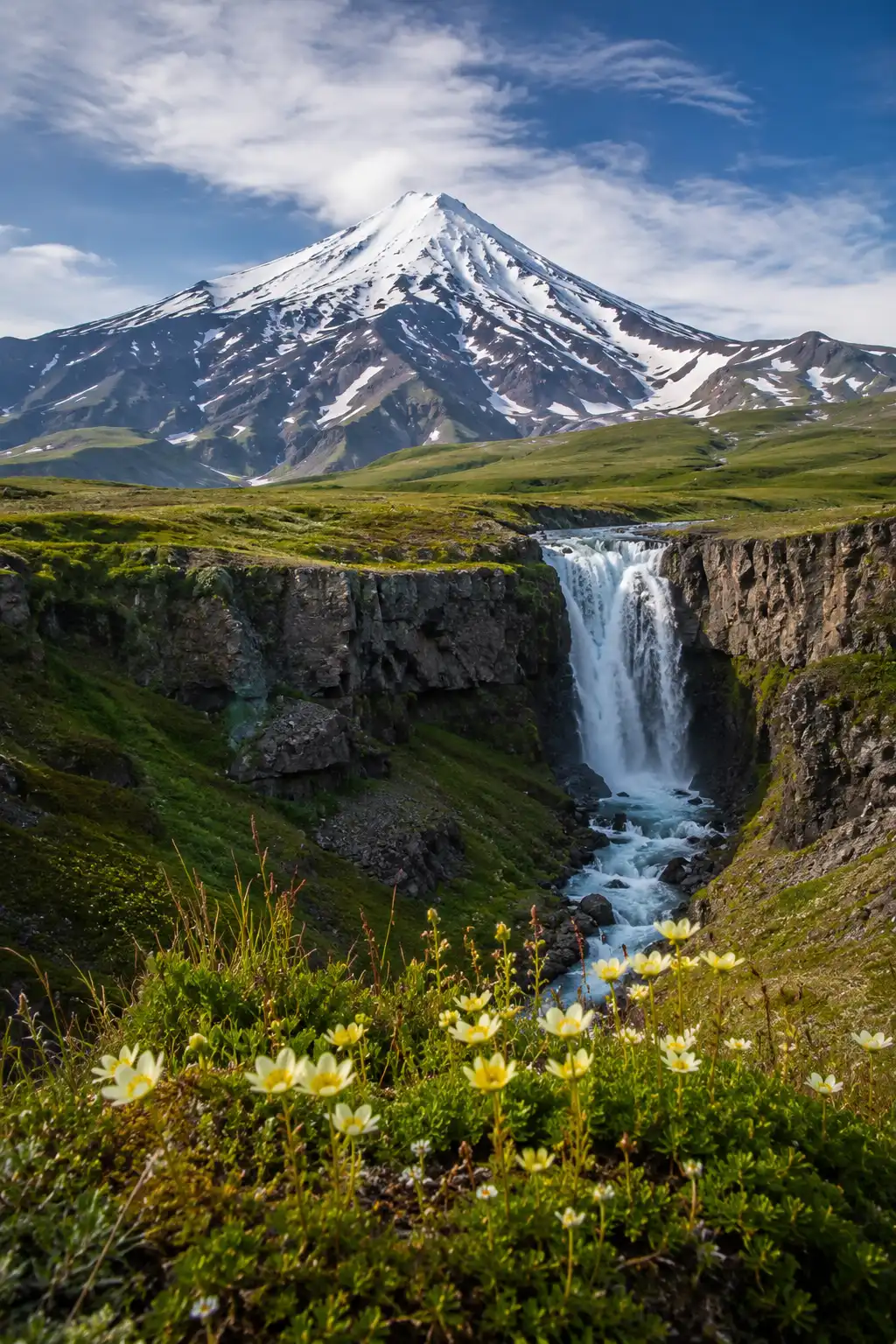
Mutnovsky Volcano is one of the most striking geothermal destinations in southern Kamchatka. Its landscape combines active fumaroles, steaming craters, glaciers, sulphur-coloured slopes, volcanic plateaus and the deep Opasny Canyon with its dramatic waterfall.
Known in Russian as Mutnovsky Vulkan, or Мутновский вулкан, the volcanic complex rises to approximately 2,323 metres in the South Kamchatka Nature Park. It lies within practical expedition distance of Petropavlovsk-Kamchatsky and Yelizovo, although the journey still requires several hours of driving and a capable off-road vehicle.
Mutnovsky differs from the more symmetrical volcanoes commonly associated with Kamchatka. It is a broad, complicated massif formed by several overlapping volcanic structures rather than one perfect cone. Multiple craters, eroded ridges, glaciers and hydrothermal fields create a landscape that feels more like an open geological laboratory than a conventional mountain.
For many years, visitors followed a route into the active crater. A major collapse in 2021 changed access conditions and made the old crater route unsafe. Visitors must now use only officially approved routes and observation areas. Route status can change because of snow, seismic activity, erosion, rockfalls and park inspections, so access must always be confirmed shortly before departure.
This Wander Russia guide explains the geology of Mutnovsky, the geothermal landscape, Opasny Canyon, current route considerations, transport, safety and the best period for planning a visit.
Where Is Mutnovsky Volcano?
Mutnovsky Volcano is located in the southern part of the Kamchatka Peninsula, southwest of Petropavlovsk-Kamchatsky and Yelizovo. It forms part of the northern section of South Kamchatka Nature Park, a protected territory containing volcanoes, calderas, mountain plateaus, rivers and geothermal areas.
The volcano stands near several other major attractions. Gorely Volcano lies to the northwest, while the distinctive cone of Vilyuchinsky Volcano can often be seen along the approach route. The Mutnovskaya geothermal power complex is also situated within the broader geothermal region.
The official approach toward Opasny Canyon begins roughly 75 kilometres from Yelizovo. Under suitable conditions, the drive to the park route area may take around two or three hours. In practice, a full journey from accommodation in Petropavlovsk-Kamchatsky or the Paratunka area can take considerably longer.
The first part of the route follows paved roads toward Paratunka and Termalny. The landscape then changes as vehicles continue onto gravel tracks, mountain roads and the volcanic plateau near Vilyuchinsky Pass.
The final stages require a high-clearance four-wheel-drive vehicle or another form of transport approved for the current surface conditions. Snow, mud, water and damaged tracks can make the journey slow even during the main summer season.
The Structure of Mutnovsky Volcano
Mutnovsky is not a single volcanic cone. The massif consists of four overlapping stratovolcanoes built during different stages of volcanic activity.
These joined structures are composed mainly of basaltic volcanic material and are crowned by several summit craters. The youngest parts of the complex contain the strongest visible hydrothermal activity.
The highest point reaches approximately 2,323 metres. However, the main attraction for ordinary visitors is not necessarily the summit itself. The geothermal crater system, glacier-filled depressions and views from approved rim routes provide the defining experience.
Mutnovsky has been shaped by both volcanic and glacial processes. Eruptions built layers of lava, ash and fragmented material, while glaciers and meltwater cut valleys through the massif. The result is a broken landscape of crater walls, ridges, ice, ravines and mineral-stained surfaces.
The presence of snow and ice close to active fumaroles produces particularly strong visual contrasts. White glaciers descend toward dark volcanic rock while steam rises from vents and yellow sulphur deposits colour the crater slopes.
Volcanic Activity and Eruptive History
Mutnovsky remains an active volcanic system. Its historical activity has often involved relatively small explosive, phreatic or phreatomagmatic events rather than the sustained production of large lava flows.
Phreatic eruptions occur when underground water is heated rapidly by volcanic energy. The sudden expansion of steam can fragment rock and eject material without requiring a large amount of new magma to reach the surface.
A small confirmed eruption occurred in June 2000. Gas, steam and ash activity was also observed during that period. Fumarolic activity has continued in the years since, demonstrating that the hydrothermal system beneath the volcano remains active.
An apparently quiet crater should never be assumed to be harmless. Steam explosions, gas concentrations, unstable ground and rockfalls can occur with limited warning.
Official monitoring information, park announcements and emergency-service guidance should therefore be checked before every visit. A route that was accessible during one season may be restricted during another.
Inside the Geothermal Landscape
The active geothermal fields are the feature that gives Mutnovsky its distinctive character.
Fumaroles release steam and volcanic gases through openings in the ground. Some create quiet white plumes, while others produce a powerful sound similar to industrial machinery or a jet engine.
Sulphur and other minerals accumulate around active vents, creating yellow, orange, grey and pale-green surfaces. The colours can appear particularly intense after rain or when sunlight reaches the crater through gaps in the cloud.
Hot mud pools and heated streams may occur in parts of the crater system. Their appearance changes according to water supply, temperature and recent geological activity.
Glaciers occupy sections of the craters and surrounding depressions. Where volcanic heat meets snow and ice, meltwater forms streams that cut through ash and loose volcanic deposits.
The combination of geothermal heat and glacial water makes the terrain unstable. Channels can change, snow bridges can collapse and apparently firm ground may conceal hot or hollow sections.
Visitors must therefore remain on the approved route. Stepping away from the trail to photograph a fumarole or mineral deposit can expose a traveller to serious burns, toxic gases or collapsing ground.
The Old Crater Route and the 2021 Collapse
The traditional Mutnovsky excursion once followed a narrow gorge into the active crater. It became one of the most widely photographed hiking routes in Kamchatka because visitors could approach geothermal fields surrounded by high crater walls and glaciers.
In August 2021, a major collapse transformed the entrance area. A large volume of unstable volcanic material moved from the slope, blocked the river channel and covered part of the former trail.
The collapse created a new dammed lake and left the gorge filled with debris. Additional landslides occurred in the wider area, confirming that the slopes remained unstable.
As a result, the old route into the crater was closed. The park has repeatedly warned visitors not to enter the gorge or attempt to reach the crater using the former trail.
This restriction remains essential. The route may still appear on old travel blogs, printed guides, videos and GPS tracks, but those sources do not represent current safety conditions.
In 2022, an alternative official route was introduced along the upper crater rim. Sections were provided with barriers and designated viewpoints so visitors could observe the crater from above without entering the unstable gorge.
Even this newer route is not permanently guaranteed to remain open. Snow, seismic activity, route inspections and rockfall risk can result in temporary or seasonal closure.
Travellers should never rely on an old itinerary or assume that a tour advertised several months earlier will follow the same route on the day of travel.
What Can Be Seen from the Crater Rim?
When the approved rim route is accessible, it provides elevated views across the crater system.
From the upper trail, visitors may see steam rising from active fumaroles, sections of glacier, mineral-coloured walls and the complex structure of the overlapping craters.
The perspective differs from the former crater-floor route. Visitors no longer stand directly beside the main geothermal fields, but the higher position reveals the scale of the volcanic massif more clearly.
On a cloudless day, the view may extend across the surrounding plateaus toward neighbouring volcanic formations. Low cloud can reduce visibility within minutes, while strong wind may make the exposed rim feel significantly colder than the departure area.
The trail is sometimes described as technically straightforward, but conditions remain mountainous. Loose ash, stones, lingering snow and steep drops require attention.
Approaching the edge beyond the approved barrier is dangerous. Volcanic deposits can collapse without warning, and overhanging sections are not always visible from above.
Opasny Canyon
Opasny Canyon is located on the slopes below the Mutnovsky crater system. Its Russian name, Каньон Опасный, means “Dangerous Canyon”, an appropriate description of its steep walls and unstable volcanic rock.
The canyon was cut through layers of lava and pyroclastic material associated with the Mutnovsky complex. Its walls reveal different phases of volcanic construction through bands of black, grey, yellow, purple and brown rock.
The gorge lies below a major waterfall on the Vulkannaya River. Water descending from the volcanic and glacial terrain reaches the edge of the canyon and plunges into the narrow chasm.
The waterfall is often called Opasny Waterfall. From the approved observation area, visitors can look across the canyon toward the falling water, glacier remnants and the Mutnovsky massif.
The viewpoint is visually impressive, but the cliffs are extremely unstable. Loose rock and sections of the canyon wall can collapse, especially after heavy rain, snowmelt or seismic activity.
Visitors must remain behind barriers and avoid approaching the edge for photographs. The danger does not always look obvious because the top of the cliff can appear broad and relatively flat while the rock beneath it is fractured.
The Route to Opasny Canyon
The official route toward Opasny Canyon crosses the volcanic plateau from the northern section of South Kamchatka Nature Park.
Vehicles travel through the Gorely caldera area and continue over rough ground toward Mutnovsky. The landscape is open, treeless and exposed to rapidly changing weather.
Depending on the chosen park entrance, the official route covers approximately 14 to 17 kilometres from the northern boundary to the canyon area. This distance refers to the park route rather than the entire journey from Yelizovo.
Much of the route may be completed by suitable off-road transport, followed by a walk to the designated viewpoint. The exact arrangement depends on the condition of the track and current park restrictions.
There is no mobile phone coverage along much of the route. Drinking water is not reliably available, so every visitor must carry an adequate personal supply.
The park may restrict vehicle access to protect soft volcanic surfaces and vegetation. Driving outside approved tracks is prohibited because tyre damage can remain visible for years in the fragile mountain environment.
How to Visit Mutnovsky
Most travellers visit Mutnovsky on an organised excursion from Petropavlovsk-Kamchatsky, Yelizovo, Paratunka or Termalny.
A typical trip begins early in the morning. Groups travel in specially prepared four-wheel-drive vehicles across Vilyuchinsky Pass and the southern volcanic plateau.
The final program depends on which routes are officially open. A tour may include the Mutnovsky crater rim, Opasny Canyon, a viewpoint at the foot of the volcano or a combination of nearby attractions.
Travellers should read the itinerary carefully. The phrases “Mutnovsky excursion”, “Mutnovsky Volcano” and “Opasny Canyon” do not necessarily describe the same route.
Questions to ask before booking include:
- Which official route will be used?
- Is the crater rim currently open?
- Is Opasny Canyon included?
- How much walking is required?
- What type of vehicle will be used?
- Does the operator arrange the park permit?
- Is emergency communication equipment carried?
- What happens if the route closes?
A reputable operator should explain that route changes are possible and should not promise entry into the old crater.
Permits and Route Registration
Mutnovsky and Opasny Canyon lie within a protected nature park. A park permit is required for routes outside the limited areas designated for unrestricted access.
Organised tour companies normally obtain the necessary permission for their groups. Independent visitors must contact the park administration and follow the current application procedure.
Self-organised hiking groups may also be required to register their journey with the regional emergency authorities before departure. Registration requirements and deadlines should be checked directly through current official channels.
A permit does not guarantee that a route will remain open. Park management can suspend access because of weather, snow, road construction, seismic activity, rockfall risk or environmental damage.
The live route-status page of the Volcanoes of Kamchatka park network should be consulted shortly before travel. Seasonal routes may remain officially closed until inspections have been completed, even when snow appears to have melted near the city.
Best Time to Visit
The usual summer travel period runs from July through September, although official seasonal descriptions may extend from June into October.
In June and early July, substantial snow can remain on the plateau. Roads may be flooded, soft or partly blocked, and the walking route may require specialised equipment.
Late July and August generally provide the most established road access. These months also bring the greatest number of organised departures, although rain, fog and wind remain common.
September offers cooler weather, autumn colours at lower elevations and potentially clearer air. Snow can return quickly, and daylight becomes shorter.
October access is highly dependent on weather and road conditions. Early winter storms can end the summer vehicle season with little warning.
Winter excursions are sometimes organised by snowmobile, ski or snowcat. These are specialised journeys with different hazards, including severe cold, avalanche conditions and limited daylight. A summer hiking description should not be used to plan a winter visit.
How Difficult Is the Excursion?
The difficulty depends heavily on the route that is open.
A visit limited to the Opasny Canyon viewpoint may require less walking than a full crater-rim excursion, but the long off-road journey can still be physically tiring.
The official upper Mutnovsky route is not normally considered a technical mountaineering climb. Nevertheless, visitors may encounter loose volcanic gravel, snowfields, steep slopes and strong wind.
A normal level of fitness is usually sufficient for the standard guided program, but travellers should be able to walk several hours on uneven ground.
People with heart, respiratory, balance or mobility problems should discuss the exact route with the operator. The altitude is moderate, but cold air, sulphurous gases and physical exertion may cause discomfort.
Children may be accepted by some operators, but the long driving time, exposed terrain and strict safety requirements must be considered.
What to Wear and Bring
Conditions near Mutnovsky can be much colder than in Petropavlovsk-Kamchatsky or Paratunka.
Recommended equipment includes:
- Waterproof hiking boots with strong soles
- Gaiters for snow, ash and loose gravel
- A waterproof and windproof jacket
- Waterproof outdoor trousers
- Warm insulating layers
- A hat and gloves
- Sunglasses and sun protection
- Trekking poles
- Sufficient drinking water
- High-energy food or snacks
- Personal medication
- A small first-aid kit
- Waterproof protection for cameras and phones
- Insect repellent for lower elevations
- A headlamp for unexpected delays
Ordinary city shoes are unsuitable. Volcanic rock can be sharp, while wet ash and snow become slippery.
A respirator or protective mask may be useful for people sensitive to volcanic gases or dust. It does not make an unsafe gas concentration acceptable, and guide instructions must always take priority.
Safety Around Fumaroles and Volcanic Gas
Fumaroles may release steam, carbon dioxide, sulphur dioxide, hydrogen sulphide and other gases.
Concentrations vary according to wind, topography and volcanic activity. Gas can collect in low areas when there is little wind.
Visitors should move away immediately if instructed by the guide. Headaches, dizziness, coughing, nausea or breathing difficulty must be reported without delay.
Standing directly inside a steam plume for a photograph is unsafe. The steam can cause burns, while gases may irritate the eyes and respiratory system.
The ground around a vent may also be thinner than it appears. Mineral crusts can cover hot mud or boiling water.
The designated trail is chosen to reduce these risks. It should not be left even when another viewpoint appears close.
Weather, Visibility and Road Conditions
Southern Kamchatka is strongly influenced by Pacific weather systems.
Cloud can hide the volcano throughout the day, even when conditions were clear at breakfast. Fog may reduce visibility on the plateau to only a few metres.
Strong wind makes exposed ridges more dangerous and can lower the perceived temperature considerably. Rain turns ash and fine volcanic material into slippery mud.
Vehicle problems are another realistic possibility. Deep snow, river crossings and damaged tracks can delay the return journey.
A well-prepared operator should carry communication equipment, recovery tools and basic emergency supplies. Travellers should also keep additional warm clothing and food in the vehicle.
Mutnovsky should not be scheduled immediately before a flight from Kamchatka. A flexible day provides protection against cancellation, delays or route changes.
Wildlife and Environmental Protection
Brown bears occur throughout Kamchatka, including the wider Mutnovsky and Gorely region.
Bears may cross roads, feeding areas and hiking routes. Visitors should remain with the group, avoid leaving food unattended and follow the guide’s instructions.
The open plateau may appear barren, but vegetation grows in protected hollows and around streams. Vehicle tracks through tundra and alpine plants can take many years to recover.
Collecting volcanic rocks, sulphur, minerals or plants is prohibited without specific authorisation.
All rubbish must be removed from the park. Food waste should not be left behind because it can attract wildlife and alter animal behaviour.
Professional or commercial filming may require additional permission. Drone use must also be confirmed with the park administration and aviation authorities rather than assumed to be allowed.
Combining Mutnovsky with Nearby Attractions
Mutnovsky can be combined with several other destinations in southern Kamchatka.
Gorely Volcano is often included in multiday programs. Its broad caldera, multiple craters and coloured crater lakes provide a different volcanic landscape.
Vilyuchinsky Pass offers panoramic views over the surrounding mountains and is frequently visited during the drive toward the southern plateau.
Dachnye Hot Springs and the geothermal area sometimes called the Small Valley of Geysers contain steam vents and thermal features closer to the main road network.
Paratunka is a practical base for travellers interested in thermal pools and day excursions. Staying there can shorten part of the morning drive compared with accommodation in central Petropavlovsk-Kamchatsky.
Trying to climb Gorely, explore Mutnovsky and visit Opasny Canyon during one rushed day is not always realistic. A two-day program provides more flexibility and reduces the pressure to continue during unsuitable conditions.
Photography Tips
A wide-angle lens is useful for crater views, glaciers and the full scale of Opasny Canyon.
A moderate telephoto lens can isolate fumaroles, mineral patterns and the waterfall without approaching dangerous edges.
Steam and cloud change the scene quickly. Photographers should keep equipment ready but protected from rain, sulphurous moisture and volcanic dust.
Dark volcanic rock can cause cameras to overexpose steam and snow. Checking the histogram and reducing exposure slightly may preserve detail in bright areas.
The most effective images often include people at a safe distance to show the scale of the crater or canyon. Models should never cross barriers or stand on unstable edges for a photograph.
Is Mutnovsky Worth Visiting?
Mutnovsky remains one of the most interesting volcanic areas accessible from the main population centre of Kamchatka.
The destination requires patience. The road is rough, weather can hide the crater and the most famous historical route is no longer accessible.
However, the current experience still combines several elements rarely found in one day: an off-road crossing of a volcanic plateau, views into an active crater system, glaciers beside fumaroles and a deep canyon cut through layered volcanic rock.
Opasny Canyon also works as a meaningful alternative when access to the higher Mutnovsky route is restricted, provided that the canyon route itself is officially open.
Wander Russia recommends viewing Mutnovsky as a changing natural environment rather than a fixed attraction. The route available during one visit may differ from the route shown in older photographs, but that instability is part of the geological character of the volcano.
Frequently Asked Questions
Can visitors still walk into the Mutnovsky crater?
The old route through the gorge into the crater was closed after the major 2021 collapse. Visitors must not attempt to follow it. Access is limited to routes currently approved by the park.
Is the new crater-rim route always open?
No. It can be closed because of snow, route inspection, seismic activity, rockfall or weather. Current status must be checked before departure.
Can Mutnovsky be visited without a guide?
Independent access may be legally possible only after obtaining the required permit and meeting current registration rules. For most international visitors, an organised excursion is safer and more practical.
Is Opasny Canyon the same attraction as the Mutnovsky crater?
No. The canyon lies below the volcano and has its own official route and viewpoint. A tour may include one or both attractions.
How long does the excursion take?
A visit normally occupies a full day. Driving conditions, the starting point and the open route determine the exact duration.
When is the best period to visit?
Late July through September generally offers the most practical summer access, but no period guarantees an open route or clear weather.
Are fumaroles dangerous?
Yes. They can release hot steam and volcanic gases, and the surrounding ground may be unstable. Visitors must remain on the approved trail.
Is there mobile phone coverage?
Mobile coverage is generally unavailable across much of the official route. Professional groups should carry suitable emergency communication equipment.
Is the hike technically difficult?
The standard approved routes are not normally technical climbs, but they involve uneven volcanic terrain, possible snow, strong wind and several hours outdoors.
Can Mutnovsky and Gorely be visited together?
They can be combined in a multiday itinerary. Completing both volcanoes properly in one day may be unrealistic because of driving time, weather and route conditions.
Conclusion
Mutnovsky Volcano represents the active and constantly changing nature of Kamchatka.
Its overlapping craters, glaciers, fumaroles and mineral fields reveal the interaction between volcanic heat, water, ice and unstable rock. Opasny Canyon extends that story beyond the crater, exposing layers of lava and fragmented volcanic material in its steep walls.
The collapse of 2021 demonstrated why access rules must be taken seriously. A route that had been used for years disappeared beneath rock and debris, and the old entrance to the crater remains unsafe.
Modern visitors must accept a more controlled experience. They may view the geothermal system from an approved rim trail, visit the canyon observation area or follow an alternative route selected according to current conditions.
These restrictions do not reduce the geological importance of the destination. They allow travellers to observe an active volcanic environment while limiting unnecessary risk and environmental damage.
A successful trip depends on suitable weather, reliable off-road transport, park permission and a willingness to change plans. Clear views cannot be guaranteed, and a route may close shortly before departure.
For travellers prepared for these conditions, Mutnovsky and Opasny Canyon provide a memorable introduction to southern Kamchatka. Steam rises beside glaciers, rivers cut through volcanic plateaus and the exposed layers of the canyon preserve the history of repeated eruptions.
The landscape remains powerful precisely because it cannot be completely controlled. Mutnovsky continues to change, and every safe visit offers only a temporary view of that continuing process.
