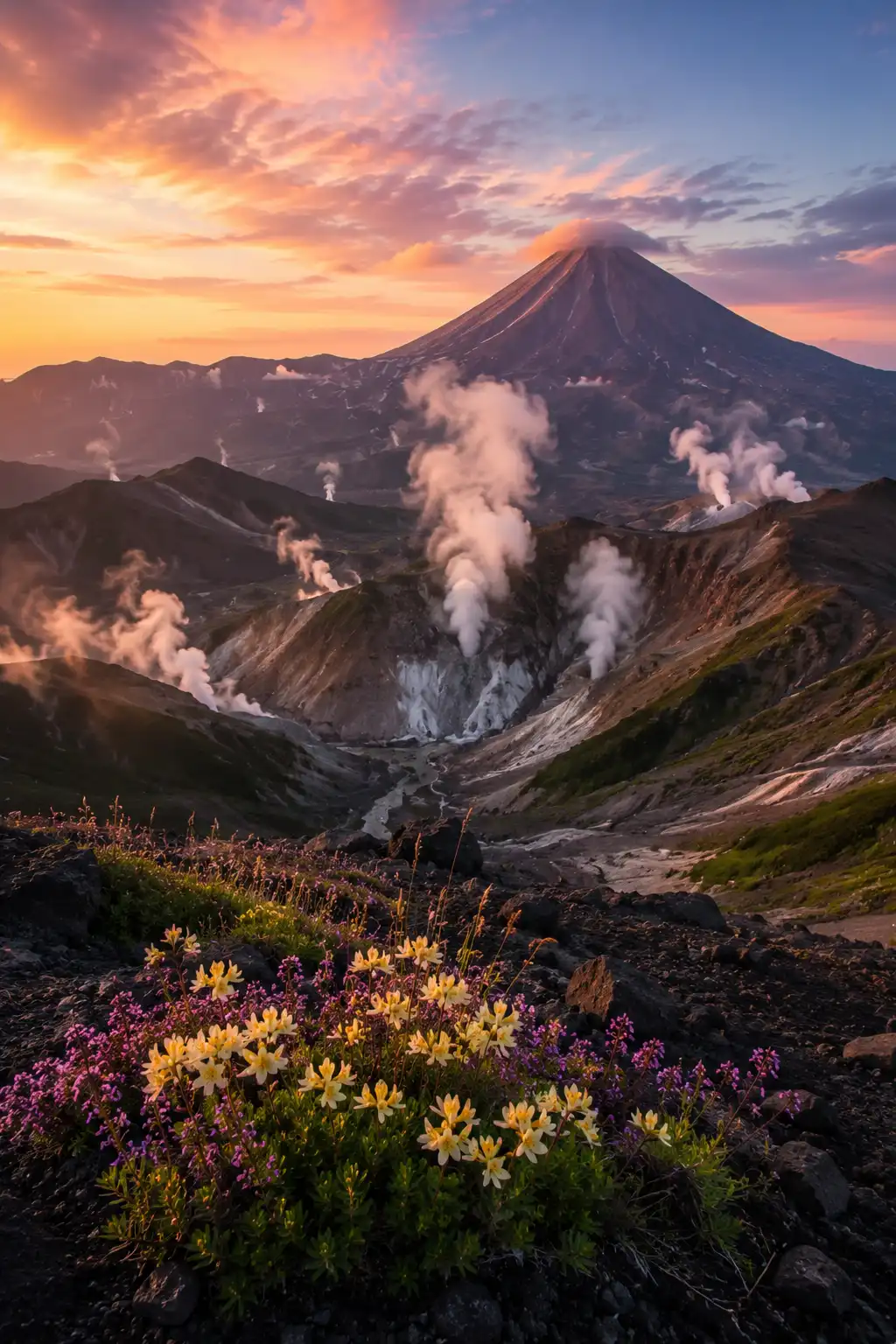
Gorely Volcano is one of the most accessible and visually varied volcanic destinations in southern Kamchatka. Its broad summit ridge contains multiple craters, steep inner walls, lingering snowfields, fumaroles and lakes whose appearance changes with weather, ice and seasonal water levels.
Known in Russian as Vulkan Gorely, or Вулкан Горелый, the active volcanic complex rises to approximately 1,829 metres in the South Kamchatka Nature Park. It is located southwest of Petropavlovsk-Kamchatsky and can normally be visited as a long day excursion from the city, Yelizovo or the Paratunka resort area.
Gorely does not have the classic symmetrical form associated with many Kamchatka volcanoes. It is a wide, elongated massif built from several overlapping volcanic cones inside an ancient caldera. Numerous summit and flank craters record different phases of volcanic activity, while lava fields and caves extend around its base.
The standard summer ascent is generally regarded as one of Kamchatka’s more manageable volcano hikes. However, the route still involves several hours on exposed volcanic terrain, rapidly changing weather and dangerous crater edges. Access depends on seasonal park approval, road conditions and current volcanic monitoring.
This Wander Russia guide explains the structure of Gorely, its crater lakes, the hiking route, lava caves, transport, safety and the best time to plan a visit.
Where Is Gorely Volcano?
Gorely Volcano lies approximately 70 to 75 kilometres southwest of Petropavlovsk-Kamchatsky and Yelizovo. It forms part of the northern area of South Kamchatka Nature Park, close to Mutnovsky Volcano and the geothermal landscapes around the Mutnovskaya power station.
The journey begins on paved roads leading through the settlements south of Yelizovo. Beyond Termalny, the route continues over gravel roads and rough tracks toward Vilyuchinsky Pass and the Gorely caldera.
The landscape changes dramatically during the drive. Forests gradually give way to open mountain terrain, snowfields, volcanic plateaus and wide views toward Vilyuchinsky and Mutnovsky volcanoes.
Under favourable conditions, the journey from Yelizovo to the foot of Gorely takes approximately two to three hours. Heavy rain, remaining snow, damaged tracks and soft volcanic ground can extend the travel time considerably.
The final approach requires a suitable four-wheel-drive vehicle, off-road minibus or expedition truck. Ordinary passenger cars are not appropriate for the full route.
The Ancient Gorely Caldera
The present Gorely massif stands inside a much older volcanic depression measuring roughly 9 by 13 kilometres.
This large caldera formed around 38,000 to 40,000 years ago after an enormous explosive eruption removed part of an earlier volcanic structure. A vast quantity of ash and fragmented volcanic material was released, and the ground later collapsed into the emptied magma system.
New volcanic cones subsequently developed inside the depression. Over thousands of years, repeated eruptions built the overlapping structures that form modern Gorely.
The result is not one simple mountain but an elongated volcanic ridge approximately three kilometres long. Its summit area contains around eleven principal craters, while numerous smaller cones and craters occur across the flanks and surrounding caldera.
This structure explains why Gorely looks different from nearby Vilyuchinsky Volcano. Vilyuchinsky rises as an elegant cone, whereas Gorely appears broader, lower and more complex.
From a distance, the mountain can seem less dramatic. Its true character becomes visible only after reaching the upper slopes and looking into the deep summit craters.
Why Is It Called Gorely?
The Russian word gorely can be translated as “burnt” or “scorched”.
Historically, Russian explorers and settlers sometimes used expressions similar to “burning hill” or “burnt hill” when referring to active volcanoes in Kamchatka. In the case of Gorely, the description gradually became the volcano’s proper name.
The name suits the landscape. Dark lava, bare ash, red-brown crater walls and extensive areas with little vegetation give the massif a visibly scorched appearance.
Even during summer, snow and ice remain in sheltered depressions. Their bright surfaces create a strong contrast with the black and reddish volcanic terrain.
The Summit Craters
The main attraction of Gorely is its collection of summit craters.
Each crater has a different shape, age and character. Some contain snow or seasonal water, while others expose volcanic walls, fumaroles and altered mineral surfaces.
The best-known craters are commonly referred to by descriptive Russian names. English translations vary, and local guides may use slightly different terminology.
The Active Crater is associated with the volcano’s strongest modern fumarolic activity. Its walls display layered volcanic rock and mineral alteration, while steam may rise from vents on the crater floor or sides.
The Blue Lake Crater is known for the water that can collect inside it. Under suitable conditions, the lake may appear turquoise, pale blue or greenish. Its colour depends on light, dissolved minerals, suspended material, ice and the surrounding rock.
The Bowl Crater is a wide depression whose shape reflects repeated volcanic collapse and erosion.
Other craters may hold snowfields, shallow pools or temporary meltwater. Their appearance can change significantly between early summer and autumn.
Visitors should not expect every crater lake to look exactly like promotional photographs. Water levels fluctuate, lakes may remain partly frozen and cloud can completely alter the colour visible from the rim.
The Blue Crater Lake
The turquoise crater lake is the most recognisable feature of Gorely.
It occupies a deep depression surrounded by steep, layered walls. Snow and ice frequently remain around parts of the basin, while the water may be divided into open and frozen sections during the early season.
The lake’s colour is not constant. Bright sunlight can produce an intense turquoise appearance, while cloud, wind and shadow may make the same water look grey, green or almost black.
Seasonal melting also changes the shoreline. At certain times, floating ice and snow form patterns across the surface. Later in the summer, more open water may become visible.
Some online descriptions refer to Gorely’s crater lakes as acidic. The volcanic complex contains several different water bodies, and their chemical conditions are not identical. Visitors should therefore avoid assuming that every lake has the same composition.
Regardless of chemistry, entering a crater lake is not part of the official hiking route. Descending from the marked trail damages unstable slopes and exposes visitors to rockfall, gas, ice and difficult evacuation conditions.
The lake is best viewed from the designated crater rim.
The Active Crater
The Active Crater provides a clear reminder that Gorely is not an extinct mountain.
Fumaroles release steam and volcanic gases through cracks and vents. Depending on wind and atmospheric conditions, a white plume may be visible from the trail.
The inner crater walls reveal layers of lava, ash and fragmented volcanic deposits. Yellow or pale mineral staining can develop around active vents where hot gases interact with rock.
The intensity of visible steaming changes. A quiet appearance does not mean that the volcanic system is inactive, while a large white plume may consist mainly of condensed water vapour.
Visitors must remain on the approved path. The interior is steep, unstable and affected by gas emissions. Loose material can fall from the walls, and sections of the rim may be undercut.
Standing directly in a gas plume for a photograph is unsafe. Sulphur dioxide and other volcanic gases can irritate the eyes, throat and lungs, particularly for people with asthma or respiratory conditions.
Historical Eruptions
Gorely has produced numerous eruptions during the Holocene period and remains classified as active.
Historical activity has often involved moderate explosive events, including phreatic and Vulcanian eruptions. These can release steam, ash, rocks and volcanic gases from summit craters.
A notable eruptive period began in 1980 and continued intermittently into 1981. Explosions produced ash plumes visible from the Petropavlovsk-Kamchatsky area, and volcanic activity affected parts of the summit zone.
Later episodes have included increased fumarolic output, seismic activity and thermal anomalies. Strong gas emissions and elevated heat were observed during the early 2010s before activity declined substantially toward the end of 2013.
The absence of a recent major eruption does not remove volcanic risk. Gorely is monitored as part of Kamchatka’s active volcanic system, and access can be restricted when conditions change.
Visitors should check current monitoring information and follow instructions issued by the nature park, emergency authorities and local guides.
The Standard Summer Hiking Route
The official summer route begins near the organised parking area at the foot of Gorely.
The ascent follows a broad volcanic slope made up of ash, gravel, lava fragments and compacted trail sections. The incline is generally moderate, although loose material can make progress tiring.
The one-way walking distance to the main summit area is approximately four kilometres. The ascent commonly requires between one and a half and three hours, depending on fitness, snow, weather and group pace.
After reaching the crater rim, visitors normally continue between several observation points. The total walking program generally lasts four to seven hours.
The summit section is more exposed than the lower slope. Strong wind, fog and cold rain can develop even when the weather at the parking area appears comfortable.
The descent is usually faster but requires attention. Loose gravel can cause slips, and tired hikers may lose concentration during the final section.
Trekking poles can improve balance on both the ascent and descent.
How Difficult Is the Gorely Hike?
Gorely is often described as one of Kamchatka’s easier volcano ascents.
That description is relative. The route is less demanding than the long climb of Plosky Tolbachik and does not usually require technical mountaineering equipment during normal summer conditions.
However, it remains a mountain hike in an active volcanic environment.
Participants should be able to walk for several hours over uneven ground and manage a sustained ascent. There is little protection from wind, rain or sun.
The route may contain snowfields during the early season. Wet ash becomes slippery, while dry volcanic dust can make walking uncomfortable.
Most people with a reasonable level of fitness can complete the standard excursion at a steady pace. Travellers with heart, respiratory, knee, hip or balance problems should discuss the route with the operator before booking.
Young children may be accepted by some providers, but the long road journey and exposed crater rim require discipline and suitable clothing.
Dangerous Sections Along the Crater Rim
The most serious walking hazard occurs near the crater edges.
Parts of the official trail pass relatively close to steep drops. The ground can consist of loose ash and fragmented volcanic rock, and sections may be weakened by erosion, snowmelt or geothermal alteration.
Visitors must remain on the marked path and follow protective barriers where installed.
Approaching the edge to improve a photograph is dangerous. An overhanging section may appear solid from above while having little support beneath it.
Fog increases the risk because crater boundaries can become difficult to see. Groups should remain close together and stop when instructed by the guide.
Snow cornices can also form along exposed edges. These structures may extend beyond the underlying rock and collapse under a person’s weight.
A guide may shorten the summit circuit when visibility or wind makes the full route unsafe.
Lava Caves at the Foot of Gorely
Gorely is surrounded by lava fields containing caves and tubes formed by flowing molten rock.
A lava tube develops when the exposed surface of a lava flow cools and hardens while liquid lava continues moving underneath. Once the internal flow drains away, a tunnel can remain.
Several caves near Gorely can be visited as part of approved routes. Inside, travellers may see hardened lava textures, arched ceilings, fractures and mineral deposits.
The temperature inside can remain low even during summer. Ice may persist in shaded passages, and the floor can be wet or uneven.
A helmet and headlamp are strongly recommended and may be required by the guide. Mobile phone lights do not provide reliable illumination or leave the hands free.
Visitors should never enter an unknown opening independently. Lava caves can contain unstable roofs, hidden drops, narrow sections and confusing branches.
Access may be closed when ice, collapse or environmental damage makes a cave unsafe.
How to Reach Gorely
Most excursions depart early in the morning from Petropavlovsk-Kamchatsky, Yelizovo or Paratunka.
The route usually passes through Termalny before joining the mountain road toward the Mutnovsky–Gorely volcanic area.
High-clearance four-wheel-drive vehicles, expedition trucks and specialised off-road minibuses are commonly used. The exact transport depends on group size and track conditions.
The journey can become one of the most memorable parts of the day. Stops may provide views of Vilyuchinsky Volcano, the volcanic plateau and distant mountain ranges.
However, the road is rough. Passengers should expect prolonged movement over gravel, potholes, snow and uneven ground.
Independent travel is possible only for experienced drivers with an appropriate vehicle, current route knowledge, park permission and emergency equipment. For most visitors, an organised tour is significantly safer and more practical.
Mobile phone coverage is limited or absent across much of the route.
Permits and Seasonal Route Status
Gorely lies within a protected nature park, and visitors require permission to use the regulated route.
Tour operators normally arrange park permits for their clients. Self-organised travellers must follow the current application process and may also need to register their route with the regional emergency authorities.
The official summer season is generally listed from June through October. This does not mean that the route automatically opens at the beginning of June.
Park staff must assess snow, track conditions, erosion and safety before opening the route. It may remain closed well into the early summer or close temporarily after bad weather.
Winter access is managed separately and usually involves snowmobiles, skis or specialised snow vehicles.
Travellers should consult the official route-status page shortly before departure. A booking confirmation from a tour provider does not override a park closure.
Best Time to Visit
The most practical period for a summer ascent generally extends from July through September.
July brings long daylight and substantial remaining snow. Crater lakes may still be partly frozen, creating dramatic patterns of blue water and white ice.
August usually provides the most stable access to the mountain road and the widest selection of organised excursions. It is also one of the busiest months.
September offers cooler temperatures, lower-angle light and autumn colours at lower elevations. Early snow and shorter daylight become increasingly likely.
June can be attractive for experienced groups equipped for snow, but the road or official trail may not yet be open.
October access depends entirely on the arrival of winter conditions. Snowstorms can end the summer hiking season quickly.
No month guarantees clear crater views. Southern Kamchatka is influenced by Pacific weather, and cloud can remain over the summit throughout the day.
Weather and Visibility
Weather around Gorely can change within minutes.
The caldera may be sunny while the summit is hidden in fog. Wind can rise suddenly, and the exposed ridge offers little shelter.
Temperatures near the top are commonly much lower than in Petropavlovsk-Kamchatsky. Rain at lower elevations can become sleet or snow near the crater.
Cloud may temporarily prevent visitors from seeing the lakes. Groups often wait for short openings in the mist, but the schedule cannot always be extended.
Sun exposure is another concern. Snow and pale volcanic surfaces reflect ultraviolet radiation, while strong wind can make travellers underestimate the intensity of the sun.
Layered clothing is essential because conditions can alternate between warm, cold, wet and windy during the same excursion.
What to Wear and Bring
Recommended equipment includes:
- Waterproof hiking boots with strong soles
- A windproof and waterproof jacket
- Waterproof or fast-drying outdoor trousers
- Warm insulating layers
- A hat and gloves
- Trekking poles
- Sunglasses and sun protection
- Gaiters for snow and volcanic gravel
- Sufficient drinking water
- Food and high-energy snacks
- Personal medication
- A small first-aid kit
- Waterproof protection for electronics
- A headlamp for lava caves or delays
- Insect repellent for lower elevations
City trainers and smooth-soled shoes provide insufficient support on loose volcanic material.
Essential clothing should be carried in the daypack rather than left in the vehicle. Conditions can change after the group has begun the ascent.
Volcanic Gas and Health Considerations
Gorely’s active crater can release sulphur dioxide, hydrogen sulphide, carbon dioxide and other gases.
Wind usually disperses emissions, but gas can become concentrated in sheltered areas or during calm conditions.
Headache, dizziness, coughing, eye irritation, nausea or breathing difficulty should be reported immediately.
People with asthma or chronic respiratory illness should seek medical advice before visiting and explain their condition to the guide.
A face covering may reduce discomfort from dust but does not protect against dangerous gas concentrations. Leaving an affected area is the appropriate response when conditions become unsafe.
Visitors should never descend into a crater or fumarolic depression without explicit scientific or park authorisation.
Wildlife and Environmental Protection
Brown bears can occur throughout the Gorely and Mutnovsky region.
The open volcanic slopes may seem unlikely bear habitat, but animals move between valleys, snowfields and feeding areas. Visitors should remain with the group and avoid leaving food unattended.
The landscape also contains fragile alpine and tundra vegetation. Plants grow slowly under Kamchatka’s climatic conditions, and vehicle tracks can remain visible for years.
Off-road driving outside approved tracks is prohibited. All rubbish and food waste must be removed.
Volcanic rocks, minerals and sulphur deposits should not be collected.
Drone use is subject to park rules and aviation restrictions. Permission should be obtained in advance rather than requested after arrival.
Combining Gorely with Other Attractions
Gorely is frequently combined with other destinations in southern Kamchatka.
Mutnovsky Volcano lies nearby, although its old crater route remains closed because of the major collapse that occurred in 2021. Current visits use only routes approved by the park.
Opasny Canyon provides views of a waterfall descending into a deep gorge cut through volcanic deposits.
Vilyuchinsky Pass is a common scenic stop along the road and offers panoramic views when the weather is clear.
The Dachnye geothermal area, sometimes promoted as the Small Valley of Geysers, contains steaming slopes and hydrothermal features closer to the road network.
Paratunka and Termalny offer thermal pools that can be visited before or after a volcano excursion.
Attempting to include Gorely, Mutnovsky and several thermal attractions in one rushed day can reduce the quality of each experience. A two-day itinerary provides more flexibility and allows weather conditions to influence the order of activities.
Photography Tips
A wide-angle lens is useful for showing the scale of the crater walls and lakes.
A moderate telephoto lens can isolate snow patterns, fumaroles and coloured sections of water without approaching dangerous edges.
Cloud often moves quickly across the summit. Photographers should be ready to work during short periods of visibility.
Crater water can reflect bright sky, making it appear less colourful in photographs than to the eye. A polarising filter may reduce some reflections, although its effect varies with the angle of the sun.
Cameras should be protected from rain, volcanic dust and condensation.
The best images often include a hiker standing safely on the marked trail. A human figure helps communicate the scale of the crater without requiring anyone to approach the edge.
Is Gorely Worth Visiting?
Gorely is an excellent choice for travellers who want to climb a Kamchatka volcano without committing to a technical expedition.
The journey can be completed in one long day, and the ascent is manageable for many reasonably fit visitors. At the summit, several craters reveal different aspects of the volcanic system.
The experience depends heavily on weather. Fog may hide the lakes, and the road may be difficult. Seasonal water levels also mean that the crater scenery does not remain identical throughout the year.
These uncertainties should be treated as part of travelling in Kamchatka rather than as defects in the attraction.
Compared with Mutnovsky, Gorely offers a more conventional summit hike. Compared with Avachinsky, it provides a greater variety of craters and crater lakes. Compared with Tolbachik, it requires much less travel time.
Wander Russia recommends Gorely as one of the most practical introductions to the volcanic landscapes of the peninsula.
Frequently Asked Questions
Can Gorely Volcano be visited as a day trip?
Yes. Most organised excursions operate as long day trips from Petropavlovsk-Kamchatsky, Yelizovo or Paratunka.
How high is Gorely Volcano?
The highest point is approximately 1,829 metres above sea level.
How long is the hike?
The ascent from the parking area is roughly four kilometres. The complete hiking program commonly lasts between four and seven hours.
Is the ascent technically difficult?
The normal summer route does not usually require technical climbing equipment, but it involves loose volcanic ground, possible snow and exposed crater rims.
Are the crater lakes always turquoise?
No. Their colour and water level change according to light, weather, ice, minerals and seasonal melting.
Can visitors swim in the crater lakes?
Swimming is not part of the authorised hiking route. Visitors should not descend into the craters or enter the water.
Is Gorely an active volcano?
Yes. It has produced historical eruptions and continues to display fumarolic and geothermal activity.
Is a guide necessary?
An organised guide is strongly recommended. Visitors also require park permission and must follow the current route status.
Can the lava caves be visited?
Some approved caves can be included in guided excursions. Access depends on safety conditions and park regulations.
When is the best time to climb Gorely?
July through September generally provides the most practical summer conditions, although weather and seasonal opening dates vary.
Conclusion
Gorely Volcano reveals the complexity of Kamchatka’s volcanic landscape within a relatively compact and accessible area.
Its broad massif rises from an ancient caldera created by a major prehistoric eruption. Later volcanic activity built overlapping cones, summit craters, lava fields and underground tubes.
At the top, visitors encounter a changing landscape of turquoise water, snow, dark rock and rising steam. No two visits are exactly alike because the lakes, ice, weather and fumarolic activity continue to change.
The ascent is manageable compared with many other Kamchatka volcanoes, but it should not be underestimated. The rough road, unstable crater edges, volcanic gases and rapid weather changes require preparation and responsible behaviour.
Access must also follow the park’s seasonal decisions. A trail may remain closed while snow melts or safety inspections continue, even when tourist excursions are already being advertised.
For travellers who approach the mountain with suitable equipment and realistic expectations, Gorely offers one of southern Kamchatka’s most rewarding day journeys.
The crater lakes provide the visual highlight, but the wider experience is equally important: the drive across the volcanic plateau, the gradual ascent through lava and ash, the view toward Mutnovsky and the knowledge that the ground belongs to an active geological system.
Gorely is not the tallest or most famous volcano on the peninsula. Its strength lies in variety. Craters, lakes, caves, snowfields and fumaroles come together in one landscape, making the mountain an essential stop for understanding the volcanic character of Kamchatka.
