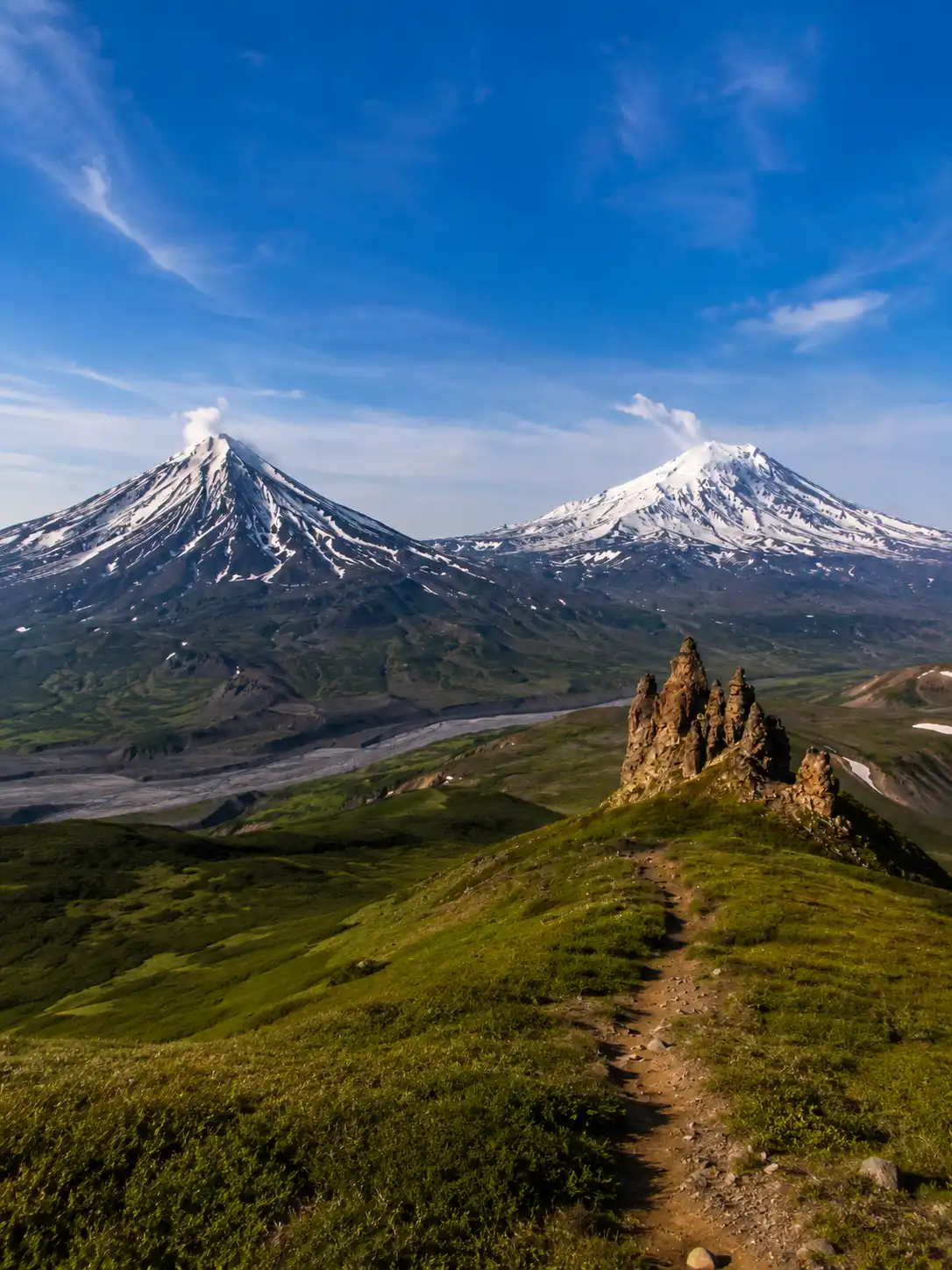
Avachinsky and Koryaksky are the two great volcanoes that dominate the skyline north of Petropavlovsk-Kamchatsky. Visible from many parts of the city, Avacha Bay and Yelizovo, their snow-covered slopes form one of the most recognisable landscapes on the Kamchatka Peninsula.
Between the two volcanoes lies Avachinsky Pass and the much smaller Camel Mountain, known in Russian as the Verblyud extrusion. This accessible volcanic formation provides panoramic views of both giants without requiring the endurance, equipment or experience needed for a full summit ascent.
The area offers three very different mountain experiences. Camel Mountain is suitable for a relatively short scenic hike. Avachinsky Volcano can be climbed during a demanding full-day excursion by physically prepared hikers. Koryaksky Volcano, by contrast, is a serious mountaineering objective with steep terrain, glaciers and substantially greater technical difficulty.
Located within Nalychevo Nature Park, the Avachinsky volcanic group combines active geology, protected mountain scenery and unusual proximity to Kamchatka’s main urban area. Few regional capitals stand so close to several active volcanoes.
This Wander Russia guide explains the difference between Avachinsky, Koryaksky and Camel Mountain, how to reach Avachinsky Pass, what each route involves, when to visit and how to prepare safely.
Where Are the Avachinsky and Koryaksky Volcanoes?
The Avachinsky volcanic group rises approximately 30 to 40 kilometres north of central Petropavlovsk-Kamchatsky.
Avachinsky Volcano stands to the southeast of Koryaksky and reaches an elevation of around 2,700 metres. Koryaksky is considerably higher, rising to approximately 3,400 metres. The two summits are separated by roughly 12 kilometres.
The volcanic group also includes Kozelsky Volcano and several smaller cones, domes and geological formations. Together, they create a broad volcanic barrier between the populated Avacha Bay area and the interior landscapes of Nalychevo Nature Park.
The starting point for most tourist routes is Avachinsky Pass, situated between Avachinsky and Koryaksky. The pass contains ranger and tourism facilities, seasonal camps and the beginning of the main walking routes.
The approach usually follows the channel of the Sukhaya River, whose name means Dry River. For much of the year, the riverbed appears as a broad track of stones, gravel and volcanic material. After heavy rain or rapid snowmelt, however, water can return quickly and change the condition of the route.
A high-clearance four-wheel-drive vehicle is generally required to reach the pass during the snow-free season. In winter and spring, visitors may travel by snowmobile, tracked vehicle, skis or snowshoes, depending on official route regulations.
The Home Volcanoes of Petropavlovsk-Kamchatsky
Avachinsky and Koryaksky are often called the home volcanoes of Petropavlovsk-Kamchatsky.
The expression reflects more than geographical proximity. The volcanoes are part of everyday life in the city. Their silhouettes appear above residential districts, roads, harbours and the shores of Avacha Bay.
Weather changes constantly alter their appearance. On clear mornings, both summits may stand sharply against the sky. A few hours later, clouds can cover them completely. During winter, the slopes appear almost entirely white, while late summer reveals dark gullies, lava surfaces and strips of lingering snow.
Avachinsky is usually the more visibly active of the two. A plume of steam can sometimes be seen drifting from its summit area. Koryaksky appears taller, steeper and more symmetrical, with deeply eroded ribs descending from its upper slopes.
Their proximity to a major population centre also gives them scientific importance. Volcanic activity, earthquakes, fumaroles and thermal changes are monitored because eruptions could affect aviation, infrastructure and nearby communities.
Avachinsky Volcano
Avachinsky, also known as Avachinskaya Sopka or simply Avacha, is one of the most active volcanoes in Kamchatka.
The present cone was built inside a much older horseshoe-shaped structure created by the collapse of an earlier volcanic edifice. That ancient collapse sent a massive debris avalanche southward across an area now occupied partly by modern settlements and infrastructure.
Later eruptions constructed the younger central cone visible today. Its upper slopes consist of lava, ash, loose scoria and fragmented volcanic rock.
Avachinsky has produced numerous recorded eruptions. Historical events have included explosive activity, ash emissions, lava extrusion, mudflows and fumarolic phases.
One of the most significant recent eruptions occurred in January 1991. Explosions sent ash several kilometres above the crater, while lava entered and largely filled the summit depression. Some lava crossed the southern rim and moved down the outer slope.
The eruption changed the appearance of the summit. Older photographs show a deep open crater, while the modern summit contains a solidified lava plug marked by cracks, fumaroles and sulphur deposits.
A smaller explosive event was recorded in 2001. Fumarolic activity has continued in later years, confirming that Avachinsky remains an active volcanic system.
What the Avachinsky Summit Looks Like
The summit of Avachinsky does not resemble a peaceful mountain lake or a wide open crater.
The central area is dominated by dark solidified lava produced during the 1991 eruption. Cracks, mineral deposits and fumarolic openings appear around the lava-filled depression.
Steam and volcanic gases can emerge from the summit zone. Their visibility depends on temperature, wind, humidity and current volcanic conditions.
Yellow sulphur deposits may be visible near active vents. These coloured surfaces are attractive to photographers but should never be approached without regard for the official route.
The ground near fumaroles can be unstable and hot. Gas concentrations may also increase when wind is weak or when emissions collect in sheltered sections.
From the upper mountain, clear weather can reveal Avacha Bay, the Pacific Ocean, Petropavlovsk-Kamchatsky, Yelizovo, Koryaksky Volcano and other peaks across southern Kamchatka.
Cloud frequently prevents these views. Reaching the summit does not guarantee visibility, even when the lower slopes were clear earlier in the day.
Climbing Avachinsky Volcano
The summer ascent of Avachinsky begins near the Avachinsky ranger station or one of the nearby seasonal camps.
The trail crosses the upper part of the Sukhaya River area and climbs gradually over volcanic terrain. The initial slopes are relatively broad, but the route becomes steeper and looser with increasing altitude.
Around the upper section, hikers reach rocky formations often described as gendarmes. Beyond them, the trail enters the younger volcanic cone and continues toward the crater rim.
Parts of the upper slope can reach an inclination of around 30 degrees. Loose scoria moves underfoot, making every step more tiring. The descent can be particularly difficult for knees and ankles because the surface encourages sliding.
The ascent normally requires approximately six to eight hours. The complete journey, including time at the summit and the return to camp, can occupy nine to twelve hours.
This is not a technical climb under normal summer conditions, but it is physically demanding. The route involves a large elevation gain, prolonged exposure and little shelter from wind, rain or sun.
Participants need strong endurance and experience walking on loose mountain terrain. The climb should not be selected simply because Avachinsky is close to the city.
Is Avachinsky Suitable for Beginners?
Avachinsky is sometimes promoted as a volcano that can be climbed without mountaineering experience.
That statement is only partly helpful.
Technical ropes, ice climbing and advanced alpine skills are not normally required during stable summer conditions. However, the route remains significantly harder than an ordinary day hike.
A beginner with good fitness, suitable equipment and an experienced guide may complete the ascent. A traveller who rarely walks in mountains may find the duration, elevation and unstable surface overwhelming.
Before booking, visitors should consider whether they can:
- Walk uphill continuously for several hours
- Spend a full day exposed to changing weather
- Descend safely on loose volcanic gravel
- Carry water, food and warm clothing
- Continue calmly when visibility becomes poor
- Follow instructions near an active volcanic crater
Camel Mountain provides a much more appropriate alternative for visitors who want the scenery without the strain of the summit ascent.
Koryaksky Volcano
Koryaksky is the highest and most imposing volcano in the Avachinsky group.
Its steep symmetrical profile rises to approximately 3,430 metres, although slightly different elevations appear in regional sources. Deeply eroded channels give the eastern face a ribbed appearance, while snowfields and glaciers cover much of the upper mountain.
Koryaksky has produced fewer recorded historical eruptions than Avachinsky. Its known activity has included lava flows, explosions, ash emissions and fumarolic episodes.
In 2008 and 2009, increased seismicity was followed by steam and ash activity from a vent high on the northwestern slope. The episode demonstrated that the apparently quieter volcano remains active.
From Avachinsky Pass, Koryaksky often appears more dramatic than Avachinsky because of its height and steepness. Its summit rises almost directly above the valley, creating one of the defining views of the region.
The beauty of the mountain can create the false impression that it is simply a higher version of the Avachinsky hike. In reality, the ascent belongs to a different category.
Can Tourists Climb Koryaksky Volcano?
A full ascent of Koryaksky is a mountaineering expedition rather than a standard tourist hike.
Routes may involve steep snow, ice, rock, glaciers, crevasses and exposed ridges. Conditions vary significantly by season, route and weather.
Climbers need appropriate alpine experience, specialised equipment and professional local guidance. Crampons, ice axes, helmets, ropes and glacier equipment may be necessary.
The route can take more than one day, depending on the chosen approach and climbing conditions. Rescue and evacuation are difficult because the mountain environment is exposed and remote despite its apparent closeness to the city.
Ordinary visitors should not attempt Koryaksky independently. The safest and most rewarding way to appreciate it is from Avachinsky Pass, Camel Mountain or one of the surrounding viewpoints.
Special winter routes may lead toward geological formations on the lower slopes, but these should not be confused with a summit climb.
Camel Mountain
Camel Mountain is the most accessible hiking destination in the Avachinsky Pass area.
Known in Russian as Gora Verblyud or Экструзия Верблюд, it is a volcanic extrusion situated between Avachinsky and Koryaksky.
An extrusion forms when viscous magma is pushed upward and solidifies close to the surface rather than flowing freely as liquid lava. Erosion later shapes the exposed rock into a distinctive formation.
Camel Mountain received its name because its outline resembles the humps of a camel when viewed from certain directions.
The formation rises to around 1,200 metres above sea level, but the starting point is already located at a considerable elevation. The actual height gained during the walk is therefore moderate.
The official route begins near the Avachinsky ranger station. The trail crosses a ravine and continues toward the rock formation through open volcanic terrain.
The route is approximately 2.5 kilometres each way and generally takes between two and four hours in total.
What Can Be Seen from Camel Mountain?
Camel Mountain provides one of the best balanced viewpoints in southern Kamchatka.
Avachinsky rises on one side, with its younger cone, dark lava and possible summit plume clearly visible. Koryaksky dominates the opposite direction, revealing its steep ribs, snowfields and glaciers.
On clear days, the panorama can extend toward the Avacha River valley, Yelizovo, Petropavlovsk-Kamchatsky, Avacha Bay and distant mountain ranges.
The walk also provides close views of the volcanic pass itself. Dark gravel, scattered rocks, lingering snow and low vegetation create a landscape that changes noticeably through the season.
During July and August, alpine flowers may appear in sheltered sections. In September, the vegetation develops autumn colours, while the first new snow may already cover higher slopes.
Camel Mountain is particularly useful at the beginning of a Kamchatka itinerary. It allows travellers to assess their fitness, clothing and reaction to local weather before attempting a longer volcano hike.
Wildlife Around Avachinsky Pass
The most visible animals around the camps and trails are often Beringian ground squirrels, locally known as evrazhki.
These small animals have become accustomed to the presence of visitors and may approach people in search of food.
They should not be fed. Human food changes natural behaviour, encourages animals to gather around vehicles and camps, and may be harmful to their health.
Birds of prey, ravens and smaller mountain birds can also be observed around the pass.
Brown bears occur throughout Kamchatka and may cross the wider area. The presence of tourism facilities does not make the landscape bear-free.
Food must be stored responsibly, and visitors should avoid walking alone through areas with limited visibility. Guides and park staff may alter routes when wildlife is present.
How to Reach Avachinsky Pass
The drive normally begins in Petropavlovsk-Kamchatsky or Yelizovo.
Vehicles leave the main Petropavlovsk–Yelizovo road and continue through areas of holiday houses and forest before entering the broad Sukhaya River channel.
The final approach follows rough volcanic ground toward Avachinsky Pass. There is no conventional paved mountain road.
The journey commonly takes around one and a half to two and a half hours in each direction, depending on departure point, vehicle, weather and track conditions.
Rain can transform sections of the route, while snow may remain well into the early summer. Local drivers choose their line through the riverbed according to current conditions.
Visitors should use a suitable off-road vehicle and an experienced driver. Rental cars are generally inappropriate unless the agreement specifically permits this type of terrain.
To protect the pass, vehicle movement may be restricted to designated parking areas. Beyond the authorised parking point, visitors continue on foot.
Permits and Official Route Status
Avachinsky Pass and the surrounding routes lie within Nalychevo Nature Park.
The official Camel Mountain route has been classified as a free-visit zone that does not normally require an individual protected-area permit. This does not mean that it is permanently open or unrestricted.
The park administration may close routes because of snow, erosion, weather, volcanic activity or damage to the trail. Vehicle access can also be limited to protect the fragile landscape.
The Avachinsky summit route has its own seasonal status. Travellers should confirm that it has officially opened before attempting the climb.
Old GPS tracks and travel reports cannot replace current information. Snow bridges, gullies and river channels change from one season to another.
Organised operators normally manage route checks, transport and any necessary administrative procedures.
Best Time to Visit
The official summer and autumn season generally extends from June through October, but practical access depends on snow and trail inspections.
Late June and early July can bring extensive snowfields. The landscape is impressive, but hiking conditions may require additional equipment.
July and August offer long daylight and the widest selection of organised excursions. They are also the busiest months around the pass.
September brings cooler air, autumn vegetation and a greater chance of fresh snow on the volcanoes. Clear days can provide excellent visibility, although weather becomes less stable.
October belongs to the transition toward winter. Snow and ice can close the summer routes quickly.
Winter and spring create a completely different experience. Access may be possible by snowmobile, tracked vehicle, ski or snowshoe on officially opened winter routes.
Weather and Visibility
The Avachinsky group creates its own rapidly changing mountain weather.
Cloud can form around the summits while the city remains sunny. Wind may increase sharply on the pass and upper slopes.
Summer temperatures at the starting area can feel mild, but conditions near the Avachinsky summit may include freezing wind, rain, sleet or snow.
Fog is a serious navigation hazard. The open volcanic terrain contains few natural landmarks, and tracks can disappear beneath snow or loose material.
Hikers must carry warm and waterproof layers even when the morning forecast appears favourable.
The summit climb should be cancelled when the guide considers visibility, wind or volcanic conditions unsafe.
What to Wear and Bring
For Camel Mountain, useful equipment includes:
- Waterproof hiking shoes
- A windproof and waterproof jacket
- Warm layers
- Long outdoor trousers
- A hat and light gloves
- Drinking water
- Snacks
- Sun protection
- Insect repellent
- A small daypack
For the Avachinsky summit climb, additional preparation is needed:
- Supportive mountain boots
- Trekking poles
- Gaiters
- Insulating clothing
- Several litres of water
- High-energy food
- A headlamp
- Personal first-aid supplies
- Spare gloves and socks
- Waterproof protection for electronics
Snow equipment may be required early or late in the season. The operator should provide specific instructions based on current conditions.
Volcanic Safety
Avachinsky and Koryaksky are active volcanoes.
Visitors should check current monitoring reports and follow all restrictions issued by park authorities, emergency services and volcanic observatories.
Potential hazards include:
- Ash emissions
- Falling volcanic material
- Gas and steam
- Earthquakes
- Loose rock
- Mudflows
- Rapid snowmelt
- Sudden route closure
A visible steam plume does not automatically indicate an eruption. At the same time, the absence of a plume does not prove that the summit is safe.
Gas can irritate the eyes and respiratory system. Anyone experiencing headache, dizziness, coughing or nausea should inform the guide immediately.
Visitors should not enter fumarolic areas or cross barriers around the summit.
Combining Camel Mountain with Other Attractions
Camel Mountain is often combined with Khalaktyrsky Beach because both can be included in one long day from Petropavlovsk-Kamchatsky.
The combination provides a strong contrast between mountain and ocean landscapes. The morning may be spent between volcanoes, followed by an afternoon on the black volcanic sands of the Pacific coast.
Another possibility is to combine the pass with a short city tour or a thermal-pool visit in Paratunka.
The full Avachinsky ascent should not be combined with multiple additional attractions. It already requires a long day and should remain the main activity.
Travellers interested in longer hiking can use Avachinsky Pass as an entry point toward the interior routes of Nalychevo Nature Park. These journeys require separate planning, permits, camping equipment and experienced guidance.
Photography Tips
Camel Mountain offers the strongest photographic balance between accessibility and scenery.
A wide-angle lens can capture both volcanic slopes and the open pass. A telephoto lens helps isolate fumaroles, glaciers and the eroded ribs of Koryaksky.
Morning light often illuminates one volcano while leaving the other partly in shadow. Later in the day, cloud can create dramatic breaks around the summits.
Photographers should avoid feeding ground squirrels to bring them closer to the camera.
Drones are subject to protected-area and aviation rules. Permission must be confirmed before the visit.
On the Avachinsky summit route, camera equipment should be kept light. Heavy lenses increase fatigue during the long ascent.
Is the Avachinsky Volcano Area Worth Visiting?
The Avachinsky Pass area is one of the most practical introductions to Kamchatka’s volcanic landscapes.
It lies close enough to the main city for a day excursion yet feels remote once the vehicle enters the Sukhaya River valley.
Camel Mountain suits travellers who want a manageable walk and panoramic views. Avachinsky provides a major physical challenge without usually requiring technical mountaineering. Koryaksky adds scale and drama to every viewpoint, even for those who never attempt to climb it.
The area is also useful when helicopter excursions are cancelled or when longer routes to Tolbachik and central Kamchatka are not possible.
Wander Russia recommends allowing flexibility. A cloud-covered visit can still provide an atmospheric mountain experience, but the full panorama requires patience and favourable weather.
Frequently Asked Questions
Can Avachinsky be visited as a day trip?
Yes. Both the Camel Mountain hike and the Avachinsky summit ascent can be organised as day trips, although the summit climb requires a very early start.
How difficult is Camel Mountain?
The hike is relatively easy to moderate. The official route is approximately five kilometres return and normally takes two to four hours.
How difficult is the Avachinsky ascent?
It is physically demanding. The climb requires several hours of continuous ascent followed by a long descent on loose volcanic material.
Can beginners climb Avachinsky?
Fit beginners may complete it with an experienced guide, but it should not be treated as an easy walk.
Can ordinary tourists climb Koryaksky?
The summit requires mountaineering experience, technical equipment and professional guidance. It is not a standard tourist hike.
Is Avachinsky still active?
Yes. It has produced historical eruptions and continues to display fumarolic activity.
Is Camel Mountain a volcano?
It is a volcanic extrusion formed by viscous magma that solidified near the surface.
Can the pass be reached by a normal car?
A capable off-road vehicle is normally required because the approach follows rough tracks and the Sukhaya River channel.
Are permits required?
Rules vary by route. Camel Mountain may be in a free-visit zone, while other routes are regulated. Current park information must always be checked.
When is the best time to visit?
July through September usually provides the most practical summer conditions, although official opening dates and weather vary.
Conclusion
The Avachinsky volcanic group brings together three contrasting mountain experiences within sight of Petropavlovsk-Kamchatsky.
Avachinsky is active, accessible and demanding. Its modern cone rises from the remains of an older collapsed volcano, while solidified lava from the 1991 eruption fills the summit crater.
Koryaksky is taller and more severe. Its glaciers, steep slopes and deeply cut ridges make it one of the dominant landmarks of southern Kamchatka and a serious objective for experienced mountaineers.
Between them, Camel Mountain offers a gentler route into the same landscape. The short climb reveals the scale of both volcanoes and provides wide views across Avachinsky Pass without requiring a full summit expedition.
The three destinations should not be treated as interchangeable. Camel Mountain is a scenic hike, Avachinsky is a long endurance climb and Koryaksky is a technical mountain.
Understanding these differences helps travellers choose an experience that matches their fitness, equipment and expectations.
Route access remains seasonal. Snow, rain, volcanic activity and environmental protection measures can all change the program. Visitors should rely on current park information rather than old route descriptions.
For those who arrive in suitable conditions, the Avachinsky Pass area provides one of Kamchatka’s clearest expressions of life beside active volcanoes. The mountains rise directly above the region’s cities, yet their upper slopes remain wild, unstable and governed by natural forces.
Whether viewed from Camel Mountain or reached after the long climb to Avachinsky’s crater, the volcanic group offers an unforgettable perspective on the landscape that defines Kamchatka.
