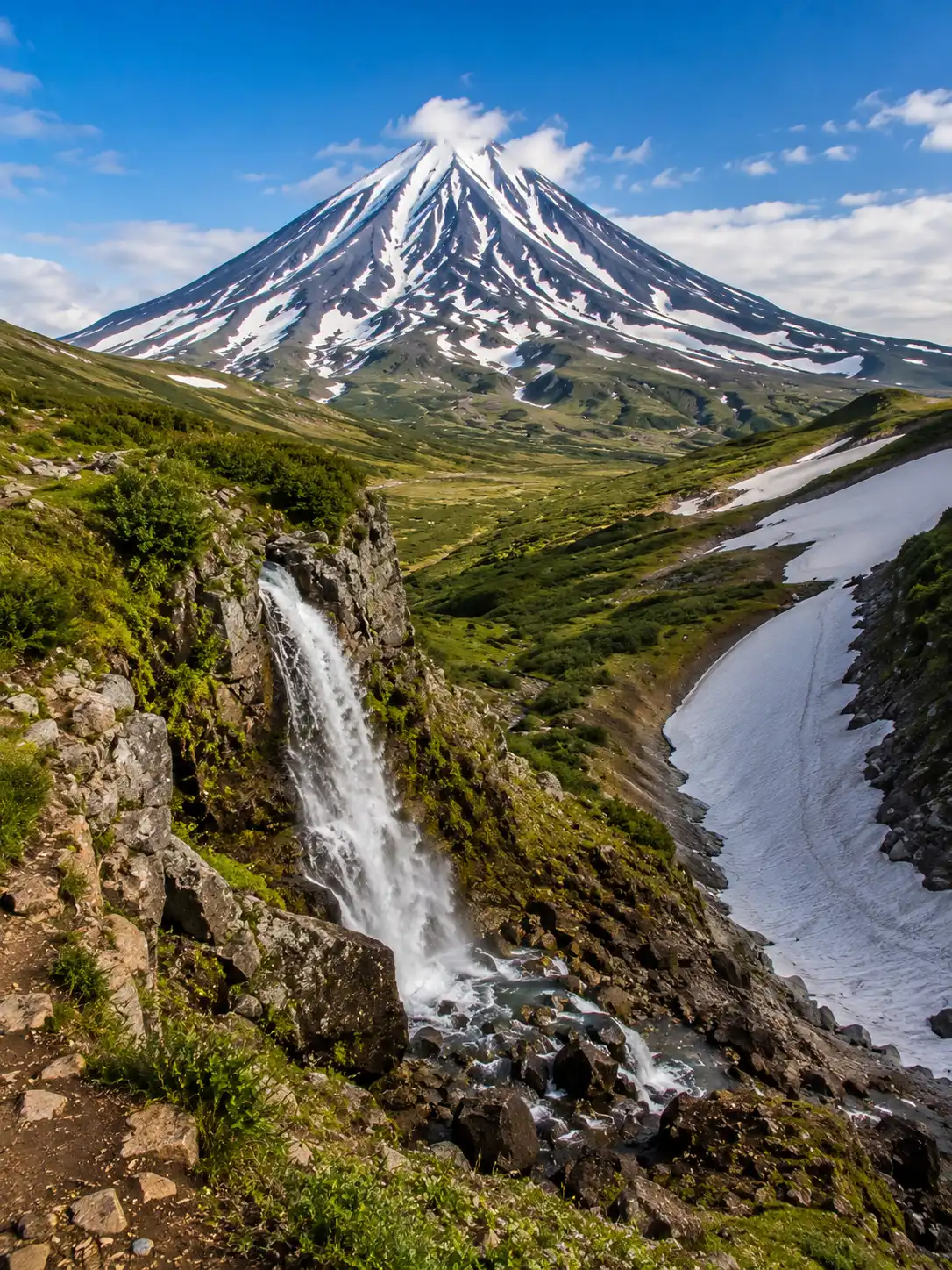
Vilyuchinsky Volcano is one of the most elegant and recognisable mountains in southern Kamchatka. Its steep, almost symmetrical cone rises above river valleys, volcanic plateaus and the road leading toward Gorely and Mutnovsky volcanoes.
Known in Russian as Вилючинский вулкан or Вилючинская сопка, the mountain reaches approximately 2,175 metres above sea level. Snowfields remain in deep gullies through much of the summer, creating a striking pattern of dark volcanic ridges and white ice.
Most visitors do not climb to the summit. The more accessible experience combines Vilyuchinsky Pass, panoramic viewpoints and a walk toward Vilyuchinsky Waterfall on the lower slopes. These attractions can be visited during a long day excursion from Petropavlovsk-Kamchatsky, Yelizovo, Paratunka or Termalny.
The pass provides broad views toward Vilyuchinsky, Gorely, Mutnovsky and the Paratunka River valley. The waterfall adds a short mountain walk through tundra, snowfields and rocky terrain. Together, they offer one of the most practical introductions to the southern volcanic landscape of Kamchatka.
The area remains remote despite its popularity. Roads are rough, weather changes quickly, mobile coverage is limited and brown bears may move through the surrounding valleys. The summit itself requires considerably more experience than the roadside viewpoints suggest.
This complete Wander Russia guide explains the geology of Vilyuchinsky Volcano, the pass, the waterfall, access conditions, hiking difficulty, safety and the best period for planning a visit.
Where Is Vilyuchinsky Volcano?
Vilyuchinsky Volcano stands southwest of Petropavlovsk-Kamchatsky and south of Avacha Bay.
It lies close to the headwaters of the Paratunka River and belongs to the southern volcanic group of Kamchatka. Gorely and Mutnovsky volcanoes are located farther south, while Avachinsky and Koryaksky rise northeast of the main urban area.
The mountain is visible from several roads and viewpoints around southern Kamchatka. On clear days, its cone can also be seen from parts of Avacha Bay and the surrounding coastal landscape.
The usual tourist approach follows the road through Paratunka and Termalny before continuing toward the mountain route leading to Vilyuchinsky Pass.
The first part of the journey is paved. The road later becomes gravel, mud and rough mountain track.
Travel time from Petropavlovsk-Kamchatsky generally ranges from two to four hours depending on the destination, vehicle and road conditions. Paratunka and Termalny provide closer starting points for day excursions.
The Shape of Vilyuchinsky Volcano
Vilyuchinsky is a steep-sided stratovolcano.
A stratovolcano forms through repeated layers of lava, ash and fragmented volcanic material. Over time, these deposits build a high cone with relatively steep slopes.
The mountain’s visual symmetry is one of its defining characteristics. From the east and north, it appears as a sharply rising pyramid above the surrounding valleys.
At closer range, the cone is less regular than it appears from a distance. Deep erosion gullies cut through the flanks, revealing the effects of snow, rain, meltwater and rockfall.
The upper mountain contains the remains of an old summit crater. Most of the volcano developed during the late Pleistocene, while its last significant known eruption occurred approximately 10,000 years ago.
Vilyuchinsky is generally described as dormant rather than currently active. However, classification does not mean that the mountain is completely free of geological hazards.
Rockfalls, landslides, snow avalanches and mudflows remain important risks. The steep eroded slopes are more immediately relevant to visitors than the possibility of a new eruption.
Is Vilyuchinsky an Active Volcano?
Vilyuchinsky is not considered one of the frequently erupting volcanoes of Kamchatka.
Its last significant eruption occurred in prehistoric time, around 10,000 years ago. That event produced ash deposits and a lava flow from the summit area.
The mountain is therefore much quieter than Avachinsky, Klyuchevskaya Sopka, Bezymianny or Karymsky.
Some reports mention occasional steam or gas near the upper mountain, but such observations do not necessarily represent a new eruption. Warm ground, snowmelt and atmospheric conditions can create temporary vapour.
The main dangers today are connected with steep terrain and weather. Rock avalanches, unstable gullies, snowfields and sudden runoff can be serious even on a dormant volcano.
Travellers should therefore avoid interpreting inactivity as complete safety.
Vilyuchinsky Pass
Vilyuchinsky Pass is one of the best roadside viewpoints in southern Kamchatka.
The pass lies west of the volcano at an elevation of approximately 800 to 1,000 metres, depending on the specific observation point and route measurement.
The road climbs through mountain terrain and reaches an open viewpoint overlooking the Paratunka valley and the surrounding volcanic group.
Vilyuchinsky Volcano dominates the eastern view. To the south, travellers may see Gorely, Mutnovsky and the broad volcanic plateau leading toward the geothermal region.
The pass is frequently included in tours to Mutnovsky, Gorely, Dachnye Hot Springs and Opasny Canyon.
Many excursions stop only briefly for photographs. However, the viewpoint deserves more time when the weather is clear because it provides an excellent introduction to the geography of southern Kamchatka.
What Can Be Seen from the Pass?
The most prominent feature is the cone of Vilyuchinsky Volcano.
Its upper slopes often retain large snowfields, even when the lower valleys are green. Deep gullies create dark vertical lines across the mountain.
Looking in the opposite direction, the landscape opens toward the Mutnovsky and Gorely volcanic area.
The Paratunka River valley extends below the pass, while low ridges and open tundra connect the mountain systems.
In clear weather, the view can include:
- Vilyuchinsky Volcano
- Gorely Volcano
- Mutnovsky Volcano
- The Paratunka River valley
- Mountain lakes and snowfields
- The southern volcanic plateau
- Distant coastal hills
Cloud often covers individual summits even when the pass itself remains clear.
The scene can change within minutes as fog moves across the valley.
The Road to Vilyuchinsky Pass
The road is part of the experience.
After leaving the populated area around Paratunka and Termalny, vehicles enter increasingly remote mountain terrain. Forest gives way to open slopes, volcanic gravel and snowfields.
The final approach follows a winding mountain road.
Surface conditions vary. During dry weather, the track may be dusty and uneven. After rain or snowmelt, it can become muddy, deeply rutted and difficult.
A high-clearance four-wheel-drive vehicle is the most reliable form of transport.
Ordinary passenger cars may not be suitable, particularly outside the most stable summer period.
Snow can remain on the road into early summer. Autumn storms may close access quickly.
Visitors should not assume that a route shown as drivable on an online map is passable on the day of travel.
Visitor Facilities at the Pass
The main viewpoint has received limited tourism infrastructure.
Depending on the season and current maintenance, visitors may find an observation platform, seating, information panels, parking space and basic toilets.
Facilities remain simple and should not be compared with a developed mountain resort.
Food, drinking water and shelter may not be available.
Seasonal kiosks or organised tour services can change from year to year.
Travellers should arrive with warm clothing, water and food even when planning only a short stop.
Vilyuchinsky Waterfall
Vilyuchinsky Waterfall lies on the slopes below the volcano.
It is formed by meltwater descending from snowfields and glaciers on the mountain. The stream crosses the upper slope before falling over a high rocky cliff into a narrow gorge.
The waterfall is generally described as approximately 40 to 60 metres high, although estimates differ according to where the drop is measured.
Its strength changes through the season.
During early and midsummer, melting snow can produce a powerful flow. Later in the season, the waterfall may become narrower.
The combination of white water, dark cliffs, snowfields and green tundra creates one of the most attractive short hiking destinations in the area.
The Walk to the Waterfall
The exact starting point depends on the road condition and the vehicle used.
In favourable summer conditions, off-road vehicles can approach relatively close to the walking route. When snow, mud or damaged tracks prevent further driving, the hike becomes longer.
The trail crosses open mountain terrain and may include:
- Tundra vegetation
- Rocky ground
- Snowfields
- Small streams
- Muddy sections
- Loose volcanic gravel
- Short steeper slopes
A normal visit may involve a walk of approximately one to three hours in total. Tour descriptions vary because operators use different parking locations.
The route is not normally considered technically difficult, but weather and snow can increase the challenge.
Waterproof hiking boots are strongly recommended.
The Waterfall Viewpoint
The safest viewpoint lies at a controlled distance from the gorge.
Visitors should not approach the upper edge of the waterfall. Wet rock, snow bridges and unstable volcanic deposits create serious fall hazards.
The lower gorge can also be dangerous because of falling stones and sudden water movement.
The best view normally includes the full drop of the waterfall with the volcanic slopes above it.
Photographers may be tempted to move toward the cliff edge for a clearer angle. This is unnecessary and unsafe.
Guides may change the route or prevent access when heavy rain, snowmelt or rockfall increases the risk.
Snowfields During Summer
Vilyuchinsky retains snow through much of the summer.
The snow is visually attractive but can conceal uneven ground, streams and hollow sections.
Snow bridges form where meltwater flows below the surface. They may appear solid while being too thin to support a person.
Visitors should cross snow only where the guide identifies a safe line.
Footwear can become wet quickly when the snow is soft.
Gaiters and trekking poles are useful during early summer.
The presence of snow also lowers the temperature around the waterfall and pass. Gloves and a warm hat may be necessary even in July or August.
Can Vilyuchinsky Volcano Be Climbed?
The lower slopes can be explored by experienced hikers, but a full summit ascent is a serious mountain route.
Some descriptions call Vilyuchinsky an easy volcano. This can be misleading.
The lower approach may be relatively manageable, but the upper mountain contains steep rock, snow, ice and unstable gullies.
A summit attempt requires:
- Strong physical fitness
- Mountain experience
- Knowledge of snow and rock travel
- Appropriate equipment
- A professional local guide
- Stable weather
- Current route information
- Emergency communication
Depending on conditions, climbers may need crampons, an ice axe, helmet, rope and other alpine equipment.
Ordinary sightseeing groups should not attempt the summit.
Why the Upper Mountain Is Dangerous
The steep flanks are heavily eroded.
Loose rock can fall through the gullies, especially during warm weather, rainfall or rapid snowmelt.
Snow avalanches remain possible outside the stable summer period. Even small slides can be dangerous on exposed slopes.
The mountain has also experienced destructive mudflows and debris flows.
In 1981, intense rainfall associated with a powerful typhoon triggered a deadly flow containing water, rock and sediment.
This history illustrates that volcanic mountains can remain dangerous even when they are not erupting.
Weather, erosion and gravity continue to reshape the slopes.
The Difference Between the Pass, Waterfall and Summit
These three experiences should be clearly separated.
Vilyuchinsky Pass is primarily a scenic vehicle-access viewpoint. It is suitable for most travellers and requires little walking.
Vilyuchinsky Waterfall is a moderate short hike. It requires suitable footwear and some physical effort but is accessible to many visitors.
The Vilyuchinsky summit is a mountaineering objective. It demands experience, equipment and professional guidance.
Tour descriptions sometimes use the general phrase “Vilyuchinsky Volcano excursion” without explaining which experience is included.
Travellers should ask exactly where the vehicle stops, how far the group walks and whether the route reaches only the waterfall or continues onto higher slopes.
How to Visit
Most visitors join an organised jeep or off-road vehicle tour.
Excursions commonly depart from Petropavlovsk-Kamchatsky, Yelizovo or Paratunka.
A standard day may include:
- The drive through Paratunka and Termalny
- A stop at Vilyuchinsky Pass
- A walk toward Vilyuchinsky Waterfall
- A picnic or lunch
- Dachnye Hot Springs
- Opasny Canyon
- A thermal-pool stop
Not every program includes all of these places.
A ten-hour tour advertised around Vilyuchinsky Pass may spend only a short period at the viewpoint before continuing toward another attraction.
Travellers should examine the route rather than choosing only by title.
Independent Travel
Independent travel is possible for experienced drivers with a suitable vehicle.
However, several factors make an organised trip more practical:
- The mountain road changes seasonally
- Mobile coverage is limited
- Snow can block tracks
- River crossings may change
- Weather can reduce visibility
- Vehicle recovery may be difficult
- Protected-area rules can apply
- Bears may be present
Rental agreements may prohibit driving on rough mountain tracks.
A mechanical problem far from the main road can become serious.
Travellers choosing independent access should carry recovery equipment, warm clothing, food, water, first-aid supplies and reliable navigation.
Best Time to Visit
The main road-based season generally runs from June through October.
The most practical period is usually July through September.
June often brings large snowfields and difficult road conditions. The scenery can be impressive, but access may be limited.
July provides long daylight and strong meltwater flow at the waterfall.
August usually offers the most stable road access and the broadest selection of excursions.
September brings cooler temperatures, autumn vegetation and fresh snow on the upper slopes.
October is increasingly unpredictable. Snowstorms can end the road season quickly.
Winter and spring visits are possible by snowmobile, tracked vehicle or specialised ski program.
Vilyuchinsky in Winter
Winter transforms the volcano into a major backcountry skiing and freeride destination.
The cone becomes deeply covered with snow, and long slopes attract experienced skiers and snowboarders.
Access may involve helicopter, snowmobile or ski touring.
This is not conventional resort skiing. There are no standard lifts, groomed pistes or permanent patrol systems across the mountain.
Avalanche risk is significant.
Winter visitors need:
- An experienced guide
- Avalanche transceiver
- Probe
- Shovel
- Appropriate ski or snowboard equipment
- Cold-weather clothing
- Emergency communication
- Knowledge of avalanche rescue
Heliskiing and freeriding should be arranged only through professional operators with current avalanche information.
Weather and Visibility
Vilyuchinsky often creates its own cloud.
The summit may disappear even while the pass remains sunny.
Wind can increase rapidly on exposed sections. Rain at lower elevations may become sleet near the pass.
Fog can reduce visibility on the mountain road and walking route.
Temperatures are generally lower than in Petropavlovsk-Kamchatsky.
Visitors should not rely only on the city forecast.
A cloudy visit is not necessarily unsuccessful. The mountain can appear dramatic when sections of the cone emerge through moving mist.
However, the pass should not be entered during unsafe road or visibility conditions.
What to Wear and Bring
Recommended equipment includes:
- Waterproof hiking boots
- A windproof and waterproof jacket
- Warm insulating layers
- Long outdoor trousers
- A hat and gloves
- Gaiters during snow season
- Trekking poles
- Sunglasses
- Sun protection
- Insect repellent
- Drinking water
- Energy-rich food
- Personal medication
- A small first-aid kit
- Waterproof protection for electronics
Even a short viewpoint visit can become cold in strong wind.
Essential clothing should remain inside the daypack rather than in the vehicle during the waterfall walk.
Brown Bear Safety
Brown bears inhabit the valleys and slopes surrounding Vilyuchinsky.
The open landscape can create the impression that bears would be easy to see from a distance. However, shrubs, ravines and uneven ground can hide an animal.
Visitors should remain with the group and avoid walking alone.
Food should be stored securely.
Running away from a bear is dangerous. The guide’s instructions must be followed immediately.
Bear spray regulations and availability differ, so travellers should not assume they can carry or use it without local guidance.
The safest approach is prevention: group travel, awareness, correct food storage and professional supervision.
Rockfall and Mudflow Risk
Rockfall is especially important near gullies and steep cliffs.
Water loosens volcanic material, while freeze-thaw cycles expand cracks.
After heavy rain, streams may rise quickly and transport stones and mud.
Visitors should avoid narrow gullies during unstable weather.
The waterfall route may be altered when guides judge the terrain unsafe.
Parking beneath steep slopes is also unwise because rocks can fall onto vehicles.
A clear sky at the pass does not guarantee that upstream snowmelt and runoff are stable.
Photography Tips
Vilyuchinsky is highly photogenic from the pass.
A wide-angle lens captures the cone together with the valley and foreground tundra. A telephoto lens emphasises gullies, snowfields and the summit.
Morning and evening light create stronger texture on the slopes.
At the waterfall, a wide lens helps include both the falling water and the mountain background.
A neutral-density filter can create longer exposures, but photographers should avoid standing on wet or unstable ground.
Fog can produce strong atmospheric images when the mountain appears only partly visible.
Drone use must comply with protected-area and aviation regulations. Permission should be confirmed before launch.
Combining Vilyuchinsky with Nearby Attractions
Vilyuchinsky Pass forms part of one of southern Kamchatka’s most popular road corridors.
Nearby attractions include:
- Gorely Volcano
- Mutnovsky Volcano
- Opasny Canyon
- Dachnye Hot Springs
- Paratunka thermal pools
- Rodnikovaya Valley
- The Mutnovskaya geothermal region
The pass can be included as a short scenic stop on a longer volcanic excursion.
The waterfall requires additional walking time and should not be added to an already overloaded itinerary without checking the schedule.
A two-day program provides a better experience than attempting the pass, waterfall, Gorely, Mutnovsky and thermal springs in one rushed day.
Is Vilyuchinsky Worth Visiting?
Vilyuchinsky is worth visiting because it offers strong volcanic scenery without requiring a difficult summit climb.
The pass is accessible to a wide range of travellers. The waterfall adds a manageable hiking element, while the surrounding road connects several of southern Kamchatka’s most important natural attractions.
The mountain itself is visually different from Gorely and Mutnovsky. Its steep symmetrical cone provides a classic volcanic silhouette, whereas the neighbouring systems are broader and more complex.
The experience remains dependent on weather. Cloud may hide the summit, road conditions may limit access and the waterfall flow changes seasonally.
These variations are part of the character of the region.
Wander Russia recommends Vilyuchinsky Pass as a valuable stop even when the waterfall walk is not possible.
Frequently Asked Questions
How high is Vilyuchinsky Volcano?
The summit reaches approximately 2,175 metres above sea level.
Is Vilyuchinsky active?
It is generally classified as dormant. Its last significant known eruption occurred around 10,000 years ago.
Can the volcano be visited as a day trip?
Yes. Vilyuchinsky Pass and the waterfall can normally be visited during a long day excursion from Petropavlovsk-Kamchatsky, Yelizovo or Paratunka.
How difficult is the waterfall walk?
The route is generally easy to moderate, but snow, mud and rough terrain can increase the difficulty.
Can ordinary tourists climb the summit?
The full summit ascent requires mountain experience, specialised equipment and a professional guide. It is not a normal tourist hike.
How high is Vilyuchinsky Waterfall?
The waterfall is commonly estimated at around 40 to 60 metres.
When is the best time to visit?
July through September generally provides the most practical road and walking conditions.
Can the pass be reached by a normal car?
A high-clearance four-wheel-drive vehicle is more reliable. The mountain road can be rough, muddy or snow-covered.
Are bears present?
Yes. Brown bears inhabit the surrounding valleys and mountain slopes.
Can Vilyuchinsky be visited in winter?
Yes, through specialised snowmobile, ski-touring or freeride programs. Winter travel requires avalanche equipment and professional guidance.
Conclusion
Vilyuchinsky Volcano is one of the defining landmarks of southern Kamchatka.
Its symmetrical cone rises above the Paratunka valley and the road leading toward Gorely and Mutnovsky. Deep gullies, lingering snowfields and dark volcanic ridges give the mountain a striking appearance in every season.
The most practical way to experience it is from Vilyuchinsky Pass. The viewpoint reveals not only the volcano but the wider geography of southern Kamchatka.
A walk to Vilyuchinsky Waterfall adds a closer encounter with the mountain. Meltwater descends from the upper slopes, crosses snow and tundra and falls into a narrow rocky gorge.
The summit belongs to a different category. It is steep, unstable and suitable only for experienced climbers with appropriate equipment and guidance.
Understanding this distinction makes the area easier to plan. Most travellers do not need to reach the top in order to appreciate the mountain.
Road conditions, fog and snow can change the schedule, while rockfall and mudflows remain realistic hazards. The tragedy associated with the 1981 debris flow demonstrates how quickly mountain weather can transform the landscape.
For visitors prepared for these conditions, Vilyuchinsky offers one of Kamchatka’s strongest combinations of accessibility and dramatic scenery.
The pass, waterfall and surrounding volcanic plateau reveal a landscape shaped by ancient eruptions but still altered daily by snow, water, wind and gravity.
