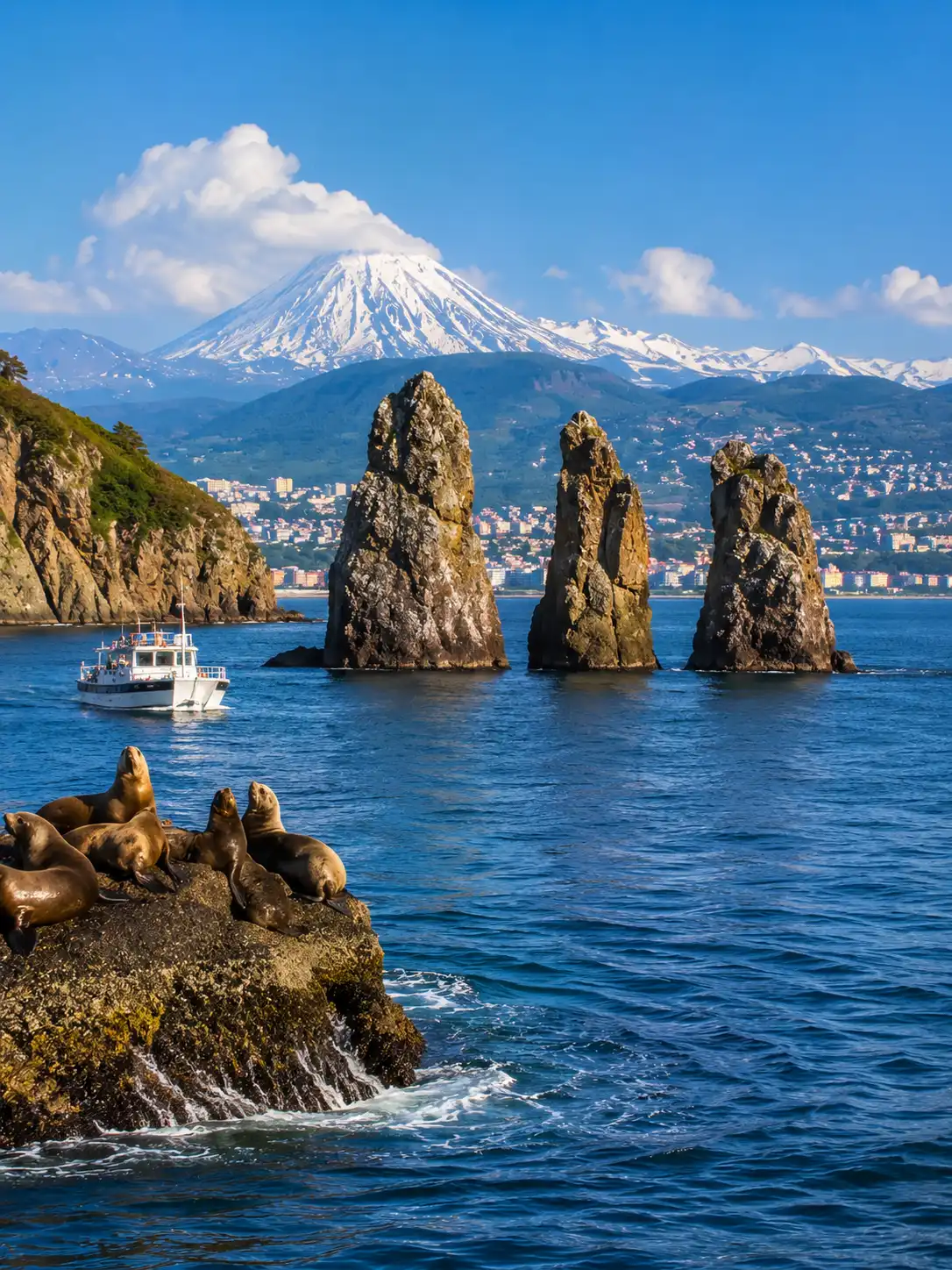
Avacha Bay is the maritime heart of Petropavlovsk-Kamchatsky and one of the most rewarding coastal destinations on the Kamchatka Peninsula. Surrounded by volcanic hills, harbour districts and distant snow-covered peaks, the bay connects the regional capital with the open Pacific Ocean.
A typical boat excursion begins inside the protected waters of the bay, passes the historic harbour and the narrow entrance between Cape Mayachny and the Zavoyko Peninsula, and continues toward the Three Brothers Rocks. Longer routes leave the bay entirely and follow the Pacific coast toward Starichkov Island, an important protected nesting site for seabirds.
Known in Russian as Авачинская бухта, Avacha Bay combines several different experiences in a single journey. Visitors can see Petropavlovsk-Kamchatsky from the water, observe the natural rock formations at the bay entrance, watch seabirds around coastal cliffs and search for seals, Steller sea lions, whales or orcas farther offshore.
Wildlife sightings are possible but never guaranteed. Sea conditions, fog, wind, migration patterns and the length of the chosen route strongly influence what can be observed.
This complete Wander Russia guide explains how to explore Avacha Bay, what makes the Three Brothers Rocks important, why Starichkov Island is protected, when boat tours operate and how to prepare for the cold and unpredictable waters of the North Pacific.
Where Is Avacha Bay?
Avacha Bay lies on the southeastern coast of the Kamchatka Peninsula beside Petropavlovsk-Kamchatsky.
The bay is connected to Avacha Gulf and the Pacific Ocean through a relatively narrow entrance. Petropavlovsk-Kamchatsky occupies part of the northern shoreline, while the settlement of Vilyuchinsk and several smaller bays lie around the wider harbour system.
The protected shape of Avacha Bay has made it a valuable natural harbour for centuries. Ships can enter from the Pacific and anchor in waters sheltered from much of the direct ocean swell.
The bay stretches far inland and is surrounded by hills, headlands, port facilities and residential districts. On clear days, several volcanoes may be visible from the water, including Avachinsky, Koryaksky and Vilyuchinsky.
Although industrial and naval infrastructure forms part of the landscape, large sections of the bay retain a dramatic natural appearance. Cliffs, forested slopes and small coves remain close to the city.
For travellers staying in Petropavlovsk-Kamchatsky, a marine excursion offers one of the easiest ways to experience Kamchatka’s Pacific coast without a helicopter or multiday expedition.
The Maritime Character of Petropavlovsk-Kamchatsky
Petropavlovsk-Kamchatsky was founded as a Pacific harbour, and the relationship between the city and the sea remains visible today.
The settlement developed around the protected waters of Avacha Bay because ships needed a safe anchorage on the remote eastern edge of the Russian Empire.
Fishing, naval activity, scientific expeditions and regional transport all contributed to the city’s development.
From the water, visitors can see how closely urban districts, port facilities and volcanic landscapes are connected. Apartment buildings rise above harbour areas, fishing vessels lie beside modern ships and snow-covered mountains appear beyond industrial infrastructure.
This combination is part of the authentic character of Petropavlovsk-Kamchatsky. The city is not a preserved historic resort separated from modern economic life. It remains a functioning Pacific port.
A boat trip therefore provides both a natural and cultural perspective. The route reveals the bay as a working harbour while gradually moving toward cliffs, sea stacks and open-ocean wildlife.
How Large Is Avacha Bay?
Avacha Bay is frequently described in tourism material as one of the largest natural harbours in the world.
The bay is approximately 24 kilometres long and around three kilometres wide at its entrance, although measurements vary depending on which inner waters are included.
Its broad sheltered basin provides substantial anchorage space.
The claim that every ship in the world could fit inside the bay is a popular local expression rather than a precise scientific measurement. It communicates the scale of the harbour but should not be treated as a literal capacity calculation.
What visitors experience directly is the contrast between the wide inner basin and the narrower opening toward the Pacific.
Inside the bay, water may appear relatively calm. Beyond the entrance, the boat can encounter ocean swell, stronger wind and rapidly changing conditions.
Boat Tours from Petropavlovsk-Kamchatsky
Most excursions depart from one of the harbour areas in Petropavlovsk-Kamchatsky.
The exact departure point depends on the operator, vessel and port regulations. Transfers from accommodation may be included or arranged separately.
Several types of marine excursion are available:
- A short cruise inside Avacha Bay
- A trip to the Three Brothers Rocks
- A half-day journey toward Starichkov Island
- A longer route to Russkaya Bay
- Wildlife-focused expeditions lasting one or more days
- Private yacht, catamaran or fishing charters
A standard Starichkov Island trip often lasts approximately five or six hours. Shorter Three Brothers tours may remain closer to the bay entrance, while longer journeys continue farther along the Pacific coast.
The itinerary can change on the day of departure. Captains consider wind, wave height, fog, visibility and current marine warnings.
Travellers should ask whether the advertised duration refers to total time away from the harbour or actual time near the island.
Leaving the Harbour
The beginning of the journey offers wide views of Petropavlovsk-Kamchatsky and the surrounding hills.
Boats pass fishing vessels, port installations and sheltered anchorages before continuing toward the outer bay.
Depending on the route, passengers may see the Zavoyko Peninsula, Cape Mayachny, small coves and rock formations along the coast.
The water inside the bay is often calmer than the open ocean, which gives passengers time to become accustomed to the movement of the vessel.
As the boat approaches the entrance, the coastline becomes steeper and more exposed. Ocean swell begins to influence the vessel, and wind can feel significantly colder.
Passengers prone to seasickness should take appropriate medication before departure according to medical advice. Waiting until nausea begins may be too late for some treatments to work effectively.
The Three Brothers Rocks
The Three Brothers Rocks are the best-known natural landmark at the entrance to Avacha Bay.
Known in Russian as Скалы Три Брата, the formation consists of three separate pillar-like sea stacks rising from the water near Shlyupochnaya Bay.
They stand close together but differ in height and shape. From certain angles, the rocks appear almost aligned, while from others the spaces between them become more visible.
The Three Brothers are considered a symbol of Avacha Bay and Petropavlovsk-Kamchatsky. They appear in tourism imagery, local artwork and historic representations of Kamchatka.
The rocks are also an officially protected natural monument.
Their exposed surfaces provide resting and nesting places for seabirds, while the surrounding water and reefs support marine life.
Boats normally approach to a safe viewing distance but do not land on the rocks.
How the Three Brothers Were Formed
The rocks are sea stacks created through long-term coastal erosion.
Waves, frost and weather gradually removed weaker sections of the surrounding coastal material while harder pillars remained standing.
They are associated with volcanic formations of the ancient Zavoyko complex, but their present shape results primarily from marine erosion.
Calling them simply lava pillars can therefore be misleading. The landscape reflects both its volcanic origin and millions of years of wave action.
The continuing force of the Pacific Ocean will eventually alter the rocks further. Cracks expand, fragments fall and the bases are continually attacked by waves.
Their current appearance represents one stage in a much longer geological process.
The Legend of the Three Brothers
A well-known local legend tells of three brothers who protected the inhabitants of the bay from an enormous ocean wave.
According to the story, the brothers stood at the entrance and resisted the destructive water. After saving the people and the harbour, they turned to stone and remained there as permanent guardians.
The legend is particularly meaningful in Kamchatka because the region is exposed to strong earthquakes and tsunami risk.
It should be presented as local folklore rather than as a historical account. The actual rocks were shaped through geological and coastal processes.
Nevertheless, the story captures the visual impression created by the formation. The three pillars stand at the boundary between the sheltered bay and the open Pacific, appearing to guard the harbour behind them.
Viewing the Rocks from Land
The Three Brothers can also be seen from viewpoints near Cape Mayachny.
Road access to the area may require a suitable vehicle and current permission, depending on the route and local restrictions.
The land-based perspective shows the rocks from above and places them within the wider entrance to Avacha Bay.
A boat trip provides a different experience. From water level, the stacks appear larger, and passengers can see their relationship to the surrounding cliffs and waves.
Travellers with limited time may choose one perspective, but combining a coastal viewpoint with a marine excursion provides a fuller understanding of the landscape.
Weather remains important. Fog can completely hide the rocks even when the city centre is clear.
Starichkov Island
Starichkov Island lies in Avacha Gulf outside the entrance to Avacha Bay.
Known in Russian as Остров Старичков, it is a small, steep-sided island with an area of approximately half a square kilometre. Its highest point rises to around 140 to 150 metres above sea level.
The island is surrounded by reefs, rocks and strong coastal water.
Its cliffs and upper plateau provide breeding habitat for large numbers of seabirds. This ecological importance led to its protection as a regional natural monument.
The name is connected with the Ancient Murrelet, known in Russian as starik. The bird nests on the island along with several other colonial species.
Ordinary tourist boats circle or approach the island from the water. Landing is generally prohibited or heavily restricted in order to protect nesting birds and avoid disturbance.
Seabird Colonies
Starichkov Island supports one of the most important seabird colonies close to Petropavlovsk-Kamchatsky.
Species recorded around the island include:
- Tufted puffins
- Horned puffins
- Ancient murrelets
- Thick-billed murres
- Common murres
- Pacific gulls
- Black-legged kittiwakes
- Pelagic cormorants
- Red-faced cormorants
- Pigeon guillemots
The exact number of birds present changes through the season and between years.
During the nesting period, birds occupy cliffs, grassy slopes, rock ledges and burrows. The air can be filled with constant movement and calls as adults travel between the colony and feeding areas.
Binoculars greatly improve the experience because boats must remain at a responsible distance.
Birds should never be attracted with food, loud sounds or playback recordings.
Why Landing Is Restricted
Starichkov Island is a protected breeding site rather than a recreational island.
Human movement can disturb nesting birds, cause adults to leave eggs or chicks and damage burrows hidden beneath vegetation.
The steep shoreline and surrounding reefs also make landing physically dangerous.
Even where a western approach appears possible, this does not mean tourists may go ashore without permission.
Visitors should choose operators that respect exclusion distances and reduce engine noise near colonies.
A boat approaching too closely may frighten birds from the cliffs or disrupt seals resting on nearby rocks.
Responsible observation means accepting that the island is best experienced from the water.
Marine Mammals
The waters around Avacha Bay and Starichkov Island support several marine mammal species.
Harbour seals may rest on reefs and rocks, particularly around low tide. Steller sea lions can also be seen in parts of the wider bay and Pacific coast.
Orcas and whales pass through the region, especially during the more productive summer season. Possible species include humpback whales, grey whales and several smaller cetaceans.
Sightings are unpredictable. A standard half-day trip may encounter several animals or none at all.
Longer routes toward Russkaya Bay generally provide more time in open coastal waters and may increase the opportunity for observation.
No operator should promise guaranteed whales or orcas on a normal sightseeing trip.
The captain must also avoid chasing animals or cutting across their direction of travel.
Steller Sea Lions
Steller sea lions are among the largest members of the eared-seal family.
Adult males can reach an impressive size and are easily distinguished from smaller females when seen together.
They may rest on coastal rocks or gather near haul-out sites in the region.
Passengers should remain quiet when the boat approaches an authorised viewing area. Sudden noise can cause animals to enter the water, wasting energy and potentially separating mothers from young.
Telephoto lenses and binoculars are more appropriate than attempting to approach closely.
Some sea lions may also be seen around harbour structures, although access and viewing conditions vary.
Fishing During Boat Excursions
Many Avacha Bay tours include a period of recreational sea fishing.
Commonly targeted fish include Pacific cod, flounder, greenling and other local species.
Fishing equipment is often provided, but travellers should confirm whether this is included and whether licences or catch rules are handled by the operator.
A catch is not guaranteed.
Some programs prepare fish soup or another simple meal on board. Crab or other seafood may also be served depending on the itinerary and legal supply.
Travellers with allergies or dietary restrictions should inform the operator before departure.
Fishing should follow current seasonal regulations, minimum-size rules and protected-species restrictions.
Food on Board
Marine excursions commonly include tea, snacks or a hot meal.
Longer journeys may offer fish soup, fresh seafood or a simple lunch prepared by the crew.
The quality and quantity vary considerably between operators, so the food program should be confirmed in advance.
Passengers should carry personal snacks if necessary, especially when dietary needs are specific.
Alcohol is not advisable on a moving vessel. It can increase seasickness, impair balance and worsen heat loss in cold weather.
Fresh drinking water should remain available throughout the trip.
Best Time for a Boat Tour
The principal marine-tourism season runs from late spring through early autumn.
June marks the beginning of many regular excursions. Seabird activity increases as nesting colonies become occupied, although air and water temperatures remain cold.
July and August provide long daylight and the broadest selection of departures. These months are also popular for wildlife-focused routes.
September can offer attractive light and continued marine activity, but storms and poor weather become more frequent.
October excursions depend heavily on the vessel, operator and current conditions.
Winter marine trips are limited and very different from standard summer sightseeing.
For a first visit, July through early September generally provides the most practical balance of access, daylight and tour availability.
Weather and Sea Conditions
Avacha Bay can appear calm while the Pacific beyond the entrance is rough.
Wind direction, swell and tide influence the comfort and safety of the trip.
Fog is common along the coast and may reduce visibility around the Three Brothers or Starichkov Island.
Rain can begin during the excursion even when the morning was clear.
The captain may shorten the route, remain inside the bay or cancel the journey entirely.
Passengers should accept these decisions. Reaching Starichkov Island is not more important than safe navigation.
A flexible schedule provides a better chance of rescheduling after cancellation.
What to Wear
Conditions on the water feel colder than conditions in the city.
Recommended clothing includes:
- A waterproof and windproof jacket
- Warm insulating layers
- Long trousers
- Waterproof footwear with non-slip soles
- A warm hat
- Gloves
- Sunglasses
- Sun protection
- Spare dry socks
- Waterproof protection for phones and cameras
Even during summer, exposed decks can be cold.
Loose clothing, scarves and hats should be secured because of wind.
Passengers should not wear smooth-soled shoes or high heels.
Some vessels provide flotation suits or additional protective clothing. The exact equipment should be confirmed before departure.
Seasickness
The open Pacific can cause seasickness even for travellers who feel comfortable inside Avacha Bay.
Possible symptoms include nausea, dizziness, sweating, fatigue and headache.
Helpful measures include:
- Taking appropriate medication in advance
- Eating a light meal before departure
- Avoiding excessive alcohol
- Remaining in fresh air
- Looking toward the horizon
- Staying near the centre of the vessel
- Avoiding prolonged phone use or reading
Passengers should discuss medication with a doctor or pharmacist, especially when they have existing health conditions.
Informing the crew early allows them to provide a safer place to sit.
Safety on the Boat
Passengers must listen to the safety briefing and know where life jackets are stored.
Hands and feet should remain inside the vessel while docking or approaching rocks.
Moving around the deck may be restricted during rough conditions.
Children should be supervised continuously.
Photography equipment must be secured because an unexpected wave or sudden movement can cause a person to lose balance.
Smoking and open flames may be restricted.
Passengers should never pressure the captain to approach wildlife, cliffs or rocks more closely.
Photography Tips
The Three Brothers are best photographed with enough surrounding water and coastline to show their position at the bay entrance.
A medium telephoto lens works well from a moving vessel, while a wide-angle lens is useful for city and volcanic panoramas.
For seabirds, a longer lens allows detailed photographs without disturbing the colony.
A fast shutter speed helps compensate for boat movement.
Salt spray can cover lenses quickly. A clean cloth and protective filter are useful.
Camera straps should remain attached at all times.
Bright ocean reflections can cause underexposed birds or cliffs, so exposure should be checked regularly.
The best photographs often include atmosphere rather than only wildlife. Fog, waves, harbour structures and volcanic silhouettes all contribute to the identity of Avacha Bay.
Responsible Wildlife Watching
Marine animals should determine the distance and duration of an encounter.
Boats should not surround whales, separate groups or block the direction in which animals are travelling.
Engines should be reduced where appropriate near sensitive wildlife.
Seabird colonies should be observed without loud music, shouting or feeding.
Nothing should be thrown into the water.
Plastic waste is particularly dangerous because it can be swallowed by birds, fish and marine mammals.
Travellers can support responsible tourism by choosing operators that explain wildlife rules and avoid guaranteed-sighting claims.
Combining the Boat Trip with Other Attractions
Avacha Bay excursions combine easily with several city attractions.
Before or after the cruise, travellers can visit Nikolskaya Hill, the waterfront, local museums or viewpoints over the harbour.
Khalaktyrsky Beach offers a contrasting view of the open Pacific from land.
Cape Mayachny provides elevated views toward the Three Brothers when road access is available.
A longer marine itinerary may continue beyond Starichkov Island toward Russkaya Bay. This route provides more remote coastal scenery and improved opportunities for marine wildlife but requires a longer day at sea.
A short city stay should include at least one flexible weather day because both boat and helicopter excursions can be cancelled.
Is the Excursion Worth Taking?
A boat trip through Avacha Bay is one of the most balanced activities in Kamchatka.
It requires less physical effort than climbing a volcano and less complex logistics than reaching the Valley of Geysers or Kurile Lake.
At the same time, it reveals several essential elements of the region: the working harbour, Pacific cliffs, seabird colonies, volcanic views and the possibility of marine mammals.
The standard route to Starichkov Island is suitable for many travellers, provided they can manage several hours on a moving vessel.
Those with severe seasickness or mobility problems should discuss vessel access and sea conditions before booking.
Wander Russia recommends choosing the route according to priorities. A short cruise is sufficient for harbour scenery and the Three Brothers. Starichkov Island is better for seabirds, while Russkaya Bay provides a longer wildlife-focused experience.
Frequently Asked Questions
Where do boat tours begin?
Most excursions depart from harbour facilities in Petropavlovsk-Kamchatsky.
How long is the Starichkov Island trip?
Typical programs last approximately five or six hours, although duration varies by vessel and sea conditions.
Can visitors land on Starichkov Island?
Ordinary tourist landing is generally prohibited or heavily restricted because the island is a protected seabird nesting site.
Are whale sightings guaranteed?
No. Whales and orcas may be seen, but wildlife sightings depend on season, route and natural movement.
Can the Three Brothers be seen from land?
Yes. Viewpoints near Cape Mayachny provide a land-based perspective when road access is available.
Is the excursion suitable for children?
Many operators accept children, but families should consider cold weather, seasickness and the need for continuous supervision.
When is the best time to go?
July through early September generally offers the widest selection of regular excursions.
What should visitors wear?
Warm layered clothing, a waterproof jacket and non-slip waterproof footwear are recommended.
Is fishing included?
Some programs include fishing, while others focus only on sightseeing. The itinerary should be checked before booking.
Can tours be cancelled?
Yes. Wind, swell, fog and marine warnings can force cancellation or route changes.
Conclusion
Avacha Bay provides one of the clearest introductions to Kamchatka’s relationship with the Pacific Ocean.
The journey begins in a working harbour surrounded by city districts and port infrastructure. As the boat moves outward, the urban landscape gives way to cliffs, headlands and the narrow entrance guarded by the Three Brothers Rocks.
Beyond them lies the open Pacific and Starichkov Island, where thousands of seabirds occupy steep cliffs and grassy slopes.
The experience is shaped by contrast. Calm harbour water becomes ocean swell. Industrial vessels give way to seals, puffins and distant whales. Volcanoes remain visible inland while the boat enters a marine environment governed by wind, waves and migration.
No excursion can guarantee clear views or wildlife. Fog may hide the rocks, rough water may prevent the boat from leaving the bay and animals may remain far from the route.
These uncertainties are part of travelling along Kamchatka’s coast.
The Three Brothers remain the symbolic centre of the journey. Their geological origin lies in erosion, but the local legend presents them as guardians protecting the harbour from the ocean.
Starichkov Island adds another layer of meaning. It demonstrates why parts of the coastline must remain protected from landing, noise and unnecessary disturbance.
For travellers staying in Petropavlovsk-Kamchatsky, the route offers an accessible encounter with the maritime side of Kamchatka. It combines scenery, wildlife, geology and the history of a city built around one of the North Pacific’s most important natural harbours.
