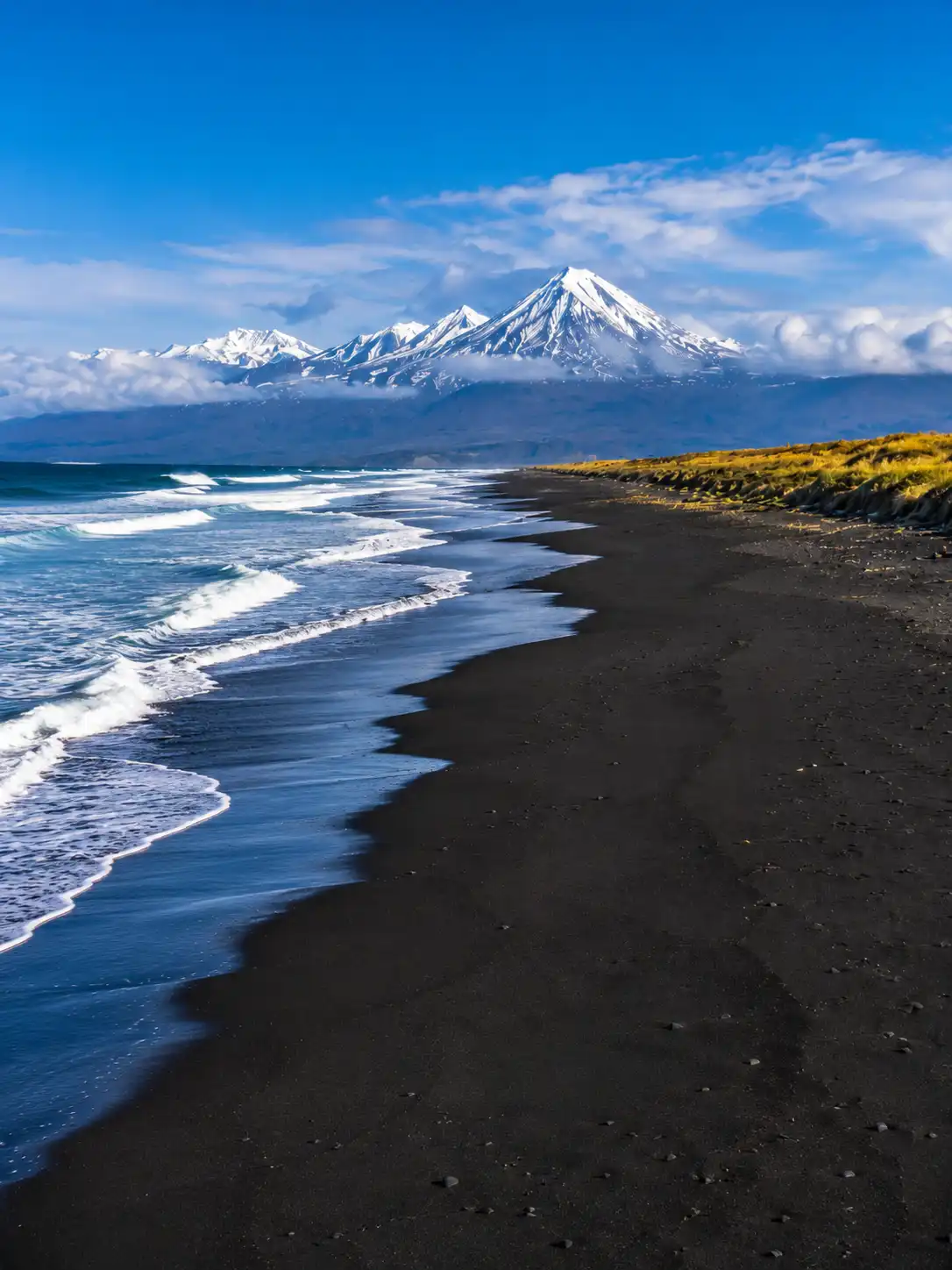
Khalaktyrsky Beach is one of the most accessible natural attractions near Petropavlovsk-Kamchatsky. Stretching along the open Pacific coast, the beach is known for its dark volcanic sand, powerful waves, wide horizon and distant views of the volcanoes surrounding the regional capital.
Known in Russian as Khalaktyrsky Plyazh, or Халактырский пляж, the coastline lies east of Petropavlovsk-Kamchatsky. Depending on the starting point, traffic and condition of the final access road, the journey usually takes less than an hour.
The beach offers a completely different experience from the volcanoes, calderas and geothermal fields that define much of Kamchatka tourism. There is no summit to climb and no helicopter required. Visitors arrive at sea level and walk across a broad strip of black sand toward the Pacific Ocean.
The apparent simplicity of the destination should not be misunderstood. Khalaktyrsky is not a sheltered swimming beach. It faces the open Pacific, where cold water, strong currents, powerful surf, sudden fog and tsunami risk require serious attention.
For experienced surfers, the same conditions create one of Russia’s most distinctive cold-water surf environments. For ordinary visitors, the main experience consists of walking on volcanic sand, listening to the ocean and seeing Kamchatka’s mountain landscape from the coast.
This complete Wander Russia guide explains how the black sand formed, how to reach the beach, what to see, when to visit, how surfing works and why swimming should be approached with extreme caution.
Where Is Khalaktyrsky Beach?
Khalaktyrsky Beach lies on the eastern side of the Kamchatka Peninsula, facing the Pacific Ocean.
It is situated approximately 20 to 25 kilometres from central Petropavlovsk-Kamchatsky. The exact distance depends on the chosen road, accommodation location and section of the coast being visited.
The main visitor area is reached by road from the city. The final section may be unpaved, uneven or muddy after rain, but the beach remains considerably easier to access than most major natural attractions in Kamchatka.
The coastline extends for around 30 kilometres. It forms a long, relatively straight strip of sand and coastal vegetation interrupted by river mouths, dunes and low areas.
The name comes from the nearby Khalaktyrka River and the wider Khalaktyrka area. Transliteration varies, so travellers may encounter spellings such as Khalaktyrsky, Khalaktyr, Halaktyrsky or Khalatyrsky.
All of these normally refer to the same Pacific coastline near Petropavlovsk-Kamchatsky.
Why Is the Sand Black?
The colour of Khalaktyrsky Beach comes from volcanic minerals.
Kamchatka’s volcanoes produce lava, ash, scoria and fragmented volcanic rock. Over long periods, rivers, snowmelt, erosion and coastal processes break this material into smaller particles and transport it toward the ocean.
Waves then redistribute the dense mineral grains along the shoreline.
The sand contains magnetite and titanium-bearing minerals, giving it a deep black or dark grey appearance. In some areas, a magnet held close to the surface can attract small grains because of their iron-rich composition.
The colour changes according to moisture and light. Dry sand can appear charcoal-grey, while wet sand close to the water becomes intensely black and reflective.
After a wave retreats, the smooth surface may briefly mirror clouds, people and the changing sky.
The beach should not be treated as a place to collect large quantities of sand. Removing natural material contributes to erosion and reduces the integrity of the landscape.
The First View of the Pacific Ocean
The approach to Khalaktyrsky Beach passes through low forest, shrubs, open fields and coastal vegetation.
For much of the drive, the ocean remains hidden. The road crosses a relatively flat landscape before the horizon suddenly opens beyond the dunes.
The first impression is often created by sound. The Pacific surf can be heard before the water becomes visible, particularly during windy weather.
Once the coastline appears, the scale becomes clear. Dark sand stretches in both directions, while the ocean continues toward an uninterrupted horizon.
On clear days, volcanoes may be visible inland. Their snow-covered slopes contrast with the flat black shoreline and create one of Kamchatka’s most distinctive landscapes.
Fog can produce a completely different atmosphere. The horizon disappears, waves emerge from grey mist and the beach feels isolated despite its closeness to the city.
How Long Is Khalaktyrsky Beach?
The commonly cited length is approximately 30 kilometres.
This figure describes the broader coastal strip rather than a single developed recreation zone. Most visitors remain near the main access point, visitor facilities or surf camps.
Walking farther along the coast quickly leads into quieter sections with fewer people and less infrastructure.
The length of the beach creates an impression of emptiness even when several groups are present. Cars and visitors become small against the open shoreline.
Anyone planning a longer coastal walk should remember that distances can be deceptive. The flat landscape makes objects appear closer than they are.
Wind, soft sand and cold temperatures can also make a return journey more tiring than expected.
What to See and Do
Khalaktyrsky Beach is primarily a landscape destination.
The main activity is walking along the shoreline. The black sand, white surf and large sky create constantly changing views without requiring a formal route.
Visitors can watch seabirds, search for naturally washed-up shells, observe surfers or sit behind the dunes where there is some protection from the wind.
Photography is especially rewarding during early morning, late evening, fog or after rain.
Some sections near the main visitor area may contain boardwalks, information panels, seating and seasonal services. The availability of cafés, equipment rental or other facilities changes between years and should not be assumed outside the main season.
Organised tours sometimes include a picnic, short coastal walk or visit to a nearby viewpoint.
Surfing is the best-known sporting activity, but it should be arranged through experienced local instructors.
Surfing at Khalaktyrsky Beach
Khalaktyrsky Beach has become one of the most important surfing locations in the Russian Far East.
The long open coastline receives swell directly from the Pacific Ocean. Waves break over sandbars shaped by currents, river outflow, storms and seasonal changes.
Surfing is possible during different parts of the year, including winter for highly experienced cold-water surfers. However, the conditions vary greatly and should never be described as continuously suitable for beginners.
Summer and early autumn normally provide the most practical introduction. Air temperatures are milder, surf schools are more active and daylight is longer.
Even in summer, the water remains cold. A full wetsuit, boots, gloves and sometimes a hood are required.
Beginners should book a supervised lesson rather than rent equipment and enter the water independently. Local instructors understand current, wind, surf zones and changing sandbanks.
The most dangerous conditions are not always the most visually dramatic. Moderate-looking waves can still create strong rip currents capable of carrying a swimmer or inexperienced surfer away from shore.
Is Khalaktyrsky Beach Suitable for Beginners?
The beach can be used for beginner surfing when conditions are appropriate and a professional instructor selects a suitable section.
That does not make the entire coastline beginner-friendly.
Wave height, wind direction, water movement and visibility change quickly. A calm section in the morning may become difficult later in the day.
Surf schools normally provide wetsuits, boards and safety instructions. The exact equipment included should be confirmed during booking.
A first lesson generally begins on the beach with information about:
- Board handling
- Correct standing position
- Wave timing
- Surf etiquette
- Rip-current awareness
- Entry and exit points
- Signals used by the instructor
Participants must explain their swimming ability honestly.
A person unable to swim confidently should discuss this before entering the water rather than assuming that the surfboard provides complete protection.
Can Visitors Swim at Khalaktyrsky Beach?
Khalaktyrsky Beach should not be approached as an ordinary bathing destination.
The water is cold, the beach is unsupervised across most of its length, and the open Pacific produces powerful surf and dangerous currents.
Local authorities have issued swimming restrictions in the past, including an official prohibition announced in 2021 following water-quality testing. Current regulations and local health guidance should therefore be checked before entering the water.
Even where no temporary water-quality restriction is in force, the physical conditions remain dangerous.
A person standing only knee-deep can be knocked down by a stronger wave. The returning water may pull sand from beneath the feet and make balance difficult.
Children should remain well away from the breaking waves unless closely supervised.
Entering the ocean for a photograph is unnecessary. The beach can be experienced fully from the shoreline.
Water Temperature
The Pacific Ocean near Petropavlovsk-Kamchatsky remains cold throughout the year.
During the warmer summer period, coastal water may reach roughly the low to mid-teens Celsius under favourable conditions. At other times, it is substantially colder.
Cold water reduces swimming ability and can cause rapid loss of coordination. Sudden immersion may trigger an involuntary gasp and panic response.
Surfers manage these conditions using specialist wetsuits and controlled sessions.
Ordinary beach visitors should not compare the coastline with summer resorts on the Black Sea or Mediterranean.
Warm air does not mean warm water. A sunny day can create comfortable conditions on the sand while the ocean remains dangerously cold.
Rip Currents and Powerful Surf
A rip current is a concentrated flow of water moving away from the beach.
It develops when waves push water toward the shore and the returning water finds a channel through the surf zone.
Rip currents may be difficult to see. Possible signs include a darker channel, fewer breaking waves, foam moving seaward or a visibly disturbed section between wave lines.
A person caught in a rip current should avoid fighting directly against it. The usual guidance is to remain calm, float if necessary, signal for help and move parallel to the shoreline until leaving the strongest flow.
Prevention remains more important than rescue advice.
Visitors who are not surfing under supervision should avoid entering the water when waves and currents are strong.
Tsunami Risk
Kamchatka lies beside the Kuril–Kamchatka Trench, one of the world’s most active seismic zones.
Strong offshore earthquakes can generate tsunamis that reach the eastern coast.
Khalaktyrsky Beach is especially exposed because it is flat, open and directly connected to the Pacific Ocean.
Anyone who feels prolonged or strong earthquake shaking near the coast should not wait for a formal announcement. The correct response is to move inland and toward higher ground immediately.
Other warning signs may include an unusual withdrawal of the sea, a sudden strong change in water level or an official alert.
Visitors should identify the road away from the coast when they arrive. Cars should not be parked in a way that blocks other vehicles or evacuation routes.
Tsunami warnings must always be taken seriously, even when previous warnings did not result in a damaging wave.
The 2020 Marine Event
Khalaktyrsky Beach received international attention in autumn 2020 after surfers reported eye irritation and unusual water conditions, while large numbers of marine organisms were found dead along parts of the eastern Kamchatka coast.
Several possible explanations were investigated, including industrial pollution, chemicals, volcanic processes and biological causes.
Subsequent scientific research found strong evidence that an extensive harmful algal bloom played a major role in the event. Unusually warm conditions, high concentrations of microalgae and the accumulation of biological toxins were linked to the marine mortality.
The event demonstrated that apparently pristine coastlines can still be affected by complex natural and environmental processes.
Travellers should avoid entering discoloured water, foam or areas containing dead marine animals. Any unusual smell, irritation or mass stranding should be reported to local authorities.
Historical incidents should not be used to claim that the beach is permanently unsafe. They do show why current water-quality information matters.
Wildlife Along the Coast
The open Pacific supports a wide range of marine life.
From shore, visitors may occasionally see seals, Steller sea lions, whales or orcas at a distance. Such sightings are possible but should never be guaranteed.
Seabirds gather along the coastline and river mouths. Gulls, cormorants and other species search the surf for food.
Salmon sharks also occur in the North Pacific. Their presence is occasionally mentioned in local tourism descriptions, but ordinary visitors are unlikely to see them from the beach.
Brown bears can move through the wider coastal landscape, especially around rivers and areas with food.
Food waste should never be left behind. Visitors walking far from the main access point should remain alert and avoid entering dense vegetation alone.
Dead animals should not be touched because they may carry disease or attract predators.
Best Time to Visit
Khalaktyrsky Beach can be visited throughout the year, but each season creates a different experience.
Summer, particularly July and August, provides the mildest conditions. Access is usually easiest, surf schools are active and the long daylight allows flexible timing.
September brings cooler air, changing vegetation and more dramatic weather. Clear autumn days can produce excellent views of the volcanoes.
October and November may bring storms, strong wind, rain and early snow.
Winter transforms the beach. Snow can cover sections of the black sand, while sea spray freezes around coastal objects. Winter surfing exists, but it is suitable only for properly equipped and experienced participants.
Spring is transitional. Roads may be muddy, snow may remain near the coast and weather changes rapidly.
For general sightseeing, July through September is normally the most practical period.
Sunrise and Sunset
The beach faces broadly eastward toward the Pacific, making sunrise especially important for photography.
During clear conditions, the first light appears over the ocean and reflects across wet black sand.
Morning often provides fewer visitors and may offer better visibility before coastal fog develops.
Sunset occurs behind the inland landscape rather than directly over the ocean. However, evening light can illuminate clouds, dunes and distant volcanoes.
The most dramatic scene depends on weather rather than time alone.
Visitors arriving before sunrise or leaving after sunset should carry a headlamp and remember that the access road may have potholes, mud or limited lighting.
Weather and Fog
The weather at Khalaktyrsky Beach may differ significantly from conditions in central Petropavlovsk-Kamchatsky.
The Pacific Ocean produces cool air, fog and strong wind. A sunny day in the city can become grey and cold at the coast.
Fog may arrive rapidly and reduce visibility along both the road and shoreline.
Wind chill is important. A moderate temperature can feel much colder when clothing becomes damp.
Layered clothing is therefore useful even during summer.
Visitors should bring:
- A windproof jacket
- A waterproof outer layer
- Warm clothing
- Waterproof shoes
- A hat
- Gloves outside midsummer
- Sun protection
- Drinking water
- Snacks
- A headlamp for late visits
Loose hats and lightweight belongings should be secured in strong wind.
How to Reach Khalaktyrsky Beach
The easiest options are an organised excursion, taxi or private transfer.
A tour is convenient for travellers without local transport. It may include hotel collection, a guide, a short walk and refreshments.
A taxi can be practical, but the return journey should be arranged in advance. Mobile reception and taxi availability may be unreliable at some points near the beach.
Visitors using a rental vehicle should confirm that unpaved-road access is permitted under the agreement.
The final road can become rough or muddy. A normal car may reach the main visitor zone during good summer conditions, while a higher-clearance vehicle is more reliable after rain or during the transitional seasons.
Public transport may cover only part of the journey. Relying on old bus descriptions can result in a long walk from the final stop.
Current local transport information should be checked shortly before departure.
Visitor Facilities
Infrastructure is concentrated around the principal access area.
Depending on the season and current operation, visitors may find a visitor centre, wooden walkways, benches, information panels, toilets, cafés or surf facilities.
Services should not be assumed to operate early in the morning, late in the evening or outside summer.
The majority of the 30-kilometre coastline remains undeveloped.
Travellers walking away from the main zone should carry everything they need and take all waste back with them.
There is little natural shelter from wind or rain. A closed café or seasonal building should not be treated as emergency accommodation.
Camping at Khalaktyrsky Beach
Camping may be possible in approved areas or through local surf and tourism camps.
Wild camping directly beside the surf line is unsafe because of waves, wind, changing tides and tsunami exposure.
Tents should be placed only where permitted and well away from the water.
Strong wind requires secure anchoring, while loose volcanic sand can make ordinary pegs ineffective.
Food must be stored carefully because of dogs, foxes and possible bears.
Campfires should not be created without permission. Coastal vegetation and driftwood form part of the natural environment and should not be damaged.
A formal camp or surf base provides a safer option than an isolated tent on the open beach.
Photography Tips
Khalaktyrsky Beach works particularly well for minimalist landscape photography.
The black sand provides a simple foreground, while waves create white lines across the frame.
Wet sand after a retreating wave can reflect the sky and volcanoes. A low camera position strengthens the reflection, but equipment must be kept away from unexpected surf.
A wide-angle lens captures the scale of the beach, while a telephoto lens can compress distant volcanoes behind surfers or coastal vegetation.
Fog creates atmospheric images with reduced colour and strong contrast.
Cameras should be protected from salt spray and wind-blown sand. Salt should be removed carefully after the visit because it can damage metal and optical surfaces.
Drones may be subject to local aviation rules and should not be flown near people, surf schools or wildlife without permission.
Responsible Travel
The popularity of Khalaktyrsky Beach increases pressure on the coastline.
Visitors should remove all rubbish, including food packaging, cigarette ends and disposable cups.
Driving on the beach should be avoided unless a route is specifically authorised. Tyres damage dunes, vegetation and nesting areas.
Sand, stones, shells and living organisms should remain where they are found.
Dogs should be controlled near wildlife and other visitors.
Surfing companies and seasonal businesses should be selected partly according to their environmental practices.
A clean beach cannot be maintained by infrastructure alone. It depends on every visitor leaving the area without waste or damage.
Combining the Beach with Other Attractions
Khalaktyrsky Beach is easy to combine with city attractions because it lies close to Petropavlovsk-Kamchatsky.
A morning visit can be followed by Nikolskaya Hill, the city centre, museums or viewpoints over Avacha Bay.
Camel Mountain and Avachinsky Pass are sometimes combined with the beach during a long excursion. This creates a strong contrast between volcanic mountain scenery and the Pacific coast.
The beach can also be visited before or after a marine excursion, although schedules should allow for changing weather and transport delays.
Travellers arriving after a demanding volcano hike may prefer a quiet beach walk rather than a surfing lesson.
Is Khalaktyrsky Beach Worth Visiting?
Khalaktyrsky Beach is one of the easiest ways to encounter the raw landscape of Kamchatka without a helicopter or multiday expedition.
Its attraction lies in simplicity. Black sand, cold wind, powerful waves and an open horizon create a strong sense of place.
It is not a tropical beach and should not be judged by swimming conditions, warm water or resort facilities.
The experience is most rewarding for travellers who enjoy coastal walking, photography, surfing or dramatic weather.
Wander Russia recommends including the beach near the beginning or end of a Kamchatka itinerary. It works well on a day when mountain routes are closed by cloud and can be reached without the long logistical preparation required for remote volcanoes.
Frequently Asked Questions
Why is Khalaktyrsky Beach black?
The sand contains dark volcanic minerals, including magnetite and titanium-bearing material eroded from Kamchatka’s volcanic landscape.
How far is the beach from Petropavlovsk-Kamchatsky?
The main visitor area is approximately 20 to 25 kilometres from the city, depending on the route and starting point.
How long is Khalaktyrsky Beach?
The broader sandy coastline extends for around 30 kilometres.
Can visitors swim there?
Swimming is not recommended because of cold water, powerful waves, rip currents and possible temporary health restrictions. Current local guidance should be checked.
Is surfing available?
Yes. Local surf schools operate during suitable conditions and provide instruction and cold-water equipment.
Can beginners surf there?
Beginners can participate under professional supervision when conditions are appropriate.
Is the water warm in summer?
No. The Pacific remains cold even during the warmest months.
Can the beach be visited in winter?
Yes, but access, weather and daylight conditions are more difficult. Winter surfing requires specialist experience and equipment.
Is there a tsunami risk?
Yes. The beach faces an active Pacific seismic zone. Visitors must follow earthquake and tsunami warnings and move inland immediately after strong shaking.
Are there facilities?
Seasonal facilities may operate near the main visitor area, but most of the coastline remains undeveloped.
Conclusion
Khalaktyrsky Beach reveals a side of Kamchatka that is different from its volcano summits and geothermal valleys.
The beach is flat, open and easy to reach, yet the landscape remains powerful. Black volcanic sand records the geological history of the peninsula, while the Pacific Ocean shapes the coast through waves, storms and currents.
The contrast defines the destination. Snow-covered volcanoes may appear inland while surfers enter cold water in full wetsuits. Wet sand reflects the sky, but strong currents make the shoreline dangerous for casual swimming.
Visitors do not need to climb or fly to experience the scale of Kamchatka here. A walk along the coast is enough to encounter the wind, sound and space of the open Pacific.
At the same time, the beach demands respect. Water temperatures remain low, rip currents are possible and tsunami warnings must be taken seriously.
Khalaktyrsky should therefore be visited as a wild coastline rather than a conventional recreation beach.
For surfers, it provides a rare cold-water experience beneath Kamchatka’s volcanic skyline. For photographers and walkers, it offers one of the region’s clearest and most accessible natural contrasts.
The black sand may be the feature that first attracts attention, but the lasting impression comes from the ocean itself: wide, cold and exposed at the eastern edge of the Russian Far East.
