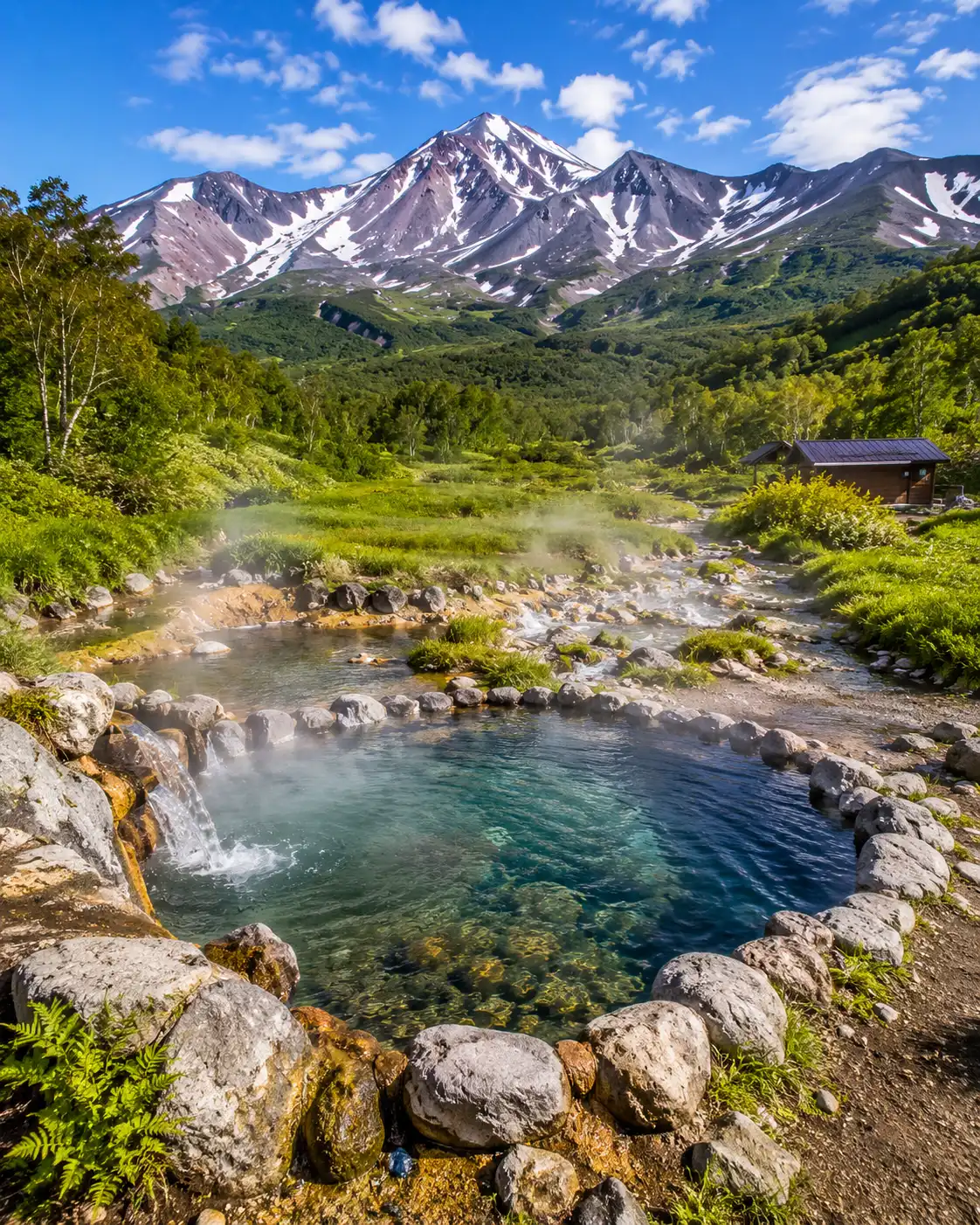
Nalychevo Nature Park is one of the most rewarding wilderness destinations near Petropavlovsk-Kamchatsky. Hidden inside a broad mountain basin north of the regional capital, the park combines volcanic scenery, hot mineral springs, cold-water springs, rivers, forests, alpine meadows and long-distance hiking routes.
Known in Russian as Природный парк «Налычево», the protected area stretches across the Nalychevo River valley and the surrounding volcanic ranges. Avachinsky and Koryaksky volcanoes dominate the southern side of the park, while Dzenzur and Zhupanovsky rise farther north and east. Kozelsky Volcano and several smaller mountain formations complete one of the most dramatic volcanic landscapes in southern Kamchatka.
The central Nalychevo Valley is famous for its thermal springs. Pools and mineral outlets occur in several groups across a relatively compact area, creating one of Kamchatka’s most varied collections of natural hot and cold mineral waters. Some springs feed simple outdoor bathing pools, while others are protected for scientific, environmental or practical reasons.
Reaching Nalychevo requires more preparation than visiting a roadside thermal resort. There is no ordinary public road connecting the central valley with Petropavlovsk-Kamchatsky. Visitors normally arrive by helicopter, walk through Avachinsky Pass during a multiday trek or join a winter expedition using skis, snowmobiles or specialised vehicles.
The journey rewards travellers with a quieter and more immersive experience than the better-known day trips around Gorely or Khalaktyrsky Beach. Nalychevo is not a single attraction but a complete mountain region where visitors can hike, bathe in thermal water, stay in basic cabins and observe the interaction between volcanoes, forests and wildlife.
This complete Wander Russia guide explains the park’s geography, thermal springs, hiking routes, wildlife, accommodation, access, safety and the best time to plan a visit.
Where Is Nalychevo Nature Park?
Nalychevo Nature Park lies north of Petropavlovsk-Kamchatsky on the southeastern part of the Kamchatka Peninsula.
The protected territory covers the Nalychevo River basin and the mountain systems surrounding it. The central valley is enclosed by several major volcanoes, giving the park a natural amphitheatre-like form.
The southern entrance is connected with Avachinsky Pass, located between Avachinsky and Koryaksky volcanoes. From there, hiking routes continue northward through mountain passes and valleys toward the central thermal area.
The eastern side of the park extends toward the Pacific coast and Cape Nalychevo. The northern sections approach the volcanic systems of Dzenzur and Zhupanovsky.
Although the park lies relatively close to the main urban centre of Kamchatka, the mountainous terrain makes access difficult. A straight-line distance on a map does not reflect the actual time required to enter the valley.
Travellers should therefore think of Nalychevo as a remote wilderness destination rather than a simple suburban nature reserve.
Why Nalychevo Is Special
Nalychevo combines several of Kamchatka’s defining landscapes in one protected area.
Visitors encounter active and dormant volcanoes, hot springs, cold mineral springs, rivers, birch forests, tundra, wetlands and mountain meadows.
The park also provides an important ecological corridor between inland volcanic regions and the Pacific coast. Brown bears, foxes, ground squirrels and many bird species move through the valleys.
Pacific salmon enter rivers connected with the wider watershed, transferring nutrients from the ocean into the terrestrial ecosystem.
The thermal springs are especially important. Different groups of springs contain varying temperatures and mineral compositions, creating a concentrated natural laboratory of hydrothermal processes.
This combination of geology, water and wildlife made Nalychevo an important component of the UNESCO World Heritage property Volcanoes of Kamchatka.
The Nalychevo Valley
The central valley is the heart of the park.
Wide meadows, rivers and forests spread across a basin surrounded by volcanoes. In clear weather, the skyline includes snow-covered peaks rising above lower green slopes.
The landscape changes through the season. Early summer brings extensive snow, high rivers and fresh vegetation. By August, meadows are fully green and many hiking routes are easier to follow. September adds yellow, red and orange autumn colours.
The Nalychevo River flows through the basin and receives water from mountain streams, snowfields and springs.
The central ranger area contains simple visitor facilities, thermal pools and the beginning of several local walking routes.
Despite the presence of cabins and marked paths, the valley remains wild. Brown bears move close to the visitor zone, weather changes quickly and communication with the outside world may be limited.
The Volcanoes Around Nalychevo
Several major volcanoes surround the park.
Avachinsky Volcano stands on the southern boundary and remains one of Kamchatka’s most active and accessible volcanic systems.
Koryaksky Volcano rises beside it and reaches more than 3,400 metres. Its steep glaciated slopes create one of the most recognisable views in the region.
Dzenzur Volcano lies toward the north of the central valley. Its eroded massif contains geothermal areas and mountain routes that can be included in longer expeditions.
Zhupanovsky Volcano forms another dominant part of the northeastern landscape. It has produced historical eruptions and remains actively monitored.
Kozelsky Volcano lies southeast of Avachinsky and is associated with climbing, skiing and mountain-training routes.
The diversity of these volcanoes gives the park a broader geological character than destinations focused on one summit.
The Thermal Springs of Nalychevo
The thermal springs are distributed across several groups within the central valley and surrounding areas.
Warm groundwater rises through faults and fractures after being heated beneath the volcanic landscape. The water carries dissolved minerals from the surrounding rock.
Some springs emerge as clear flowing water, while others form pools, channels or mineral deposits.
Water temperature differs between outlets. Certain springs are suitable for controlled bathing after mixing or cooling, while others may be too hot or chemically unsuitable.
Visitors should use only pools officially designated for bathing.
Natural-looking water is not automatically safe. High temperature, unstable ground or unsuitable mineral concentration can create risks.
The park’s springs should also not be confused with a commercial spa. Infrastructure is basic, changing rooms may be simple and pool conditions depend on maintenance and natural water flow.
Hot and Cold Mineral Springs
Nalychevo is unusual because hot and cold mineral springs occur within the same broader valley.
Cold springs emerge at lower temperatures but may still contain significant concentrations of dissolved minerals.
Local names are sometimes associated with the composition or historical use of individual springs. Visitors may encounter references to iron-rich, arsenic-bearing, siliceous or other mineral waters.
These descriptions should not be interpreted as medical prescriptions.
Drinking mineral water directly from a natural spring can be unsuitable for people with certain health conditions. Some water may contain elements that are beneficial only in limited quantities or under medical supervision.
Travellers should follow the advice of park staff and avoid drinking from unapproved sources.
Bathing in the Thermal Pools
Bathing is one of the most memorable experiences in Nalychevo.
After a long hike, visitors can enter a simple outdoor pool surrounded by forest, meadow and volcanic mountains.
The experience is especially atmospheric during cool weather, when steam rises above the water and snow remains on distant slopes.
Bathing times should remain moderate. Prolonged exposure to hot mineral water can cause dizziness, dehydration or changes in blood pressure.
Visitors should enter slowly and leave immediately if they feel weak, nauseous or uncomfortable.
Alcohol should not be consumed before bathing.
People with cardiovascular conditions, pregnancy or other significant medical concerns should seek professional advice before using hot springs.
Soap, shampoo and chemical products should not be used in natural pools because they pollute the water and surrounding soil.
The Central Visitor Area
The central Nalychevo visitor zone provides basic infrastructure for multiday stays.
Depending on current operation, facilities may include ranger buildings, simple cabins, cooking areas, toilets, bathing pools and marked paths.
Accommodation is functional rather than luxurious. Cabins may contain shared sleeping spaces, basic bunks or simple heating.
Electricity, hot showers, internet and mobile reception should not be expected.
Visitors should confirm whether bedding, meals, cooking equipment and sleeping bags are included in their program.
The central zone also serves as a starting point for shorter walks toward springs, river viewpoints and surrounding hills.
Helicopter Access
The fastest way to reach the central valley is by helicopter.
Flights usually depart from the Yelizovo or Petropavlovsk-Kamchatsky area and land near the main visitor zone.
The flight crosses forests, rivers and volcanic ridges, offering views that are impossible to obtain from the ground.
Helicopter access is normally used by travellers joining shorter stays, guided wellness programs or expeditions that begin in the central valley.
Weather determines whether the flight can operate. Fog, low cloud, wind and poor visibility may cause delay or cancellation.
Passengers should keep several flexible days in their itinerary.
A helicopter transfer should not be scheduled immediately before an international or long-distance departure.
Hiking from Avachinsky Pass
The classic overland approach begins near Avachinsky Pass.
Hikers travel through the mountain gap between Avachinsky and Koryaksky before continuing north toward the Nalychevo basin.
The full journey normally takes several days and requires camping equipment, food, river-crossing ability and professional route knowledge.
The trail crosses volcanic terrain, tundra, forest and mountain passes. Snow may remain in shaded areas even during summer.
Daily distances vary according to the program, but participants should be prepared for long walking days while carrying personal equipment.
Some organised tours transport part of the luggage by helicopter or vehicle. Others require participants to carry all supplies.
The route should not be attempted independently by inexperienced travellers.
A Typical Multiday Trek
A standard expedition may begin with an off-road transfer from Petropavlovsk-Kamchatsky to Avachinsky Pass.
The first walking stage crosses open volcanic terrain and gradually moves away from the popular Camel Mountain area.
Later days descend into forest and river valleys before reaching the central Nalychevo thermal zone.
Travellers may spend one or two nights near the hot springs, using the time for bathing and shorter local hikes.
The return route can follow the same path, continue toward another exit or end with a helicopter transfer.
Longer programs may include Dzenzur Volcano, Talovsky springs, local waterfalls or the Pacific coast.
Every itinerary remains vulnerable to weather, river conditions and volcanic restrictions.
Dzenzur Volcano and Geothermal Routes
Dzenzur lies north of the central visitor area.
The volcano is heavily eroded and appears broader and less symmetrical than Avachinsky or Koryaksky.
Its surrounding landscape contains geothermal features, mountain valleys and remote hiking routes.
Excursions toward Dzenzur usually require an additional full day or form part of a longer trek.
Routes may cross wet ground, rivers and areas without established infrastructure.
The volcano should be approached only with current park information because weather and volcanic conditions can alter access.
The experience is quieter and more remote than the central springs, making it suitable for travellers seeking a deeper expedition.
Talovsky Springs
The Talovsky spring group is another important thermal area in the park.
It lies away from the main central visitor zone and requires a separate hike or expedition stage.
The springs emerge in a natural setting of forest, meadow and volcanic terrain.
Depending on current infrastructure, simple pools or cabins may be available.
Conditions can change between seasons, and travellers should not assume that every pool shown in older photographs remains open.
Talovsky is best included in a guided multiday route rather than treated as an independent day excursion.
Wildlife in the Park
Nalychevo supports a rich range of wildlife.
Brown bears are the most significant large animals for visitor safety. They use river valleys, berry fields, forests and mountain passes throughout the season.
Foxes, sable, ground squirrels and smaller mammals also inhabit the region.
Birdlife includes raptors, waterfowl, forest birds and species associated with mountain environments.
Salmon migrations influence the wider river ecosystem and attract bears to productive feeding areas.
Wildlife sightings are possible but should never be forced.
Visitors must avoid approaching animals, feeding them or leaving food waste near camps.
Brown Bear Safety
Brown bear safety is essential in Nalychevo.
Visitors should travel in groups, make normal human noise in dense vegetation and remain alert around rivers, berry patches and blind corners.
Food must be stored according to park instructions.
Cooking and sleeping areas may need to be separated.
Running from a bear is dangerous. The correct response depends on distance, behaviour and local conditions, so instructions from experienced guides must take priority.
Bear spray availability and legal rules differ. Travellers should discuss deterrent equipment with their operator rather than bringing unapproved products.
A bear seen near a thermal pool may appear calm, but it remains a wild predator.
Best Time to Visit
The main hiking season generally runs from July through September.
July offers long daylight, fresh vegetation and extensive remaining snow. Rivers may be high because of meltwater.
August usually provides the most practical trail conditions and the greatest number of organised departures.
September brings autumn colours, colder nights and a higher chance of fresh snow.
June is often too early for ordinary trekking because mountain passes may remain snow-covered.
October can bring rapid winter conditions and reduced transport availability.
Winter travel is possible but requires a specialised program.
Nalychevo in Winter
During winter, Nalychevo becomes a destination for ski touring, snowmobile expeditions and remote thermal bathing.
The landscape is covered by deep snow, while steam rises from the hot springs.
Access may involve helicopter, snowmobile, tracked vehicle or several days of skiing.
Winter travel requires significantly more preparation than summer hiking.
Temperatures can be severe, daylight is limited and avalanche conditions must be assessed.
Participants need proper cold-weather clothing, insulated sleeping equipment and emergency communication.
Independent winter travel is unsuitable for most visitors.
Weather Conditions
Weather in Nalychevo changes quickly.
The central valley may be sunny while cloud surrounds the passes. Rain can continue for several days, making trails muddy and rivers difficult to cross.
Night temperatures can fall close to freezing even during midsummer.
Snow is possible at higher elevations throughout the hiking season.
The surrounding volcanoes influence local cloud and wind patterns.
Travellers should bring clothing for warm sun, cold rain and strong wind rather than relying on one forecast.
River Crossings
Some trekking routes include river and stream crossings.
Water levels vary according to rain, snowmelt and upstream conditions.
A shallow crossing in the morning can become more difficult later in the day.
Guides choose crossing points according to current flow.
Hikers should not enter fast water independently.
Trekking poles, secure footwear and correct group technique improve safety.
Backpack straps may need to be loosened so the pack can be removed quickly during a fall.
What to Wear and Bring
A summer trekking kit should include:
- Waterproof hiking boots
- A waterproof jacket and trousers
- Warm insulating layers
- Thermal underwear
- A hat and gloves
- Gaiters
- Trekking poles
- A sleeping bag suitable for cold nights
- A headlamp with spare batteries
- Insect repellent
- Sunglasses and sun protection
- Personal medication
- A first-aid kit
- Waterproof bags for documents and electronics
- Sufficient water capacity
- Quick-drying clothing
- Sandals or light footwear for camp
- A towel and bathing clothes
The exact list depends on whether tents, food and cooking equipment are provided.
Mosquitoes and Insects
Mosquitoes and other biting insects can be intense during summer.
Wetlands, river valleys and warm weather create favourable conditions.
Insect repellent is essential.
Long sleeves, trousers and a head net may be useful during calm evenings.
Cabin windows and tent entrances should remain closed where possible.
Insect activity normally decreases during cooler weather and later in the season.
The presence of mosquitoes should be considered when planning photography, meals and rest.
Park Permits
Nalychevo is a protected nature park.
Visitors must follow current entry, route and camping regulations.
Organised operators normally arrange permits and registration.
Independent groups should contact the park administration in advance and select an approved route.
Remote expeditions may also need to register with regional emergency services.
Permits do not guarantee that every route will remain open. Volcanic activity, fire, flood, damaged bridges or wildlife conditions may cause temporary closure.
The official route status should be checked shortly before departure.
Volcanic Activity
Several volcanoes around Nalychevo remain active.
Avachinsky, Koryaksky and Zhupanovsky have produced historical activity, including ash and gas emissions.
Ashfall can affect the valley even when an eruption occurs several kilometres away.
Fine ash irritates the eyes and lungs and can contaminate water or equipment.
Travellers should follow KVERT monitoring reports and park instructions.
A route may be closed because of activity on a volcano that is not part of the planned hike.
Face coverings can reduce dust exposure but do not provide full protection against volcanic gas.
Environmental Protection
The thermal fields and wetlands of Nalychevo are sensitive.
Visitors must use established paths, bathing pools and campsites.
Driving off approved tracks damages tundra and wetland vegetation.
Soap and detergents should not enter springs, rivers or natural pools.
Rubbish must be carried out or disposed of only in approved facilities.
Plants, minerals and volcanic rocks should remain in place.
Drone use requires permission and may be restricted around wildlife, helicopters and protected zones.
Responsible behaviour is especially important because recovery is slow in Kamchatka’s short growing season.
Photography Tips
Nalychevo is ideal for wide landscape photography.
Volcanoes, steam, meadow and river can often be included in the same composition.
Early morning may provide calm air and clearer mountain views before cloud develops.
Evening light highlights autumn vegetation and volcanic ridges.
A telephoto lens is useful for wildlife and distant summit details.
Cameras should be protected from rain, thermal moisture and insects.
A lightweight tripod can help during low light but adds weight to multiday trekking.
Photographers should never leave the group or approach wildlife for a closer image.
Is Nalychevo Worth Visiting?
Nalychevo is worth visiting for travellers who want more than a short scenic stop.
The park provides a complete wilderness experience combining trekking, thermal bathing, volcanic views and wildlife.
It requires time and flexibility. Helicopters may be cancelled, trails may be wet and accommodation is basic.
The destination is less suitable for travellers seeking easy road access, luxury facilities or a fixed daily schedule.
For hikers and nature-focused visitors, these limitations are part of the appeal.
Wander Russia recommends allowing at least three or four days for a meaningful visit. Longer routes provide a deeper understanding of the valley and reduce the pressure created by weather delays.
Frequently Asked Questions
Can Nalychevo be reached by car?
There is no ordinary public road to the central valley. Visitors generally arrive by helicopter or on foot through mountain routes.
Can the park be visited as a day trip?
A helicopter day visit may occasionally be available, but the park is better experienced through an overnight or multiday stay.
Are the hot springs suitable for bathing?
Selected pools are used for bathing. Visitors should enter only areas approved by park staff.
Is the water medically beneficial?
The springs contain different minerals, but general tourism information should not be treated as medical advice.
Are bears common?
Brown bears live throughout the park. Sightings are possible, and strict food-storage and group-safety rules are necessary.
When is the best time to hike?
July through September generally provides the most practical summer conditions.
Are permits required?
Yes. Access and regulated routes require compliance with park procedures. Tour operators normally arrange the necessary documents.
Is there mobile coverage?
Coverage is limited or absent across much of the park.
What accommodation is available?
Visitors may use simple cabins, ranger facilities or tents, depending on the program.
Is Nalychevo part of a UNESCO World Heritage Site?
Yes. It is one of the protected components of the Volcanoes of Kamchatka World Heritage property.
Conclusion
Nalychevo Nature Park offers one of the most complete wilderness experiences in southern Kamchatka.
The park is defined not by a single famous sight but by the relationship between volcanoes, water, forests, wildlife and people travelling through the landscape.
Avachinsky and Koryaksky rise above the southern entrance. Dzenzur and Zhupanovsky shape the northern horizon. Rivers cross the central basin, while hot and cold mineral springs emerge from faults beneath the valley.
The thermal pools provide the most comfortable part of the journey, but they gain meaning from the effort required to reach them. After days of walking through rain, ash, forest and tundra, warm water beneath the volcanic skyline feels closely connected to the geology of Kamchatka.
The park also requires humility. Bears use the same valleys, rivers rise after rain and cloud can close mountain passes without warning.
Infrastructure remains simple, and even a carefully planned journey may change because of weather or volcanic conditions.
These uncertainties make Nalychevo different from a conventional resort. The valley cannot be experienced through a rushed schedule or reduced to a photograph of a thermal pool.
A meaningful visit requires time: time to cross the mountains, wait for clear weather, observe the changing light and understand how the springs fit into the larger protected ecosystem.
For travellers prepared for basic conditions and long routes, Nalychevo offers a quieter alternative to Kamchatka’s famous helicopter attractions.
It combines the physical experience of hiking with the calm of thermal water and the scale of a volcanic landscape that remains largely governed by natural forces.
