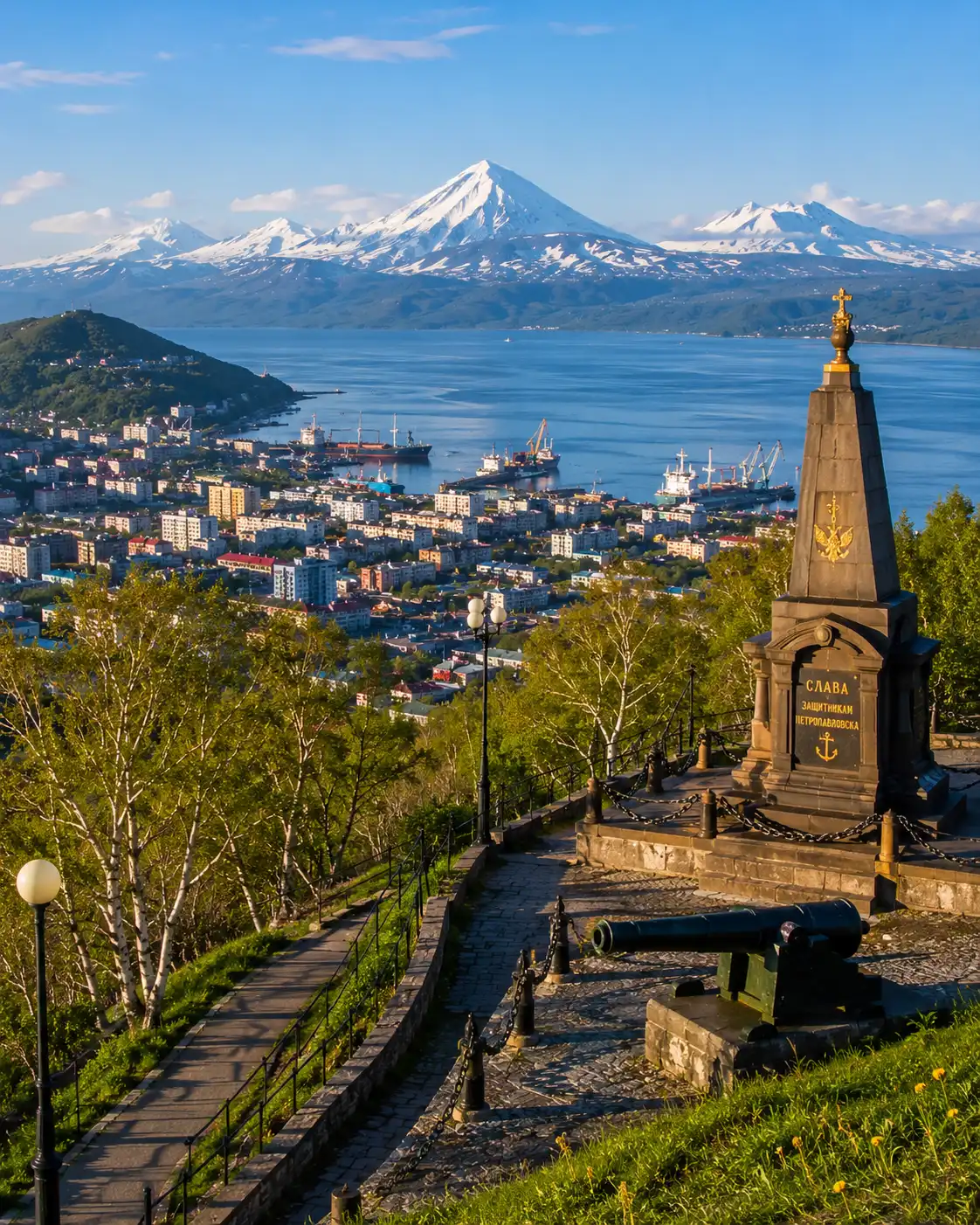
Petropavlovsk-Kamchatsky is the administrative, cultural and maritime centre of the Kamchatka Peninsula. Built between steep green hills and the sheltered waters of Avacha Bay, the city provides the main starting point for journeys to volcanoes, geothermal valleys, wildlife reserves and the Pacific coast.
Many travellers spend only a short period in Petropavlovsk-Kamchatsky before joining a helicopter excursion or travelling into the mountains. However, the city deserves time of its own. Its harbour, monuments, museums, hills and historical sites explain how a remote settlement developed into one of the most important ports in the Russian Far East.
The most significant historical landscape is Nikolskaya Hill, known in Russian as Никольская сопка. Rising beside the centre and the waterfront, the wooded hill combines walking paths, viewpoints, memorials and the battlefield associated with the defence of Petropavlovsk during the Crimean War in 1854.
From the hill, visitors can look across Avacha Bay, the port, city districts and surrounding coastline. In clear weather, volcanic peaks may appear beyond the urban landscape. The contrast between history, sea and mountains makes Nikolskaya Hill one of the most meaningful places in Petropavlovsk-Kamchatsky.
This complete Wander Russia guide explains the city’s history, Nikolskaya Hill, the memorials of 1854, museums, viewpoints, waterfront, transport, weather and the best way to plan a visit.
Where Is Petropavlovsk-Kamchatsky?
Petropavlovsk-Kamchatsky lies on the southeastern coast of the Kamchatka Peninsula beside Avacha Bay.
The city occupies a narrow and uneven strip of land between the water and a chain of hills. Residential districts extend along valleys and slopes, while the historical centre remains close to the harbour.
Avacha Bay provides a naturally protected anchorage connected with the Pacific Ocean through a narrower entrance. This geographical setting made the area attractive to explorers, naval expeditions, fishing vessels and later regional transport.
The city is surrounded by volcanic landscapes. Avachinsky and Koryaksky volcanoes rise north of the urban area, while Vilyuchinsky can be seen toward the south under favourable weather conditions.
Petropavlovsk-Kamchatsky is connected with Yelizovo Airport by road. The airport lies near Yelizovo, approximately 30 kilometres from the city centre, depending on the chosen route.
Most visitors arrive by air from other parts of Russia. There is no railway connection with the rest of the country, and the peninsula has no continuous public road linking it with the mainland Russian road network.
The Founding of the City
The modern city traces its foundation to 1740 and the Second Kamchatka Expedition.
Navigator Ivan Yelagin reached the harbour area during the summer and selected a site at Niakina Harbour, now associated with the inner port area. Buildings and facilities were prepared for the expedition led by Vitus Bering and Alexei Chirikov.
Later that year, the packet boats Saint Peter and Saint Paul entered Avacha Bay and remained for the winter.
The settlement took its name from the two ships. The original Petropavlovsk Port gradually developed into Petropavlovsk-Kamchatsky.
The harbour became an important location for expeditions crossing the North Pacific. Russian and foreign navigators stopped here for supplies, repairs and information.
The city’s early history is therefore closely connected with exploration, cartography, maritime science and the expansion of knowledge about the Pacific.
Monuments to Bering, La Pérouse and Charles Clerke reflect this international maritime heritage.
A City Built Around Avacha Bay
Petropavlovsk-Kamchatsky cannot be understood separately from its harbour.
Fishing vessels, cargo ships, naval facilities and port infrastructure remain visible parts of the city. The waterfront is not designed only for tourism; it continues to serve a working maritime economy.
This creates a cityscape that feels different from a preserved resort. Apartment blocks, administrative buildings, cranes, vessels, hills and volcanoes appear within the same panorama.
The urban layout follows the natural terrain. Roads curve around hills and bays rather than forming a simple rectangular grid.
Distances can look short on a map but involve slopes, stairways and long detours. Walking is rewarding in the centre, while taxis or local transport are practical for districts farther away.
The best city views are usually found from elevated points such as Nikolskaya Hill, Mishennaya Hill and other official observation areas.
Nikolskaya Hill
Nikolskaya Hill is the principal historical attraction in Petropavlovsk-Kamchatsky.
The hill rises beside the central waterfront and reaches approximately 100 metres above sea level. Its wooded slopes contain paths, stairways, memorials and viewpoints.
Local residents sometimes call it the Hill of Love because it is a popular place for walks and meetings. Its atmosphere can feel peaceful, especially among the stone birch trees and quieter sections overlooking the bay.
However, the hill also carries deep military significance.
During the defence of Petropavlovsk in 1854, Nikolskaya Hill became one of the main battlefields. Russian defenders fought British and French landing forces on its slopes during the Crimean War.
Today, the hill functions as both a public park and a memorial landscape.
The Defence of Petropavlovsk in 1854
The Crimean War was fought across a much wider geographical area than Crimea itself.
In 1854, a combined British and French naval squadron entered Avacha Bay and attempted to capture Petropavlovsk Port. The attackers possessed more ships, personnel and artillery than the local defenders.
The Russian defence was organised under Vasily Zavoyko, the military governor of Kamchatka.
The harbour was protected by ships, shore batteries, soldiers, sailors and local residents. Several artillery positions were constructed around the bay and nearby hills.
Fighting continued for several days. One of the decisive actions occurred on Nikolskaya Hill, where an Anglo-French landing force attempted to gain control of the heights above the harbour.
The defenders counterattacked across difficult terrain. The landing force suffered substantial losses and withdrew to its ships.
The squadron eventually left Avacha Bay without capturing the settlement.
The defence became one of the most important events in the history of Petropavlovsk-Kamchatsky. Streets, memorials and annual commemorations continue to preserve the memory of those involved.
The Glory Monument
The Glory Monument is one of the main memorials on Nikolskaya Hill.
Known in Russian as the Monument Slava, it was created in honour of the successful defence of Petropavlovsk against the British and French squadron.
The monument dates to the nineteenth century and was erected several decades after the battle.
Its elevated position gives it a strong symbolic relationship with the hill and harbour. Visitors can stand near the memorial and imagine why control of the terrain mattered during the fighting.
The monument should not be treated only as a decorative city landmark. It represents an event central to local identity and to the historical status of Petropavlovsk-Kamchatsky as a City of Military Glory.
Maksutov’s Battery
The reconstructed battery associated with Lieutenant Alexander Maksutov stands among the best-known military memorials on Nikolskaya Hill.
During the defence of 1854, Maksutov commanded one of the key artillery positions protecting the harbour.
The battery became known for continuing to fight under intense enemy fire. Maksutov was seriously wounded and later died from his injuries.
The modern memorial includes reconstructed artillery pieces based on weapons from the period.
The site helps visitors understand the physical layout of the defence more clearly than a conventional monument alone. The cannons face the maritime approaches, showing how shore batteries attempted to prevent hostile ships and landing forces from controlling the bay.
The memorial is sometimes referred to with slightly different numbering or names in local descriptions. Visitors should focus on its historical connection with the third battery and Lieutenant Maksutov.
The Memorial Chapel and Burial Site
Near the foot and slopes of Nikolskaya Hill lies a memorial chapel associated with those killed during the battle.
The area contains burial sites for both Russian defenders and British and French servicemen.
This shared memorial landscape gives the site a more reflective character. It recognises the dead from opposing sides rather than presenting the hill only as a symbol of victory.
The chapel developed from earlier efforts to mark the graves and commemorate the battle. The present memorial complex reflects several periods of construction and restoration.
Visitors should behave respectfully, especially during commemorative ceremonies.
The site is most meaningful when viewed together with the monuments higher on the hill and the harbour below.
Stone Birch Forest
One of the attractive features of Nikolskaya Hill is its vegetation.
Kamchatka stone birch grows across the slopes, creating a green canopy during summer and strong yellow colours in autumn.
The trees have irregular trunks and branches adapted to snow, wind and difficult climatic conditions.
Walking beneath them creates a quiet atmosphere despite the hill’s central location.
The forest also helps separate the paths from surrounding roads and buildings. Short sections can feel surprisingly remote even though the city centre is only minutes away.
After rain, paths may become slippery. Fallen leaves and wet roots require attention, especially on steeper sections.
Visitors should remain on established trails to protect vegetation and avoid erosion.
Nikolskaya Hill Viewpoints
Several parts of the hill provide views over the city and Avacha Bay.
The perspective changes as the path moves around the slopes. One viewpoint may face the inner harbour and port, while another looks toward the coastline and the entrance to the bay.
The lower shoreline beneath the hill includes a narrow beach and walking areas beside the water.
On a clear day, the panorama can include:
- Avacha Bay
- The historical centre
- Port facilities
- Signalnaya Hill
- The Ozernovskaya Spit area
- Ships entering or leaving the harbour
- Distant volcanic and mountain silhouettes
Fog and low cloud may hide the volcanoes while leaving the harbour visible.
Early morning often brings calmer light, while evening can produce attractive reflections across the bay.
Walking Around Nikolskaya Hill
The official walking route can be completed without advanced hiking experience.
The paths include paved sections, steps, forest trails and viewing platforms. The total distance depends on where the walk begins and which memorials are included.
A short visit may take one hour. A slower historical walk with the shoreline, memorials and photography can occupy two or three hours.
Comfortable shoes are recommended because the route contains slopes and uneven sections.
During winter, snow and ice can make the paths difficult. Footwear with strong grip or removable traction devices may be useful.
The hill can be visited throughout the year, but daylight, wind and surface conditions change significantly by season.
The Historic Centre
The central streets near Nikolskaya Hill contain several important monuments and public spaces.
Leninskaya Street runs through the historic area and connects memorials, administrative buildings, the waterfront and cultural institutions.
The monument to Vitus Bering commemorates the navigator whose expedition played a central role in the foundation of the settlement.
A monument to the French explorer Jean-François de La Pérouse reflects the city’s connection with international Pacific exploration.
The memorial to Charles Clerke commemorates the British naval officer who assumed command of James Cook’s expedition after Cook’s death. Clerke died during the expedition and was buried in Kamchatka.
These monuments demonstrate that the city’s history is not limited to Russian expansion. Petropavlovsk became a meeting point for explorers from several maritime nations.
Kultuchnoye Lake and the Central Waterfront
Kultuchnoye Lake lies close to the historical centre.
A walking route around the lake provides a relatively easy urban promenade and connects with nearby squares, monuments and streets.
The lake is part of the city landscape rather than a wilderness attraction. Roads and buildings remain visible around it.
Nevertheless, the water adds openness to the centre and creates useful views toward the surrounding hills.
The nearby waterfront area offers benches and perspectives across Avacha Bay.
Weather can make the promenade feel very different from one day to another. In sunshine, it becomes a comfortable place for a slow walk. In strong Pacific wind, the exposed sections can feel cold even during summer.
Kamchatka Regional Museum
The Kamchatka Regional United Museum is one of the most useful places for understanding the peninsula before travelling into remote regions.
Its collections cover the natural environment, archaeology, history, Indigenous cultures, exploration, regional development and the modern life of Kamchatka.
Exhibitions can help visitors distinguish between the peninsula’s ethnic groups, volcanic regions, wildlife and historical periods.
The museum is particularly valuable for travellers whose itinerary focuses heavily on nature. It provides cultural and historical context that may otherwise be missed during helicopter and hiking excursions.
Opening hours, temporary exhibitions and ticket conditions can change. Current information should be checked through the museum’s official channels.
The museum also conducts projects and exhibitions devoted specifically to the history of Petropavlovsk Port.
Volcanarium
Volcanarium is a modern museum and educational centre devoted to volcanoes.
Interactive displays explain how magma forms, why eruptions differ, how volcanic rocks are created and how monitoring systems work.
The museum is especially useful before visiting active volcanoes such as Avachinsky, Gorely or Klyuchevskaya Sopka.
It can also serve as a strong alternative during poor weather when mountain excursions are cancelled.
Visitors should check the current location, opening schedule and availability of guided programs before arrival.
A museum visit does not replace field experience, but it makes the geological landscape easier to interpret.
Mishennaya Hill
Mishennaya Hill provides one of the broadest panoramas over Petropavlovsk-Kamchatsky.
It is higher than Nikolskaya Hill and reveals a larger section of the city, Avacha Bay, harbour and surrounding volcanic landscape.
The viewpoint is particularly popular near sunset when conditions are clear.
Road and walking access can vary with snow, maintenance and current regulations.
Mishennaya is better for understanding the overall shape of the city, while Nikolskaya is stronger for history and close waterfront views.
Travellers with sufficient time should visit both.
The Port and Fish Market Atmosphere
Seafood is an important part of local life.
Shops and markets may sell salmon, red caviar, crab and other regional products. Availability changes according to season, regulation and supply.
Travellers should purchase products only from established sellers and check transport rules before carrying fish or caviar on a flight.
Restaurants commonly serve salmon, halibut, crab, fish soup and other dishes connected with the Pacific.
Prices and menus change frequently, so a city guide should avoid presenting one restaurant or market as permanently essential.
The strongest approach is to look for current local menus and choose places specialising in regional seafood rather than relying on old rankings.
How Many Days Are Needed?
One full day is sufficient for the main historical centre.
A balanced day can include Nikolskaya Hill, the memorials, the regional museum, Kultuchnoye Lake and the waterfront.
Two days allow more time for Mishennaya Hill, Volcanarium, markets, additional viewpoints and a relaxed meal.
Petropavlovsk-Kamchatsky also works well as a base for several day excursions:
- Khalaktyrsky Beach
- Avacha Bay boat tours
- Camel Mountain
- Avachinsky Volcano
- Vilyuchinsky Pass
- Gorely Volcano
- Paratunka thermal pools
Flexible city days are valuable because helicopter and mountain excursions can be cancelled by weather.
A museum or historical walk can fill a day that would otherwise be lost.
How to Get Around
The historical centre can be explored partly on foot.
Taxis are practical for longer journeys, steep districts and viewpoints such as Mishennaya Hill.
Local buses and minibuses connect major districts, but routes may be difficult for first-time visitors to understand without Russian-language information.
Traffic can slow journeys during busy periods.
Street names and addresses should be saved offline because mobile data may be unreliable in some situations.
For an organised city tour, a guide provides historical interpretation that is especially valuable on Nikolskaya Hill.
Best Time to Visit
Petropavlovsk-Kamchatsky can be visited throughout the year.
July and August provide the mildest conditions, long daylight and the broadest selection of regional excursions.
September brings autumn colour to Nikolskaya Hill and can offer clear mountain views, although temperatures decline.
October and November are transitional months with rain, wind and early snow.
Winter transforms the city. Snow covers the hills, roads and harbour slopes, while volcanic peaks appear especially dramatic during clear weather.
Spring can be snowy, wet and muddy. Paths on Nikolskaya Hill may remain icy after lower roads have cleared.
For a first visit combined with hiking and marine tourism, July through September is generally the most practical period.
Weather and Clothing
The city has a cool maritime climate influenced by the Pacific Ocean.
Summer can bring sunshine, rain, fog and strong wind during the same day.
Temperatures near the waterfront may feel colder than in sheltered streets.
Useful clothing includes:
- A waterproof jacket
- Warm layers
- Comfortable walking shoes
- Long trousers
- A hat
- Light gloves outside midsummer
- Sun protection
- A small umbrella only in calm weather
- A waterproof cover for electronics
Winter visitors need insulated boots and clothing suitable for heavy snow and wind.
Weather forecasts should be checked daily, but local conditions can still change quickly.
Photography Tips
Nikolskaya Hill works well for photographing the relationship between city and sea.
A wide-angle lens can include trees, memorials and the bay. A telephoto lens is useful for ships, harbour details and distant volcanoes.
Morning light often provides calmer water and softer visibility across the bay.
Autumn colours create strong foregrounds around the memorials.
Mishennaya Hill is better for large panoramic views.
Photographers should avoid climbing barriers or leaving official paths. Slopes near the shoreline and hill edges can be unstable, especially after rain or snow.
Drone use must comply with local aviation, military and urban restrictions. Permission should never be assumed in a strategic port city.
Is Petropavlovsk-Kamchatsky Worth Exploring?
Petropavlovsk-Kamchatsky is worth exploring because it gives context to the landscapes surrounding it.
Without the city, a Kamchatka journey can become a sequence of volcanoes and wildlife sites without a clear understanding of the people, history and maritime systems that connect them.
Nikolskaya Hill is the best place to begin. It combines the founding harbour, the battlefield of 1854, memorials, forest and views across Avacha Bay.
The city is not conventionally polished. Industrial areas, Soviet-era housing and steep roads form part of its appearance.
That realism is part of its value. Petropavlovsk-Kamchatsky remains a working port at the edge of an active volcanic peninsula.
Wander Russia recommends allowing at least one full city day rather than using every available hour for excursions outside the urban area.
Frequently Asked Questions
When was Petropavlovsk-Kamchatsky founded?
The city traces its foundation to 1740, when the Second Kamchatka Expedition established a base at the harbour and the ships Saint Peter and Saint Paul arrived.
What is Nikolskaya Hill known for?
It is known for viewpoints, stone birch forest and memorials connected with the defence of Petropavlovsk in 1854.
Is Nikolskaya Hill difficult to climb?
The standard walking paths are relatively easy, although there are slopes, stairs and uneven sections.
How much time is needed for the hill?
A short visit takes about one hour. A slower historical walk may require two or three hours.
Can the volcanoes be seen from the city?
Yes, under clear conditions. Avachinsky, Koryaksky and other mountains may be visible from several viewpoints.
What are the main museums?
The Kamchatka Regional Museum and Volcanarium are among the most useful visitor attractions.
Is the city walkable?
The historical centre is walkable, but the wider city is spread across hills and valleys. Taxis or public transport are useful.
When is the best season?
July through September generally offers the most convenient combination of city walking and regional excursions.
Can Nikolskaya Hill be visited in winter?
Yes, but snow and ice may make paths slippery.
How many days should be spent in the city?
One full day covers the main historical sights. Two days allow museums, additional viewpoints and a more relaxed visit.
Conclusion
Petropavlovsk-Kamchatsky is more than the transport gateway to Kamchatka.
The city represents the human history of a peninsula better known for volcanoes, bears and geothermal landscapes. Its harbour supported exploration, fishing, military defence and scientific travel across the North Pacific.
Nikolskaya Hill brings these layers together.
The stone birch forest creates a peaceful urban park, while monuments preserve the memory of the 1854 battle. From the viewpoints, visitors can see the harbour that made the settlement possible and the hills that shaped its defence.
The city’s international maritime history is reflected in memorials to Russian, French and British navigators. Its museums explain the natural and cultural complexity of the wider peninsula.
Petropavlovsk-Kamchatsky is not a city of grand boulevards or monumental architecture. Its identity lies in geography: steep hills, protected water, working docks and volcanoes appearing through cloud.
That landscape also makes the city unpredictable. Fog can hide the mountains, wind can transform the waterfront and snow can make a short hill walk demanding.
A successful visit does not depend on perfect weather. The harbour, memorials and museums remain meaningful even when the volcanoes are invisible.
For travellers beginning or ending a journey through Kamchatka, Nikolskaya Hill provides the most appropriate viewpoint. It looks over the port where the city began and across the bay that continues to define its existence.
Spending time here adds historical depth to every later excursion. The volcanoes explain how Kamchatka was formed, while Petropavlovsk-Kamchatsky explains how people learned to live, travel and defend a settlement within that powerful landscape.
