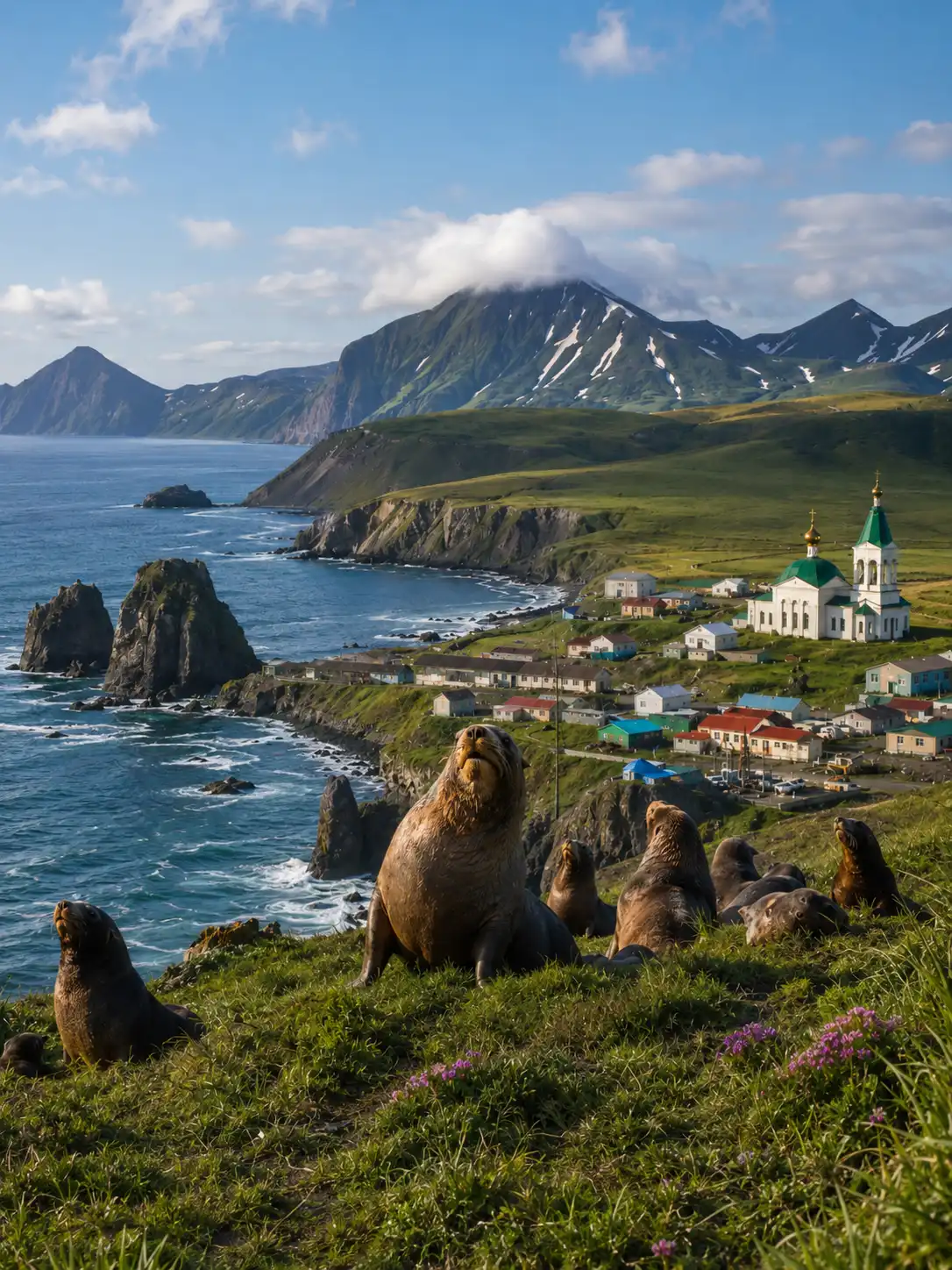
The Commander Islands are among the most remote and distinctive destinations in the Russian Far East. Rising from the waters between the Bering Sea and the North Pacific, the archipelago combines treeless mountain tundra, sea cliffs, fog-covered valleys, seabird colonies, marine mammal rookeries and the cultural heritage of Russia’s Aleut community.
Known in Russian as Командорские острова, the islands lie east of the Kamchatka Peninsula and form the western end of the Commander–Aleutian island chain stretching toward Alaska. The two principal islands are Bering Island and Medny Island. Smaller islands and offshore rocks include Toporkov Island, Ariy Kamen and several isolated formations used by seabirds and marine mammals.
Most travellers begin on Bering Island, the only permanently inhabited island in the archipelago. Its village of Nikolskoye serves as the administrative, cultural and logistical centre. From there, visitors can explore tundra routes, coastal bays, wildlife observation sites and places connected with Vitus Bering, Georg Wilhelm Steller and the Second Kamchatka Expedition.
The Commander Islands are not part of the UNESCO World Heritage property Volcanoes of Kamchatka. They are recognised separately as a UNESCO Biosphere Reserve and have also appeared on Russia’s UNESCO World Heritage Tentative List. This distinction is important because the islands have their own geological, ecological and cultural identity.
Travel requires careful planning. Flights can be delayed for several days, accommodation is limited and access to protected areas must be arranged through authorised channels. Weather, wildlife and transport conditions determine the itinerary.
This Wander Russia guide explains how to reach the Commander Islands, what to see on Bering Island, the history of Vitus Bering’s expedition, Aleut culture, wildlife, permits, accommodation, safety and the best period for visiting.
Where Are the Commander Islands?
The Commander Islands lie approximately 175 to 190 kilometres east of the Kamchatka Peninsula.
The archipelago stands near the boundary between the Bering Sea and the North Pacific Ocean. It represents the westernmost section of the Aleutian island arc, which continues eastward for more than 2,000 kilometres toward Alaska.
The islands are the exposed peaks of a large submarine mountain ridge. Their geology is significantly older than many of the active volcanic landscapes on the Kamchatka Peninsula.
The archipelago contains around 15 islands and rocks, although the exact count depends on whether very small offshore formations are included.
Bering Island is by far the largest. Medny Island lies southeast of it and is narrower, steeper and almost entirely protected from ordinary settlement and tourism.
Toporkov Island and Ariy Kamen are smaller but extremely important for nesting seabirds and marine mammals.
Bering Island
Bering Island is the main destination for most travellers.
The island extends roughly 90 kilometres from northwest to southeast. Its northern section contains lower plateaus, rolling tundra and the village of Nikolskoye. The southern section becomes more mountainous and rugged.
The highest point is Steller Peak, which rises to approximately 755 metres.
The island has no forests in the conventional sense. Vegetation consists mainly of tundra, grasses, low shrubs, wetlands and flowering meadows.
The lack of tall trees gives the landscape an open character. Hills, coastlines and approaching weather systems remain visible across long distances.
Rivers and streams cut through the tundra toward the sea. Lakes, waterfalls and marshes occupy lower areas, while cliffs dominate parts of the Pacific and Bering Sea coasts.
Travel outside Nikolskoye usually requires off-road vehicles, guides and park permission.
Medny Island
Medny Island lies southeast of Bering Island.
Its Russian name means Copper Island, although it did not become a major mining centre. The island is long, narrow and mountainous, with steep coastal cliffs and limited landing places.
A settlement called Preobrazhenskoye once existed there, but the population was later relocated to Nikolskoye. Medny is now uninhabited apart from temporary scientific and ranger activity.
The island supports major seabird colonies, Arctic foxes, sea otters, seals and Steller sea lions.
Ordinary travellers cannot simply hire a boat and walk ashore. Access is tightly controlled because of weather, difficult landings and the ecological sensitivity of the island.
Visits normally form part of scientific work, authorised park expeditions or specialised expedition cruises.
For most visitors, Medny should be understood as a protected remote island rather than a standard tourist excursion from Nikolskoye.
Nikolskoye
Nikolskoye is the only permanently inhabited settlement in the Commander Islands.
The village lies in the northwestern part of Bering Island and contains the airport, administrative offices, school, cultural institutions, basic accommodation and essential services.
Its population is small, numbering only several hundred residents. The community includes both Russian and Aleut families.
Nikolskoye is not a tourism resort. Supplies arrive by aircraft or ship, weather can interrupt deliveries and the selection of food and services remains limited.
The settlement has a distinctive atmosphere created by its isolation. Buildings stand between open tundra and the sea, while fog and strong wind frequently shape everyday life.
Travellers should arrive with realistic expectations. Accommodation is simple, internet may be unreliable and shops cannot be expected to offer the variety available in Petropavlovsk-Kamchatsky.
The village is nevertheless the cultural centre of the islands and an essential part of the travel experience.
Aleut Culture on the Commander Islands
The Aleut people, who also call themselves Unangan, are central to the history and identity of the Commander Islands.
The islands were uninhabited before the arrival of the Bering expedition in 1741. During the nineteenth century, the Russian-American Company relocated Aleut families from islands farther east, including areas that are now part of Alaska.
These communities brought knowledge of marine hunting, skin-boat construction, fishing, clothing and survival in a harsh oceanic environment.
Over generations, Aleut and Russian cultural traditions became closely connected.
Nikolskoye remains one of the principal centres of Aleut culture in Russia. Local institutions preserve language, dance, crafts, family history and knowledge connected with the sea.
Visitors should approach this culture respectfully. Aleut traditions are not staged entertainment created for tourists. They belong to a living community dealing with population decline, language loss, isolation and the challenges of maintaining cultural continuity.
When cultural programs, workshops or performances are available, they should be arranged through local organisations rather than assumed to occur on demand.
The Aleut Museum of Local History
The museum in Nikolskoye provides the best introduction to the islands before travelling into the national park.
Its exhibitions explore Aleut culture, the history of settlement, the Bering expedition, traditional marine hunting, archaeology, natural history and life in an isolated island community.
Objects may include hunting equipment, clothing, household items, photographs, models, maps and materials connected with local wildlife.
The museum also explains the relationship between residents and the surrounding ocean.
Visiting at the beginning of a stay helps travellers understand why the islands cannot be viewed only as a wildlife destination. Their modern landscape was shaped by exploration, commercial hunting, relocation, conservation and local adaptation.
Opening hours should be confirmed after arrival because small regional institutions may operate according to local staffing and seasonal conditions.
Vitus Bering and the 1741 Expedition
The islands received their name from Commander Vitus Bering.
During the Second Kamchatka Expedition, Bering commanded the packet boat Saint Peter on a voyage eastward from Kamchatka. The expedition reached the coast of North America but suffered disease, exhaustion and severe weather during the return journey.
In November 1741, the damaged Saint Peter reached an unknown island. The vessel was driven ashore, and the crew established a winter camp.
The island was later named Bering Island.
Many expedition members suffered from scurvy and other illnesses. Vitus Bering died there in December 1741, along with numerous members of the crew.
Naturalist Georg Wilhelm Steller helped survivors identify edible plants and marine resources. His observations produced some of the earliest scientific descriptions of North Pacific animals.
The survivors eventually built a smaller vessel from the remains of the Saint Peter and returned to Kamchatka in 1742.
Commander Bay
Commander Bay is one of the most important historical places on Bering Island.
The bay lies on the island’s eastern side and is associated with the wreck and winter camp of the Saint Peter expedition.
The site includes memorials connected with Vitus Bering and the crew members who died during the winter.
Reaching the bay from Nikolskoye requires a long off-road journey across tundra, rivers and rough tracks. Travel time varies greatly according to weather and surface conditions.
The historical importance of the destination makes it one of the central excursions on Bering Island.
Visitors should remember that the modern memorial landscape does not reproduce the exact conditions of 1741. The original crew survived without roads, permanent buildings or reliable outside support.
Standing near the bay nevertheless provides a powerful sense of the isolation they faced.
The Grave of Vitus Bering
Vitus Bering was buried on the island after his death.
For many years, uncertainty surrounded the exact location and identification of his remains. Archaeological work during the late twentieth century investigated several graves associated with the expedition.
Researchers examined skeletal evidence and reconstructed facial features believed to belong to Bering.
The remains were later reburied in a memorial grave at Commander Bay.
The site is modest compared with the historical importance of the explorer. Its remote position reflects the circumstances of his final expedition more effectively than a large urban monument could.
Visitors should treat the area as both a historical memorial and a burial site.
Georg Wilhelm Steller
Georg Wilhelm Steller was the expedition’s physician and naturalist.
His work on Bering Island became one of the most important early scientific records of North Pacific wildlife.
Steller described animals that were then little known to European science, including the Steller sea lion, Steller’s eider, Steller’s sea eagle and the sea otter.
He also documented the animal later known as Steller’s sea cow.
Steller’s knowledge of plants and food sources helped expedition members survive the winter. He recognised that scurvy was connected with diet and encouraged the use of local vegetation and marine resources.
Several species still carry his name, and his legacy remains visible in museums and memorials across the Commander Islands and Kamchatka.
Steller’s Sea Cow
Steller’s sea cow was a very large marine mammal related to modern dugongs and manatees.
The species lived in the shallow kelp-rich waters around the Commander Islands.
Steller described it during the winter of 1741–1742. The animals were slow-moving, lived close to shore and fed on marine vegetation.
Their size and behaviour made them easy targets.
After the expedition survivors returned to Kamchatka with reports of the islands’ wildlife, commercial hunters began visiting the region. Steller’s sea cows were killed for meat and fat.
The species was declared extinct only a few decades after its scientific discovery, commonly dated to 1768.
Its extinction became one of the earliest well-documented examples of humans rapidly eliminating a large marine mammal.
Bones and historical materials associated with the species can be seen in local collections.
The Fur Trade and Sea Otters
Sea otters played a major role in the expansion of Russian commercial activity across the North Pacific.
Their dense fur was extremely valuable, particularly in trade with China.
Reports from Bering’s survivors encouraged fur hunters to travel eastward from Kamchatka. The search for sea otters contributed to Russian exploration and colonisation across the Aleutian Islands and Alaska.
Hunting dramatically reduced sea otter populations.
The establishment of protected areas and international regulation later allowed numbers to recover in parts of the region.
Sea otters can now be observed around the Commander Islands, especially in kelp-rich coastal waters.
They should be viewed from a distance. Boats must avoid separating mothers and pups or approaching resting groups too closely.
Commander Islands National Park
The protected area surrounding the Commander Islands was originally established as a strict nature reserve in 1993.
It later received UNESCO Biosphere Reserve recognition in 2002.
The protected territory includes most of the islands and an enormous surrounding marine zone. In recent years, the conservation system has been reorganised as Commander Islands National Park.
The park protects seabird colonies, marine mammal rookeries, kelp forests, tundra, rivers and historical sites.
Its marine territory is particularly important. The productivity of the Bering Sea and North Pacific supports whales, seals, sea lions, sea otters and vast numbers of birds.
Visitors must follow park rules and use authorised routes.
A national park designation does not mean unrestricted access. Medny Island, sensitive rookeries and scientific zones can remain closed or require special permission.
UNESCO Status
The Commander Islands have more than one UNESCO-related designation, which can create confusion.
They were recognised as a UNESCO Biosphere Reserve in 2002 through the Man and the Biosphere Programme.
The islands have also been included on Russia’s UNESCO World Heritage Tentative List since 2005.
A Tentative List entry is not the same as inscription as a World Heritage Site.
The Commander Islands are therefore not currently a UNESCO World Heritage property. They should not be described as part of Volcanoes of Kamchatka.
Their biosphere-reserve status remains important because it recognises the connection between conservation, scientific research and the local population.
Marine Mammals
The islands support one of Russia’s richest concentrations of marine mammals.
Species occurring in the surrounding waters include:
- Northern fur seals
- Steller sea lions
- Harbour seals
- Largha seals
- Sea otters
- Orcas
- Humpback whales
- Sperm whales
- Fin whales
- Minke whales
- Beaked whales
- Rare North Pacific right whales
The presence of a species does not guarantee a sighting during a short visit.
Wildlife observation depends on season, weather, route and natural movement.
Some animals gather predictably at rookeries, while whales travel through large areas of open water.
Tour operators should never chase whales or approach resting seals excessively closely.
Northern Fur Seal Rookeries
Northern fur seals are among the characteristic animals of the Commander Islands.
Large seasonal rookeries form along selected coastlines, including areas on Bering Island.
Adult males arrive and establish territories, while females later give birth and gather in breeding groups.
The colonies can contain intense sound, movement and competition.
Visitors observe rookeries only from designated trails, viewing platforms or approved boat routes.
Approaching seals on foot can cause panic and force animals toward the water.
Park staff control access to protect the colonies and reduce disturbance.
A telephoto lens and binoculars are essential for responsible observation.
Steller Sea Lions
Steller sea lions also use rookeries and coastal rocks around the archipelago.
Adult males are extremely large and can appear imposing when viewed beside females and younger animals.
Their population has experienced declines in parts of the North Pacific, making monitoring particularly important.
Scientists record breeding success, mortality and movement between colonies.
Tourists should remain quiet near haul-out sites and follow the distance selected by rangers.
A sea lion entering the water because of a visitor’s approach has already been disturbed.
Sea Otters
Sea otters are frequently associated with the kelp forests around the islands.
They spend much of their lives in the water and use stones or other hard objects to open shellfish.
A thick coat rather than a heavy layer of blubber protects them from cold water.
Sea otters may rest in groups or float among kelp.
Mothers often carry pups on their bodies while swimming or feeding.
Boats should move slowly and avoid separating animals.
The survival of healthy kelp forests is closely connected with sea otter ecology because otters help control sea urchin populations that would otherwise consume large quantities of kelp.
Whales and Orcas
The waters around the Commander Islands lie along important feeding and migration routes.
Humpback whales may be seen feeding in productive coastal waters. Orcas travel through the region in family groups, while sperm and fin whales occur farther offshore.
The North Pacific right whale is among the rarest large whales on Earth and has occasionally been recorded in the region.
A standard island visit cannot guarantee whale observation.
Fog, rough seas and limited boat access may reduce viewing opportunities even during a productive season.
Longer expedition cruises generally provide more time to search for cetaceans than short coastal excursions from Nikolskoye.
Seabirds
The cliffs and offshore islands support vast seabird colonies.
Species include tufted puffins, horned puffins, murres, auklets, kittiwakes, cormorants, fulmars and guillemots.
Toporkov Island takes its name from the Russian word for tufted puffin.
Ariy Kamen is another major nesting site where birds occupy narrow ledges and rock faces.
During the breeding season, the air around colonies can be filled with thousands of birds travelling between the sea and nests.
Tourist vessels must remain at approved distances.
Landing on small nesting islands is normally prohibited because footsteps can destroy burrows and disturb breeding birds.
Arctic Foxes
The Commander Islands are home to distinctive island populations of Arctic foxes.
Unlike the white winter form commonly associated with the Arctic mainland, many island foxes have dark blue-grey or brown coats.
Bering Island and Medny Island have separate subspecies.
Foxes may approach settlements, camps or visitor sites because they have learned that people sometimes leave food.
Feeding them is prohibited and harmful. It changes their behaviour and increases the risk of conflict, disease and dependence.
Food waste must be secured, and visitors should not encourage foxes for photographs.
How to Reach the Commander Islands
Most travellers reach Bering Island by air from the Petropavlovsk-Kamchatsky or Yelizovo area.
Flights land at the airfield near Nikolskoye.
Schedules are limited and highly vulnerable to fog, wind and cloud.
A flight may be delayed for several hours or postponed for multiple days. Travellers must build substantial flexibility into the itinerary.
Sea transport is another possibility, but it is not a simple regular tourist ferry service. Cargo or passenger voyages depend on seasonal schedules, vessel availability and weather.
Expedition cruise ships occasionally include the Commander Islands as part of longer Russian Far East itineraries.
Travellers should not purchase tightly connected onward flights immediately after a planned return from Nikolskoye.
Flights and Weather Delays
The island climate is notoriously foggy.
Aircraft require suitable visibility at both the departure and arrival points. Strong wind can also prevent landing.
Delays are a normal logistical feature rather than an exceptional failure.
Accommodation and transport plans should therefore allow for additional nights in both Nikolskoye and Petropavlovsk-Kamchatsky.
Essential medication should be carried in quantities sufficient for unexpected delays.
Travellers should also keep extra funds and food flexibility.
A rigid itinerary with no reserve days is unsuitable for the Commander Islands.
Permits
Foreign visitors must confirm current entry and protected-area requirements well in advance.
The Commander Islands form part of a sensitive border and maritime region. Additional permissions may apply depending on nationality, route and planned activities.
The national park also regulates access to protected zones, rookeries, islands and historical sites.
A tour operator or inviting organisation normally assists with the necessary documentation.
Applications should begin several months before travel.
Permission to enter Nikolskoye does not automatically allow unrestricted travel across Bering Island or access to Medny Island.
Accommodation
Accommodation in Nikolskoye is limited.
Visitors may stay in a small guesthouse, park facility, local homestay or expedition accommodation arranged by a tour operator.
Rooms are normally simple and may use shared bathrooms.
Heating is important even during summer because temperatures remain cool.
Food may be included as part of a full-board program. This is often more practical than relying entirely on local shops.
Travellers should confirm:
- Whether meals are included
- Bathroom arrangements
- Bedding and towels
- Electricity availability
- Internet access
- Transfer from the airfield
- What happens during flight delays
Luxury accommodation should not be expected.
Food and Supplies
Local cuisine is closely connected with the sea.
Fish, salmon roe, crab and other seafood may be available depending on season, regulation and supply.
Traditional Aleut food culture also includes marine products and dishes developed for an isolated environment.
Shops in Nikolskoye carry basic goods, but choice can be limited and deliveries may be interrupted.
Travellers with allergies, medical diets or vegetarian requirements should notify their host in advance.
Specialist snacks, medication and personal products should be brought from Petropavlovsk-Kamchatsky.
The islands are not a place where forgotten equipment can easily be replaced.
Best Time to Visit
The main tourism season generally extends from June through September.
June brings active seabird colonies, cool weather and remaining snow in higher areas.
July and August provide the mildest conditions, long daylight and the widest range of local excursions.
August can be especially attractive for marine wildlife, although fog remains common.
September brings autumn colours, stronger storms and increasingly difficult transport.
Even in midsummer, temperatures are cool and rain is frequent.
Winter travel is possible only through specialised arrangements and presents far more difficult transport and weather conditions.
For a first journey, July or August is usually the most practical choice.
Climate and Weather
The islands have a cool maritime climate.
Fog, wind and precipitation occur frequently. Summers are mild rather than warm, while winters are moderated by the surrounding ocean but remain stormy.
The weather can change several times within one day.
A clear morning may become foggy before an excursion reaches the coast.
Strong wind is a constant consideration on open tundra and cliffs.
Visitors should not rely only on temperature forecasts. Wind chill and wet clothing make conditions feel much colder.
What to Wear and Bring
Recommended equipment includes:
- Waterproof hiking boots
- A waterproof jacket and trousers
- Warm insulating layers
- Thermal underwear
- A warm hat and gloves
- Quick-drying clothing
- Binoculars
- A telephoto lens
- Waterproof camera protection
- Personal medication
- A small first-aid kit
- Insect repellent
- Sun protection
- A headlamp
- Spare batteries or power banks
- Dry bags
- Snacks for delays
- Motion-sickness medication for boat travel
Cotton clothing is less suitable because it dries slowly.
Off-Road Excursions
Most land excursions use off-road vehicles.
Tracks cross tundra, streams, mud and rocky terrain. Some routes may be passable one week and flooded the next.
A typical excursion can involve several hours inside a vehicle followed by walking near bays, cliffs or wildlife sites.
Passengers should expect a rough ride.
Seat belts should be used where available, and equipment must be secured.
Independent driving is not realistic for most visitors because rental vehicles, fuel, route knowledge and recovery services are extremely limited.
Boat Excursions
Boat travel provides access to coastal wildlife and offshore islands.
Conditions can become rough quickly. Fog may reduce visibility, while strong swell can force the captain to return early.
Life jackets and appropriate safety equipment are essential.
Visitors should wear waterproof outer clothing and warm layers even on sunny days.
Sea-sickness medication should be taken before departure when medically appropriate.
A planned route to Toporkov Island, Ariy Kamen or Medny may be changed because of wind, nesting restrictions or marine conditions.
Responsible Wildlife Watching
Wildlife must always determine the distance of an encounter.
Visitors should not approach rookeries, block animals moving between land and water or use food to attract foxes and birds.
Noise should be kept low near colonies.
Drones can cause severe disturbance and require explicit permission.
No bones, eggs, feathers, stones or historical objects should be removed.
The park’s value depends on maintaining natural behaviour.
A close photograph obtained by disturbing an animal is not a successful wildlife encounter.
Is the Journey Worth It?
The Commander Islands are worth visiting for travellers who value isolation, wildlife, maritime history and cultural context.
The destination requires time, patience and acceptance of uncertainty.
Flights may not operate, fog may hide the coast and a planned boat trip may be cancelled.
Infrastructure is basic and the journey is difficult compared with attractions near Petropavlovsk-Kamchatsky.
In return, visitors experience one of Russia’s most unusual island landscapes.
Few places combine Aleut culture, the history of Vitus Bering, sea otters, fur-seal rookeries, puffin colonies and a vast protected ocean within one journey.
Wander Russia recommends planning at least five to seven days, including reserve time for weather delays. A shorter schedule creates a high risk of spending most of the visit waiting for transport.
Frequently Asked Questions
Where are the Commander Islands?
They lie east of the Kamchatka Peninsula between the Bering Sea and North Pacific Ocean.
Which island can tourists visit?
Most visitors travel to Bering Island and stay in Nikolskoye. Access to Medny Island is highly restricted.
How do travellers get there?
The usual method is a regional flight from the Petropavlovsk-Kamchatsky or Yelizovo area to Nikolskoye.
Are flights reliable?
Weather delays are common because of fog and wind. Several reserve days are essential.
Are the islands part of UNESCO World Heritage?
No. They are a UNESCO Biosphere Reserve and are included on Russia’s World Heritage Tentative List, but they are not currently inscribed as a World Heritage Site.
Can visitors see whales?
Whales and orcas occur in the region, but sightings are not guaranteed.
Are there hotels?
Accommodation is limited to simple guesthouses, local facilities and arrangements provided by tour operators.
When is the best time to visit?
July and August usually offer the most practical combination of access, wildlife and daylight.
Are permits required?
Protected-area and regional permissions may be required, especially for foreign visitors and remote routes.
How many days are needed?
At least five to seven days are advisable, including flexibility for flight and boat delays.
Conclusion
The Commander Islands represent one of the most remote extensions of Kamchatka travel.
Their landscape differs from the volcanoes and forests of the mainland peninsula. Treeless tundra, low mountains, sea cliffs and open ocean shape the islands instead.
Bering Island carries the history of one of the most significant expeditions in the North Pacific. Vitus Bering died there, Georg Wilhelm Steller documented its wildlife and the survivors of the Saint Peter built a new vessel from the wreck in order to return to Kamchatka.
The discovery also began a period of intense commercial hunting. Sea otters, fur seals and Steller’s sea cow became resources in a rapidly expanding fur economy. The extinction of the sea cow remains one of the clearest warnings about the vulnerability of isolated island species.
Modern protection has changed the purpose of travel to the islands. Scientists monitor whales, seals, sea lions, foxes, seabirds and marine pollution. Park staff protect rookeries, while local residents preserve Aleut culture and knowledge.
Tourism must remain limited and carefully managed.
Visitors cannot expect unrestricted access, guaranteed wildlife or reliable transport. Fog and wind control flights, rough seas control boat routes and nesting animals determine how closely people may approach.
These limitations are not obstacles separate from the experience. They are part of life on the Commander Islands.
A journey here requires patience. Travellers may spend hours crossing tundra, wait days for an aircraft or see only a brief opening in the fog around a distant cliff.
When conditions align, the reward is exceptional. Sea otters float among kelp, fur seals fill coastal rookeries, puffins cross the sky and the open Pacific surrounds an island community shaped by centuries of exploration, hunting, adaptation and conservation.
The Commander Islands are not an easy final stop on a Kamchatka itinerary. They are an expedition destination in their own right and one of the clearest places for understanding the connection between Russia, Alaska, Aleut culture and the wildlife of the North Pacific.
