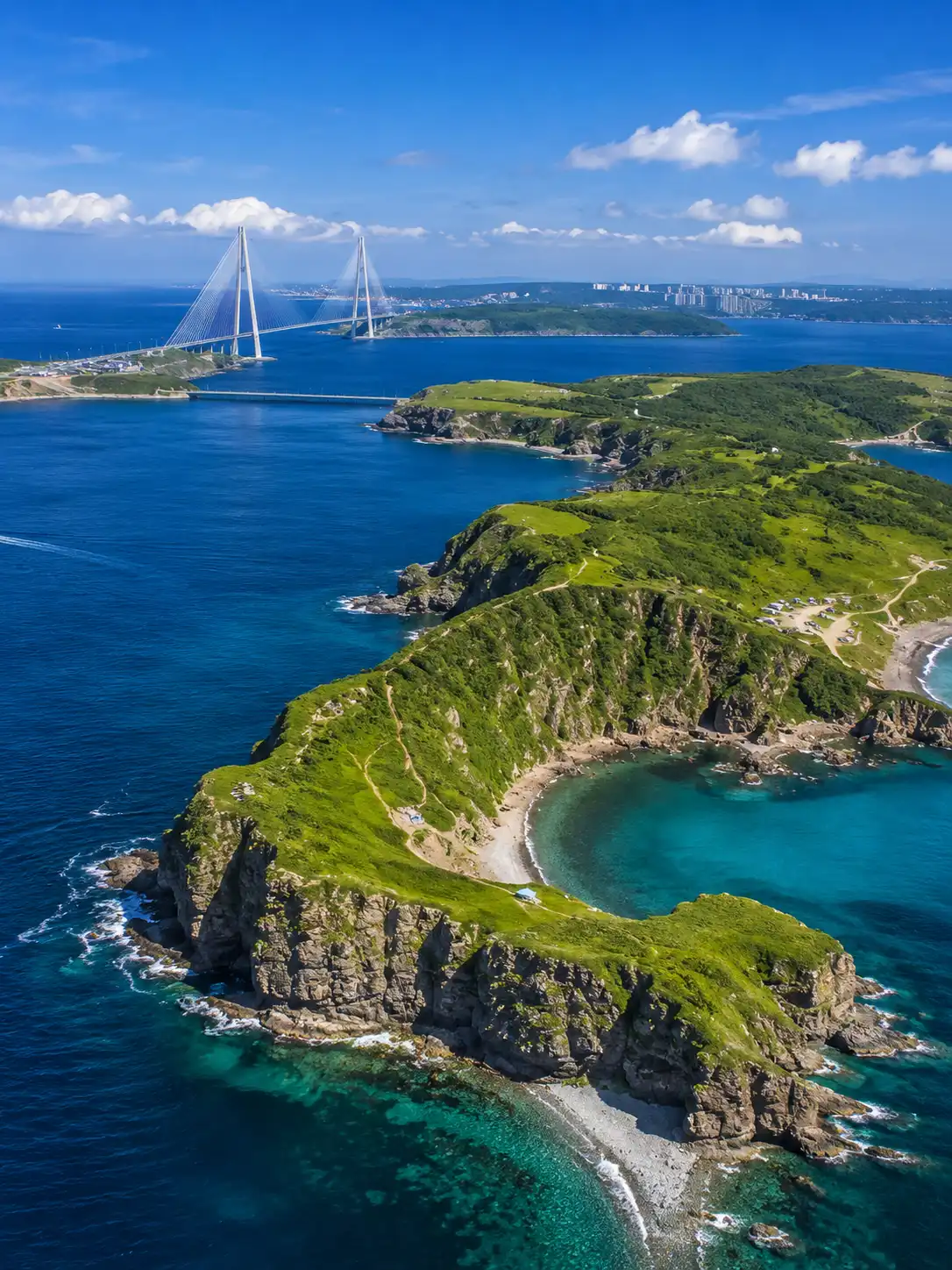
Russky Island is one of the most important destinations in Vladivostok and one of the most varied places to explore in the Russian Far East. Located south of the city centre and connected to the mainland by the record-breaking Russky Bridge, the island combines dramatic coastal scenery, military history, modern university architecture, beaches, hiking trails, abandoned fortifications and the Primorsky Aquarium.
Known in Russian as Остров Русский, the island lies in Peter the Great Gulf and forms part of the wider Vladivostok urban area. It measures roughly 18 kilometres from north to south and approximately 13 kilometres across at its widest point. Although the modern bridge makes the island easy to reach, its attractions remain widely separated, and a full visit requires careful planning.
Russky Island is not a single compact attraction. The northern side contains the Far Eastern Federal University campus, Ajax Bay and the Primorsky Aquarium. Farther south and east, the island becomes wilder, with rocky capes, forest tracks, beaches and military remains. Cape Tobizina is the best-known hiking destination, while Cape Vyatlin provides another dramatic coastal landscape.
For Wander Russia, Russky Island represents the point where modern Vladivostok meets the open maritime environment of Primorye. The bridge, university and aquarium reflect the city’s recent development, while cliffs, forts and isolated bays preserve a much older relationship with military defence and the Sea of Japan.
Where Is Russky Island?
Russky Island lies immediately south of mainland Vladivostok, separated from the Muravyov-Amursky Peninsula by the Eastern Bosphorus Strait.
The island forms part of Peter the Great Gulf, which contains numerous bays, islands and peninsulas along the southern coast of Primorsky Krai. Its position near the entrance to Vladivostok gave it major strategic importance because artillery batteries placed here could help control maritime approaches to the city.
The Russky Bridge connects the northern section of the island with mainland Vladivostok. Before the bridge opened in 2012, regular access depended heavily on ferries and other marine transport. The new road connection transformed the island into a realistic day-trip destination and supported the development of the Far Eastern Federal University campus.
The modern road network serves the university, aquarium and several developed areas. Remote capes and beaches may still require taxis, organised tours or high-clearance vehicles.
Distances should not be underestimated. A map may make the island appear compact, but winding roads, unfinished tracks and dispersed attractions can turn short-looking journeys into long transfers.
Why Russky Island Is Worth Visiting
Russky Island combines several different types of experience within one destination.
Visitors can cross one of the world’s most impressive cable-stayed bridges, walk through a modern seaside university campus, visit Russia’s largest public aquarium, hike to remote cliffs, swim or relax on seasonal beaches and explore military remains connected with the Vladivostok Fortress.
The island also offers a different perspective of the city. Central Vladivostok feels dense, vertical and urban. Russky Island feels more open, with forests, sea views and long stretches of less developed coastline.
This contrast is one of the main reasons to include the island in a Vladivostok itinerary.
A traveller interested mainly in architecture may focus on the bridge and university. Families often prioritise the aquarium. Hikers head toward Cape Tobizina, while visitors interested in military history explore the batteries and forts.
The island works best when one or two themes are selected rather than attempting to see everything in one rushed day.
The Russky Bridge
The Russky Bridge is the island’s gateway and one of Vladivostok’s defining landmarks.
Its 1,104-metre main span established a world record for cable-stayed bridges when it opened in 2012. The bridge crosses the Eastern Bosphorus and connects the mainland with the northern coast of Russky Island.
The crossing is brief by car or bus, but the scale of the structure becomes apparent as vehicles pass between its immense pylons and long cable fans.
Pedestrian access is normally prohibited, so visitors experience the bridge from a moving vehicle, nearby viewpoints or boat excursions.
The bridge changed the practical role of the island. What had previously been more isolated became connected directly with the city’s road system, university life and tourism infrastructure.
For first-time visitors, the crossing creates a strong transition from urban Vladivostok to the broader coastal landscape of the island.
Far Eastern Federal University Campus
The Far Eastern Federal University campus occupies a large area around Ajax Bay in the northern part of Russky Island.
The modern campus was developed in connection with the 2012 APEC summit and later became the university’s principal base. Its official address is at Ajax Bay on Russky Island.
The complex includes academic buildings, student accommodation, landscaped grounds, sports infrastructure and a long seafront setting.
The campus is not a conventional tourist attraction, and access to buildings or controlled sections may be restricted. Visitors should respect signs, security procedures and the daily life of students.
The surrounding bay and modern architecture are nevertheless important parts of the island’s identity. They show how Russky Island has moved from a heavily militarised territory toward a centre of education, science and international events.
Public access conditions can change during conferences, major forums or security-controlled events. Current information should be checked before planning a detailed campus visit.
Primorsky Aquarium
The Primorsky Aquarium is one of the island’s major attractions and one of the most significant scientific and educational facilities of its kind in Russia.
The aquarium presents almost 500 species of marine and freshwater life and houses nearly 10,000 animals across its exhibitions and research programmes. Its collection represents different oceans and climatic zones.
The building stands on the coast and has a distinctive shell-like design. Inside, visitors encounter large tanks, tropical environments, freshwater species, marine mammals, jellyfish and displays explaining aquatic ecosystems.
The aquarium is suitable for families, but adults interested in marine biology and the Pacific environment can also spend several hours there.
The official schedule for 2026 lists the grounds as open Tuesday through Sunday, with the main building generally open from 10:00 to 20:00. Demonstration times and closed days can vary by month, so tickets and the current programme should be checked shortly before arrival.
At least three hours should be reserved for the aquarium. A slower visit, including the grounds and marine mammal programme, can occupy half a day.
Cape Tobizina
Cape Tobizina is the best-known natural destination on Russky Island.
The route leads through forest, open grassland and increasingly dramatic coastal terrain before reaching cliffs above the sea. The full walk commonly takes around three hours, depending on starting point, pace and weather.
The landscape is defined by rocky headlands, blue water, steep drops and wind-shaped vegetation.
Foxes are often seen along the route and may approach visitors because they have become accustomed to people. They should not be fed. Feeding changes natural behaviour, encourages dependence and can increase conflict.
The main danger is the cliff edge. There are unprotected drops, fractured rock and surfaces that become slippery during rain, fog or freezing weather.
Visitors should remain well back from the edge and avoid climbing onto isolated rock formations for photographs.
Cape Tobizina is best visited with suitable footwear, water and enough time to return before darkness.
Cape Vyatlin
Cape Vyatlin lies on the southeastern part of Russky Island and provides a quieter alternative to Cape Tobizina.
The area contains open hills, rocky shoreline, coves and broad views across Peter the Great Gulf.
It generally receives fewer visitors than Tobizina, partly because access can be more difficult and the road may be rough.
Cape Vyatlin suits travellers looking for coastal photography, walking and a less crowded landscape.
There is less formal infrastructure, so visitors should bring water, food, warm clothing and reliable navigation.
Mobile reception can be inconsistent. Drivers should avoid entering remote tracks without understanding current road conditions.
The capes should not automatically be combined in one day unless transport is organised efficiently. Their locations and approach routes can make such an itinerary more tiring than expected.
Vladivostok Fortress on Russky Island
Russky Island contains numerous fortifications connected with the larger Vladivostok Fortress system.
The fortress was not a single castle but a network of forts, coastal batteries, tunnels and defensive positions created to protect the strategic harbour. Construction took place mainly between the late nineteenth century and the early twentieth century. The modern museum-reserve works to preserve and interpret this complex heritage.
Russky Island’s position made it particularly important for coastal artillery. Batteries could monitor and defend approaches through Peter the Great Gulf and the Eastern Bosphorus.
Some structures are accessible through organised excursions. Others remain abandoned, unstable or restricted.
Visitors should not enter unknown tunnels, underground chambers or ruins independently. Hazards include collapsed ceilings, deep shafts, darkness, rusted metal and unexploded military material.
The safest approach is to join a specialist fortress tour or visit sites officially maintained by the museum-reserve.
Voroshilov Battery
The Voroshilov Battery is one of the most famous military structures on Russky Island.
Built during the Soviet period, it was designed as a powerful coastal artillery installation. Its large gun turrets and underground spaces demonstrate the strategic importance of the island during the twentieth century.
The battery is often included in military-history tours and can provide a stronger impression than isolated ruins because the scale of the installation remains visible.
Access arrangements can change, and guided interpretation is highly valuable. Without historical context, the underground rooms and mechanical systems are difficult to understand.
Visitors should confirm whether the battery is open, whether tickets are required and whether photography is permitted in every section.
Beaches and Bays
Russky Island contains numerous beaches and sheltered bays.
Ajax Bay, Novik Bay and other coastal areas provide opportunities for walking, picnics, kayaking and seasonal swimming.
Beach quality varies. Some places have developed recreation areas, while others remain largely natural.
The water is cold for much of the year, and even in summer conditions can change quickly.
Remote beaches may lack lifeguards, toilets, cafés or mobile reception.
Visitors should also check local information regarding water quality, jellyfish, wind and strong currents before swimming.
The beaches become especially popular in July and August, when residents of Vladivostok travel to the coast during warm weather.
Novik Bay
Novik Bay cuts deeply into Russky Island and creates one of its most recognisable internal maritime landscapes.
The long sheltered inlet differs from the exposed capes facing the open gulf. Its calmer water supports boating, recreation and shoreline development.
Several roads and settlements are arranged around the bay.
The area is useful for travellers who want coastal scenery without a long cliff hike.
Some recreation centres and seasonal services operate around the bay, although availability changes throughout the year.
The calm appearance should not remove normal water-safety precautions. Weather and wind can still change quickly.
Hiking on Russky Island
Russky Island is well suited to hiking, but routes vary greatly in difficulty and infrastructure.
Cape Tobizina is the most established independent hiking destination. Other routes lead toward capes, beaches and fortifications but may be less clearly marked.
Useful equipment includes:
- Supportive hiking shoes
- A windproof jacket
- Drinking water
- Sun protection
- Insect repellent
- Offline maps
- A charged phone and power bank
- A small first-aid kit
- Food and snacks
- A headlamp for unexpected delays
Fog can reduce visibility along coastal ridges.
Visitors should tell someone where they are going when entering remote areas.
Weather and Fog
Russky Island has a strongly maritime climate.
Summer brings green landscapes and the best conditions for beaches and walking, but fog and humidity are common.
Autumn often provides clearer air, cooler temperatures and attractive colours.
Winter transforms the island into a snow-covered coastal landscape. Roads, stairs and trails can become icy.
Spring is often windy, muddy and changeable.
The coast may be much colder than central Vladivostok, even on the same day.
Layered clothing is therefore essential.
Best Time to Visit
The most practical season extends from June through October.
July and August are best for beaches, long daylight and full visitor services.
September is especially attractive for hiking because the air may be clearer and temperatures are cooler.
October offers autumn colour but shorter daylight and a greater risk of cold wind.
Winter visits can be atmospheric but require careful driving and appropriate clothing.
The aquarium remains a year-round attraction, making Russky Island worthwhile even when outdoor conditions are poor.
How to Reach Russky Island
The island can be reached by car, taxi, organised tour or public bus across the Russky Bridge.
Public transport connects Vladivostok with the university and developed northern sections of the island.
For the aquarium, a bus or taxi is practical.
For Cape Tobizina, Cape Vyatlin and remote military sites, a taxi, private vehicle or organised excursion is usually more convenient.
Drivers should confirm road quality before entering remote routes. Some tracks become muddy or damaged after rain.
Rental-car agreements may restrict travel on unpaved roads.
Getting Around the Island
Russky Island is too large to explore effectively on foot alone.
The northern area has better roads and public transport. Remote sections become less accessible.
Taxis can be arranged, but return transport should be confirmed in advance. Mobile coverage may be unreliable at remote capes.
Organised tours provide the simplest solution for travellers who want to combine several attractions.
A realistic full-day itinerary should normally include no more than two or three major stops.
Suggested One-Day Itinerary
Begin with a morning crossing of the Russky Bridge.
Continue to the Primorsky Aquarium and spend approximately three hours there.
After lunch, choose one outdoor destination.
Cape Tobizina is the strongest option for hiking and dramatic cliffs.
Travellers interested in history can replace the hike with the Voroshilov Battery or another official fortress site.
Finish with a coastal viewpoint or a short walk around Ajax Bay before returning across the bridge.
Trying to include the aquarium, Cape Tobizina, Cape Vyatlin and multiple forts in one day is usually unrealistic.
Two-Day Itinerary
A two-day visit provides a much better balance.
The first day can focus on the university area, Primorsky Aquarium and Ajax Bay.
The second day can concentrate on Cape Tobizina, Cape Vyatlin or military history.
An overnight stay on the island may be possible through selected hotels, recreation centres or accommodation connected with organised programmes.
Availability and access conditions should be checked in advance, especially during major forums or university events.
Wildlife
Foxes are among the most visible animals around Cape Tobizina.
Birds, small mammals and marine life also occur around the coastline.
Visitors may occasionally see seals or other marine animals offshore, but sightings are not guaranteed.
Wildlife should never be fed.
Food waste must be removed because it attracts animals and changes their behaviour.
Dogs should be controlled near cliffs, wildlife and other visitors.
Safety
The main risks are cliffs, rough roads, sudden fog, cold water and abandoned military structures.
Visitors should remain behind safe distances from cliff edges.
Swimming should occur only in suitable weather and at appropriate beaches.
Military tunnels should be entered only through authorised tours.
Remote trails should not be attempted late in the day without navigation and lighting.
Strong wind can make exposed capes dangerous even when the sky is clear.
Photography Tips
The island offers excellent landscape photography.
Cape Tobizina works best with wide-angle lenses that include cliffs, sea and open sky.
The Russky Bridge is easier to photograph with a telephoto lens from coastal viewpoints.
The university campus provides modern architecture and symmetrical waterfront compositions.
Military structures benefit from softer light and guided access.
Fog can create dramatic images, but it also reduces navigation safety.
Drone use requires explicit permission because the island contains strategic infrastructure, university facilities, shipping routes and protected or restricted zones.
Is Russky Island Worth Visiting?
Russky Island is essential for travellers who want to understand Vladivostok beyond the historic centre.
The island combines the city’s modern ambitions with its military past and maritime geography.
The Russky Bridge and university represent recent development. The forts reveal strategic history. The aquarium introduces the marine environment, while the capes and beaches show the natural landscape of Peter the Great Gulf.
Its only real challenge is scale. Attractions are dispersed, transport must be planned and weather can change quickly.
Wander Russia recommends allowing at least one full day. Two days are better for travellers interested in both nature and history.
Frequently Asked Questions
How far is Russky Island from central Vladivostok?
The northern island is connected directly to the city by Russky Bridge. Travel time depends on traffic and the final destination.
Can the island be reached by public transport?
Yes. Buses connect the mainland with the university, aquarium and other developed areas.
Is one day enough?
One day is enough for the aquarium and one additional attraction. A deeper visit requires two days.
What is the best attraction?
Cape Tobizina is the strongest natural attraction, while the Primorsky Aquarium is the main family and educational destination.
Can visitors walk across Russky Bridge?
No. Ordinary pedestrian access is prohibited.
Are the forts safe to explore independently?
No. Many structures are unstable or restricted. Guided visits are safer.
Can visitors swim?
Swimming is possible at selected beaches during suitable summer conditions, but water temperature and safety vary.
When is the best season?
July through September generally provides the best combination of access, hiking and coastal conditions.
Are foxes dangerous?
Foxes usually avoid conflict, but they should not be fed or approached.
Is Russky Island part of Vladivostok?
Yes. It forms part of the Vladivostok urban district.
Conclusion
Russky Island is one of the most complete destinations in Vladivostok.
It brings together engineering, nature, education, military history and the maritime environment of the Russian Far East.
The Russky Bridge provides the modern entrance. The Far Eastern Federal University campus reflects the island’s transformation into an academic and international centre. The Primorsky Aquarium explains the marine ecosystems surrounding Primorye.
Beyond the developed north, the island becomes increasingly wild.
Cape Tobizina reveals dramatic cliffs and open sea. Cape Vyatlin offers quieter coastal scenery. Beaches and bays provide seasonal recreation, while forts and batteries preserve the strategic history of Vladivostok.
The island cannot be understood through a quick crossing alone.
Its attractions are spread across a large territory, and each section presents a different character. A rushed itinerary may include many names but little real experience.
A stronger approach is to choose one cultural attraction and one outdoor destination.
Weather should also guide the day. Fog may hide the capes but make the aquarium an ideal alternative. A clear autumn morning may be better spent hiking than indoors.
Russky Island represents the broader identity of Vladivostok: a city looking toward the Pacific, shaped by defence, sea routes, science and difficult coastal geography.
For Wander Russia, it is not simply an island beside the city. It is one of the most important places for understanding how Vladivostok connects its past with its future.
