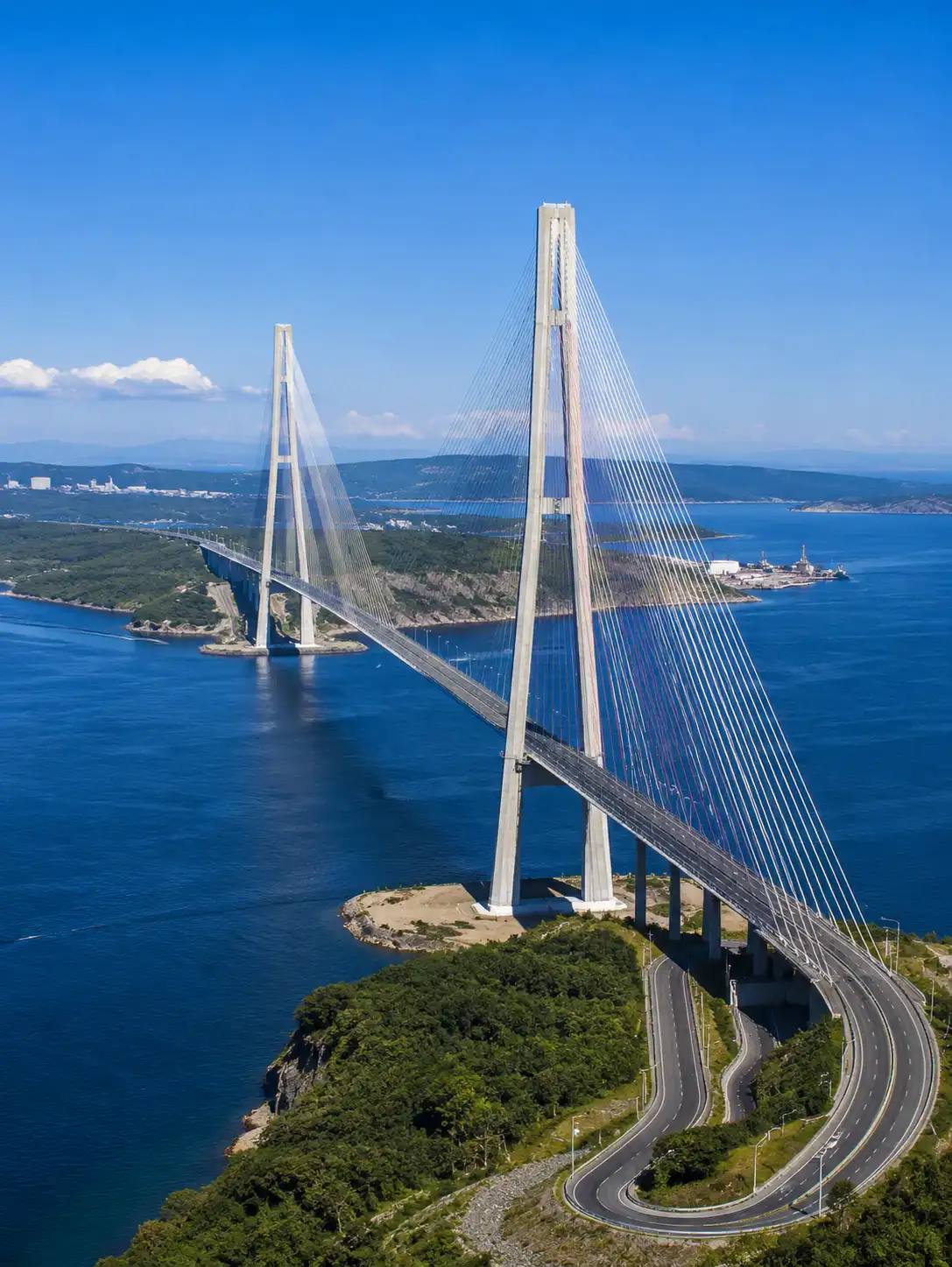
Russky Bridge is one of the most recognisable landmarks in Vladivostok and one of the most important modern engineering projects in the Russian Far East. Crossing the Eastern Bosphorus Strait, the bridge connects the mainland section of Vladivostok with Russky Island, transforming a journey that once depended heavily on ferries into a direct road connection.
Known in Russian as Russky Most, or Русский мост, the bridge was completed in 2012 as part of the major infrastructure programme connected with the Asia-Pacific Economic Cooperation summit held on Russky Island. Its immense pylons, fan-shaped cables and long central span have since become central elements of Vladivostok’s maritime skyline.
The bridge is not designed as a conventional pedestrian attraction. Visitors normally experience it by car, taxi or bus, from coastal viewpoints, or during a boat excursion through the Eastern Bosphorus. Stopping on the roadway or attempting to walk across it is not permitted under normal conditions.
For travellers heading toward the Primorsky Aquarium, Cape Tobizina, Cape Vyatlin, the Far Eastern Federal University campus or the southern coastline of Russky Island, crossing the bridge becomes part of the journey. Its scale is best understood not from a single photograph but by seeing it from several perspectives: from the mainland, from Russky Island, from the water and from a moving vehicle.
This complete Wander Russia guide explains the history, construction, dimensions, engineering importance, viewpoints, transport options, photography opportunities and practical details visitors should know before seeing Russky Bridge.
Where Is Russky Bridge?
Russky Bridge crosses the Eastern Bosphorus Strait between the Nazimov Peninsula on the mainland side of Vladivostok and Cape Novosilsky on Russky Island.
The strait connects parts of the Peter the Great Gulf and separates Russky Island from the Muravyov-Amursky Peninsula, where central Vladivostok is located.
Before the bridge opened, Russky Island could be reached mainly by ferry or other marine transport. Weather, sea conditions and limited capacity could complicate travel, especially when large numbers of passengers needed to reach the island.
The bridge created a continuous road connection between the city and the island. This made the island more accessible for residents, students, university employees, tourists and public services.
It also strengthened the connection between central Vladivostok and the Far Eastern Federal University campus, which was developed on Russky Island for the 2012 APEC summit.
Why Was Russky Bridge Built?
The bridge was built primarily to improve transport between mainland Vladivostok and Russky Island.
The immediate political and logistical reason was the 2012 APEC summit. Large conference facilities, roads and the new university campus were developed on the island, creating the need for a reliable high-capacity connection.
The bridge formed part of a wider transformation that also included the Golden Bridge across Golden Horn Bay, road improvements and upgrades to transport infrastructure across Vladivostok.
Before construction, dependence on ferries limited the island’s development. Regular movement of large groups, goods and services was difficult to organise efficiently.
The new crossing allowed traffic to reach the island directly in almost all ordinary conditions. It also opened Russky Island to far more day visitors, making natural attractions such as Cape Tobizina significantly easier to reach.
The project was therefore both a summit-related investment and a long-term attempt to integrate Russky Island more closely into Vladivostok.
Construction and Opening
Construction began in 2008 and continued through one of the most demanding engineering periods in the modern history of the city.
The builders had to work above deep water, in strong coastal winds and through large seasonal temperature differences. The region is also affected by sea ice, storms and seismic conditions.
The two sides of the central span were gradually extended from the enormous pylons until they met above the Eastern Bosphorus.
The bridge was completed in 2012 and opened to traffic shortly before the APEC summit. It was officially given the name Russky Bridge in September 2012.
Its opening was celebrated as one of the largest infrastructure achievements in the Russian Far East.
The bridge immediately became one of the central symbols used to represent modern Vladivostok internationally.
A Record-Breaking Central Span
The most important engineering feature is the 1,104-metre central span.
At the time of completion, it established a world record for the longest main span of any cable-stayed bridge. The design pushed cable-stayed construction beyond the limits reached by earlier projects.
A cable-stayed bridge supports its deck using cables that run directly from the roadway to tall pylons.
This differs from a suspension bridge, where the deck hangs from vertical cables connected to large main cables draped between towers.
Russky Bridge uses two immense A-shaped pylons and 168 stay cables. The longest stays approach 580 metres.
The cables create the bridge’s characteristic visual pattern. From some angles, they appear as parallel lines. From others, they form dense fans crossing the sky and water.
The central span needed to remain free of intermediate supports so that ships could continue passing through the strait.
Main Dimensions
The overall bridge crossing, including approach structures, extends for approximately 3.1 kilometres.
The bridge structure itself is commonly measured at around 1.9 kilometres, while the full length includes long viaducts connecting it with the road network on both sides.
The central span is 1,104 metres long.
The pylons rise to approximately 320–324 metres, depending on the exact point used for measurement.
The navigation clearance beneath the central span is approximately 70 metres, allowing large vessels to pass below.
The roadway carries four traffic lanes, with two lanes in each direction.
These dimensions make the bridge appear impressive even from a great distance. From directly beneath it, the pylons and cables are difficult to comprehend within a single field of vision.
Engineering for Wind and Extreme Weather
The Eastern Bosphorus is exposed to strong wind, storms, salt water and winter ice.
Long stay cables can begin to vibrate under certain combinations of wind and rain. For a bridge of this scale, controlling cable movement was an important part of the engineering design.
Special compact cable systems and damping technology were developed to reduce aerodynamic effects and improve stability.
The materials also needed protection from salt, moisture and severe temperature changes.
The bridge experiences hot summers, freezing winters and rapid weather transitions. Fog can cover the pylons, while winter storms can produce ice on cables and road surfaces.
Monitoring and maintenance are therefore continuous rather than occasional tasks.
Crossing Russky Bridge
The easiest way to experience the bridge is by car, taxi or public bus.
The crossing itself is relatively brief, but the approach allows passengers to watch the pylons grow rapidly in scale.
As the vehicle enters the cable-supported section, lines of steel rise diagonally on both sides of the roadway. The sea becomes visible beyond the barriers, with Russky Island on one side and the mainland coastline on the other.
Passengers should prepare their cameras before reaching the bridge because the strongest views appear quickly.
Drivers must not stop or slow unpredictably for photographs.
The roadway is an active transport route, not an observation deck.
Weather may affect the experience. Clear conditions reveal surrounding islands and vessels, while fog can hide the upper sections of the pylons.
Can Visitors Walk Across Russky Bridge?
Pedestrian access is normally prohibited.
The bridge was designed for vehicle traffic, and there is no ordinary public pedestrian promenade.
Strong winds, the exposed roadway and fast-moving vehicles make informal walking unsafe.
Visitors should not attempt to enter restricted maintenance areas or walk along the roadside.
Special organised events may occasionally allow controlled pedestrian access. The Vladivostok Bridges Marathon, for example, has used the bridge under temporary traffic-management arrangements.
Such events are exceptions and require formal registration.
Outside organised conditions, the bridge should be viewed from approved locations or crossed by vehicle.
Reaching Russky Island by Bus
Public buses connect mainland Vladivostok with Russky Island.
Routes can serve the Far Eastern Federal University campus, Primorsky Aquarium and other island destinations.
Bus numbers and schedules may change, so current local transport information should be checked before departure.
For visitors without a car, a bus is generally the most affordable way to cross the bridge and reach the developed northern part of the island.
Travelling farther toward Cape Tobizina, Cape Vyatlin or remote beaches usually requires a taxi, tour or additional local transport.
The island is much larger than it appears from the bridge, and attractions can be widely separated.
Far Eastern Federal University
One of the most visible destinations after crossing the bridge is the Far Eastern Federal University campus.
The large waterfront complex was originally developed in connection with the 2012 APEC summit and later became the university’s principal campus.
Its buildings, promenade and landscaped grounds occupy a substantial area on Ajax Bay.
The campus helped create a permanent reason for large numbers of people to cross the bridge daily.
Visitors should remember that the university remains a functioning educational institution. Access to individual buildings or controlled areas may be restricted.
The surrounding roads also provide useful perspectives of the bridge and coastal landscape.
Best Views from Russky Island
Several coastal and elevated locations on Russky Island provide views of the bridge.
The exact quality of each viewpoint depends on road access, vegetation and current development.
The northern coastline near the bridge offers the closest perspectives of the pylons and approach structures.
Roadside clearings may provide views across the Eastern Bosphorus toward mainland Vladivostok.
Higher ground farther inland can reveal the bridge as part of a wider panorama containing bays, hills and ships.
Visitors should avoid stopping in dangerous traffic areas. A visually attractive roadside location is not automatically a legal or safe parking place.
Guided tours often know the most reliable current viewpoints and can avoid restricted or unstable ground.
Views from the Mainland
The mainland side also contains several places from which the bridge can be seen.
The Tokarevsky Lighthouse area offers a distant but recognisable composition, especially when ships and the lighthouse are included in the foreground.
Coastal viewpoints on the Egersheld Peninsula can also reveal the bridge across open water.
Higher urban hills may provide partial views, although buildings and terrain often obstruct the lower structure.
The bridge is not as central to the Eagle’s Nest panorama as the Golden Bridge, so visitors should not confuse the two.
Golden Bridge crosses Golden Horn Bay in the centre. Russky Bridge stands farther south across the Eastern Bosphorus.
Viewing the Bridge from the Water
A boat excursion provides one of the strongest perspectives.
From the water, the pylons rise more than 300 metres above the strait, while the roadway appears suspended between dense cable fans.
Marine excursions may pass beneath the central span or approach it from Peter the Great Gulf, depending on route and navigation conditions.
This perspective also shows why the 70-metre navigation clearance was necessary.
Ships, ferries and smaller vessels passing below help communicate the scale.
Boat routes vary. Some focus on Vladivostok’s bridges, while others continue toward islands, lighthouses or coastal bays.
Fog, wind and port restrictions can change the planned route.
Russky Bridge and the 2,000-Ruble Banknote
Russky Bridge appears on Russia’s 2,000-ruble banknote.
The note, introduced in 2017, features the bridge as a symbol of the Russian Far East.
The Vostochny Cosmodrome appears on the opposite side, linking two major eastern infrastructure projects within one design.
The banknote strengthened the bridge’s status as a nationally recognised landmark.
For many people across Russia, the note became their first regular exposure to the image of the bridge.
It also helped distinguish Russky Bridge from Golden Bridge, which is often more visible in everyday photographs of central Vladivostok.
Russky Bridge Versus Golden Bridge
The two bridges are frequently confused.
Golden Bridge crosses Golden Horn Bay within central Vladivostok.
Russky Bridge crosses the Eastern Bosphorus and connects the mainland with Russky Island.
Golden Bridge has the stronger relationship with the city centre and Eagle’s Nest Hill.
Russky Bridge is larger, taller and has a significantly longer central span.
Golden Bridge carries six traffic lanes, while Russky Bridge carries four.
Both opened in 2012 and both were associated with the infrastructure programme surrounding the APEC summit.
Together, they transformed Vladivostok’s skyline and transport network.
Best Time to Visit
Russky Bridge can be seen throughout the year.
Late spring brings improving road conditions and clearer coastal landscapes.
Summer offers long daylight but also frequent maritime fog and high humidity.
Early autumn is often especially attractive because of clearer air, warm colours and stable daylight.
Winter provides sharp visibility on clear days, with snow covering the island hills and ice sometimes appearing in nearby bays.
Strong wind can occur in every season.
The best time of day depends on the chosen viewpoint.
Sunrise can illuminate the eastern side of the island and produce soft colour across the strait.
Late afternoon and sunset often create warmer light on the pylons and cables.
Blue hour and night photography emphasise the bridge lighting and vehicle movement.
Fog and Changing Visibility
Fog is part of the character of Vladivostok.
The upper sections of Russky Bridge may disappear into cloud while the roadway remains visible.
At other times, only part of one pylon can be seen.
These conditions can make the structure appear even more dramatic.
However, dense fog reduces visibility for drivers and boat operators.
Visitors planning photography should remain flexible and return under different conditions when possible.
A completely clear day is useful for wide landscapes, while fog creates more atmospheric and abstract images.
Photography Tips
A telephoto lens is useful from distant mainland viewpoints because it compresses the bridge against Russky Island.
A wide-angle lens works better from nearby coastal locations or during a boat trip.
Vertical compositions emphasise the height of the pylons.
Sunset photographs can use the pylons to frame the sun, especially during winter when the solar position may align more closely with the structure.
From a moving vehicle, a fast shutter speed helps reduce blur.
Passengers should photograph through a clean side window rather than asking the driver to slow unexpectedly.
Night photographs benefit from a tripod at safe land-based viewpoints.
Drone use should never be assumed to be permitted. The area contains strategic infrastructure, shipping routes, military zones and controlled airspace.
Safety Around Viewpoints
The bridge itself is heavily regulated, but informal coastal viewpoints may present additional risks.
Cliffs can be unstable, especially after rain or freezing weather.
Road shoulders may be narrow.
Visitors should park only where vehicles are fully clear of traffic.
Crossing barriers or entering construction and maintenance areas is prohibited.
Strong wind can affect balance near exposed coastal edges.
Winter ice makes both roads and walking surfaces dangerous.
Professional photographs do not justify entering a restricted or hazardous location.
Combining Russky Bridge with Russky Island
The bridge should be treated as the gateway to a full island day.
A practical itinerary can include the Far Eastern Federal University campus, Primorsky Aquarium and a coastal viewpoint.
A longer nature-focused day may continue toward Cape Tobizina.
Cape Vyatlin, Voroshilov Battery and selected beaches provide additional possibilities depending on transport and season.
The bridge itself requires little time to cross, but the island deserves several hours.
Travellers should avoid attempting too many remote sites in one day because distances and road conditions can slow movement.
Is Russky Bridge Worth Seeing?
Russky Bridge is worth seeing both as an engineering landmark and as part of the wider experience of Russky Island.
It changed access to one of Vladivostok’s largest islands and created a new visual symbol for the entire Russian Far East.
Its dimensions are impressive, but statistics alone do not communicate the experience.
The real impact comes from approaching the pylons, crossing above the Eastern Bosphorus and then seeing the structure again from the coast.
Wander Russia recommends crossing the bridge during daylight and viewing it from a safe external viewpoint later in the day.
Frequently Asked Questions
When did Russky Bridge open?
The bridge opened to traffic in 2012, shortly before the APEC summit held on Russky Island.
How long is the main span?
The central cable-stayed span measures 1,104 metres.
How tall are the pylons?
The pylons rise to approximately 320–324 metres.
How long is the complete crossing?
The total length including approach structures is approximately 3.1 kilometres.
Can visitors walk across the bridge?
No. Ordinary pedestrian access is prohibited.
Can visitors cross by bus?
Yes. Public transport connects mainland Vladivostok with destinations on Russky Island, although routes should be checked locally.
What does the bridge connect?
It connects the Muravyov-Amursky Peninsula with Russky Island across the Eastern Bosphorus Strait.
Is Russky Bridge the same as Golden Bridge?
No. Golden Bridge crosses Golden Horn Bay in central Vladivostok.
What is the best way to photograph it?
Useful options include coastal viewpoints, boat trips and elevated locations on Russky Island. Photographing from the roadway is only practical for passengers in a moving vehicle.
Is the bridge shown on Russian money?
Yes. It appears on the 2,000-ruble banknote.
Conclusion
Russky Bridge represents one of the most important changes in the modern history of Vladivostok.
Before 2012, Russky Island remained physically close to the city but depended largely on marine transport. The bridge converted that separation into a direct road journey.
Its construction supported the APEC summit and the development of the Far Eastern Federal University campus, but its long-term significance extends much further.
Students, residents, tourists and services now cross the Eastern Bosphorus daily. Natural destinations that once required more difficult planning have become realistic day trips.
The bridge also pushed cable-stayed engineering to a new scale. Its 1,104-metre main span established a record when the structure opened, while the immense pylons and exceptionally long stay cables had to withstand Vladivostok’s wind, salt, cold and seismic conditions.
For visitors, the bridge works on several levels.
It is a transport route, an engineering monument, a national symbol and the visual gateway to Russky Island.
Crossing it provides the most immediate impression, but outside viewpoints reveal its true relationship with sea, islands and city.
Fog may hide the upper pylons, winter may surround the approaches with snow and summer light may turn the strait deep blue. Each season changes the structure without reducing its scale.
Russky Bridge should therefore not be treated as a brief object seen through a car window. It belongs within a broader island itinerary that includes the university coast, Primorsky Aquarium, Cape Tobizina and the maritime landscapes of Peter the Great Gulf.
For Wander Russia, it represents modern Vladivostok at its most ambitious: a city using engineering to connect difficult coastal geography with its future.
