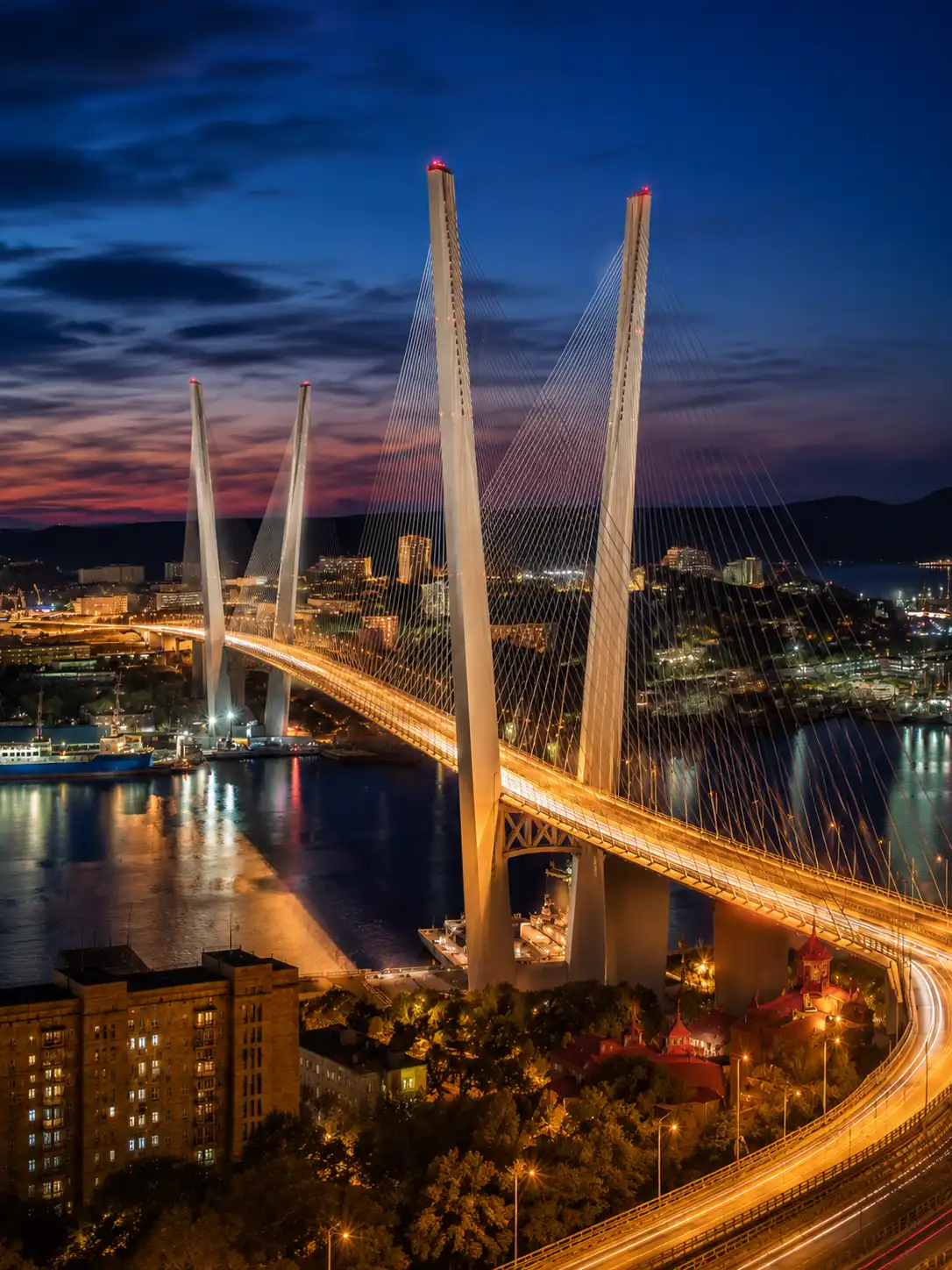
The Golden Bridge is one of the defining landmarks of modern Vladivostok. Spanning the narrow Golden Horn Bay, the cable-stayed bridge connects the historic centre with the Churkin Peninsula and has transformed both the city’s transport network and its skyline.
Known in Russian as Zolotoy Most, or Золотой мост, the bridge opened in August 2012 as part of the large infrastructure programme created before the APEC summit on Russky Island. Its tall V-shaped pylons, long central span and dense pattern of cables quickly became visual symbols of Russia’s Pacific capital.
The Golden Bridge is not a pedestrian attraction in the conventional sense. Ordinary visitors cannot simply walk across it because pedestrian access is prohibited. The best way to experience the structure is from Vladivostok’s hills, waterfront promenades, harbour viewpoints or during a boat trip beneath the bridge.
Eagle’s Nest Hill provides the classic elevated panorama. The Tsesarevich Embankment offers a closer view from water level, while Korabelnaya Embankment places the bridge within the historical and naval landscape of Golden Horn Bay. Boat excursions reveal the underside of the structure and show how dramatically it rises above ships and port infrastructure.
This complete Wander Russia guide explains the history, architecture, engineering, viewpoints, photography opportunities, access conditions and practical details visitors should know before exploring the Golden Bridge in Vladivostok.
Where Is the Golden Bridge?
The Golden Bridge crosses Golden Horn Bay in central Vladivostok.
The northern end connects with the historical centre and the streets rising around Eagle’s Nest Hill. The southern end reaches the Churkin Peninsula, where residential districts, port facilities, shipyards and the Primorsky Stage of the Mariinsky Theatre occupy the opposite side of the bay.
Golden Horn Bay cuts deeply into the Muravyov-Amursky Peninsula and historically divided the city into two areas that were physically close but inconveniently connected by road.
Before the bridge opened, travelling between central Vladivostok and the Churkin district could require a long detour around the inner end of the bay. Official regional tourism information states that journeys that once took approximately one and a half to two hours could be reduced to roughly five to ten minutes after completion of the bridge.
This functional importance distinguishes the Golden Bridge from a purely decorative monument. It was designed to solve a major urban transport problem while also becoming one of the city’s most recognisable structures.
Golden Horn Bay and the Name of the Bridge
Golden Horn Bay is known in Russian as Zolotoy Rog, or Золотой Рог.
The bay was named after the Golden Horn in Istanbul because the protected inlet and its relationship with the surrounding city reminded observers of the famous Turkish waterway. Vladivostok’s bay later gave its name to the new bridge.
During construction, the bridge did not yet have an officially confirmed public name. Various proposals were discussed, and local surveys invited residents to express preferences.
The name Golden Bridge was formally approved on September 3, 2012, shortly after the structure opened.
The English translation can occasionally cause confusion. Golden does not refer to the physical colour of the structure. The bridge is associated with Golden Horn Bay, while its steel and concrete surfaces appear primarily grey.
At night, artificial illumination gives the bridge a warmer visual character, which makes the name seem especially appropriate when reflected across the harbour.
The Long Dream of a Bridge
The idea of crossing Golden Horn Bay existed long before the modern structure was built.
For approximately a century, residents and planners imagined a direct bridge connecting the two sides of central Vladivostok. Proposals appeared in urban plans, illustrations and discussions, but geography, cost and engineering complexity prevented construction from moving forward.
The city’s steep hills and narrow waterfront created a difficult setting. Any bridge needed to provide sufficient clearance for ships while connecting roads built at different elevations on opposite shores.
The project finally became realistic during preparations for the 2012 Asia-Pacific Economic Cooperation summit. Major investments were directed toward roads, airports, utilities and several large bridge projects.
Construction of the Golden Bridge began in 2008. At the same time, work proceeded on the much larger Russky Bridge across the Eastern Bosphorus Strait and on the low-water bridge across the Amur Bay.
Together, these three bridges changed the transport geography of Vladivostok. The Golden Bridge addressed movement within the central city, the Russky Bridge connected the mainland with Russky Island, and the Amur Bay crossing improved access between the peninsula and outer districts.
Opening in 2012
The Golden Bridge officially opened in August 2012.
Its completion took place shortly before the APEC summit, which was held on Russky Island in September of the same year. Vladivostok became the first Russian city to host that summit.
The opening was a major event for residents because the bridge fulfilled an urban ambition that had existed across several generations.
It also changed how Vladivostok was represented internationally. Older images of the city focused on ships, Soviet-era buildings, hills and the railway terminus. After 2012, the Golden and Russky bridges began to dominate promotional photography.
The Golden Bridge soon became closely associated with the identity of the city. It appears in souvenirs, advertisements, tourism materials, television footage and contemporary artwork.
Its influence extends beyond transport. The bridge has helped frame Vladivostok as a modern Pacific metropolis rather than only a remote naval and industrial port.
Engineering and Dimensions
The Golden Bridge is a cable-stayed structure.
Two tall pylons support the central section through multiple steel cables arranged in fan-like patterns. The pylons resemble the letter V when seen from several angles, a form that regional tourism information connects symbolically with the first letter of Vladivostok.
The bridge itself measures approximately 1,388 metres, while the full bridge crossing with connecting approaches is around 2.1 kilometres long.
Its central span extends for 737 metres above Golden Horn Bay. The roadway contains six traffic lanes, with three lanes in each direction.
The navigation clearance beneath the main span is approximately 64 metres, allowing large vessels to continue using the harbour.
The structure was designed to withstand strong winds reaching approximately 47 metres per second and seismic loads corresponding to an intensity of around eight points. Such engineering requirements reflect Vladivostok’s exposed maritime climate and the seismic conditions of the Russian Far East.
The Golden Bridge is smaller than the Russky Bridge, whose central span is substantially longer. Nevertheless, the Golden Bridge has a more direct relationship with the central urban landscape.
Why the Bridge Changed Vladivostok
The bridge did more than shorten travel time.
Before its construction, Golden Horn Bay divided central districts from the Churkin Peninsula. The two areas faced each other across the water but depended on roads around the inner bay.
The new connection improved access to residential neighbourhoods, shipyards, port areas and the cultural district around the Primorsky Stage of the Mariinsky Theatre.
It also altered traffic patterns across the centre. Roads and interchanges were redesigned to feed vehicles toward the bridge, producing a more direct east–west connection across the harbour.
The visual change was equally important.
The bridge introduced a strong vertical and geometric element into a city previously dominated by hills, cranes and irregular urban development. Its pylons now rise above the waterfront from almost every major central viewpoint.
For visitors, the bridge has become a geographical reference point. It helps orient walks through the historic centre and makes it easier to understand the relationship between Golden Horn Bay, Churkin, Eagle’s Nest Hill and the surrounding waterfronts.
Can Visitors Walk Across the Golden Bridge?
The Golden Bridge is closed to ordinary pedestrian traffic.
There is no standard public walkway comparable with pedestrian routes on some city bridges elsewhere in the world.
Visitors should not attempt to enter the roadway or walk along restricted maintenance areas. The bridge carries fast-moving traffic, and stopping on the structure is unsafe.
Special events can occasionally create controlled exceptions. The annual Vladivostok Bridges Marathon uses a route that includes the Golden and Russky bridges under organised conditions and temporary traffic arrangements.
Participation in such an event requires registration and does not mean the bridge is normally open to pedestrians.
For everyday sightseeing, the appropriate options are viewpoints, embankments, vehicle crossings and authorised boat excursions.
Driving Across the Bridge
Crossing the bridge by car or taxi provides a useful sense of scale.
From the roadway, passengers move between the pylons and beneath the fan-shaped cables while gaining short views over the bay and surrounding hills.
Drivers should concentrate on traffic and should not stop for photographs.
A taxi ride can be combined with a visit to the Primorsky Stage of the Mariinsky Theatre, Tsesarevich Embankment or other sites on the Churkin side.
The drive is brief under normal conditions. Traffic congestion, roadworks or accidents can lengthen the crossing, particularly during busy urban periods.
Passengers should keep a camera ready before entering the bridge because the strongest views appear quickly and may be partially blocked by barriers or other vehicles.
A vehicle crossing is worthwhile, but it does not replace visiting a proper viewpoint. The best understanding of the bridge’s design comes from seeing the entire structure within the cityscape.
Eagle’s Nest Hill
Eagle’s Nest Hill offers the most famous elevated view of the Golden Bridge.
The viewpoint looks down toward the central span, Golden Horn Bay and the opposite districts. The bridge’s pylons and cables appear against the water, harbour infrastructure and surrounding hills.
Official tourism material identifies Eagle’s Nest and the nearby funicular area among the best panoramic locations for photographing the bridge.
The viewpoint works well during daylight, sunset, blue hour and after dark.
Morning light may create clearer detail across the harbour, while evening brings city illumination and reflections.
The hill is centrally located and can be reached on foot, by taxi or through the Vladivostok Funicular when it is operating.
For first-time visitors, Eagle’s Nest should normally be the first bridge viewpoint.
Tsesarevich Embankment
The Tsesarevich Embankment provides one of the best water-level views.
The promenade lies on the Golden Horn Bay and opened as an urban recreation area in 2012. It occupies part of a historically industrial and shipbuilding landscape.
From the embankment, the bridge appears much larger than from the hill. Its cables rise directly above the harbour, while ships, shipyard buildings and waterfront structures create a strong foreground.
The promenade is broad and comparatively flat, which is unusual in a city known for steep streets and stairways.
It is suitable for walking, photography and relaxed evening visits. Parking is available but may be paid.
The most attractive time is often around sunset and early evening, when the bridge illumination begins to stand out against the remaining light in the sky.
Korabelnaya Embankment
Korabelnaya Embankment, also known as the Ship Embankment, places the bridge within Vladivostok’s military and maritime history.
The waterfront provides views across Golden Horn Bay toward the bridge and ships of the Pacific Fleet. It is also close to the S-56 Submarine and the Pacific Fleet memorial complex.
This makes it especially valuable for a combined historical route.
The view is not as open as Eagle’s Nest and not as modern in atmosphere as Tsesarevich Embankment. Its strength lies in the connection between bridge, harbour, warships and memorials.
Visitors can continue from here toward Svetlanskaya Street, the railway station or central squares.
Boat Tours Beneath the Bridge
A boat trip offers the most dramatic close view of the engineering.
Marine excursions through Golden Horn Bay may pass directly beneath the central span, depending on route and harbour regulations.
From below, the height of the pylons and the complexity of the cables become much clearer. Ships and port cranes provide a realistic sense of scale.
Vladivostok tourism information describes one- and two-hour harbour trips with themes including bridges, lighthouses and the city’s bays. Exact schedules, prices and departure points can change and should be checked locally.
A harbour trip can also include views of the Russky Bridge or other coastal landmarks when a longer route is selected.
Fog, wind and maritime restrictions may alter the itinerary.
Primorsky Stage of the Mariinsky Theatre
The Primorsky Stage of the Mariinsky Theatre stands near the southern end of the Golden Bridge.
Its glass-and-metal architecture rises above the Churkin side of Golden Horn Bay and has become one of Vladivostok’s main cultural venues.
Combining the bridge with an opera, ballet or concert creates an effective evening programme.
The building also provides useful exterior perspectives of the bridge, particularly when approached from the surrounding roads and waterfront areas.
Performance schedules and ticket availability should be checked through the theatre’s current official programme.
The Bridge at Night
The Golden Bridge becomes particularly photogenic after dark.
Lighting emphasises the pylons, cable pattern and roadway, while reflections appear across Golden Horn Bay.
From Eagle’s Nest Hill, the bridge becomes part of a broad city panorama filled with harbour and traffic lights.
From Tsesarevich Embankment, the structure appears closer and more monumental.
Night photography requires stable support and care with exposure. The bridge and road lights can become overexposed while the surrounding bay remains dark.
A tripod may be useful where permitted, although photographers should avoid blocking promenades or observation areas.
Winter nights can be extremely cold and windy, especially near the water.
Sunrise and Sunset
The ideal lighting depends on season and viewpoint.
From Eagle’s Nest Hill, morning can offer clear harbour detail and softer shadows.
Late afternoon provides warmer light across parts of the bridge and the surrounding city. Sunset may produce strong colour behind or beside the structure depending on the time of year.
From waterfront viewpoints, reflected light often becomes more important than the position of the sun itself.
Blue hour is one of the most reliable periods because the sky retains colour while the bridge lighting becomes visible.
Visitors should arrive before the preferred light begins. Parking, traffic and the climb to Eagle’s Nest can take longer than expected.
Fog and Weather
Vladivostok has a maritime climate strongly influenced by the Sea of Japan.
Summer fog can cover the bridge partially or completely. Pylons may rise above low cloud while the roadway disappears, producing highly atmospheric scenes.
Wind is common around exposed viewpoints and waterfronts.
Winter can bring sharp visibility, snow, strong wind and ice. Autumn often offers clear air and attractive light.
No season guarantees perfect views.
Visitors should keep the bridge flexible within the itinerary and return under different conditions when possible.
A foggy visit should not automatically be considered unsuccessful. The bridge can appear especially dramatic when cables and pylons emerge through moving cloud.
Photography Tips
Eagle’s Nest Hill is best for the complete city panorama.
A wide-angle lens can include the bridge, bay and urban foreground. A moderate telephoto lens creates stronger compositions by compressing the bridge against port districts and distant hills.
Tsesarevich Embankment works well for low-angle images that emphasise height.
Korabelnaya Embankment allows the bridge to be combined with ships and military memorials.
A boat trip provides unusual symmetrical views from beneath the central span.
Photographers should also look for reflections after rain and during calm evenings.
Drones should not be used without explicit permission. Vladivostok contains strategic port, naval, aviation and urban infrastructure, so restrictions can be significant.
Bridge Murals and Urban Art
The area around the bridge continues to evolve.
Regional tourism information reported that bridge supports near Svetlanskaya Street received large-scale murals during a street-art project in 2025.
Such additions demonstrate how the structure has moved beyond its original transport function and become part of the city’s cultural landscape.
Public art can change, be restored or replaced, so travellers should treat individual murals as potentially temporary.
Major Events
The Golden Bridge has occasionally served as a setting for public events.
One notable flash mob organised on the bridge entered the Guinness World Records, according to regional tourism information.
The annual Vladivostok Bridges Marathon also uses the bridge as part of its route. Thousands of participants have taken part in recent editions, including runners from multiple countries and Russian cities.
Event-related closures can affect traffic and viewpoint access.
Travellers visiting during a major festival or marathon should check local transport arrangements in advance.
Combining the Golden Bridge with Other Attractions
The bridge can be integrated into several efficient city routes.
A panoramic route can combine Eagle’s Nest Hill, the funicular and a drive across the bridge.
A historical route can include Korabelnaya Embankment, the S-56 Submarine, the Pacific Fleet memorial and Svetlanskaya Street.
An evening route can combine Tsesarevich Embankment, the Primorsky Stage of the Mariinsky Theatre and bridge illumination.
A marine route can include a harbour boat trip beneath the Golden Bridge and continue toward the entrance of Golden Horn Bay.
Visitors travelling to Russky Island will also encounter the city’s second major cable-stayed landmark, the Russky Bridge.
Is the Golden Bridge Worth Visiting?
The Golden Bridge is essential to understanding modern Vladivostok.
It is not a conventional attraction with an entrance hall, museum route or public walkway. Its significance is distributed across the city.
The bridge is transport infrastructure, architectural landmark, observation subject and symbol of Vladivostok’s twenty-first-century transformation.
A brief view from Eagle’s Nest may be sufficient for travellers with limited time. A more complete experience includes the elevated panorama, a waterfront walk and a vehicle or boat crossing.
Wander Russia recommends seeing the bridge at least twice: once during daylight and once after illumination begins.
Frequently Asked Questions
When did the Golden Bridge open?
The bridge officially opened in August 2012 before the APEC summit.
How long is the bridge?
The bridge itself measures approximately 1,388 metres, while the full crossing with approaches extends for around 2.1 kilometres.
How long is the main span?
The central span measures 737 metres.
Can visitors walk across it?
No. The bridge is normally closed to pedestrians.
Where is the best viewpoint?
Eagle’s Nest Hill provides the classic elevated panorama. Tsesarevich Embankment offers one of the strongest views from water level.
Can visitors drive across it?
Yes. The bridge carries six traffic lanes, with three in each direction.
Is it illuminated at night?
The bridge forms a prominent part of Vladivostok’s evening skyline, and regional tourism guidance particularly recommends viewing it after dark.
Can it be seen during a boat tour?
Yes. Harbour excursions may pass beneath or close to the bridge, depending on the selected route and current port conditions.
Why is it called Golden Bridge?
It is named after Golden Horn Bay, which the bridge crosses.
Is it the same as the Russky Bridge?
No. The Golden Bridge crosses Golden Horn Bay within central Vladivostok. The Russky Bridge connects the mainland with Russky Island.
Conclusion
The Golden Bridge represents the modern transformation of Vladivostok more clearly than almost any other structure.
For generations, Golden Horn Bay divided districts that stood close together across the water. The bridge finally created the direct connection residents had imagined for roughly a century.
Its practical influence was immediate. Long journeys around the bay became short crossings, while Churkin and the historic centre gained a stronger relationship.
Its visual influence was equally significant. The V-shaped pylons and fan of cables reshaped the skyline, giving Vladivostok a new international image before the 2012 APEC summit.
The bridge should not be experienced from only one location.
From Eagle’s Nest Hill, it explains the geography of the city. From Tsesarevich Embankment, it rises above the harbour as a monumental engineering structure. From Korabelnaya Embankment, it connects modern Vladivostok with naval and maritime history. From a boat, its true height and scale become visible.
Pedestrian restrictions mean visitors cannot explore the deck freely, but this does not reduce its importance as an attraction. The bridge belongs to the wider cityscape rather than to one controlled visitor area.
Weather constantly changes its appearance. Summer fog can hide the roadway, clear autumn air reveals distant hills and winter light sharpens every cable. At night, the bridge becomes one of the central illuminated landmarks of Golden Horn Bay.
The Golden Bridge is therefore more than a route across water. It is a symbol of how Vladivostok adapted its difficult coastal geography to the needs of a modern port city.
For travellers following Wander Russia through the Russian Far East, Zolotoy Most provides an essential introduction to a city where engineering, maritime history and steep urban landscapes remain inseparable.
