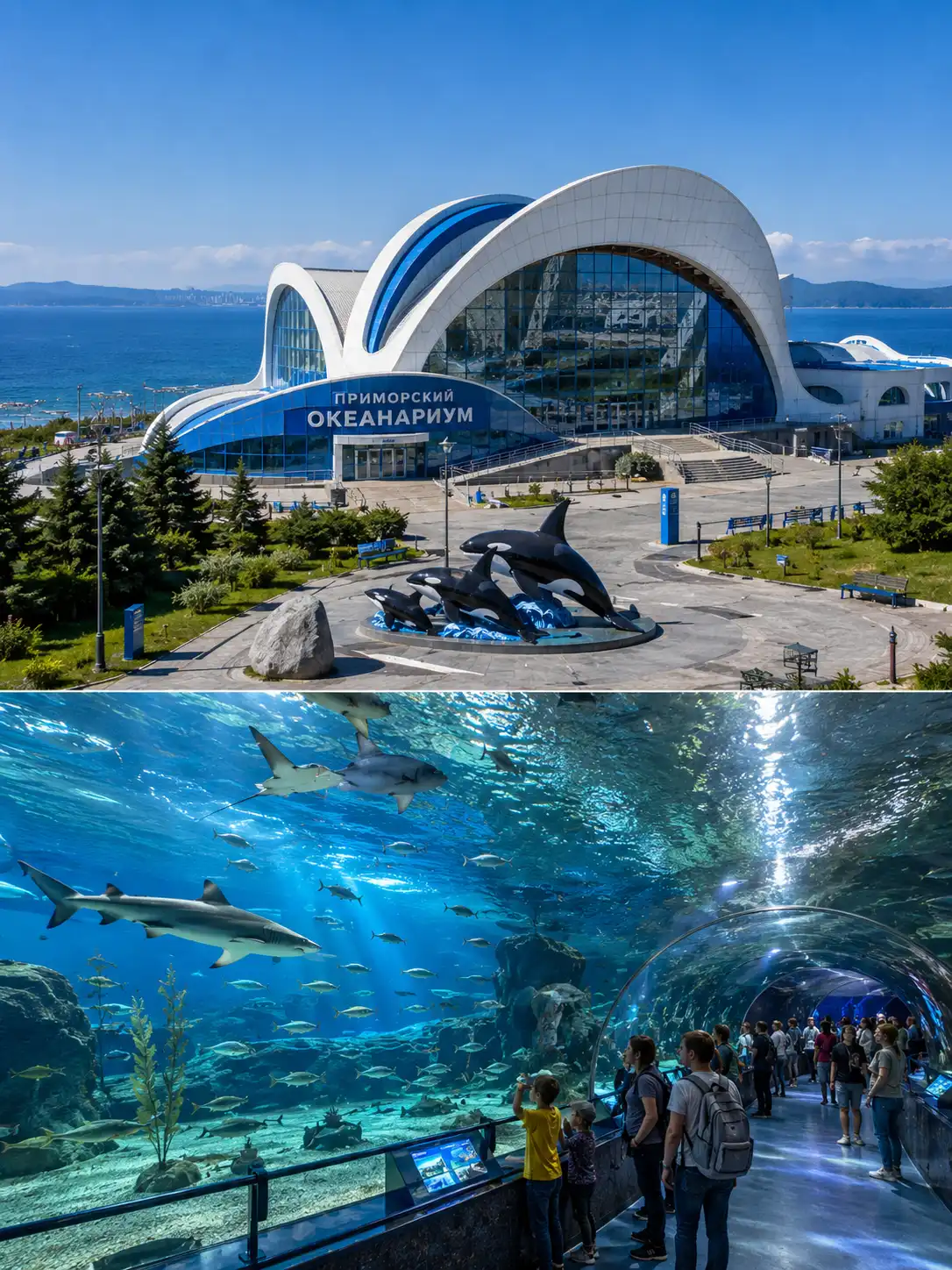
The Primorsky Aquarium is one of the most important family, educational and scientific attractions in Vladivostok. Located on the coast of Russky Island, the large complex introduces visitors to marine and freshwater ecosystems from the Russian Far East and other regions of the world.
Known in Russian as Приморский океанариум, the institution is more than a conventional public aquarium. It operates as a scientific and educational centre within the Russian Academy of Sciences, combining visitor exhibitions with biological research, animal-care programmes, breeding projects and environmental education. The official aquarium describes the facility as the largest public aquarium in Russia, displaying almost 500 species and housing approximately 10,000 animals.
The main building stands near the coastline of Russky Island and has a distinctive curved form inspired by a large seashell. Inside, a sequence of themed exhibitions guides visitors from the earliest development of ocean life through freshwater habitats, polar seas, the waters of the Russian Far East and tropical marine environments.
The aquarium is especially useful for travellers who want to understand the biological diversity surrounding Vladivostok before exploring the coast, islands and bays of Primorsky Krai. Exhibitions devoted to the Sea of Japan, Bering Sea and Sea of Okhotsk connect directly with landscapes and wildlife that can later be encountered during boat excursions and journeys through the Russian Far East.
A normal visit requires at least three hours. Travellers interested in the complete exhibition route, the surrounding grounds and a marine-mammal presentation should allow most of a day.
This Wander Russia guide explains what visitors can see, how the exhibition route is organised, how to reach the aquarium, how tickets work, what facilities are available and how to plan a balanced visit to Russky Island.
Where Is the Primorsky Aquarium?
The Primorsky Aquarium stands on Russky Island, south of central Vladivostok.
Russky Island is connected with the mainland by the Russky Bridge, making the aquarium accessible by car, taxi and public transport. The journey from central Vladivostok normally includes a crossing of the Eastern Bosphorus Strait on one of the city’s most recognisable engineering landmarks.
The aquarium occupies a coastal site away from the densely built historic centre. Its grounds include landscaped walking areas, viewpoints, outdoor sculptures and access routes leading toward the main building.
The surrounding maritime setting is an important part of the experience. Visitors are not entering an aquarium hidden within a shopping centre or city block. The institution stands in a landscape where the actual sea remains visible nearby.
The official address and transport information should be checked shortly before travel because bus routes, stopping points and visitor-access arrangements can change.
The Role of the Aquarium
The Primorsky Aquarium has several connected purposes.
It presents aquatic life to the public, conducts scientific research, develops educational programmes and supports professional breeding and animal-care work.
The institution’s collection represents all oceans and multiple climatic zones. Its specialists breed jellyfish, amphibians, bony fish, cartilaginous fish and marine mammals as part of managed biological programmes.
Research activity distinguishes the aquarium from an attraction focused only on visual entertainment. Scientific work associated with the centre has included studies of marine biology, animal behaviour, microscopic organisms, coastal ecosystems and the health of marine mammals.
The educational function is equally important. Programmes for children and teenagers introduce participants to marine zoology, microscopy, ecology, genetics and scientific research methods. Some long-term educational projects allow students to carry out experiments and complete individual research projects under specialist supervision.
Ordinary visitors do not see every research area, but the exhibition route reflects the institution’s scientific character through explanatory displays, reconstructed environments and comparisons between ecosystems.
The Architecture of the Main Building
The main aquarium building is designed to resemble an open shell or wave-shaped marine form.
Its curved exterior creates a recognisable silhouette above the coastal landscape. Large glazed sections, broad interior halls and flowing visitor routes reinforce the connection with the sea.
The building’s size may not be fully apparent from the entrance. Inside, the exhibition route extends through multiple themed zones, large tanks, tunnels, educational installations and a separate dolphinarium area.
Visitors should not rush through the first rooms. The scale of the building means that energy and attention are needed throughout the route.
Comfortable footwear remains useful even though the visit takes place indoors. Long corridors, ramps and exhibition halls can result in several kilometres of walking during a complete day.
The Exhibition Route
The aquarium organises its public displays into nine major themed exhibitions.
These include:
- Evolution of Life in the Ocean
- Microworld
- Rivers and Lakes
- Polar World
- Bering Sea and Sea of Okhotsk
- Sea of Japan or East Sea
- Tropical Rain Forest
- Tropical Seas
- Ocean Abyss
This structure allows visitors to move through biological history, freshwater systems, cold northern seas, regional marine habitats and tropical ecosystems.
The route is most meaningful when followed in its intended sequence. Beginning with early life and microscopic processes creates a stronger understanding of the more complex organisms encountered later.
Evolution of Life in the Ocean
The Evolution of Life in the Ocean exhibition introduces the long biological history of aquatic life.
Displays explain how the earliest organisms developed in water and how marine ecosystems changed across geological time.
Models, fossils, reconstructed organisms and living displays help connect ancient life with modern species.
This section provides important context for the rest of the aquarium. Modern fish, reptiles, mammals and invertebrates did not appear independently. They belong to evolutionary histories extending over hundreds of millions of years.
Children may initially be attracted by the larger reconstructions, while adults can focus on the scientific explanations and chronological development.
The exhibition also prepares visitors to understand why certain modern animals retain features associated with very ancient biological groups.
The Microworld
The Microworld exhibition focuses on organisms and biological structures that are normally invisible without magnification.
Microscopes, enlarged images and interactive displays introduce plankton, cells and microscopic aquatic life.
These organisms may appear less dramatic than sharks or marine mammals, but they form the base of many aquatic food systems.
Plankton influences ocean productivity, carbon cycles and the survival of fish, whales and seabirds. Changes in microscopic communities can affect entire regional ecosystems.
The exhibition demonstrates that understanding the ocean requires attention not only to large animals but also to organisms too small to see directly.
Rivers and Lakes
The Rivers and Lakes section introduces freshwater environments.
Freshwater occupies only a small part of the planet compared with the oceans, yet rivers and lakes support highly specialised species and provide essential resources for human societies.
The displays include organisms from different freshwater regions and explain how temperature, current, depth and water chemistry shape biological communities.
Visitors travelling through Russia may recognise references to famous river systems and lakes, including environments connected with Siberia and the Russian Far East.
The section also illustrates the vulnerability of freshwater ecosystems. Pollution, dams, invasive species and changing water levels can affect habitats more rapidly than many people expect.
The Polar World
The Polar World exhibition explores life in cold aquatic environments.
Polar and subpolar seas may appear barren from the surface, but they support food webs containing plankton, fish, seabirds and marine mammals.
Animals living in these conditions require specialised adaptations. Insulation, body shape, seasonal migration and efficient energy use help them survive cold water and limited winter light.
The exhibition can be especially relevant to visitors continuing toward Kamchatka, Sakhalin, the Commander Islands or other northern maritime regions.
It also prepares visitors for later displays devoted to the Bering and Okhotsk seas.
The Bering Sea and Sea of Okhotsk
This section is one of the most regionally important parts of the aquarium.
The Bering Sea and Sea of Okhotsk are among Russia’s most productive marine environments. They support major populations of fish, crabs, molluscs, marine mammals and seabirds.
The official exhibition information notes that the Bering Sea contains approximately 400 fish species and supports feeding areas used by several whale species. The Sea of Okhotsk is described as one of Russia’s most biologically productive marine ecosystems, with significant populations of king crab, molluscs, seaweed and commercially valuable fish.
For travellers interested in Kamchatka and the northern Pacific, this exhibition provides direct ecological context.
Sea otters, fur seals, Steller sea lions and whales are not isolated attractions. They depend on connected marine systems shaped by currents, temperature, plankton and seasonal food supply.
The section also introduces environmental pressures, including fishing, industrial development and the historical overhunting of marine mammals.
The Sea of Japan Exhibition
The Sea of Japan, also called the East Sea in some international contexts, directly surrounds the wider Vladivostok region.
This makes the exhibition especially relevant to the location of the aquarium.
Visitors can learn about species living in the waters of Peter the Great Gulf and along the coast of Primorsky Krai.
The marine environment around Vladivostok changes dramatically through the year. Summer water becomes relatively warm, while winter brings freezing conditions in sheltered bays.
Local species must adapt to strong seasonal variation.
The exhibition helps visitors interpret what may be seen during boat trips, coastal walks, diving activities and visits to Russky Island’s bays.
It also reinforces the relationship between the aquarium and the scientific study of nearby marine waters.
Tropical Rain Forest
The Tropical Rain Forest section changes the atmosphere of the visit.
Warm temperatures, dense vegetation and freshwater habitats contrast strongly with the northern marine exhibitions.
The environment may include reptiles, amphibians, tropical fish and other organisms associated with humid forest ecosystems.
Rain forests depend on water at every level. Rivers, pools, rainfall and moisture connect terrestrial and aquatic life.
The exhibition demonstrates that an aquarium can examine more than open-ocean species. Many aquatic systems begin inland, where rain enters streams and rivers before eventually reaching the sea.
Visitors wearing heavy winter clothing may find this section particularly warm, so layered clothing is useful.
Tropical Seas
The Tropical Seas exhibition presents colourful coral-associated environments and warm-water marine life.
Tropical tanks often contain some of the most visually striking animals in the complex.
Bright fish, rays, corals and other invertebrates demonstrate how biodiversity increases in warm, structurally complex habitats.
Coral reefs occupy a relatively small area of the ocean but support a large proportion of marine species.
The displays also create an opportunity to explain bleaching, pollution, temperature change and the sensitivity of reef systems.
Visitors should avoid treating the section only as a background for photographs. The biological relationships between coral, algae, fish and invertebrates are central to understanding why tropical ecosystems are so diverse.
Ocean Abyss
The Ocean Abyss section explores deeper marine environments.
The deep ocean is cold, dark and under extreme pressure. Organisms living there often possess unusual forms, reduced pigmentation, sensitive sensory systems or biological light production.
Some deep-sea species are difficult to maintain alive in public exhibitions because their natural pressure and temperature conditions cannot be reproduced easily.
As a result, the section may combine living displays with models, video, preserved material and scientific interpretation.
The exhibition helps correct the common belief that the deep ocean is empty.
Large areas of the planet lie beneath deep water, and many species remain poorly studied.
Large Tanks and Underwater Views
One of the main visual highlights is the opportunity to observe large marine animals through broad viewing windows and underwater passage areas.
Sharks, rays and schooling fish create a sense of scale that smaller tanks cannot provide.
The movement of animals changes continuously, so no two visits follow exactly the same visual sequence.
Visitors should allow time to remain near a large tank rather than walking past immediately. Rays may approach the glass, sharks may pass above and schools of fish can change direction suddenly.
Quiet observation often produces a better experience than attempting to photograph every animal.
Flash photography should be avoided where prohibited because it can disturb animals and produce reflections.
Marine Mammals
The aquarium maintains a dolphinarium and marine-mammal division.
Species presented by the institution include bottlenose dolphins, beluga whales, Pacific white-sided dolphins, walruses, northern fur seals and Steller sea lions. The exact animals participating in public programmes can change according to health, training and operational decisions.
The marine-mammal presentation is described by the aquarium as a demonstration of skills rather than simply a performance.
Modern presentations increasingly emphasise animal cognition, voluntary training, veterinary care and communication between animals and specialists.
The aquarium has stated that its marine-mammal work forms part of a broader scientific and educational approach rather than functioning only as entertainment.
Visitors should understand that programme schedules can change at short notice. Animal welfare, technical maintenance or veterinary needs may lead to cancellation.
Marine-Mammal Demonstrations
The marine-mammal presentation takes place at scheduled times and may require a specific ticket or reservation arrangement.
The official schedule changes by month. For example, the published 2026 timetable listed one daily presentation on selected days in April and two daily presentations during May, while Mondays remained closed. This demonstrates why visitors must check the exact calendar for their chosen date rather than relying on a permanent timetable.
Arriving shortly before the presentation begins may be insufficient during busy periods.
Visitors should allow time for ticket checks, walking from the main exhibition route and finding seats.
Late admission may be restricted once the programme has started.
Animal Welfare and Visitor Behaviour
Animals should be observed without tapping on glass, shouting or using prohibited lighting.
Aquarium rules exist to protect both visitors and animals.
Some species are sensitive to vibration, bright flashes and sudden movement.
Children should be supervised closely, especially near large viewing windows, railings and crowded areas.
Food should never be given to animals unless a formal programme is supervised by aquarium staff.
Visitors should also avoid making assumptions about an animal’s condition based on a brief observation. Resting behaviour, temporary separation or absence from a display can be part of normal care.
Tickets
Admission tickets can be purchased online or through the aquarium ticket office.
The official ticket information states that tickets may be bought up to 30 days before the planned visit. The ticket office generally operates Tuesday through Sunday from 9:30 until 18:30. Children under three may enter free, although identification can be requested when age-based ticket categories are used.
Prices and categories can change, so fixed amounts should not be treated as permanent.
Online purchase is advisable during weekends, school holidays and the main summer season.
Visitors should confirm whether the selected ticket includes only the exhibition route or also a marine-mammal presentation.
Electronic tickets should be saved offline in case mobile reception is weak at the entrance.
Opening Hours
The main building is generally open Tuesday through Sunday from 10:00 until 20:00.
The grounds normally open earlier, while the ticket office closes before the main building. Monday is usually the regular closing day.
Special closures can occur because of maintenance, official events, technical work or changes in the animal programme.
Opening arrangements may also vary during holidays.
The official website should therefore be checked on the morning of the visit.
How Much Time Is Needed?
A rapid visit requires around three hours.
A balanced visit should allow four to five hours.
A full experience including the grounds, exhibitions, breaks and marine-mammal presentation can occupy six hours or more.
Families with young children may need additional rest periods.
Visitors interested in reading scientific information should plan more time than those moving mainly between the large tanks.
The building closes at a fixed time, so arriving late in the afternoon can result in a rushed route.
Best Time to Arrive
Morning is generally the most efficient period.
Arriving near opening time allows visitors to explore the early exhibitions before larger groups arrive.
A morning visit also creates more flexibility if a marine-mammal presentation is scheduled later.
Weekdays are usually calmer than weekends, although school and organised groups may be present.
Summer holidays bring higher demand because Russky Island receives more visitors and outdoor travel conditions are favourable.
Rainy or foggy days can also increase aquarium attendance because coastal hiking becomes less attractive.
Getting There by Public Transport
Public buses connect mainland Vladivostok with Russky Island and the aquarium area.
Routes and departure points can change, so current navigation services or official transport information should be checked.
The journey includes crossing Russky Bridge and continuing through the developed northern part of the island.
Public transport is usually the most economical option but requires more time than a taxi.
Visitors should also confirm the final return service, especially when remaining until the evening.
Getting There by Taxi or Car
A taxi provides the simplest door-to-door solution from central Vladivostok.
Travel time depends on traffic, road conditions and the starting district.
The journey across Russky Bridge is part of the experience and offers brief views over the Eastern Bosphorus.
Drivers using a private or rental car should follow signs toward the aquarium and use designated parking areas.
Major events on Russky Island can alter traffic or security arrangements.
Additional time should be allowed during weekends and public holidays.
Accessibility
The aquarium has developed accessible programmes and visitor services for people with different physical and sensory needs. Its official site includes dedicated information under the Accessible Aquarium section.
The main building uses broad internal routes, lifts and ramps to connect exhibition levels.
Nevertheless, visitors with specific mobility requirements should confirm current lift access, wheelchair availability and assistance procedures before travel.
The complete route remains long, so rest periods may be necessary.
Caregivers should also ask whether priority entrance or specialised tours are available.
Food and Shopping
Dining and shopping facilities may operate within or near the main visitor complex.
Availability, opening times and menu options can change.
Visitors with dietary restrictions should not depend entirely on finding a suitable meal after arrival.
A small personal snack may be useful, although eating is restricted to designated areas.
The gift shop generally operates on public opening days and sells marine-themed souvenirs, books and educational products. The official 2026 timetable listed gift-shop hours from 10:00 until 19:00.
Visiting with Children
The aquarium is one of the strongest family attractions in Vladivostok.
Large tanks, colourful fish, marine mammals and interactive exhibitions hold the attention of different age groups.
Young children may become tired before completing the full route.
Parents should identify rest areas, toilets and meal options early in the visit.
The marine-mammal programme can be memorable, but loud sound and crowded seating may be difficult for some children.
A slower visit with breaks usually works better than attempting to complete every exhibition quickly.
Photography
Photography is normally possible in public exhibition areas, subject to aquarium rules.
Flash may be prohibited around animals.
Large tanks create reflections, especially when bright clothing or illuminated screens are close to the glass.
Holding the camera near the glass without touching it can reduce reflections.
A fast shutter speed helps with moving fish and marine mammals.
Wide-angle lenses work well for tunnels and large tanks, while moderate telephoto lenses are useful during presentations.
Tripods and commercial photography may require permission.
Combining the Aquarium with Other Attractions
The aquarium can be combined with one additional Russky Island destination.
The Far Eastern Federal University campus and Ajax Bay provide the easiest nearby combination.
A Russky Bridge viewpoint can be added during the return journey.
Cape Tobizina is possible on the same day only with an early start and efficient private transport. The combination creates a long schedule and may not suit families.
Cape Vyatlin, the Voroshilov Battery and remote beaches are better reserved for another day.
A relaxed aquarium visit should remain the central activity rather than one short stop among many.
Suggested Day Plan
Leave central Vladivostok in the morning.
Cross Russky Bridge and arrive near the aquarium opening time.
Explore the early exhibition zones before the busiest period.
Take a short break before continuing through the regional and tropical sections.
Attend the marine-mammal presentation when included in the day’s programme.
Walk briefly through the surrounding grounds after leaving the main building.
Finish with a short stop near Ajax Bay or the university waterfront before returning to central Vladivostok.
This schedule provides a complete experience without excessive rushing.
Is the Primorsky Aquarium Worth Visiting?
The Primorsky Aquarium is worth visiting because it connects entertainment with regional science and environmental education.
Its strongest feature is not simply size.
The exhibitions move from microscopic organisms and ancient biological development to freshwater systems, polar seas, tropical reefs and the marine ecosystems surrounding the Russian Far East.
The regional sections help travellers understand the waters around Vladivostok, Kamchatka, Sakhalin and the Bering Sea.
The location on Russky Island also adds value. The aquarium can be experienced as part of a wider maritime journey rather than an isolated indoor attraction.
Wander Russia recommends reserving at least half a day and checking the official schedule before departure.
Frequently Asked Questions
Where is the Primorsky Aquarium?
It is located on Russky Island in Vladivostok.
Is it the largest aquarium in Russia?
The institution describes itself as Russia’s largest public aquarium, with almost 500 species and approximately 10,000 animals.
How long should visitors stay?
Three hours is the minimum for the main exhibitions. Four to six hours provides a more comfortable visit.
What days is it open?
The aquarium generally opens Tuesday through Sunday and closes on Monday. Current hours should be checked before travel.
Can tickets be purchased online?
Yes. The official ticket system allows advance purchase, generally up to 30 days before the selected date.
Is the marine-mammal presentation included?
Ticket arrangements can vary. Visitors should confirm whether a separate ticket or reservation is required.
Is the aquarium suitable for children?
Yes. The exhibitions and educational elements are designed for a broad age range.
Can visitors take photographs?
Photography is normally possible in public areas, but flash and commercial equipment may be restricted.
Can the aquarium be reached by bus?
Yes. Public transport connects Vladivostok with Russky Island, although current routes should be verified.
Is it open during winter?
The aquarium operates throughout the year, subject to its regular calendar and temporary closures.
Conclusion
The Primorsky Aquarium is one of the most complete visitor attractions in Vladivostok.
It provides the visual impact expected from a major aquarium while maintaining a strong connection with science, education and the marine environment of the Russian Far East.
The exhibition route begins with the development of life and the microscopic foundations of aquatic ecosystems. It then moves through rivers, lakes, polar seas, regional waters, tropical forests and the deep ocean.
This progression gives the visit a clear structure.
The Bering Sea, Sea of Okhotsk and Sea of Japan exhibitions are especially valuable for travellers exploring Russia’s Pacific regions. They explain why local waters support such rich fisheries, seabird colonies and marine-mammal populations.
The aquarium’s scientific role adds another dimension. Breeding, research and educational projects continue beyond what ordinary visitors see in the public halls.
Marine-mammal presentations remain among the most popular parts of the visit, but they should be understood within the institution’s broader work on animal behaviour, care and public education.
Practical planning is important. The building is large, the complete route takes several hours and programme schedules change. Tickets, opening times and demonstration times should be checked through the official website shortly before arrival.
The location on Russky Island makes the journey part of the experience. Visitors cross Russky Bridge, leave the dense city centre and arrive at a marine complex facing the actual waters that shape Vladivostok.
For Wander Russia, the Primorsky Aquarium is more than a rainy-day alternative. It is one of the most useful places for understanding the biological world surrounding Vladivostok and the wider Pacific coast of Russia.
