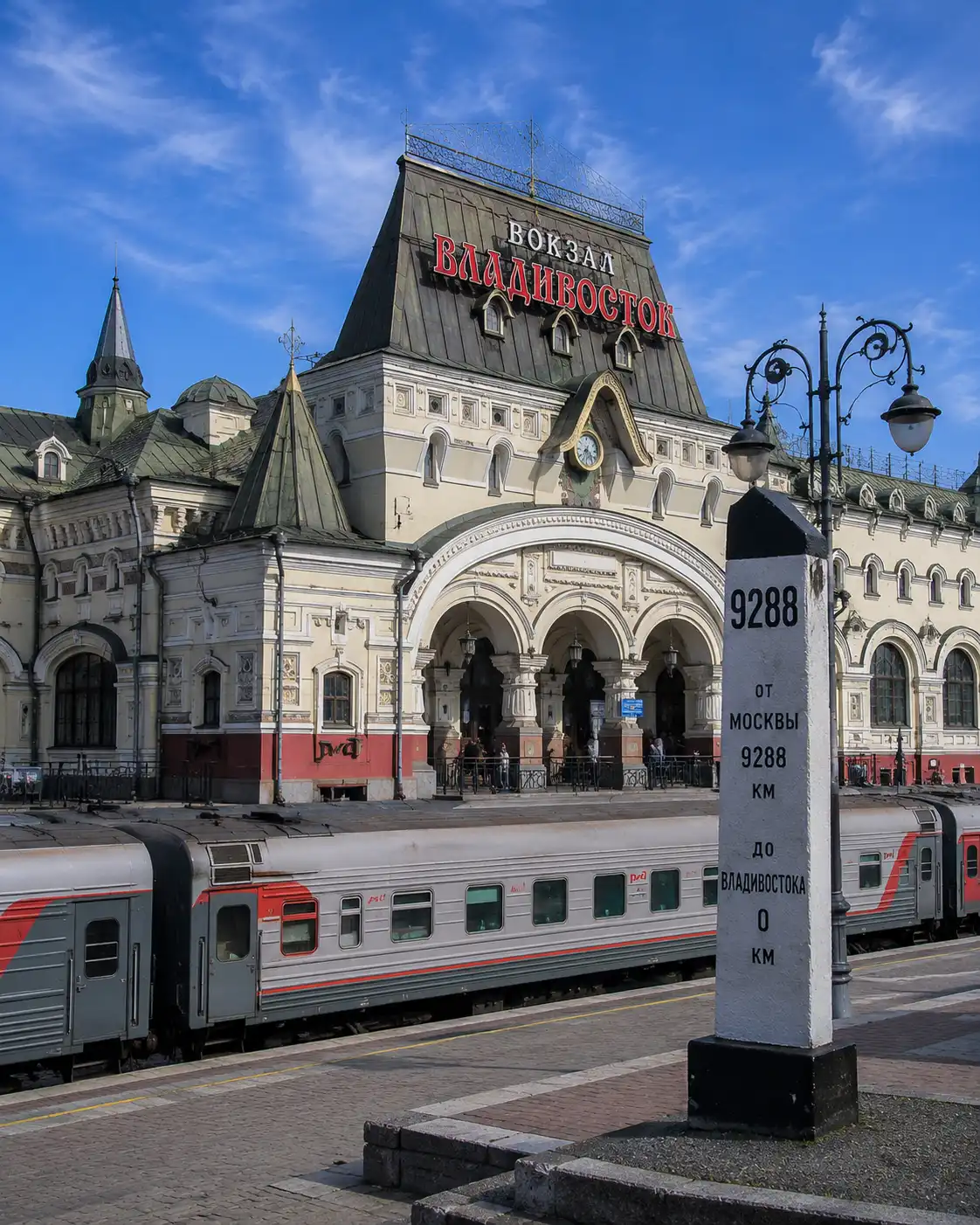
Vladivostok Railway Station is one of the most meaningful transport landmarks in Russia and one of the most symbolically important places in the Russian Far East. For many travelers, it is not simply a station. It represents the eastern end of the Trans-Siberian Railway, the point where one of the world’s most famous railway routes finally reaches the Pacific coast.
Located close to the historic center of Vladivostok and only a short walk from the city’s waterfront, the station combines architecture, transport history, imperial-era ambition, Soviet memory and modern everyday movement. It is a place where long-distance railway mythology meets the practical rhythm of daily urban life. Commuters, regional passengers, long-distance travelers and tourists all pass through the same halls and platforms.
For visitors exploring Vladivostok, the station is one of the easiest places to understand the city’s broader significance. Vladivostok is not only a Pacific port and a city of bridges, bays and hills. It is also the eastern anchor of a continental route that crosses the whole of Russia. That connection gives the station a meaning far beyond its size.
The building itself is also worth attention. Its appearance reflects the style of Russia’s great railway era and deliberately recalls the architecture of the Yaroslavsky Railway Station in Moscow, creating a symbolic link between the western and eastern ends of the Trans-Siberian route. This idea of two distant railway gates connected by one line remains one of the most powerful themes in Vladivostok.
This Wander Russia guide explains the history, architecture, symbolism, layout, nearby sights, practical travel tips and the best way to experience Vladivostok Railway Station.
Why Vladivostok Railway Station Matters
The station is important because it represents one of the great geographical ideas of Russia.
The Trans-Siberian Railway connects European Russia with Siberia and the Pacific coast. For countless travelers, the image of that journey ends here, at Vladivostok Railway Station. Even for visitors who are not arriving by train, standing on the platforms gives a strong sense of scale. The railway does not simply connect nearby cities. It links one end of an enormous country with the other.
This makes the station meaningful on several levels.
First, it is historically important. The railway helped shape settlement, administration, trade and movement across vast territories.
Second, it is symbolically important. The station expresses the idea of Russia as a transcontinental country reaching from Europe to the Pacific.
Third, it is visually important. The architecture, station signs and famous kilometer marker all make it one of the most recognizable railway locations in the country.
Finally, it remains functional. This is not a museum station preserved only for nostalgia. Trains still arrive and depart, passengers still wait with luggage, and the station continues to play an active role in the transport system of the Russian Far East.
Location in the City
Vladivostok Railway Station is located in a highly convenient part of the city.
It stands near the waterfront, close to the Sea Terminal area and within walking distance of central streets such as Svetlanskaya. This means the station is not isolated on the urban edge, as in some cities. Instead, it forms part of the central historical and transport zone.
This location makes it easy to combine with several other important attractions in Vladivostok. Visitors can walk from the station to the harbor, the S-56 Submarine Museum complex, central squares, the Millionka district or the lower parts of the historic center. Because of this, even travelers with limited time can include the station naturally in a city route.
Its central position also helps explain why the station feels integrated into the life of Vladivostok rather than standing apart from it.
The Eastern End of the Trans-Siberian Railway
The most famous aspect of the station is its role as the eastern terminus of the Trans-Siberian Railway.
For many people, the phrase “Trans-Siberian Railway” immediately evokes enormous distances, long train journeys, changing landscapes and the dream of traveling from Moscow to the Pacific. Vladivostok Railway Station is the final point of that route.
This is one reason the station attracts visitors even when they are not planning to travel by train. The appeal is emotional and geographic. Standing here means standing at one end of one of the world’s great rail lines.
The route itself passes through many major cities and landscapes, crossing the Urals, the Siberian plains, great rivers and wide forest zones before eventually reaching the Pacific side of Russia.
For travelers interested in railway culture, the station is therefore not just a local stop. It is a destination in its own right.
The Kilometer Post
One of the most photographed features of the station is the kilometer post associated with the Trans-Siberian Railway.
This marker symbolizes the distance between Vladivostok and Moscow and gives visitors a tangible sense of the route’s scale. It is one thing to know intellectually that the Trans-Siberian Railway is long. It is another to stand beside a marker that turns that abstract length into a visible number.
For many travelers, this is the highlight of the station visit. The marker transforms the place from an attractive station into a symbolic endpoint.
Visitors often take photographs here even if they do not enter a train. It is one of the simplest and most effective travel images in Vladivostok because it combines geography, history and personal memory in a single object.
History of the Station
The station’s history is closely tied to the development of Vladivostok and the expansion of the railway network toward the Pacific.
As Vladivostok grew in strategic and economic importance, the need for a railway connection became increasingly clear. The station emerged as part of the larger project of integrating the Russian Far East more closely with the rest of the empire.
The building dates to the early twentieth century and reflects the ambition of that period. It was not meant to be a minor provincial structure. It was intended as the eastern railway gate of the country.
Its appearance deliberately echoed the Yaroslavsky Railway Station in Moscow, creating a visual relationship between the two ends of the railway. This architectural dialogue reinforced the idea that Moscow and Vladivostok, though enormously distant from one another, belonged to one connected national route.
Over time, the station witnessed imperial travel, Soviet expansion, wartime movement, post-Soviet transition and modern tourism. Through all these changes, it retained its identity as a symbolic endpoint.
Architectural Character
Vladivostok Railway Station is one of the more attractive station buildings in the Russian Far East.
Its design reflects Russian revival influences and gives the building a formal, almost ceremonial character. The façade, rooflines, decorative elements and symmetry convey the importance that railway architecture held in the late imperial period.
The station does not overwhelm through size alone. Its strength lies in proportion and symbolism. It looks like a station meant to mark an important threshold.
For architecture lovers, the most interesting aspect is the way it balances utility and representation. It functions as a transport building, but it also communicates an idea: that the arrival at the Pacific coast is significant, dignified and connected to the wider identity of the state.
Inside, the atmosphere is more practical than grand, but that contrast is part of the station’s authenticity. The exterior carries history and symbolism, while the interior reflects real transport use.
A Link to Moscow
One of the most interesting interpretive ideas at Vladivostok Railway Station is its relationship with Moscow.
The station is often discussed as a kind of eastern counterpart to Yaroslavsky Station, the western departure point of the Trans-Siberian Railway in Moscow. This pairing gives both stations a special place in the imagination of rail travelers.
The journey between the two cities is not just a route. It is a narrative of scale, distance and continuity. The architecture helps express that narrative. When visitors understand this connection, the station becomes more than a local landmark. It becomes part of a two-ended story stretching across the entire country.
This symbolic connection is one of the reasons Wander Russia treats the station as an essential sight in Vladivostok.
The Station as a Working Transport Hub
Despite its historical and symbolic importance, the station remains an active transport hub.
Passengers use it for long-distance trains, regional rail services and commuter connections. This living function is important because it prevents the station from becoming a frozen heritage object.
Visitors will see people arriving with luggage, waiting for departures, reading timetables and moving through the halls. This constant movement helps preserve the station’s atmosphere. It feels alive rather than staged.
For travelers actually using the station, practical elements such as ticketing, waiting areas, security procedures and platform access matter as much as history. For non-traveling visitors, these same elements provide authenticity and help bring the station’s story into the present.
What to See at the Station
A good visit to Vladivostok Railway Station includes several key elements.
- The exterior façade
- The main entrance area
- The station hall
- The platforms
- The kilometer marker
- Views toward the rail lines
- The surrounding square and urban context
Taken together, these features provide the full experience.
The building exterior gives the strongest architectural impression. The interior shows the practical side of railway life. The platforms offer the real emotional connection to the Trans-Siberian Railway. The kilometer marker adds the clearest symbolic detail.
Even a short visit feels meaningful when these parts are seen in sequence.
The Platforms
The platforms are among the most atmospheric parts of the station.
This is where the railway becomes most tangible. Tracks extend outward, trains wait under the open sky, and the physical reality of long-distance travel becomes immediately visible.
For travelers departing Vladivostok, the platforms are the beginning of a major journey. For those arriving from inland Russia, they are the final stage of a transcontinental route.
Even for casual visitors, the platforms convey something that cannot be fully captured by the building façade alone. They reveal the station’s purpose and its emotional power.
The open-air setting also creates good photography opportunities, especially when trains are present.
Nearby Attractions
One reason the station is especially worthwhile is that it sits near several other important places.
A visitor can easily combine the station with:
- The harbor and Sea Terminal
- Korabelnaya Embankment
- The S-56 Submarine Museum
- The Pacific Fleet memorial complex
- Svetlanskaya Street
- Millionka Historic Quarter
- Central Vladivostok viewpoints later in the day
This means the station fits naturally into a half-day or full-day city route.
A particularly effective plan is to begin at the station, continue toward the waterfront and then move deeper into the historical center.
The Atmosphere Around the Station
The surroundings of Vladivostok Railway Station contribute strongly to its character.
Because the station lies near the sea, the area feels more open and connected to movement than many inland railway stations. The combination of rail, harbor and city center creates a layered sense of travel. Trains, ships, streets and pedestrian flows all meet in a relatively compact zone.
This environment gives the station a distinctly Vladivostok identity. It is not only a railway building. It is part of a broader transport landscape where maritime and land-based routes converge.
That combination makes the area especially interesting for travelers who enjoy observing how a city functions.
Best Time to Visit
The station can be visited throughout the year.
There is no single season in which it becomes inaccessible or irrelevant. However, the mood changes with weather and light.
In summer, the station area feels active and bright, and the nearby waterfront makes the whole district pleasant to walk.
In autumn, the softer light can be excellent for photography, and the air often feels clearer.
In winter, the station gains a more dramatic and sometimes nostalgic atmosphere. Snow, cold light and steam or frost around the tracks can create powerful images.
Spring is often more transitional, but the station remains worthwhile because of its central location and all-weather accessibility.
Best Time of Day
Morning is often the best time for a station visit.
The light can be clean, and the station may feel calmer before the busiest parts of the day. Morning also works well if the station visit is meant to begin a broader city route.
Late afternoon is also rewarding, especially if travelers want to combine the station with an evening walk toward the waterfront or harbor.
Night photography can be attractive when station lights and urban illumination begin to shape the scene, but interior and platform access may depend on practical travel conditions.
Photography Tips
Vladivostok Railway Station is highly photogenic, but it works best when photographed thoughtfully.
Good options include:
- A frontal exterior shot showing the architecture
- Platform perspectives with tracks leading into the distance
- The kilometer marker as a symbolic focal point
- Details such as signs, clocks or rooflines
- Wider views showing the station as part of the city
Photographers should pay attention not only to the building but also to movement. People, luggage, trains and platform rhythms often add life to the images.
If photographing inside or on platforms, it is wise to remain respectful of travelers and any station rules.
Practical Travel Tips
For visitors using the station practically rather than only as a sightseeing destination, a few basic points help.
Arrive early for long-distance departures, especially if unfamiliar with the layout.
Keep identification and tickets easily accessible.
Allow time for security checks or platform-control procedures where required.
Check departure information carefully rather than relying only on assumptions about the platform.
Bring food or water for longer waits, though the exact availability of station services may vary.
Even travelers not boarding a train should remember that this is an active station, so awareness and courtesy are important.
How Much Time Is Needed?
A short visit can take 20 to 30 minutes.
A fuller visit with platforms, photographs and time to appreciate the symbolism of the place may take 45 minutes to an hour.
If combined with nearby waterfront areas and memorials, the station easily becomes part of a two- to three-hour route.
This flexibility makes it useful for many types of travelers, including those with tight schedules.
Is Vladivostok Railway Station Worth Visiting?
Yes, absolutely.
It is one of the most important symbolic places in Vladivostok and one of the clearest expressions of the city’s place within Russia as a whole.
The station offers architecture, history, transport culture and one of the most powerful geographic ideas in the country: the eastern end of the Trans-Siberian Railway.
Even travelers who do not usually care about stations often find this one meaningful because its significance is so easy to understand.
Wander Russia recommends it as an essential stop, especially for first-time visitors.
Suggested Visit Plan
A simple and effective plan is to visit the station in the morning.
Begin with the exterior and main entrance.
Continue inside for a brief look at the hall and practical station atmosphere.
Then move toward the platforms and the kilometer marker.
Spend time taking in the rail perspective and the symbolic sense of arrival or departure.
After that, walk toward the waterfront or continue to nearby historical and naval landmarks.
This creates a balanced experience without requiring too much time.
Conclusion
Vladivostok Railway Station is much more than a transport building.
It is one of the places where the scale of Russia becomes emotionally visible. The station’s meaning comes not only from architecture or history but from the larger idea it represents. It stands at the eastern end of a railway that crosses the whole country, linking the Pacific coast with Moscow and beyond.
That alone would make it important. But the station also succeeds as an urban landmark. Its attractive façade, central setting and proximity to the harbor make it easy and rewarding to visit.
The platforms add the strongest dimension. They remind visitors that the railway is not just a historical concept. It remains active, lived and real. Trains still come and go. Journeys still begin and end here.
For travelers exploring Vladivostok, the station offers one of the clearest introductions to the city’s larger identity. It shows Vladivostok not just as a local port or regional capital, but as one end of a continental connection.
That is why Vladivostok Railway Station deserves its place among the essential sights of the city.
