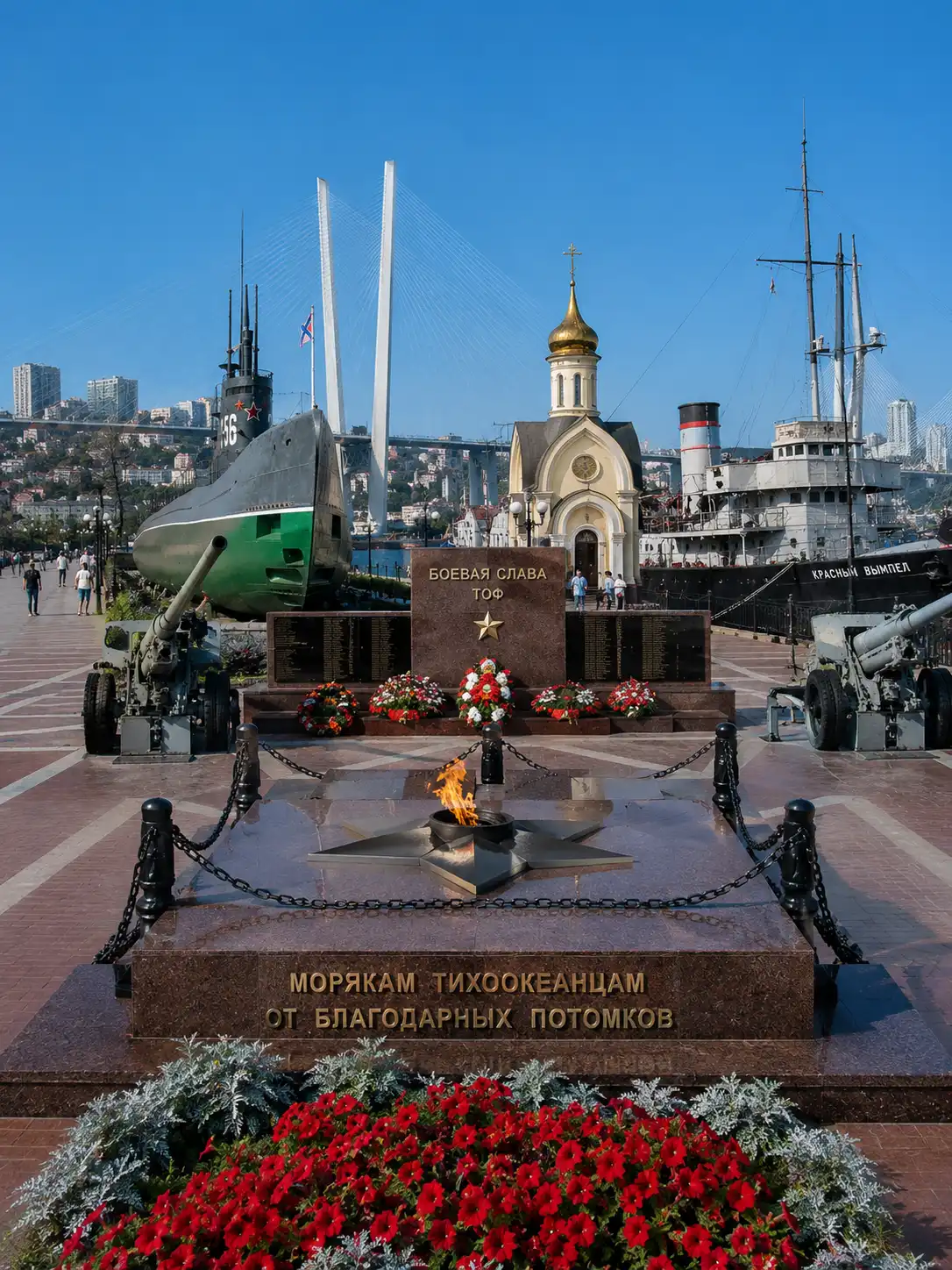
The Memorial Complex of the Pacific Fleet is one of the most important historical and commemorative places in central Vladivostok. Located on Korabelnaya Embankment beside Golden Horn Bay, the complex brings together the Eternal Flame, naval artillery, memorial plaques, the preserved S-56 submarine, the Krasny Vympel memorial ship and several monuments connected with the history of Russia’s Pacific Fleet.
Known in Russian as Мемориальный комплекс «Боевая слава Тихоокеанского флота», the site is not a single monument surrounded by an empty square. It is a larger historical ensemble extending through one of Vladivostok’s most significant waterfront areas. Visitors encounter military vessels, commemorative stones, names of fallen sailors, naval weapons and views across the working harbour toward the Golden Bridge.
The complex is closely connected with the identity of Vladivostok. The city began as a military post beside Golden Horn Bay, later developed into a major port and remains the headquarters of the Russian Pacific Fleet. Korabelnaya Embankment therefore provides an appropriate setting for a memorial devoted to naval service, wartime sacrifice and the development of Russia’s maritime presence in the Far East.
For many travellers, the preserved submarine S-56 is the most immediately recognisable attraction. However, visiting only the submarine means missing the wider meaning of the site. The Eternal Flame, memorial plaques, ship guns, Krasny Vympel and the nearby Chapel of Saint Andrew the First-Called transform the area into a connected landscape of remembrance.
This Wander Russia guide explains the history of the memorial complex, its principal monuments, the role of the Pacific Fleet, visitor etiquette, access, photography and the best way to combine the site with nearby attractions.
Where Is the Pacific Fleet Memorial Complex?
The memorial complex stands on Korabelnaya Embankment, commonly translated as Ship Embankment, in the historic centre of Vladivostok.
The waterfront lies beside Golden Horn Bay and is within walking distance of Svetlanskaya Street, the central square, Vladivostok Railway Station and several important museums and monuments. The approximate address commonly associated with the complex is around 2 Petra Velikogo Street, although the monuments extend across a broader section of the embankment.
The location is one of the reasons the memorial is so accessible. It does not require a long journey outside the city or a dedicated full-day excursion. Visitors can incorporate it into a historical walking route through central Vladivostok.
The embankment also provides views of Golden Horn Bay, the Golden Bridge and naval vessels moored in the harbour. This creates a direct visual connection between the history commemorated by the complex and the continuing maritime role of Vladivostok.
Why the Memorial Is Important
The complex honours sailors of the Pacific Fleet and residents of Primorsky Krai who served and died during the Great Patriotic War, the term used in Russia for the Soviet struggle against Nazi Germany and its allies from 1941 to 1945.
Its importance extends beyond a single period. The site also presents the development of the Pacific Fleet, the growth of submarine forces and the wider naval history of the Russian Far East.
Vladivostok’s position made it strategically significant from the beginning. The protected waters of Golden Horn Bay allowed military and commercial ships to operate from a harbour connected with Peter the Great Gulf and the Sea of Japan. Over time, the city became one of Russia’s principal Pacific naval centres.
The memorial therefore belongs naturally within the city. It represents not an abstract national story but a history deeply connected with Vladivostok’s geography, institutions and population.
The Eternal Flame
The Eternal Flame is the emotional centre of the memorial complex.
It burns on a polished stone platform and symbolises the continuing memory of those who died during the war. Naval artillery pieces and memorial elements surround the flame, reinforcing the connection with the Pacific Fleet.
The flame is used during official commemorations, wreath-laying ceremonies and remembrance events. Important dates can bring military personnel, veterans’ organisations, cadets, families and civic representatives to the site.
Visitors should approach the Eternal Flame quietly and respectfully. It is not simply an attractive feature for photographs. It is an active place of remembrance where relatives and official delegations continue to place flowers.
During ordinary days, the area may appear calm and open. That quiet atmosphere gives visitors time to read the memorial inscriptions and understand the purpose of the complex without the pressure of a formal ceremony.
Naval Guns at the Memorial
Several naval guns form part of the memorial composition.
The official regional tourism description identifies weapons associated with an armoured boat and a 102-millimetre naval gun produced by the Obukhov factory. They frame the Eternal Flame and connect the abstract act of remembrance with the material history of naval warfare.
These guns should not be viewed only as military curiosities. They represent the technologies with which sailors served, fought and sometimes died.
Their placement within a memorial rather than an isolated technical museum changes their meaning. The weapons are no longer functioning instruments of war. They have become historical objects used to commemorate people and events.
Visitors should avoid climbing onto the guns or using them as casual seating.
Submarine S-56
The preserved S-56 submarine is the best-known component of the memorial complex.
It was installed on the embankment on 9 May 1975 to commemorate the thirtieth anniversary of victory in the Second World War. The vessel had completed eight wartime patrols and was credited in official regional tourism material with sinking ten enemy vessels. After the war, it continued serving before eventually being converted into a memorial and museum.
Three of its seven compartments remain preserved largely in their original wartime form: the living, central and torpedo compartments. The others were adapted into museum galleries devoted to the crew, the vessel’s service and the development of Russian submarine forces.
The submarine also has an unusual geographical history. After serving with the Northern Fleet, it returned to the Pacific in 1954 through the Northern Sea Route. Vladivostok’s official tourism portal describes this voyage as making S-56 the first Soviet submarine to complete an around-the-world journey in this broader sense.
A separate full visit inside S-56 requires additional time. The memorial complex can still be appreciated from outside when the museum is closed, but entering the submarine provides a much deeper understanding of the people and technology represented by the site.
Krasny Vympel Memorial Ship
Krasny Vympel, translated as Red Pennant, forms another major part of the naval memorial ensemble.
The vessel began its history before the Soviet period and later served in the Far East. It participated in naval service, expeditions and the development of the Pacific maritime region before eventually being preserved as a memorial ship.
Together with S-56, it forms part of the Military Glory of the Pacific Fleet complex and a branch of the Pacific Fleet’s military-historical museum system.
The two vessels represent different periods and types of naval history. S-56 is strongly associated with submarine warfare during the Second World War, while Krasny Vympel connects the memorial with an earlier period of maritime development and Soviet naval formation in the Far East.
Access to the ship can change according to museum operations, restoration and weather. Visitors should confirm current opening conditions rather than assuming that the deck or interior is always accessible.
Memorial Plaques and Names
The names inscribed throughout the complex are among its most important features.
Memorial plaques attached to the granite structures identify vessels, crews and residents of Primorsky Krai who died during the war. These names prevent the complex from becoming only a celebration of military equipment. They return attention to individual human lives.
Visitors should take time to examine the plaques rather than moving directly from one large object to another.
A submarine or gun can attract immediate attention because of its size. A list of names may appear visually quieter, but it carries the deeper commemorative meaning of the site.
The memorial is ultimately about people rather than machines.
Chapel of Saint Andrew the First-Called
The Chapel of Saint Andrew the First-Called stands close to the memorial complex.
Saint Andrew is traditionally regarded as a protector of sailors and has an important place in Russian naval symbolism. The Russian Navy’s ensign is also known as the Saint Andrew flag.
The small Orthodox chapel adds a religious dimension to the memorial landscape. Its pale walls and golden roof contrast with the dark metal of the submarine, guns and stone monuments.
Visitors may enter when the chapel is open, but respectful dress and quiet behaviour are appropriate. Photography inside may be restricted, especially during prayer or services.
The chapel demonstrates that remembrance at the site is not limited to military ceremony. It also includes mourning, personal reflection and religious commemoration.
Korabelnaya Embankment
Korabelnaya Embankment is more than the physical location of the memorial.
The waterfront is closely connected with the founding and growth of Vladivostok. Regional tourism information describes it as the place where construction of the original military post began, marking the start of the settlement that later became the city.
The embankment contains a collection of monuments from different historical periods, including the memorial complex, the S-56 submarine, Krasny Vympel, the Chapel of Saint Andrew, an obelisk associated with Vladivostok’s founders and the reconstructed triumphal arch of Crown Prince Nicholas.
This concentration of sites makes the area one of the strongest historical walking zones in Vladivostok.
A visitor can move from the founding of the city to imperial maritime history, the Soviet wartime period and the modern Pacific Fleet within a relatively compact area.
The Monument to Vladivostok’s Founders
A fourteen-metre obelisk shaped like wind-filled sails commemorates the founding of Vladivostok and the landing of the soldiers who established the military post in 1860.
The monument reinforces the relationship between the city and the sea. Its sail-like form reflects movement, exploration and maritime settlement.
Including the founders’ monument in a visit provides a broader historical beginning before approaching the Pacific Fleet memorial.
The story of Vladivostok did not start with the Second World War. The memorial landscape stretches across the city’s full development from military outpost to strategic port and regional capital.
The Triumphal Arch of Crown Prince Nicholas
The reconstructed Arch of Crown Prince Nicholas stands nearby.
The original arch was built to commemorate the visit of the future Emperor Nicholas II to Vladivostok during his eastern journey. It was destroyed during the Soviet period and reconstructed in 2003.
Its architectural style differs sharply from the Soviet naval memorials. This contrast makes the area historically interesting.
Within a short walk, visitors encounter imperial, Soviet and modern Russian layers. These monuments do not tell one simple story. Together, they reveal how Vladivostok’s public memory changed across political periods.
The arch is sometimes photographed without this context, but understanding its reconstruction gives the monument greater meaning.
Modern Pacific Fleet Vessels
Warships of the modern Pacific Fleet may be visible from Korabelnaya Embankment.
The exact vessels present change according to operational schedules, maintenance and deployment. Visitors should not expect one specific ship to remain permanently in view.
When ships are moored nearby, they provide a striking connection between the historical memorial and the continuing naval role of Vladivostok.
Photography of military vessels and facilities must be approached carefully. Strategic infrastructure may be subject to restrictions, and visitors should obey all signs, barriers and instructions.
The embankment is a public sightseeing area, but that does not mean every military object or facility may be photographed freely.
Respectful Visitor Behaviour
The memorial complex remains an active commemorative site.
Visitors should behave quietly around the Eternal Flame and memorial plaques.
Appropriate conduct includes:
- Avoiding loud music
- Not sitting or climbing on memorial structures
- Supervising children closely
- Respecting ceremonies and wreath-laying events
- Not moving flowers or commemorative objects
- Following photography restrictions
- Keeping food and drinks away from the central memorial area
Casual photography is normally possible outdoors, but poses should remain appropriate to the character of the site.
The memorial is open to visitors, yet it continues to hold personal meaning for families, veterans and serving personnel.
Best Time to Visit
The memorial complex can be visited throughout the year.
Late spring and summer provide comfortable walking conditions and longer daylight. The trees around the nearby square are green, and the bay is usually active with ships and boats.
Early autumn offers softer light and fewer large tourist groups. This can be one of the best periods for photography and a quieter visit.
Winter gives the memorial a more severe atmosphere. Snow, cold wind and dark water reinforce the naval character of the site, though icy surfaces require caution.
The outdoor memorial can be visited at any time, while museum access to S-56 and Krasny Vympel follows separate opening schedules. Regional tourism information currently lists S-56 as operating daily from 10:00 to 18:00, but hours can change and should be checked before arrival.
Visiting During Commemorative Dates
The complex becomes particularly important around Victory Day on 9 May and the Day of Remembrance and Sorrow on 22 June.
Official ceremonies can include military formations, flowers, wreaths and large numbers of visitors.
These events provide a deeper view of how the memorial functions within modern civic life. However, access may be restricted temporarily, and photography should be especially respectful.
Travellers interested in quiet observation may prefer another date.
Those wishing to witness a ceremony should arrive early, follow security instructions and avoid obstructing participants.
Photography Tips
The memorial complex offers several different photographic themes.
A wide-angle lens can include the Eternal Flame, naval guns and surrounding structures.
A telephoto lens is useful for details on S-56, Krasny Vympel and ships across the bay.
The best exterior compositions often connect memorial objects with Golden Horn Bay or the Golden Bridge.
Morning usually provides quieter conditions and cleaner views of the complex.
Late-afternoon light can warm the stone and metal surfaces, while cloudy weather creates a more solemn atmosphere.
Night photography may be possible around the illuminated waterfront, but barriers and security rules must be respected.
How to Reach the Memorial
The complex is easily reached from central Vladivostok.
From the central square, visitors can walk toward Korabelnaya Embankment along the streets surrounding the Pacific Fleet headquarters.
The Lazo public-transport stop is also within a short walk of the waterfront. Regional tourism information describes the walk from that area as approximately five to seven minutes.
Vladivostok Railway Station is close enough to combine with the memorial during the same central walking route.
A taxi is practical for travellers with limited mobility, although the final approach may still require a short walk because of road access and parking conditions.
Accessibility
The outdoor embankment and memorial areas include paved surfaces, but slopes, stairs and changes in level may create difficulties.
S-56 is not fully accessible to visitors with limited mobility. Its narrow passages, hatches and internal construction reflect the original submarine rather than modern museum accessibility standards.
The surrounding memorial can still be appreciated from outside without entering the vessel.
Visitors who use wheelchairs or walking aids should confirm the most convenient access point and current route conditions before arrival.
Winter snow and ice can significantly reduce accessibility.
How Much Time Is Needed?
A short exterior visit to the memorial complex requires approximately 30 to 45 minutes.
A more complete visit including the Eternal Flame, plaques, chapel and wider Korabelnaya Embankment takes around one to one and a half hours.
Entering S-56 adds approximately 30 to 60 minutes depending on crowds and interest.
Including Krasny Vympel, the founders’ monument and the triumphal arch can extend the visit to two or three hours.
The area is best explored slowly rather than treated as a quick photo stop.
Combining the Memorial with Nearby Attractions
The memorial fits naturally into a central Vladivostok itinerary.
A strong historical route can include:
- Vladivostok Railway Station
- Korabelnaya Embankment
- Pacific Fleet Memorial Complex
- Submarine S-56
- Chapel of Saint Andrew
- Triumphal Arch of Crown Prince Nicholas
- Svetlanskaya Street
- Millionka Historic Quarter
A panoramic continuation can lead later toward Eagle’s Nest Hill.
A waterfront route can continue toward Tsesarevich Embankment and views of the Golden Bridge.
Is the Pacific Fleet Memorial Worth Visiting?
The memorial complex is essential for travellers who want to understand Vladivostok beyond its modern bridges and coastal viewpoints.
It reveals why the city developed as a military and maritime centre and how the memory of wartime service remains visible in public life.
The site is also unusually complete. Visitors encounter a preserved submarine, a memorial ship, artillery, plaques, an Eternal Flame, religious architecture and the modern harbour within one connected area.
Wander Russia recommends visiting the complex even when there is not enough time to enter S-56. The outdoor memorial alone provides valuable historical context for the city.
Frequently Asked Questions
Where is the Pacific Fleet Memorial Complex?
It is located on Korabelnaya Embankment beside Golden Horn Bay in central Vladivostok.
Is the outdoor memorial free?
The outdoor memorial and embankment can generally be visited without an admission charge. Museum vessels may require tickets.
What are the main parts of the complex?
The central elements include the Eternal Flame, naval guns, memorial plaques, submarine S-56 and the Krasny Vympel memorial ship.
Can visitors enter S-56?
Yes, during museum opening hours. Three original compartments remain preserved, while other sections contain exhibitions.
Is the memorial open in winter?
The outdoor complex can be visited throughout the year, although snow and ice may affect walking conditions.
How much time is required?
Allow at least one hour for the outdoor complex and more time when entering the museum vessels.
Is the site suitable for children?
Yes, but children should be supervised and taught to behave respectfully around the memorial.
Can modern warships be seen?
Pacific Fleet vessels may be visible from the embankment, depending on current operations.
What is the nearest major attraction?
S-56 forms part of the complex. Vladivostok Railway Station, Svetlanskaya Street and the triumphal arch are also nearby.
When is the best time to visit?
Morning offers quieter conditions, while late afternoon provides attractive light across Golden Horn Bay.
Conclusion
The Memorial Complex of the Pacific Fleet is one of the places where Vladivostok’s history, geography and identity come together most clearly.
The Eternal Flame and memorial plaques keep attention focused on the people who served and died. The naval guns, S-56 submarine and Krasny Vympel give physical form to the technologies and vessels associated with that history.
The surrounding waterfront adds another dimension. Golden Horn Bay remains active, modern warships may be visible nearby and the Golden Bridge rises above the harbour. The past is therefore not isolated from the present.
Korabelnaya Embankment also connects several periods of Vladivostok’s development. The founders’ monument recalls the establishment of the original military post. The reconstructed triumphal arch represents the imperial period. The Pacific Fleet memorials reflect Soviet wartime memory, while the continuing naval presence shows the strategic role of the modern city.
A visit should not be rushed. The largest objects attract attention immediately, but the quieter elements often carry the deepest meaning. Names inscribed in stone, flowers beside the Eternal Flame and the small Chapel of Saint Andrew transform the area from an outdoor military museum into a place of personal and collective remembrance.
For travellers following Wander Russia through Vladivostok, the complex provides essential context. The bridges reveal the city’s modern ambition, the railway station represents its continental connection and the Pacific Fleet Memorial explains its maritime and military foundations.
