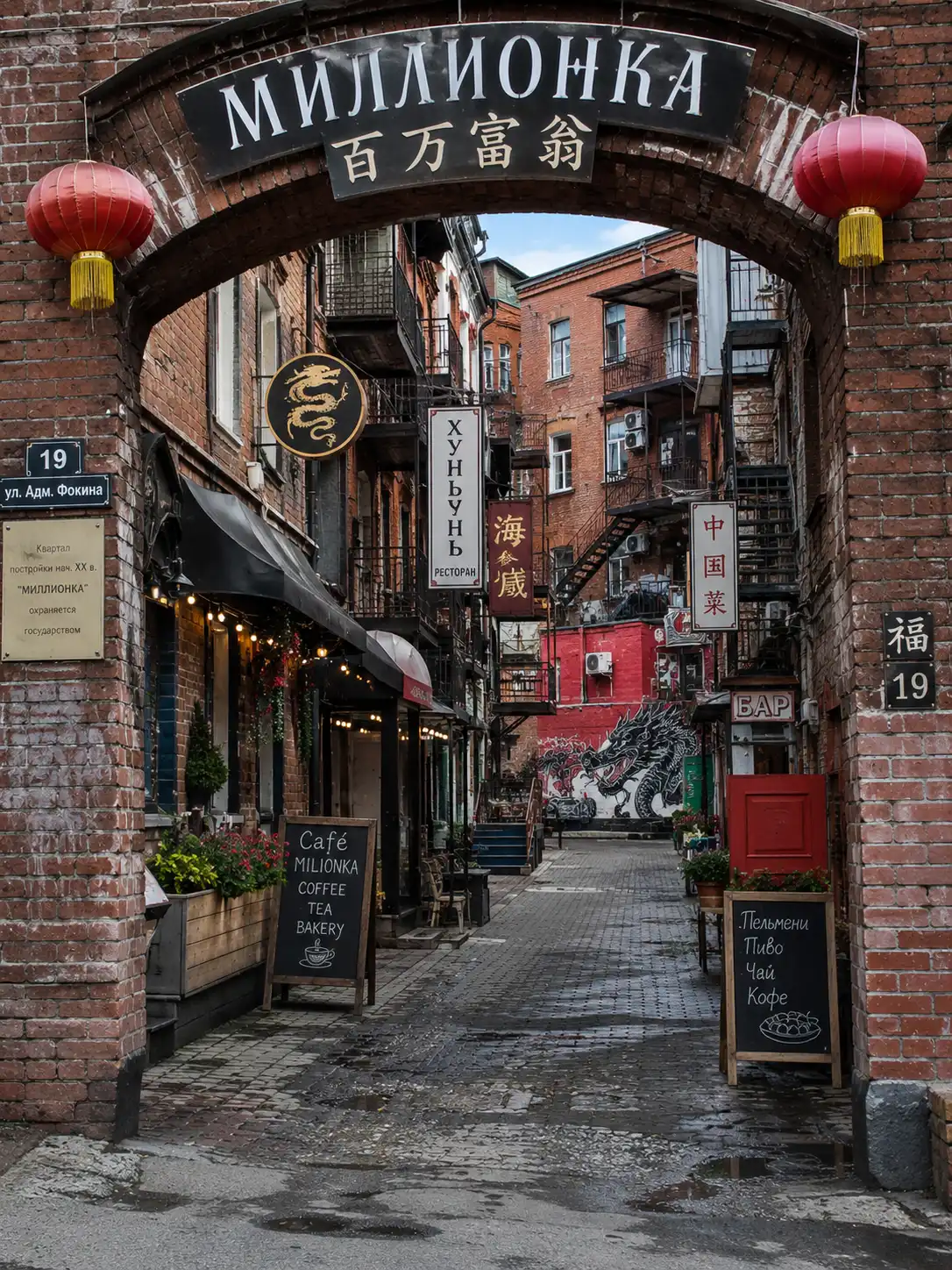
Millionka is one of the most atmospheric and historically complex neighbourhoods in Vladivostok. Hidden behind the busier streets of the city centre, the quarter consists of red-brick buildings, narrow passages, arched gateways, balconies, enclosed courtyards and irregular routes that preserve the memory of Vladivostok’s former Chinese district.
Known in Russian as Миллионка, the historic area developed during the late nineteenth and early twentieth centuries, when Vladivostok was becoming a major port, military centre and commercial meeting point between Russia and East Asia. Chinese workers, merchants, craftsmen, restaurant owners and traders formed an important part of the city’s population and economy. Their presence shaped the architecture, food culture and everyday life of the district.
Millionka was never a formally planned Chinatown with ceremonial gates and broad commercial streets. Its buildings grew in a more irregular way, producing an interconnected urban labyrinth of passageways, staircases, inner courtyards and residential blocks. The quarter is generally associated with the area between Pogranichnaya, Semyonovskaya, Admirala Fokina and Aleutskaya streets, although definitions of its exact boundaries vary.
Today, Millionka is no longer the overcrowded district described in early twentieth-century accounts. Cafés, restaurants, bars, small hotels, creative businesses and street art now occupy parts of the old quarter. However, the architectural structure remains visible, and the neighbourhood still feels different from the more formal façades of Svetlanskaya Street.
A visit is most rewarding when approached as a historical walk rather than simply a search for colourful walls. The quarter reflects migration, inequality, commerce, policing, cultural exchange and the complicated relationship between Vladivostok and its Asian neighbours.
This complete Wander Russia guide explains Millionka’s history, architecture, Chinese heritage, legends, courtyards, walking routes, guided tours, photography opportunities and practical visitor information.
Where Is Millionka?
Millionka lies in the historical centre of Vladivostok.
The most commonly described boundaries are Pogranichnaya Street, Semyonovskaya Street, Admirala Fokina Street and Aleutskaya Street. Some local interpretations include additional nearby lanes and buildings because the original Chinese residential and commercial activity was not limited by one officially defined perimeter.
The quarter is within walking distance of several major city landmarks, including Vladivostok Railway Station, Revolution Fighters Square, Svetlanskaya Street, Sportivnaya Embankment and the Arseniev Museum of Far East History.
This central location makes Millionka easy to include in a broader historical route. Visitors do not need specialised transport or a full-day excursion. The quarter can be explored during a short independent walk, although a guided tour provides considerably more historical meaning.
From the outside, Millionka can be easy to miss. Many of its most interesting spaces lie behind street-facing façades. The defining features appear after passing through an archway into an interior courtyard or following a narrow passage between buildings.
The Origins of Vladivostok’s Chinese Quarter
Vladivostok developed quickly after its establishment as a Russian military post in 1860.
The growing port required labour, construction workers, traders, food suppliers and craftsmen. Chinese migrants from neighbouring regions became deeply involved in the economic life of the young city.
They worked in markets, workshops, laundries, restaurants, transport, construction and domestic services. Wealthier Chinese merchants owned businesses and property, while poorer workers often lived in overcrowded rooms and shared accommodation.
The Chinese population was not isolated completely from the rest of Vladivostok. Commercial and social interaction occurred throughout the city. Nevertheless, Millionka became the most visible concentration of Chinese residential, commercial and entertainment life.
The buildings were constructed with limited central planning. Wealthy owners created stone tenement houses, while wooden structures, extensions, kitchens and temporary spaces filled the courtyards. This unplanned growth produced the irregular urban form that still defines the quarter.
Why Is It Called Millionka?
Several explanations exist for the name.
One widely repeated theory links it to a particularly crowded building or courtyard on Semyonovskaya Street. Because so many people lived there, residents referred to it as the “Million Yard” or simply “Million,” and the name later spread to the surrounding neighbourhood.
Another interpretation suggests that the name was ironic. Many residents were extremely poor, and the term may have played on the Russian word for millionaire.
The title did not mean that one million people actually lived there. Historical descriptions of the quarter sometimes use exaggerated language to communicate the density and intensity of life, but the literal population was far smaller.
The uncertainty surrounding the name is part of Millionka’s character. Much of its public image developed through oral stories, newspaper reports, police records and later urban legends.
Architecture of Millionka
Millionka is primarily recognised by its red-brick architecture.
The buildings were constructed during the late nineteenth and early twentieth centuries and often contain irregular façades, external balconies, metal staircases, arched passageways and internal courtyards.
Several architectural features are especially characteristic:
- Red and dark brick walls
- Arched entrances between streets and courtyards
- Narrow passageways
- Enclosed courtyard wells
- External balconies and galleries
- Decorative metal railings
- Uneven building heights
- Windows facing internal spaces
- Multiple entrances within one building
- Staircases connecting different levels
Official tourism descriptions emphasise the arches, balconies, labyrinths, decorative grilles and enclosed courtyards that distinguish the quarter from surrounding streets.
The architecture reflects practical adaptation rather than one unified artistic plan. Buildings were extended, subdivided and reused according to the needs of owners and tenants.
The Courtyard Labyrinths
The inner courtyards are the most memorable part of Millionka.
From the street, a building may appear ordinary. Passing through an arch reveals a narrow enclosed space surrounded by several floors of windows, balconies and staircases.
Some courtyards connect with additional passages, creating routes that emerge onto another street. Others end inside residential spaces.
This labyrinthine structure contributed to Millionka’s historical reputation as a place where strangers could become disoriented and where police surveillance was difficult.
The courtyards also reveal the density of former living conditions. Large numbers of residents shared limited space, sanitation and access routes.
Modern visitors should remember that many courtyards remain residential. They are not theme-park sets or permanently open museum exhibits. Noise should be kept low, doorways should not be blocked and private staircases should not be entered without permission.
Living Conditions in Old Millionka
Historical descriptions of Millionka often contrast wealthy merchant apartments with extremely overcrowded accommodation for poorer labourers.
Workers slept in small rooms, shared bunks or floor space, while poor ventilation, dampness and limited sanitation created difficult conditions. Official regional tourism material reproduces historical accounts describing cramped rooms, overcrowding and unhealthy surroundings.
This social contrast is essential to understanding the quarter.
Millionka was not simply an exotic entertainment district. It was also a place of poverty, migration and unequal labour conditions.
Wealthy merchants could control property and commerce, while temporary workers and new arrivals depended on cheap lodging and informal employment.
Presenting the quarter only through stories of gambling and secret tunnels risks ignoring the ordinary people who worked, cooked, traded, raised families and survived within these buildings.
Shops, Restaurants and Everyday Commerce
Millionka functioned as an important commercial district.
Residents and visitors could find food stalls, tea houses, workshops, laundries, lodging houses, pharmacies, small shops and restaurants.
Chinese businesses supplied both the migrant community and the wider city. Food culture became one of the strongest areas of exchange between Chinese and Russian residents.
Some businesses were formal and successful, while others operated informally from courtyards or small rooms.
The quarter’s location near the port, markets and railway made it convenient for workers, sailors, merchants and travellers.
Modern Millionka continues this commercial tradition in a different form. Cafés, restaurants, bars, studios and small hotels now occupy sections of the historic buildings.
Gambling Houses, Opium Dens and Brothels
Millionka developed a reputation for nightlife, gambling, prostitution and opium use.
Vladivostok’s official tourism information describes the old quarter as containing brothels, gambling houses and opium dens, with criminal networks operating within its dense courtyards and passages.
These activities became central to the district’s later mythology.
The stories are not entirely invented. Police records and contemporary reports confirm that illegal businesses operated in the quarter.
However, Millionka should not be reduced to criminal folklore. The emphasis placed on vice was also influenced by prejudice against migrant communities and by political campaigns seeking to control or remove Chinese residents.
The historical district contained crime, but it also contained ordinary homes, legitimate businesses, religious practices, cultural networks and mutual support.
Chinese Gangs and Urban Legends
Millionka is frequently associated with Chinese secret societies and organised criminal groups.
Some criminal networks collected payments, protected businesses or controlled gambling and opium operations. The enclosed architecture made police raids difficult and allowed people to move between connected courtyards.
Over time, these facts became mixed with stories of secret tunnels, hidden rooms, underground escape routes and mysterious disappearances.
Some underground structures and service spaces existed, but not every story can be verified. Millionka’s reputation encouraged generations of guides, journalists and residents to expand the mythology.
Visitors should enjoy the stories while distinguishing between documented history and theatrical legend.
A good guide will explain which claims are supported by evidence and which belong to local folklore.
Attempts to Remove the Chinese Population
City authorities repeatedly attempted to regulate or relocate Vladivostok’s Chinese population.
At the beginning of the twentieth century, plans were developed to move Chinese residents beyond the central city and demolish wooden houses and informal structures.
Resistance from the community prevented the complete implementation of these plans. Only part of the population was relocated, while some wooden buildings were replaced by stone structures.
These campaigns reflected concerns about sanitation, crime and urban planning, but they were also shaped by ethnic discrimination and political tension.
The Chinese community remained economically important, yet it was often treated as temporary, foreign or undesirable by authorities.
This contradiction defined much of Millionka’s history: the city depended on Chinese labour and commerce while simultaneously seeking to control or exclude the people providing them.
The End of Old Millionka
The historical Chinese quarter changed dramatically during the Soviet period.
By the 1930s, political campaigns, arrests, deportations and border-security policies brought the old Millionka community to an end.
Chinese residents were removed, businesses closed and the district lost the social networks that had defined it.
The buildings remained, but their population and function changed. Apartments, offices, storage spaces and communal housing replaced much of the former commercial and cultural life.
This transformation is why modern Millionka should be understood as an architectural survival rather than a continuously functioning Chinatown.
The Chinese community that created the quarter was largely displaced, and today’s cultural businesses represent a new phase rather than an uninterrupted tradition.
Millionka Today
Modern Millionka combines residential life, historical architecture, tourism and creative business.
Cafés, bars, restaurants, galleries, studios, hotels and shops occupy parts of the old quarter.
Street art has become another visible feature. Tourism descriptions note a series of murals known as the “Inhabitants of Millionka,” inspired by the Chinese past of the neighbourhood.
The result is visually appealing, but visitors should avoid assuming that every modern decorative feature is historically original.
Millionka is now a layered urban space. Imperial-era brickwork, Soviet alterations, contemporary murals and modern commercial signs appear beside one another.
This mixture is part of the attraction. The quarter is not preserved as a frozen nineteenth-century museum. It continues to change.
Street Art and Modern Creative Culture
Street art has helped renew interest in Millionka.
Murals referencing former residents, merchants and Chinese cultural imagery appear across several walls and courtyards.
Some works provide a visual connection with the district’s history, while others belong more broadly to Vladivostok’s contemporary creative scene.
Photography enthusiasts often focus on the contrast between bright murals and weathered brick.
The most effective images include architectural context rather than isolating the artwork completely. Balconies, pipes, arches and courtyard surfaces help show how modern interventions exist within the old quarter.
Artworks can be repainted, restored or replaced. Visitors should therefore expect the visual appearance of individual courtyards to change over time.
Admirala Fokina Street
Admirala Fokina Street forms one of the principal pedestrian approaches to Millionka.
The street is often called Vladivostok’s Arbat because of its pedestrian atmosphere, cafés, shops, fountains and street performers.
Interior courtyards leading from the street provide access to parts of the historical district. Vladivostok’s official walking-route information describes these courtyards as preserved surroundings of the early twentieth-century Chinatown.
Admirala Fokina works well as a comfortable starting or finishing point.
The contrast is immediate: the main pedestrian street feels open and active, while the courtyards behind it become narrower, darker and more irregular.
Semyonovskaya Street
Semyonovskaya Street is strongly connected with the origin of the Millionka name.
Several historical merchant buildings and crowded residential courtyards were associated with this part of the quarter.
Today, it remains one of the useful orientation streets for exploring the district.
Traffic and modern commercial activity can make the street itself feel less atmospheric than the inner passages. The historical experience begins when visitors move behind the principal façades.
Semyonovskaya also connects Millionka with public transport, markets and central Vladivostok.
Aleutskaya Street
Aleutskaya Street forms another important edge of the quarter.
It connects the railway station area with central commercial districts and contains several significant historical buildings.
The street helps place Millionka within the broader geography of old Vladivostok. The Chinese quarter was not isolated far outside the city. It stood close to major transport, trade and administrative routes.
A walking itinerary can begin at Vladivostok Railway Station, continue along Aleutskaya and enter Millionka before reaching Admirala Fokina or Svetlanskaya Street.
The Arseniev Museum and Guided Walks
The Arseniev Museum of Far East History provides valuable context for Millionka and Vladivostok’s multicultural development.
The museum’s sightseeing bureau has offered thematic walks such as “Labyrinths of Chinatown — Millionka.” Official city tourism information notes that these tours are conducted by museum staff and are particularly active during the warmer season, while bus programmes operate more frequently in winter.
A guided walk is strongly recommended for a first visit.
Many important locations have no large information boards. Without interpretation, a visitor may see only old brick walls and cafés.
A knowledgeable guide can explain property ownership, migration patterns, police campaigns, individual buildings and the difference between documented history and later legends.
Independent Walking Route
Millionka can also be explored independently.
A practical route begins near Admirala Fokina Street and enters the courtyards through one of the open arches.
Continue slowly through the passages while keeping track of the direction toward Semyonovskaya and Pogranichnaya streets.
Return to the main pedestrian areas rather than entering uncertain private corridors.
An independent visit should last approximately one hour.
The purpose is not to enter every courtyard. A shorter route that respects residents is better than aggressive exploration of private spaces.
Offline maps are useful, but GPS signals can become less accurate between dense buildings.
How Much Time Is Needed?
A brief independent walk requires approximately 30 to 45 minutes.
A more thoughtful self-guided exploration takes around one to one and a half hours.
A guided historical tour may last between one and a half and two hours.
Combining Millionka with the Arseniev Museum, Admirala Fokina Street and Svetlanskaya Street can create a half-day programme.
The quarter is compact, but understanding it requires more time than simply walking through.
Best Time to Visit
Millionka can be visited throughout the year.
Late spring, summer and early autumn offer the most comfortable conditions for courtyard walking.
Summer brings cafés, street activity and longer daylight, although the quarter can become crowded.
September and October often provide attractive light and cooler temperatures.
Winter creates a different atmosphere. Snow and ice emphasise the enclosed architecture, but courtyards and staircases can become slippery.
Rain can make brick surfaces, metal stairs and uneven paving dangerous.
The quarter is especially photogenic in soft morning or late-afternoon light.
Photography Tips
Millionka is well suited to architectural and street photography.
A wide-angle lens helps capture narrow courtyards and tall enclosed walls.
A standard lens works well for balconies, arches, murals and environmental portraits.
Visitors should look for repeating patterns in windows, railings, staircases and brickwork.
Light changes quickly inside enclosed courtyards. One side may remain dark while sunlight reaches only upper floors.
Photographing residents without permission should be avoided.
Tripods can block narrow passages and are generally unnecessary during daylight.
Safety and Visitor Etiquette
Millionka lies in the city centre and is generally straightforward to visit.
The most realistic risks are uneven surfaces, slippery stairs, vehicle access through narrow courtyards and entering private or poorly maintained areas.
Visitors should:
- Remain in publicly accessible passages
- Avoid locked or marked private doors
- Keep noise low
- Avoid climbing external staircases without permission
- Watch for cars entering courtyards
- Wear shoes with reliable grip
- Avoid poorly lit passages late at night
- Respect residents and local businesses
The historical reputation of Millionka should not be confused with current conditions. It is no longer the criminal district described in early twentieth-century accounts.
Combining Millionka with Nearby Attractions
Millionka fits naturally into a central Vladivostok walking route.
A balanced itinerary can include:
- Vladivostok Railway Station
- Aleutskaya Street
- Millionka
- Admirala Fokina Street
- Arseniev Museum
- Svetlanskaya Street
- Revolution Fighters Square
- Sportivnaya Embankment
This route combines migration history, architecture, museums, public spaces and the maritime atmosphere of central Vladivostok.
Is Millionka Worth Visiting?
Millionka is essential for travellers who want to understand Vladivostok as a multicultural Pacific city.
The bridges and viewpoints reveal the city’s modern image. The fortress and naval memorials explain its strategic role. Millionka reveals the human complexity created by migration, trade and proximity to East Asia.
Its value lies not in one monumental building but in the complete urban fabric.
Arches, courtyards and brick walls preserve traces of a community that played a major role in Vladivostok’s development but was later removed.
Wander Russia recommends exploring the quarter with a guide at least once. Independent walking can show the architecture, but historical interpretation reveals why the neighbourhood matters.
Frequently Asked Questions
Where is Millionka?
It lies in central Vladivostok, generally between Pogranichnaya, Semyonovskaya, Admirala Fokina and Aleutskaya streets.
Was Millionka Vladivostok’s Chinatown?
Yes. It was the city’s main historical Chinese residential and commercial district, although it was never formally planned as a ceremonial Chinatown.
Why is it called Millionka?
The name may derive from an overcrowded “Million Yard” on Semyonovskaya Street or from an ironic reference to the poverty of residents.
Is Millionka free to visit?
Yes. Public streets and open courtyards can generally be explored without an entrance fee. Guided tours have separate charges.
How long does a visit take?
Allow approximately one hour independently or up to two hours with a guided historical tour.
Is it safe?
The central quarter is generally accessible, but visitors should avoid private, abandoned or poorly lit areas and take care on uneven surfaces.
Are the courtyards residential?
Yes. Many spaces remain part of residential or commercial buildings and should be entered respectfully.
When is the best time to visit?
Late spring through early autumn provides the most comfortable walking conditions.
Can Millionka be visited at night?
Restaurants and bars may make the area active after dark, but historical courtyard exploration is easier and safer during daylight.
Is a guide necessary?
It is not required, but a guide provides valuable historical context and helps distinguish documented events from legends.
Conclusion
Millionka is one of Vladivostok’s most layered historical districts.
Its red-brick buildings and narrow courtyards preserve the physical shape of a community that played a major role in the development of the city. Chinese workers built, transported, cooked, traded and provided services during a period of rapid urban growth.
The quarter also reveals the contradictions of that history.
Vladivostok depended on Chinese labour and commerce, yet local authorities repeatedly attempted to regulate, relocate or remove the community. Wealth existed beside severe poverty. Legitimate businesses stood beside gambling houses and opium dens. Cultural exchange developed within an atmosphere of discrimination and political tension.
Modern Millionka is different. Cafés, murals, hotels and creative businesses now occupy parts of the old district. The courtyards attract visitors rather than hiding overcrowded lodging houses.
However, the architecture still communicates the past. Arched entrances, internal galleries and enclosed courtyard wells show how densely people once lived and worked.
The most responsible way to visit is to look beyond the legends. Stories of secret societies and hidden tunnels are entertaining, but Millionka’s deeper significance lies in migration, labour, urban inequality and the multicultural identity of the Russian Far East.
For Wander Russia, the quarter provides an essential counterpoint to Vladivostok’s monumental attractions.
The Golden and Russky bridges represent modern engineering. Eagle’s Nest presents the city from above. The Pacific Fleet Memorial explains naval history. Millionka brings attention back to the people who lived behind ordinary walls and shaped the city through daily work.
