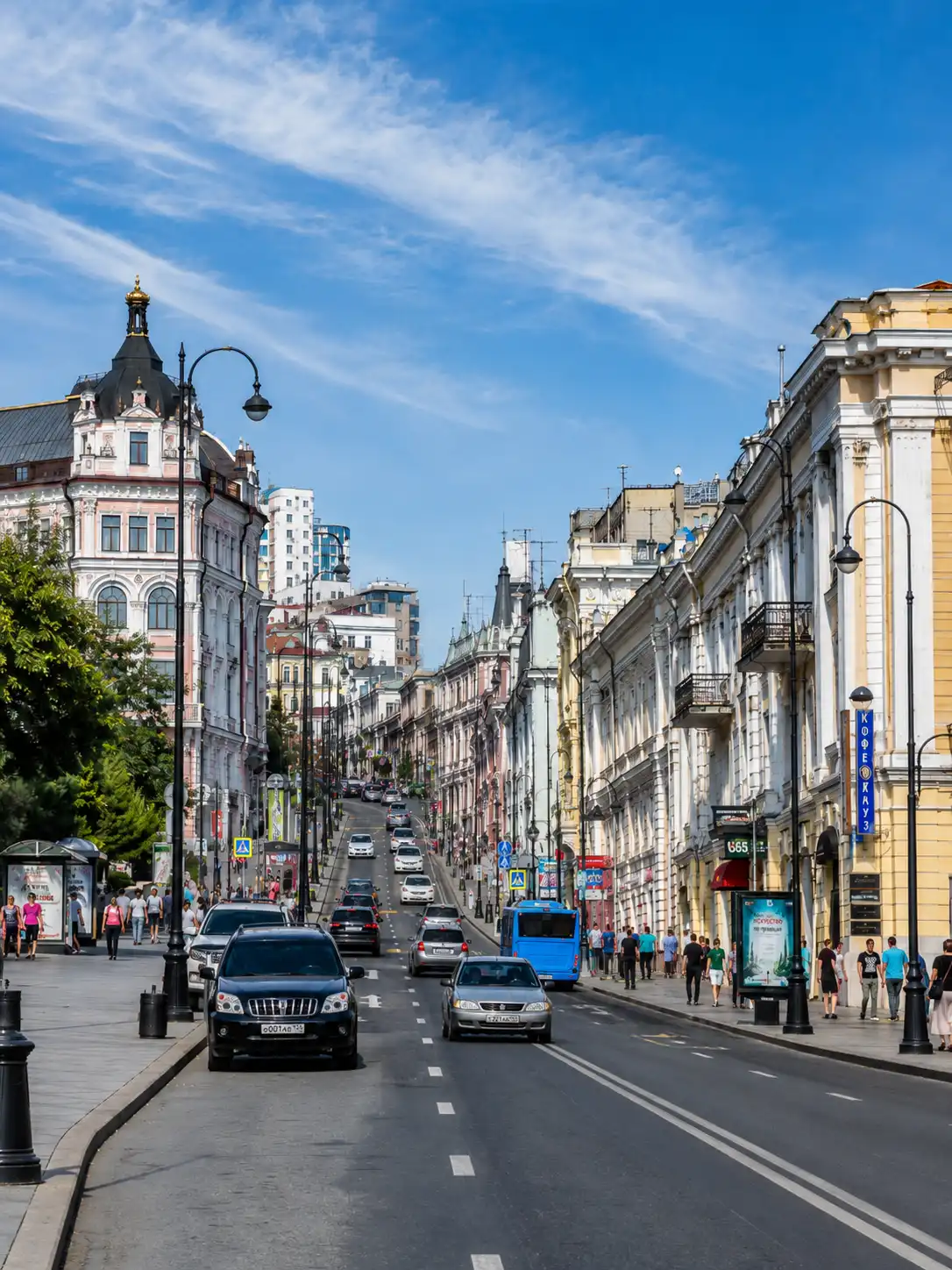
Svetlanskaya Street is the historical backbone of Vladivostok and one of the most useful places for understanding how the city developed from a small military post into a major Pacific port. Stretching through the centre beside the hills and waters of Golden Horn Bay, the street connects architectural landmarks, museums, public squares, monuments, commercial buildings and several of Vladivostok’s most important historical districts.
Known in Russian as Светланская улица, Svetlanskaya is not a pedestrian promenade in the strict sense. It remains an active urban road used by buses, cars and everyday city traffic. Its value lies in the concentration of history along its route. Merchant houses, former hotels, administrative buildings, museums and public spaces preserve the appearance of Vladivostok during the late nineteenth and early twentieth centuries, while modern businesses and transport show that the street continues to function as part of the living city.
The most rewarding section for visitors begins near Vladivostok Railway Station and the western end of the historic centre, continues past the Arseniev Museum, Revolution Fighters Square and Korabelnaya Embankment, and then follows the curve of Golden Horn Bay toward the eastern districts. This route reveals how closely Vladivostok’s architecture is connected with its coastal geography.
Svetlanskaya should not be treated as one individual attraction requiring a ticket. It is better experienced as a historical walking corridor connecting many separate places. A short walk may focus on the central blocks, while a deeper exploration can occupy half a day when museums, courtyards and nearby memorials are included.
This Wander Russia guide explains the history of Svetlanskaya Street, its name, architecture, principal buildings, museums, walking routes, transport, photography and the best way to include it in a Vladivostok itinerary.
Where Is Svetlanskaya Street?
Svetlanskaya Street runs through the historical centre of Vladivostok, broadly following the northern side of Golden Horn Bay.
Its western section lies close to Vladivostok Railway Station, Aleutskaya Street, the central square and the lower historic districts. Farther east, the street passes near Korabelnaya Embankment, the Pacific Fleet memorial area, government buildings, theatres and neighbourhoods extending along the bay.
The road follows the coastal contours rather than cutting through the city in a completely straight line. This reflects Vladivostok’s difficult topography. The historic centre developed between steep hills and the harbour, so streets were shaped by slopes, bays and limited flat land. Svetlanskaya became the main route running parallel to Golden Horn Bay, while streets crossing it climb sharply toward the hills.
The complete street is several kilometres long, but visitors normally concentrate on the central section. The most historically interesting area can be explored comfortably on foot, although traffic, road crossings and elevation changes must be considered.
The First Main Street of Vladivostok
Svetlanskaya is generally regarded as Vladivostok’s first and principal historical street.
The original settlement was established beside Golden Horn Bay in 1860. As the military post grew, the earliest administrative, commercial and residential buildings appeared close to the harbour. The street later became the main urban axis connecting these developing areas.
The first city plan organised Vladivostok into blocks adapted to the shoreline and surrounding hills. Svetlanskaya emerged as the principal route running along the bay, while Aleutskaya became the important cross-city street connecting the port area with the inland section of the peninsula. Their intersection near the railway station helped define the historical structure of central Vladivostok.
This early urban role explains why so many major buildings appeared along Svetlanskaya. Banks, shops, hotels, administrative offices, theatres and merchant houses wanted addresses on the city’s most visible and commercially active street.
Why Is It Called Svetlanskaya?
The street was originally known as Amerikanskaya Street, a name connected with the Russian corvette Amerika.
In 1873, it was renamed Svetlanskaya in honour of the frigate Svetlana, which brought Grand Duke Alexei Alexandrovich to Vladivostok during his visit to the Russian Far East.
During the Soviet period, the street was renamed Leninskaya. The historical name Svetlanskaya was restored during the 1990s.
These successive names reflect the political history of Vladivostok. Amerikanskaya belonged to the earliest maritime period, Svetlanskaya reflected imperial Russia, Leninskaya represented the Soviet era, and the return to Svetlanskaya restored the older historical identity.
The name is sometimes translated incorrectly as Svetlana Street, but Svetlanskaya is an adjectival form associated with the frigate rather than simply the female name Svetlana.
The Architectural Character of Svetlanskaya
Svetlanskaya contains one of the strongest concentrations of late imperial architecture in Vladivostok.
Many buildings were constructed during the rapid growth of the port in the late nineteenth and early twentieth centuries. Merchants, shipping companies, banks and trading houses invested in substantial brick and stone buildings intended to display wealth and stability.
Architectural styles vary. Visitors can find elements of Russian Revival, Art Nouveau, neoclassicism, eclectic European design and practical commercial architecture.
The buildings are generally not monumental in the scale of Saint Petersburg or Moscow. Their importance comes from the way they form a coherent urban street adapted to a Pacific port city.
Decorative façades often include:
- Arched windows
- Balconies
- Cornices and mouldings
- Corner towers
- Decorative brickwork
- Classical columns
- Art Nouveau curves
- Historic shopfront proportions
- Roof ornaments
- Inner courtyards and passageways
The official regional tourism portal describes Svetlanskaya as a street where late nineteenth- and early twentieth-century buildings stand beside museums, theatres and modern business centres.
The Relationship with Golden Horn Bay
Svetlanskaya developed in close connection with Golden Horn Bay.
The harbour provided the economic reason for the growth of Vladivostok. Ships delivered goods, workers and travellers, while businesses established offices and shops near the waterfront.
The street therefore became a meeting point between maritime activity and urban commerce.
Although later construction, roads and port infrastructure altered direct access to the water, the bay remains visually and historically connected with the street. Several side routes lead toward Korabelnaya Embankment, the Pacific Fleet memorial and views of the Golden Bridge.
Walking along Svetlanskaya helps visitors understand why Vladivostok grew in a long, narrow pattern beside the harbour rather than around one central inland square.
Revolution Fighters Square
Revolution Fighters Square is one of the principal public spaces connected with Svetlanskaya Street.
The square is dominated by a large Soviet monument commemorating the struggle for Soviet power in the Russian Far East. It remains an important location for public ceremonies, gatherings and city events.
The open space contrasts with the narrower historic streets surrounding it. From the square, visitors can orient themselves toward the railway station, waterfront, Svetlanskaya Street and nearby commercial districts.
The square is also useful as a starting point for a walking route because several major attractions lie within a short distance.
Its present monumental appearance belongs primarily to the Soviet period, but the location has long served as a central urban meeting point.
Arseniev Museum of Far East History
The main building of the Vladimir K. Arseniev Museum of Far East History stands at Svetlanskaya Street 20.
The museum traces its origins to the Society for the Study of the Amur Region, founded in 1884. Its first museum building opened to the public in 1890, making the institution one of the oldest and most important museums in the Russian Far East.
The current main building was originally constructed as a commercial property associated with the Churin and Kasyanov trading house. It later housed various organisations before becoming the museum’s principal location.
The collections cover archaeology, Indigenous cultures, regional exploration, nature, trade, urban development and the history of Primorsky Krai.
A museum visit adds depth to the Svetlanskaya walk. The street shows the architecture of Vladivostok, while the museum explains the broader region that supported and shaped the city.
Current exhibitions and opening hours should be verified through the museum’s official information before arrival.
Versailles Hotel
The historic Versailles Hotel is one of the best-known architectural landmarks near the western section of Svetlanskaya Street.
The Art Nouveau building was completed in 1909 and designed as a fashionable hotel with shops and an elegant restaurant. Vladivostok’s official tourism portal identifies it as one of the city’s significant architectural heritage sites.
The hotel became associated with travellers, diplomats, merchants and political figures passing through the Pacific port.
Its façade illustrates the international character of pre-revolutionary Vladivostok. The city was connected not only with inland Russia but also with Japan, China, Korea, Europe and maritime routes across the Pacific.
Visitors can appreciate the architecture from the street even when not staying in the building.
Historic Trading Houses
Several buildings along Svetlanskaya were constructed for trading companies that became wealthy during Vladivostok’s rapid commercial expansion.
These firms imported and exported goods, operated warehouses, financed transport and supplied the growing population.
The architecture often communicated reliability and international ambition. Large windows, decorated façades and prominent corner locations helped attract customers and business partners.
Some buildings have changed function several times. Former trading houses now contain offices, shops, museums or other public institutions.
The ability of these structures to adapt has helped preserve the historical street. Their interiors may be modern, but the façades continue to show the economic confidence of the early Pacific city.
Soviet Architecture and Urban Layers
Svetlanskaya is not preserved exclusively as an imperial-era street.
Soviet buildings, monuments and alterations form another important layer. Some earlier façades were simplified, shops were reorganised and new administrative buildings appeared.
The Soviet period also changed the symbolic identity of the street when it became Leninskaya.
After the restoration of the Svetlanskaya name, the Soviet buildings and monuments remained. This creates a layered streetscape rather than a reconstructed imperial theme.
Visitors can therefore read the street as a sequence of historical periods: imperial trade, revolution, Soviet administration, post-Soviet commerce and contemporary city life.
The GUM Building and Commercial Heritage
Vladivostok’s historic department-store and commercial buildings form an important part of the Svetlanskaya experience.
Large trading complexes introduced urban retail culture to the rapidly expanding port city. Imported goods, clothing, food and household products were sold to residents, officials, sailors and visitors.
Some buildings developed internal courtyards and passages that remain interesting today.
Modern shops and cafés continue the commercial function, even when the products and interiors have changed completely.
The street therefore remains faithful to one of its original roles: it is still a place where people shop, meet, travel and conduct business rather than a historical zone separated from everyday life.
The Dynamo Stadium and Eastern Svetlanskaya
Farther east, Svetlanskaya extends beyond the densest concentration of tourist landmarks.
The street becomes increasingly mixed, with administrative buildings, residential areas, sports facilities and everyday neighbourhood life.
This section is useful for travellers who want to see Vladivostok beyond the central postcard views.
The full street reveals that Svetlanskaya is not merely a preserved historical strip. It remains a functioning urban route connecting multiple districts along Golden Horn Bay.
Most first-time visitors do not need to walk its entire length. The central section contains the highest concentration of major attractions, while the eastern sections are better suited to travellers with additional time or a strong interest in urban geography.
Walking the Central Section
A practical walking route begins near Vladivostok Railway Station.
From the station, continue toward Aleutskaya Street and the western end of Svetlanskaya. Walk past historic commercial buildings and the Versailles Hotel before reaching the Arseniev Museum.
Continue toward Revolution Fighters Square, where the wide public space provides a break from the denser street.
From there, follow Svetlanskaya toward the entrances leading down to Korabelnaya Embankment, the Pacific Fleet Memorial and Submarine S-56.
The walk can continue toward the Tsarevich Triumphal Arch and other historic buildings farther east.
A basic route requires approximately two hours without entering museums. Adding the Arseniev Museum, S-56 and nearby waterfront monuments can extend the programme to half a day.
Connecting Svetlanskaya with Millionka
Millionka Historic Quarter lies close to the western and central sections of Svetlanskaya.
Combining the two areas provides a broader understanding of Vladivostok’s multicultural history.
Svetlanskaya represents the formal commercial and administrative face of the city. Millionka reveals the dense courtyards and migration history hidden behind the main streets.
The contrast is valuable. Grand merchant façades and official buildings stand only a short distance from the former Chinese residential district.
A walking route can begin on Svetlanskaya, enter Millionka through Admirala Fokina or nearby passages, and then return toward the central square or waterfront.
Connecting Svetlanskaya with Korabelnaya Embankment
Korabelnaya Embankment lies below parts of Svetlanskaya near Golden Horn Bay.
The waterfront contains the Pacific Fleet Memorial Complex, S-56 submarine, Krasny Vympel memorial ship and the Chapel of Saint Andrew.
This combination connects civilian city history with naval history.
Svetlanskaya explains the growth of commerce, administration and urban architecture. Korabelnaya Embankment explains the military and maritime foundations of Vladivostok.
The two areas should ideally be explored together.
Public Transport
Svetlanskaya remains one of Vladivostok’s major transport corridors.
Buses and other public transport services use the street and nearby stops, making it easy to reach from different districts.
Traffic can be heavy during busy periods. The street is not fully pedestrianised, and road crossings require attention.
Visitors should use designated crossings and avoid stepping into traffic while photographing architecture.
Public transport routes can change, so current local navigation applications are more reliable than older printed guides.
Because the central section is compact, walking is generally the best method once visitors arrive.
Best Time to Visit
Svetlanskaya can be explored throughout the year.
Late spring brings improving weather, longer daylight and comfortable walking conditions.
Summer provides the liveliest atmosphere. Cafés, public spaces and central attractions are active, although humidity, fog and traffic can reduce comfort.
September and early October are often especially rewarding. Cooler temperatures, clearer air and softer light improve architectural photography.
Winter creates a more severe cityscape. Snow and cold emphasise the historic façades, but pavements and steps can become icy.
The central museums and cafés make Svetlanskaya a practical destination even during poor weather.
Best Time of Day
Morning is ideal for architectural photography because traffic and pedestrian numbers may be lower.
Late morning and afternoon are better for museums, shops and a more active urban atmosphere.
Evening lighting can create attractive views of historic façades, public squares and nearby waterfronts.
The street remains active after dark, but detailed architectural exploration is easier during daylight.
A successful itinerary may begin with a morning walk, include a museum during midday and finish at Korabelnaya Embankment or Eagle’s Nest Hill near sunset.
Photography Tips
Svetlanskaya is ideal for urban and architectural photography.
A wide-angle lens is useful for complete façades, but very wide lenses can distort buildings when used too close.
A standard lens produces more natural proportions and works well for street scenes.
Useful subjects include:
- Historic corner buildings
- Decorative balconies
- Arched windows
- Old shopfronts
- Street signs
- Public monuments
- Views toward Golden Horn Bay
- Modern traffic beside historic façades
- Courtyard entrances
- Evening illumination
Visitors should avoid standing in the road or blocking building entrances.
The most interesting photographs often show the contrast between old architecture and modern city life rather than attempting to remove cars, signs and pedestrians entirely.
Accessibility
The central section of Svetlanskaya has paved pavements and access to public transport, but Vladivostok’s hills create challenges.
Some side streets and museum approaches involve slopes, stairs or uneven paving.
The main route is generally manageable for visitors with normal mobility, but wheelchair users should plan crossings and building entrances carefully.
Winter snow and ice can significantly reduce accessibility.
Taxis can shorten the distance between major landmarks when a full walking route is impractical.
Safety and Visitor Etiquette
Svetlanskaya is a central urban street and generally straightforward to explore.
The main risks are traffic, slippery pavements, crowded crossings and winter ice.
Visitors should:
- Use marked pedestrian crossings
- Keep valuables secure in busy areas
- Avoid photographing from the roadway
- Respect entrances to offices and residences
- Wear shoes suitable for hills
- Check museum schedules before arrival
- Allow extra time during heavy traffic
- Remain alert around buses and turning vehicles
Historic façades and courtyards should be treated respectfully. Decorative architectural elements should not be climbed or touched unnecessarily.
Is Svetlanskaya Street Worth Visiting?
Svetlanskaya is essential for understanding Vladivostok.
It may not provide one dramatic experience comparable with Russky Bridge or Cape Tobizina. Its value is cumulative.
Walking along the street reveals how the city developed around trade, maritime transport, migration, administration and the difficult geography of Golden Horn Bay.
The architecture provides continuity between different historical periods, while museums and nearby memorials add cultural depth.
Wander Russia recommends using Svetlanskaya as the central route connecting several major Vladivostok attractions rather than treating it as a short isolated stop.
Frequently Asked Questions
Where is Svetlanskaya Street?
It runs through the historic centre of Vladivostok, broadly parallel to Golden Horn Bay.
Why is it important?
It was the city’s first major street and became the principal commercial, administrative and cultural axis of early Vladivostok.
Why is it called Svetlanskaya?
It was renamed in 1873 after the frigate Svetlana, which brought Grand Duke Alexei Alexandrovich to Vladivostok.
Was it always called Svetlanskaya?
No. It was originally Amerikanskaya Street and was called Leninskaya during the Soviet period. The historical name returned in the 1990s.
How long is needed for a visit?
Allow approximately two hours for the central section. A half-day is better when museums and waterfront attractions are included.
Is Svetlanskaya pedestrianised?
No. It remains an active road carrying city traffic.
What are the main attractions?
The Arseniev Museum, Revolution Fighters Square, historic merchant buildings, the Versailles Hotel and nearby access to Korabelnaya Embankment are among the principal sights.
Can it be combined with Millionka?
Yes. Millionka lies close to the central section and creates an excellent combined historical walk.
When is the best time to visit?
Late spring through early autumn provides comfortable walking conditions, while September and early October often offer especially attractive light.
Is the street free to explore?
Yes. Walking along Svetlanskaya is free, although museums and individual attractions may charge admission.
Conclusion
Svetlanskaya Street is the historical thread connecting many of Vladivostok’s most important stories.
The city began beside Golden Horn Bay as a military post, but its growth depended on much more than naval strategy. Merchants, railway workers, migrants, officials, sailors and foreign companies transformed Vladivostok into a commercial Pacific city.
Svetlanskaya became the stage on which that transformation was most visible.
Trading houses, hotels, banks and administrative buildings appeared along the street. Their façades reflected international ambition and the confidence of a port connected with Russia, East Asia and the wider Pacific.
Later political periods added new layers. The street became Leninskaya, Soviet monuments reshaped nearby public spaces and administrative buildings altered the urban landscape. The restoration of the Svetlanskaya name did not remove those later layers. Instead, the street now presents several periods of Vladivostok’s history at once.
Its greatest strength is connection.
From Svetlanskaya, travellers can reach Vladivostok Railway Station, Millionka, the Arseniev Museum, Revolution Fighters Square, Korabelnaya Embankment, the Pacific Fleet Memorial and several viewpoints toward Golden Horn Bay.
No single building defines the experience. The meaning emerges gradually while walking.
For travellers following Wander Russia through Vladivostok, Svetlanskaya provides the most effective route through the historical centre. It connects architecture with geography, commerce with maritime history and the formal city with the hidden courtyards behind it.
The bridges may define modern Vladivostok from a distance, but Svetlanskaya reveals how the city developed at street level.
