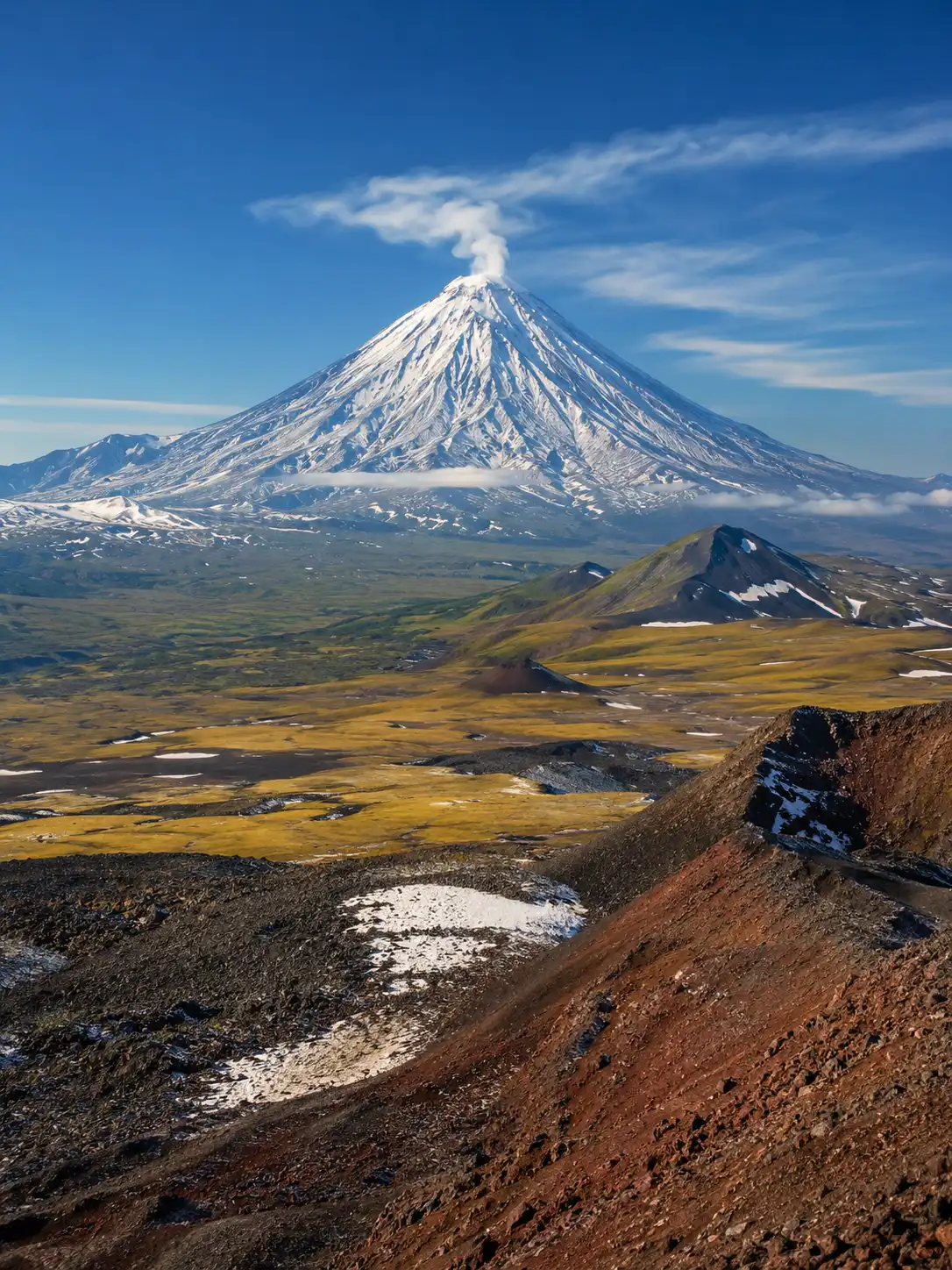
Klyuchevskaya Sopka is the defining summit of central Kamchatka. Rising as an almost symmetrical cone above forests, tundra and neighbouring volcanoes, it is widely regarded as the highest active volcano in Eurasia and one of the most powerful volcanic landmarks in Russia.
Known in Russian as Ключевская сопка or Ключевской вулкан, the mountain reaches approximately 4,750 metres above sea level. Its height can vary slightly between measurements because eruptions, crater collapse, snow and volcanic deposits continually alter the summit.
Klyuchevskaya Sopka stands within Klyuchevskoy Nature Park, a vast protected landscape containing some of the most active and visually impressive volcanoes on the Kamchatka Peninsula. The park includes Klyuchevskaya Sopka, Bezymianny, Plosky Tolbachik, Ostry Tolbachik, Kamen, Ushkovsky and several additional peaks, lava fields and glacier systems.
For ordinary travellers, the main experience is not necessarily climbing the summit. The volcano can be appreciated from Klyuchi village, mountain camps, tundra routes, off-road expeditions and multiday treks through the wider park. These journeys offer views of active cones, enormous glaciers, ash-covered plains and landscapes shaped by repeated eruptions.
A full ascent of Klyuchevskaya Sopka belongs to a completely different category. It is a serious and dangerous mountaineering expedition exposed to altitude, falling volcanic material, ice, avalanches, rapid weather changes and sudden eruptive activity. It should never be treated as a standard tourist hike.
This Wander Russia guide explains the volcano, the surrounding nature park, the best viewpoints, practical routes, access, safety and the most suitable period for visiting central Kamchatka.
Where Is Klyuchevskaya Sopka?
Klyuchevskaya Sopka lies in the central part of the Kamchatka Peninsula, approximately 360 kilometres north of Petropavlovsk-Kamchatsky by road.
The nearest major settlement is Klyuchi, a village on the Kamchatka River northeast of the volcano. Kozyrevsk, farther southwest, serves as another important base for journeys into Klyuchevskoy Nature Park and the Tolbachik region.
The volcano belongs to the Klyuchevskaya group, one of the most concentrated volcanic complexes in Kamchatka. Several high mountains stand within a relatively compact area, creating a landscape often called the Valley of the Giants.
The main road through central Kamchatka allows travellers to reach Klyuchi, Kozyrevsk and nearby settlements, but access inside the nature park usually requires off-road vehicles, river crossings and travel on unpaved tracks.
The journey from Petropavlovsk-Kamchatsky normally takes most of a day. Road conditions, construction, weather and stops can extend the travel time.
Because of the distance, Klyuchevskaya Sopka should not be planned as a day trip from the regional capital. Most meaningful itineraries require several days and often form part of a longer expedition through central Kamchatka.
The Highest Active Volcano in Eurasia
Klyuchevskaya Sopka is commonly described as the highest active volcano in Eurasia.
Its elevation is usually given as approximately 4,750 to 4,754 metres. Small variations appear in scientific and cartographic sources because the summit changes over time.
The mountain rises dramatically above the surrounding plain. Its conical structure is formed from repeated layers of lava, ash, scoria and other volcanic material deposited during thousands of years of eruptions.
The volcano is geologically young. Its modern cone developed during the Holocene period, and frequent eruptions have continued to reshape its slopes and summit crater.
More than one hundred secondary cones and eruptive centres have formed on the flanks during roughly the past three thousand years. Many are arranged along radial fissures where magma has moved outward from the central volcanic system.
The summit crater is several hundred metres across and changes during strong explosive or effusive events. Lava can emerge from the summit or from openings on the flanks, while ash plumes may rise high enough to affect aviation across the North Pacific.
Its exceptional height and activity make Klyuchevskaya Sopka scientifically important as well as visually impressive.
Why the Volcano Has Such a Perfect Shape
Klyuchevskaya Sopka appears unusually symmetrical when viewed from Klyuchi or the surrounding plain.
This form results from repeated eruptions building successive layers around a central vent. Lava flows spread down the sides, while ash and fragmented material accumulate across the slopes.
The mountain’s isolated position also makes the cone appear more regular than it actually is. At closer range, the surface contains deep gullies, lava channels, secondary cones, snowfields and areas damaged by eruptions.
The upper slopes are extremely steep and unstable. Volcanic gravel, ice and loose rock create a surface that constantly changes under gravity, weather and geothermal heat.
Its famous silhouette is therefore not a smooth or simple mountain. It is a complex structure shaped by continuous construction and erosion.
When the summit is clear, a plume of steam or gas may drift from the crater. During eruptive phases, ash, incandescent material and lava flows can dramatically alter the appearance of the cone.
A Brief History of Eruptions
Klyuchevskaya Sopka has one of the most active eruptive histories in Kamchatka.
Its first recorded eruption dates to the late seventeenth century, but geological evidence shows that the volcano had been active long before written observations began.
Historical eruptions have included summit explosions, ash columns, lava fountains, lava flows and flank eruptions. Some phases last only a limited period, while others continue intermittently for months or years.
The volcano has produced frequent activity during the twenty-first century. Eruptions have sent ash across large distances, created lava flows on several flanks and generated glowing nighttime scenes visible from surrounding settlements.
A particularly significant eruptive phase occurred in 2023, when strong explosive activity and lava flows were observed. Further renewed activity was reported in 2025.
The situation can change rapidly. A volcano may appear quiet for weeks before seismic activity, gas emissions or ash production increase.
No travel article can provide a permanent assessment of current conditions. Visitors must consult the latest information from volcanic monitoring organisations, park authorities and regional emergency services shortly before departure.
Klyuchevskoy Nature Park
Klyuchevskoy Nature Park protects the central volcanic group surrounding Klyuchevskaya Sopka.
The park covers approximately 376,000 hectares and contains thirteen major volcanoes, including active and extinct structures. Its combination of young cones, glacier systems, lava fields, tundra and forests creates one of the most concentrated volcanic landscapes in the world.
Klyuchevskaya Sopka is the most famous mountain, but the park’s character depends on the entire group.
Kamen Volcano rises beside Klyuchevskaya as a steep and deeply eroded extinct peak. Bezymianny is an active volcano known for a catastrophic eruption in the twentieth century and continuing dome growth. Ushkovsky supports extensive ice fields, while Tolbachik is associated with enormous lava fields and the Dead Forest.
The interaction between these volcanoes makes the park valuable for scientific research. Different peaks demonstrate different volcanic forms, eruption styles and stages of erosion.
The park also supports wildlife, river systems and vegetation adapted to frequent natural disturbance. Brown bears, foxes, ground squirrels and numerous bird species inhabit the broader landscape.
Klyuchevskoy Nature Park forms an important component of the UNESCO World Heritage property Volcanoes of Kamchatka.
The Valley of the Giants
The central volcanic group is sometimes promoted as the Valley of the Giants.
The name reflects the extraordinary concentration of high peaks visible from the plateau. Klyuchevskaya Sopka, Kamen, Ushkovsky, Krestovsky, Bezymianny and other volcanoes rise around broad valleys shaped by glaciers and volcanic deposits.
A traveller standing on the tundra may see several major volcanoes without changing location. Their forms differ sharply: Klyuchevskaya is conical and active, Kamen is jagged and eroded, Ushkovsky is broad and glaciated, while Bezymianny has a truncated summit and active lava dome.
This diversity is one of the strongest reasons to visit the park. The experience is not limited to checking one famous summit from a list. It provides a wider understanding of how volcanic landscapes evolve.
Some trekking routes cross open plains between these mountains. Others lead to observation points, mountain huts or camps where the peaks dominate the horizon.
Weather determines what can be seen. Entire volcanoes may disappear behind cloud, while brief clear periods can reveal several summits at once.
Kamen Volcano
Kamen stands southwest of Klyuchevskaya Sopka and reaches approximately 4,580 metres.
Although it is slightly lower, its steep ridges and broken summit can make it appear more severe. The mountain is considered extinct or no longer active in the modern sense.
Kamen was once a larger volcanic structure. A major prehistoric collapse removed a substantial part of the eastern side, leaving a dramatic cliff facing Klyuchevskaya Sopka.
The mountain is one of the most difficult climbing objectives in Kamchatka. Its unstable rock, steep walls and glaciated terrain make it unsuitable for ordinary tourism.
Most visitors experience Kamen from viewpoints within the park. Its dark, rugged profile provides a strong contrast to the smoother cone of Klyuchevskaya.
Bezymianny Volcano
Bezymianny is one of the most scientifically important volcanoes in central Kamchatka.
Its name means “Nameless” in Russian. For a long period, it was considered inactive until signs of unrest began in 1955.
A catastrophic eruption in March 1956 destroyed the summit, produced a massive lateral blast and created a large horseshoe-shaped crater. The event is often compared with the later 1980 eruption of Mount St. Helens because both involved structural collapse and directed explosive activity.
After the eruption, a lava dome began growing inside the crater. Bezymianny has remained active, producing repeated explosions, ash clouds and dome changes.
The volcano can be viewed from several park routes, but access depends heavily on current activity. Exclusion zones may be enlarged when the risk of explosions, pyroclastic flows or ashfall increases.
The presence of Bezymianny reinforces an important principle for travelling in Klyuchevskoy Nature Park: several volcanoes may be active at the same time, and route safety depends on the entire volcanic group rather than one mountain alone.
Ushkovsky and the Glacier Landscapes
Ushkovsky is a broad volcanic massif northwest of Klyuchevskaya Sopka.
Its summit consists of several connected structures covered by extensive snowfields and glaciers. Unlike the sharp cone of Klyuchevskaya, Ushkovsky appears wide and heavily glaciated.
The ice systems of the central group feed rivers and influence the landscape far beyond the summits. Meltwater cuts channels through volcanic ash, creates unstable riverbeds and affects seasonal road access.
Glaciers also introduce additional hazards. Crevasses, falling ice and sudden meltwater flows make independent travel dangerous.
Most visitors admire Ushkovsky from a distance during park expeditions. Specialist climbers and scientific teams require suitable glacier equipment and professional planning.
Klyuchi Village
Klyuchi is one of the most practical bases for viewing Klyuchevskaya Sopka.
The village lies on the Kamchatka River northeast of the volcano. On clear days, the cone rises prominently above streets, houses and the surrounding plain.
Klyuchi is not a conventional resort town. Accommodation and visitor services are limited compared with Petropavlovsk-Kamchatsky, and planning should be completed before arrival.
Its strength is location. Travellers can observe the volcano from several viewpoints around the settlement and use the village as a starting point for authorised off-road routes.
The Kamchatka River also gives the area a different character from southern Kamchatka. Forests, broad river channels and the open central valley surround the settlement.
Cloud can hide Klyuchevskaya for entire days. Staying at least two nights improves the chance of seeing the summit in clear conditions.
Kozyrevsk as an Alternative Base
Kozyrevsk lies southwest of the Klyuchevskaya group and provides access to several routes in Klyuchevskoy Nature Park.
It is especially important for expeditions toward Tolbachik, the Dead Forest and western approaches to the central volcanic group.
The village has developed a modest tourism infrastructure with guesthouses, camps and local transport providers. Conditions remain simple, but it can be more practical than Klyuchi for certain multiday routes.
The correct base depends on the planned itinerary.
Klyuchi is generally better for northeastern views of Klyuchevskaya Sopka and routes approaching from that side. Kozyrevsk is often preferred for Tolbachik expeditions and journeys through the western part of the park.
Some longer tours connect both settlements.
Visiting the Foot of Klyuchevskaya Sopka
Several guided expeditions approach the lower slopes without attempting the summit.
These journeys normally begin with a long off-road drive from Klyuchi or another local base. Vehicles travel through forest, riverbeds, tundra and ash-covered terrain toward an authorised camp or viewpoint.
One recognised area is the Apakhonchich station and surrounding field routes on the eastern side of the volcano. Other itineraries use different approaches according to road conditions and park rules.
Travellers may hike across alpine tundra, lava deposits and eruption-affected landscapes. The objective is to experience the scale of the volcano rather than climb to the crater.
This option is suitable for a much wider range of visitors. It still requires physical fitness, suitable footwear and acceptance of basic field conditions, but it avoids the extreme risks of the upper mountain.
Access changes regularly. Flooded dry riverbeds, damaged tracks, volcanic warnings and park restrictions may force guides to use a different route.
Multiday Trekking in the Nature Park
The most rewarding way to understand the park is often a multiday trek.
Longer routes may connect the Tolbachik region with the central volcanic group, cross the Valley of the Giants or lead between mountain huts and expedition camps.
Daily distances vary according to the program. Hikers may carry personal equipment while group gear is transported by vehicle, or they may participate in fully self-supported trekking.
Conditions are demanding. The terrain includes ash, lava, rivers, snowfields, tundra and loose volcanic slopes. Weather can change quickly, while shelters and communications are limited.
Brown bears are present throughout the region. Food storage, group discipline and professional guidance are essential.
A multiday itinerary should include reserve days. Volcanic activity or weather can force the route to change, and long transport stages can be delayed by river conditions.
Can Klyuchevskaya Sopka Be Climbed?
Klyuchevskaya Sopka has been climbed, but it is not a normal trekking summit.
The first recorded ascent took place in 1788 during an expedition associated with the Russian exploration of the North Pacific.
Modern climbing routes generally involve several days, high camps and an ascent over snow, ice, volcanic scree and steep upper slopes.
The technical difficulty varies according to conditions, but the objective risks remain extremely high.
Hazards include:
- Sudden explosive eruptions
- Falling volcanic bombs and rocks
- Ash emissions
- Lava flows
- Avalanches
- Glacier crevasses
- Icefall
- Severe altitude exposure
- Strong wind and extreme cold
- Rapidly changing route conditions
Fatal accidents have occurred on the mountain. In some cases, climbers were struck by eruptive material or caught in severe mountain conditions.
Even experienced mountaineers should not plan an ascent when the volcano is active, when official restrictions are in place or when monitoring agencies advise against approaching the summit.
For most travellers, the responsible choice is to observe Klyuchevskaya Sopka from the park rather than attempt to climb it.
Altitude and Physical Demands
The summit rises almost 4,750 metres above sea level, while many approach areas begin at comparatively low elevation.
This creates a large altitude gain. Rapid ascent increases the risk of acute mountain sickness, including headache, nausea, fatigue, poor coordination and breathing difficulty.
Acclimatisation is required for any serious climbing plan. Spending several days at intermediate elevation may reduce risk but does not eliminate it.
The upper slopes are exposed to cold, wind and low oxygen. A climber who is physically strong at sea level may perform poorly at altitude.
Emergency evacuation is difficult. Helicopter assistance depends on weather, visibility and availability and cannot be assumed.
These realities distinguish the summit from lower volcano hikes such as Gorely or Avachinsky.
Volcanic Hazards and Current Activity
Klyuchevskaya Sopka can change from a period of relatively low activity to an eruption with limited notice.
Monitoring organisations use seismic instruments, satellite data, visual observations and gas measurements to assess activity. Alert levels may be raised when earthquakes, thermal anomalies, ash emissions or lava activity increase.
Ash clouds are particularly important because they can reach aviation routes. Even moderate eruptions may affect flights across the North Pacific.
Lava flows are visually dramatic but not the only danger. Explosions can eject blocks far beyond the summit, while hot avalanches and mudflows may travel through valleys.
Visitors should not approach an eruption for photography. Distance does not always provide protection because ash, projectiles and river hazards can extend far from the crater.
The latest KVERT and regional emergency information should be treated as more important than any pre-booked itinerary.
Park Permits and Route Registration
Klyuchevskoy Nature Park is a protected area.
Visitors generally require permission for regulated routes, camps and vehicle access. Organised tour operators normally manage the required documentation.
Independent groups must contact the park administration, select an approved route and comply with current entry regulations.
Remote trekking groups may also need to register with regional emergency services. The route, group members, dates and communication plan may need to be supplied in advance.
A park permit does not guarantee access to every volcano. Closures can be imposed because of eruptions, wildfire, damaged infrastructure, river conditions or wildlife risk.
Foreign travellers should also ensure that their immigration documents permit travel in the region and that the operator has accurate passport information when arranging permits.
Best Time to Visit
The main season for central Kamchatka travel usually extends from July through September.
July brings long daylight, green tundra and substantial remaining snow. Rivers may be high because of meltwater, and some tracks can remain difficult.
August is often the most practical month for off-road expeditions and trekking. Trails are better established, but demand for transport and accommodation is higher.
September brings colder nights and intense autumn colour. Fresh snow may appear on the volcanoes, creating excellent photographic conditions. Weather becomes less stable as the month progresses.
June may be too early for several summer routes, while October can bring rapid winter conditions.
Clear visibility is never guaranteed. Klyuchevskaya Sopka may remain behind cloud for several days even during the main season.
Weather and Camp Conditions
Central Kamchatka has a more continental climate than the Pacific coast, but weather remains unpredictable.
Summer days can be warm on the lower plain, while mountain camps experience freezing nights, strong wind and sudden snow.
Ash and volcanic dust enter tents, clothing and camera equipment. Sealed bags are useful for electronics and documents.
Accommodation inside the park may consist of tents, simple huts or basic field camps. Electricity, showers, internet and mobile service may be unavailable.
Drinking water must be treated or obtained from sources approved by the guide. Volcanic rivers can carry fine sediment, while water near geothermal areas may be unsuitable.
Campers must follow strict rules for food storage because of brown bears.
What to Wear and Bring
For lower-level park excursions, useful equipment includes:
- Waterproof trekking boots
- A windproof and waterproof jacket
- Warm insulating layers
- Long hiking trousers
- A hat and gloves
- Gaiters
- Trekking poles
- Sun protection and sunglasses
- Insect repellent
- A headlamp
- A personal first-aid kit
- Waterproof bags for electronics
- Sufficient water capacity
- A sleeping bag suitable for cold nights
- Bear-safe food storage as instructed
A summit expedition requires full mountaineering equipment selected for the current route. This may include crampons, ice axe, helmet, harness, rope, glacier equipment and high-altitude clothing.
Equipment lists must be confirmed with a qualified expedition leader rather than copied from a general travel article.
Brown Bears and Wildlife
Brown bears inhabit Klyuchevskoy Nature Park.
They move through forest, tundra, river valleys and volcanic plateaus in search of food. Sightings are possible but should never be deliberately encouraged.
Visitors must remain with the group, make their presence known in areas with limited visibility and store all food correctly.
A bear approaching camp may be attracted by cooking smells, rubbish or improperly stored supplies.
Ground squirrels, foxes and numerous birds also inhabit the park. Wildlife should not be fed or approached.
The open volcanic landscape may appear empty, but it forms part of a connected ecosystem extending from mountain glaciers to the Kamchatka River.
Photography Tips
Klyuchevskaya Sopka is especially photogenic from the northeast and east, where the cone appears most symmetrical.
Early morning often provides the clearest visibility before cloud builds around the summit. Evening light can illuminate ash, autumn vegetation and snow.
A telephoto lens compresses the volcano against village buildings or tundra, while a wider lens communicates the scale of the entire volcanic group.
Long exposure may capture a summit plume, but photographers should never approach an active area for a better angle.
At night, eruptions can produce visible glow or incandescent lava. Such events should be photographed only from a safe, officially approved distance.
Drone use is regulated within the protected park and may also be affected by aviation restrictions and volcanic monitoring operations.
Is Klyuchevskaya Sopka Worth Visiting?
Klyuchevskaya Sopka is worth visiting even without attempting the summit.
Its scale, symmetry and activity make it one of the defining natural features of Kamchatka. The surrounding nature park adds multiple volcanoes, glaciers, lava landscapes and trekking possibilities.
The journey requires time. Central Kamchatka is far from Petropavlovsk-Kamchatsky, road travel is long and accommodation is basic.
Cloud may hide the volcano, while volcanic activity can close the most attractive routes.
These limitations should be included in the itinerary from the beginning. A flexible multiday stay offers a much better experience than a rushed attempt to photograph the summit during one short stop.
For most travellers, the strongest combination includes Klyuchi or Kozyrevsk, a guided journey into the nature park and several days around Tolbachik or the Valley of the Giants.
Frequently Asked Questions
How high is Klyuchevskaya Sopka?
Its elevation is approximately 4,750 to 4,754 metres, although the precise summit height can change after eruptions.
Is it the highest active volcano in Eurasia?
Yes. It is widely recognised as the highest active volcano in Eurasia.
Can it be visited as a day trip from Petropavlovsk-Kamchatsky?
No. The road journey to central Kamchatka takes most of a day, and meaningful park visits require several days.
Can ordinary tourists climb the summit?
A summit ascent is a serious mountaineering expedition. It is unsuitable for ordinary hikers and may be prohibited during volcanic activity.
Where is the best place to see the volcano?
Klyuchi provides prominent views from the northeast. Guided park routes and field camps offer closer perspectives.
Is Klyuchevskaya Sopka currently active?
Yes. It is one of Kamchatka’s most active volcanoes. The current status must be checked immediately before travel.
Are permits required?
Permits are generally required for regulated routes and camps inside Klyuchevskoy Nature Park. Tour operators normally arrange them.
When is the best time to visit?
July through September generally offers the most practical conditions for road travel and trekking.
Is the park part of a UNESCO World Heritage Site?
Yes. Klyuchevskoy Nature Park is an important component of the Volcanoes of Kamchatka World Heritage property.
Can the park be visited without climbing?
Yes. Most visitors explore viewpoints, lava fields, camps and trekking routes without attempting any major summit.
Conclusion
Klyuchevskaya Sopka is much more than a high volcanic cone.
It forms the centre of a vast landscape where active and extinct volcanoes stand beside glaciers, lava fields, forests and river valleys. Kamen reveals the remains of an ancient collapse, Bezymianny demonstrates the destructive power of modern eruptions, and Tolbachik records the formation of new land across enormous lava fields.
Klyuchevskaya rises above them as the highest and most active summit in the group. Its symmetry gives it a calm appearance from a distance, but the mountain is continuously changing.
Eruptions rebuild the crater, open new flank vents and send ash and lava across the slopes. Weather adds another layer of uncertainty, hiding the summit and altering access routes within hours.
A visit therefore requires flexibility and respect. Travellers should not measure success only by reaching a particular trail or seeing the volcano completely free of cloud.
Standing on the tundra beneath the Klyuchevskaya group already reveals the extraordinary scale of central Kamchatka. Several of Eurasia’s most impressive volcanoes rise within one horizon, while the ground preserves traces of eruptions extending from prehistory to the present.
Wander Russia recommends experiencing the volcano through the wider nature park rather than treating the summit as a trophy. A guided journey to the lower slopes, the Valley of the Giants or a viewpoint near Klyuchi offers a far safer and often more meaningful encounter.
Klyuchevskaya Sopka remains unpredictable, active and difficult to approach. That is not a weakness of the destination. It is the reason the mountain still represents the untamed volcanic character of Kamchatka.
