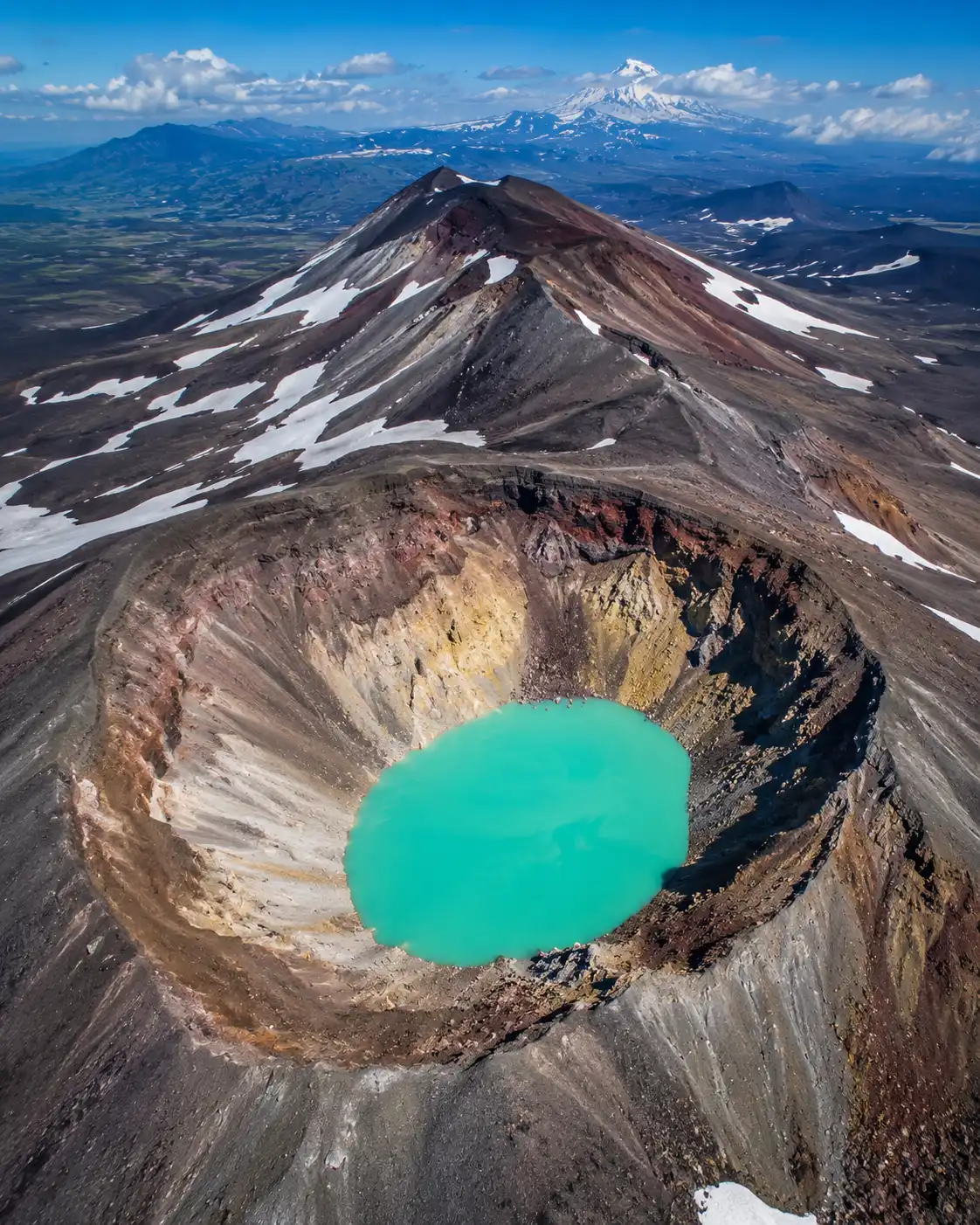
Maly Semyachik is one of the most visually distinctive volcanoes on the Kamchatka Peninsula. Its elongated volcanic ridge contains several overlapping cones and summit craters, but the feature that defines the mountain is the intensely coloured lake inside Troitsky Crater.
Depending on the light, weather and viewing angle, the water can appear turquoise, pale blue, green or milky aquamarine. The colour contrasts sharply with the steep grey, brown and yellow crater walls surrounding it. From the air, the lake resembles a bright mineral eye set into an otherwise severe volcanic landscape.
Known in Russian as Малый Семячик, Maly Semyachik rises in the remote eastern volcanic belt of Kamchatka. It lies north of Karymsky Volcano and southeast of the Kronotsky Nature Reserve, far from the roads and settlements used by most visitors to the peninsula.
The volcano is frequently seen during helicopter journeys toward the Valley of Geysers and Uzon Caldera. Some specialised excursions include a landing near Maly Semyachik, followed by a guided ascent to the rim of Troitsky Crater. Other flights pass over the volcano without landing, allowing passengers to view the lake from the air when weather, visibility and aviation regulations permit.
Maly Semyachik should not be treated as an ordinary crater-lake hike. The mountain remains volcanically active, the lake is highly acidic, the crater rim is unstable and the surrounding terrain is extremely remote. Access requires professional organisation, favourable weather and current information from volcanic monitoring authorities.
This complete Wander Russia guide explains the formation of Maly Semyachik, the turquoise crater lake, helicopter access, possible hiking routes, safety requirements and the best period for planning a visit.
Where Is Maly Semyachik?
Maly Semyachik is located in eastern Kamchatka, approximately 130 kilometres north-northeast of Petropavlovsk-Kamchatsky.
It forms part of a long volcanic zone containing some of the peninsula’s most active geological systems. Karymsky Volcano lies to the south, while the Valley of Geysers, Uzon Caldera and Kronotsky Volcano are situated farther north and northeast.
There is no ordinary public road leading directly to the volcano. The surrounding landscape consists of volcanic plateaus, river valleys, tundra, snowfields and difficult off-road terrain.
Most travellers experience Maly Semyachik from a helicopter. Flights to the Valley of Geysers may pass near the massif, while specialised tours can sometimes include an authorised landing and guided walk.
The exact route is never guaranteed. Helicopters may change direction because of cloud, wind, volcanic activity or instructions from aviation authorities.
Travellers should confirm whether a program includes only an aerial view or an actual landing. A tour description mentioning Maly Semyachik does not automatically mean that passengers will walk to the crater rim.
A Complex Volcanic Massif
Maly Semyachik is not one simple cone.
It is a compound volcanic massif formed inside a roughly ten-kilometre-wide caldera. This younger caldera lies within the much larger Stena-Soboliny volcanic depression, which measures approximately 15 by 20 kilometres.
The massif developed through several major stages.
Paleo-Semyachik began forming around 20,000 years ago in the northern part of the older caldera. Its lava flows extended beyond the caldera margins before activity gradually declined.
Volcanic activity later migrated toward the southwest and formed Meso-Semyachik approximately 11,000 to 9,000 years ago.
The youngest part, known as Ceno-Semyachik, began developing about 8,000 years ago and remains the active section of the complex.
These overlapping structures created the elongated shape visible today. Rather than rising as a perfect isolated pyramid, Maly Semyachik extends along a ridge containing several craters, eroded slopes and volcanic formations.
The highest point of the massif reaches approximately 1,527 metres above sea level.
Troitsky Crater
Troitsky Crater is the youngest and southernmost of the principal summit craters.
It formed during a large explosive eruption approximately 400 years ago. The event removed part of the summit structure and created a steep-sided depression that was later filled by the present crater lake.
The crater measures roughly 700 metres across and several hundred metres deep, although published dimensions vary according to the measuring method.
Its inner walls reveal layers of lava, ash, fragmented volcanic material and rock altered by hot acidic fluids.
Pale sections of the eastern wall indicate strong hydrothermal alteration. Darker lava flows and eruption deposits lie above and around these lighter surfaces.
Historical eruptions have originated from the Troitsky Crater area. The lake therefore occupies not a dormant decorative basin but the active centre of a volcanic system.
Visitors must remain at a safe distance from the inner edge. Rock weakened by acid, frost and geothermal processes can collapse without warning.
The Turquoise Crater Lake
The lake inside Troitsky Crater is the main reason Maly Semyachik has become one of Kamchatka’s most recognisable aerial sights.
Its colour results from the interaction of volcanic gases, acidic water, minerals, suspended particles and reflected light.
The lake does not always appear bright turquoise. Under cloud, it may look pale grey, green or almost white. Direct sunlight can intensify the blue-green colour, while shadow from the crater walls can darken part of the surface.
Weather conditions also influence visibility. Wind creates ripples, fog can fill the crater and fresh snow may cover sections of the rim.
The lake is hot compared with ordinary mountain lakes, although temperature readings vary over time and by measurement location. Heat from the active hydrothermal system enters the water through vents and fractures below the surface.
Volcanic gases continue to influence its chemistry. The lake is strongly acidic and contains dissolved substances that make direct contact dangerous.
It is not suitable for swimming, bathing or collecting water.
How Acidic Is the Lake?
The Troitsky Crater lake is commonly described as one of the world’s highly acidic volcanic lakes.
Its acidity is caused mainly by volcanic gases dissolving in water. Sulphur dioxide and hydrogen chloride can form sulphuric and hydrochloric acids, while other gases and minerals contribute to the lake’s unusual chemistry.
Measurements have varied over time because volcanic systems are constantly changing. Rainfall, snowmelt, gas supply, water level and geothermal activity can all affect the chemistry.
The exact acidity on any particular day is less important to visitors than the practical conclusion: the water is hazardous.
Travellers should never touch the lake, descend toward its shore or attempt to collect a sample.
Even mist or spray close to the water may irritate the skin, eyes and respiratory system. Access to the crater interior is therefore inappropriate for ordinary tourism.
The lake should be viewed only from officially approved points on the rim or from the air.
Why the Lake Changes Colour
Crater-lake colour is influenced by more than one factor.
Suspended mineral particles scatter light and can create an opaque turquoise appearance. Dissolved sulphur and other volcanic compounds affect both chemistry and colour.
The angle of the sun also plays an important role. When sunlight reaches the lake directly, blue and green tones become more visible. Under heavy cloud, the same water may look dull or metallic.
Snow around the rim can brighten the scene, while dark crater walls increase the visual contrast.
Wind changes surface reflections. A calm lake can resemble smooth coloured glass, while strong wind breaks the reflection into darker patches.
Photographs taken on different days may therefore show noticeably different colours without any of them being inaccurate.
Visitors should avoid expecting the lake to match highly edited promotional images. Its natural appearance depends on conditions at the moment of the visit.
Historical Eruptions
Maly Semyachik has produced both explosive and hydrothermal eruptions.
The volcano’s most recent confirmed eruption occurred in 1952. Historical accounts also describe earlier activity during the eighteenth and nineteenth centuries.
Some eruptions involved ash, steam and fragmented volcanic material from the Troitsky Crater area.
Because the crater contains a lake, interactions between heat, magma, gas and water create the potential for sudden steam-driven explosions.
A phreatic eruption can occur when water is heated rapidly and expands into steam. Such an explosion may eject existing rock and lake material without requiring a large amount of fresh magma to reach the surface.
This type of activity can begin with less obvious warning than a major magmatic eruption.
Maly Semyachik is therefore monitored even during long quiet periods.
Resuspended Ash and False Eruption Signals
Old volcanic ash covers parts of Maly Semyachik and the surrounding landscape.
During strong winds, this loose material can be lifted into the atmosphere and form an ash-like plume. Satellite images may initially make such a plume resemble a new eruption.
In October 2022, strong winds lifted previously deposited ash from the volcano and carried it more than one hundred kilometres toward the southeast. The aviation alert level was briefly raised before monitoring confirmed that the volcano itself was not erupting.
This event illustrates why volcanic reports must be interpreted by specialists.
A visible plume near a volcano may consist of fresh ash, resuspended old ash, steam or a mixture of several materials.
Travellers should rely on official monitoring organisations rather than social-media images or distant visual impressions.
How to See Maly Semyachik
There are three principal ways to experience the volcano.
The most common is an aerial view during a helicopter excursion toward the Valley of Geysers or Uzon Caldera. When the route and weather are favourable, the aircraft may pass close enough for passengers to see the summit and crater lake.
The second possibility is a specialised helicopter landing near the volcano followed by a guided hike to the crater rim.
The third is a longer overland or trekking expedition through the remote eastern volcanic zone. This option requires considerably more time, field equipment, professional guides and complicated logistics.
For most visitors, the helicopter provides the most realistic solution.
Even then, seeing the lake is not guaranteed. Cloud may cover the summit, flight paths can change and landing permission may be withdrawn.
Helicopter Excursions
Helicopter programs normally depart from aviation bases near Yelizovo or Petropavlovsk-Kamchatsky.
Mi-8 helicopters are widely used because they can operate in remote terrain and carry groups of passengers.
Flights toward the Valley of Geysers may pass Karymsky and Maly Semyachik before continuing toward Uzon and the Kronotsky Reserve.
The exact flight line depends on air traffic restrictions, wind, visibility, volcanic hazards and the selected operator.
Aerial viewing offers a strong understanding of the volcano’s structure. From above, passengers can see the elongated massif, neighbouring craters, snowfields and the bright lake inside Troitsky Crater.
Window seats cannot usually be guaranteed to every passenger. Seating is assigned according to aviation and weight requirements.
Passengers must remain seated and follow all crew instructions. Moving around the cabin for a photograph may be prohibited.
Landing Near Maly Semyachik
Some specialist tours include a helicopter landing on suitable terrain near the volcano.
The landing zone is chosen according to snow, wind, surface stability and current safety restrictions. It may be located at a considerable distance from the crater rim.
After landing, visitors walk with guides across volcanic ground toward an approved viewpoint.
The hike can involve ash, gravel, loose scoria, snowfields and moderate elevation gain. Conditions vary significantly throughout the season.
A landing should never be assumed from a general sightseeing itinerary. It must be specifically listed and confirmed by the operator.
Even a confirmed landing can be cancelled on the day of travel.
A helicopter crew may decide that wind, cloud, visibility or surface conditions make the landing unsafe. Volcanic monitoring authorities may also restrict access.
Hiking to the Crater Rim
The walk toward Troitsky Crater is not usually a technical mountaineering ascent, but it should not be underestimated.
The route crosses open volcanic terrain with little shelter. Loose ash and stones can make uphill walking tiring, while snow may conceal uneven ground.
The final approach to the rim requires particular caution.
Crater edges are often fractured, undercut or weakened by hydrothermal alteration. A solid-looking surface may extend beyond the supporting rock beneath it.
Visitors must remain behind the guide and use only the approved viewpoint.
The crater interior should not be entered. Descending toward the lake would expose travellers to acidic water, gas, rockfall and an extremely difficult evacuation.
Fog can arrive quickly and remove all visual landmarks. Groups must remain together, especially during the return to the landing zone.
Overland Expeditions
Reaching Maly Semyachik without a helicopter is possible only as a serious remote expedition.
There is no maintained public road to the volcano. Off-road routes cross rivers, tundra, forests, marshes and volcanic plateaus.
A journey may involve specialised vehicles, several camps and sections completed on foot.
River levels can change rapidly, while old tracks may disappear beneath vegetation, ash or snow.
Mobile coverage is generally absent. Satellite communication, first-aid equipment, repair tools and emergency supplies are essential.
Such an expedition should be organised with experienced Kamchatka guides who understand current routes and protected-area regulations.
Independent travellers should not rely on online GPS tracks. A route recorded in one year may be impassable in another.
Best Time to Visit
The most practical period generally extends from July through September.
July offers long daylight and substantial remaining snow. The contrast between white slopes, dark volcanic rock and the turquoise lake can be especially dramatic.
Some landing areas or hiking routes may still be obstructed by snow early in the month.
August is usually the central helicopter season. Access conditions are often more established, but demand for flights is also high.
September brings cooler temperatures, lower-angle light and autumn colours at lower elevations. Fresh snow becomes increasingly possible.
Early October may still allow flights in favourable conditions, but weather becomes less predictable.
No period guarantees a successful landing or clear crater view.
Weather and Visibility
Eastern Kamchatka is strongly influenced by Pacific weather.
Fog, low cloud, wind and rain can develop quickly. A volcano visible from a distance may be completely hidden by the time a helicopter approaches.
Cloud often forms around summit ridges, including Troitsky Crater.
Landing requires suitable visibility and wind at both the aviation base and the volcano.
Passengers should be prepared for cancellation even after arriving at the departure point. Helicopter excursions sometimes wait several hours for an improvement before the final decision is made.
Maly Semyachik should not be planned for the final available day of a Kamchatka trip.
Several flexible days improve the chance of rescheduling.
What to Wear and Bring
Conditions near the volcano can be cold and windy even during summer.
Recommended clothing and equipment include:
- Waterproof hiking boots with reliable grip
- A windproof and waterproof jacket
- Warm insulating layers
- Long outdoor trousers
- A warm hat and gloves
- Gaiters for snow and volcanic ash
- Sunglasses and sun protection
- Trekking poles when permitted
- Drinking water
- Energy-rich snacks
- Personal medication
- Waterproof protection for electronics
- A camera with spare batteries
- A lens cloth
- A small first-aid kit
Helicopter operators may impose strict baggage and weight limits. Large backpacks should not be brought unless approved in advance.
Loose objects must be secured during boarding because rotor wash can lift hats, bags and lightweight equipment.
Volcanic Gas Safety
Troitsky Crater can release steam and volcanic gases.
Possible emissions include sulphur dioxide, hydrogen chloride, hydrogen sulphide and carbon dioxide.
Wind normally disperses gases, but concentrations can increase near the rim or in sheltered areas.
Visitors experiencing coughing, eye irritation, headache, dizziness, nausea or breathing difficulty must inform the guide immediately.
A simple dust mask does not provide reliable protection against volcanic gases.
Moving away from the affected area is the correct response when concentrations become uncomfortable or potentially dangerous.
People with asthma or chronic respiratory conditions should discuss the excursion with a medical professional and the operator before booking.
Crater-Rim Safety
The greatest immediate danger for visitors is the unstable crater edge.
Volcanic rock can be fractured by frost, earthquakes and acidic alteration. Sections may collapse without an obvious warning.
Travellers should never stand on an overhang, cross a safety line or move closer for a photograph.
A wide-angle photograph taken from a safe position is preferable to a closer image obtained by taking unnecessary risks.
Strong wind can also affect balance near the rim.
Guides may prevent visitors from approaching the main viewpoint when conditions are unsuitable.
This decision must be accepted even after a successful landing and hike.
Wildlife and the Surrounding Landscape
The region around Maly Semyachik forms part of Kamchatka’s wider wilderness.
Brown bears may move through valleys and lower slopes, particularly where vegetation, berries or river systems provide food.
Ground squirrels, foxes and birds also inhabit the surrounding area.
The upper volcanic zone may appear lifeless, but plants colonise sheltered surfaces and older ash deposits.
Visitors should not feed animals, leave food waste or remove rocks and plants.
Tour groups must carry out all rubbish. Even biodegradable food can attract wildlife and change natural behaviour.
Photography Tips
The most famous view of the lake is from the air.
A polarising filter may reduce window reflections, although it can produce uneven effects through thick helicopter glass.
The camera should be held close to the window without touching it, as vibration can reduce sharpness.
A fast shutter speed helps compensate for aircraft movement.
For ground views, a wide-angle lens is useful for showing the complete crater, while a moderate telephoto lens can isolate mineral patterns and sections of the lake.
The brightest part of the water can be easily overexposed. Slightly reducing exposure may preserve turquoise detail.
Steam, fog and rapidly moving cloud can change the composition within seconds.
Photography should never delay the group’s return to the helicopter.
Combining Maly Semyachik with Other Attractions
Maly Semyachik is most naturally combined with the Valley of Geysers and Uzon Caldera.
Many helicopter routes cross the same eastern volcanic zone, although not every program lands at all three locations.
Karymsky Volcano may also be visible from the air. It is one of Kamchatka’s most active volcanoes and may be subject to substantial exclusion zones.
Longer specialised programs can include Kronotsky Volcano, the Pacific coast or remote field camps.
Travellers should distinguish between attractions seen from the helicopter and those actually visited on the ground.
A full-day flight may include several spectacular aerial views but only two or three landings.
Responsible Tourism
Maly Semyachik occupies a fragile volcanic environment.
Visitors should use authorised operators, follow route restrictions and avoid collecting volcanic rocks or mineral deposits.
The crater lake must not be approached as a recreational water body.
Drones require explicit permission and may be restricted because of aviation safety, protected-area rules and volcanic monitoring operations.
Commercial filming can require additional authorisation.
Responsible tourism also means accepting cancellation. Pressuring a pilot or operator to fly in unsafe conditions places passengers and crew at risk.
Is Maly Semyachik Worth Visiting?
Maly Semyachik is worth visiting for travellers interested in volcanic geology, crater lakes and remote aerial landscapes.
The turquoise lake is visually exceptional, but the experience involves uncertainty.
Cloud may hide the crater, the flight path may change and a planned landing can be cancelled. Even after landing, strong wind or gas may prevent access to the preferred viewpoint.
The destination is therefore best included as part of a wider Kamchatka itinerary rather than treated as the only reason for travelling to the peninsula.
An aerial view alone can be memorable. Seeing the entire massif from above reveals its overlapping cones, snowfields and relationship to the surrounding volcanic landscape.
A guided walk to the crater rim provides a deeper experience but requires more time, favourable conditions and strict safety discipline.
Wander Russia recommends choosing a program that clearly explains what is included and what remains dependent on weather.
Frequently Asked Questions
How high is Maly Semyachik?
The highest point of the massif reaches approximately 1,527 metres above sea level.
Where is the turquoise lake?
The lake lies inside Troitsky Crater, the youngest and southernmost major crater of the volcanic complex.
Is the lake safe for swimming?
No. The water is hot, strongly acidic and located inside an active volcanic crater.
Can Maly Semyachik be reached by road?
There is no normal public road to the volcano. Most visitors arrive by helicopter.
Do all Valley of Geysers flights pass Maly Semyachik?
Flight paths vary according to weather, volcanic hazards and aviation instructions. A close view cannot be guaranteed.
Can visitors land at the volcano?
Some specialised tours include a landing and guided hike. Standard sightseeing flights may provide only an aerial view.
Is Maly Semyachik active?
Yes. Its most recent confirmed eruption occurred in 1952, and the volcanic system remains monitored.
How difficult is the hike?
The normal guided approach is not usually technical, but it involves loose volcanic ground, possible snow, wind and an unstable crater rim.
When is the best time to visit?
July through September generally provides the most practical conditions for helicopter operations and guided walking.
Why is the lake turquoise?
The colour is influenced by acidic volcanic water, dissolved minerals, suspended particles, light and weather conditions.
Conclusion
Maly Semyachik is one of the clearest examples of how volcanic activity can create both beauty and danger within the same landscape.
The turquoise lake inside Troitsky Crater appears calm from a helicopter or distant viewpoint. Its bright colour contrasts with the dark, fractured volcanic ridge and snow-covered slopes.
Beneath that visual calm lies an active hydrothermal system. Volcanic gases enter the water, acidic fluids alter the crater walls and unstable rock continues to be affected by frost, earthquakes and heat.
The wider massif records several stages of volcanic construction. Paleo-Semyachik, Meso-Semyachik and Ceno-Semyachik developed as activity moved across older calderas over thousands of years.
Troitsky Crater represents the youngest major stage. Formed by a powerful eruption only a few centuries ago, it later became the basin for one of Kamchatka’s most unusual crater lakes.
Reaching the volcano requires flexibility. Helicopter routes depend on Pacific weather, and even a confirmed landing may be cancelled shortly before arrival.
These uncertainties are part of remote travel in Kamchatka. The mountain cannot be reduced to a fixed attraction with guaranteed opening hours and predictable views.
For travellers who see it clearly, Maly Semyachik provides one of the peninsula’s most memorable images: an intensely coloured lake contained within the summit of a rugged active volcano.
The responsible way to experience it is from the air or from an authorised crater-rim viewpoint, with professional guidance and full respect for the restrictions of the landscape.
