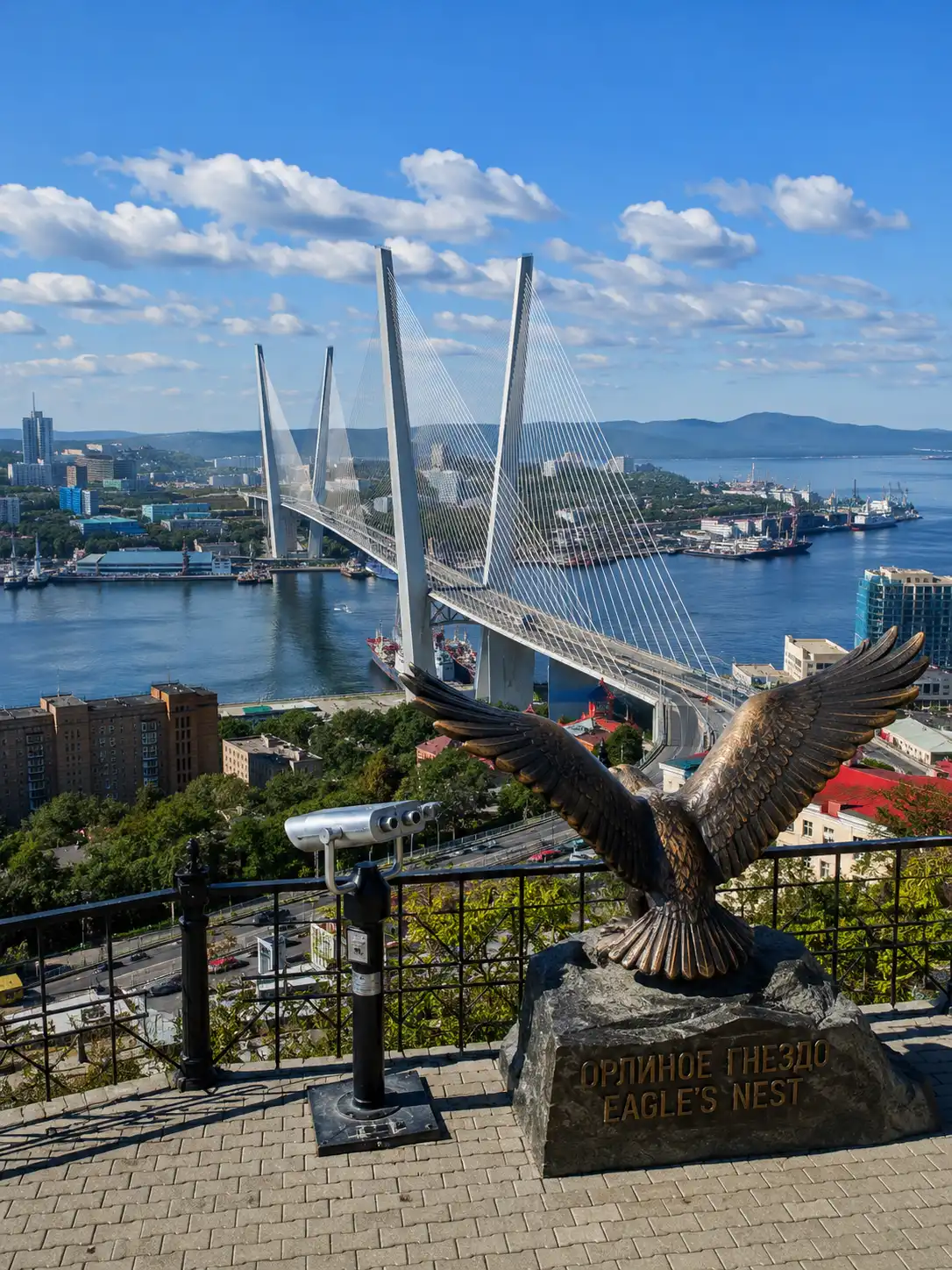
Eagle’s Nest Hill is one of the most recognisable viewpoints in Vladivostok and an appropriate place to begin exploring the city. Rising above the historic centre, the hill provides a panoramic view of Golden Horn Bay, the Golden Bridge, busy harbour districts, residential neighbourhoods and the layered hills that define the urban landscape.
Known in Russian as Orlinoye Gnezdo, or Орлиное гнездо, the hill occupies a central position within Vladivostok. Its location makes it considerably easier to reach than the remote capes, islands and coastal trails surrounding the city. Visitors can approach it on foot, by taxi, by public transport or through the historic Vladivostok Funicular when it is operating.
The viewpoint is especially valuable for first-time visitors because Vladivostok can be difficult to understand from street level. The city is built across steep hills and narrow coastal spaces, with roads, stairways and buildings arranged around several bays. From Eagle’s Nest Hill, this complex geography becomes much clearer.
The Golden Bridge dominates the foreground, crossing the narrow Golden Horn Bay between the historic centre and the Churkin Peninsula. Port cranes, ships, apartment blocks and distant hills extend beyond it, creating a view that combines maritime industry, modern engineering and the distinctive topography of Russia’s Pacific capital.
This Wander Russia guide explains the history of Eagle’s Nest Hill, what can be seen from the viewpoint, how to reach it, how the funicular fits into the visit, when to go and how to combine the hill with nearby attractions.
Where Is Eagle’s Nest Hill?
Eagle’s Nest Hill is located in central Vladivostok, immediately northeast of the historic districts surrounding Svetlanskaya Street and Golden Horn Bay.
The hill is the highest point within the historic central part of the city and rises to roughly 190–200 metres above sea level. Its elevated position offers broad views over Golden Horn Bay, the Amur Bay, the Egersheld Peninsula and large sections of central Vladivostok.
The best-known observation deck is located near Nerchinskaya Street. Visitors arriving through navigation applications may find slightly different labels for the viewpoint, the hill, the Monument to Saints Cyril and Methodius or the upper funicular station. These locations are close together but are not exactly the same point.
The principal public viewing platform overlooks the Golden Bridge and Golden Horn Bay. Short paths and stairways around the upper hill lead toward additional urban perspectives, although construction, maintenance or private development can affect access to individual sections.
Because the hill stands within a densely developed district, visitors should not expect a large natural park. Residential buildings, roads, utility structures and modern construction occupy parts of the slopes. The importance of Eagle’s Nest lies in the panorama rather than in an untouched natural environment.
Why Is It Called Eagle’s Nest?
The Russian name Orlinoye Gnezdo means Eagle’s Nest.
The hill was previously known by another geographical name during the early development of Vladivostok. It later became associated with the image of an eagle’s nest because of its high position above the harbour and city.
The name suits the experience. From the viewing platform, visitors look down across roads, rooftops, ships and the water of Golden Horn Bay. The city appears to spread outward and downward from the ridge.
Several locations around the world use the name Eagle’s Nest for elevated viewpoints, mountain structures or fortifications. Vladivostok’s Eagle’s Nest should not be confused with similarly named sites in Europe or elsewhere in Russia.
In local tourism material, the name may refer both to the hill itself and to its principal observation deck.
Understanding Vladivostok from Above
Vladivostok is a city shaped by geography.
It occupies the Muravyov-Amursky Peninsula and extends across a series of steep hills between the Amur and Ussuri bays. Golden Horn Bay cuts deeply into the urban centre, dividing neighbourhoods and creating the protected harbour around which the city developed.
At street level, this geography can be confusing. Roads curve around slopes, stairways climb between terraces and short distances on a map may involve substantial elevation changes.
Eagle’s Nest Hill provides an immediate explanation of this structure.
From the viewpoint, the Golden Bridge crosses the narrow bay below. The historic centre lies on one side, while the Churkin Peninsula and residential districts rise on the other. Port areas extend along the shoreline, and distant islands and coastal hills appear beyond the city when visibility is good.
This is why official tourism sources describe Eagle’s Nest as a suitable starting point for becoming familiar with Vladivostok.
The Golden Bridge View
The Golden Bridge is the dominant feature of the panorama.
Known in Russian as Zolotoy Most, the cable-stayed bridge crosses Golden Horn Bay and connects central Vladivostok with the districts on the opposite shore. It opened in 2012 as part of the major infrastructure development completed around the APEC summit.
Its tall pylons rise above the bay, while long cables create a geometric pattern across the water and cityscape.
Eagle’s Nest Hill is widely identified as one of the strongest public viewpoints for seeing the bridge. Regional tourism guidance also recommends viewpoints near the marine station, the Primorsky Stage of the Mariinsky Theatre and several waterfront areas, but the hill offers the most complete elevated perspective.
The bridge appears especially impressive when traffic, ships and port cranes are visible below it. These elements show the structure as part of a working city rather than an isolated architectural monument.
After dark, bridge lighting creates another version of the panorama. The cables and pylons stand against the illuminated harbour, while vehicle lights trace the roadway across the bay.
Golden Horn Bay
Golden Horn Bay is the narrow inlet directly below the viewpoint.
Its Russian name is Bukhta Zolotoy Rog, or Бухта Золотой Рог. The name was inspired by the Golden Horn in Istanbul because of the similarity between the two protected urban waterways.
The bay played a decisive role in the foundation and development of Vladivostok. Its sheltered water provided a strategic harbour for naval and commercial shipping, while the surrounding hills offered defensive and observational advantages.
Today, the shoreline combines naval facilities, commercial port infrastructure, ship-repair areas, roads, residential buildings and modern cultural projects.
From Eagle’s Nest, visitors can watch cargo vessels, smaller boats and port operations. The movement below changes throughout the day, ensuring that the view never feels completely static.
The industrial character should not be regarded as something separate from Vladivostok’s beauty. Harbour cranes, ships and warehouses are central to the identity of the city.
What Else Can Be Seen?
The exact panorama depends on weather, season and visibility.
Besides the Golden Bridge and Golden Horn Bay, visitors may see parts of the historic centre, port districts, the Churkin Peninsula, distant coastal hills and sections of the Amur Bay.
Russky Island may be visible beyond the urban landscape during clear conditions, although the Russky Bridge is not always as prominently positioned from the principal observation deck as visitors expect.
Residential buildings rise across the surrounding hills, revealing how Vladivostok expanded within limited coastal terrain.
The road network below the hill is also striking. Curving streets, bridge approaches and viaducts illustrate the engineering challenges created by steep slopes and narrow waterfront spaces.
During cold clear weather, the distant landscape can appear exceptionally sharp. Summer humidity, sea fog or haze may reduce visibility even when the immediate bridge remains clear.
The Monument to Saints Cyril and Methodius
A monument to Saints Cyril and Methodius stands near the upper part of Eagle’s Nest Hill.
The brothers are traditionally credited with missionary and scholarly work that influenced the development of Slavic literacy. The monument reflects the cultural and educational symbolism associated with them.
The figures stand near a bell structure and occupy a prominent position overlooking the city.
Visitors frequently include the monument in photographs with the Golden Bridge in the background. However, the site should be approached as a cultural monument rather than simply a photographic prop.
The surrounding space can become busy during organised tours, school visits, public events and the main summer travel season.
The monument also serves as a useful orientation point when walking between the upper funicular station and the main viewing areas.
Vladivostok Funicular
The Vladivostok Funicular is one of the city’s characteristic forms of transport.
It connects two levels of the steep urban centre near Eagle’s Nest Hill. The line is short, and the journey normally lasts only a few minutes, but it offers an atmospheric way to experience Vladivostok’s topography.
The funicular opened during the Soviet period and remains both a practical transport link and a tourist attraction.
Its small cars travel along a steep track between lower and upper stations. From the upper area, visitors can continue on foot toward the viewpoint and the Monument to Saints Cyril and Methodius.
The funicular may close temporarily for scheduled maintenance, technical work or seasonal repairs. Operating hours and fares can also change. Visitors should therefore confirm its current status shortly before travelling rather than relying on older timetables.
Regional tourism guidance continues to present the funicular as a classic part of a visit to Eagle’s Nest Hill.
The Funicular Stairway
A long stairway runs beside the funicular line.
It is sometimes called the Funicular Stairway or the staircase of Eagle’s Nest Hill. It provides an alternative when the cars are not operating and is also used by residents moving between different levels of the city.
Climbing the stairs offers a more direct sense of Vladivostok’s steep terrain. The route is physically more demanding than the short funicular journey but remains manageable for visitors with normal mobility.
The steps can become slippery after rain, snow or freezing temperatures. In winter, ice creates a significant hazard.
The stairway is functional rather than purely scenic. Urban structures, roads and buildings remain visible along the route.
Visitors carrying heavy luggage or managing limited mobility may find a taxi more comfortable.
How to Reach Eagle’s Nest Hill
The most suitable route depends on where the journey begins.
From the historic centre, visitors can walk uphill through a combination of streets, stairs and the funicular. The ascent is relatively short in distance but can feel demanding because of the gradient.
Using the funicular reduces the amount of climbing, although a short walk is still necessary between the upper station and the principal viewpoint.
A taxi provides the simplest option. Giving the driver the Russian name Орлиное гнездо or specifying the observation deck near Nerchinskaya Street can prevent confusion.
Public buses serve the surrounding central districts, but routes and stop names can change. Navigation applications with current local transport data are helpful.
Drivers should expect limited parking near the viewpoint. The central location and narrow roads make private-car access less convenient during busy periods.
Walking from the Historic Centre
A walking approach can be incorporated into a broader city route.
Starting around Svetlanskaya Street, visitors can pass historic buildings, urban stairways and residential slopes before reaching the funicular area.
The climb reveals how sharply Vladivostok rises from the waterfront. Streets that appear parallel on a map can be separated by considerable differences in elevation.
After visiting the viewpoint, the route can continue downhill toward Golden Horn Bay, the S-56 Submarine, Korabelnaya Embankment or the historic centre.
Official city-walk material connects the viewpoint with broader routes through central Vladivostok, highlighting the city’s terraced hills, waterfront and historic streets.
Comfortable walking shoes are important. Smooth footwear can become unsafe on wet stairs and steep pavements.
Best Time of Day
Early morning provides quieter conditions and often softer light.
The city may be less affected by traffic haze, and the observation platform usually has fewer visitors. Morning light can illuminate sections of the harbour and reveal detail across the surrounding hills.
Late afternoon and sunset are the most popular periods. The sun descends toward the western side of the city, creating warm light across the bay and bridge.
The exact sunset position changes through the year. The sun does not necessarily disappear directly behind the Golden Bridge, but evening colour can still transform the scene.
Blue hour begins after sunset, when city lights and the remaining colour in the sky create balanced photographs.
Night visits are worthwhile for bridge illumination, but cold wind, ice and reduced visibility on paths require more caution.
Best Season to Visit
Eagle’s Nest Hill can be visited throughout the year.
Late spring brings clearer walking conditions and flowering vegetation across Primorye. May can be attractive, although fog and cool wind remain possible.
Summer offers long daylight and green hills. July and August can be humid, and sea fog may obscure the distant landscape.
Early autumn is often especially rewarding. September and October bring clearer air, lower humidity and warm seasonal colours. Regional tourism guidance notes that October light is particularly valued for urban and coastal photography.
Winter offers sharp visibility during clear weather. Snow-covered hills and frozen sections of the Amur Bay may be visible in the distance. Temperatures and wind chill can be severe, while stairs and platforms may be icy.
There is no completely reliable season for unobstructed views. Vladivostok’s maritime weather changes quickly.
Weather and Fog
The city’s weather is influenced by the Sea of Japan and the surrounding bays.
Fog is particularly common during the warmer part of the year. It may hide the bridge pylons or distant coast while leaving the streets below visible.
Wind is another important factor. Eagle’s Nest is exposed, and conditions at the viewpoint may feel much colder than in sheltered streets.
A clear forecast does not guarantee perfect visibility. Local cloud can move across the harbour within minutes.
Visitors should carry a light windproof layer even during summer. In autumn and winter, gloves and a warm hat can make a substantial difference.
Poor weather does not always ruin the experience. Fog moving between the bridge pylons can create atmospheric views unavailable on a clear day.
Photography Tips
A wide-angle lens is useful for capturing the observation deck, Golden Bridge and bay in one composition.
A standard or short telephoto lens provides stronger images of bridge cables, ships and harbour infrastructure.
Morning and late-afternoon light create more texture than the harsh light around midday.
After dark, a tripod can help with longer exposures, although it must not obstruct other visitors. Handrails or stable surfaces can provide support where tripods are inconvenient.
The bridge lights and bright roadways can be overexposed easily. Slightly reducing exposure preserves detail.
Visitors should also photograph away from the main bridge view. Residential hills, port cranes, roads and urban terraces are equally important to the identity of Vladivostok.
Drones are subject to aviation, security and urban restrictions. The hill’s proximity to central infrastructure and strategic harbour areas means that permission should never be assumed.
Accessibility
The main viewpoint can be approached by vehicle, but the final surfaces, slopes and steps may create difficulties for some visitors.
The funicular is helpful when operating, although station access and the route toward the platform may not be fully barrier-free.
People using wheelchairs, walking aids or managing limited mobility should confirm current access conditions and consider arriving by taxi.
Snow and ice reduce accessibility considerably during winter.
The viewpoint itself is relatively compact. Visitors do not need to complete a long hike once they reach the upper area.
Safety at the Viewpoint
Eagle’s Nest is an urban attraction, but basic caution remains necessary.
Visitors should stay behind railings and avoid climbing onto walls or structures for photographs.
Children require supervision because of slopes, traffic and crowded viewing areas.
Personal belongings should be kept secure during busy periods.
The steep streets and stairways around the hill are more dangerous in wet or icy conditions than the platform itself.
At night, visitors should use illuminated routes rather than informal shortcuts through poorly lit areas.
Combining Eagle’s Nest with Nearby Attractions
The hill fits naturally into a central Vladivostok itinerary.
The Vladivostok Funicular should form part of the same visit when it is operating.
Svetlanskaya Street lies downhill and provides access to historic architecture, shops, museums and public squares.
The S-56 Submarine and Pacific Fleet Memorial are close enough to combine during a longer walk through the centre.
Korabelnaya Embankment reveals the harbour from water level, creating a useful contrast with the elevated view.
Tsesarevich Embankment stands on another section of Golden Horn Bay and offers a strong evening view of the bridge from below.
Millionka Historic Quarter can be visited before or after the hill, allowing travellers to combine city history with the modern skyline.
A Suggested Half-Day Route
Begin in the historic centre around Svetlanskaya Street.
Walk toward the lower station of the Vladivostok Funicular and ride to the upper level when services are operating.
Continue toward the Monument to Saints Cyril and Methodius and the principal Eagle’s Nest observation deck.
Allow time for the Golden Bridge panorama and views across Golden Horn Bay.
Descend through the stairway or return by funicular.
Continue toward Korabelnaya Embankment, the S-56 Submarine and the Pacific Fleet Memorial.
Finish with a walk along the central waterfront or a meal in the historic centre.
This route connects Vladivostok’s geography, transport, maritime history and modern engineering within one manageable program.
Is Eagle’s Nest Hill Worth Visiting?
Eagle’s Nest Hill is worth visiting because it explains Vladivostok better than almost any street-level attraction.
The viewpoint is not remote, physically demanding or surrounded by untouched nature. Apartment buildings, roads and urban infrastructure occupy the hill.
These elements do not weaken the experience. They demonstrate how the city developed across difficult terrain around a strategic harbour.
The Golden Bridge provides the immediate visual focus, but the full panorama contains much more: port cranes, ships, residential terraces, winding roads and distant hills.
Wander Russia recommends visiting near the beginning of a stay. Understanding the city from above makes later walks through the centre, waterfront and harbour districts easier to place geographically.
Frequently Asked Questions
How high is Eagle’s Nest Hill?
The hill rises to roughly 190–200 metres above sea level and is regarded as the highest point in Vladivostok’s historic central area.
What can be seen from the viewpoint?
The panorama includes Golden Horn Bay, the Golden Bridge, harbour districts, central Vladivostok, surrounding hills and more distant coastal areas in clear weather.
Is the viewpoint free?
The public observation area is generally visited without an admission charge. Transport, tours and nearby commercial facilities may have separate costs.
How long is needed?
Approximately 30–60 minutes is sufficient for the viewpoint. Allow two hours when including the funicular, stairways and nearby monuments.
Can the hill be reached by funicular?
Yes, when the Vladivostok Funicular is operating. Temporary closures for maintenance are possible.
Is the walk difficult?
The final viewpoint visit is short, but walking from the lower city involves steep streets or stairs.
When is the best time for photographs?
Early morning, late afternoon, sunset and blue hour generally provide the most attractive light.
Can the viewpoint be visited in winter?
Yes. Clear winter days can offer excellent visibility, but ice, wind and low temperatures require suitable clothing and footwear.
Is the Golden Bridge illuminated at night?
The bridge normally forms part of Vladivostok’s illuminated evening skyline, although lighting arrangements can change.
Is Eagle’s Nest the highest point in all of Vladivostok?
It is commonly described as the highest hill in the historic centre, not necessarily the highest natural elevation across the entire modern city territory.
Conclusion
Eagle’s Nest Hill is the most effective place to begin understanding Vladivostok.
From its observation deck, the city’s defining elements come together within one panorama. Golden Horn Bay cuts through the centre, the Golden Bridge links its two sides and port facilities line the protected water below.
Residential districts rise across the hills, showing why roads, stairways and viewpoints play such an important role in daily life.
The hill also connects old and new Vladivostok. The harbour represents the reason the city was founded, while the Golden Bridge reflects its modern transformation.
The nearby funicular adds another layer to the experience. Its short journey demonstrates how residents have adapted public transport to a city built on steep terrain.
Weather determines the atmosphere. A clear day reveals distant coastlines and urban detail. Fog reduces the view but creates a more dramatic image of bridge pylons disappearing into cloud. Winter produces sharp air and snow-covered hills, while autumn adds warm colour to the slopes.
No extensive expedition is needed. Eagle’s Nest stands in the centre and can be integrated easily into a walking route through historic Vladivostok.
Its accessibility makes it popular, but its significance comes from more than convenience. The view provides a geographical introduction to the entire city.
For travellers continuing toward Russky Island, Cape Tobizina, the Vladivostok Fortress or the coast of Primorye, the hill establishes the broader setting: a Pacific port constructed between water, steep land and maritime routes.
Eagle’s Nest Hill is therefore not simply a place for one photograph of the Golden Bridge. It is the viewpoint from which Vladivostok begins to make sense.
