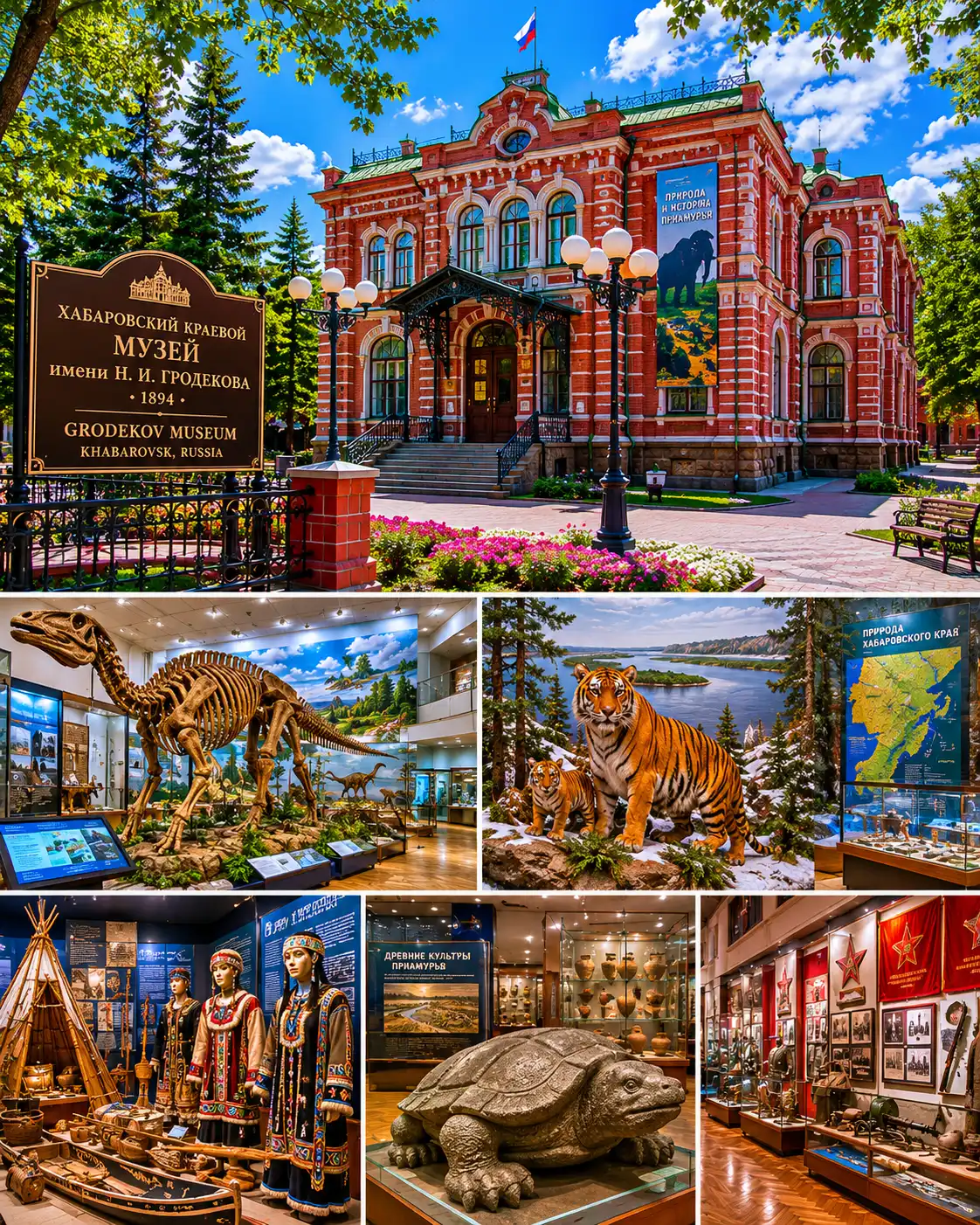
The Grodekov Khabarovsk Regional Museum is one of the most important cultural institutions in the Russian Far East and one of the strongest places to understand the history, nature and peoples of the Amur region. Located near Muravyov-Amursky Park and the famous Amur Cliff, the museum forms part of Khabarovsk’s principal historical and cultural district.
Known in Russian as Хабаровский краевой музей имени Н. И. Гродекова, the institution presents a broad interpretation of Khabarovsk Krai rather than focusing on one narrow subject. Its permanent displays cover geology, prehistoric life, regional wildlife, archaeology, the traditional cultures of Indigenous peoples, Russian expansion along the Amur, the development of Khabarovsk and the political transformations of the twentieth century.
The museum describes itself as the largest local-history museum in the Russian Far East, with more than 500,000 objects in its collections. This scale makes it significantly more than a small provincial museum. It functions as a scientific institution, a regional archive, an educational centre and an introduction to territories extending from the Amur River to the Sea of Okhotsk.
For travellers, the museum is especially valuable because many of the landscapes around Khabarovsk can otherwise be difficult to interpret. The Amur may appear simply as a broad river, and the forests beyond the city may seem like one continuous natural environment. Inside the museum, visitors begin to understand the region as a complex meeting point of ecosystems, Indigenous cultures, migration routes, imperial administration and political change.
This Wander Russia guide explains the museum’s history, architecture, principal collections, Indigenous cultural exhibitions, natural-history displays, archaeological objects, visitor facilities and the best way to include it in a Khabarovsk itinerary.
Where Is the Grodekov Museum?
The main museum building stands at 11 Shevchenko Street in central Khabarovsk.
Its location is one of its greatest advantages. Muravyov-Amursky Park, the Amur Cliff viewpoint, the Far Eastern Art Museum and the Admiral Nevelskoy Embankment are all nearby. Visitors can therefore combine the museum with the city’s most important river panorama without making a separate journey across Khabarovsk.
The museum occupies a prominent red-brick complex on the high bank above the Amur. The combination of historical architecture, mature trees and nearby viewpoints creates one of the most attractive cultural settings in the city.
A first visit to Khabarovsk can begin here before continuing into Muravyov-Amursky Park. The museum provides the historical and ecological context, while the park and Amur Cliff reveal the actual landscape described in the exhibitions.
The Foundation of the Museum
The museum opened on 19 April 1894 through the initiative of the Priamur Division of the Imperial Russian Geographical Society.
Its creation reflected the growing scientific interest in the Russian Far East during the late nineteenth century. Researchers, officials, teachers, doctors, military officers and local residents contributed objects and financial support. The earliest collections were formed largely through donations rather than systematic state purchasing.
Early contributions included birds, insects, plants, archaeological material and ethnographic objects. These collections reflected the priorities of the period: mapping unfamiliar territory, documenting wildlife, studying ancient cultures and recording the lives of Indigenous communities.
The museum was therefore connected from the beginning with field expeditions and regional research. It was not established simply to display decorative objects. Its purpose was to gather and organise knowledge about a territory that remained poorly understood by many officials and scientists in European Russia.
The First Museum Building
As the collections grew, the need for a permanent building became urgent.
By 1896, the museum already held more than 10,000 objects, and the collections were moved into an unfinished purpose-built structure. The first section of the building officially opened in December of that year. Construction and expansion continued as donations and scientific expeditions added more material.
The original red-brick architecture remains an important part of the visitor experience. Its heavy masonry, decorative details and institutional appearance reflect the confidence of Khabarovsk during the period when the city was developing into an administrative centre of the Russian Far East.
A newer wing later expanded the museum’s exhibition and storage capacity, but the historical section preserves the atmosphere of a late imperial scientific institution.
Why the Museum Is Named After Nikolai Grodekov
The museum is named after Nikolai Ivanovich Grodekov, a military officer and Governor-General of the Priamur region.
Grodekov supported the development of the museum and regional scientific work. His administrative influence and financial assistance contributed to the institution’s growth, and the museum received his name in the early twentieth century. The name was later removed and restored during the post-Soviet period.
Grodekov’s legacy should be understood within the broader context of imperial administration in the Far East. Support for science, mapping and museum collections occurred alongside military expansion and the consolidation of Russian authority over territories inhabited by Indigenous peoples.
The museum now presents a wider historical narrative than the one available during Grodekov’s own era, including exhibitions devoted to local cultures and the complex political history of the Amur region.
The Size of the Collections
The museum’s collections contain more than half a million objects, making it one of the largest regional museum collections in eastern Russia.
Only a fraction of these objects can be displayed at any one time. The remainder are preserved in scientific storage, used for research or included in temporary exhibitions.
The collections cover several broad fields:
- Natural history
- Geology and palaeontology
- Archaeology
- Ethnography
- Indigenous cultures
- Imperial and Soviet history
- Military history
- Documents and photographs
- Decorative and applied art
- Regional economic development
The breadth of the collection allows the museum to explain Khabarovsk Krai as both a natural and human landscape.
Natural History of Khabarovsk Krai
The natural-history galleries provide a strong introduction to the ecosystems of the Russian Far East.
Khabarovsk Krai extends across an enormous territory containing taiga, wetlands, mountains, river valleys and the coast of the Sea of Okhotsk. The region supports species associated with both northern and more temperate environments.
Museum displays commonly include mounted animals, birds, fish, plants and geological samples. Dioramas reconstruct habitats and help visitors understand how species are distributed across the region.
The Amur tiger is naturally one of the most recognisable animals associated with the wider Far East. Other exhibits may feature bears, deer, wolves, foxes, birds of prey and aquatic species from the Amur basin.
The natural-history section is especially useful for travellers who plan to visit wildlife areas, forests or regional reserves after leaving Khabarovsk.
The Amur River Ecosystem
The Amur River receives particular attention because it is the central natural feature of the region.
Its basin supports fish, wetlands, migratory birds and floodplain forests. Seasonal water changes influence both wildlife and human settlement.
The museum helps explain that the Amur is not one uniform channel. It is a broad river system containing islands, tributaries, marshes and changing flood zones.
Visitors who see the river first from Amur Cliff may appreciate the landscape more deeply after examining maps, animal displays and environmental exhibits inside the museum.
The museum and viewpoint therefore work particularly well as a combined experience.
Dinosaurs and Prehistoric Life
Palaeontology is one of the museum’s most memorable areas.
The Amur region has produced important dinosaur discoveries, and visitors may encounter fossils or reconstructions connected with prehistoric animals found in the Russian Far East. Visitor accounts frequently mention the museum’s Amurosaurus material as a notable highlight.
Amurosaurus was a herbivorous hadrosaur associated with fossil sites in the Amur region. Displays connected with such discoveries demonstrate that the Far East has a geological history extending far beyond the foundation of modern cities and political borders.
The palaeontological section is particularly effective for families and younger visitors, but it also introduces adults to a part of regional science that is often overshadowed by later military and political history.
Steller’s Sea Cow Skeletons
Among the museum’s historically significant acquisitions were two skeletons of Steller’s sea cow, added to the collection in 1897.
Steller’s sea cow was a large marine mammal discovered by European science during Vitus Bering’s eighteenth-century expedition. It lived in the waters around the Commander Islands and became extinct only a few decades after intensive hunting began.
The presence of these remains connects the museum with the wider environmental history of the North Pacific.
They also provide a powerful example of how quickly human exploitation can eliminate an isolated species.
Archaeology of the Amur Region
The archaeological collections introduce the long human history of the Amur basin.
People lived along the river for thousands of years before the foundation of Khabarovsk or the arrival of Russian imperial administration. Archaeological objects can include pottery, tools, weapons, jewellery and material from medieval cultures.
One of the most unusual objects associated with the museum’s early history is a large granite tortoise from the medieval burial complex of a Jurchen military leader known as Esikui. The stone sculpture was transported to the museum during the construction of its first permanent building.
The Jurchen established powerful states in Northeast Asia and played an important role in the history of territories now divided between Russia and China.
Such objects demonstrate that the Amur region possessed complex political and cultural traditions long before modern national borders were formed.
Traditional Cultures of Indigenous Peoples
The exhibition devoted to the traditional cultures of the peoples of Khabarovsk Krai is among the museum’s most important sections.
The display was completely reconstructed and reopened in 2021. It presents the material culture, livelihoods, clothing, beliefs and artistic traditions of Indigenous communities living across the Amur and northern coastal regions.
Groups represented may include Nanai, Ulchi, Udege, Oroch, Evenki, Evens, Nivkh and other peoples connected with the wider region.
The exhibits help visitors understand that the Russian Far East was never an empty wilderness waiting for settlement. Its rivers, forests and coastlines supported established communities with their own languages, trade networks and environmental knowledge.
Nanai Culture
The Nanai are among the Indigenous peoples most closely associated with the lower and middle Amur.
Fishing traditionally played a central role in Nanai life. Salmon and other river fish supplied food and raw materials.
One of the most distinctive traditions involves clothing and objects made from processed fish skin. The material could be cleaned, softened and sewn into garments suitable for life beside the river.
Museum displays may include clothing, fishing equipment, household objects and decorative work.
These exhibits reveal a sophisticated adaptation to the Amur environment rather than a simple subsistence lifestyle.
Northern Indigenous Cultures
The museum also introduces communities living in the northern and coastal parts of Khabarovsk Krai.
Reindeer herding, hunting, fishing and seasonal movement shaped life in areas far removed from the city of Khabarovsk.
Clothing, sled equipment, tools and ritual objects demonstrate how communities adapted to cold climates and immense distances.
Visitors should remember that these cultures are not only historical. Indigenous people continue to live in the region, although many communities face language loss, economic pressure and the effects of industrial development.
A respectful museum visit recognises both historical tradition and modern continuity.
Russian Expansion Along the Amur
Historical galleries explain the nineteenth-century growth of Russian power in the Amur region.
Expeditions, military posts, treaties and administrative decisions led to the establishment of settlements such as Khabarovka, which later became Khabarovsk.
Maps, uniforms, documents and photographs help visitors follow this process.
The museum’s interpretation is especially useful when combined with the monument to Nikolai Muravyov-Amursky in the nearby park. The monument presents one powerful public symbol, while the museum provides the broader historical context behind Russian expansion.
This history includes exploration and urban development, but also imperial competition and the transformation of Indigenous territories.
The Founding and Development of Khabarovsk
Exhibits devoted to Khabarovsk trace the city’s growth from a military post into a regional administrative, commercial and cultural centre.
Historical photographs show wooden buildings, early streets, river transport and the gradual appearance of substantial brick architecture.
The arrival of railway connections strengthened the city’s economic role, while institutions such as museums, schools and government offices established its administrative identity.
These exhibitions help visitors interpret landmarks encountered elsewhere in the city, including Muravyov-Amursky Street, Amur Cliff and the Khabarovsk Bridge.
Revolution and Civil War in the Russian Far East
The revolutionary period and Civil War affected the Russian Far East differently from European Russia.
The region experienced competing military forces, foreign intervention, shifting governments and political instability.
The museum developed a dedicated exhibition on the events of the Civil War in the Far East during its modernisation in the late twentieth century.
Documents, weapons, uniforms and photographs help explain why political change continued in the Far East after major events elsewhere in Russia had already passed.
This section provides useful context for visitors interested in Soviet history and the strategic importance of Khabarovsk.
The Soviet Period
The Soviet galleries address industrialisation, education, regional development, wartime mobilisation and social transformation.
Khabarovsk became an important administrative and transport centre during the Soviet era. New industries, housing districts and institutions reshaped the city.
The museum itself also developed significantly during this period. Attendance once reached approximately 200,000 visitors annually, and the institution received recognition as one of the leading regional museums in the Russian Soviet republic.
The Soviet section should be read alongside the museum’s earlier galleries. Together, they show how the region moved from Indigenous and imperial systems into a centralised modern state.
The Amur Museum and Modern Exhibitions
A major expansion opened in 2008, adding modern exhibition halls, improved storage facilities and an interactive section known as the Amur Museum.
This newer development allowed the institution to present the region through updated museum design and technology.
The museum currently advertises around twelve permanent exhibitions covering nature, archaeology, ethnography, history and culture, alongside temporary regional and federal projects.
Temporary exhibitions change regularly, so returning visitors may encounter new themes even when the main permanent route remains familiar.
The Children’s Museum Centre
The museum has developed educational programmes and interactive activities for younger visitors.
A Children’s Museum Centre was established as part of the institution’s modern development.
Family facilities and activities can include creative workshops, play spaces, interactive exhibits and programmes connected with nature or archaeology.
Availability depends on the current calendar, so families should check whether special sessions require advance booking.
The museum’s combination of animals, fossils and cultural objects makes it suitable for children even without a formal programme.
How Much Time Is Needed?
A rapid visit requires at least one and a half hours.
A balanced first visit should allow two to three hours.
Travellers who read detailed labels, examine the Indigenous culture galleries and explore temporary exhibitions may need four hours or more.
The museum is larger than its historic exterior initially suggests.
It is better to prioritise a few main sections than rush through every gallery shortly before closing.
Opening Hours and Current Information
The main museum is generally listed as open Tuesday through Sunday from 10:00 until 18:00, with Monday closed.
Schedules may change during public holidays, exhibition installation, maintenance or monthly sanitation days.
Ticket prices and temporary exhibition access can also change, so fixed costs should not be treated as permanent.
The official museum website should be checked shortly before visiting.
Language Considerations
Most exhibition interpretation is primarily in Russian.
Foreign-language information may be available in selected sections, but visitors should not assume that every label has a complete English translation.
A translation application can be useful.
Travellers who want a deeper historical understanding may consider arranging an English-speaking guide. Visitor feedback frequently notes that the museum is highly informative but that language can affect how fully foreign travellers understand the displays.
Accessibility
The modern museum complex has developed accessibility information and programmes for visitors with disabilities.
However, the combination of historical and modern buildings means that conditions can vary between exhibition areas.
Visitors with specific mobility or sensory requirements should contact the museum in advance to confirm lift access, available assistance and accessible routes.
The official website includes dedicated visitor guidance for accessible museum visits.
Photography
Personal photography may be permitted in many public areas, subject to current museum rules.
Flash, tripods or commercial equipment may be restricted.
Natural-history halls and large archaeological objects can be photographed effectively with a standard or wide-angle lens.
Low light in some galleries may require higher camera sensitivity or a steady hand.
Visitors should avoid blocking narrow routes or photographing other guests closely without permission.
Combining the Museum with Nearby Attractions
The museum fits naturally into a half-day or full-day itinerary.
A strong route includes:
- Grodekov Regional Museum
- Muravyov-Amursky Park
- Monument to Muravyov-Amursky
- Amur Cliff
- Admiral Nevelskoy Embankment
- Far Eastern Art Museum
Begin at the museum while attention and energy are strongest.
Continue into the park during the late afternoon and finish at the Amur Cliff viewpoint or embankment near sunset.
This route combines intellectual context with the physical landscape of Khabarovsk.
Is the Grodekov Museum Worth Visiting?
The Grodekov Museum is essential for travellers who want to understand Khabarovsk beyond its monuments and river views.
It explains the region as a meeting point of natural systems, ancient cultures, Indigenous communities, imperial expansion and Soviet development.
The museum’s strongest quality is breadth. A single visit can move from dinosaur fossils and Amur wildlife to fish-skin clothing, Jurchen archaeology and the Civil War in the Far East.
Wander Russia recommends allowing at least two to three hours and visiting before exploring Amur Cliff and the riverfront.
Frequently Asked Questions
Where is the Grodekov Museum?
The main building is located at 11 Shevchenko Street in central Khabarovsk.
When was it founded?
The museum opened on 19 April 1894.
How large is the collection?
The museum reports more than 500,000 objects in its collections.
What are the main exhibitions?
The collections cover regional nature, palaeontology, archaeology, Indigenous cultures, imperial history, Khabarovsk’s development and the Soviet period.
How much time is needed?
Allow two to three hours for a balanced first visit.
Is it suitable for children?
Yes. Wildlife, fossils and interactive educational areas make the museum suitable for families.
Is English information available?
Some foreign-language support may be available, but much of the interpretation is primarily in Russian.
What days is it open?
The main building is generally open Tuesday through Sunday, while Monday is usually closed.
Is it close to Amur Cliff?
Yes. The museum stands beside Muravyov-Amursky Park and only a short walk from the viewpoint.
What is the most unusual exhibit?
The stone Jurchen tortoise, regional dinosaur material and objects connected with Indigenous Amur cultures are among the most distinctive parts of the collection.
Conclusion
The Grodekov Khabarovsk Regional Museum is one of the most complete introductions to the Russian Far East.
Its collections demonstrate that Khabarovsk Krai cannot be understood through one simple narrative. The region contains ancient geological formations, dinosaur fossil sites, taiga wildlife, enormous river systems, Indigenous cultures and several layers of political history.
The museum begins with the land itself. Natural-history and palaeontological displays reveal environments that existed long before modern borders and cities.
Archaeological collections then show that the Amur basin supported complex communities, trade and political power before Russian expansion.
The Indigenous galleries are especially important. They demonstrate how Nanai, Ulchi, Evenki and other peoples developed detailed knowledge of rivers, forests, animals and seasonal movement. Their clothing, tools and art reflect adaptation and cultural creativity rather than isolation.
Later sections explain the arrival of Russian military posts, administrative control and urban development. The growth of Khabarovsk, construction of transport links and political upheavals of the twentieth century become part of a wider regional story.
The museum itself is also a historical institution. Founded by members of the Geographical Society and supported by residents, researchers and officials, it grew alongside the city. Its red-brick building, scientific collections and later modern extensions reflect more than a century of changing museum practice.
A visit should ideally continue outside.
After several hours among maps, fossils, clothing and historical documents, Muravyov-Amursky Park and the Amur Cliff provide the actual landscape connecting those stories. The river visible from the viewpoint is the same waterway that supported Indigenous fishing, imperial expeditions, military settlement and modern Khabarovsk.
For Wander Russia, the Grodekov Museum is not merely an indoor alternative for a rainy day. It is the cultural key to understanding the city and the immense region surrounding it.
