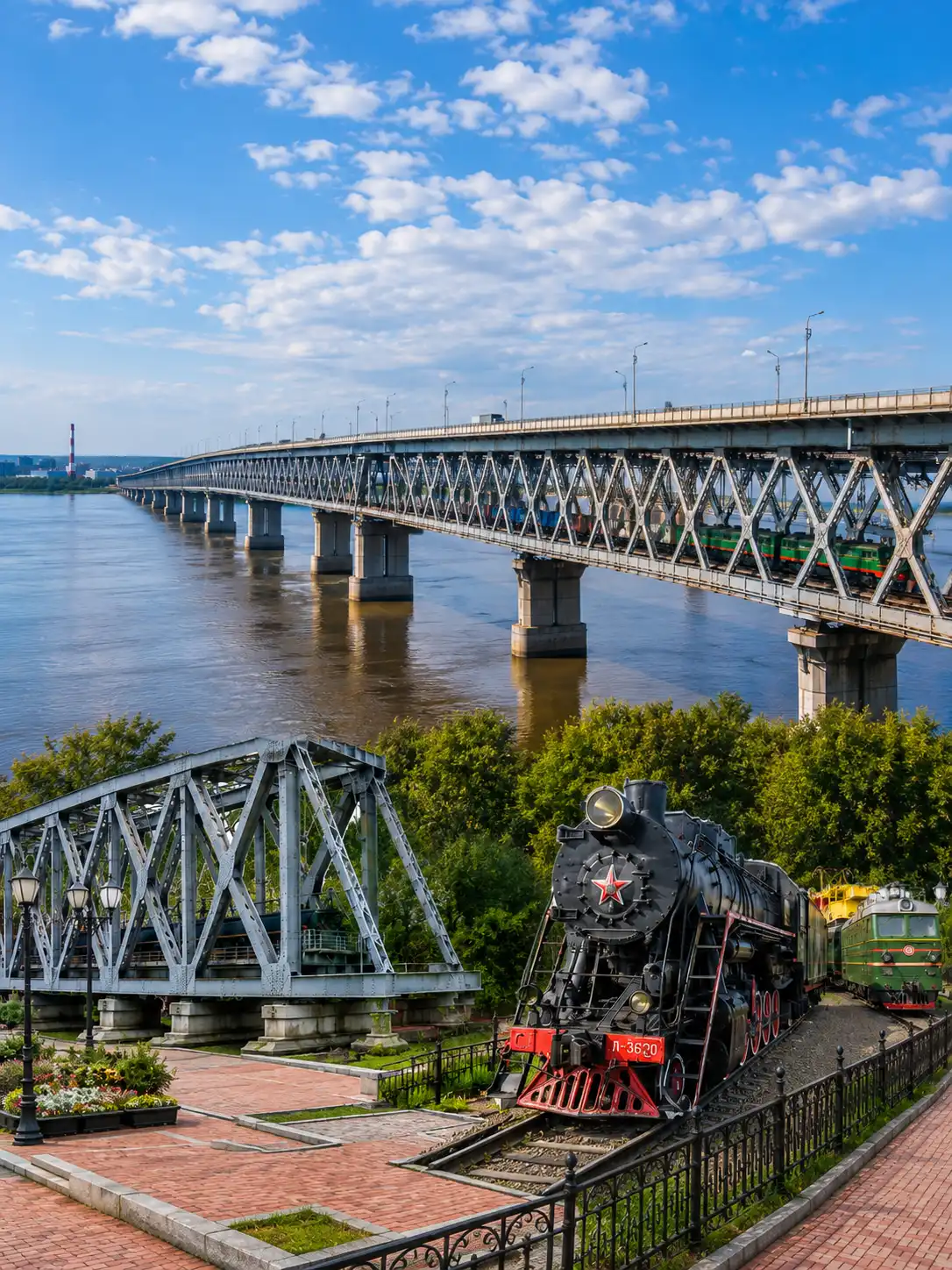
Khabarovsk Bridge is one of the most important engineering landmarks in the Russian Far East and one of the clearest symbols of the city’s connection with the Trans-Siberian Railway. Crossing the broad Amur River northeast of central Khabarovsk, the two-level structure carries railway traffic on its lower deck and road vehicles above, linking Khabarovsk Krai with the Jewish Autonomous Oblast.
Known in Russian as Хабаровский мост or Амурский мост, the crossing is frequently called the “Amur Miracle.” Its importance is not limited to size or appearance. The bridge completed one of the final major gaps in the original Trans-Siberian Railway, strengthened communication between European Russia and the Pacific and transformed Khabarovsk into an essential transport gateway of the Far East.
The present structure combines modern bridge engineering with the history of the original railway crossing opened in 1916. During the late twentieth century, the ageing imperial bridge was gradually replaced and expanded into a larger road-and-rail connection. One surviving historic steel span was preserved on the riverbank and became the centrepiece of the Amur Bridge History Museum.
The bridge is also nationally recognisable because it appears on Russia’s 5,000-ruble banknote. The reverse side shows the Amur crossing, while the front depicts the monument to Nikolai Muravyov-Amursky in Khabarovsk. Together, these images connect the city’s imperial history, river geography and modern transport identity.
Unlike Amur Cliff or Muravyov-Amursky Street, the bridge and museum lie outside the compact historical centre. Visiting therefore requires additional planning, especially because museum access and opening arrangements may change. Current travel listings have recently described the museum as temporarily closed, so its operational status should be confirmed directly before making the journey.
This Wander Russia guide explains the history of Khabarovsk Bridge, its relationship with the Trans-Siberian Railway, the construction of the original crossing, the modern two-level structure, the museum collection, viewpoints, transport and practical visitor information.
Where Is Khabarovsk Bridge?
Khabarovsk Bridge crosses the Amur River northeast of the main city centre.
The western end lies within Khabarovsk Krai, while the eastern approach reaches the settlement of Imeni Telmana in the Jewish Autonomous Oblast. The bridge therefore connects not only two riverbanks but also two federal regions of Russia.
The bridge stands several kilometres from the central waterfront around Amur Cliff and Admiral Nevelskoy Embankment. It cannot be treated as a brief extension of the main historical walking route.
Travellers normally reach the museum and suitable viewing areas by taxi, private car or organised excursion. Public transport may serve nearby districts, but the final approach can be less convenient than the city-centre attractions.
The railway line crossing the bridge belongs to the wider Trans-Siberian system, while the upper roadway forms an important regional road connection.
Why the Bridge Is So Important
Khabarovsk Bridge is significant because it solved one of the most difficult transport challenges on the route across Siberia.
The Trans-Siberian Railway connected cities, settlements and industrial regions across an immense distance, but the Amur represented a major natural barrier. Before a permanent bridge was completed, trains and passengers had to rely on temporary or seasonal arrangements.
During warmer months, railway carriages and goods could be transferred across the river using ferries. Winter conditions sometimes allowed tracks or transport routes to be established over the frozen surface. Neither method offered the reliability required by a permanent transcontinental railway.
The construction of a large steel bridge created continuous rail communication across the Amur. It strengthened Khabarovsk’s role as a strategic, administrative and commercial centre and made the eastern section of the Trans-Siberian Railway far more efficient.
For travellers arriving in Khabarovsk by train, the bridge remains part of the experience of reaching the city. It demonstrates that the railway does not merely cross plains and mountains; it also had to overcome some of Asia’s largest rivers.
The Trans-Siberian Railway and the Amur
The Trans-Siberian Railway was one of the most ambitious infrastructure projects of the Russian Empire.
Its purpose included economic development, settlement, administration and military communication across Siberia and the Far East. The line ultimately connected Moscow with Vladivostok and other eastern destinations across thousands of kilometres.
The Amur crossing was among the most technically demanding parts of the route.
The river is broad, affected by strong currents, severe winter ice and substantial seasonal changes in water level. Engineers needed to design foundations capable of surviving pressure from moving ice and a steel superstructure long enough to cross the main channel.
The original bridge became the final major link of the Amur section of the Trans-Siberian Railway. Its completion allowed trains to continue without the previous seasonal river transfer.
The Original Alekseyevsky Bridge
Construction of the original bridge began in 1913.
It was designed with eighteen large steel truss spans, each measuring approximately 127 metres. The total bridge length was around 2,600 metres, making it one of the largest bridge projects in Imperial Russia.
The structure became known as the Alekseyevsky Bridge, named in honour of Tsarevich Alexei Nikolaevich, the son of Emperor Nicholas II.
Its appearance was characteristic of major railway bridges of the era. Large steel trusses rose above the track, creating a repeated geometric sequence across the river.
The design combined engineering efficiency with a monumental visual identity. It quickly became one of the defining structures of Khabarovsk and a symbol of the completion of the transcontinental railway route.
Lavr Proskuryakov and the Bridge Design
The bridge is closely associated with engineer Lavr Proskuryakov, one of the leading Russian bridge designers of the late imperial period.
Proskuryakov developed innovative steel-truss structures and contributed to several important railway bridges across the Russian Empire.
The surviving historical span preserved at the museum allows visitors to observe the scale and structure of the original design directly.
Its open lattice of steel members is visually different from the heavier and more modern appearance of the present bridge. This contrast is one of the most interesting aspects of the museum site.
Wartime Delays During Construction
The construction programme was disrupted by the First World War.
Steel components were manufactured in western parts of the Russian Empire and needed to be transported to the Far East. The outbreak of war complicated these deliveries.
One vessel transporting bridge sections was sunk in the Indian Ocean by the German cruiser Emden. Replacement components had to be manufactured, causing a substantial delay.
The bridge was eventually completed and opened in October 1916.
Its inauguration represented a major engineering achievement at a time when the Russian Empire was already experiencing severe wartime pressure.
The Bridge During the Russian Civil War
The bridge soon became involved in the instability of the Russian Civil War and foreign intervention in the Far East.
In April 1920, retreating partisan forces destroyed two steel spans. The damage interrupted through railway traffic across the Amur for several years.
Reconstruction began after Soviet power was consolidated in the region.
Replacement sections were assembled using available components from different locations. The restored crossing reopened to through traffic in 1925.
This episode shows the strategic importance of the bridge. Controlling or disabling it affected movement across the entire eastern railway network.
Seven Decades of Railway Service
After reconstruction, the original bridge carried railway traffic for more than seventy years.
The volume and weight of trains increased steadily. Freight transport expanded, passenger services became more frequent and the wider Far Eastern railway system grew in importance.
By the late Soviet period, inspections showed that several parts of the steel superstructure were deteriorating. Speed restrictions became necessary, even though many of the original bridge supports remained usable.
A major reconstruction was therefore planned to increase capacity and create a modern crossing suitable for both railway and road traffic.
Construction of the Modern Bridge
The modern bridge was developed beside and partly on the alignment of the historic structure.
Construction began during the early 1990s, a period of major political and economic difficulty in Russia. Despite these challenges, the first modern stage was completed in 1999.
The new crossing introduced a two-level arrangement. Railway tracks occupy the lower level, while the roadway runs above.
Later stages increased both railway and road capacity. The project transformed the former single-track railway bridge into a much larger transport complex designed to accommodate modern freight, passenger trains and vehicles.
Engineering documentation describes the reconstruction objective as converting the original single-track bridge into a double-track railway crossing with a four-lane roadway above.
The Two-Level Structure
The two-level design is one of the most distinctive features of Khabarovsk Bridge.
Railway traffic passes through the lower part of the steel structure. Cars and other road vehicles use the upper deck.
This arrangement allows two major transport systems to share the same river crossing while reducing the need for separate bridge alignments.
For passengers travelling by train, the steel framework and river views create a brief but memorable approach to Khabarovsk.
Drivers experience a broader panorama from the upper level, although stopping on the bridge is prohibited and unsafe.
The complete bridge complex measures several kilometres when its approaches are included. The central river crossing remains the visually dominant section.
The Khabarovsk Bridge on the 5,000-Ruble Banknote
The bridge appears on the reverse side of the Russian 5,000-ruble banknote.
The front of the note features the monument to Nikolai Muravyov-Amursky and the Khabarovsk riverfront. The reverse shows the bridge crossing the Amur.
This combination makes the banknote a compact representation of the city.
Muravyov-Amursky symbolises nineteenth-century Russian expansion and administration in the Amur region. The bridge represents engineering, transport and Khabarovsk’s connection with the wider country.
Many visitors carry a banknote to compare the printed image with the actual landmarks.
The bridge’s presence on one of Russia’s highest-denomination notes has made it recognisable throughout the country, even among people who have never travelled to the Far East.
Why the Bridge Is Called the Amur Miracle
The nickname “Amur Miracle” reflects the extraordinary scale of the original engineering project.
At the time of completion, the bridge was one of the largest structures of its kind in the Russian Empire. It crossed a river known for severe winter ice, changing water levels and difficult construction conditions.
The name also captures the emotional impact of seeing such a large steel structure in the landscape of the Russian Far East.
Even after reconstruction, the nickname remains associated with the wider crossing and its history.
The Amur Bridge History Museum
The Amur Bridge History Museum was created during the reconstruction of the crossing.
Railway authorities decided to preserve one original imperial steel span rather than dismantling every historical element.
In 2008, the surviving 127-metre truss, weighing more than 1,000 tonnes, was moved and rotated onto prepared supports beside the river. It became the dominant exhibit of the museum complex.
The museum now combines industrial archaeology, railway history and open-air technical exhibits.
Its collection is reported to contain more than 5,000 objects.
What Can Be Seen at the Museum?
The surviving bridge span is the main attraction.
Walking beside or beneath it allows visitors to understand the size and complexity of the original 1916 structure. Rivets, steel beams and the repeated truss geometry can be examined much more closely than on an active bridge.
The wider outdoor collection may include:
- Historic steam locomotives
- Diesel or electric railway equipment
- Passenger and freight carriages
- Railway platforms and tanks
- Track-maintenance machinery
- Signals and communication equipment
- Historical tools
- Models of bridge construction
- Photographs and engineering drawings
- Documents related to the Far Eastern Railway
The exact display arrangement can change according to restoration and museum operations.
Historic Locomotives and Railway Equipment
The outdoor rolling stock helps place the bridge within the larger history of rail transport.
A bridge alone cannot explain the changing weight, speed and technology of the trains that crossed it.
Historic locomotives show how railway engineering developed from steam power to later traction systems. Freight wagons and service vehicles reveal the practical work required to maintain the railway.
Families often find the outdoor equipment especially engaging because its scale is easier to appreciate than small objects inside display cases.
Visitors should not climb onto vehicles unless access is explicitly permitted.
The Preserved Imperial Span
The preserved span is the most historically important object at the museum.
Most of the original bridge’s steel superstructure was dismantled during reconstruction. Saving one complete section preserved the physical identity of the Alekseyevsky Bridge.
Its 127-metre length provides an immediate sense of the engineering ambition involved in repeating such a structure eighteen times across the river.
The span also shows the difference between early twentieth-century bridge construction and the modern crossing visible nearby.
For photographers, the historic truss can be framed against the present bridge to create a direct comparison between two engineering periods.
Indoor Exhibitions
The museum’s indoor displays explain the planning, construction, destruction, repair and later reconstruction of the bridge.
Historical maps and photographs may show the Amur before the permanent crossing, early construction camps, installation of the steel spans and damage during the Civil War.
Engineering drawings help explain the foundations, trusses and methods used to move heavy components.
Models can make the bridge’s overall design easier to understand than observation from ground level alone.
Much of the interpretation is likely to be in Russian, so international visitors may benefit from a translation application or a guided visit.
The Museum as an Open-Air Railway Park
The museum is more than a traditional indoor collection.
Its combination of the preserved bridge span, railway tracks and full-sized rolling stock creates the atmosphere of an open-air technical park.
Russian Railways has promoted the site as a place where visitors can interact with selected railway elements, including a trolley and station bell, when museum programmes permit.
This interactive quality makes the museum suitable for both engineering enthusiasts and families.
However, operational conditions can change, and interactive access should not be assumed without confirmation.
Current Opening Status
The museum’s current operational status requires verification.
The official Khabarovsk tourism listing provides the address, contact number and collection information but does not present a reliable current daily schedule in the available English page. Commercial travel listings have recently marked the museum as temporarily closed.
Visitors should therefore call or check current Russian Railways information before travelling to the site.
The published museum contact number is +7 4212 79-61-65, and the listed address is 1A VOKhR Street in Khabarovsk.
A closure may affect indoor access while parts of the outdoor collection remain visible, but this should never be assumed.
How to Reach the Museum
The museum lies outside the main historical centre.
A taxi is generally the simplest option for visitors.
The journey from Amur Cliff, Lenin Square or Khabarovsk railway station takes visitors toward the northeastern outskirts and the bridge approach.
Private vehicles should use authorised parking and follow signs around railway property.
The site is connected with active railway infrastructure, so visitors must remain within public museum areas and avoid tracks, service roads and restricted zones.
The return journey should be planned in advance, especially when visiting late in the day.
Viewing the Bridge Without Entering the Museum
The bridge can still be appreciated even when the museum is closed.
Possible perspectives include authorised roadside viewpoints, areas near the museum and seasonal boat excursions on the Amur.
A river cruise may provide the most complete external view because the bridge can be seen across its full width from the water. Visitor reviews frequently identify boat excursions as one of the strongest viewing options.
Views from the central Khabarovsk embankment are generally distant, and the bridge may not dominate the panorama as strongly as first-time visitors expect.
A telephoto lens is useful when photographing it from farther viewpoints.
Crossing the Bridge by Train
Crossing by train is one of the most authentic ways to experience the structure.
Passengers travelling on the Trans-Siberian Railway or regional services pass through the lower deck.
The crossing itself is relatively brief, but the Amur’s width becomes clear through the windows.
Passengers should prepare cameras before reaching the river because the view appears quickly.
Reflection and the steel structure can make photography difficult, but the experience remains memorable even without a perfect image.
Crossing by Road
Drivers and taxi passengers use the upper level.
The elevated roadway provides wider river views than the railway deck, but barriers and traffic limit photography.
Drivers must not stop, slow unpredictably or use a phone for photographs.
Passengers can watch for islands, channels and railway traffic below.
The crossing also provides a practical connection toward the Jewish Autonomous Oblast and the road network east of the river.
The Amur Railway Tunnel
An additional engineering landmark lies beneath the river.
The Amur railway tunnel was constructed during the Soviet period as a strategic alternative to the exposed bridge. The approximately eight-kilometre tunnel became one of Russia’s unusual underwater railway structures.
Its construction reflected concerns about wartime vulnerability. A bridge could be bombed or destroyed, while an underground route offered greater protection.
The tunnel later carried regular railway traffic but has been affected by major repair and operational changes.
It is not a conventional tourist attraction and should not be approached or entered independently.
Its history nevertheless adds another remarkable layer to the engineering landscape around Khabarovsk.
Best Time to Visit
Late spring through early autumn provides the most comfortable conditions for the outdoor museum.
June offers long daylight and green surroundings.
July and August can be warm, humid and affected by insects.
September is often particularly suitable because temperatures become milder and visibility can improve.
Winter offers dramatic views of the bridge over the frozen Amur, but severe cold and wind make an outdoor technical museum much less comfortable.
Access and museum schedules should always take priority over seasonal preference.
Photography Tips
The bridge and museum offer strong industrial and engineering subjects.
A wide-angle lens is useful beneath the historic truss.
A standard lens works well for locomotives, rivets and structural details.
A telephoto lens helps isolate the active bridge, trains and distant sections across the river.
Useful compositions include:
- The preserved historic span beside the modern bridge
- A locomotive framed by the steel truss
- Riveted joints and lattice details
- Trains crossing the active structure
- The bridge over winter ice
- Riverboats passing beneath the crossing
- The 5,000-ruble banknote held against the real bridge
Photography near active railway or strategic infrastructure may be restricted. Visitors should obey signs and staff instructions and avoid photographing controlled facilities.
Drone use should never be assumed to be permitted.
How Much Time Is Needed?
A museum visit generally requires one and a half to three hours.
Railway enthusiasts may wish to stay longer to examine locomotives, bridge details and indoor documents.
Transport from central Khabarovsk should be included when planning the day.
Combining the bridge museum with a full historical-centre walking route can create an overly long schedule. It is often better to visit the museum during a separate half-day.
Is Khabarovsk Bridge Worth Visiting?
Khabarovsk Bridge is essential for understanding the city’s role within the Russian Far East.
Amur Cliff explains the geography of Khabarovsk. Muravyov-Amursky Street explains its urban development. The bridge explains how the city became connected to the wider Russian transport system.
The museum adds considerable value because the active bridge cannot be explored safely on foot.
Through the surviving imperial span, locomotives and engineering displays, visitors can understand the structure rather than merely seeing it from a distance.
Wander Russia recommends the site particularly for travellers interested in railways, industrial heritage, engineering and the Trans-Siberian route.
Frequently Asked Questions
When did the original Khabarovsk Bridge open?
The original Alekseyevsky Bridge opened in October 1916.
How long was the original bridge?
It measured approximately 2,600 metres and used eighteen steel spans of about 127 metres each.
Does the current bridge carry cars and trains?
Yes. Railway traffic uses the lower level, while road vehicles use the upper deck.
Is the bridge shown on Russian money?
Yes. It appears on the reverse of the 5,000-ruble banknote.
What is the main exhibit in the museum?
The centrepiece is a preserved 127-metre steel span from the original imperial bridge.
How many objects does the museum hold?
The official Khabarovsk tourism site reports more than 5,000 items in the museum collection.
Is the museum currently open?
Recent listings have described it as temporarily closed. Visitors should confirm directly before travelling.
Where is the museum?
It is listed at 1A VOKhR Street in Khabarovsk.
How can visitors see the bridge?
Useful options include the museum area, crossing by train or car and viewing it during a seasonal river excursion.
Is pedestrian access allowed on the bridge?
The bridge is an active road-and-rail crossing and should not be treated as a pedestrian attraction.
Conclusion
Khabarovsk Bridge represents one of the most important engineering chapters in the history of the Russian Far East.
Before its construction, the Amur interrupted continuous railway travel across the region. Ferries and seasonal ice routes could not provide the permanent connection required by the Trans-Siberian Railway.
The original Alekseyevsky Bridge solved that problem on an extraordinary scale.
Its eighteen steel trusses crossed a river known for ice, powerful currents and seasonal flooding. Construction continued despite the disruption of the First World War and the loss of imported bridge components at sea.
The opening in 1916 completed one of the great infrastructure projects of Imperial Russia.
The bridge’s later history reflects the political instability of the Far East. Spans were destroyed during the Civil War, railway traffic was interrupted and reconstruction required creative use of replacement components.
For more than seventy years, the restored bridge carried the increasing demands of Soviet and Russian railway traffic.
The modern two-level crossing created a new relationship between road and rail. Trains now pass through the lower structure while vehicles travel above, allowing the bridge to remain one of the region’s most important transport links.
The Amur Bridge History Museum preserves the transition between these two eras.
Its surviving imperial truss prevents the original structure from disappearing entirely. Full-sized locomotives, railway equipment, photographs and construction models turn the site into one of Khabarovsk’s most distinctive technical museums.
The bridge’s appearance on the 5,000-ruble banknote confirms its place within the national image of the city. Together with the Muravyov-Amursky monument, it expresses the two central themes of Khabarovsk: control of the Amur region and connection across the river.
For travellers following Wander Russia through Khabarovsk, the bridge provides the final essential perspective after the cliff, embankment, museum and historic centre.
Those attractions explain the city from the inside. Khabarovsk Bridge explains how the city became connected with the continent beyond it.
