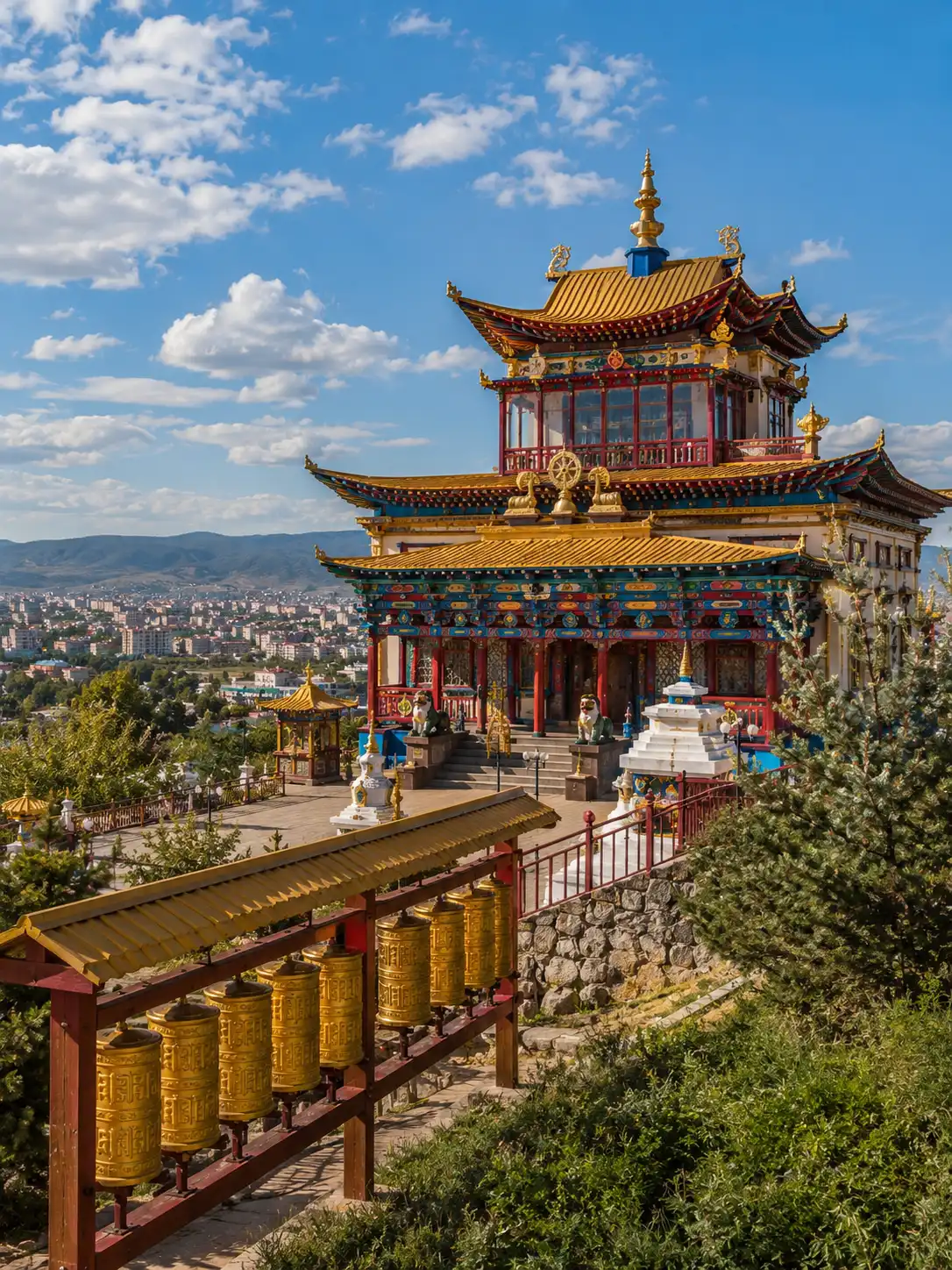
Rinpoche Bagsha Datsan is one of the most important Buddhist landmarks in Ulan-Ude and one of the most rewarding places to experience the spiritual identity of Buryatia without leaving the city. Located on Lysaya Mountain in the northern part of Ulan-Ude, the temple complex combines Buddhist worship, panoramic city views, prayer wheels, sacred sculptures, teaching halls and a peaceful walking route above the surrounding urban landscape.
Known in Russian as Дацан «Ринпоче Багша», the Buddhist centre was established in 2000 by the respected teacher Yeshe Lodoy Rinpoche with the blessing of the Fourteenth Dalai Lama. Its stated purpose is to preserve and develop Buddhism in Russia and to create suitable conditions for studying and practising Buddhist teachings.
The datsan is considerably younger than many historical monasteries in Buryatia. However, its relatively recent foundation does not reduce its religious importance. Daily khurals, or prayer services, take place within the complex, monks receive visitors and Buddhist festivals are observed according to the lunar calendar. The site functions as an active religious centre rather than as a purely architectural attraction.
One of the principal features inside the main temple is a six-metre bronze statue of Shakyamuni Buddha covered with gold leaf. The official datsan describes this statue as a central sacred object of the complex.
The elevated location adds another dimension to the visit. From the grounds and nearby observation areas, travellers can look across Ulan-Ude, the surrounding hills and the broader landscape of the Selenga region. This combination of Buddhist culture and panoramic scenery makes Rinpoche Bagsha particularly suitable for travellers who want to understand both the spiritual and geographical character of the Buryat capital.
This Wander Russia guide explains the history of the datsan, its religious purpose, principal sacred objects, prayer route, visitor etiquette, opening hours, transport and the best way to combine it with other important attractions in Ulan-Ude.
Where Is Rinpoche Bagsha Datsan?
Rinpoche Bagsha Datsan stands at 1 Streletskaya Street on Lysaya Mountain in Ulan-Ude.
The official monastery information lists the full address as 670024, Ulan-Ude, Republic of Buryatia, Russia. The complex is reached directly by bus number 97, which terminates near the datsan. The official site currently states that the centre is open every day, generally from 09:00 until 17:30, and that general entrance is free.
The hilltop setting distinguishes Rinpoche Bagsha from temples located within dense residential or commercial districts. The final approach rises above much of the city, gradually revealing broader views over Ulan-Ude.
The elevated position also creates stronger exposure to wind. Temperatures at the datsan can feel noticeably colder than in the centre, particularly during autumn, winter and early spring.
Why Rinpoche Bagsha Is One of Ulan-Ude’s Essential Sights
Rinpoche Bagsha belongs among the top attractions in Ulan-Ude because it combines three experiences within one destination.
First, it is an active Buddhist religious centre. Visitors can observe daily prayers, Buddhist ritual practices and the continuing importance of Tibetan Buddhism in Buryatia.
Second, it offers a strong architectural and artistic experience. The gold-covered Buddha statue, coloured temple details, prayer wheels and religious imagery create a visually distinctive environment.
Third, it provides one of the broadest public views over Ulan-Ude. The city’s position between hills, rivers and open Transbaikal landscapes becomes easier to understand from this elevated location.
Unlike Ivolginsky Datsan, which requires a journey outside Ulan-Ude, Rinpoche Bagsha can be reached directly from the city. This makes it particularly useful for travellers with limited time or those who want to compare an urban Buddhist centre with the larger monastery complex in the Ivolga Valley.
The Foundation of the Buddhist Centre
The Rinpoche Bagsha Buddhist centre was created in 2000 by Yeshe Lodoy Rinpoche, also known as Yelo Rinpoche IV.
According to the official datsan, the centre was founded with the blessing of the Fourteenth Dalai Lama. Its purpose was to preserve Buddhism, support Buddhist practice and create an environment in which people could study the teachings.
The main temple was opened publicly in 2004. The twentieth anniversary of that opening was marked in 2024, confirming 27 June 2004 as the official public opening date associated with the complex.
The creation of the datsan belongs to the broader Buddhist revival that followed the end of the Soviet period.
For much of the twentieth century, religious institutions across Buryatia faced closure, destruction or severe restrictions. The reopening and construction of datsans after the 1990s allowed Buddhist education, ceremonies and public religious life to expand again.
Rinpoche Bagsha represents this modern revival. It is not a reconstruction of one specific destroyed monastery but a new centre created for contemporary Buddhist life.
Who Was Yeshe Lodoy Rinpoche?
Yeshe Lodoy Rinpoche was the founder and spiritual leader closely associated with the development of the datsan.
He belonged to the Gelug school of Tibetan Buddhism, the same broad tradition that has strongly influenced Buddhist life in Buryatia and Mongolia.
His work focused on Buddhist teaching, monastic practice and the revival of religious education in Russia. The datsan continues to present him as its founding teacher and central spiritual figure.
The word “Rinpoche” is a Tibetan honorific generally used for highly respected Buddhist teachers. “Bagsha” is connected with the idea of a teacher or spiritual instructor in Buryat usage.
The name of the centre therefore emphasises teaching and spiritual guidance rather than referring only to a geographical location.
The Main Temple
The principal temple stands at the centre of the complex.
Its architecture combines features associated with Tibetan and Buryat Buddhist traditions, including colourful façades, symbolic roof decorations, painted details and a formal entrance leading toward the main prayer hall.
The building should not be approached as a museum exhibit. Daily religious services take place inside, and monks may be chanting, receiving visitors or preparing for ceremonies.
Visitors should enter quietly, reduce phone noise and avoid interrupting anyone engaged in prayer.
The main interior focus is the large image of Shakyamuni Buddha.
The Six-Metre Shakyamuni Buddha Statue
The six-metre bronze statue of Shakyamuni Buddha is the most important visual and sacred feature of Rinpoche Bagsha Datsan.
The official datsan states that the statue is covered with gold leaf. It occupies a dominant position within the temple and immediately establishes the scale and spiritual focus of the prayer hall.
Shakyamuni Buddha refers to Siddhartha Gautama, the historical Buddha whose teachings form the foundation of Buddhism.
The seated posture, hand gestures and surrounding symbols may communicate specific aspects of Buddhist teaching. Visitors unfamiliar with Buddhist iconography may benefit from a guide who can explain the meaning of the pose, lotus throne and decorative elements.
The statue should be approached respectfully. Loud conversation, inappropriate poses and intrusive photography are unsuitable.
Interior photography rules may vary, and permission should be confirmed before using a camera.
Daily Khurals
Khurals are Buddhist prayer services and ritual assemblies.
The official schedule shows that morning services commonly take place from 09:00 until around 11:00 or 11:30. Additional prayers, rituals and afternoon services are held according to the weekday and lunar calendar. A daily afternoon khural is generally listed around 15:00.
The exact content varies. Individual services may focus on compassion, protection, health, prosperity, purification or particular Buddhist deities and teachers.
Visitors may attend quietly when public access is permitted.
A khural should not be treated as a staged show. People may be attending because of personal illness, family concerns, remembrance or religious commitment.
Entering late, walking repeatedly across the front of the prayer hall or photographing worshippers can disturb the ceremony.
Meeting the Monks
The official schedule includes periods during which monks receive visitors.
Current information generally lists visitor consultations after the morning khural and again during the afternoon, although precise times can change.
People may consult monks about prayers, personal difficulties, health, family concerns or Buddhist practice.
Travellers interested in such a consultation should ask staff how the process works and whether language assistance is available.
The meeting should be approached sincerely. It is not comparable with a casual fortune-telling attraction.
The Buddhist Prayer Route
One of the most meaningful ways to explore the complex is to follow the traditional clockwise route.
Buddhist temples, stupas and prayer wheels are normally circled clockwise, following the direction of the sun. This practice represents respect and forms part of Buddhist circumambulation.
Visitors should begin near the entrance, continue in the established direction and avoid moving against the flow of worshippers.
The complete route may include the main temple, prayer wheels, sacred structures and panoramic points around the hill.
Walking slowly allows time to observe the details and experience the quiet atmosphere rather than treating the datsan as a rapid photo stop.
Prayer Wheels
Prayer wheels contain Buddhist texts or mantras.
Turning a wheel clockwise is understood as symbolically setting the prayers into motion.
Visitors are generally welcome to turn the wheels gently while following the clockwise route.
The action should remain calm and respectful. The wheels should not be spun violently, pushed in the wrong direction or used as props for playful photographs.
Prayer wheels are among the easiest religious practices for visitors to understand because they connect physical movement with meditation and prayer.
Stupas and Sacred Structures
Stupas are Buddhist monuments associated with enlightenment, sacred relics and the preservation of teachings.
Their form carries symbolic meaning, from the base representing the earthly realm to the upper elements referring to spiritual development and awakening.
Visitors should walk clockwise around stupas and avoid touching or climbing on them.
Offerings, scarves or objects placed nearby should not be moved.
The open setting of Rinpoche Bagsha allows these structures to be seen against the sky and surrounding hills, creating especially attractive compositions for photography.
The View Over Ulan-Ude
The panoramic setting is one of the major reasons travellers visit Rinpoche Bagsha.
From Lysaya Mountain, the city extends below with residential districts, central buildings, distant hills and open Transbaikal landscapes visible beyond.
The panorama helps explain Ulan-Ude’s geography. The city lies within a broad inland region shaped by the Selenga and Uda river systems and surrounded by low mountains and dry steppe environments.
A guided visitor programme often begins at the observation area because the viewpoint provides an immediate orientation before entering the temple complex.
Visibility depends strongly on weather. Clear autumn and winter days can provide exceptionally long views, while haze, smoke or snow may reduce detail.
Sunrise and Sunset
The elevated hill provides attractive light during both morning and evening.
Morning is generally quieter and suits visitors who want to attend the early khural.
Late afternoon can produce warmer light across the city and hills.
Sunset times vary greatly by season, and the official closing time may limit access during late summer evenings. Visitors planning sunset photography should check the current opening schedule before travelling.
Winter sunsets occur earlier and may coincide more easily with visiting hours, but extreme cold can make long outdoor stays difficult.
Buddhist Festivals
The datsan follows the Tibetan Buddhist lunar calendar.
Major prayers and festive khurals occur throughout the year, with dates changing annually. The official website publishes schedules for weekly services, daily khurals and principal ceremonies.
Sagaalgan, the Buryat Buddhist New Year, is among the most important periods in the regional religious calendar.
Festival visits provide a deeper view of living Buddhist culture, but they also bring larger crowds, more formal ceremonies and possible access restrictions.
Visitors seeking quiet architecture and panoramic views may prefer an ordinary weekday.
Visitor Etiquette
Rinpoche Bagsha welcomes visitors, but the complex remains a sacred place.
Appropriate behaviour includes:
- Walking clockwise around temples and stupas
- Speaking quietly
- Wearing modest clothing
- Removing hats inside when requested
- Turning prayer wheels clockwise
- Avoiding physical contact with statues and ritual objects
- Following photography restrictions
- Not interrupting monks or worshippers
- Keeping food away from sacred interiors
- Avoiding alcohol, smoking and disruptive behaviour
Traditional guidance also recommends entering and leaving temples through the appropriate doors where indicated and avoiding direct movement across the central area in front of an altar.
Visitors should never sit with their feet pointing directly toward the Buddha image or altar.
What to Wear
There is no requirement for specialised religious clothing, but modest dress is appropriate.
Shoulders and the upper body should be covered. Very short clothing is unsuitable.
Comfortable shoes are useful because the grounds involve outdoor walking and some elevation changes.
Winter visitors need insulated boots, gloves, a hat and a windproof outer layer.
The exposed hill can feel much colder than the city centre.
During summer, sun protection is important because several areas have limited shade.
Opening Hours and Admission
The official datsan currently lists daily opening hours from approximately 09:00 until 17:30, Monday through Sunday. General admission is free.
The schedule currently includes:
- Morning khural from approximately 09:00 to 11:30
- Monk consultations during late morning
- A midday break
- Additional consultations in the afternoon
- Afternoon khural around 15:00
These times can vary according to ceremonies and the lunar calendar. The official schedule should be checked before a visit centred on one particular service.
Donations and offerings may be made in designated areas.
How to Reach Rinpoche Bagsha Datsan
The official site identifies bus number 97 as the direct public-transport route to the datsan. The temple is located at the final stop.
Public transport provides an affordable and practical option from central Ulan-Ude.
A taxi is faster and particularly useful during severe winter weather or for travellers with limited time.
Drivers should use the official address:
1 Streletskaya Street, Ulan-Ude.
The return journey should be planned before the closing time, especially during evenings or holidays.
How Much Time Is Needed?
A basic visit requires approximately one to one and a half hours.
A more complete experience including the temple, prayer route, observation area and quiet time on the grounds requires two to three hours.
Attending a khural or meeting a monk can extend the visit.
Rinpoche Bagsha can fit into a half-day city programme, but it should not be reduced to a brief bus stop between unrelated attractions.
Best Time to Visit
Rinpoche Bagsha can be visited throughout the year.
Late spring and summer provide mild conditions, green surroundings and easier outdoor walking.
Early autumn often offers clearer air, warm colours and comfortable temperatures.
Winter creates a striking combination of colourful temple architecture and snow. However, the hill is exposed and conditions can be extremely cold.
A weekday morning is generally the best option for travellers seeking a calm first visit.
Arriving before the morning khural provides time to explore the grounds and enter the temple quietly.
Combining Rinpoche Bagsha with Other Attractions
Rinpoche Bagsha can be combined with several important central Ulan-Ude sights.
A practical route includes:
- Soviet Square and the Lenin Head Monument
- Arbat pedestrian street
- Odigitrievsky Cathedral
- Lunch in the historical centre
- Rinpoche Bagsha Datsan in the afternoon
Travellers with a strong interest in Buddhism should visit both Rinpoche Bagsha and Ivolginsky Datsan.
The two sites are complementary.
Ivolginsky Datsan is the principal monastic and administrative centre of traditional Russian Buddhism and lies outside the city.
Rinpoche Bagsha is a modern urban Buddhist centre with easier access and one of Ulan-Ude’s strongest panoramas.
Rinpoche Bagsha or Ivolginsky Datsan?
Travellers with enough time should visit both.
Ivolginsky Datsan offers a larger monastery landscape, several temples, Buddhist education and the sacred association with Dashi-Dorzho Itigelov.
Rinpoche Bagsha provides a more compact experience within Ulan-Ude, a monumental Buddha statue and panoramic views over the city.
For a short city visit, Rinpoche Bagsha is easier to include.
For a deeper introduction to Buryat Buddhism, Ivolginsky Datsan remains essential.
Photography Tips
The datsan offers excellent architectural and landscape photography.
A wide-angle lens is useful for the main temple and open grounds.
A standard lens works well for prayer wheels, statues and architectural details.
A telephoto lens can isolate distant city districts and hills from the viewpoint.
Useful subjects include:
- The main temple against the sky
- Prayer wheels in the foreground
- Stupas and sacred structures
- Gold and coloured roof details
- The city panorama
- Snow-covered grounds in winter
- Pilgrims walking the clockwise route
- Evening light across the surrounding hills
People should not be photographed closely without permission.
Interior photography should only take place when explicitly allowed.
Accessibility
The site is reached directly by road and public transport.
Some exterior sections are relatively level, but the mountain setting, steps and temple thresholds can create difficulties for visitors with limited mobility.
Winter snow and ice can reduce accessibility.
A taxi allows visitors to arrive close to the main complex without completing a long uphill walk.
Visitors with specific needs should contact the datsan before travelling.
Is Rinpoche Bagsha Datsan Worth Visiting?
Rinpoche Bagsha is one of the essential sights in Ulan-Ude.
It provides a direct introduction to Buddhism in Buryatia, one of the cultural traditions that most clearly distinguishes the city from other regional capitals in Russia.
The experience combines active religious practice with accessible architecture and an exceptional view.
Its value does not depend on great age. The centre represents the modern revival and continuation of Buddhist teachings after the restrictions of the Soviet period.
Wander Russia recommends allowing at least two hours and, when possible, visiting during a public khural.
Frequently Asked Questions
Where is Rinpoche Bagsha Datsan?
It is located at 1 Streletskaya Street on Lysaya Mountain in Ulan-Ude.
When was the datsan founded?
The Buddhist centre was established in 2000 and the temple opened publicly in 2004.
Who founded it?
It was founded by Yeshe Lodoy Rinpoche with the blessing of the Fourteenth Dalai Lama.
What is the main attraction?
The principal sacred feature is a six-metre bronze statue of Shakyamuni Buddha covered with gold leaf.
Is admission free?
Yes. The official site currently states that general entry is free.
What are the opening hours?
The datsan is currently listed as open daily from approximately 09:00 until 17:30.
How can visitors get there?
Bus number 97 travels to the final stop near the datsan. Taxis are also practical.
Can non-Buddhists enter?
Yes. Visitors are welcome when they follow religious etiquette.
Can visitors attend a khural?
Public attendance is generally possible when access is open. The current daily and festival schedule should be checked in advance.
How long should a visit take?
Allow approximately two hours for the temple, prayer route and observation area.
Conclusion
Rinpoche Bagsha Datsan is one of the most meaningful places to visit in Ulan-Ude.
The centre represents the modern renewal of Buddhism in Buryatia. Founded in 2000 with the blessing of the Fourteenth Dalai Lama, it was created to preserve Buddhist teaching and provide a place for study and religious practice.
Its importance comes from living activity rather than historical age.
Daily khurals continue within the main temple. Monks receive visitors, lunar-calendar ceremonies are observed and local people come to pray, request guidance and participate in rituals.
The six-metre golden Shakyamuni statue gives the prayer hall a powerful visual centre, but the experience extends beyond one object.
Prayer wheels, stupas and the clockwise walking route introduce visitors to the physical rhythm of Buddhist devotion. The panoramic viewpoint connects the religious complex with the city below, showing how Buddhist identity remains part of contemporary Ulan-Ude rather than belonging only to remote rural monasteries.
Rinpoche Bagsha also works as a useful contrast with Ivolginsky Datsan.
Ivolginsky represents the principal monastic centre of Buryatia and requires a journey into the Ivolga Valley. Rinpoche Bagsha stands directly above the regional capital and reflects the accessibility of modern Buddhist life.
The best visit is unhurried.
Walking quietly, observing a khural, turning the prayer wheels and spending time at the viewpoint provides a deeper experience than simply photographing the colourful temple façade.
For travellers following Wander Russia through Ulan-Ude, Rinpoche Bagsha is the essential second Buddhist destination after Ivolginsky Datsan. Together, the two centres reveal the spiritual, cultural and geographical character of Buryatia.
