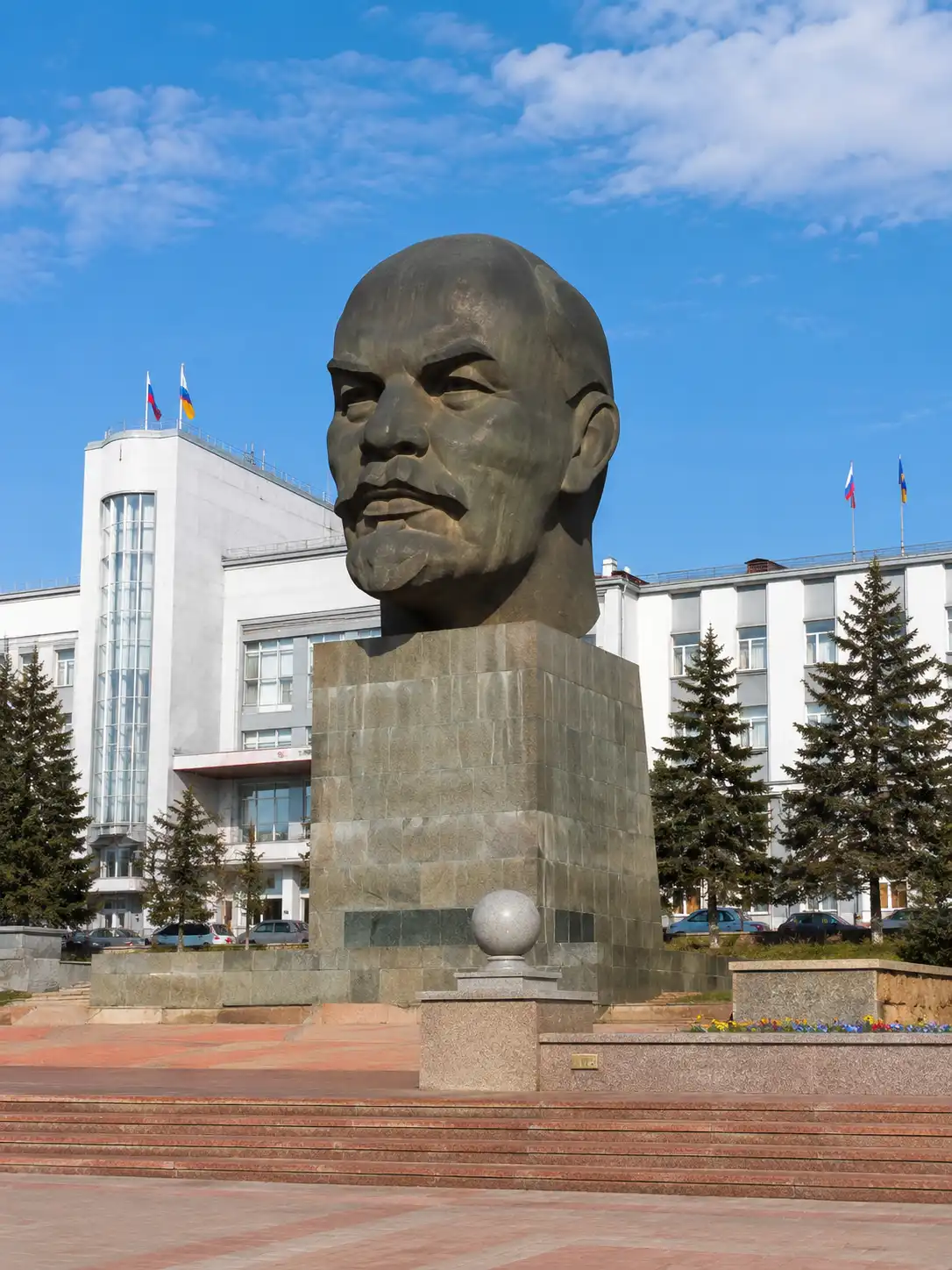
The Lenin Head Monument is the most recognisable landmark in Ulan-Ude and one of the most unusual surviving monuments from the Soviet period. Standing on Soviet Square in the centre of the Buryat capital, the colossal bronze head of Vladimir Lenin dominates the surrounding public space and has become a visual symbol of the city.
Known in Russian as Памятник В. И. Ленину or Голова Ленина, the monument differs sharply from the thousands of conventional Lenin statues erected across the Soviet Union. Instead of showing Lenin standing, walking or addressing a crowd, the Ulan-Ude monument consists only of an enormous head placed on a tall polished pedestal.
The sculpture is generally described as the largest monumental representation of Lenin’s head in the world. The bronze head measures approximately 7.7 metres in height and weighs around 42 tonnes. Together with its pedestal, the complete monument reaches approximately 14 metres, making it higher than many surrounding trees and comparable with a four-storey building.
The monument was created for the centenary of Lenin’s birth and installed at the beginning of the 1970s. It now stands in front of the Government House of the Republic of Buryatia, surrounded by Soviet-era administrative architecture. The combination of the oversized bronze face, broad square and monumental government building creates one of the most distinctive urban scenes in eastern Russia.
For travellers following Wander Russia through Ulan-Ude, the Lenin Head Monument provides an essential contrast with the Buddhist datsans, Orthodox churches and traditional Buryat culture found elsewhere in the city. It reveals the Soviet layer of Ulan-Ude’s identity and demonstrates how one political monument can gradually become a broader civic and tourist symbol.
This guide explains the history, design, dimensions, sculptors, symbolism, surrounding square, photography opportunities and practical visitor information for the Lenin Head Monument.
Where Is the Lenin Head Monument?
The monument stands on Soviet Square, known in Russian as Площадь Советов, in the administrative centre of Ulan-Ude.
The square is surrounded by the Government House of the Republic of Buryatia, public offices, university buildings and other institutions. Soviet Square functions as the main formal civic space of the city and remains closely connected with regional administration.
The location is central and easy to reach from other major Ulan-Ude attractions. The pedestrian section of Lenin Street, commonly called the local Arbat, begins nearby and leads toward the historical centre, merchant houses and Odigitrievsky Cathedral.
Ulan-Ude railway station is also relatively close, making the monument one of the easiest landmarks for travellers arriving on the Trans-Siberian or Trans-Mongolian Railway to visit first.
The square is open and the monument can be viewed freely at any time.
Why the Monument Is Famous
The monument is famous primarily because of its unusual form and enormous scale.
Lenin monuments became common throughout the Soviet Union, but most presented him as a complete figure. He was typically shown standing with one hand extended, holding a coat, speaking to workers or looking toward an imagined socialist future.
Ulan-Ude’s sculpture removes the body completely.
This creates a more abstract and visually powerful image. The head appears to rise directly from the pedestal, with the face turned slightly forward and the expression serious and concentrated.
Its proportions are intentionally monumental rather than realistic. The broad forehead, heavy facial planes and large features were designed to remain visible across the open square.
The result is both politically symbolic and visually surreal.
Even visitors with little interest in Soviet history often remember the monument because it looks unlike almost any other public sculpture in Russia.
The Centenary of Lenin’s Birth
The monument was created to mark the 100th anniversary of Vladimir Lenin’s birth in 1970.
The Soviet Union organised extensive celebrations around this anniversary. New statues, memorials, exhibitions and cultural programmes appeared across the country as the state reinforced Lenin’s role as the founder of the Soviet political system.
The Ulan-Ude project belonged to this wider commemorative campaign.
Rather than installing another conventional standing statue, the designers selected a monumental head that would be visible across the main administrative square.
Sources differ slightly on whether the monument should be described as installed in 1970 or formally unveiled in 1971. The consistent point is that it was created during the centenary period and became part of the cityscape at the beginning of the 1970s.
The Sculptors
The monument was created by sculptors Georgy Neroda and Yuri Neroda, with architectural work associated with Alexei Dushkin and Pavel Zilberman.
Georgy Neroda was an established Soviet sculptor known for monumental and politically themed works. Yuri Neroda continued within the same artistic tradition.
Their design focused on Lenin’s head rather than a complete body, allowing the face itself to carry the symbolic message.
The monument is often described as having been developed from a smaller sculptural model shown at exhibitions before the full-scale bronze version was produced for Ulan-Ude.
Stories surrounding the monument’s exhibition history have become mixed with local legend, and not every popular version can be verified. The most reliable facts concern the artists, dimensions, centenary context and eventual installation on Soviet Square.
Dimensions and Weight
The bronze head is approximately 7.7 metres high.
Its widest dimension is commonly given as around 4.5 metres, while its depth is approximately 4.2 metres.
The head weighs around 42 tonnes.
Together with the pedestal, the complete monument reaches approximately 13.5 to 14 metres in height.
These dimensions are difficult to appreciate in photographs because the broad square provides few immediate scale references.
The true size becomes clearer when a person stands near the base or when the monument is compared with the Government House behind it.
The sculpture’s massive weight also required a substantial foundation and pedestal capable of supporting the bronze structure through Ulan-Ude’s severe winters and strong seasonal temperature changes.
The Bronze Surface
The monument is made from bronze and has developed a dark, almost black appearance.
The material gives the face a heavy and permanent visual character. Sunlight creates strong highlights across the forehead, nose and cheekbones, while the deeper parts of the face remain in shadow.
This interaction between light and surface changes throughout the day.
In bright morning light, the features appear sharper and more graphic.
Under overcast conditions, the monument becomes darker and more severe.
Snow creates one of the strongest visual contrasts, especially when the bronze head rises above the white square during winter.
The surface requires maintenance, as exposure to weather, pollution and birds can affect monumental bronze over time.
Lenin’s Facial Expression
The monument presents Lenin with a serious and concentrated expression.
The eyes appear focused into the distance, while the mouth remains closed. The face communicates determination rather than warmth.
This was consistent with Soviet monumental art, which often represented political leaders as calm, visionary and intellectually controlled.
The absence of a body intensifies the expression. There are no gestures, clothing details or surrounding figures to distract from the face.
Visitors frequently comment on the slightly unusual appearance of the features. Some believe that the face appears to reflect elements associated with the local Buryat population.
There is no clear evidence that the sculptors deliberately altered Lenin’s ethnicity or intended to create a specifically Buryat version. The impression may result from the monument’s scale, simplified facial planes and viewing angle.
The interpretation has nevertheless become part of local and visitor folklore.
Soviet Square
Soviet Square is the formal setting that gives the monument much of its visual power.
The square developed as Ulan-Ude’s principal administrative space and was formerly known as Nagornaya Square before receiving its Soviet-era name. Government and institutional buildings surround the open area.
The broad surface creates distance between the monument and surrounding streets. This allows the bronze head to dominate the view without interference from shops, advertising or dense traffic.
The Government House behind the monument forms a deliberate architectural backdrop. Its horizontal and symmetrical appearance contrasts with the vertical form of the pedestal and rounded shape of the head.
Together, the building, square and monument create a unified example of Soviet civic planning.
The Government House of Buryatia
The Government House stands directly behind the Lenin monument.
Its restrained monumental design reflects the administrative architecture associated with the Soviet period.
The building’s central position reinforces the political meaning of the sculpture. Lenin’s head does not stand in an ordinary park or residential district. It faces the main governmental space of the republic.
This relationship was intentional.
The monument represented the ideological foundation of the Soviet state, while the government building represented the practical regional administration operating within that system.
Today, the same arrangement remains in place even though the Soviet Union no longer exists.
The square therefore preserves a complete political landscape rather than an isolated statue removed from its original context.
From Political Symbol to City Landmark
During the Soviet period, the monument functioned primarily as an ideological symbol.
It honoured Lenin, marked the centenary of his birth and occupied the most important administrative square in the city.
After the collapse of the Soviet Union, monuments to Lenin followed different paths across former Soviet republics and Russian regions. Some were removed, moved to parks or damaged. Others remained in their original locations.
The Ulan-Ude monument stayed on Soviet Square.
Over time, its meaning expanded.
It remains connected with Soviet ideology, but it has also become a distinctive emblem of Ulan-Ude. Souvenirs, postcards, travel photographs and tourism materials frequently use the monumental head as shorthand for the city.
This transformation demonstrates how public monuments can acquire new identities without losing their original historical associations.
The Monument and Buryat Identity
The monument creates an interesting contrast with the cultural identity of Buryatia.
Ulan-Ude is one of Russia’s principal centres of Tibetan Buddhism and Buryat culture. Ivolginsky Datsan, Rinpoche Bagsha, Buryat language, traditional food and Indigenous history give the city a character different from many other regional capitals.
At the same time, Ulan-Ude contains a strong Soviet architectural and historical layer.
The giant Lenin head stands at the centre of that layer.
For visitors, the city is most interesting when these identities are not treated as contradictions. Buddhist temples, Orthodox churches, merchant houses and Soviet monuments all belong to different periods of Ulan-Ude’s development.
The Lenin monument does not represent the entire city, but it represents one unavoidable chapter of its history.
Is It Really the Largest Lenin Head in the World?
The monument is widely described as the world’s largest monumental head of Lenin.
Its 7.7-metre bronze head and 42-tonne weight support that claim, and major travel sources consistently identify it as the largest sculpture devoted specifically to Lenin’s head.
This description should be distinguished from claims about the tallest complete Lenin statue.
Several larger full-body Lenin monuments exist or have existed elsewhere. The Ulan-Ude record concerns a head-only sculpture rather than the overall tallest Lenin monument of any type.
This distinction is useful because travel descriptions sometimes combine different records imprecisely.
Visiting the Monument
A basic visit is simple.
Approach Soviet Square from Lenin Street or the nearby administrative district.
Walk across the square toward the monument and observe it from a distance first. The overall composition with the Government House is more impressive from farther away than directly beside the pedestal.
Continue around the monument to see how the face changes from different angles.
The sculpture is three-dimensional, and the profile views reveal the depth and construction more clearly than the standard frontal photograph.
After visiting the monument, continue toward the pedestrian section of Lenin Street and the historical centre.
How Much Time Is Needed?
A quick visit takes approximately 15 to 20 minutes.
Travellers interested in photography, Soviet architecture and the surrounding square may spend 30 to 45 minutes.
The monument works best as part of a broader central walking route rather than as a separate half-day attraction.
Combining it with Lenin Street, the Triumphal Arch, merchant houses and Odigitrievsky Cathedral creates a balanced two- to three-hour walk.
Best Time to Visit
The monument can be visited throughout the year and at any time of day.
Late spring through early autumn provides the most comfortable walking conditions.
Summer offers long daylight and active city streets.
Early autumn often provides clearer air and softer light.
Winter creates the most dramatic contrast between bronze, snow and the pale Siberian sky. However, temperatures in Ulan-Ude can be extremely low, and the open square is exposed to wind.
There is no admission fee and no controlled entrance.
Best Time of Day
Morning is usually the best period for a quieter visit.
The square is less crowded, and the lower angle of sunlight can create stronger shadows across the face.
Midday provides even illumination but can flatten the facial details.
Late afternoon produces warmer light on suitable days.
At night, artificial lighting gives the monument a more theatrical appearance. The square remains central, but visitors should remain aware of cold conditions and slippery surfaces in winter.
Winter at Soviet Square
Winter gives the monument a particularly Siberian atmosphere.
Snow may cover the square and pedestal surroundings, while the dark bronze head remains visually dominant.
Temperatures can fall far below freezing.
The open administrative square offers little protection from wind, so insulated boots, gloves, a hat and a windproof coat are essential.
Ice can form on paved areas. Visitors should watch their footing, especially when moving backward while taking photographs.
Winter daylight is shorter, making planning more important.
Photography Tips
The monument is highly photogenic but can be difficult to frame because of its scale.
A wide-angle lens works well for including the complete pedestal, Government House and open square.
A standard lens produces more natural proportions when photographing from farther away.
A telephoto lens can isolate the facial details and remove surrounding distractions.
Useful compositions include:
- The monument centred against the Government House
- A side profile showing the depth of the head
- A person near the base to demonstrate scale
- The bronze head against a blue sky
- Snow around the pedestal in winter
- Reflections in wet paving after rain
- Evening illumination
- The monument framed by Soviet architecture
Visitors should avoid climbing on the pedestal or using disrespectful poses.
The square is an active public and administrative space, so photography of security installations or government entrances should be approached cautiously.
How to Reach Soviet Square
Soviet Square lies in central Ulan-Ude and is served by multiple public-transport routes.
Visitors staying near the historical centre can usually reach it on foot.
The railway station is also close enough for a short taxi ride or a longer walk, depending on luggage and weather.
Using the Russian name Площадь Советов in navigation applications produces the clearest result.
Taxis can stop near the surrounding streets, although direct vehicle access to the centre of the square is restricted.
Accessibility
The square is broad, paved and relatively level.
This makes the monument more accessible than hilltop attractions such as Rinpoche Bagsha Datsan.
Curbs, snow and winter ice may still create difficulties.
Visitors using wheelchairs or walking aids should approach from the most level surrounding street and avoid untreated icy sections.
There are no significant stairs required to obtain a full view of the monument.
Combining the Monument with Lenin Street
The most natural continuation is the pedestrian section of Lenin Street.
This route passes historical buildings, cafés, shops and the reconstructed Tsar’s Gate or Triumphal Arch.
Farther south, visitors can continue toward the merchant quarter and Odigitrievsky Cathedral.
The sequence works well because it connects Soviet Ulan-Ude with the older pre-revolutionary city.
A practical route is:
- Soviet Square
- Lenin Head Monument
- Pedestrian Lenin Street
- Triumphal Arch
- Historic merchant houses
- Revolution Square
- Odigitrievsky Cathedral
This walk provides one of the strongest introductions to central Ulan-Ude.
Combining the Monument with Buddhist Attractions
The Lenin monument can also be combined with Rinpoche Bagsha Datsan.
Begin at Soviet Square in the morning, continue through the historical centre and travel to the hilltop datsan later in the day.
This creates a powerful contrast between Soviet monumental art and contemporary Buddhist religious life.
Ivolginsky Datsan requires more time and is better treated as a separate half-day excursion.
Is the Lenin Head Monument Worth Visiting?
The Lenin Head Monument is essential for any first visit to Ulan-Ude.
It is not necessary to admire Lenin or Soviet ideology to find the sculpture interesting.
Its value lies in scale, design, historical context and the way it has become inseparable from the identity of the city.
Many Russian cities contain Lenin statues. Only Ulan-Ude contains this monumental bronze head dominating an entire administrative square.
Wander Russia recommends visiting it as the starting point for a walk through central Ulan-Ude.
Frequently Asked Questions
Where is the Lenin Head Monument?
It stands on Soviet Square in the administrative centre of Ulan-Ude.
How tall is the monument?
The bronze head is approximately 7.7 metres high. Together with the pedestal, the full monument reaches around 14 metres.
How much does it weigh?
The bronze head weighs approximately 42 tonnes.
When was it installed?
It was created for Lenin’s centenary and installed at the beginning of the 1970s. Sources commonly cite 1970 or 1971.
Is it the largest Lenin monument in the world?
It is widely described as the world’s largest sculpture consisting specifically of Lenin’s head. It is not the tallest full-body Lenin monument.
Who created it?
The sculptors were Georgy Neroda and Yuri Neroda, with architects Alexei Dushkin and Pavel Zilberman associated with the project.
Is there an entrance fee?
No. The monument stands in an open public square and can be viewed freely.
How long is needed?
Allow around 20 to 45 minutes, depending on photography and interest in the surrounding architecture.
Can it be visited in winter?
Yes, but Ulan-Ude winters are extremely cold and the square can be icy and windy.
What should be visited nearby?
Pedestrian Lenin Street, the Triumphal Arch, historic merchant buildings and Odigitrievsky Cathedral are all easy to combine with the monument.
Conclusion
The Lenin Head Monument is one of the most distinctive pieces of Soviet monumental art in Russia.
Its design is immediately memorable. By removing the body and enlarging only the head, the artists created a sculpture that appears more abstract and psychologically intense than a conventional political statue.
The size reinforces that effect.
A 7.7-metre bronze face weighing around 42 tonnes rises above Soviet Square and confronts the viewer from almost every angle. The Government House behind it completes the ideological urban composition conceived during the Soviet period.
Yet the monument’s meaning has changed.
It was created to celebrate Lenin’s centenary and demonstrate Soviet political continuity. After the end of the Soviet Union, it remained in place and gradually became something broader: an identifying image of Ulan-Ude.
Today, it appears in tourism photography, souvenirs and city itineraries. Visitors approach it with curiosity, humour, historical interest or admiration for monumental design.
The city surrounding it adds further complexity.
Ulan-Ude is simultaneously a centre of Buryat culture, Tibetan Buddhism, Russian Orthodox history, Trans-Siberian travel and Soviet architecture. The Lenin head belongs to this mixture rather than replacing it.
A complete visit should therefore continue beyond the square.
Walking along Lenin Street reveals merchant architecture and the older town. Visiting Odigitrievsky Cathedral introduces Orthodox tradition. Travelling to Rinpoche Bagsha or Ivolginsky Datsan reveals the Buddhist identity of Buryatia.
The monument becomes most meaningful when seen as one layer within that wider cultural landscape.
For Wander Russia, the Lenin Head Monument is the natural starting point for central Ulan-Ude. It is accessible, visually powerful and historically revealing.
Few monuments communicate the scale, ambition and strangeness of Soviet public art as directly.
