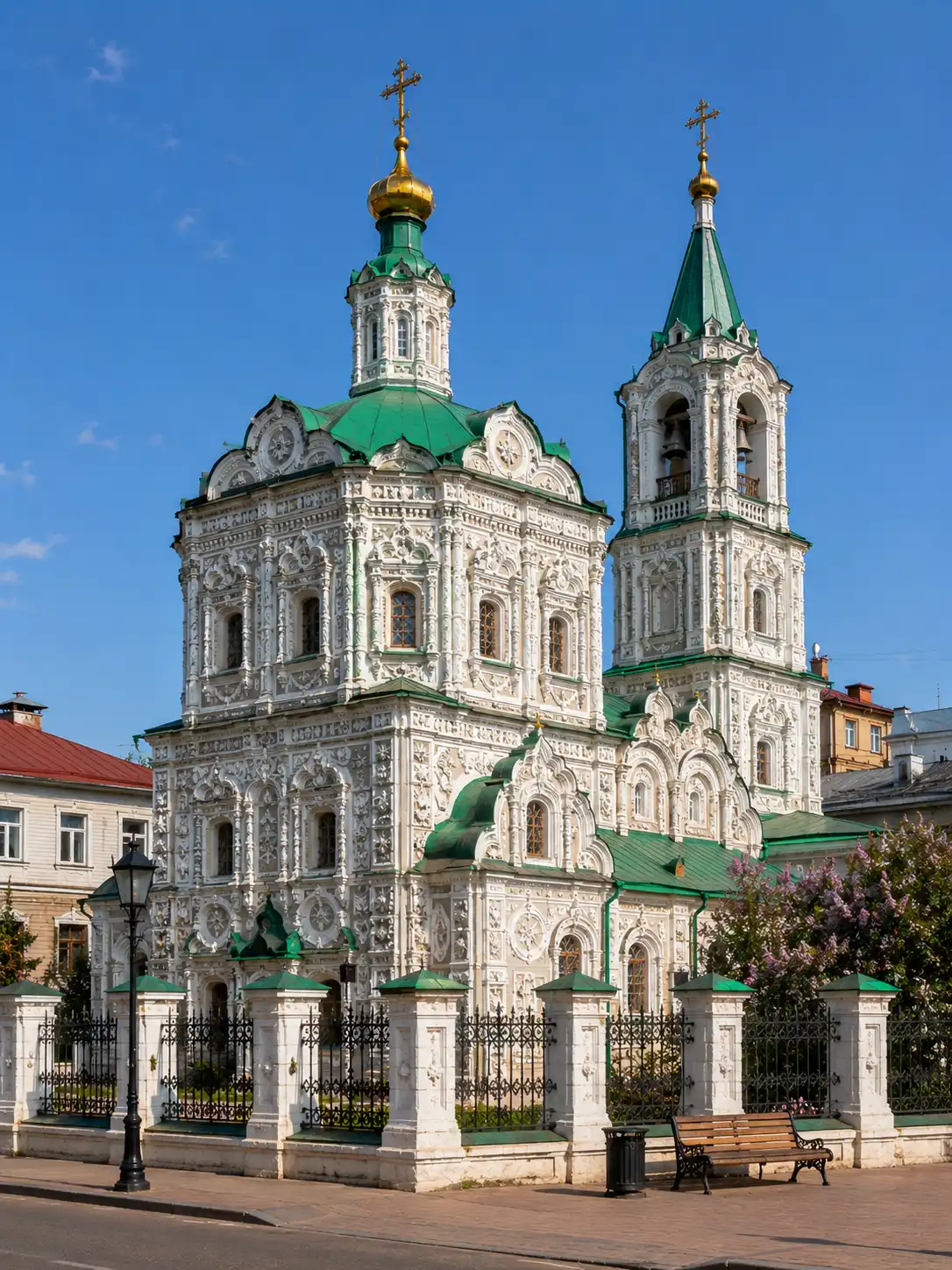
Holy Cross Church is one of the most remarkable religious buildings in Irkutsk and one of the clearest architectural expressions of Siberian Baroque. Located on a small rise directly beside 130 Kvartal, the church combines traditional Russian Orthodox forms with unusually dense exterior ornamentation that has long attracted historians, architects and travellers.
Known in Russian as Крестовоздвиженская церковь, the church is dedicated to the Exaltation of the Holy Cross. Its white walls, green roofs, golden crosses and richly modelled façades make it visually distinct even in Irkutsk, a city known for elaborate churches and decorative wooden architecture.
The present stone church was founded in 1747 with financial support from the Irkutsk merchant Ivan Amosov. Construction continued for more than a decade and was largely completed around 1758–1760. It replaced an earlier wooden church built on Krestovaya Hill during the early eighteenth century.
Holy Cross Church is often described as one of the finest surviving examples of Siberian Baroque. Its exterior decoration combines geometric forms, floral patterns and motifs that some scholars have compared with Buryat, Mongolian or Tibetan Buddhist artistic traditions. The exact origins of these details remain debated, but the church clearly reflects Irkutsk’s position at a cultural crossroads between Russia, Siberia, Mongolia and China.
The building is also notable for the survival of historic iconostases and a large collection of icons. Unlike many churches that were demolished or radically altered during the Soviet period, Holy Cross Church retained much of its architectural identity and eventually returned to regular Orthodox worship.
For travellers following Wander Russia through Irkutsk, the church provides an ideal continuation after visiting 130 Kvartal. The two attractions stand close together but represent different sides of the city’s heritage: one presents restored wooden urban architecture, while the other preserves eighteenth-century stone craftsmanship and living religious tradition.
Where Is Holy Cross Church?
Holy Cross Church stands at 1 Sedova Street in central Irkutsk.
The building occupies a small elevated area known historically as Krestovaya Hill. It lies directly opposite or immediately beside the 130 Kvartal heritage district, making it one of the easiest churches to include in a central walking route.
The location is particularly convenient because several important streets and public-transport routes pass nearby. Visitors exploring 130 Kvartal can reach the church in only a few minutes on foot.
Current visitor listings commonly describe the church as open daily, often approximately from 09:00 until 19:00. Because it remains an active place of worship, access can change during services, religious holidays or private ceremonies.
The Russian name Крестовоздвиженская церковь is the most reliable term to use in local navigation applications.
Why Holy Cross Church Is One of Irkutsk’s Must-See Places
Holy Cross Church belongs among Irkutsk’s essential attractions because it combines architectural originality, historical depth and an active religious role.
It is important for several reasons:
- It is one of the finest examples of Siberian Baroque.
- Its exterior ornamentation is unusually dense and complex.
- Some decorative elements appear influenced by the cultures of Inner Asia.
- It preserves historic iconostases and a substantial collection of icons.
- It stands beside one of Irkutsk’s most popular heritage districts.
- It survived political change and remains an active Orthodox church.
- It provides a clear comparison with Epiphany Cathedral and the Church of the Savior.
The church is not the largest religious building in Irkutsk, but its façades contain more concentrated decorative detail than many larger cathedrals.
Visitors who see it only from a passing vehicle may miss much of its importance. The building is best understood by walking around the entire exterior and examining the repeated patterns closely.
The First Wooden Church
Before the present stone building existed, a wooden religious complex stood on Krestovaya Hill.
A cross had been erected on the hill to mark a place associated with a proposed women’s religious community. Between approximately 1717 and 1719, a two-storey wooden church was constructed there.
Wooden churches were common in early Irkutsk. Timber was readily available, practical in a frontier settlement and suitable for rapid construction.
However, wooden buildings were vulnerable to fire, decay and severe climatic conditions. As Irkutsk became wealthier during the eighteenth century, local merchants increasingly financed permanent stone churches.
The replacement of the wooden church by the present stone structure therefore reflected both religious devotion and the economic growth of the city.
Construction of the Stone Church
The foundation of the stone church was laid in 1747.
Merchant Ivan Amosov provided major financial support for the project. Wealthy merchants played an essential role in the construction of churches across Siberia, where state funding and specialist labour were often limited.
The church was built over approximately eleven to thirteen years and was completed around 1758–1760. Different sources provide slightly different completion dates because individual chapels and architectural sections were consecrated or finished at different stages.
The building was initially connected with the names Trinity and Saint Sergius before becoming known primarily as the Church of the Exaltation of the Holy Cross.
The long construction period allowed different decorative ideas and practical changes to enter the design. This helps explain the architectural complexity visible today.
The Meaning of the Exaltation of the Holy Cross
The church is dedicated to the Orthodox feast of the Exaltation of the Holy Cross.
The feast commemorates the discovery and ceremonial elevation of the cross associated in Christian tradition with the crucifixion of Jesus Christ.
Within Orthodox Christianity, the cross represents suffering, sacrifice, victory over death and the promise of salvation.
Churches dedicated to the feast often include prominent cross imagery in their iconostases, liturgical decoration and exterior symbolism.
The dedication also connects naturally with the historical name Krestovaya Hill, which can be translated as Cross Hill.
Siberian Baroque
Holy Cross Church is widely regarded as a masterpiece of Siberian Baroque.
Siberian Baroque developed during the eighteenth century as builders adapted Russian Baroque, Ukrainian Baroque, older Moscow traditions and regional decorative practices to the towns of Siberia.
The style is generally characterised by:
- Layered architectural volumes
- Complex silhouettes
- Decorative brickwork
- Elaborate window surrounds
- Curved gables
- Floral and geometric ornament
- Strong vertical compositions
- Distinctive regional motifs
Holy Cross Church is frequently singled out as one of the most original examples of the style. Architectural historians have described it as a particularly important work because of its unusual combination of Russian, Ukrainian and eastern decorative elements.
The building should therefore be viewed not simply as an attractive church but as a major architectural document of eastern Siberia.
The Exterior Decoration
The exterior decoration is the feature that makes Holy Cross Church exceptional.
The walls are covered with relief patterns formed from plaster and masonry. Rather than using one simple decorative system, the church combines repeated geometric shapes, floral forms, arches, circular motifs and complex window frames.
Some areas resemble carved textile patterns or embroidery translated into stone.
The decoration is particularly dense around windows, upper levels, gables and the transitions between architectural sections.
A close exterior walk reveals details that are almost invisible from the opposite side of the street.
The patterns create strong shadows in angled sunlight, making morning and late afternoon especially suitable for photography.
Buryat and Buddhist Influences
Scholars have long debated whether some of the church’s ornament was influenced by Buryat, Mongolian or Tibetan Buddhist art.
Certain forms have been compared with Buddhist wheels, lotus-like patterns and decorative motifs found in temples and objects from Inner Asia. Architectural historians have also considered whether Buryat craftsmen may have participated in construction or decoration.
These interpretations should be presented carefully.
The church remains fundamentally Russian Orthodox in plan, function and symbolism. Not every geometric or circular design should automatically be identified as Buddhist.
However, Irkutsk was located on major trade routes connecting Russia with Mongolia and China. Cultural exchange was part of everyday life, and local craftsmen could encounter a wide range of decorative traditions.
The façades may therefore reflect not a direct copying of Buddhist architecture but the broader cultural environment of eastern Siberia.
This makes the church especially important as evidence of Irkutsk’s position between European Russia and Inner Asia.
The Church Plan
The church follows the longitudinal arrangement common in Russian Orthodox architecture.
The principal sacred space stands toward the eastern end, while the refectory and bell-tower sections extend westward.
Several chapels and levels were incorporated into the overall structure.
The building’s masses become progressively narrower and higher, creating a vertical rhythm. This stacked appearance is characteristic of many regional Baroque churches.
From the side, the church looks almost like several connected buildings rather than one simple structure.
Walking around it reveals how the smaller chapels, central volume and tower were combined into one complex composition.
The Bell Tower and Later Changes
The western entrance area changed during the nineteenth century.
In 1806, an older porch was replaced with a two-level narthex associated with Irkutsk architect V. A. Kudelsky.
This later work altered the original eighteenth-century appearance but became an important historical layer in its own right.
A stone fence containing 39 wrought-iron sections was constructed around the church in 1852.
The fence helped define the church grounds and created a formal boundary between sacred space and the surrounding streets.
Today, the combination of church, gates, landscaping and fencing contributes strongly to the atmosphere of the site.
Recognition as an Architectural Monument
The church’s architectural importance was recognised before the Russian Revolution.
In 1887, the Imperial Archaeological Commission included it among important monuments of Russian antiquity.
This early recognition is significant because it shows that scholars already considered the church exceptional before the modern preservation movement developed.
During the early Soviet period, the building was also recognised as an architectural monument of high importance.
Official heritage status helped protect the church during a period when many other religious buildings were closed, altered or demolished.
Interior of the Church
The interior is less immediately visible than the exterior but is equally important.
Visitors encounter icons, candle stands, painted surfaces, religious furnishings and several historic iconostases.
An iconostasis is a screen covered with icons that separates the altar from the main worship area in an Orthodox church.
Holy Cross Church is associated with three iconostases and a substantial icon collection. Some travel sources state that the church contains around 650 icons, with approximately 400 recognised for artistic significance. Many date from the eighteenth century, while some may be older.
Exact counts and attributions can change through restoration and cataloguing, but the collection is clearly one of the church’s most important cultural assets.
Historic Iconostases
The survival of historic iconostases is particularly valuable.
Many Siberian church interiors were destroyed, dispersed or heavily reconstructed during the Soviet period. Original icons were removed, sold, transferred to museums or lost.
Holy Cross Church preserves a rare sense of the visual richness of an eighteenth-century Orthodox interior.
The iconostases contain organised rows of sacred images representing Christ, the Mother of God, saints, apostles and major religious feasts.
Visitors should avoid treating them as ordinary decorative screens.
Within Orthodox tradition, icons form part of worship and prayer. Barriers should be respected, and sacred objects should not be touched.
Religious Services
Holy Cross Church remains an active Orthodox parish.
Regular liturgies, prayer services, baptisms, funerals and feast-day ceremonies take place inside.
The Feast of the Exaltation of the Holy Cross is one of the most important dates in the church calendar.
Visitors arriving during a service may remain quietly near the rear or side of the church when access is permitted.
Orthodox services often involve chanting, incense, candles and long periods of standing.
Tourists should avoid walking repeatedly across the main worship space or photographing clergy and parishioners during sensitive moments.
The Soviet Period
The church survived the Soviet era more successfully than many religious buildings in Irkutsk.
It received architectural protection relatively early, which reduced the risk of demolition.
Religious activity was nevertheless affected by broader Soviet policies toward churches and clergy.
The history of individual chapels, interior objects and parish use during this period is complex, and some details vary between sources.
The essential point is that the building retained its architectural importance and survived with enough historic material to remain one of Irkutsk’s most authentic religious monuments.
Its survival is especially significant when compared with the destruction of the former Kazan Cathedral near Kirov Square and other lost churches of the city.
The Church and 130 Kvartal
Holy Cross Church stands immediately beside 130 Kvartal, making the two attractions easy to combine.
The contrast is particularly useful.
130 Kvartal presents wooden houses, reconstructed streets, cafés and a modern heritage-development project.
Holy Cross Church presents an original eighteenth-century stone monument with an active religious function.
A visitor can therefore move within minutes from commercial heritage tourism to a sacred building that has shaped the city for more than two and a half centuries.
The church also provides a visual backdrop to parts of the quarter.
Its towers and domes rise above the wooden roofs, linking Irkutsk’s stone and timber architectural traditions.
Suggested Walking Route
A practical route begins at the entrance to 130 Kvartal near the Babr Monument.
Walk through the pedestrian district and examine the restored wooden houses.
Continue toward Sedova Street and cross to Holy Cross Church.
Walk around the complete exterior before entering.
After the visit, continue toward Karl Marx Street, the Angara River Embankment or Kirov Square.
A longer route may include:
- 130 Kvartal
- Holy Cross Church
- Karl Marx Street
- Monument to Alexander III
- Angara River Embankment
- Kirov Square
- Epiphany Cathedral
- Church of the Savior
This creates a balanced half-day exploration of wooden architecture, Siberian Baroque and the historic waterfront.
Best Time to Visit
Holy Cross Church can be visited throughout the year.
Summer provides green surroundings, open paths and comfortable exterior viewing.
Early autumn offers softer light and colourful trees.
Winter creates one of the most atmospheric settings. Snow highlights the dark rooflines, white walls and intricate relief ornament. Visitor accounts frequently mention the attractive winter garden and ice decorations around the church grounds.
A weekday morning is usually best for a quiet interior visit.
Late afternoon provides the most textured light for the façade.
Sundays and major feast days offer a stronger religious atmosphere but may bring larger congregations.
Photography Tips
The dense façade decoration makes Holy Cross Church especially rewarding for photography.
Useful subjects include:
- The full church from Sedova Street
- Window surrounds and relief ornament
- Green roofs and golden crosses
- The church framed by 130 Kvartal
- Geometric and floral details
- Winter snow around the church
- The stone fence and gates
- The bell tower against the sky
- Evening illumination
- Interior iconostases when photography is permitted
A standard lens is useful for natural architectural proportions.
A telephoto lens helps isolate decorative details.
A moderate wide-angle lens can capture the full building from close range, but excessive distortion may make the tower appear to lean.
Visitor Etiquette
Appropriate behaviour includes:
- Speaking quietly
- Switching phones to silent mode
- Wearing modest clothing
- Removing hats for men inside
- Following local guidance regarding women’s head coverings
- Avoiding food and drinks inside
- Not touching icons or iconostases
- Asking before photographing the interior
- Avoiding direct photography of worshippers
- Remaining clear of processions and clergy
Visitors are not required to participate in Orthodox rituals.
Respectful observation is sufficient.
How Much Time Is Needed?
A basic visit takes approximately 30 minutes.
Travellers interested in architecture, ornament and the icon collection should allow 45 minutes to one hour.
Combining the church with 130 Kvartal creates a two- to three-hour itinerary, especially when cafés, shops and photography are included.
Accessibility
The church is centrally located and easy to reach by taxi or public transport.
The surrounding grounds are relatively compact, but entrances may include steps and raised thresholds.
Historic church architecture can limit full step-free access.
Winter snow and ice may make the grounds more difficult for visitors with limited mobility.
A taxi can stop nearby, reducing the walking distance from the central streets.
Is Holy Cross Church Worth Visiting?
Holy Cross Church is essential for travellers interested in architecture, religion and the cultural history of Siberia.
Its importance comes from originality rather than size.
The building demonstrates how Russian Orthodox architecture changed when it reached eastern Siberia and entered a landscape connected with Buryat, Mongolian and Chinese culture.
Its exterior ornament is among the most complex in Irkutsk, while the historic iconostases give the interior unusual artistic value.
Wander Russia recommends visiting it together with 130 Kvartal and examining the façades slowly rather than treating the church as a brief photo stop.
Frequently Asked Questions
Where is Holy Cross Church?
It stands at 1 Sedova Street in central Irkutsk, directly beside 130 Kvartal.
When was it built?
Construction began in 1747 and was largely completed between 1758 and 1760.
What architectural style does it represent?
It is considered one of the finest surviving examples of Siberian Baroque.
Why is the decoration unusual?
The façades combine geometric, floral and regional patterns, some of which have been compared with Buryat and Buddhist decorative traditions.
Is it an active church?
Yes. It remains an active Russian Orthodox place of worship.
Is there an entrance fee?
General entry to active Orthodox churches is normally free, although donations may be made.
How long should visitors spend there?
Allow approximately 30 to 60 minutes.
What is nearby?
130 Kvartal, the Babr Monument, Karl Marx Street and the Angara River Embankment are all easy to combine with the church.
What are the usual opening hours?
Current listings commonly indicate daily opening from around 09:00 until 19:00, but service schedules and holidays may affect access.
Can visitors photograph the interior?
Rules can vary. Signs should be checked and permission requested before taking photographs.
Conclusion
Holy Cross Church is one of the clearest examples of how architecture in Siberia developed its own regional identity.
The first wooden church on Krestovaya Hill belonged to the early growth of Irkutsk. As trade and merchant wealth increased, local residents replaced it with a more permanent stone structure.
The building completed during the eighteenth century was not merely a distant copy of architecture from Moscow.
Its Russian Orthodox plan and Baroque structure were transformed by local craftsmanship, eastern trade routes and the cultural environment of the Baikal region.
The result was a church covered in ornament unlike almost any other building in Irkutsk.
Geometric patterns, floral designs, layered window frames and motifs sometimes compared with Buddhist art turn the exterior into an architectural tapestry.
Inside, historic iconostases and hundreds of icons preserve another layer of religious and artistic history.
The church survived earthquakes, severe winters, political change and Soviet anti-religious policy. Early recognition as an architectural monument helped prevent the loss experienced by many other churches.
Its location beside 130 Kvartal makes the historical contrast especially visible.
The restored wooden quarter represents the modern effort to preserve and commercialise Irkutsk’s architectural heritage. Holy Cross Church represents an original sacred monument that continues to serve its religious community.
For Wander Russia, Holy Cross Church is the essential ninth destination in Irkutsk.
It demonstrates that the city’s finest architecture is not defined only by imported European forms. It emerged from the meeting of Russian Orthodox tradition, Siberian conditions and the cultures of Inner Asia.
