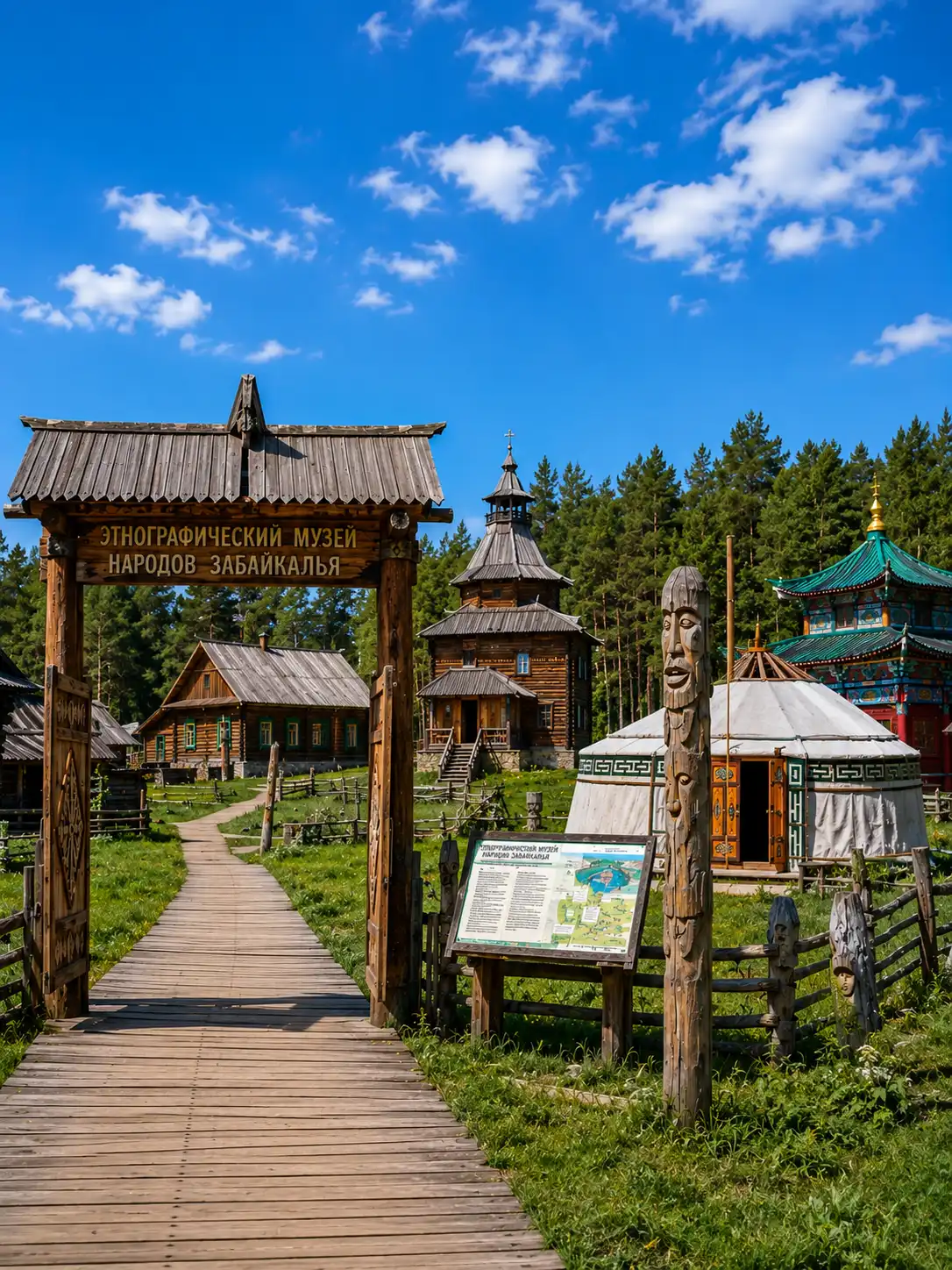
The Ethnographic Museum of the Peoples of Transbaikalia is one of the most important cultural attractions in Ulan-Ude and one of the largest open-air museums in Russia. Located in Verkhnyaya Berezovka on the northeastern edge of the city, the museum presents the architecture, everyday life, religious traditions and material culture of the peoples who have inhabited the Baikal and Transbaikal regions.
Known in Russian as Этнографический музей народов Забайкалья, the museum is not organised as one conventional building filled with display cases. It extends across a large park-like landscape containing historic wooden houses, yurts, storage structures, religious buildings, archaeological reconstructions and complete farmsteads transferred from different parts of Buryatia and neighbouring regions.
The museum covers approximately 37 hectares and contains more than 40 architectural monuments together with a collection of around 11,000 objects. Its exhibitions represent Buryats, Evenks, Soyots, Russian settlers, Cossacks and Semeiskie Old Believers, as well as archaeological cultures that existed in Transbaikalia long before the foundation of Ulan-Ude.
Visitors move between separate cultural complexes rather than following one indoor corridor. This arrangement allows houses, yurts, temples and farm buildings to be experienced within open space closer to their original environmental setting.
For travellers following Wander Russia through Ulan-Ude, the museum provides the broadest introduction to the cultural diversity of Buryatia. Ivolginsky Datsan explains the region’s Buddhist identity, Rinpoche Bagsha presents contemporary Buddhist life, Odigitrievsky Cathedral represents Orthodox history and the Ethnographic Museum brings these traditions together within a much wider story of migration, adaptation and coexistence.
This guide explains the museum’s history, principal cultural complexes, traditional architecture, religious heritage, practical visitor information, seasonal conditions and the best way to organise a visit.
Where Is the Ethnographic Museum?
The museum is located at 17B Verkhnyaya Berezovka, approximately eight kilometres northeast of central Ulan-Ude.
The surrounding district lies beyond the dense historical centre and has a more open, wooded character. This location gives the museum enough space to present complete architectural groups rather than isolated buildings.
A taxi is usually the easiest way to reach the museum, particularly for families, winter visitors and travellers with limited time.
Public transport also serves the Verkhnyaya Berezovka area, but routes and final walking distances should be checked locally because schedules may change.
The museum grounds are extensive, so reaching the entrance is only the beginning of the visit. Comfortable shoes and enough time are essential.
Why the Museum Is Important
The museum is important because Transbaikalia has never belonged to one single cultural tradition.
The region developed at the meeting point of Siberian forests, steppe landscapes, Lake Baikal, Mongolia and trade routes leading toward China. Indigenous peoples, nomadic pastoral communities, Russian settlers, Cossacks, merchants, Buddhist monks and Old Believers all contributed to its history.
The museum preserves this diversity through buildings and objects rather than through one simplified narrative.
Visitors can compare the portable dwellings of mobile communities with permanent timber houses, Buddhist sacred architecture with Old Believer chapels and hunting equipment with agricultural tools.
This makes the museum particularly valuable for understanding how environment shaped culture.
People living in forest zones, steppe regions and river valleys developed different methods of transport, housing, food storage and seasonal movement.
The Foundation of the Museum
The museum opened to visitors in 1973 after several years of research, field expeditions and collection work.
Museum specialists travelled through Buryatia, the Irkutsk and Chita regions, the Agin and Ust-Orda districts and other parts of Siberia to document traditional buildings and collect household objects. Some historic structures were carefully dismantled, transported to Ulan-Ude and reconstructed within the museum grounds.
The project belonged to a wider Soviet movement to create open-air museums that preserved wooden architecture and regional folk culture.
Rapid urbanisation, collective agriculture, changing construction methods and the abandonment of older villages threatened many traditional buildings.
Transferring selected examples to the museum prevented them from disappearing entirely.
The result is not a complete preserved village from one location. It is a carefully assembled cultural landscape containing buildings from different communities, periods and areas.
The Museum as an Open-Air Cultural Park
The museum is arranged as a sequence of cultural and historical complexes.
Current museum descriptions identify sections devoted to archaeology, Evenks, Soyots, Buryats from the western and eastern sides of Lake Baikal, Russian settlers, Cossacks, Old Believers and urban wooden architecture. Some descriptions also mention a wildlife area or eco-zoo within the grounds.
Each complex presents characteristic buildings and objects associated with a particular community or way of life.
The route is therefore both chronological and cultural.
Visitors may begin with archaeological material, continue through Indigenous forest and steppe cultures and later reach Russian settlement architecture and old Verkhneudinsk.
This structure allows the development of Transbaikalia to be understood as a long sequence rather than a story beginning with Russian colonisation.
The Archaeological Complex
The archaeological section introduces cultures that existed in the Baikal region thousands of years before modern ethnic and political boundaries.
Outdoor displays may include stone burial structures, standing stones, ritual objects and reconstructed archaeological features associated with the Slab Grave culture and Xiongnu period.
The Xiongnu created a powerful nomadic state across Central and East Asia and left important archaeological sites in the region around modern Buryatia.
Museum displays also include material connected with the Lower Ivolga fortified settlement, one of the most important archaeological sites near Ulan-Ude.
The archaeological complex helps visitors understand that Transbaikalia was part of wider steppe networks linking Mongolia, China, Siberia and Central Asia.
The Evenki Complex
The Evenks traditionally inhabited enormous forest territories across Siberia and the Russian Far East.
Their lives were closely connected with hunting, fishing, reindeer and seasonal movement.
The museum’s Evenki complex includes portable dwellings known as chums, storage platforms, sledges, boats and objects used in daily forest life.
Chums could be constructed using poles covered with bark, skins or other available material. Their design allowed them to be assembled, dismantled and moved as families followed seasonal routes.
Raised storage structures protected food and equipment from moisture and animals.
The museum may also present a shaman’s chum containing symbolic figures connected with animals, birds and spiritual traditions.
These displays should be approached respectfully. Shamanic objects belong to a living cultural and spiritual heritage rather than merely to folklore.
The Soyot Complex
The Soyots are an Indigenous people associated mainly with the mountainous Oka region of western Buryatia.
Their traditional economy included reindeer herding, hunting and movement through mountain and taiga environments.
The Soyot section broadens the museum beyond the better-known cultures of the central Buryat steppe.
Housing, clothing and transport objects demonstrate how life in highland forests differed from life beside the Selenga or on the open grasslands.
The inclusion of Soyot heritage is especially important because smaller Indigenous communities can easily be overlooked in general descriptions of Buryatia.
The Buryat Complexes
The museum contains extensive exhibitions devoted to the Buryats, the Indigenous Mongolic people who form one of the principal cultural communities of the republic.
Buryat culture developed differently on the eastern and western sides of Lake Baikal.
Eastern Buryats were more strongly influenced by Tibetan Buddhism, Mongolian traditions and steppe pastoralism. Western Buryat communities often maintained stronger connections with shamanic practices, forest environments and later Russian administrative systems.
The museum reflects these regional differences through architecture, household objects and religious structures.
Traditional Buryat Yurts
Yurts are among the most recognisable structures in the Buryat section.
The museum presents both felt-covered and wooden yurts.
A felt yurt was portable and suited to pastoral mobility. Its circular structure resisted wind and could be heated efficiently during cold weather.
Wooden yurts were more permanent and became common among settled or semi-settled Buryat families.
The circular interior had a clear symbolic and social organisation. Different areas were associated with cooking, guests, family possessions and sacred objects.
The central stove provided heat, while the roof opening allowed smoke to escape.
Visitors should avoid viewing the yurt as a simple tent. It represents a highly developed architectural response to the climate and lifestyle of the Eurasian steppe.
Buryat Buddhist Architecture
The museum includes Buddhist religious architecture connected with the historic datsan tradition.
One significant building is the Devadzhin Dugan, transferred from the Tamchinsky Datsan area. The temple demonstrates a type of Buryat Buddhist architecture influenced by Tibetan and Mongolian forms but adapted to local timber construction.
Bright colours, symbolic paintings and curved roof forms distinguish the structure from Russian Orthodox and residential buildings elsewhere in the museum.
Its presence shows that Buddhist temples were not isolated religious monuments. Datsans served as centres of education, medicine, art and community organisation.
Visitors who have already seen Ivolginsky Datsan can use this museum building to understand earlier forms of Buryat Buddhist architecture.
The Pre-Baikal Buryat Complex
The Pre-Baikal section presents the culture of Buryat communities from the western side of Lake Baikal.
One notable building is the winter house of a prosperous Buryat Cossack, originally constructed in the Irkutsk region and transferred to the museum during the 1970s.
The structure illustrates how Buryat families adapted Russian-style timber housing while maintaining local cultural practices.
It also reveals the social differences within Buryat communities. Not every family lived in the same conditions, and wealth affected house size, decoration, livestock ownership and access to manufactured goods.
Russian Settlers and Cossacks
Russian settlers entered Transbaikalia through military service, trade, exile, agriculture and government expansion.
The museum’s Russian and Cossack complexes contain timber houses, barns, workshops, gates and household structures arranged to resemble village streets or farmsteads.
The houses demonstrate major social differences.
A wealthy Cossack or village leader might possess a large decorated home, several storage buildings and substantial agricultural equipment.
Poorer residents lived in smaller houses with fewer rooms and simpler furnishings.
Cossacks played an important role in guarding borders, maintaining transport routes and supporting Russian administration in Siberia.
Their architecture reflects both military responsibility and agricultural settlement.
Exile and Transport Routes
Some museum structures also refer to the history of exile and prisoner movement through Siberia.
Shelters and roadside buildings were constructed at intervals along routes used by exiles, officials and travellers before modern railways and highways existed.
These structures demonstrate how difficult long-distance movement was across Transbaikalia.
The region’s history includes not only voluntary migration and settlement but also forced relocation, penal labour and political exile.
The Semeiskie Old Believers
The Old Believer complex is one of the most visually distinctive parts of the museum.
The Semeiskie are descendants of Russian Old Believers who were moved eastward after resisting religious reforms within the Russian Orthodox Church.
Many settled in Transbaikalia during the eighteenth century and developed close-knit agricultural communities.
Their houses became known for bright painted shutters, decorative gates, clean courtyards and carefully organised farm buildings.
The museum preserves houses from families of different economic status, together with tools, furniture, religious objects and agricultural equipment.
The cultural traditions of the Semeiskie include distinctive singing, clothing, family customs and religious observance.
Old Believer Religious Life
Old Believers preserved liturgical and ritual practices that predated the reforms introduced by Patriarch Nikon in the seventeenth century.
They faced discrimination and pressure from both church and state authorities and often established communities in remote areas.
Religious books, icons and domestic prayer spaces became especially important.
The museum’s collections include rare Old Believer books, icons and objects associated with Semeiskie religious culture.
Visitors should recognise that the colourful houses represent more than decorative folk architecture. They belong to a community shaped by persecution, migration and strong internal solidarity.
The Church of Saint Nicholas
A wooden Saint Nicholas Church is one of the museum’s major architectural monuments.
The church was originally associated with an Old Believer community and was transferred to the museum during the early 1970s. Restoration was later completed, and its iconostasis eventually became accessible to visitors.
The building demonstrates the skill of Siberian timber construction.
Its towers, rooflines and log walls create a strong contrast with the brightly painted Buddhist structures and Buryat yurts elsewhere in the museum.
This contrast is one of the museum’s greatest strengths. Different religious traditions appear within walking distance without being merged into one artificial style.
Old Verkhneudinsk
The urban complex reconstructs elements of old Verkhneudinsk, the name used for Ulan-Ude until 1934.
Historic town houses, shops and wooden buildings demonstrate how merchants, craftsmen and urban residents lived before Soviet redevelopment transformed much of the city.
Covered staircases, upper floors, storage spaces and street-facing commercial rooms reveal the architecture of a growing Siberian trading town.
This section complements the historic buildings that still survive along Lenin Street in central Ulan-Ude.
The city centre shows preserved structures in their modern urban context, while the museum allows visitors to examine similar buildings in greater detail.
Interiors and Household Objects
Many of the museum buildings contain reconstructed interiors.
Furniture, kitchen equipment, textiles, tools, religious objects and personal items help explain how spaces were actually used.
Without interiors, a wooden house can appear visually attractive but historically empty.
The objects reveal sleeping arrangements, cooking methods, gender roles, family organisation and economic differences.
Visitors should allow enough time to look inside rather than walking only between exterior façades.
Traditional Crafts
The museum preserves evidence of woodworking, metalworking, textile production, leatherwork and agricultural crafts.
Buryat and Evenki communities produced equipment suited to hunting, horse culture and pastoral life.
Russian settlers and Old Believers developed farming tools, carts, storage systems and domestic crafts.
Decorative patterns appeared on clothing, furniture, gates and religious objects.
Special events and workshops may allow visitors to observe demonstrations or participate in traditional activities.
Programmes vary by season and should be checked before arrival.
Festivals and Cultural Events
The museum functions as an active cultural venue rather than only a static exhibition.
Folk festivals, traditional games, craft programmes, family events and seasonal celebrations may take place within the grounds.
The large outdoor space is particularly suitable for performances, reconstructed ceremonies and community gatherings.
Such events can make the museum more lively, but they also bring larger crowds.
Travellers seeking quiet architectural photography may prefer an ordinary weekday, while those interested in living traditions may find festival days more rewarding.
The Wildlife Area
Some museum descriptions include a wildlife corner or eco-zoo.
Animals associated with the region may be displayed there, although the exact collection and operating conditions can change.
Visitor opinions about the animal area have been mixed, particularly regarding enclosure conditions.
Travellers concerned about animal welfare may choose to focus on the cultural and architectural sections.
The open-air museum remains worthwhile even without visiting the wildlife area.
How Much Time Is Needed?
A rapid visit requires at least two hours.
A balanced visit should allow three to four hours.
Travellers who enter most buildings, read the exhibitions and stop for photography may need half a day.
The grounds are extensive, and the cultural complexes should not be rushed.
Visitors with children or limited mobility should allow additional time for rest.
Opening Hours
The museum operates on a seasonal schedule.
Published visitor information indicates different hours for winter, spring, summer and autumn. Summer arrangements may include closure of the main museum exhibitions on Mondays and Tuesdays while the park or wildlife area remains accessible.
Because schedules can change, visitors should verify current opening days shortly before travelling.
This is especially important outside the main summer season or during public holidays.
Best Time to Visit
Late spring through early autumn provides the most comfortable conditions.
June offers long daylight and green surroundings.
July and August can be warm, but shade is available in parts of the park.
September is especially attractive because temperatures become cooler and autumn colour begins to appear.
Winter creates a visually striking atmosphere, but many buildings may be cold, snow can cover paths and outdoor walking becomes more demanding.
What to Wear
Comfortable walking shoes are essential.
The museum contains paved, gravel and natural paths.
A windproof jacket is useful during spring and autumn.
Summer visitors should bring water, sun protection and insect repellent.
Winter visitors need insulated boots, gloves, a hat and warm layers suitable for extended outdoor exposure.
Because some historic interiors are unheated, temperatures inside may remain close to outdoor conditions.
Photography
The museum is one of the strongest photography locations in Ulan-Ude.
Useful subjects include:
- Felt and wooden Buryat yurts
- Buddhist temple architecture
- Old Believer houses with painted shutters
- Historic Russian farmsteads
- Wooden churches
- Archaeological stone monuments
- Traditional tools and interiors
- Autumn foliage around timber buildings
- Snow-covered museum villages
- Cultural festivals and crafts
A wide-angle lens works well inside small interiors.
A standard lens is suitable for houses and environmental scenes.
People participating in cultural events should not be photographed closely without permission.
Accessibility
The museum’s open-air character creates some accessibility challenges.
Distances between complexes are considerable, and not every historic building has step-free access.
Raised thresholds, narrow doors and wooden stairs reflect the original architecture.
Some main paths may be manageable for wheelchairs and walking aids, but natural surfaces, snow and rain can affect conditions.
Visitors with specific requirements should contact the museum before arrival and identify which sections are easiest to reach.
Guided Tours
A guided tour is strongly recommended.
Without explanation, visitors may recognise a yurt or wooden house but miss differences between Buryat, Evenki, Cossack and Old Believer traditions.
A guide can explain how buildings were transported, how interiors were organised and why particular objects mattered.
Foreign-language availability may be limited, so English-speaking guides should be arranged in advance when possible.
Translation applications can help with labels, but they cannot fully replace cultural interpretation.
Combining the Museum with Other Attractions
The museum can be combined with Rinpoche Bagsha Datsan because both lie north of the historical centre.
A practical route includes:
- Ethnographic Museum during the morning
- Lunch in Ulan-Ude
- Rinpoche Bagsha Datsan during the afternoon
- Sunset view over the city
The museum should not be combined with Ivolginsky Datsan on a rushed schedule because the two sites lie in different directions and each deserves several hours.
A separate day for central Ulan-Ude, the ethnographic museum and Buddhist excursions usually produces a better experience.
Is the Ethnographic Museum Worth Visiting?
The Ethnographic Museum of the Peoples of Transbaikalia is essential for travellers who want to understand Buryatia beyond its most famous monuments.
It presents the region as a cultural meeting place rather than as one uniform society.
The museum explains how Indigenous forest communities, steppe pastoralists, Buddhist Buryats, Russian settlers, Cossacks and Old Believers adapted to the same broad region in different ways.
Its open-air format makes those differences visible through architecture and space.
Wander Russia recommends allowing at least three hours and visiting with a guide when possible.
Frequently Asked Questions
Where is the museum?
It is located at 17B Verkhnyaya Berezovka on the northeastern edge of Ulan-Ude.
When did it open?
The museum opened to visitors in 1973 after several years of research and collection work.
How large is it?
The museum covers approximately 37 hectares and contains more than 40 architectural monuments.
Which peoples are represented?
The exhibitions include Buryats, Evenks, Soyots, Russian settlers, Cossacks and Semeiskie Old Believers.
How long should visitors stay?
Allow three to four hours for a balanced visit.
Is it entirely outdoors?
No. The museum is mainly an open-air complex, but many historic buildings contain indoor exhibitions and reconstructed interiors.
Is it suitable for children?
Yes. The houses, yurts and large outdoor spaces are generally engaging for families.
Is a guide necessary?
It is not required, but a guide greatly improves understanding of the cultural differences between the complexes.
Can it be visited in winter?
Yes, although cold weather, snow and unheated interiors make the visit more demanding.
What is the most important section?
The answer depends on individual interests, but the Buryat, Evenki and Old Believer complexes provide the strongest overall introduction to Transbaikalian culture.
Conclusion
The Ethnographic Museum of the Peoples of Transbaikalia is one of the most complete cultural experiences in Ulan-Ude.
Its value lies in the way it turns regional history into a physical landscape.
Visitors do not simply read about Buryat yurts, Evenki hunting camps or Old Believer houses. They walk between them, enter reconstructed interiors and observe how architecture changed according to climate, economy and belief.
The archaeological complex extends the story deep into the past.
Stone burials and objects connected with ancient steppe cultures demonstrate that the region participated in Asian political and cultural networks long before Russian settlement.
The Evenki and Soyot sections show the importance of mobility, hunting and adaptation to forest and mountain environments.
The Buryat complexes explain pastoral life, family organisation and the influence of Tibetan Buddhism.
Russian settlement architecture reveals the development of agriculture, military administration and urban trade.
The Old Believer houses present a community whose religious resistance led to migration but also produced one of the most distinctive cultural traditions in Buryatia.
These groups did not live in complete isolation from one another. They traded, borrowed techniques, shared landscapes and experienced conflict, pressure and political change.
The museum allows those relationships to be considered without reducing the region to one dominant identity.
Its open-air design is especially effective. Architecture becomes evidence. The size of a house reveals wealth. The position of a stove reveals climate adaptation. Painted shutters reveal aesthetic tradition. Portable dwellings reveal seasonal movement.
For travellers following Wander Russia through Ulan-Ude, the museum is the essential fifth destination after Ivolginsky Datsan, Rinpoche Bagsha, the Lenin Head Monument and Odigitrievsky Cathedral.
Those four landmarks introduce religion, Soviet history and architecture.
The Ethnographic Museum brings the wider human story together.
