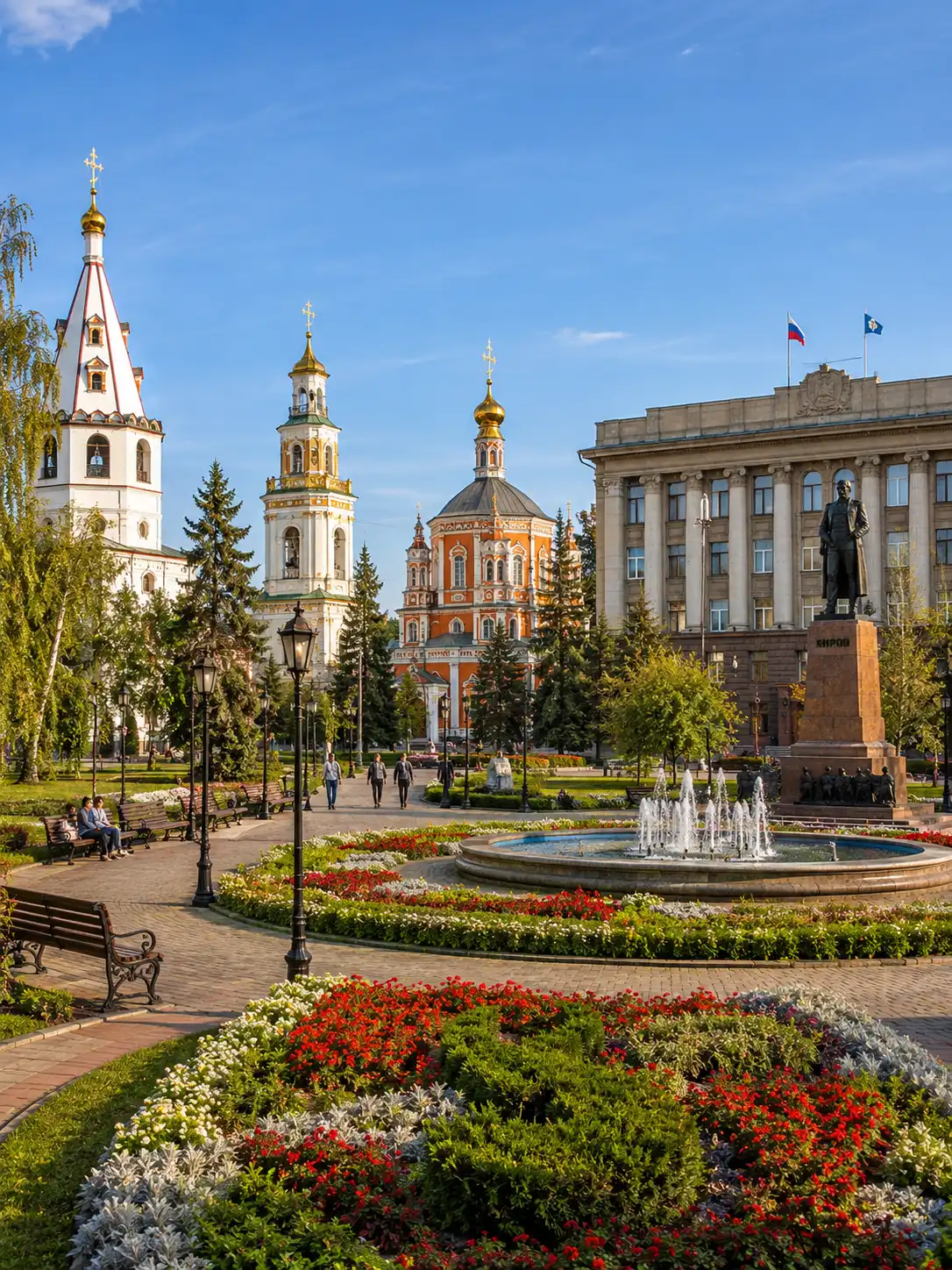
Kirov Square is the historical heart of Irkutsk and one of the most useful places to begin exploring the city. Located close to the Angara River, the square connects some of Irkutsk’s oldest churches, important administrative buildings, memorial spaces, landscaped gardens and the streets of the historic centre.
Known in Russian as Сквер имени Кирова or Площадь Кирова, the area looks more like a landscaped city park than a conventional paved square. Trees, flower beds, benches, walking paths and a central fountain create a calm public space surrounded by architecture from several different periods.
The square stands close to the site where Irkutsk began in 1661 as a wooden fortified settlement. The early ostrog was established near the meeting of the Angara and Irkut rivers, and the surrounding territory gradually developed into the political, religious and commercial centre of the growing Siberian city.
Over the centuries, the square changed names and functions repeatedly. It served as a marketplace, fairground, administrative centre and ceremonial public space. Its various historical names included Kremlin Square, Spasskaya, Tikhvinskaya, Gostinodvorskaya and Bogorodskaya Square. It received its current name in 1935 in honour of Soviet politician Sergei Kirov.
Today, Kirov Square remains one of Irkutsk’s principal gathering places. Public celebrations, seasonal decorations, concerts and commemorative events take place here, while residents use the gardens as a place to rest between the busy streets of the city centre.
For travellers following Wander Russia through Irkutsk, Kirov Square offers a natural transition between the wooden architecture of 130 Kvartal, the churches of the historical centre and the Angara River Embankment. This guide explains the history of the square, the development of Irkutsk, the surrounding landmarks, the best walking routes, seasonal atmosphere and practical visitor information.
Where Is Kirov Square?
Kirov Square lies in the oldest part of central Irkutsk, only a short walk from the Angara River.
It is surrounded by important city streets, government buildings, educational institutions and several of Irkutsk’s oldest religious monuments. Kirov Square also provides easy access to the Church of the Savior, Epiphany Cathedral, the Eternal Flame memorial, the Lower Angara Embankment and Karl Marx Street.
Because of its central location, the square can be reached comfortably on foot from many hotels and attractions. Visitors arriving by taxi or public transport can use the Russian name Сквер имени Кирова or Площадь Кирова in local navigation applications.
The square is open to the public and does not require an entrance ticket.
The Foundation of Irkutsk
Irkutsk was founded in 1661 when a wooden fortified post was established near the confluence of the Angara and Irkut rivers. The settlement initially served administrative, military and taxation purposes, including the collection of yasak, a tribute often paid in valuable furs by local Indigenous populations.
The location was strategically important. The Angara provided a natural transport route, while the surrounding territory connected western Siberia with Lake Baikal, Transbaikalia, Mongolia and China.
The wooden fort gradually developed into a permanent settlement. Within approximately 25 years, Irkutsk had received official city status.
The area around modern Kirov Square became the centre of this early urban development. Administrative buildings, churches, markets and merchant premises appeared close to the original fortress.
Little survives from the wooden ostrog itself, but the layout of the historical centre still reflects its position. The Church of the Savior and Epiphany Cathedral preserve the religious and architectural memory of Irkutsk’s earliest period.
From Fortress Square to Commercial Centre
As Irkutsk expanded beyond its original wooden fortifications, the area around Kirov Square became a major commercial and social centre.
Markets and fairs attracted merchants, farmers, craftsmen and travellers from across Siberia. Goods traded here included furs, timber, tea and other regional products.
Irkutsk’s position on routes between Russia and China contributed greatly to its prosperity. Tea, textiles and manufactured goods moved through the region, while Siberian furs, natural resources and agricultural products travelled in the opposite direction.
The square’s changing names reflected the important buildings and activities surrounding it. Names such as Gostinodvorskaya referred to commercial trading facilities, while Spasskaya and Tikhvinskaya reflected nearby churches.
The square was never only a decorative urban space. It functioned as a practical centre where business, religion, government and public entertainment met.
The Great Fire and Transformation of the Square
Fire was a constant danger in historic Irkutsk because so much of the city was built from wood.
The devastating fire of 1879 destroyed large sections of the central city, including homes, businesses and public buildings. The disaster accelerated the construction of more stone and brick architecture and changed the appearance of central Irkutsk.
The area that became the modern landscaped square emerged more clearly after the remains of former shopping rows and market structures were removed around 1890 and 1891.
This change gradually transformed the space from a crowded commercial zone into a more formal civic centre.
Trees, paths and landscaped areas eventually replaced many of the earlier market structures. The present square still carries the memory of trade, but its modern atmosphere is quieter and more park-like.
The Many Names of Kirov Square
Kirov Square has carried numerous names during its long history.
Among the names associated with the area are:
- Kremlin Square
- Spasskaya Square
- Bogorodskaya Square
- Tikhvinskaya Square
- Gostinodvorskaya Square
- Speransky Square
- Kirov Square
The changing names reflected churches, commercial functions, political figures and administrative periods.
The name Speransky is connected with Count Mikhail Speransky, a major Russian statesman who served as Siberian Governor-General from 1819 to 1821 and introduced important administrative reforms.
The current name honours Sergei Kirov, a prominent Bolshevik political figure. The square was renamed after him in 1935, shortly after his assassination in 1934. Kirov had also lived illegally in Irkutsk during the revolutionary period of 1908–1909.
The survival of the Soviet-era name demonstrates how different historical periods continue to overlap in Irkutsk’s public geography.
The Appearance of the Square Today
Despite being called a square, the area has the character of a landscaped park.
Broad paths pass between lawns, mature trees, flower beds and seating areas. A circular fountain forms one of the main visual features during the warmer months.
The greenery provides a welcome contrast with the surrounding administrative and commercial buildings. Local residents use the square as a place to meet friends, rest, walk or pass between different parts of the city centre.
The central position and open layout also make the square suitable for festivals, public ceremonies and seasonal installations.
In summer, the fountain, flower beds and leafy trees create a relaxed atmosphere.
In winter, snow, decorative lighting, ice sculptures and a large seasonal tree can transform the square into one of central Irkutsk’s most festive public spaces.
The Lost Kazan Cathedral
One of the most important historical buildings once standing near the square was Irkutsk’s former Kazan Cathedral.
Construction began in 1875 and was completed in 1894. The large cathedral could accommodate approximately 5,000 worshippers and became the dominant architectural and spiritual landmark of the square.
The cathedral should not be confused with the surviving red Kazan Church located elsewhere in Irkutsk.
The former cathedral at Kirov Square was destroyed during the Soviet period. Its disappearance dramatically changed the visual balance of the square.
Today, photographs and historical models help visitors imagine how the cathedral once dominated central Irkutsk.
Its loss is an important reminder that the modern square does not show every layer of the city’s history. Several monuments and buildings disappeared through fire, demolition, political change or urban redevelopment.
The Government of Irkutsk Oblast Building
One of the largest buildings facing the square is the administrative headquarters of the Irkutsk regional government.
The monumental Soviet-era structure was originally associated with the House of Soviets. Construction began before the Second World War and the building was completed during the post-war period.
Its large, restrained façade contrasts sharply with the smaller churches and decorative historical architecture nearby.
This architectural contrast is characteristic of central Irkutsk. Baroque churches, imperial merchant houses, Soviet administrative buildings and modern commercial structures stand within a relatively compact area.
The government building continues the square’s long role as the administrative centre of the region.
The Church of the Savior
The Church of the Savior, or Spasskaya Church, is one of the most important buildings near Kirov Square.
The present stone church was begun in the early eighteenth century on the site of an earlier wooden church connected with the original Irkutsk fortress. It is one of the oldest surviving stone buildings in Siberia.
The church is recognised by its white walls, green roof details and external religious paintings.
Its location helps visitors understand the relationship between the original fortress and the modern city centre. The church once stood near the northwestern corner of the fortification.
The Spasskaya Church deserves a separate visit rather than being viewed only from the square. Its architecture, exterior murals and historical setting make it one of the strongest landmarks in old Irkutsk.
Epiphany Cathedral
Epiphany Cathedral stands close to the Angara River and forms another major part of the historical ensemble near Kirov Square.
The brightly decorated church is known for its colourful exterior, ornamental brickwork and distinctive Siberian Baroque character.
It was built outside the eastern wall of the original fortress and became one of the most important religious buildings in the early city. Together with the Church of the Savior, it preserves the architectural layout of Irkutsk’s oldest centre.
The cathedral’s colourful appearance provides a striking contrast with the grey regional government building and the landscaped green square.
Visitors can combine Kirov Square, the Church of the Savior and Epiphany Cathedral within a short walk.
The Eternal Flame and Victory Memorial
Behind the regional government building lies a memorial complex devoted to residents of Irkutsk who died during the Great Patriotic War.
The Eternal Flame and Tomb of the Unknown Soldier form the emotional centre of the memorial area.
The site was developed around the thirtieth anniversary of victory in the Second World War and remains an important location for remembrance ceremonies.
Visitors may encounter flowers, official delegations, veterans’ events or ceremonial guards.
The atmosphere here differs from the relaxed gardens of Kirov Square. Behaviour should remain quiet and respectful around the Eternal Flame and memorial plaques.
This memorial area is sometimes referred to as Veterans Boulevard and is used by residents for both remembrance and walking.
The Angara River Connection
Kirov Square lies only a short distance from the Angara River.
This proximity explains why the historical centre developed here. The river provided transport, water, trade routes and communication with Lake Baikal and other parts of Siberia.
From the square, visitors can continue toward the Lower Angara Embankment and observe the broad river landscape.
The transition from the landscaped square to the waterfront is one of the most rewarding short walks in central Irkutsk.
It also creates a natural connection with the Monument to Alexander III farther along the river.
The Historic City Center
Kirov Square forms the centre of a wider historical district rather than standing as an isolated attraction.
The surrounding streets contain merchant houses, administrative buildings, churches, museums and examples of Irkutsk’s famous wooden architecture.
The historic centre has attracted international preservation attention because of its mixture of carved wooden houses and stone urban buildings. The World Monuments Fund has highlighted the importance and vulnerability of Irkutsk’s architectural heritage.
Many wooden houses remain outside the most polished tourist zones. Some are carefully restored, while others show signs of age, subsidence and limited maintenance.
This imperfect preservation is part of the character of Irkutsk. The city is not a single reconstructed historical park. It is a living urban environment containing buildings in very different conditions.
The Irkutsk Green Line
One of the most practical ways to explore the historical centre is to follow the Irkutsk Green Line.
This self-guided walking route links approximately 30 significant historical buildings, churches, museums, monuments and private residences around the city centre.
A painted line or route markers help visitors move between attractions without needing a guide.
Kirov Square is one of the natural starting points because several of the city’s oldest landmarks are located nearby.
The Green Line makes it easier to discover buildings that might otherwise be overlooked. It also provides structure while still allowing visitors to stop for cafés, museums or photography.
Karl Marx Street
Karl Marx Street is one of the principal historical streets connected with the city centre.
Formerly known as Bolshaya Street, it developed as an important commercial and cultural route. Museums, theatres, shops, restaurants and historic buildings line the approximately two-kilometre street.
Walking from Kirov Square toward Karl Marx Street expands the visit beyond the religious and administrative centre.
The street reveals the merchant prosperity and civic development of nineteenth-century Irkutsk.
It also connects naturally with the Angara Embankment and the Monument to Alexander III.
Public Events and Celebrations
Kirov Square remains one of the principal public-event spaces in Irkutsk.
Victory Day, New Year celebrations, seasonal festivals and community events may take place around the square.
During large events, the atmosphere becomes much more crowded and active than on ordinary days.
Stages, decorations, food stalls and temporary barriers may alter the appearance of the square.
Visitors seeking a quiet architectural walk may prefer an ordinary weekday morning.
Those interested in local civic life may find major celebrations especially memorable.
Kirov Square in Summer
Summer is one of the most pleasant seasons for visiting the square.
Trees provide shade, flower beds are in bloom and the fountain becomes a lively focal point.
The gardens provide a useful rest stop during a longer walking route through central Irkutsk.
Temperatures can become warm, but the proximity of the Angara often brings cooler air.
Summer also provides long daylight, making it possible to combine the square with churches, museums, the embankment and 130 Kvartal within one full day.
Kirov Square in Winter
Winter transforms the square into a distinctly Siberian public space.
Snow covers the lawns and paths, the fountain is inactive and seasonal decorations may include ice sculptures, illuminated installations and a large New Year tree.
The square can be particularly attractive after dark when the decorations are illuminated.
However, Irkutsk winters are severe. Visitors need insulated boots, gloves, a hat and a windproof outer layer.
Ice can form on paths, especially where snow has been compacted by pedestrians.
Best Time of Day
Morning is the best time for quiet photography and architectural observation.
The square is less crowded, and the surrounding churches can often be photographed with fewer people.
Late morning and afternoon bring more activity and are practical for combining the square with museums and church interiors.
Evening can be especially attractive during winter or major celebrations because of decorative lighting.
The square is centrally located and generally active, but detailed exploration is easier during daylight.
Photography Tips
Kirov Square offers a wide variety of photographic subjects.
Useful compositions include:
- The central fountain framed by trees
- The regional government building across the gardens
- The Church of the Savior from the memorial area
- Epiphany Cathedral with the Angara nearby
- Winter ice sculptures and seasonal decorations
- Flower beds during summer
- The Eternal Flame and memorial walls
- Contrasts between Soviet and religious architecture
- Historic city models or information displays
- Evening illumination
A wide-angle lens is useful for the square and government building.
A standard lens works better for churches and everyday street scenes.
Visitors should remain respectful around the war memorial and avoid using the Eternal Flame as a casual photo prop.
Suggested Walking Route
A practical route begins in Kirov Square.
Walk through the landscaped gardens and observe the regional government building.
Continue behind the building toward the Eternal Flame and Victory Memorial.
Visit the Church of the Savior and then walk toward Epiphany Cathedral.
Continue to the Angara River Embankment and follow the waterfront.
From there, walk toward the Monument to Alexander III or return through Karl Marx Street.
Travellers with additional time can continue toward 130 Kvartal.
This route can take two to four hours depending on church visits, photography and rest stops.
How Much Time Is Needed?
A basic visit to the square requires approximately 30 to 45 minutes.
A complete exploration including the nearby churches and memorial area takes one and a half to two hours.
Combining Kirov Square with the Angara Embankment, Karl Marx Street and additional historical buildings creates a half-day itinerary.
Visitors following the full Green Line may spend most of a day exploring the wider centre.
Accessibility
The landscaped paths around Kirov Square are generally level and paved.
This makes the area more accessible than some wooden residential districts with uneven roads and raised pavements.
Church entrances, memorial steps and winter ice can still create difficulties.
Visitors with limited mobility may use taxis to move between the square, embankment and 130 Kvartal.
Snow and frozen surfaces reduce accessibility significantly during winter.
Is Kirov Square Worth Visiting?
Kirov Square is essential for understanding Irkutsk.
It may not contain one single attraction as visually dominant as the Alexander III Monument or the Babr statue, but it connects the city’s most important historical themes.
The square stands close to the birthplace of Irkutsk, the oldest churches, the Angara River, Soviet administrative architecture and major memorial spaces.
Its value is cumulative.
Walking through the square reveals how Irkutsk changed from a wooden fortress to a commercial centre, imperial administrative city, Soviet regional capital and modern gateway to Lake Baikal.
Wander Russia recommends using Kirov Square as the starting point for exploring the historic centre.
Frequently Asked Questions
Where is Kirov Square?
It is located in the historical centre of Irkutsk, close to the Angara River, the Church of the Savior and Epiphany Cathedral.
Why is the square historically important?
The area lies close to the site where Irkutsk’s original wooden fortress was established in 1661.
Why is it called Kirov Square?
It was renamed in 1935 after Soviet political figure Sergei Kirov.
Was the square always a park?
No. It previously functioned as a marketplace, fairground and commercial centre.
Is the square free to visit?
Yes. The gardens and public spaces are freely accessible.
How much time is needed?
Allow 30 to 45 minutes for the square alone or two hours when including the nearby churches and memorials.
What is nearby?
The Church of the Savior, Epiphany Cathedral, Eternal Flame, Angara Embankment and Karl Marx Street are all nearby.
Is it worth visiting in winter?
Yes. Seasonal lighting, ice sculptures and snow create a particularly Siberian atmosphere, although warm clothing is essential.
Can the square be included in the Green Line route?
Yes. It is one of the natural starting points for Irkutsk’s self-guided historical walking route.
Conclusion
Kirov Square is the place where the different historical layers of Irkutsk meet most clearly.
The city began nearby as a wooden fortified settlement in 1661. The location beside the Angara supported transport, administration, taxation and trade.
As Irkutsk expanded, the area became a busy marketplace where merchants exchanged fur, timber, tea and other goods. Churches, administrative buildings and trading rows transformed the former fortress surroundings into the civic heart of eastern Siberia.
Fire, demolition and political change repeatedly altered the square.
The great Kazan Cathedral disappeared. Market buildings were removed. Soviet administrative architecture replaced parts of the older urban landscape. The square received a new name connected with Sergei Kirov.
Yet several essential elements survived.
The Church of the Savior still recalls the original fortress. Epiphany Cathedral preserves the religious architecture of early Irkutsk. The Angara continues to flow beside the historical centre, linking the city with Lake Baikal.
The landscaped gardens now provide a peaceful public space within this complex setting.
Residents sit beside the fountain, children play, ceremonies take place at the war memorial and visitors begin walking routes through the old city.
For Wander Russia, Kirov Square is not simply a park or public square. It is the geographical and historical centre from which the wider story of Irkutsk becomes easier to understand.
